· Digital Footprint Check · Digital Security · 19 min read
Digital Footprint Vs. Digital Shadow: What''s the Difference?
Your digital footprint is the trail of bread crumbs you leave behind in the digital landscape.
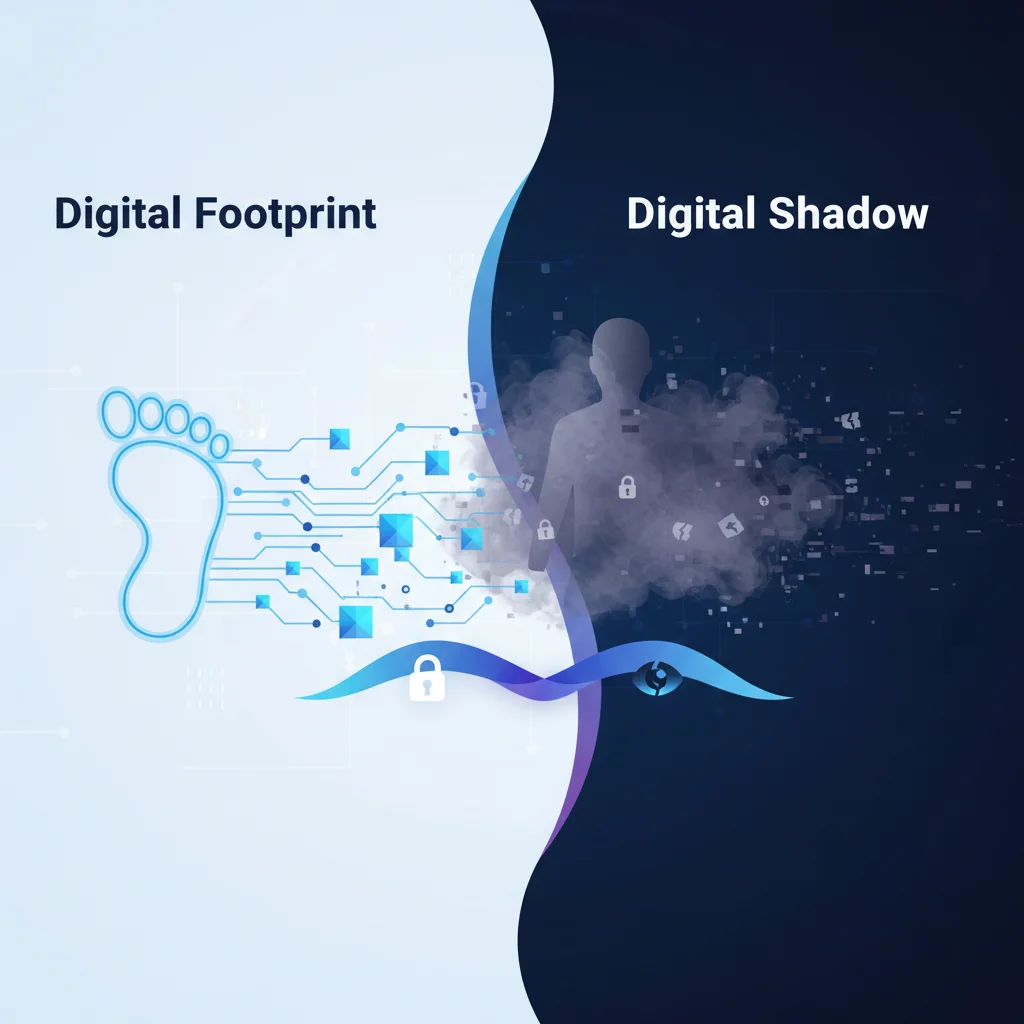
Digital Footprint vs. Digital Shadow: What’s the Difference and Why Does It Matter?
You know your digital footprint: the social posts, purchases, and visits you make on purpose. But there’s a second, larger collection of data about you that forms in the background: your digital shadow.
Your footprint is what you choose to do; your shadow is data collected without your knowledge or consent. The distinction matters for privacy, identity theft, and controlling your online presence.
This guide explains the difference between your digital footprint and digital shadow, why both matter, and how to manage them effectively.
Understanding Digital Footprint: The Path You Choose
Your digital footprint is the trail of information you leave on purpose. Each step is a conscious choice.
Components of Your Active Digital Footprint
Social Media Activity
- Posts, photos, and videos you publish
- Comments and reactions on others’ content
- Profile information (bio, location, interests)
- Friend/follower connections
- Group memberships and page likes
Online Communications
- Emails you send
- Forum posts and discussions
- Blog comments and reviews
- Direct messages (though supposedly private)
Content Creation
- Personal websites or blogs you maintain
- Articles you write or publish
- Videos or podcasts you upload
- GitHub repositories and code contributions
E-Commerce and Financial
- Online purchases and order history
- Reviews you write for products/services
- Subscription service signups
- Newsletter enrollments
Professional Presence
- LinkedIn profile and endorsements
- Professional portfolios and resumes
- Conference presentations or speaking engagements
- Published research or articles
Active vs. Passive Footprints
Your digital footprint actually splits into two categories:
Active Footprint: Information you deliberately share by posting, commenting, or filling out forms. You have direct control over creating (or not creating) this content.
Passive Footprint: Data collected as you browse and interact with websites without you actively posting content—though you’re aware you’re visiting these sites. This includes:
- Websites you visit (browser history)
- Videos you watch (YouTube history)
- Articles you read
- Items you view (but don’t purchase)
- Apps you download
According to a 2024 Pew Research study, the average American adult visits approximately 130 unique websites per month, leaving passive footprint data across all of them.
Want to check what your digital footprint reveals? Start with our guide on how to check your digital footprint.
Understanding Digital Shadow: The Data You Don’t Control
Your digital shadow is the significantly larger and more concerning collection of data about you that exists without your direct creation or even awareness. This is the monster lurking behind you—a comprehensive profile compiled by third parties using data you never explicitly shared.
How Your Digital Shadow Forms
Data Brokers and Aggregators Data broker companies collect information from hundreds of sources:
- Public records (property ownership, court filings, voting records)
- Commercial transactions (purchases, catalog subscriptions)
- Social media scraping (even from “private” profiles)
- Online behavior tracking across thousands of websites
- Offline data (store loyalty cards, magazine subscriptions)
These brokers don’t need your permission. They compile profiles containing:
- Current and past addresses
- Phone numbers and email addresses
- Age, date of birth, relatives
- Education and employment history
- Income estimates
- Property values
- Political affiliations
- Interests and hobbies
- Purchasing behaviors
Companies like Acxiom, Epsilon, and Experian maintain profiles on over 700 million consumers globally, with each profile containing 3,000+ data points according to a 2024 Federal Trade Commission report.
Behavioral Tracking Technology Every website you visit collects data:
Cookies: Small files stored on your device tracking:
- Sites you visit
- How long you stay
- What you click on
- Items you view or add to cart
- When you return
Tracking Pixels: Invisible images embedded in emails and websites collecting:
- Whether you opened an email
- What time you opened it
- What device you used
- Your approximate location
Device Fingerprinting: Advanced technique identifying your device based on:
- Screen resolution
- Installed fonts
- Browser plugins
- Operating system
- Hardware configurations
- Battery level
- Timezone
This creates a unique “fingerprint” allowing trackers to identify you even if you clear cookies or use private browsing.
Location Tracking Your physical movements create shadow data:
- Cell phone tower connections
- GPS coordinates from apps
- WiFi network connections
- Bluetooth beacon proximities
- IP address geolocations
According to a 2024 New York Times investigation, some apps collect location data every few seconds, creating minute-by-minute maps of users’ movements that are then sold to advertisers and data brokers.
Social Graph Analysis Even without directly sharing information, companies infer data about you based on:
- Who you connect with on social media
- What your friends post about
- Events you’re tagged in (even if you didn’t post)
- Groups your connections belong to
- Demographics of your social network
Facebook’s algorithms can predict political leanings, relationship status, sexual orientation, and likelihood of major life events (pregnancy, job changes, breakups) based entirely on social graph analysis—even for users who never explicitly share this information.
Search Engine Profiling Google, Bing, and other search engines build profiles based on:
- Search queries (even deleted ones)
- Clicked results
- Time spent on pages
- Searches abandoned mid-query
- Autocomplete selections
These profiles reveal health concerns, relationship issues, financial problems, political beliefs, and personal struggles you’ve never posted publicly.
The Scale of Your Digital Shadow
How extensive is your digital shadow? Consider these statistics:
- Data Broker Profiles: The average American appears on 200-300 data broker websites
- Third-Party Trackers: The average website contains 40+ third-party trackers
- Daily Data Generation: The average internet user generates 1.7 MB of data per second
- Lifetime Digital Shadow: By age 18, the average American has had 70,000+ photos posted about them online
Your digital shadow is typically 10-50 times larger than your visible digital footprint. While you might have 500 Facebook posts, your shadow contains millions of data points about your behavior, preferences, location, and relationships.
Understanding the difference between your footprint and shadow is essential. Learn more in our comprehensive guide on what is a digital footprint.
Key Differences: Footprint vs. Shadow
Let’s clarify the distinctions:
| Aspect | Digital Footprint | Digital Shadow |
|---|---|---|
| Control | You create it through deliberate actions | Created about you by third parties |
| Awareness | You know you’re creating it | Often unaware it exists |
| Visibility | Generally visible and searchable | Hidden in corporate databases |
| Deletion | You can delete content you control | Requires opt-out requests to hundreds of sources |
| Size | Thousands of data points | Millions of data points |
| Permanence | Can be removed with effort | Persists and respawns even after deletion |
| Examples | Social posts, blog comments | Cookie tracking, data broker profiles |
Footprint Analogy: You deliberately walked down a sandy beach leaving footprints. You know where you walked and can return to erase them.
Shadow Analogy: Hundreds of cameras you didn’t know existed filmed your walk, analyzed your gait, measured your height, estimated your weight, predicted where you’ll walk next, and sold this analysis to companies you’ve never heard of. You don’t know which cameras exist or what data they captured.
Why Your Digital Shadow Matters More Than Your Footprint
While managing your digital footprint is important, your digital shadow poses greater risks to privacy, security, and autonomy.
Privacy Invasion Without Consent
Your digital shadow grows without your permission or knowledge. Data brokers don’t need to ask before:
- Collecting your information from public records
- Scraping your social media profiles
- Purchasing your transaction history from retailers
- Tracking your web browsing across thousands of sites
- Selling your profile to advertisers, employers, landlords, and insurers
You can’t consent to something you don’t know is happening.
Identity Theft Vulnerabilities
Data breaches don’t just expose accounts you created—they expose your shadow data:
- The 2024 National Public Data breach exposed 2.9 billion records containing Social Security numbers, addresses, and phone numbers scraped from data brokers
- Most victims never had accounts with the breached company
- Their shadow data was collected, aggregated, and exposed without their knowledge
Your digital shadow provides identity thieves with comprehensive dossiers containing:
- Maiden names and relatives (for security question answers)
- Address history (for impersonation)
- Phone numbers (for SIM swapping attacks)
- Employment and income data (for financial fraud)
Discrimination and Bias
Your digital shadow influences decisions affecting your life:
Employment Screening: Background check companies purchase data broker profiles showing:
- Neighborhoods you’ve lived in
- Estimated income levels
- Social network demographics
- Consumer behavior patterns
This information can introduce bias into hiring decisions—even when employers don’t explicitly request it.
Insurance Pricing: Life and health insurers increasingly use shadow data:
- Social media analysis predicting risky behaviors
- Shopping patterns suggesting health issues
- Location data tracking gym visits or fast food restaurants
- Online search history revealing health concerns
A 2024 investigation by Consumer Reports found some insurers charged higher premiums based on applicants’ digital shadows indicating “risky lifestyles”—even when these conclusions were based on flawed data.
Lending Decisions: Alternative credit scoring systems analyze:
- Social media connections
- Online shopping behavior
- Device types and browsers used
- Time of day you browse websites
These “shadow credit scores” can result in loan denials or higher interest rates based on data unrelated to actual creditworthiness.
Housing Discrimination: Landlords and property management companies purchase tenant screening reports containing:
- Social media sentiment analysis
- Estimated income and employment stability
- Online review patterns and complaint history
- Social network analysis
This can perpetuate housing discrimination based on protected characteristics inferred from shadow data.
Manipulation and Targeted Influence
Your digital shadow enables unprecedented manipulation:
Microtargeted Political Advertising: Political campaigns purchase voter profiles containing:
- Psychological profiles
- Emotional triggers
- Information consumption patterns
- Social media habits
- Predicted voting likelihood
They use this to serve customized messages designed to manipulate your opinions and behavior—often with misleading or false information targeted so precisely it only reaches susceptible audiences.
Predatory Marketing: Companies identify vulnerable consumers through shadow data:
- People with gambling problems receive casino ads
- People searching for debt relief receive predatory loan offers
- People with health issues receive unproven remedy ads
- People experiencing loneliness receive romance scam ads
The FTC reported that in 2024, consumers lost over $10 billion to scams enabled by digital shadow targeting.
Price Discrimination: E-commerce sites adjust prices based on your shadow profile:
- Higher prices for wealthier neighborhoods
- Urgency messaging for impulsive shoppers
- Premium versions for users of expensive devices
- Discounts withheld from loyal customers unlikely to comparison shop
A 2024 study by Princeton University found dynamic pricing based on digital shadows resulted in price variations exceeding 30% for identical products.
The Permanence Problem
Your digital footprint can be managed—you can delete posts, close accounts, and remove content. Your digital shadow is far more persistent:
Data Broker Whack-a-Mole:
- You opt out from one data broker
- They remove your listing
- Three months later, you reappear (they re-scrape public sources)
- Meanwhile, 50 other brokers you didn’t know about maintain profiles
- The cycle never ends
Third-Party Data Persistence:
- You delete your Facebook account
- Facebook still retains shadow data about you from others’ posts
- Facebook’s tracking pixels on millions of websites continue collecting data
- Facebook owns Instagram and WhatsApp, which have separate shadow profiles
- Your shadow persists even though you “deleted” your presence
Aggregation Effects: Individual pieces of shadow data seem harmless:
- One store knows you buy running shoes
- Another knows you browse marathonmarathon training articles
- A third knows you searched for knee pain remedies
Aggregated together, they reveal you’re training for a marathon and experiencing overuse injuries—information that could affect insurance rates, employment (perceived availability for work travel), or enable targeted marketing of expensive “miracle” treatments.
How to Discover Your Digital Shadow
Unlike your digital footprint, which you can easily search for, discovering your shadow requires detective work.
Check Data Broker Websites
Start with major people search sites:
- Spokeo (spokeo.com) - Comprehensive aggregator
- Whitepages (whitepages.com) - Phone/address listings
- BeenVerified (beenverified.com) - Background check data
- MyLife (mylife.com) - “Reputation scores”
- Intelius (intelius.com) - Public records compilation
- PeekYou (peekyou.com) - Social media aggregation
- Radaris (radaris.com) - Contact information
- TruePeopleSearch (truepeoplesearch.com) - Free people finder
Search for yourself on each site. You’ll likely find:
- Current and previous addresses
- Phone numbers and email addresses
- Age and relatives
- Associates and neighbors
- Employment and education history
- Property ownership
- Court records
This represents just a fraction of your shadow—these are the publicly accessible brokers. Hundreds more operate behind the scenes selling data to businesses.
Request Your Data from Major Platforms
Under GDPR (Europe) and CCPA (California), companies must provide copies of data they hold about you.
Request Data From:
- Google (takeout.google.com) - Search history, location history, YouTube activity, ad profile
- Facebook (facebook.com/dyi) - Off-platform activity, ad interests, shadow contact information
- Amazon (amazon.com/gp/privacycentral/dsar) - Browsing history, Alexa recordings, shopping patterns
- Apple (privacy.apple.com) - Siri requests, device usage, app activity
- Microsoft (account.microsoft.com/privacy) - Search history, location data, Cortana interactions
Review these downloads to see the extensive shadow data these companies maintain—much of which you never explicitly provided.
Analyze Browser Tracking
Use privacy analysis tools to see who’s tracking you:
Browser Extensions:
- Ghostery (ghostery.com) - Shows trackers on each website
- Privacy Badger (privacybadger.org) - Reveals tracking behaviors
- uBlock Origin (ublockorigin.com) - Displays blocked trackers
- Disconnect (disconnect.me) - Visualizes tracking networks
Visit your frequently used websites with these tools enabled. You’ll discover dozens of third-party trackers collecting shadow data on each site.
Website Privacy Reports: Use services like:
- Blacklight (themarkup.org/blacklight) - Scan any website for tracking technologies
- WebKoll (webbkoll.dataskydd.net) - Privacy and security analysis
- BuiltWith (builtwith.com) - Identifies tracking and analytics tools
Check Your “Ad Profile”
See what advertisers know about you:
Google Ad Settings: Visit adssettings.google.com to see:
- Age range and gender
- Languages
- Interests and hobbies
- Life events (graduated, moved, got married)
- Employer and industry
Facebook Ad Preferences: Visit facebook.com/ads/preferences to see:
- Advertisers who uploaded your contact information
- Interests Facebook assigned to you
- Categories you’re placed in (homeowner, frequent traveler, etc.)
- Interactions with business pages
Amazon Ad Profile: Visit amazon.com/adprefs to see:
- Shopping preferences
- Lifestyle interests
- Purchase behaviors
These profiles represent tiny fractions of your actual shadow—they’re merely what these companies publicly admit to tracking.
Need help finding all your online information? Check our guide on how to find your digital footprint.
How to Minimize Your Digital Shadow
While you can’t eliminate your digital shadow entirely, you can significantly reduce it.
Opt Out of Data Brokers
The most tedious but important step:
Manual Opt-Out Process:
- Search for yourself on each broker site
- Locate their opt-out/removal page (usually buried in Privacy Policy)
- Submit removal request with required information
- Verify via email confirmation
- Check back in 30-90 days (many re-add your information)
Major Opt-Out Links:
- Spokeo: spokeo.com/optout
- Whitepages: whitepages.com (scroll to bottom: “Do not sell my info”)
- BeenVerified: beenverified.com/app/optout/search
- MyLife: mylife.com/privacy-policy (scroll to “Suppression Request”)
- Intelius: intelius.com/opt-out
- PeekYou: peekyou.com/about/contact/optout
- Radaris: radaris.com/page/how-to-remove
- TruePeopleSearch: truepeoplesearch.com (search yourself, click “Remove”)
Automated Services: Manual opt-out takes 20-40 hours. Consider paid services:
- DeleteMe (joindeleteme.com) - $129/year, removes from 20+ brokers
- Kanary (kanary.com) - $114/year, quarterly scans
- Privacy Bee (privacybee.com) - $197/year, most comprehensive
These services submit recurring opt-out requests since brokers frequently re-list you.
Block Third-Party Tracking
Prevent shadow data collection as you browse:
Browser-Level Protection:
Firefox with Enhanced Tracking Protection:
- Settings > Privacy & Security
- Select “Strict” blocking
- Enable “Delete cookies and site data when Firefox is closed”
- Enable “Send websites a ‘Do Not Track’ signal”
Brave Browser:
- Built-in tracker and ad blocking
- Fingerprint randomization
- Automatic HTTPS upgrades
- No setup required
Safari with Intelligent Tracking Prevention:
- Preferences > Privacy
- Enable “Prevent cross-site tracking”
- Enable “Hide IP address from trackers”
Privacy Extensions:
- uBlock Origin (github.com/gorhill/uBlock) - Comprehensive blocker
- Privacy Badger (eff.org/privacybadger) - Learns tracker patterns
- DuckDuckGo Privacy Essentials (duckduckgo.com/app) - All-in-one protection
Use Privacy-Focused Alternatives
Replace shadow-generating services with privacy-respecting alternatives:
Search Engines:
- DuckDuckGo (duckduckgo.com) - No search history tracking
- Startpage (startpage.com) - Google results without tracking
- Brave Search (search.brave.com) - Independent index, no profiling
Email:
- ProtonMail (proton.me/mail) - End-to-end encryption, Switzerland-based
- Tutanota (tutanota.com) - Zero-knowledge encryption
- Fastmail (fastmail.com) - Privacy-focused, Australia-based
Messaging:
- Signal (signal.org) - Industry-standard encryption
- Threema (threema.ch) - Swiss-based, anonymous
- Session (getsession.org) - Decentralized, no phone number required
Cloud Storage:
- Tresorit (tresorit.com) - End-to-end encrypted
- Sync.com (sync.com) - Zero-knowledge cloud storage
- Proton Drive (proton.me/drive) - Encrypted by default
Minimize Location Tracking
Your physical movements generate significant shadow data:
Smartphone Privacy:
- Disable location services for apps that don’t need it
- Use “Ask Next Time” or “While Using App” instead of “Always”
- Turn off WiFi and Bluetooth when not needed (prevents beacon tracking)
- Disable advertising ID (iOS: Settings > Privacy > Tracking > toggle off; Android: Settings > Google > Ads > Delete advertising ID)
Remove EXIF Data from Photos: Photos contain metadata including:
- GPS coordinates
- Date and time
- Camera model and settings
Before sharing photos online:
- Mac: Select photo > Tools > Show Inspector > GPS tab > Remove Location Info
- Windows: Right-click photo > Properties > Details > Remove Properties and Personal Information
- Smartphone: Use apps like Metapho (iOS) or Photo Metadata Remover (Android)
Use Virtual Privacy Tools
Virtual Private Network (VPN): Masks your IP address and location from websites and ISPs:
- Mullvad (mullvad.net) - Maximum privacy, no email required, $5.50/month
- ProtonVPN (protonvpn.com) - Switzerland-based, secure core servers
- IVPN (ivpn.net) - Independently audited, privacy-focused
Important: Free VPNs often track and sell your data—defeating the purpose. Pay for reputable services.
Virtual Credit Cards:
- Privacy.com - Generate unique card numbers for each merchant
- Prevents merchants from tracking purchase history
- Protects real card from breaches
- Enables easy cancellation of recurring subscriptions
Temporary Email Addresses: For one-time signups use:
- SimpleLogin (simplelogin.io) - Email alias service
- Temp Mail (temp-mail.org) - Disposable addresses
- Guerrilla Mail (guerrillamail.com) - No registration required
Review Privacy Settings on Existing Accounts
Minimize shadow data collection from services you continue using:
Google Account: Visit myaccount.google.com/data-and-privacy:
- Turn off Web & App Activity (stops search history tracking)
- Turn off Location History (stops movement tracking)
- Set auto-delete for remaining activity (3 or 18 months)
- Turn off YouTube History (stops viewing pattern analysis)
- Disable Ad Personalization (reduces profiling)
Facebook: Visit facebook.com/settings?tab=privacy:
- Limit past posts to Friends Only
- Review Activity Log and delete old posts
- Limit who can look you up using email/phone
- Turn off face recognition
- Visit facebook.com/off_facebook_activity and Disconnect future activity
Amazon: Visit amazon.com/gp/privacy:
- Turn off browsing history
- Delete voice recordings (for Alexa devices)
- Manage advertising preferences
- Turn off interest-based ads
Managing Both: Holistic Digital Privacy Strategy
Effective digital privacy requires managing both your footprint and shadow simultaneously.
The Dual Approach
For Your Digital Footprint:
- Audit regularly - Google yourself quarterly
- Delete strategically - Remove old, problematic content
- Create intentionally - Only post what serves your goals
- Maintain privacy settings - Default to maximum restriction
- Monitor mentions - Set up Google Alerts for your name
For Your Digital Shadow:
- Opt out continuously - Data brokers re-add you regularly
- Block tracking - Use privacy tools as default
- Minimize data generation - Question every signup and app
- Use privacy-focused alternatives - Choose services that don’t track
- Request data deletion - Exercise GDPR/CCPA rights annually
The Privacy-Convenience Tradeoff
Reducing your digital shadow requires accepting some inconvenience:
Convenience You’ll Sacrifice:
- Personalized recommendations (the algorithm won’t know you)
- Autofill features (privacy tools block tracking that enables this)
- Seamless cross-device experiences (requires account syncing)
- “Free” services (privacy-respecting alternatives often cost money)
- One-click shopping (privacy tools may break “Buy Now” buttons)
Privacy You’ll Gain:
- Reduced identity theft risk
- Less targeted manipulation
- More control over your information
- Reduced discrimination based on digital profiles
- Peace of mind about data breaches
Most people find a middle ground—accepting some tracking for critical conveniences while minimizing shadow data for less important services.
Quarterly Digital Hygiene Routine
Schedule recurring privacy maintenance:
Every 3 Months:
- Search for yourself on Google, Bing, DuckDuckGo (30 minutes)
- Check 5-10 data broker sites and submit opt-out requests if relisted (60 minutes)
- Review privacy settings on your most-used platforms (30 minutes)
- Update passwords and enable 2FA on additional accounts (45 minutes)
- Check for data breaches at haveibeenpwned.com (5 minutes)
- Review app permissions on smartphone and delete unused apps (20 minutes)
Total time investment: 3 hours per quarter = 12 hours per year to significantly reduce your digital shadow.
Want to check what information is publicly available about you? Try our free digital footprint checker.
Legal Protections for Your Digital Shadow
Understanding your rights helps combat unwanted shadow data collection.
GDPR (European Union)
If you’re in the EU or your data is processed by EU companies:
Right to Access: Request copies of all data held about you Right to Rectification: Correct inaccurate information Right to Erasure (“Right to be Forgotten”): Request deletion of your data Right to Restrict Processing: Limit how your data is used Right to Data Portability: Receive your data in machine-readable format Right to Object: Stop processing for marketing/profiling purposes
How to Exercise Rights: Most companies have GDPR request forms on their privacy pages. In the EU, you can also file complaints with your national Data Protection Authority.
CCPA/CPRA (California)
California residents have similar rights:
Right to Know: What personal information is collected and sold Right to Delete: Request deletion of collected information Right to Opt-Out: Prohibit sale of personal information Right to Non-Discrimination: Companies can’t charge different prices for exercising rights Right to Correct: Fix inaccurate personal information (CPRA addition) Right to Limit Sensitive Information: Restrict use of sensitive data (CPRA addition)
How to Exercise Rights: Look for “Do Not Sell My Personal Information” links in website footers. California Attorney General’s office accepts complaints at oag.ca.gov.
US Federal Legislation
While the US lacks comprehensive federal privacy law, specific protections exist:
COPPA (Children’s Online Privacy Protection Act): Limits data collection from children under 13
HIPAA (Health Insurance Portability and Accountability Act): Protects medical information privacy
FCRA (Fair Credit Reporting Act): Regulates consumer reporting agencies and background checks
State Laws: Several states have passed or are considering GDPR-like privacy laws (Virginia, Colorado, Connecticut, Utah, etc.)
Frequently Asked Questions
What’s more dangerous: my digital footprint or digital shadow? Your digital shadow poses greater risks because:
- You can’t easily see or control it
- It’s much more extensive (10-50x larger)
- It combines data you never intentionally shared
- It enables discrimination and manipulation without your knowledge
- It persists even after you “delete” your online presence
However, your footprint can cause immediate reputation damage (embarrassing posts, etc.) while shadow risks are often invisible until they affect loan applications, insurance rates, or job opportunities.
Can I have a large digital footprint but small digital shadow? Partially. If you:
- Use strong privacy tools (VPN, tracker blockers, privacy browsers)
- Opt out of data brokers regularly
- Avoid platforms that aggressively track (Facebook, Google)
- Use privacy-focused alternatives (ProtonMail, DuckDuckGo, Signal)
You might maintain social media presence (footprint) while minimizing tracking and data aggregation (shadow). However, any online activity generates some shadow data.
If I delete my social media, does my shadow disappear? No. Your shadow includes:
- Data brokers scraped before deletion
- Third-party tracker data from websites you visited
- Public records (property, court documents, voting)
- Commercial transactions
- Information others posted about you
Deleting social media shrinks your footprint but only slightly reduces your shadow. You need separate opt-out and privacy tool strategies.
How do companies profit from my digital shadow? Multiple revenue streams:
- Advertising targeting - Charge higher prices for precisely targeted ads
- Data sales - Sell your profile to other companies ($0.50-$2 per record)
- Risk assessment - Sell profiles to insurers, lenders, employers ($10-$50 per report)
- Product development - Use aggregated data to develop new products
- Market research - Sell anonymized (but often re-identifiable) trend data
Data brokers are multi-billion dollar industries built entirely on your shadow.
Can my employer access my digital shadow? Yes. Background check companies sell comprehensive reports including:
- Data broker profiles
- Social media sentiment analysis
- Online behavior patterns
- Social network analysis
- Predicted personality traits
In the US, employers can access most shadow data without your permission if it’s deemed relevant to employment (though FCRA requires disclosure before using formal background check reports).
Are there tools that automatically manage my digital shadow? Partially:
- DeleteMe, Kanary, Privacy Bee - Automate data broker opt-outs ($100-$200/year)
- Privacy-focused browsers (Brave, Firefox, Tor) - Block tracking automatically
- VPNs - Hide your location and browsing from ISPs and websites
- Privacy.com - Prevents payment tracking
However, no single tool handles everything. Comprehensive shadow management requires combining multiple tools and ongoing manual effort.
How long does it take to reduce my digital shadow? Timeline varies:
- Immediate: Browser protection (install privacy extensions today)
- 30-90 days: Data broker opt-outs take effect
- 3-6 months: Search engine results reflect deletions
- 6-12 months: Noticeable reduction in targeted advertising
- Ongoing: Continuous maintenance required as new data accumulates
Expect to invest 12-20 hours initially, then 3-4 hours quarterly for maintenance.
Should I be more concerned about my footprint or shadow? Both matter, but prioritize based on your situation:
Prioritize Footprint if:
- Job searching (employers Google candidates)
- Building professional reputation
- Concerned about specific embarrassing content
- Dealing with harassment or stalking
Prioritize Shadow if:
- Concerned about identity theft
- Experiencing price discrimination
- Worried about data breaches
- Value privacy over convenience
- Applying for credit/insurance/housing
Most people need strategies addressing both simultaneously.
Conclusion: Taking Control of Both Your Footprint and Shadow
Your digital footprint is the visible tip of the iceberg. Your digital shadow is the massive, hidden bulk beneath the surface—often 10-50 times larger and far more difficult to discover or control.
While you can manage your footprint by being selective about what you post and maintaining strict privacy settings, addressing your shadow requires active defense:
- Opting out of data brokers repeatedly
- Using privacy tools by default
- Minimizing data generation
- Exercising legal rights
- Accepting the privacy-convenience tradeoff
The stakes are high. Your shadow data influences:
- Job offers and career opportunities
- Insurance rates and loan terms
- Housing applications
- What prices you see online
- What information and misinformation you’re served
- Your vulnerability to identity theft and fraud
In 2025, digital privacy isn’t just about what you choose to share—it’s about actively defending against the invisible collection of data about you happening constantly in the background.
Start today:
- Check 3-5 data broker sites to see your shadow
- Install Privacy Badger or uBlock Origin
- Adjust privacy settings on your most-used platforms
- Set a quarterly reminder for digital hygiene maintenance
Your digital footprint shows the world who you want to be. Your digital shadow reveals who data brokers think you are. Take control of both.
Ready to discover what information exists about you? Use our comprehensive digital footprint checker to scan for both your visible footprint and hidden shadow data—then follow our step-by-step guides to minimize both.
Your data. Your privacy. Your choice.