· Digital Footprint Check · Content Marketing · 22 min read
A Guide to the Pre Employment Screening Process
Master the pre employment screening process with this practical guide. Learn how to run compliant, fair, and effective background checks for better hiring.

A solid pre employment screening process makes hiring safe, fair, and consistent. It’s a standard playbook: define what you check for each role and follow the legal rules, like the FCRA. Every applicant gets evaluated consistently, protecting your company as much as the candidate.
Building Your Compliant Screening Framework
Before running a background check, you need a blueprint. A clear screening framework is a legal shield: it defends against bias, reduces risk, and makes every hiring decision justifiable.
Without clear policies and criteria, judgments become inconsistent, which can lead to discrimination claims and expensive legal fights.
Your screening framework is the plan: it gives structure to every check. That starts with writing your approach down in a formal policy.
Establish Clear Screening Policies
Your screening policy is the reference for background checks. It spells out why you check, what you check for each role, and how the information is used. It should be easy for your HR team and hiring managers to find and follow.
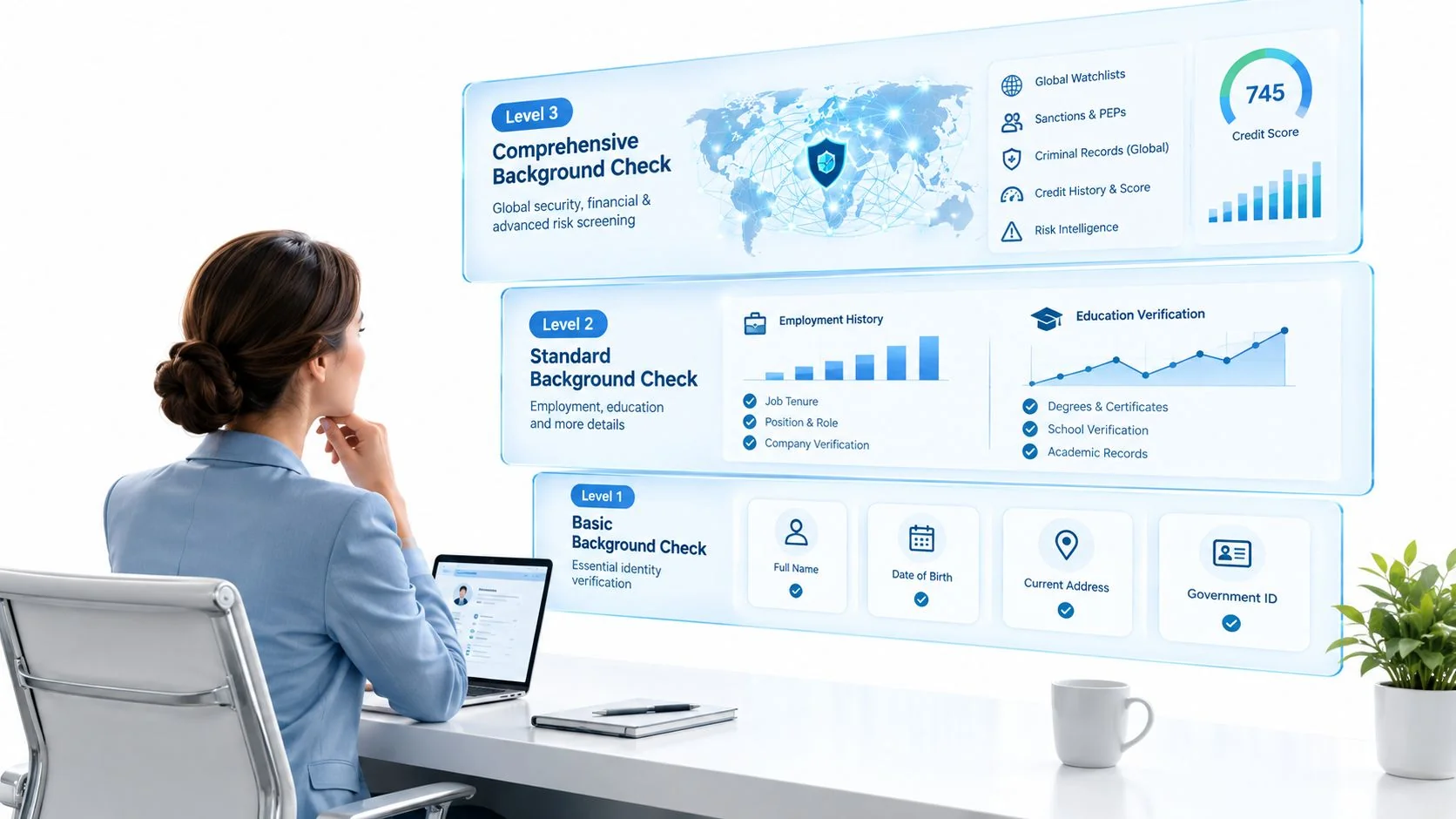
Tailor the checks to the job. A cashier doesn’t need the same screening as a CFO. Map out different “tiers” of screening that align with job responsibilities.
For example, you might set up something like this:
- Tier 1 (Entry-Level Roles): The basics—identity verification and a national criminal database search.
- Tier 2 (Management/Finance Roles): Everything in Tier 1, plus employment and education verification, and maybe a credit check.
- Tier 3 (Executive/Sensitive Data Roles): The works. All of the above, plus a more thorough criminal record check for employers and professional license verification.
This kind of tiered approach shows that your pre employment screening process is directly tied to the job’s demands, which is a cornerstone of compliance.
Define Consistent Criteria for Each Role
Once your policies are in place, get specific about what you’re looking for. Create a matrix that links job roles to exact screening criteria, removing guesswork and subjectivity.
For instance, if you’re hiring a delivery driver, a major moving violation in the last three years might be an automatic disqualifier. For an accountant, a conviction for fraud would be a massive red flag.
By setting objective, role-specific criteria before you even look at a report, you change the entire conversation. It’s no longer about a candidate’s past mistakes; it’s about their suitability for the specific duties of the job. That is the absolute key to making fair, unbiased, and legally defensible hiring decisions.
This infographic breaks down the essential steps for building a compliant screening process, from your internal policies to the external legal rules.

As you can see, a structured approach—starting with your own policies before you even get to the legal stuff—creates a system that’s both robust and easy to defend if it’s ever challenged.
Navigate the Legal Landscape
Let’s be honest: the legal side of background checks is a minefield. It’s complex and always seems to be changing. In the United States, the big one is the Fair Credit Reporting Act (FCRA), which governs how background check companies (known as consumer reporting agencies, or CRAs) collect and handle personal information.
The FCRA puts strict procedural requirements on employers, like getting a candidate’s explicit consent before a check and following the “adverse action” process if you decide not to hire them based on the results.
What’s really telling is that in 2025, regulatory compliance and speed have overtaken cost as the top priorities for employers. That shift says a lot about how critical it is for companies to get this right.
But the FCRA is just the beginning. You also have to pay close attention to EEOC guidance and a tangled web of state and local “ban-the-box” laws that dictate when you can even ask about criminal history. A strong framework has to account for all these layers to keep you out of trouble.
Choosing the Right Types of Background Checks

On background checks, a one-size-fits-all approach just doesn’t cut it. Putting an entry-level intern through the same rigorous screening as a senior finance executive isn’t just inefficient—it can open you up to unnecessary legal risks.
The real key to a solid pre employment screening process is building a smart, role-specific program. You want to match the intensity of the check to the actual responsibilities of the job. For every role, you should be able to justify exactly why you’re running a particular check. This saves time and money, sure, but it also shows you’re committed to fairness and relevance, which is everything on compliance.
The Foundational Checks Everyone Should Consider
For most roles, a handful of core checks create the bedrock of a good screening program. These are your baseline verifications, confirming the basic info a candidate gives you and helping you build trust from the get-go.
Think of these as the non-negotiables. They’re your first line of defense against résumé fraud and help ensure the person you’re talking to is who they say they are.
- Criminal History Search: This is what most people think of first. It can turn up felony and misdemeanor convictions, but it’s crucial to look at any findings in context. Consider the job, the nature of the offense, and how long ago it happened.
- Employment Verification: This check confirms a candidate’s past job titles and dates of employment. Big discrepancies here can be a red flag, suggesting someone has either embellished their experience or is trying to cover up an employment gap.
- Education Verification: This one is simple: it confirms degrees and certifications. It’s especially critical for roles where specific academic credentials are required to do the job safely and effectively.
It’s no surprise that accuracy has become the top concern for employers picking a screening provider. The 2025 Global Benchmark Report found that nearly nine out of ten companies run criminal record checks globally. Interestingly, while employment and education checks are standard in Europe and the Asia-Pacific region, they’re less common in North America. To see more of these global trends, check out the full findings in the 2025 benchmark report from HireRight.
Specialized Screens for Specific Job Functions
Once you have the basics covered, some roles demand a deeper look because of their specific duties. This is where specialized checks come in, giving you insights directly related to the risks of the position. Building these into a tiered screening policy is just plain smart risk management.
Think about it: handing someone the keys to the company finances or a company vehicle without the right checks is a huge liability waiting to happen.
Consider adding these common specialized screens:
- Motor Vehicle Records (MVR) Check: An absolute must for anyone who will drive for work, whether it’s in a company car or their own. This check pulls their driving history, including violations, suspensions, and license status.
- Credit Report Check: Use this one sparingly and only for roles with major financial responsibility, like accounting, executive leadership, or anyone handling large amounts of cash. The FCRA has strict rules here, so you need a clear, job-related reason.
- Professional License Verification: For positions like nurses, lawyers, or public accountants, this check confirms their license is active and in good standing with the proper state or federal board.
The goal isn’t to dig for dirt; it’s to align the verification process with the real-world demands of the job. A clean driving record is irrelevant for a software developer but critical for a delivery driver. This context is everything.
Common Pre-Employment Screening Checks and Their Purpose
To help you visualize how this works, we’ve broken down the most common checks, what they’re for, and where they fit best. This is a great starting point for building out your own tiered screening packages.
| Type of Check | What It Verifies | Best For These Roles |
|---|---|---|
| Criminal History | Felony and misdemeanor convictions | Nearly all roles, especially those involving trust, safety, or access to vulnerable populations. |
| Employment Verification | Job titles, dates of employment, and reasons for leaving | All roles to confirm experience and identify résumé discrepancies. |
| Education Verification | Degrees, diplomas, certifications, and attendance dates | Roles requiring specific academic qualifications (e.g., engineers, teachers, scientists). |
| MVR Check | Driving record, license status, and moving violations | Anyone driving for company business (e.g., delivery drivers, sales reps, technicians). |
| Credit Report | Credit history, debt levels, and financial responsibility | Roles with significant financial oversight (e.g., CFOs, accountants, controllers). |
| Professional License | License status, disciplinary actions, and expiration dates | Licensed professionals (e.g., healthcare workers, lawyers, financial advisors, CPAs). |
| Digital Footprint Check | Publicly available online behavior, looking for business-related red flags | Public-facing roles, leadership positions, and roles requiring high levels of professionalism. |
Remember, this isn’t an exhaustive list. The right combination of checks will always depend on the specific role, your industry, and your company’s risk tolerance.
Navigating the Digital Footprint Ethically
In our hyper-connected world, a candidate’s online activity can offer real insight into their judgment and professionalism. But tread very, very carefully here. Screening social media and a candidate’s digital footprint can easily cross legal and ethical lines.
A casual Google search is a recipe for disaster. You’re almost guaranteed to stumble upon protected information—like someone’s age, religion, or family status—which can lead straight to a discrimination claim.
If you decide to screen a candidate’s digital footprint, it has to be done consistently and ethically. The focus must be solely on publicly available, job-related information. You’re looking for clear red flags like demonstrations of violence, discriminatory behavior, or illegal activity—not their vacation photos.
The only compliant way to do this is with a third-party service. This creates a necessary buffer, ensuring your hiring team isn’t exposed to protected information and that your decision is based on legitimate, business-related concerns. For a more detailed walkthrough, you can learn more about how to conduct background checks that safely include online screening. By picking the right mix of foundational and specialized checks, you can design a screening program that’s both effective and legally sound.
Crafting a Positive Candidate Screening Experience

Sure, the mechanics of a pre-employment screening process are important, but how a candidate feels while going through it leaves a lasting mark on your employer brand. A clunky, secretive, or slow process can make even the most excited talent second-guess their decision to join your team.
On the flip side, a process built on transparency, clear communication, and professionalism does more than tick the compliance boxes. It builds trust from the very first interaction and reinforces the message that your company is a fantastic place to work. Think of this as your chance to show your culture, not just talk about it.
Getting Proper Candidate Consent
Before a single check is run, you must get the candidate’s explicit, written permission. This isn’t just good manners; it’s a non-negotiable requirement under the Fair Credit Reporting Act (FCRA). You can’t just bury this permission slip deep inside a lengthy application document.
The FCRA is crystal clear on this: you need a standalone disclosure and authorization form. That means the document must be only for the disclosure that you intend to run a background check. It can’t be bogged down with other legal jargon, like liability waivers or acknowledgements of at-will employment.
Your form should clearly spell out a few key things:
- That you might obtain a consumer report for employment purposes.
- The name and contact information of the screening company you’re working with.
- That the candidate has the right to request a copy of their own report.
Clarity here is everything. Mixing in other legal language is one of the most common—and easily avoidable—mistakes that lands companies in hot water with compliance.
Keeping Candidates in the Loop
Imagine you’ve submitted your personal details for a background check and then… radio silence for a week. That quiet can be stressful for someone who’s excited about a new job. Proactive communication is the perfect antidote to that anxiety.
You don’t need anything complex; a simple, automated email workflow can make all the difference. The goal is to send notifications at key milestones in the process.
Key Communication Touchpoints:
- Confirmation: Shoot off an immediate email letting them know the screening process has officially started.
- Status Updates: If a check is taking longer than the usual 3-5 business days, send a quick note. Something as simple as, “Your screening is still underway, and we’ll be in touch as soon as it’s complete,” is often all it takes.
- Completion Notice: Let them know once the report is back and your team is reviewing it.
This level of transparency shows you respect the candidate’s time and their emotional investment in the role.
A positive candidate experience isn’t about fancy perks; it’s about clear, consistent, and respectful communication. Managing expectations with proactive updates turns the screening from a mysterious black box into a professional and understandable part of the hiring journey.
Handling Requests for More Information
It happens. Sometimes a screening report comes back with a piece of information that’s incomplete or unverified. A past employer might have gone out of business, or a university’s records office is moving at a snail’s pace. When this occurs, you’ll need to circle back to the candidate for help.
How you frame this request is critical. You want to avoid any language that sounds accusatory. Instead, approach it as a collaborative effort to get to the finish line.
For instance, instead of saying, “We couldn’t verify your employment at XYZ Corp,” try a more supportive angle: “Our screening partner is having trouble reaching your previous manager at XYZ Corp to confirm your employment dates. Could you possibly provide an alternative contact or a W-2 to help us finalize this step?”
This approach smooths over any friction and keeps the candidate feeling like part of the solution, not the problem. Remember, this is all part of the larger picture you’re building of the candidate, which includes their online presence and what employers see when they Google you.
Making Fair Decisions with Screening Results

So, the background check report is in. Now what? Getting the results isn’t the final step of your pre employment screening process—in fact, it’s where one of the most critical phases begins. The real test is how you interpret the findings to make fair, consistent, and legally sound hiring decisions.
This is exactly where that screening policy you worked so hard on becomes your north star. A report might flag a criminal conviction or a mismatch in job history, but that information is just data without context. Your job is to weigh each finding against the specific, pre-defined criteria you already set for the role.
Applying an Individualized Assessment
Before you even think about making a judgment call, it’s crucial to follow the Equal Employment Opportunity Commission (EEOC) guidance on conducting an individualized assessment for any criminal records. This isn’t about a simple pass/fail; it’s about looking at the specifics to gauge actual relevance and risk. This is your key to avoiding discrimination.
When you’re looking at a criminal record, the EEOC wants you to consider what’s often called the “nature-time-nature” test:
- The Nature of the Offense: How serious was it? A petty theft conviction from ten years ago is a world away from a recent felony for embezzlement, especially if you’re hiring for your finance team.
- The Time Elapsed: How long ago did this happen? The EEOC gives much less weight to older offenses, as they’re far less likely to indicate a person’s current character or future risk.
- The Nature of the Job: How does the offense relate to the actual duties of the position? There needs to be a clear, direct line connecting the crime to the job’s responsibilities. A DUI from five years back is a big deal for a delivery driver, but it’s far less relevant for a graphic designer working from home.
A blanket policy that disqualifies any candidate with a criminal record is not just unfair—it’s a direct route to a discrimination lawsuit. The individualized assessment is your mechanism for making fair, job-related decisions that protect both the applicant and your organization.
This thoughtful approach ensures your decisions are rooted in business necessity, not unconscious bias. It’s all about evaluating the whole person in front of you today, not just one line item on a report from their past.
Navigating the Adverse Action Process
Let’s say that after a careful, individualized review, you’re leaning toward not hiring a candidate based on what the background check revealed. You can’t just ghost them. You are legally required to follow a specific, two-step process dictated by the FCRA.
This is known as the adverse action process, and skipping it can land you in some serious legal hot water. The whole point is to give the candidate a chance to see the information and correct any errors before you make a final call. It’s a fundamental protection that guarantees transparency.
Step 1: The Pre-Adverse Action Notice
Before you officially decide against them, you must send the candidate a package containing:
- A formal pre-adverse action notice letter.
- A complete copy of the background check report you used.
- A copy of the document “A Summary of Your Rights Under the Fair Credit Reporting Act.”
This gives the candidate a chance to look everything over for inaccuracies. Mistakes happen—names get mixed up, records are reported incorrectly—and this is their opportunity to set the record straight. You have to give them a reasonable amount of time to respond, which is typically about five business days.
Step 2: The Final Adverse Action Notice
If the candidate doesn’t respond, or if they do but the information is confirmed as accurate and you’re sticking with your decision, you then send the final notice. This is the letter that officially informs them you won’t be moving forward.
This second notice has to include:
- The name and contact information of the screening company that ran the report.
- A statement clarifying that the screening company did not make the hiring decision and can’t explain why it was made.
- A notice of their right to dispute the report’s accuracy and to request another free report from that agency within 60 days.
Mastering this two-step dance isn’t optional. It’s a core piece of a compliant pre employment screening process that ensures you treat every candidate with fairness and respect, even when you have to deliver bad news.
Finding the Right Screening Partner and Tech
https://www.youtube.com/embed/wDiiGzK-rBs
Trying to run a compliant pre employment screening process entirely in-house is a massive undertaking. Between navigating the maze of legal requirements and manually chasing down candidate data, the workload is intense, and the risk of a costly mistake is high. This is exactly why so many businesses decide to team up with a professional screening provider.
A good partner does more than run background checks; they become a strategic extension of your HR team. They bring deep expertise, powerful technology, and a nuanced understanding of compliance that’s nearly impossible to build from scratch. This relationship is what separates a reactive, burdensome process from a proactive, efficient one that actually strengthens your hiring.
What to Look for in a Screening Vendor
Choosing the right screening partner is a huge decision. It will directly impact your compliance risk, your hiring speed, and even your candidate experience. Don’t fall into the trap of letting cost be the only factor; things like accuracy, compliance, and integration capabilities are far more important when you’re playing the long game.
As you evaluate potential providers, zoom in on these critical areas:
- Compliance Expertise: Your partner needs to be an absolute expert on the FCRA, EEOC guidance, and the ever-changing patchwork of state and local laws. They should provide compliant forms, clear guidance on adverse action, and keep you in the loop on new legislation.
- Data Accuracy and Quality: Ask them where their data comes from and what they do to ensure it’s accurate. A wrong report is worse than no report at all—it can lead to a bad hire or, even worse, unfairly knocking out a great candidate.
- Integration Capabilities: A smooth integration with your existing HR software is a must for efficiency. When you’re adding tech to your process, it’s not just about features, but also how candidates experience it. Understanding how to effectively utilize applicant tracking systems (ATS) can really help you refine your entire screening framework.
- Turnaround Time: In a tight job market, speed is everything. Get their average completion times for different types of checks to make sure their timeline won’t create a bottleneck in your hiring process.
The right screening partner isn’t just a vendor; they’re your compliance safeguard. Their ability to navigate complex laws and deliver accurate, timely results protects your organization and ensures a fair, consistent process for every applicant.
How Technology and Automation Make Screening Better
The world of background checks has been reshaped by technology. We’ve moved from slow, paper-based processes to quick, automated workflows that are not only more convenient but also far more reliable. Automation takes care of the tedious work of collecting data, verifying information, and generating reports, which slashes the risk of human error. This frees up your HR team to focus on what they do best—connecting with people.
This tech-driven shift is a huge reason for the industry’s growth. The global pre-employment background check market, valued at around $20 billion in 2025, is expected to keep climbing. Much of this growth is powered by the adoption of advanced tools, like AI, that make screening faster and more dependable. You can dig into these market trends and projections at Data Insights Market.
Modern screening platforms give you a central dashboard to manage the entire process. From sending the initial disclosure forms to reviewing the final reports, it’s all in one place. Most also include candidate-facing portals where applicants can enter their own information, provide consent electronically, and track the status of their check in real time. This level of transparency goes a long way in reducing candidate anxiety and cuts down on the back-and-forth for your team, creating a much smoother experience for everyone.
Common Questions About the Pre Employment Screening Process
Even with a perfectly mapped-out pre employment screening process, you’re bound to run into some unique situations. When you do, having clear, straightforward answers ready for your team is the key to navigating those moments with confidence. It keeps everything fair, compliant, and moving forward.
Here are a few of the most common questions that pop up.
How Long Does a Pre Employment Screening Process Take?
There’s really no single answer here—turnaround times can be anything from a few hours to several weeks. Simple, automated checks like an identity verification? That’s often nearly instant. On the other hand, if a criminal record search requires a county clerk to physically pull old courthouse records, you’re in for a longer wait.
On average, you can expect a comprehensive U.S. background check to be wrapped up in about 2 to 5 business days.
So, what causes the hold-ups?
- A common name: John Smith is going to trigger a lot more potential records than a more unique name, and each one has to be carefully vetted.
- Multiple addresses: If your candidate has lived in several counties or states, each location needs its own search, which adds up.
- Unresponsive sources: Sometimes, the bottleneck is simply a past employer or a university registrar who is slow to get back to the screening provider.
The best thing you can do is set realistic expectations with candidates from the start. A little transparency about the timeline goes a long way in creating a positive experience.
What If a Candidate Disputes Their Background Check?
Under the FCRA, candidates have a legal right to dispute any information they believe is wrong. The moment a candidate flags an error, you have to hit pause on any hiring decision based on that specific piece of information. You simply can’t move forward until the dispute is resolved.
Your screening provider is legally required to investigate the claim, usually within 30 days, and must fix any information that turns out to be incorrect. Your job as the employer is to make sure the candidate knows they have this right, which is why it’s a critical part of the pre-adverse action notice.
Can We Screen Current Employees?
Absolutely. Screening current employees is often called “rescreening” or “ongoing monitoring,” and it’s a standard practice in a few key scenarios. Think highly regulated industries, or when an employee is promoted into a role with much greater responsibility or access to sensitive data.
The same rules apply, though. You still need a permissible, job-related reason for the check, and you must get the employee’s written consent before each new screen. The best practice here is a transparent, written policy on rescreening. It ensures everyone is on the same page and avoids any feelings of being caught off guard.
Your policy on ongoing monitoring should clearly spell out when and why rescreening happens. This kind of transparency builds trust. It reinforces that the goal isn’t to play “gotcha,” but to maintain a safe and secure workplace for everyone.
What Shows Up on a Pre Employment Background Check?
What you see on the report depends entirely on the specific checks you choose to run. There’s no one-size-fits-all report. A fairly standard screening package will likely include:
- Criminal records (felonies and misdemeanors)
- Employment history verification
- Education and degree confirmation
- Checks for professional licenses
If you need to dig deeper, you might add things like motor vehicle records, credit reports (which have their own strict compliance rules), or civil court records. All of these results are then pulled together into a single, consolidated report for your team to review against the hiring criteria you’ve already established.
A well-managed pre employment screening process is the foundation for building a team you can trust. Digital Footprint Check takes the complexity out of the equation with fast, compliant, and accurate screening services that fit right into your hiring workflow. Our reports deliver the clear insights you need to make confident decisions while ensuring your candidates have a positive experience.
Learn more about our compliant screening solutions at digitalfootprintcheck.com