· Digital Footprint Check · Content Marketing · 13 min read
Background Check Levels: a Complete Comparison Guide
Understand background check levels from basic to comprehensive. Learn what each tier reveals, who uses them, and how to choose the right screening
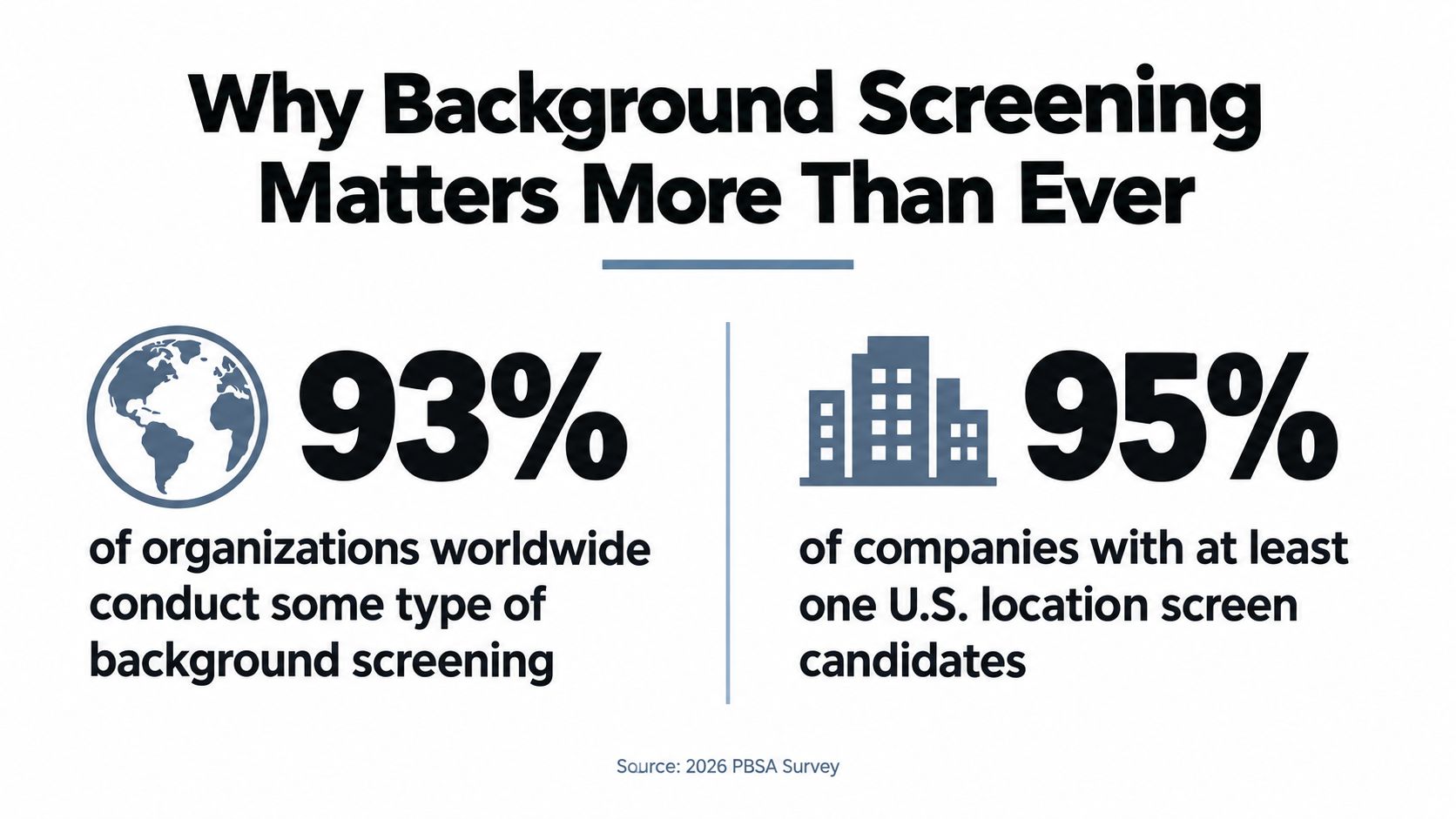
93% of organizations worldwide conduct some type of background screening, while 92% of U.S. employers perform criminal background checks during hiring. The right background check level depends on the role’s risk, access, and legal context, not on a universal package label.
That distinction matters because a “Level 1” check in one setting may mean something entirely different elsewhere. Commercial providers often use labels such as basic, standard, and advanced, while U.S. federal personnel vetting uses risk-based investigation tiers tied to job sensitivity and potential harm. A good screening program asks which information is decision-relevant, how reliably it can be verified, and whether the organization needs protection only at hiring or after the person starts work.
Why Background Screening Matters More Than Ever
A 2026 PBSA/HR.com survey found that 93% of organizations worldwide conduct some type of background screening, and 95% of organizations with at least one U.S. location do so. The same survey reported that 76% of organizations worldwide have a documented screening policy, while Cornell’s ILR history records that 92% of U.S. employers perform criminal background checks during hiring. These figures show how screening moved from a specialized safeguard to a routine pre-employment control. (PBSA and HR.com survey)
Consider a small employer hiring for a role with access to customer records, company funds, or vulnerable people. Years ago, the hiring manager might have relied on references and an interview. Today, the organization is more likely to verify identity, review criminal records, confirm qualifications, and document the decision. That shift reflects a practical reality. An employer can be responsible for foreseeable hiring risks even when a screening vendor performed the search.
Screening became an operational control
The industry’s expansion reflects that change. Cornell’s ILR history says the background screening industry was valued at $2.8 billion in 2022 and is projected to reach $5.8 billion by 2032. A separate Consumer Financial Protection Bureau market snapshot reported 1,954 background screening companies and about $3.2 billion in revenue in 2019. (Cornell ILR history of employment background searches)
The growth creates choice, but it also creates confusion. Providers may describe their offerings with similar terms while searching different databases, jurisdictions, and verification sources. “Comprehensive” can mean a investigation, or it can mean a longer checklist that produces little additional insight.
That is why background check levels matter beyond HR. Job seekers need to understand what employers may review. Individuals concerned about identity theft need to distinguish public records from exposed online accounts. Parents, daters, gamers, and professionals also face digital identity risks that a conventional criminal search won’t necessarily reveal.
Practical rule: Treat the level as a starting point for a risk decision, not as proof that the screening is complete.
For household and care-related hiring, a role-specific resource such as the nanny background check guide by Superstar Nannies can help families think through screening needs beyond a generic “clear” result. The same principle applies in business. A person’s identity, qualifications, public online presence, and continuing eligibility may each require a different verification method.
Basic versus Comprehensive Screening Packages
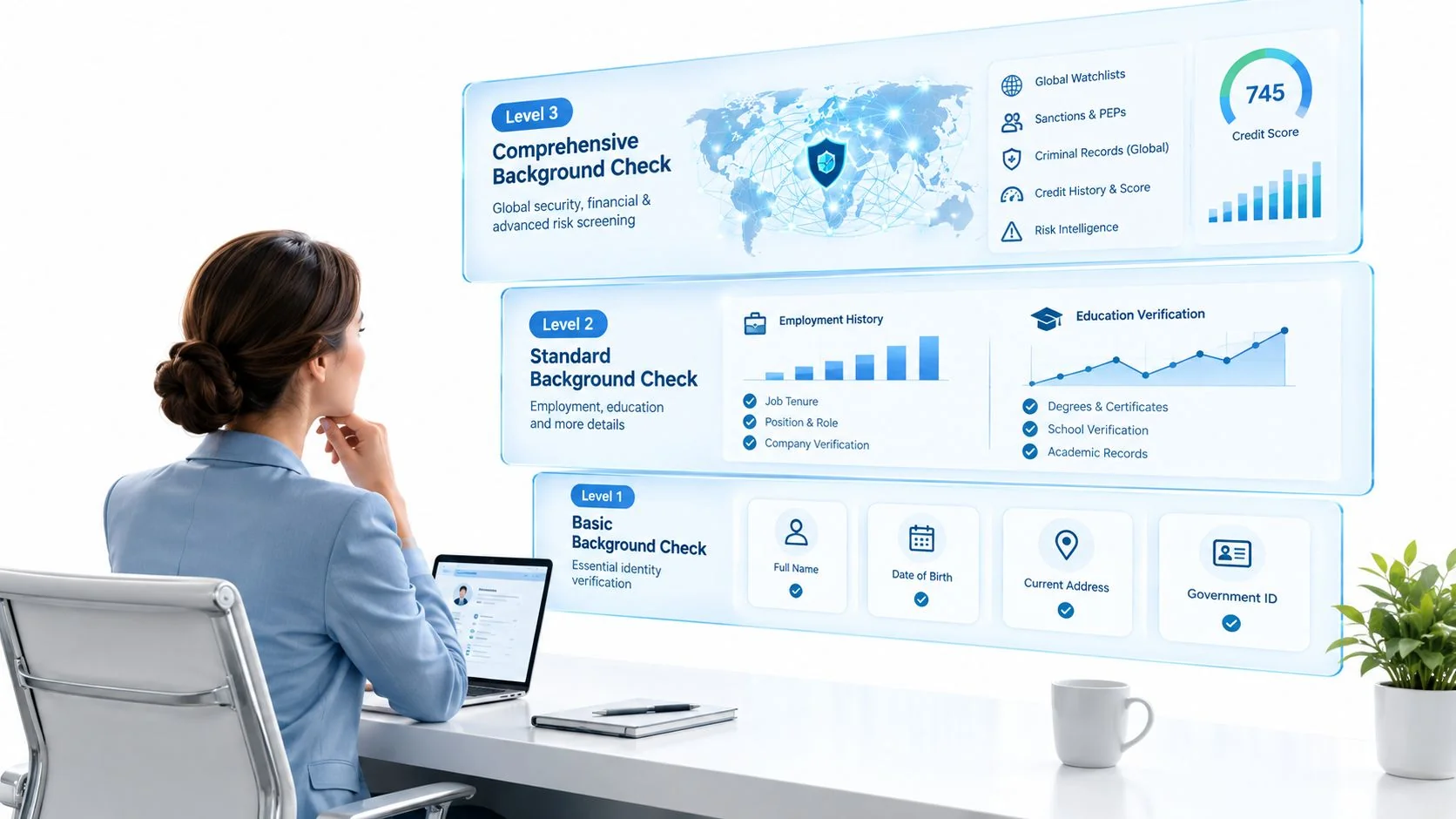
Commercial screening packages generally become broader as the role becomes more sensitive. Industry guidance describes basic screening as identity verification, a Social Security trace, and a national criminal search. Standard packages add employment and education verification plus reference interviews, while full or executive packages may include global criminal searches, civil records, credit reports, and sanctions screening. (pre-employment screening guidance)
| Package Type | Core Components | Best For |
|---|---|---|
| Basic | Identity verification, Social Security trace, national criminal search | Lower-risk roles where identity and broad criminal-history screening are the initial priorities |
| Standard | Basic components, employment verification, education verification, reference interviews | Roles where qualifications, work history, and professional reliability affect the hiring decision |
| Comprehensive or executive | Standard components, global criminal searches, civil records, credit reports, sanctions screening | Sensitive roles involving significant authority, financial exposure, international activity, or regulated responsibilities |
A basic package is useful when an employer needs an initial identity and criminal-history screen, but it has clear limits. A national database search may produce a lead that requires county-level or jurisdiction-specific verification. Identity traces can also contain outdated or mismatched information. A basic result shouldn’t be treated as a complete investigation.
A standard package improves decision quality by testing the candidate’s stated history. Employment and education checks can identify discrepancies that a criminal search won’t address. Reference interviews add context, although employers should still define consistent questions and apply them fairly across candidates.
A full package makes sense only when the additional sources connect to the role’s actual exposure. A credit report may be relevant to a position involving financial responsibility where legally permitted, but it isn’t automatically relevant to every office role. Sanctions screening may be important for international transactions or regulated work, while global criminal searches can introduce translation, jurisdiction, privacy, and data-quality issues.
More coverage creates more administration
As the search expands across databases and jurisdictions, signal quality can improve for certain forms of fraud or risk detection. The trade-off is a heavier process for consent, adverse-action review, false-positive resolution, data retention, and jurisdiction-specific compliance under laws such as the Fair Credit Reporting Act and relevant Equal Employment Opportunity Commission guidance.
Employers should define the decision before ordering the search. Ask:
- Role exposure: What information, money, equipment, clients, or vulnerable people can the person access?
- Verification need: Which claims must be confirmed, such as licenses, education, or employment history?
- Legal relevance: Is each search lawful, job-related, consistently applied, and properly disclosed?
- Resolution process: Who reviews a possible match, and how does the candidate get a chance to explain it?
A landlord or property manager faces a similar problem when selecting checks for applicants. Guidance on how to avoid rental background check mistakes is useful because an incomplete search and an overbroad search can both create avoidable decisions, disputes, and compliance risks.
Before choosing a provider, compare the actual components rather than the marketing name. Review background check pricing alongside search scope, identity matching, verification methods, consent workflows, dispute handling, and retention practices.
Federal Background Check Tiers Explained
U.S. federal personnel vetting uses a risk-based framework rather than a simple commercial package ladder. The tier reflects the position’s duties, sensitivity, and potential harm if the person misuses access or authority. It therefore answers a different question from “Which package did the vendor sell?”
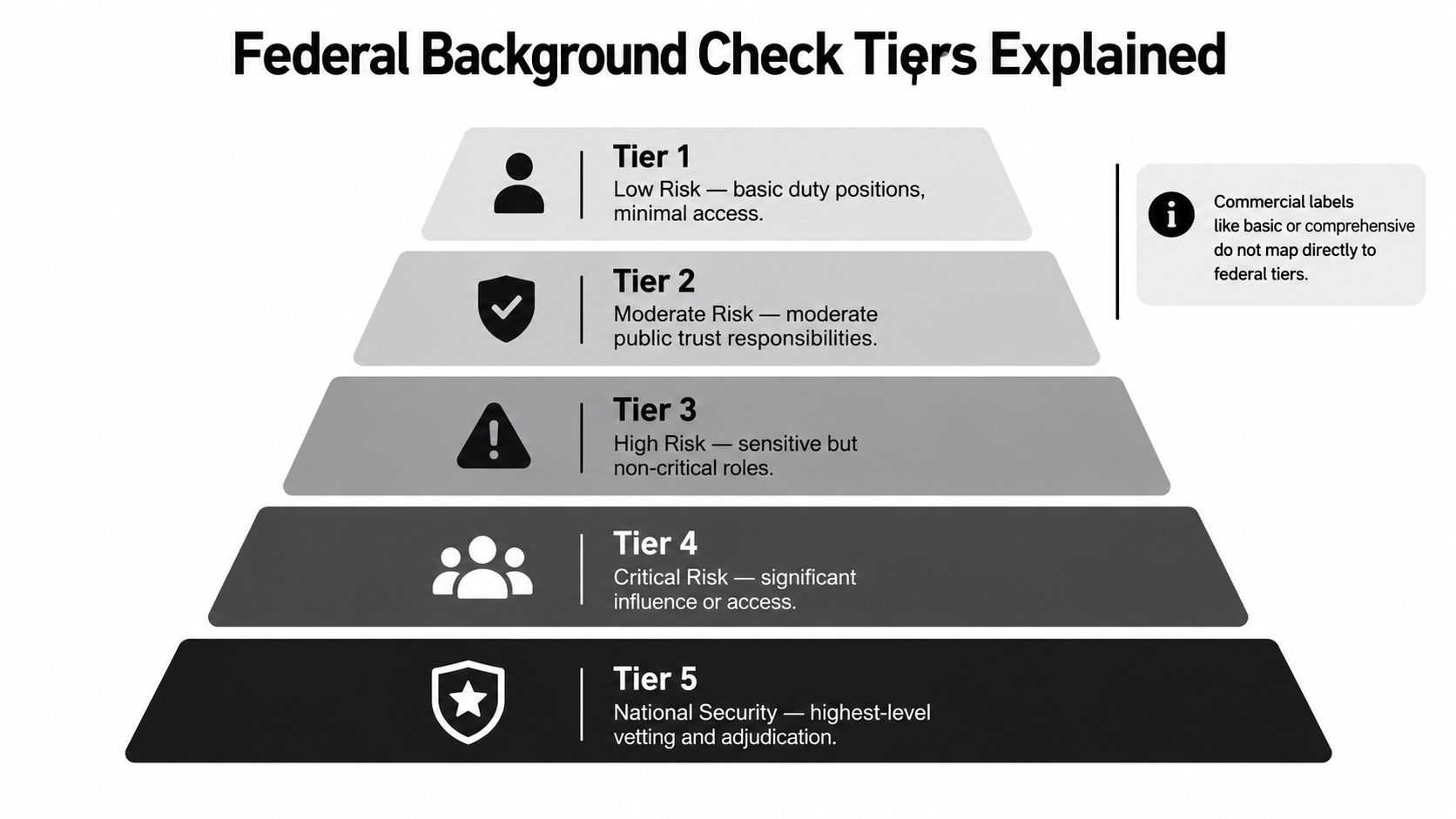
The five federal tiers are:
- Tier 1 covers non-sensitive positions.
- Tier 2 covers public trust positions.
- Tier 3 covers non-critical sensitive national security roles and can support Secret eligibility.
- Tier 4 covers certain public trust roles.
- Tier 5 supports Top Secret eligibility.
The National Institutes of Health explanation of federal background investigations describes how these tiers connect investigation intensity to the role rather than to a one-size-fits-all checklist.
How reinvestigation changes the control
Federal screening also demonstrates why a background check isn’t always a one-time event. Reassessment timing differs by tier:
| Federal Tier | Position Context | Reassessment Timing |
|---|---|---|
| Tier 1 | Non-sensitive positions | When the investigation is older than 10 years |
| Tier 2 | Public trust positions | Every 5 years |
| Tier 3 | Non-critical sensitive national security roles | Every 10 years |
| Tier 4 | Certain public trust roles | Every 5 years |
| Tier 5 | Positions supporting Top Secret eligibility | Every 7 years |
These cycles aren’t interchangeable. A sensitive position may require deeper initial investigation, stronger access controls, and a planned process for later review. The screening team must connect the result to the person’s actual duties, not merely file a certificate in the personnel record.
Commercial providers may call a product “Level 3,” but that label doesn’t automatically map to federal Tier 3. A company should never assume that a vendor’s naming convention establishes federal eligibility or satisfies a government investigation requirement.
Apply the logic outside government
Private employers can borrow the underlying method without copying federal terminology. Start with the consequences of misuse. Then identify the data, credentials, physical access, and decision-making authority attached to the role. Finally, specify the checks and review intervals that address those risks.
Consent documents should match the searches being conducted. Teams can use background check consent forms as part of a documented workflow, but legal review remains important when the process involves consumer reports, online information, international data, or ongoing monitoring.
Compliance principle: A higher-risk role needs a stronger control system, not simply a package with a higher number.
The Quality Problem with Level-Based Screening
More screening levels don’t automatically produce better screening. A 2026 benchmark found that database checks represented 58% of all screening volume yet flagged discrepancies under 1% of the time. The same benchmark found that screening depth ranged from 2.5 checks per hire in Business Services to 13.1 in Capital Markets. (2026 Veremark screening benchmark)
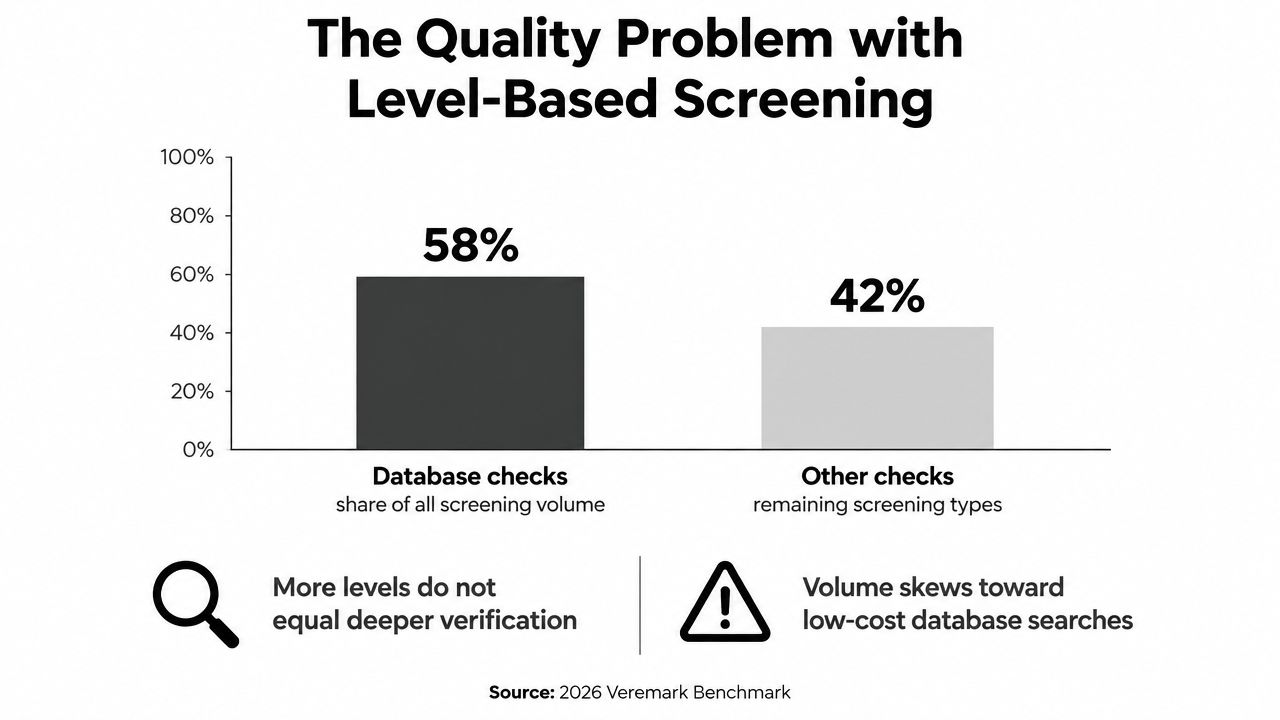
Those findings expose a common weakness in package-led buying. Organizations may order a high-volume database search because it’s fast and easy to automate, even when the risk depends on a license, a professional history, a local court record, or an online identity that changes after hiring.
A database check can still be useful. It may identify a lead, confirm basic identity signals, or provide an efficient first pass. The problem starts when a low-discrepancy source is treated as a complete answer.
Replace “deeper” with “more relevant”
A role-specific program might use fewer searches than an executive package but produce more useful evidence. For example, an employer hiring for a regulated position may prioritize license status and sanctions screening. A company hiring for a role with access to payment systems may focus on identity assurance, financial controls, and carefully reviewed history where legally permitted.
The right questions are:
- What could change after hire? Criminal records, licenses, driving eligibility, and public online profiles can change.
- Which source is authoritative? Primary records and direct verification generally deserve more weight than aggregated results.
- What requires human review? Potential name matches, aliases, conflicting dates, and ambiguous online profiles need adjudication.
- What is the response? A finding has little operational value if nobody knows whether to pause access, investigate, or document no action.
Background check levels also lack a universal meaning across markets and industries. Federal roles use sensitivity and risk tiers, while commercial vendors may define their own packages. The label can help organize purchasing, but it shouldn’t replace a written risk assessment.
Use a criminal search to answer a criminal-history question, not every identity or reputation question. A focused criminal record check for employers can sit within a broader process that also verifies qualifications, confirms identity, and evaluates relevant public information.
Digital Footprints and Continuous Monitoring
A conventional background check captures a person’s information at a particular point in time. Modern screening can also include social media and online presence review, along with continuous monitoring for new criminal records, license changes, or driving violations after hire. Guidance on what a background check may show emphasizes that investigation intensity should follow job sensitivity and risk, while screening depth varies from 2.5 to 13.1 checks per hire across industries. (modern background screening guidance)
An online footprint can affect hiring, personal safety, gaming accounts, dating decisions, and reputation management. It can reveal exposed contact details, inconsistent identity signals, public posts, old profiles, or account activity that deserves review. It can also create false positives. A similar username, copied photograph, or unrelated person may look connected until someone checks context.
Use OSINT as a complement
Ethical OSINT tools should support, not replace, consent, lawful screening, and human judgment. Employers should review only information that is relevant to the role, apply the same standard to comparable candidates, and avoid decisions based on protected characteristics or private activity unrelated to job duties.
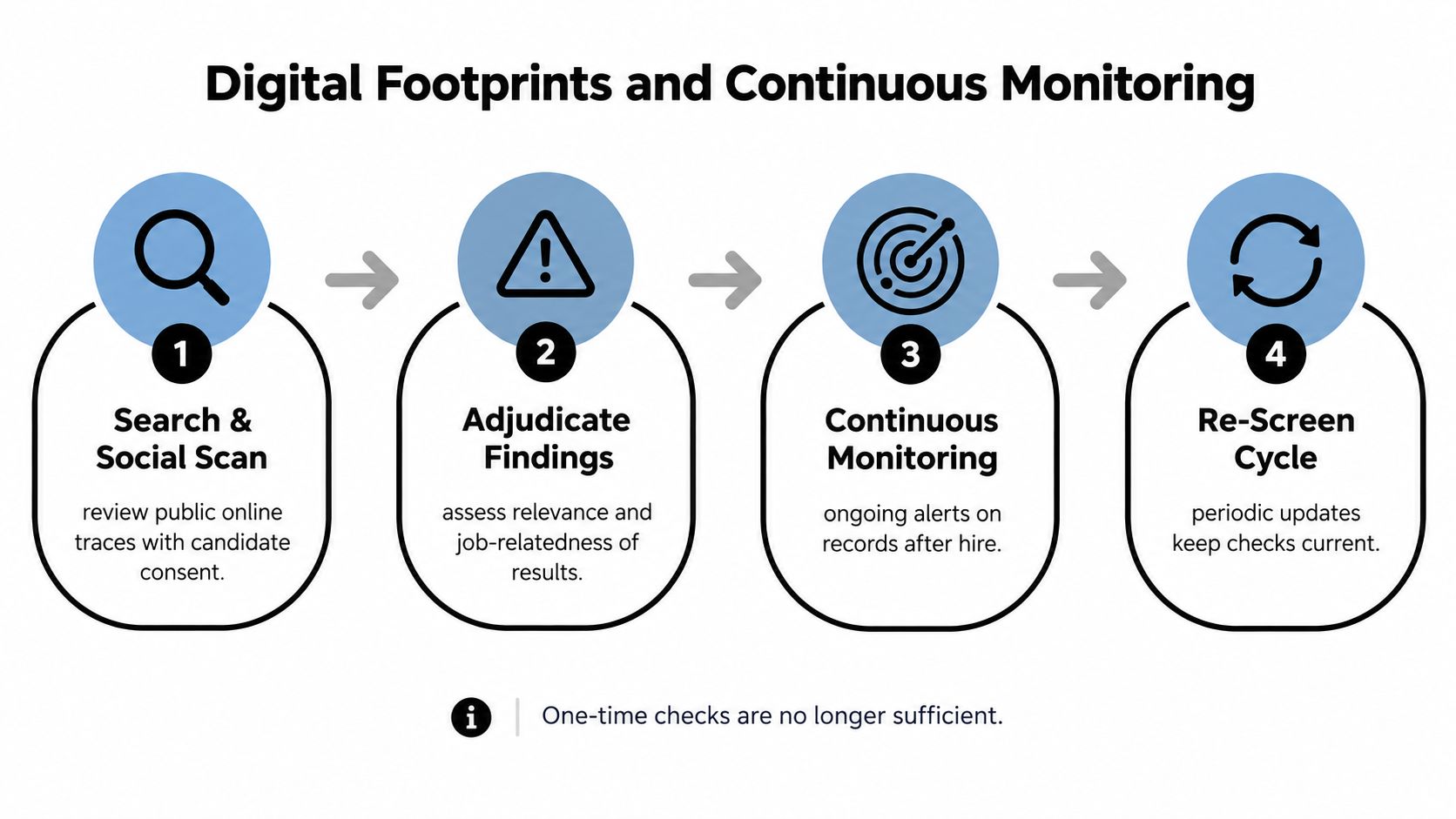
A practical process has four stages:
- Search and social scan: Review public online traces with appropriate consent and a defined purpose.
- Adjudicate findings: Assess whether a result belongs to the person and whether it is relevant and job-related.
- Monitor appropriate changes: Use lawful alerts for developments such as license changes or new records when the role justifies them.
- Re-screen on a defined cycle: Update the review when risk, responsibilities, or access changes.
This approach works better than searching everything indiscriminately. A public profile may matter for an official spokesperson, while it may have little connection to an internal role with no public-facing duties. The same source can therefore be relevant in one role and irrelevant in another.
Protect the individual as well as the organization
Digital footprint reviews also help individuals find exposed information before someone else uses it. Job seekers can identify old profiles or inconsistent professional details. Gamers can locate public account associations and secure neglected accounts. People using dating platforms can check whether a new contact’s identity signals are coherent without treating an online search as proof of character.
A digital footprint assessment can be one component of that process. It should lead to concrete actions, such as removing unnecessary public details, strengthening account security, documenting impersonation, or escalating a suspicious finding through the appropriate channel.
Privacy safeguard: Don’t collect information simply because it is available. Collect what you can justify, protect it carefully, and delete it when the purpose ends.
Choosing the Right Level for Your Situation
The right screening depth follows the consequence of failure. A high-security role with privileged access may justify a layered process similar in intensity to federal Tier 3 through Tier 5 work. A lower-risk role may need identity confirmation and a focused criminal search, followed by verification of the claims that matter.
Dating safety requires a different approach. Nearly 60% of people who reported losing money to a romance scam in 2025 said the scam started on a social media platform, according to the Federal Trade Commission’s data on social-media scams. A separate FTC update reported more than 1 million imposter-scam reports in 2025, with reported losses rising nearly 20% to $3.5 billion. Within that trend, romance-scam losses rose 22% to $1.48 million, or about $2,020 per person. (FTC consumer alert on imposter scams)
These figures don’t mean a background check can guarantee safety. They do show why identity consistency, image reuse, location claims, sudden financial requests, and pressure to move conversations off-platform deserve attention.
Match the control to the exposure
TransUnion found that 85% of women and 87% of men said dating platforms should verify information such as age, photo recency, and location, and that more than three quarters of users were willing to undergo background checks. (TransUnion survey on dating-platform verification)
For employers, use this decision sequence:
- Define the harm: Identify the realistic consequences of fraud, unsafe conduct, unauthorized access, or misrepresentation.
- Select relevant sources: Choose identity, criminal, employment, education, license, sanctions, credit, or online sources only when they address that harm.
- Set review points: Add post-hire monitoring when the risk can change after onboarding.
- Document fairness: Apply consistent criteria, provide required notices, and give candidates a way to dispute inaccurate information.
- Protect the data: Limit access, set retention rules, and avoid storing sensitive reports in uncontrolled email or shared folders.
Businesses that need structured hiring research can consider background check services for businesses, while still confirming that the selected workflow meets applicable employment and privacy requirements. For individuals, the same risk-based logic helps with identity theft prevention and online reputation management. The objective isn’t to investigate everyone to the maximum possible depth. It’s to make the most defensible decision using information that is relevant, current, and properly verified.
Digital Footprint Check helps individuals and businesses discover public online traces, exposed personal data, breached credentials, gaming profiles, professional accounts, and other identity signals across the internet. Visit Digital Footprint Check to start with a free check and use the findings to improve privacy, protect your reputation, and complement a role-appropriate background screening process.