· Digital Footprint Check · Content Marketing · 18 min read
10 Pre Employment Screening Tools: Compliance, Pricing, Fit
Compare 10 pre employment screening tools by features, compliance notes, pricing tiers, and best-fit use cases to hire with confidence in 2026.
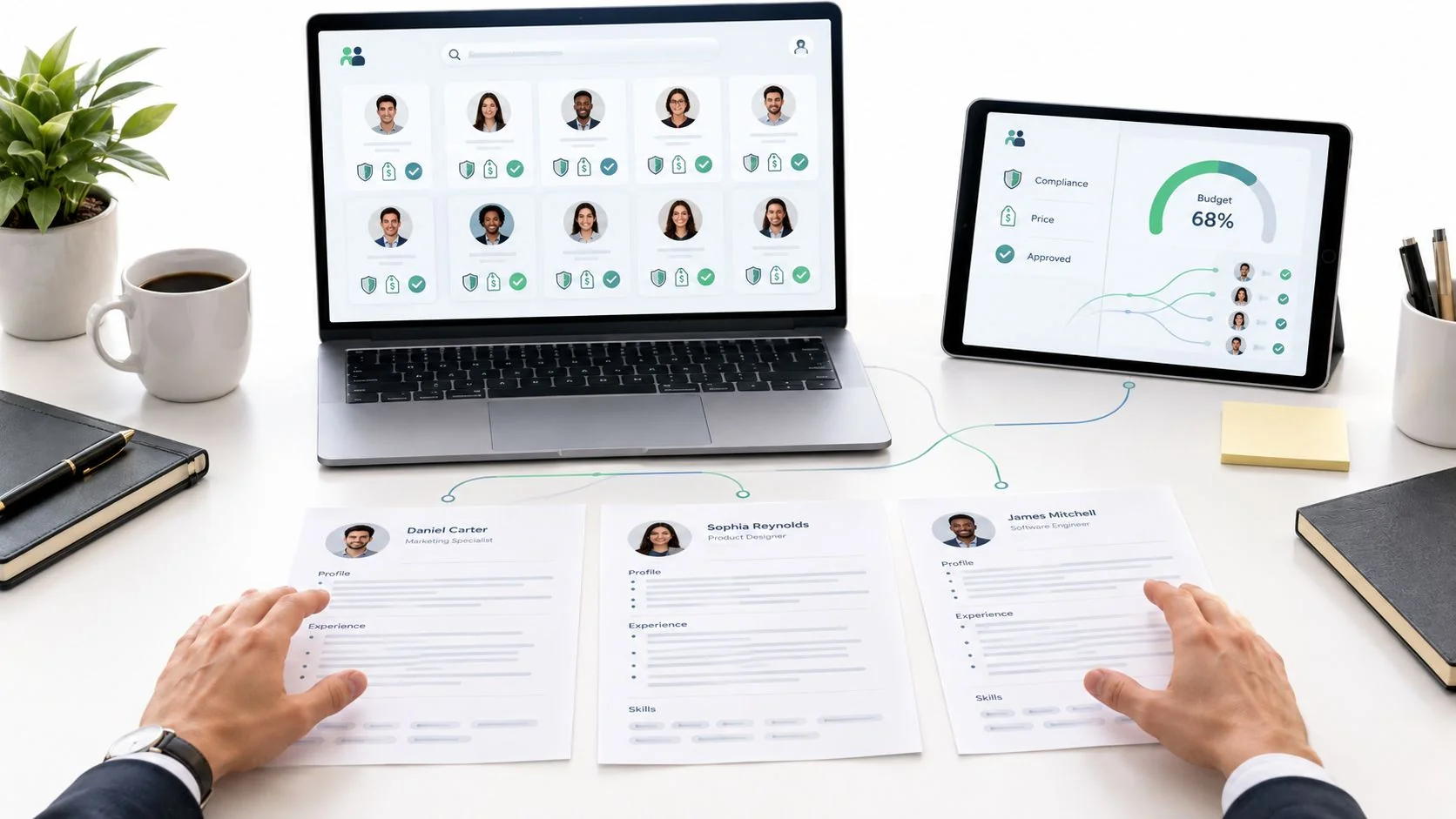
Three finalists remain for one role, and your screening budget covers a single provider. Every vendor promises fast, accurate results. The practical differences appear elsewhere: what the check covers, which compliance duties it creates, how identity uncertainty is handled, and how the report reaches the hiring team. A criminal-record search, an employment verification, and an online reputation review aren’t interchangeable signals.
This shortlist compares pre-employment screening tools by hiring scenario rather than by feature volume. It includes formal background-screening suites, assessment-adjacent workflows, and specialized online screening. The right choice depends on your hiring volume, risk profile, geographic coverage, and the amount of compliance work your team can manage internally.
1. Digital Footprint Check
A recruiter has a finalist in hand, but the question is narrower than a full background check. Does this person have a public online trail that could create risk, confusion, or an identity mismatch? Digital Footprint Check fits that early screening moment. It gathers publicly discoverable signals across social platforms, gaming accounts, professional profiles, breach databases, public records, and other open sources, then turns them into a report for human review.
The product is lighter than a regulated screening suite, and that is the point. It helps teams find what is publicly visible before they decide whether to order criminal, employment, or education verification. It also works for candidates who want to see their own exposure before entering a hiring process.
The company says the platform scans 500+ platforms, tracks 1,000+ breaches, and combines profile discovery with breach monitoring, search-result review, public-record signals, and checks tied to gaming and professional identities. A free one-time profile or breach check is available without a card. Paid plans add monitoring and alerts. See the Digital Footprint Check employer screening overview for how public-footprint discovery fits a compliant workflow.
Where it fits
This tool makes the most sense when the hiring team wants a first pass on reputation and identity signals without standing up a full enterprise screening program. It can flag duplicate profiles, exposed credentials, tagged media, public contact information, and search results that need context. That is useful before interviews, before a formal background order, or during a workforce privacy review.
There are limits, and they matter. Digital Footprint Check gives removal guidance, but the user still has to contact sites or data brokers directly. Enterprise screening and API access are available, but monitoring and some business features sit behind paid plans. Pricing for broader use depends on plan level, so teams should expect some setup decisions before it fits cleanly into an HR workflow.
Digital Footprint Check also highlights GDPR compliance, 256-bit SSL encryption, and a policy of not selling user data. Those controls help, but they do not answer the core hiring question on their own.
Practical rule: Treat an OSINT finding as a lead to verify, not proof of misconduct, dishonesty, or poor job performance.
The compliance trade-off is straightforward. Public-footprint research can surface relevant context, but it can also pull in stale, misattributed, or irrelevant material. The EEOC’s guidance on arrest and conviction records makes clear that an arrest alone does not establish criminal conduct. Employers still need a documented process, source dates, role relevance, and a way for candidates to explain disputed findings.
Pros
- Broad discovery: Covers social, gaming, professional, breach, public-record, and data-broker signals.
- Fast first review: Free profile and breach checks offer a low-friction starting point.
- Privacy-oriented controls: Includes GDPR-conscious handling, encryption, and user-directed remediation.
- Flexible deployment: Supports one-time reports, subscriptions, enterprise screening, and API integrations.
Cons
- No removal service: Users get instructions, then handle takedown requests themselves.
- Paid continuity: Monitoring, alerts, and some enterprise functions require a paid plan.
- Needs review: Findings still require identity matching, relevance checks, and human judgment.
Explore Digital Footprint Check’s OSINT screening platform
2. Fama
Fama is designed for the narrow problem that traditional background suites often leave open: reviewing public online behavior for job-relevant risk. It acquired Social Intelligence and focuses on signals such as violence, harassment, and intolerance across 10,000+ sources, according to the product description. That makes it a specialist layer, not a replacement for criminal, employment, identity, or education verification.
The platform offers Essential, Plus, and 360 tiers, along with Pulse for recurring screening. Analyst-reviewed reports are intended to remove protected-class information and focus the hiring team on behavior that may be relevant to the role. That human review is important because social content is often ambiguous, satirical, misattributed, outdated, or separated from its original context.
The compliance trade-off
Fama is a better fit when your organization already has a primary screening provider and needs an online-presence workflow with stronger controls than an informal recruiter search. It can be useful for executive due diligence, public-facing roles, and organizations with a documented policy for online screening.
The trade-off is scope and cost. Fama won’t provide the full package of identity, criminal, employment, education, or drug-testing checks. Pricing is quote-based, so you should ask for a written breakdown of setup, per-candidate screening, Pulse monitoring, analyst review, retention, and candidate dispute handling.
For a practical policy framework, review this guide to employer social media screening. It should help your team define what counts as job-related evidence, who can see raw findings, and when a hiring manager must not act on an unverified signal.
Explore Fama’s online screening platform.
3. Verified First
Verified First is built around speed and low implementation effort. Its CONNECTOR+ browser extension embeds screening into more than 150 ATS and HR platforms, with support for Chrome, Edge, Firefox, and Safari. That approach suits small and midsize businesses, franchises, and decentralized recruiting teams that don’t have an IT group available for a long integration project.
The platform combines background checks, drug testing, and I-9 or E-Verify services in a central portal. It also provides compliance resources and pass-through fee transparency. API options are available for teams that need a more controlled workflow, but the browser-extension model is the main attraction for a team that wants to begin ordering quickly.
What works and what doesn’t
The strongest operational benefit is time to value. A recruiter can work inside an existing hiring workflow instead of exporting candidate information between disconnected systems. Customer support is also positioned as a strength, which matters for small teams that don’t have dedicated screening operations staff.
The limitation is consistency across integrations. Some platforms support a one-way extension flow, and the way results appear can vary by ATS. Test the exact workflow your recruiters will use, including invitation delivery, candidate status updates, report access, audit history, and adverse-action steps.
Pricing isn’t broadly published for business customers, so request a quote that separates package fees, court or agency charges, drug testing, I-9 services, and integrations. The product is most suitable when low IT lift matters more than building a highly customized screening architecture.
Review Verified First’s screening options.
4. Checkr
Checkr is a strong fit for high-volume hiring teams that want a cloud workflow, broad add-ons, and visible pay-as-you-go pricing. Its Basic, Essential, and Complete packages can be customized for different roles, while Assess Lite, Standard, and Premium provide adjudication options. The platform also supports identity verification, motor-vehicle records, drug testing, FACIS, continuous criminal checks, and social-media searches.
The integration story is one of its main advantages. Checkr lists 200+ prebuilt ATS and HRIS integrations, which can reduce manual handoffs when a recruiting team is screening large candidate pools. That matters for hourly hiring, distributed operations, and organizations where recruiters need consistent steps rather than ad hoc searches.
Where the bill grows
Published package pricing is clearer than quote-only platforms, and pass-through court and DMV fees are shown as part of the pricing model. That doesn’t mean the cheapest package is automatically the lowest total cost. Add-ons, international coverage, drug testing, MVR checks, monitoring, and adjudication can raise the final amount quickly.
Checkr is also more platform than a very small business may need. A company screening occasional hires might find the configuration, policy setup, and package choices heavier than a simple ordering portal.
Use a separate online-footprint review when public reputation or exposed-account risk matters. This employer background-check comparison explains why an OSINT layer should complement, not replace, regulated searches. Also document what happens after an error, including the candidate’s opportunity to dispute a report, as shown in this background-check example.
See Checkr’s background screening platform.
5. Sterling
Sterling serves two different buyers. SterlingNOW targets small businesses with self-service ordering and flat per-report packages, while Sterling Check supports larger programs involving global screening, I-9 and E-Verify, workforce monitoring, and API-based package design.
That range is useful for a company expecting its hiring program to mature. A small team can start with a simpler workflow, then move toward customized searches and integrated administration as hiring expands. Sterling also offers a broad menu of criminal checks, identity services, employment and education verification, drug and health testing, and monitoring.
A scalable choice with pricing caveats
Sterling’s main strength is breadth across organizational size. Its compliance resources can help a growing team formalize policies instead of relying on recruiter judgment. The API also gives enterprise teams more control over role-specific packages, which is useful when a driver, clinician, finance employee, and office administrator need different checks.
The drawback is that SMB package pricing isn’t always displayed publicly. Add-on fees and court costs may apply, so ask for a complete quote rather than comparing only a headline package price. Confirm whether the quote includes candidate support, international searches, reinvestigation, monitoring, integration, and adverse-action administration.
Sterling is a practical choice when you need a provider that can support both immediate SMB needs and a more complex future program. It may be excessive for a small employer that only needs occasional identity and employment verification.
Visit Sterling’s screening platform.
6. Asurint
Asurint focuses on technology-driven search logic and a full screening suite for U.S. employers. Its services include national and multi-county criminal searches where available, employment, education, and professional verification, drug testing, I-9 services, and a candidate portal.
The product is appealing to teams that want a conventional screening provider without committing immediately to a large enterprise ecosystem. A pilot program can reduce switching risk. Instead of trusting a sales demonstration, run representative roles through the pilot and compare turnaround, report clarity, candidate communication, escalation handling, and the work required from your internal team.
The right pilot questions
Asurint is positioned around quick turnaround and helpful support, but county and court responsiveness still affect the final result. A technology layer can’t eliminate local record-access delays or resolve an identity mismatch without adequate candidate information.
Pricing is generally quote-based, and the public integration ecosystem is smaller than the largest providers. That isn’t necessarily a problem for an SMB, but it becomes important if your ATS, HRIS, payroll, drug-testing network, or compliance reporting workflow requires a specific connector.
Before signing, ask what the pilot includes and whether the quoted price changes after the test period. Also clarify the fee structure for searches, verifications, court charges, corrections, and recurring checks. Teams comparing providers can use this guide to estimate employee background-check costs, while keeping vendor quotes separate from general market assumptions.
Explore Asurint’s background screening services.
7. Accurate Background
Accurate Background fits teams that hire across very different risk levels and do not want one screening package applied to every role. Its services cover criminal and civil searches, employment and education verification, drug testing, I-9 and E-Verify, plus ATS and HRIS integrations. That makes it a practical option when HR needs one vendor but legal and operations need different workflows by job type.
The main strength is control. A finance or regulated position can go through a stricter package than a low-risk support role, which helps keep the screen tied to the actual job instead of collecting extra data that creates review work and compliance exposure.
Good for complex programs
I see Accurate as a better fit once hiring teams have enough volume or role variation to justify setup time. It can support SMB hiring, but the value shows up more clearly when you need approval rules, role-based packages, reporting, user permissions, and documented processes across departments or locations.
That setup work is the trade-off.
Pricing is usually quote-based, and the cost is not just the per-search fee. Ask for a line-item proposal that separates implementation, pass-through court costs, verification attempts, international searches, drug-testing arrangements, recurring checks, and any charges tied to monitoring or account changes.
The FTC’s guidance on background checks explains why disclosure, written permission, consistent use, protected-characteristic safeguards, and individualized review matter when a third party compiles background information. Use those questions during vendor review, not after rollout.
8. First Advantage
First Advantage, often called FADV, is built for organizations running broad screening programs at scale. Its services include identity verification, criminal checks, credential verification, drug and health screening, and continuous workforce risk solutions. The platform combines a candidate portal with service-level emphasis, which can make the process clearer for applicants moving through a large hiring operation.
Identity verification is especially important because a criminal or employment record isn’t useful if the employer hasn’t established that it belongs to the right person. A strong workflow should preserve the identity signals used, show their source and date, and route conflicts to human review instead of automatically treating a mismatch as deception.
Enterprise reach and operational friction
FADV’s international reach and broad coverage suit employers with multiple locations, recurring hiring, or workforce monitoring needs. It can support a consistent policy across regions while allowing local requirements to be configured. Large programs should still validate local coverage rather than assuming a global label means identical search depth everywhere.
Pricing is quote-based, and enterprise orientation can make implementation complex for a small HR team. Turnaround also varies with county and court responsiveness. Ask how the portal communicates delays, what candidates see, how recruiters receive exceptions, and who owns follow-up when a verification cannot be completed.
Learn about First Advantage screening.
9. HireRight
HireRight is a mature global provider for employers that need a wide catalog and substantial candidate support. It covers criminal checks, civil searches, employment and education verification, drug and health screening, sanctions and monitoring, identity verification, and continuous risk programs.
The platform’s documentation and candidate materials are useful in large-scale programs where applicants need clear instructions and recruiters need a repeatable process. Global operations can also reduce the need to assemble different providers for every country, although coverage and turnaround should still be validated market by market.
A heavyweight option
HireRight makes sense when the hiring program includes multiple jurisdictions, credential types, recurring monitoring, or a formal compliance function. It can be too heavy for a small employer that only needs occasional checks. Enterprise workflows bring more configuration, user roles, approvals, and vendor-management work.
Pricing is quote-only and can vary substantially by program. Ask for separate prices for domestic and international searches, verifications, drug and health testing, monitoring, candidate support, integrations, implementation, and dispute handling.
Your procurement team should also review how the vendor documents source reliability and corrects inaccurate records. This business background-check guide is useful for distinguishing a formal provider’s report from broader public-footprint research.
10. Cisive
Cisive is designed for high-stakes, regulated sectors where a generic package rarely fits the job. Its brand family includes PreCheck for healthcare, Driver iQ for driver-related workflows, IntelliCorp, and eVerifile. The broader offering covers global screening, local compliance alignment, credentialing, driver monitoring, adjudication support, and compliance training.
That vertical specialization is the main reason to consider it. A healthcare employer may need credential and license controls that differ sharply from a financial-services employer’s requirements. A transportation company may prioritize driver monitoring and DOT-related workflows. Cisive’s brand structure reflects those operational differences rather than treating every employee as the same screening case.
Strong fit, limited flexibility for small teams
Cisive is best for enterprise organizations with regulated roles, complex risk profiles, and internal staff who can manage policy configuration. Its emphasis on adjudication practices and training can help standardize decisions across locations.
The limitation is cost and complexity. Pricing is bespoke, and smaller employers may pay for capabilities they won’t use. Before choosing it, document the role-specific checks you need, the jurisdictions involved, who reviews exceptions, and how candidates can challenge inaccurate information.
A criminal-record check for employers should be treated as one controlled step in a wider process. It shouldn’t replace identity verification, employment confirmation, candidate notice, or individualized review.
Explore Cisive’s enterprise screening solutions.
Top 10 Pre-Employment Screening Tools Comparison
| Product | Core features & USPs ✨ | Quality & trust ★ | Pricing / Value 💰 | Target audience 👥 |
|---|---|---|---|---|
| 🏆 Digital Footprint Check | ✨ Scans 500+ sources (social, gaming, brokers), dark‑web & public records; breach monitoring; API | ★ 25K+ users, GDPR-compliant, 256‑bit SSL | 💰 Free one-off report; optional subs for continuous monitoring | 👥 Individuals, job-seekers, HR teams, security pros |
| Fama (Social Intelligence) | ✨ Analyst-reviewed social screening; “Pulse” continuous re-screen; 10k+ sources | ★ FCRA-aware, job‑relevant risk focus | 💰 Quote-based; adds to primary screening costs | 👥 Employers, HR, executive due‑diligence |
| Verified First | ✨ CONNECTOR+ browser extension; 150+ ATS integrations; API | ★ Fast time‑to‑value; strong customer service | 💰 Quote-based; SMB-friendly integrations | 👥 SMBs, franchises, decentralized teams |
| Checkr | ✨ 200+ ATS/HRIS integrations; adjudication filters; many add‑ons | ★ Transparent pay-as-you-go; fast automation for scale | 💰 Pay-as-you-go; add-ons & pass-through fees apply | 👥 High-volume hiring orgs, enterprises |
| Sterling (SterlingNOW) | ✨ SterlingNOW self-service; global enterprise suite; I-9/E-Verify & API | ★ Large, established provider with compliance resources | 💰 Flat per-report (SMB) / quote-based enterprise | 👥 SMBs to global enterprises |
| Asurint | ✨ Multi-county criminal logic; verifications; pilot program | ★ Quick turnaround; supportive onboarding | 💰 Quote-based; pilot to reduce switching risk | 👥 Employers seeking fast support & trials |
| Accurate Background | ✨ Tailored packages by role/industry; broad ATS integrations | ★ Suited for regulated industries & complex programs | 💰 Quote-based; customized pricing | 👥 Regulated industries, mid-to-large employers |
| First Advantage (FADV) | ✨ Identity verification, continuous workforce monitoring, drug/health screening | ★ Built for scale; clear candidate portal & timelines | 💰 Quote-based; enterprise-oriented | 👥 High-volume US programs, enterprises |
| HireRight | ✨ Global coverage, continuous monitoring, robust candidate support | ★ Mature global operations; extensive documentation | 💰 Quote-only; varies by program | 👥 Large employers, global screening needs |
| Cisive (PreCheck, Driver iQ, etc.) | ✨ Verticalized solutions (healthcare, DOT), adjudication training & compliance | ★ Enterprise-grade; specialized subsidiaries | 💰 Bespoke pricing for enterprise programs | 👥 Regulated sectors (finance, healthcare, transportation) |
Turning This Shortlist Into a Compliant Hiring Process
The best provider isn’t the one with the longest product page. It’s the one that fits your hiring volume, role risk, geographic footprint, integration capacity, and review discipline. A startup screening a few office hires has different needs from a healthcare network, delivery company, or global enterprise with recurring monitoring.
Narrow the shortlist to two or three tools. For a lightweight public-footprint review, Digital Footprint Check may be enough to identify questions that require clarification. For formal consumer reports, compare providers such as Checkr, Sterling, Verified First, Accurate Background, First Advantage, HireRight, Asurint, and Cisive according to the checks your roles require.
Request written quotes. Ask vendors to show:
- Base screening fees: Identify what each package includes and whether pricing is per candidate, per search, subscription-based, or customized.
- Pass-through costs: Separate court, DMV, agency, international, and other third-party charges.
- Add-on pricing: Price drug testing, MVR, I-9 or E-Verify, monitoring, social screening, identity verification, and credential checks independently.
- Integration effort: Confirm setup, maintenance, supported ATS or HRIS connections, API access, and data-mapping responsibilities.
- Candidate workflow: Review notices, consent collection, identity verification, status updates, dispute access, and candidate support.
- Audit records: Confirm that the system records source, timestamp, reviewer, decision, override, retention, and correction activity.
In the United States, employers using a third party to compile background information must follow the FCRA. The EEOC explains the required employment-purpose disclosure and written permission, along with requirements for investigative reports, consistent use, protected-characteristic safeguards, and individualized decision-making. Have employment counsel review your disclosure, consent, adjudication, and adverse-action procedures before the first check runs.
Don’t let an online search bypass those controls. Public information can be inaccurate, outdated, duplicated, or attached to the wrong person. A candidate’s public profile may reveal a useful identity clue, but it isn’t automatic evidence of misconduct. Record why a signal is relevant to the role, preserve the source context, allow the candidate to respond, and avoid collecting sensitive information that your decision doesn’t require.
Technology also needs a human owner. Assign responsibility for reviewing exceptions, correcting records, restricting access, answering candidate questions, and testing the process for disparate impact. If an AI-assisted system ranks or flags candidates, ask the vendor how it was validated, what confidence information is available, how false positives are handled, and whether the output can be explained at factor level.
For a quick look at your own public footprint before you apply or interview, start with the free Digital Footprint Check. It can show what public profiles, exposed accounts, breach records, and reputation signals may appear during a hiring process. You can then correct outdated information and secure exposed accounts before they create confusion.
For broader hiring process tips, connect screening to structured interviews, role-relevant assessments, documented decisions, and a clear candidate communication plan. A compliant workflow is not just a vendor purchase. It’s a repeatable system that explains what you checked, why it mattered, what remained uncertain, and how the candidate could respond.
Digital Footprint Check helps employers and candidates discover public social, professional, gaming, breach, news, forum, and public-record signals without treating online discovery as an automatic hiring verdict. Use Digital Footprint Check to audit a digital footprint, document remediation steps, and make privacy-conscious screening decisions with clearer evidence.