· Digital Footprint Check · Content Marketing · 19 min read
Your Guide to Employer Social Media Screening in 2026
Master employer social media screening in 2026. This guide covers legal risks, HR best practices, and how to protect your digital footprint for your next job.

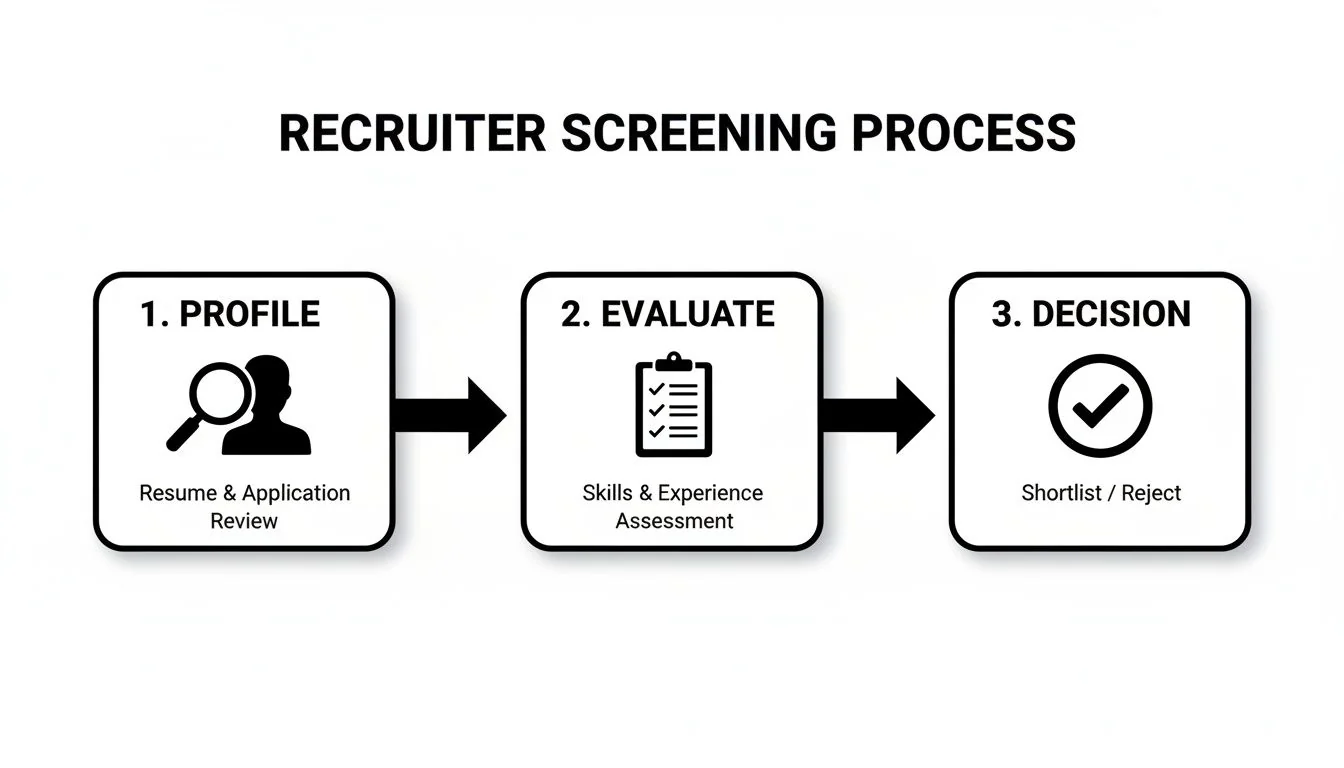
Your online life is an open-book interview that often happens before you meet a hiring manager. Employer social media screening researches a candidate’s public profiles to assess character, professionalism, and cultural fit — a behind-the-scenes test of your digital reputation that can open or close doors.
With growing privacy concerns and OSINT (Open-Source Intelligence) tools, this once-casual practice has become a formal, often automated part of hiring. For job seekers, understanding it matters for protecting your identity and job prospects.
Why Social Media Screening Is The New Normal In Hiring
Your public posts are an extension of your resume. Companies screen to verify qualifications, gauge personality, and spot red flags that might signal a risky hire.
The numbers are clear: 91% of all employers now use social media in hiring, which makes online reputation management essential. See whether employers check social media for every role.
The Real-World Impact On Job Prospects
The consequences of a negative online presence can be quick. One study found 21% of recruiters have rejected candidates after reviewing their Facebook profiles, and 5% have canceled interviews based on a poor social media impression.
Real-world example: A graphic designer lost an offer at a top agency after the hiring manager found aggressive posts on a public forum where the designer argued about gaming account security. Unrelated to design, the posts raised concerns about professionalism.
These figures show how much a clean, professional image matters. See more social media recruitment statistics. This isn’t about a fake persona; it’s professional self-awareness and privacy. Recruiters look for both reasons to say no and positive signs you’re a good fit.
Your digital footprint is the first handshake with a potential employer. A firm, confident one gives you an edge in a competitive market.
What Recruiters Are Really Looking For
To pass this new hiring standard, understand what raises alarms and what builds confidence. Recruiters look for online behaviors they believe translate to workplace conduct. The table below covers the content that helps or hurts your chances.
Recruiter Red Flags Vs Green Flags On Social Media
This table covers the “Red Flags” that can get you rejected and the “Green Flags” that help you land the job.
| Category | Red Flags (Negative Indicators) | Green Flags (Positive Indicators) |
|---|---|---|
| Professionalism | Bad-mouthing previous employers or colleagues; frequent complaints about work. | Positive engagement with industry content; a polished LinkedIn profile. |
| Behavior | Discriminatory comments related to race, gender, or religion; references to illegal drug use; signs of promoting online scams. | Volunteer work or community involvement; posts showcasing creativity and passion projects. |
| Credibility | Inconsistencies between a resume and online profiles (e.g., conflicting job titles or dates). | Endorsements from former colleagues; evidence of skills and accomplishments. |
Looking at this, it’s clear what kind of candidate persona comes across as a safe bet versus a potential liability. Ultimately, employer social media screening has reshaped the hiring process. For companies, it’s a risk management tool. For you, the job seeker, it’s a critical test of your digital reputation. The first step to passing that test is understanding exactly what employers can see.
Before you apply for your next job, discover what a background check might reveal about your online life. Get a confidential, no-cost scan of your digital footprint at www.digitalfootprintcheck.com/free-checker.
Navigating the Legal and Ethical Minefield
That casual scroll through a candidate’s social media profile might feel harmless, but it’s the digital equivalent of asking illegal questions in an interview, creating a serious risk for the employer. Browsing a candidate’s profile cracks open a legal and ethical can of worms that can easily lead to a devastating discrimination claim.
Here’s why: a single glance at a social media page can instantly reveal protected characteristics. This is information an employer is legally barred from even knowing, let alone considering. This includes a candidate’s age, religion, ethnicity, parental status, disability, or sexual orientation.
Once a hiring manager sees this information, it’s impossible to “un-see” it. If that candidate is later rejected—for any reason at all—they can argue the decision was based on unconscious bias or outright discrimination. The burden of proof then falls squarely on the employer to prove it wasn’t.
Key Laws You Cannot Ignore
Several major regulations create a compliance minefield for any company doing employer social media screening. Pleading ignorance won’t work in court, and a single mistake can trigger costly lawsuits and permanently damage your brand’s reputation.
Here are the big ones to have on your radar:
- Fair Credit Reporting Act (FCRA): If you pay a third-party service to run social media checks, that company is a Consumer Reporting Agency (CRA). Under the FCRA, you must get the candidate’s explicit written consent. They also have a right to see the report and dispute any inaccuracies, a key component of online identity protection.
- Equal Employment Opportunity Commission (EEOC): The EEOC enforces federal laws that make it illegal to discriminate based on race, color, religion, sex, national origin, age, or disability. Social media screening that digs up this kind of information is a direct path to an EEOC violation.
- General Data Protection Regulation (GDPR): Hiring in the European Union? GDPR puts strict limits on how you can process anyone’s personal data. You need a legitimate, lawful reason to review a candidate’s online life, and the information you collect must be relevant and necessary for the specific job.
To wrap your head around the risks, it’s crucial to understand the different kinds of workplace discrimination examples that can pop up. This knowledge is the first step toward building a fairer, more defensible hiring process.
The Real-World Consequences of Non-Compliance
This isn’t just a theoretical problem. The rise of social media screening has had a real impact, with 1 in 20 job seekers reporting they lost out on a job because of what was on their online profiles.
The legal ground is also constantly shifting under employers’ feet. New regulations are demanding ‘explainability’ in AI-powered OSINT tools, while laws like the FCRA, EEOC, and GDPR are being enforced more strictly. For example, the Consumer Financial Protection Bureau recently expanded the FCRA to cover many third-party data tools, and a major California class-action lawsuit is targeting AI platforms for alleged bias. You can read more about these evolving workplace trends to stay ahead of the curve.
Unstructured screening is a gamble where the house always loses. A consistent, documented, and compliant process is the only way to turn a potential liability into a reliable hiring tool.
On top of federal rules, state-specific laws are adding even more layers of complexity. Some states, for instance, have passed laws holding companies directly responsible for discriminatory outcomes caused by biased AI screening tools. The message from regulators is crystal clear: if you’re going to screen, you must do it right. This means a structured, compliant system isn’t just a “nice-to-have”—it’s non-negotiable. You can explore our guide on building a compliant pre-employment screening process to see how to protect your organization.
Building a Compliant and Fair Screening Workflow
Shifting from risky, ad-hoc social media browsing to a formal, structured process isn’t just a good idea—it’s essential for any company that screens candidates online. A well-defined workflow is your single best defense against discrimination claims and legal headaches. This is the playbook for doing it right.
A haphazard approach, where one manager’s “red flag” is another’s non-issue, is a lawsuit waiting to happen. The goal is to build a transparent, repeatable system that protects your company and gives every candidate a fair shake.
The Foundation of a Strong Policy
Your screening policy is the bedrock of this entire process. It has to be written down, applied to everyone without exception, and communicated clearly. Think of it as the constitution for this part of your hiring process.
A solid policy needs to spell out, in no uncertain terms:
- What you will review: Get specific. Name the public platforms you’ll look at, like LinkedIn, X (formerly Twitter), or public-facing Facebook profiles.
- What you are looking for: Clearly define the job-related red flags. This isn’t about personal opinions; it’s about identifying things like threats of violence, intolerant behavior, illegal activity, or leaking a previous employer’s confidential information.
- When you will conduct the search: Pinpoint the exact moment this happens in the hiring funnel.
- Who will conduct the search: Designate a specific, trained person (or a third-party service) to do the review. This should not be the hiring manager.
Timing Is Everything: Why You Must Screen Late in the Process
One of the most critical parts of your policy is deciding when to run the social media check. The undisputed best practice is to screen candidates late in the process—ideally, after the interviews are done but before you extend a formal offer.
Screening any earlier is a massive liability. A hiring manager who sees a candidate’s family photos, learns their religion, or discovers a disability before even meeting them can’t un-see that information. This knowledge, even if subconscious, can easily taint their perception and open the door to a discrimination claim, undermining your efforts at reputation management.
By waiting until after the interviews, you ensure the candidate is first judged on their skills and experience. The social media check then becomes a final verification step, not a tool for biased, premature filtering.
Standardizing the Evaluation Criteria
To make this fair, every candidate has to be measured against the exact same yardstick. Your policy must include a standardized rubric or checklist for evaluating what you find. This is how you remove subjective “gut feelings” and focus only on legitimate business risks related to cybersecurity and personal safety.
This process flow shows just how quickly unstructured screening can blow up into a serious legal claim.
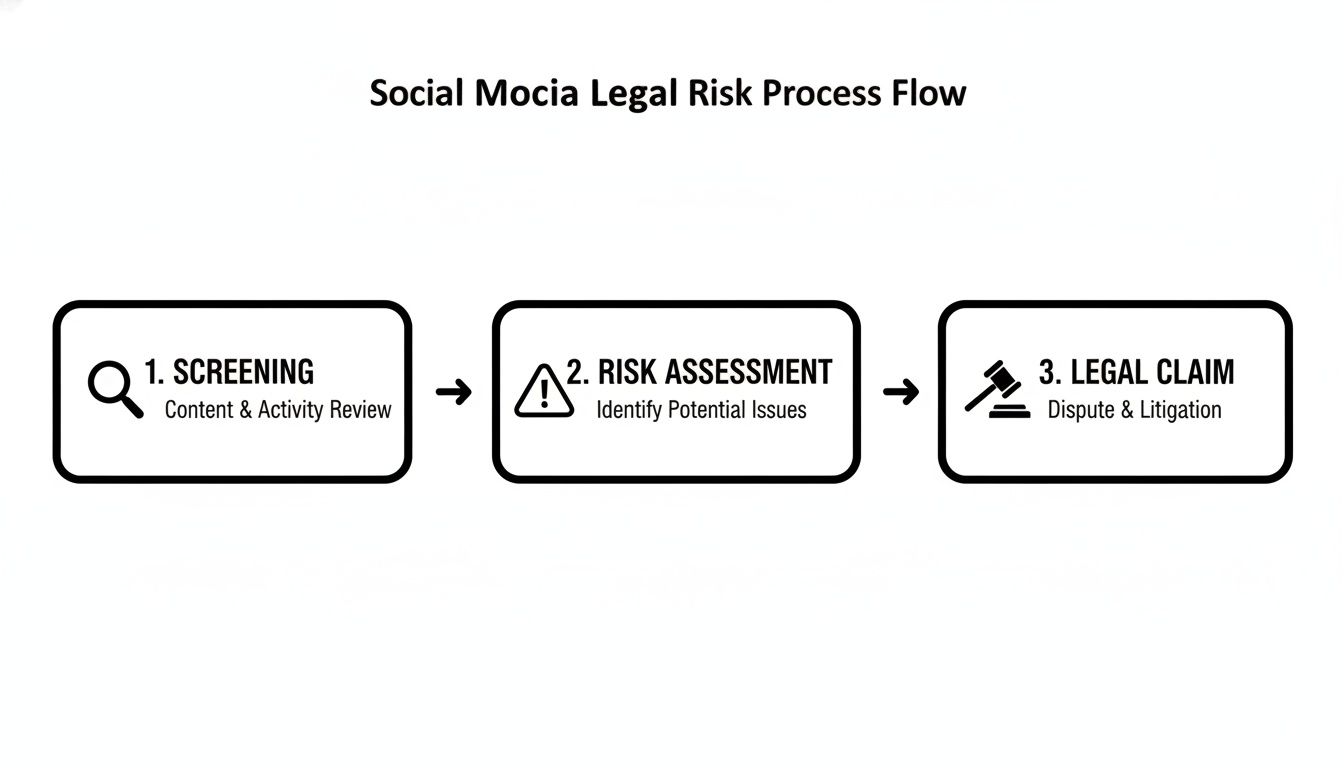
As the visual shows, without a compliant process, a simple screen can lead directly to significant legal trouble. Standardizing your criteria is one of the most important steps you can take to break that chain.
Your rubric should focus exclusively on pre-defined red flags directly related to job performance and workplace safety. For example, your checklist might include looking for:
- Violent content or direct threats
- Discriminatory or hateful language
- Content depicting potentially illegal acts
- Clear breaches of confidentiality from past jobs
A consistent, documented process isn’t just about legal cover; it’s about making better, more objective hiring decisions. It forces you to evaluate a candidate on relevant risk factors, not on your own personal biases.
Ultimately, building a compliant workflow requires a complete shift in mindset. You’re not digging for dirt. You’re simply verifying that a candidate you’re already excited about aligns with your company’s professional standards and doesn’t pose an obvious risk. For teams looking to learn more about locating public profiles, our guide on how to find a person on social media ethically is a great place to start.
The Future of Screening With AI and Automation
Welcome to the next frontier in hiring. The old-school image of an HR manager manually scrolling through a candidate’s Facebook profile is fading fast. That process is being replaced by artificial intelligence and automation—OSINT tools that are reshaping employer social media screening and bringing powerful new capabilities and serious challenges.
This isn’t just about scanning for a few keywords. Today’s AI-powered tools are built to dig much deeper, analyzing huge volumes of public data to spot behavioral patterns. They’re looking for indicators that might correlate with workplace safety, integrity, or even a tendency toward harassment, helping to prevent future cybersecurity incidents.
Instead of a human spending hours combing through a single profile, an automated system can process thousands of data points in minutes. It can surface patterns of concerning behavior that a person might otherwise miss, delivering a far more comprehensive and standardized risk assessment.
The Power of Algorithmic Analysis
The biggest draw for using AI in screening is its incredible speed and scale. For a large company hiring hundreds of people a year, manual screening isn’t practical. Automation allows them to apply a consistent standard to every applicant, which, in theory, should help reduce human bias.
But there’s a massive catch: the algorithms themselves can be dangerously biased.
If an AI is trained on data that reflects existing societal prejudices, the tool can end up unfairly flagging candidates from specific backgrounds. This doesn’t eliminate discrimination; it just automates it, posing a new challenge for online identity protection.
This is the paradox of AI in hiring: it gives companies an unprecedented ability to analyze behavior at scale, but it also creates a huge risk of automated bias. The legal and ethical duty to ensure fairness doesn’t just vanish—it gets a lot more complicated.
This shift has also cranked up the compliance pressure. Looking toward 2026 and beyond, regulators are taking a much closer look at how this tech is used. In California, for example, new regulations hold employers liable for any discrimination caused by their AI tools. As you can learn more about the critical points for checking applicant social media, the legal stakes have never been higher.
The Critical Need for Explainability
One of the biggest legal minefields for AI-driven screening is “explainability.” If a candidate gets flagged by an AI tool, the employer has to be able to explain exactly why. A vague reason like “the algorithm detected a risk” simply won’t hold up in court.
This means employers must demand transparency from their screening vendors. You need to understand the logic behind the flags and be able to trace any negative report back to specific, publicly available content that violates a clear, documented hiring policy. Anything less is flying blind into a legal storm. This need for transparency is just a glimpse of what’s on the horizon. To see how these trends are reshaping our online identities, explore our guide on the digital footprint of the future.
Contextualizing Behavior Across Generations
Today’s workforce is more generationally diverse than ever, with up to six different generations working side-by-side. Each has its own unique digital dialect and online norms. This is where “contextualizing digital behavior” becomes essential.
An AI that can’t tell the difference between a Gen Z candidate’s ironic, meme-heavy online persona and a Baby Boomer’s formal LinkedIn profile is broken. Future-proof screening must go beyond simple keyword flags and learn to interpret context. This means understanding:
- Platform Norms: Behavior that’s normal on TikTok would be bizarre on LinkedIn.
- Generational Language: Slang, memes, and irony are easily lost in translation.
- Public vs. Private: Differentiating between a post meant for close friends and one broadcast to the world.
The future of employer social media screening hinges on finding a careful balance. While technology makes the process faster, ethical oversight and human judgment are more critical than ever. The goal is to use these tools to identify genuine, public-facing risks—not to penalize people for their online culture.
A Job Seeker’s Guide to Cleaning Your Digital Footprint
Let’s be blunt: if you’re job hunting, your social media is under a microscope. With 70% of employers now using social networks to screen candidates, you can’t afford to just hope for the best. It’s time to take control of your online story.
This isn’t about scrubbing your personality from the internet. It’s about smart reputation management and digital privacy. Think of it as ensuring the public version of you is working for you, not against you. Let’s walk through the practical steps.
Step 1: Discover What Recruiters Can See
You can’t fix what you can’t find. The first step in any cleanup is figuring out what’s out there. This goes beyond your main Facebook or Instagram profile—we’re talking about old forum posts, dormant accounts, and what data brokers have on you. An OSINT-based tool can map this out for you.
The only way to start is with a comprehensive scan. This gives you a baseline, a complete map of what a curious recruiter or a sophisticated employer social media screening tool would dig up.
Taking control of your online presence begins with a single action: seeing yourself as the internet sees you. A thorough scan is the only way to get a complete, unbiased picture of the digital breadcrumbs you’ve left behind.
An OSINT-based tool built for this exact purpose is your best first move. You can get an instant, no-cost look at your public data with our free Digital Footprint Check. It searches across hundreds of sources to give you the map you need to begin your cleanup mission.
Step 2: Audit Your Social Media Profiles
With your report in hand, it’s time to get your hands dirty. Go to your most visible profiles—LinkedIn, Facebook, X (formerly Twitter), and Instagram—and start scrolling. The trick is to put on your “recruiter hat” and look at your own timeline with a critical eye.
Look for anything that could be misunderstood or raise a red flag. Pay special attention to:
- Photos and Videos: Are there pictures of you doing things you wouldn’t want a future boss to see? Ditch the photos from that wild party or anything that looks unprofessional.
- Past Posts and Comments: Use the search bar. Dig up and delete old rants about previous jobs, aggressive arguments, or any discriminatory comments.
- Likes and Shares: What you engage with says a lot about you. Go through your activity log and unlike or un-share content that doesn’t fit the professional image you’re building.
- Group Memberships: Take a look at the groups you’ve joined on Facebook or other platforms. Do they align with your professional goals?
Remember, the aim is to present a version of yourself that fits the standards of the industry you’re trying to break into. For a deeper dive, check out our complete guide on how to clean up social media for a job search.
Step 3: Lock Down Your Privacy Settings
Once the problematic content is gone, your next move is to control who sees your stuff from now on. Every social media site has powerful privacy settings. Use them. This is a fundamental step in online identity protection.
Take a few minutes to walk through the privacy and security sections of each account:
- Set Your Profile to Private: For personal accounts like Instagram and Facebook, this is your strongest line of defense. It means only people you’ve approved can see what you post.
- Limit Past Post Visibility: Facebook has a tool called “Limit Past Posts.” In one click, it changes all your old public posts to “Friends” only.
- Control Who Can Tag You: Change your settings so you have to approve any tag before it appears on your timeline. No more surprise party photos from a well-meaning friend.
- Manage Public Information: Review what’s visible to everyone, like your bio. Remove sensitive details you wouldn’t put on a resume.
This isn’t about hiding; it’s about drawing a healthy line between your personal and professional lives. The one big exception is LinkedIn—you want to keep that profile public to make sure recruiters and networking contacts can find you.
Answering Your Top Screening Questions
Even after you get the basics, social media screening can feel like a gray area. Job seekers and HR pros alike are often stuck on the specific do’s and don’ts. Let’s clear up the confusion by tackling the most common questions head-on so you know exactly how to move forward.
Can An Employer Ask For My Social Media Passwords?
Absolutely not. In fact, in many places, it’s illegal for an employer to even ask for your login details for personal social media. This practice is a major red flag for job seekers concerned about their digital privacy.
Think of it like an employer asking for the keys to your house—it’s a massive invasion of privacy and puts them at huge legal risk. Screening should only ever touch information that is already public. You have no obligation to hand over your passwords, and any company that asks is waving a giant red flag about its culture and respect for employee privacy.
What If I Am Rejected Because Of False Information Online?
This is an frustrating spot to be in, and it highlights the dangers of online identity theft and misinformation. If the employer used a third-party screening service that complies with the Fair Credit Reporting Act (FCRA), you have rights. You can ask for a copy of the report they saw and formally dispute any errors it contains.
But if the employer did the search themselves, proving that false information was the reason you were rejected is next to impossible. This is where your best defense becomes a good offense.
The most powerful move a job seeker can make is to own their online narrative before an employer sees it. Discovering and correcting false information is a critical part of preparing for a modern job search.
Proactively scan your own digital footprint for anything that’s false or misleading. Fixing it before it becomes an issue is far easier than trying to undo the damage after you’ve already been passed over for a great role.
Is It Legal To Screen Current Employees Too?
Yes, employers can generally monitor the public social media activity of their current team. However, all the same rules and risks that apply to candidates still apply here. The key is to have a crystal-clear and consistently enforced social media policy that every employee has read and agreed to. This is a crucial aspect of internal cybersecurity and reputation management.
This isn’t a free pass for companies to spy on their staff’s personal lives. Action should only be taken for clear policy violations, such as:
- Workplace harassment that spills over into online spaces
- Posting hateful or discriminatory content
- Sharing confidential company information
- Publicly posting about illegal activities
Targeting one specific employee for monitoring without a legitimate business reason (like a formal internal investigation) is just asking for a discrimination lawsuit. Any policy has to be applied fairly to everyone, every time.
How Can I Build a Positive Online Presence For My Job Search?
Building a positive online presence is the best way to turn an employer social media screening from something you fear into something that works for you. The goal is simple: create a professional trail that proves you are the expert your resume says you are.
Start with LinkedIn. A professional headshot, a keyword-rich summary, and a detailed work history are the foundation. From there, it’s time to shift from being a passive lurker to an active voice in your field.
- Share relevant content: Find articles, studies, or news related to your industry and post them with a quick comment on why you think it’s important.
- Engage thoughtfully: Don’t just hit “like.” Leave insightful comments on posts from industry leaders to show you know your stuff and get on their radar.
- Showcase your skills: Write your own short posts or articles on LinkedIn. Talk about a project you’re proud of or a trend you’re noticing in your field.
As you get your digital footprint ready for employers, exploring where to find remote jobs is a great next step. A strong, professional online presence will make you a much more attractive candidate for those roles.
Your digital footprint is your modern resume. Before your next job application, see what employers will find. Digital Footprint Check offers a no-cost scan to instantly reveal your public information across hundreds of sources. Take control of your online reputation today at www.digitalfootprintcheck.com/free-checker.