· Digital Footprint Check · Content Marketing · 15 min read
Background Check Services for Businesses: a 2026 Guide
A complete guide to background check services for businesses. Learn about types of checks, FCRA compliance, digital footprint analysis, and vendor selection.

Nearly every employer now screens candidates. Surveys cited by MyShortlister's background check statistics roundup say 95% of employers conduct some form of background screening. That single fact changes how business owners should think about hiring. Background checks aren't an extra precaution anymore. They're part of standard operating procedure.
That matters because many leaders still treat screening as a one-time report they buy near the end of hiring. In practice, good screening is a risk-management system. It helps you verify identity, confirm claims, reduce legal exposure, and spot gaps before a bad hire becomes a safety problem, a fraud issue, or a reputational mess.
It also helps to update the mental model. A modern hiring review doesn't stop with criminal and employment checks. Public online behavior, impersonation risks, exposed credentials, and broader digital footprint issues can change how much risk a candidate brings into a role. Traditional reports still matter. They just don't tell the whole story.
Why Background Checks Are Required for Modern Businesses
Hiring risk starts before day one. The moment you give a new employee access to payroll, customer records, inventory, buildings, or internal systems, you are handing over trust in a form that can affect safety, compliance, and reputation.
For business owners, that is the reason screening matters. It is a control measure, much like locking your office, separating financial duties, or limiting who can approve refunds. You are checking whether the facts behind the application support the level of access the role requires.
That matters even more for small and mid-sized companies. Larger employers often have in-house counsel, formal HR teams, and documented review steps. Smaller organizations usually have less room for error. One skipped verification, one inconsistent decision, or one poorly documented screening step can create legal exposure and operational problems at the same time.
A useful rule is simple. If a role gives someone access to money, customers, confidential information, vehicles, physical locations, or your brand in public, screening should be part of the hiring process.
Screening protects the business in several ways
Business owners sometimes treat a background check as a search for a single red flag. A better way to view it is as a set of filters that reduce avoidable risk before a hiring decision becomes expensive to reverse.
That process usually helps you answer four practical questions:
- Is this person who they say they are? Identity resolution helps connect the applicant to the right records and reduces mistakes tied to aliases or incomplete information.
- Did they accurately represent their experience and credentials? Employment, education, and license checks help confirm whether key claims are true.
- Does the level of screening match the role? A delivery driver, controller, caregiver, and retail cashier create different kinds of exposure.
- Can you show that your process is consistent? A documented, repeatable approach matters if a decision is later challenged.
Consistency deserves more attention than many employers give it. Screening is not only about what you find. It is also about whether you apply the same job-related process across candidates, document your decisions, and follow the rules that govern consent, disclosure, and adverse action.
Traditional checks do not cover the full risk picture
Standard reports are still important, but they mainly verify recorded history. They often do not show what a candidate is publicly signaling right now through online activity, impersonation risks, exposed accounts, or other open-source indicators that can affect your business after hire.
A practical comparison helps here. Traditional screening works like checking a property title before you buy a building. You confirm the official record. Digital footprint review adds the street-level inspection. It helps you see visible issues that do not always appear in the paperwork but can still create risk once you take possession.
That is why more employers are adding public online review and OSINT-informed digital footprint analysis to their hiring process, especially for leadership, finance, customer-facing, and high-trust roles. This article on how digital footprint signals affect job opportunities and what employers actually review gives useful context for that layer.
A business can verify past records and still miss present-day reputation risk. Modern screening works best when traditional checks and digital footprint analysis support each other.
Decoding the Different Types of Background Checks
Many employers say they "run a background check" as if it's one thing. It isn't. Employer-grade screening works best as a layered process. SHRM vendor guidance describes best practice as a pipeline that combines identity resolution, address-history tracing, criminal searches at different levels, and verification steps because no single data source provides complete coverage across jurisdictions.
That point causes a lot of confusion. A national search sounds broad, so employers assume it's complete. Broad isn't the same as complete.
Why the process has layers
Think of screening like using several maps for the same trip. One shows highways. Another shows local roads. A third confirms whether the address exists at all. If you use only one map, you'll miss something.
The same logic applies to hiring checks:
- Identity and address history help connect a candidate to names, aliases, and places that should be searched.
- County, state, and federal criminal searches each cover different records and jurisdictions.
- Employment and education verification test whether the person told the truth about key credentials.
- Role-based add-ons fill gaps for jobs involving driving, finance, regulated work, or international exposure.
For a deeper employer-focused overview, this piece on a criminal record check for employers is a helpful companion.
Comparison of Common Background Check Components
| Check Type | What It Reveals | Best For | Key Limitation |
|---|---|---|---|
| Identity resolution and address history | Prior names, aliases, and locations tied to the applicant | Establishing search scope and reducing mismatch risk | Doesn't prove criminal history or job qualifications by itself |
| County criminal search | Court records at the county level | Roles where local court accuracy matters | Only covers searched counties |
| State criminal search | State-level records where available | Broader in-state review | Coverage varies by jurisdiction |
| Federal criminal search | Federal cases such as certain fraud or interstate matters | Finance, compliance-sensitive, or higher-risk roles | Doesn't replace local court searches |
| Sex offender registry check | Registry matches tied to the applicant | Safety-sensitive roles | Limited to that registry category |
| Employment verification | Job titles, dates, and sometimes eligibility details | Resume validation | Past employers may provide limited information |
| Education verification | Degree, school, attendance, or credential confirmation | Degree-dependent roles | Doesn't measure actual skill |
| Credit report check | Financial history relevant to authorized roles | Finance or fiduciary positions where legally permitted | Not appropriate for every role and often regulated |
| Motor vehicle records | License status and driving-related history | Driver, delivery, field service roles | Doesn't reflect broader conduct outside driving |
| Drug screening | Presence of tested substances under program rules | Safety-sensitive positions | Doesn't replace broader behavioral review |
What employers usually misunderstand
The biggest misunderstanding is assuming a "database search" closes the file. It doesn't. A broad database can point you toward records, but it isn't the same as full verification.
Another common mistake is using the same package for every hire. That wastes money on low-risk positions and under-screens higher-risk ones. A warehouse picker, controller, executive assistant, and home-health worker shouldn't all be screened the same way.
A background check package should match the job. Good screening is role-based, not one-size-fits-all.
A practical example helps. If you're hiring a bookkeeper, you may care more about identity resolution, employment verification, and a legally permitted financial-risk layer. If you're hiring a driver, motor vehicle records become more important. If you're hiring a senior manager, the case for a broader review grows because the role has more access, more discretion, and more reputational impact.
Staying Compliant with FCRA and Local Screening Laws
Most hiring problems with background checks don't come from ordering the report. They come from what the employer does before and after.
The legal core is straightforward. If you're using a third-party screening provider for employment purposes, you need a compliant process around disclosure, authorization, and adverse action. You also need to check state and local rules, because local restrictions can change timing, scope, and how criminal history can be used.
The compliance sequence employers need to follow
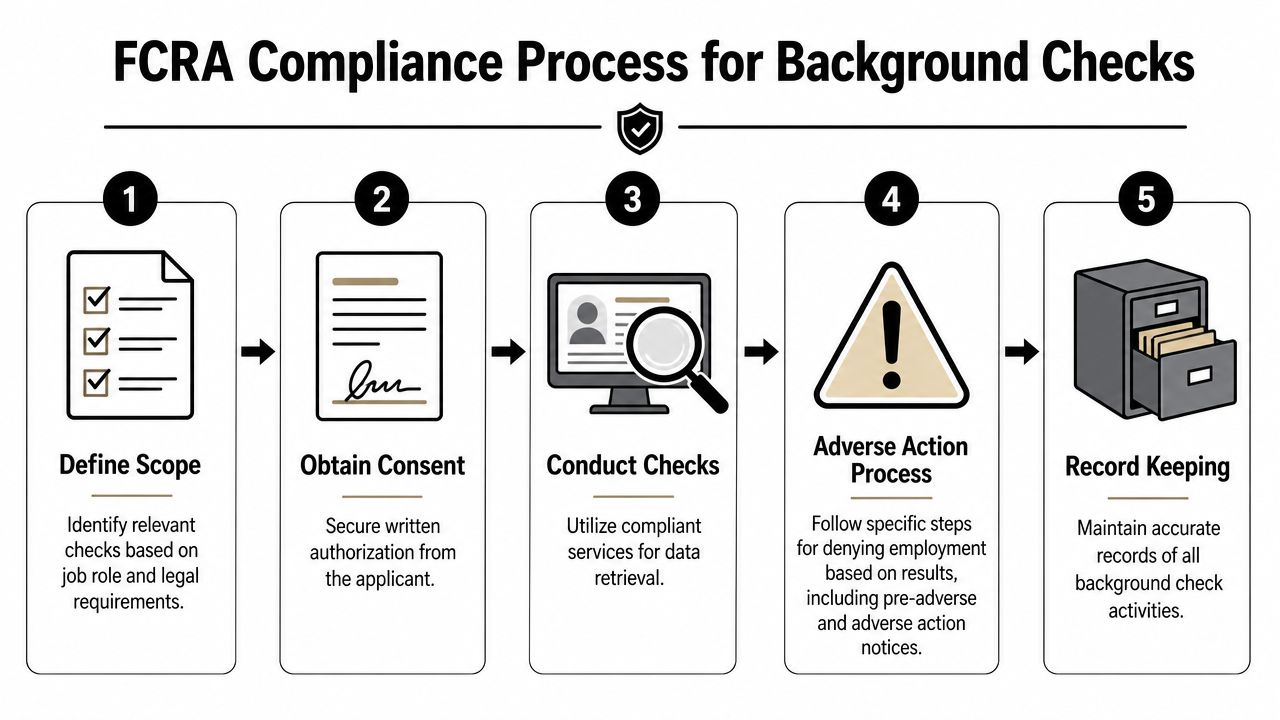
A clean process usually looks like this:
-
Define job-related scope
Decide which checks fit the role. Don't order everything by default. Match the package to the position and your legal obligations. -
Get clear written authorization
The candidate should know a background report will be obtained and should sign the required authorization. -
Use a compliant screening partner
Your vendor should support employer workflows, documentation, and candidate dispute procedures. -
Pause before adverse action
If a report raises concerns and you may deny employment, don't jump straight to rejection. -
Complete final adverse action properly
Follow the required notice process if you make a final negative decision based on the report.
What adverse action looks like in practice
A lot of employers get tripped up here. They see a record that worries them and send a rejection email. That's where legal risk starts.
A safer path is this: review whether the information is job-related, make sure the report belongs to the right person, and then follow the pre-adverse action process before making a final decision. That gives the candidate a chance to review and dispute inaccuracies.
Compliance note: A report is not a verdict. Treat it as information that requires context, accuracy checks, and a fair process.
Local law adds another layer. Some jurisdictions restrict when criminal history can be considered. Others impose extra notice requirements or limit the use of certain records. That means your hiring workflow in one city may need to differ from your workflow in another.
Build compliance into the workflow, not after it
The easiest way to stay consistent is to put compliance into the operating system of hiring. Recruiters, hiring managers, and HR coordinators should all know who sends notices, who reviews reports, and who has authority to make the final call.
This is also where broader HR governance helps. If you want a practical overview of how organizations structure policy and process around legal exposure, LeaveWizard's compliance management insights offer a useful framework for thinking beyond one isolated hiring task.
Public online review creates its own legal and fairness questions too. If your team looks at social platforms during hiring, they need guardrails. This overview of employer social media screening is worth reading before anyone on your team starts doing informal searches on their own.
What Traditional Background Checks Miss and Why It Matters
A standard screening package can verify a lot. It can confirm identity elements, search courts, and check employment or education claims. But it can still miss what many business owners care about most. How does this person present themselves publicly, and what online risks follow them into the workplace?
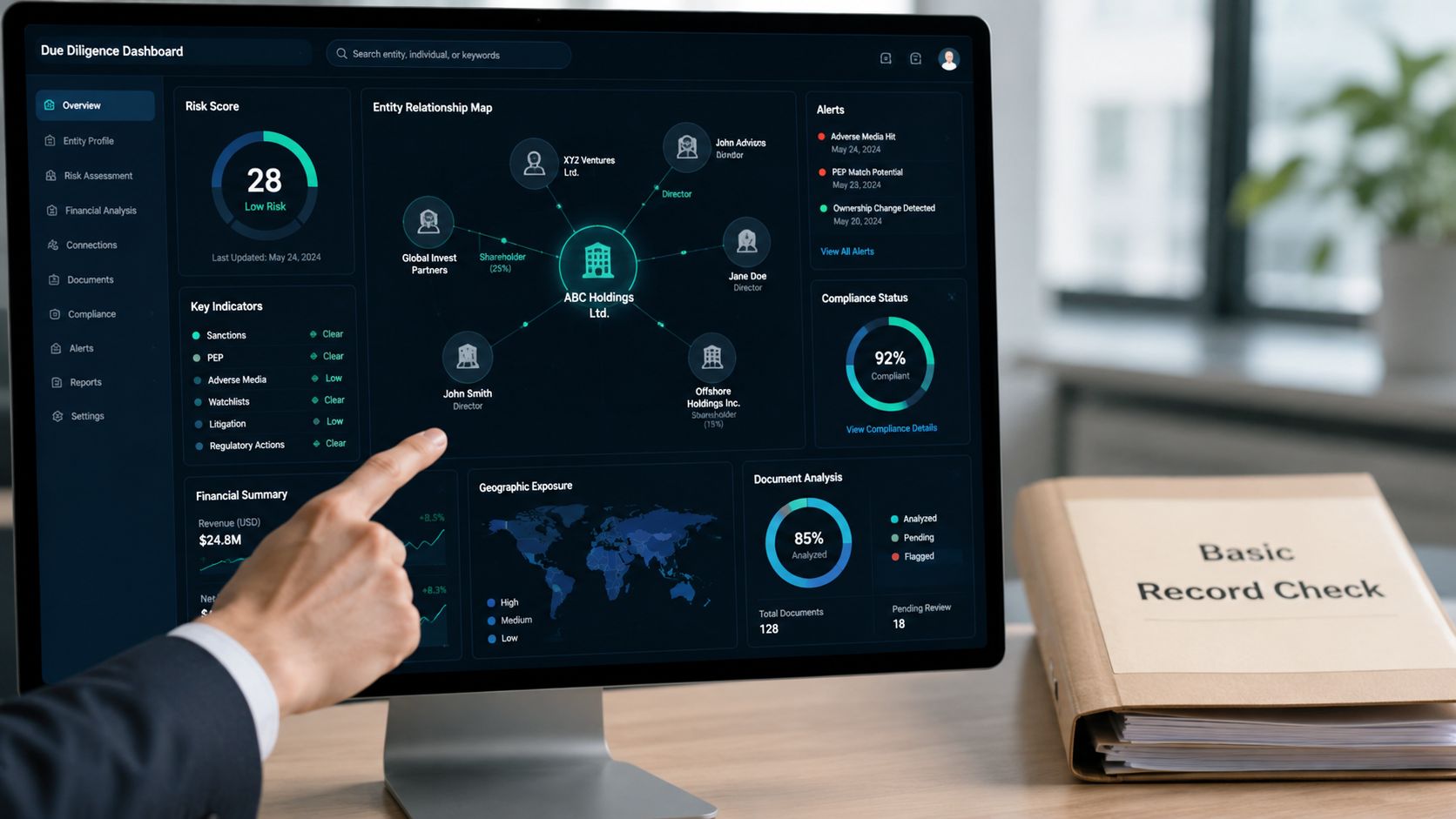
The U.S. Chamber notes an important gap in business screening guidance. Standard checks often miss digital-risk signals such as exposed credentials, online impersonation, and public social content that can point to behavioral or reputational concerns, leaving employers with an incomplete picture, as described in its background check service guide.
Public online risk isn't the same as private surveillance
Some employers hesitate at this point, and rightly so. They don't want to cross the line into invasive monitoring. The answer isn't to ignore online risk. The answer is to focus on public, job-relevant, ethically reviewed information.
That means looking for issues such as:
- Impersonation or identity confusion: A candidate may be using aliases publicly, or someone may be impersonating them online.
- Exposed credentials: Public evidence that an email, username, or related account has been compromised can create security concerns for sensitive roles.
- Reputational red flags: Public posts, comments, or affiliations may conflict with the trust required for the role.
- Conflicts of interest: A candidate's public business activity may raise questions that never appear on a traditional report.
What it should not mean is casual snooping by untrained managers.
Examples of what a standard report may miss
A criminal search won't show that a candidate publicly attacks customers under a pseudonym linked back to their real identity. An employment verification won't reveal that their credentials have been exposed in public breach data. A county search won't show a pattern of online impersonation tied to the same email handle across platforms.
Those issues may not automatically disqualify anyone. But they can change how you assess risk, especially for roles involving trust, access, public communication, or account security.
Public digital behavior can affect a business even when a traditional report comes back clean.
This video gives useful context on modern online due diligence and why employers need to think beyond the old checklist:
A fair way to add this layer
The key is consistency. If your company includes digital footprint review, define what you look for, who reviews it, and how findings are documented. Keep the focus on public information and job relevance. Don't let managers freestyle their own internet investigations.
A useful discipline is to first see what your own online exposure looks like before applying similar thinking to hiring. This guide on running a background check on yourself shows why many people have a much larger public footprint than they realize.
A Practical Checklist for Choosing a Vendor and Getting Started
The market for background check services for businesses is large and mature. IBISWorld projects 1,018 U.S. background check services businesses in 2025, and that scale means the challenge usually isn't finding a vendor. It's choosing one whose workflow, compliance support, and integrations fit your hiring process, according to IBISWorld's industry business count data.
That changes how you should evaluate providers. Don't ask only, "Can they run checks?" Ask, "Can they run the right checks, in the right order, with the right documentation, for the way we hire?"
Vendor selection checklist
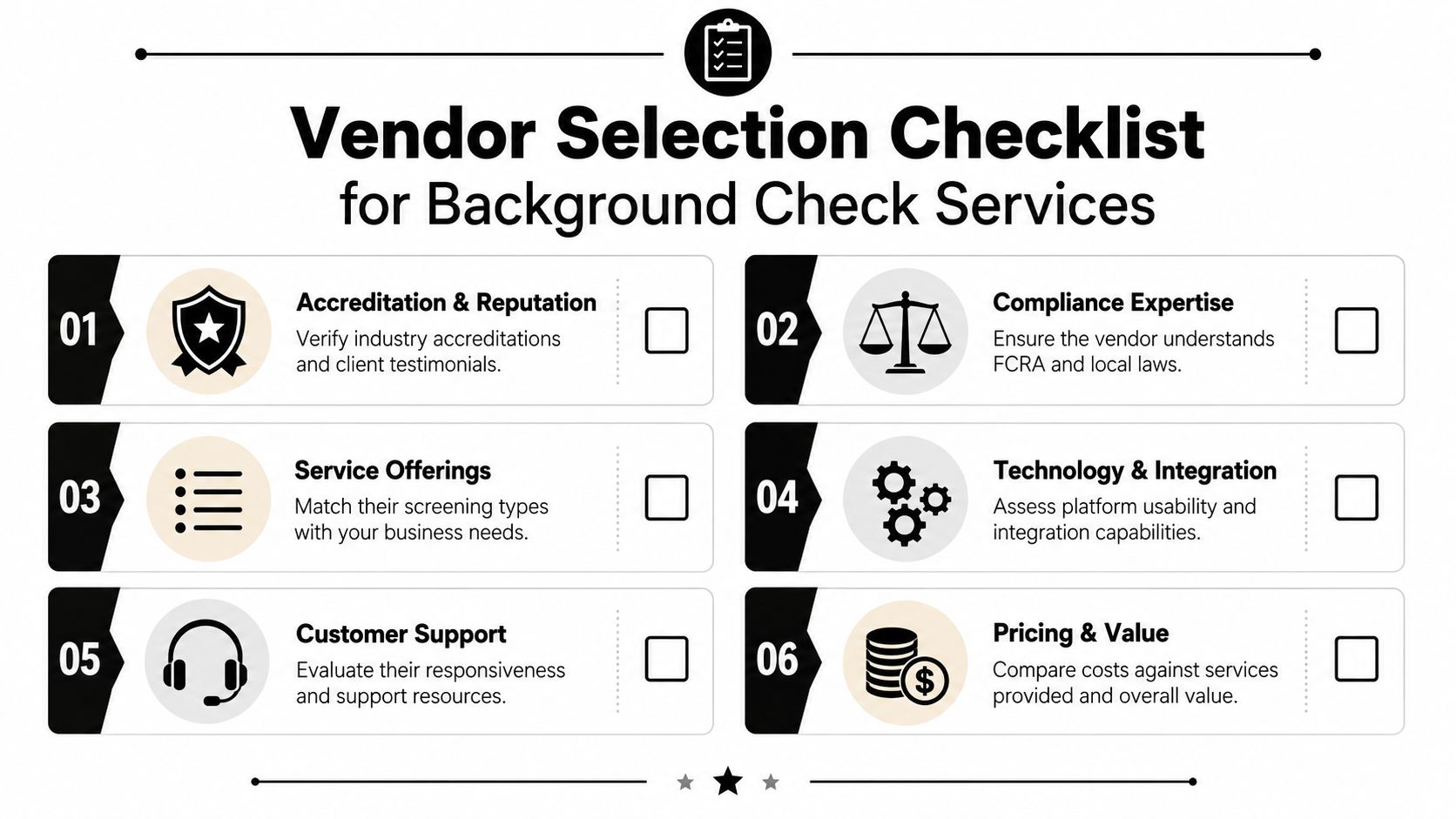
Use this shortlist when comparing providers:
-
Compliance capability
Ask how the vendor supports disclosure, authorization, dispute handling, and adverse action workflows. If the answer is vague, keep looking. -
Screening depth Make sure they can support the layers you need. That may include identity resolution, criminal searches, verifications, driving records, or international searches depending on the role.
-
Technology fit
If your team uses an applicant tracking system, ask whether the provider integrates cleanly or creates extra manual work. -
Candidate experience
A confusing portal creates delays and candidate frustration. Ask what the applicant sees, signs, and receives. -
Role-based package design
Better vendors help you build screening packages by job type instead of selling the same bundle for every position. -
Support quality
Ask who handles escalations. You want real help when a report is delayed, disputed, or legally sensitive.
Questions worth asking on the sales call
Many businesses buy too quickly because the market looks similar from the outside. It isn't. Ask pointed questions:
| Question | Why It Matters |
|---|---|
| How do you support FCRA workflows? | Compliance failures often happen after the report is delivered |
| What checks are included by default, and which are optional? | You need to know whether the package matches your roles |
| How do you handle identity mismatches or disputed records? | Errors become hiring risk if no one owns resolution |
| What systems do you integrate with? | Manual re-entry creates delays and process gaps |
| How do you support candidate communications? | Candidate experience affects completion and fairness |
| Can you help us create role-based packages? | Different jobs need different screening depth |
If you want a broader roundup of employer-focused providers, this guide to the best background check sites for employers is a useful starting point for comparison.
A simple consent template to adapt
Employers often overcomplicate the first step. The language should be clear and separate from unrelated forms.
We may obtain a consumer report and, where permitted by law, an investigative consumer report for employment purposes. By signing below, you authorize us to obtain such reports from a third-party screening provider in connection with your application and, if hired, during employment where legally permitted.
Have counsel review your final version for your jurisdiction and workflow.
How to launch without chaos
A smooth rollout usually starts with a pilot. Pick a few role types, define the package for each, train the people who will review reports, and document who handles adverse action steps. Keep the decision chain short.
Don't treat vendor selection as procurement alone. This is a hiring operations decision, a legal process decision, and a reputation decision wrapped into one.
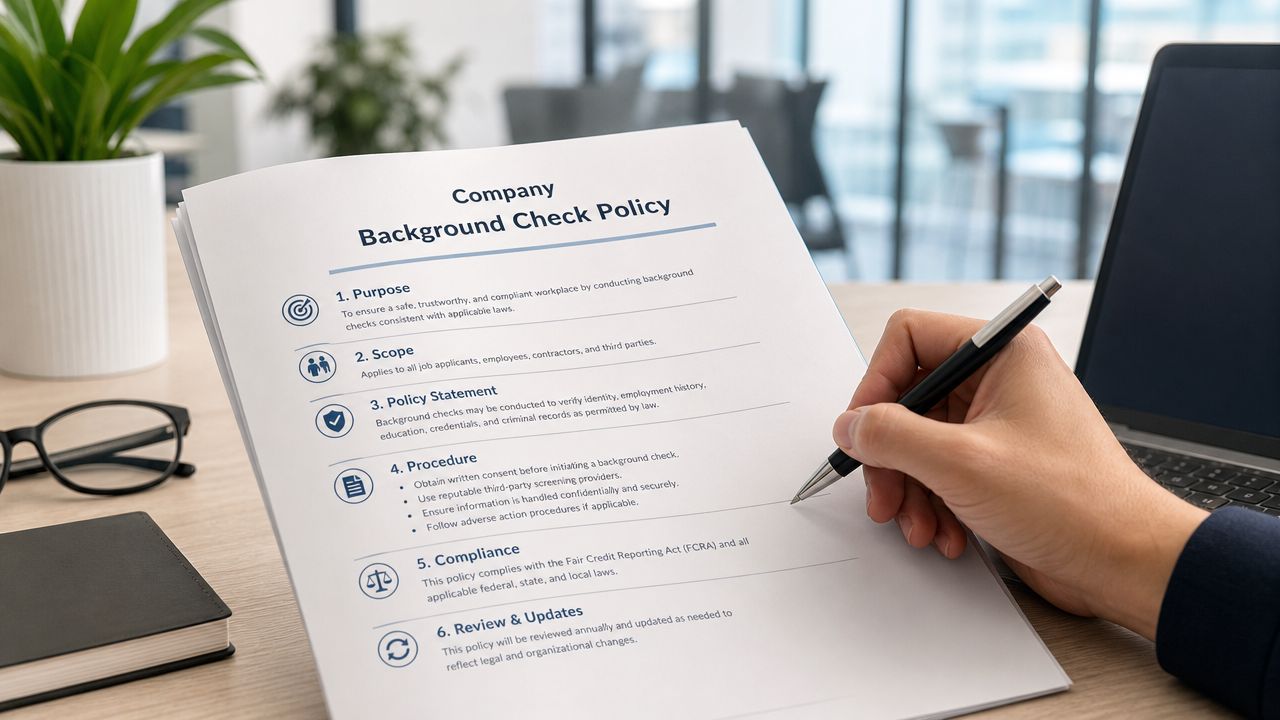
Building a Fair and Effective Background Check Policy
A strong screening program becomes durable when it turns into policy. Without a written policy, companies drift. One manager orders extra checks. Another skips them. A third Googles candidates on their own and never documents what they found.
A better approach is a tiered written standard.
What the policy should define
Start by grouping roles based on risk and access. Entry-level roles with limited access may need a basic package. Finance, leadership, driving, regulated, or public-facing roles may require additional layers. Public online review, if used, should also be defined in writing and limited to job-relevant, ethical review criteria.
Your policy should also answer these questions:
- Who gets screened: Employees, contractors, volunteers, or all three.
- Which checks apply to which roles: Not every role needs the same package.
- When screening happens: Pre-offer, post-offer, or at another lawful stage depending on local law.
- Who reviews results: Limit access to trained decision-makers.
- How decisions are made: Use consistent, job-related criteria.
- How disputes are handled: Build in a documented process.
Fairness matters as much as thoroughness
Consistency is what makes a policy defensible. Two similar candidates should be reviewed under the same standard for the same role. Findings should be tied to business necessity, not personal reaction.
Hiring standard: The best policy is both disciplined and narrow. It gathers what you need, protects privacy, and applies the same rules every time.
The most effective background check services for businesses support that kind of discipline. Traditional checks give you verified history. A carefully defined digital footprint layer helps you see public-facing risk that older screening models often miss. Put both inside a fair policy, and hiring becomes safer, more consistent, and easier to defend.
If you want to see what public online information may already be visible about a person or brand, try Digital Footprint Check and start with the free checker. It's a practical way to assess digital exposure, spot reputation risks, and understand the online layer that traditional screening often overlooks.