· Digital Footprint Check · Content Marketing · 19 min read
Data Breach Notification Requirements a Complete Guide 2026
Understand data breach notification requirements under GDPR and US state laws. Our guide covers deadlines, notice content, penalties, and how to comply.
You open your laptop on a normal workday and see three things at once. An alert from your IT provider. A strange spike in account activity. A message from a customer asking why they received a password reset email they didn't request.
That's the moment breach law stops being a legal topic and becomes an operations problem.
Most business managers don't get stuck because they don't care. They get stuck because the first questions arrive faster than the answers. Was this a security incident or an actual breach? Do we need to notify customers? Which regulator matters? How much time do we have? If your team has customers, staff, or users in more than one place, the answers may differ depending on whose data was exposed.
The hard part is that data breach notification requirements aren't just about sending a letter. They shape what your team must investigate, who needs to approve decisions, what evidence must be preserved, and what affected people need to do next to protect themselves from fraud, account takeover, or stalking. For individuals, the same timeline matters because the earlier you know your information is exposed, the faster you can change passwords, monitor accounts, and limit damage.
The Moment Every Business Dreads A Data Breach
A small retail company notices unusual database queries late on a Friday. At first, the manager hopes it's a software bug. By Saturday morning, the IT vendor says an unauthorized user may have accessed customer records. No one knows yet whether the exposed information includes only names and email addresses, or whether it also includes addresses, payment-related details, or login credentials.
That uncertainty is where most breach responses begin. Not with certainty. With fragments.
What happens next usually feels chaotic because several tracks start at once. Someone wants the affected system shut down. Someone else wants customer support talking points. Legal wants facts before anyone sends a message. Leadership wants to know whether the company has to notify regulators today, this week, or at all.
Why the first hours matter
A breach response is a race against two clocks.
The first clock is technical. Your team has to contain the issue, preserve logs, and figure out what was accessed. The second clock is legal. Some laws measure time from when the organization becomes aware of a breach, not from when the investigation feels complete.
Practical rule: If your team waits for perfect certainty before organizing a notification decision, you may lose valuable time you can't get back.
This isn't theoretical. Public-sector and private-sector organizations alike face the same problem when a system holding personal information is exposed. If you want a current legal example of how seriously breach events are treated, the discussion around the Toronto Police data breach shows why early legal analysis and clear communication matter when sensitive records may be involved.
The questions that drive the response
In plain terms, every manager needs fast answers to four questions:
- What happened: Was there unauthorized access, disclosure, loss, or theft of personal data?
- What data was involved: Names only, or data that could be used for fraud or account abuse?
- Who was affected: Customers, employees, vendors, minors, or people in multiple jurisdictions?
- What action is required now: Containment, escalation, regulator notice, consumer notice, or all of them?
If you remember one thing, remember this. A breach response isn't only about legal exposure. It's also about reducing personal risk for the people behind the records.
Defining What Legally Constitutes a Data Breach
Business teams often use the words “incident” and “breach” as if they mean the same thing. Legally, they often don't.
A security incident is a broad term. It can include suspicious activity, failed login attempts, malware detection, or an employee emailing a file to the wrong person. A data breach is narrower. It usually involves unauthorized access to, acquisition of, or disclosure of protected personal information in a way that can trigger legal duties.
Incident versus breach
A simple analogy helps. Think of your office like a building.
If someone jiggles the front door handle but never gets in, that's an incident. If they enter the building, open filing cabinets, and copy customer records, that's much closer to a breach. If they enter but the files are unreadable because they're strongly protected and the key wasn't exposed, notification may not always be required.
That distinction matters because legal duties don't normally start with every suspicious event. They start when the facts meet the trigger in the relevant law.
Here's a practical way to consider it:
| Question | Why it matters |
|---|---|
| Was there unauthorized access or disclosure? | Access is often a core trigger for notification analysis. |
| What kind of information was involved? | Laws focus on protected categories of personal information. |
| Was the information usable? | Encryption or other safeguards can affect whether notice is required. |
| Is there real risk to the person affected? | Some laws use harm-based standards rather than automatic notice. |
What counts as personal information
Managers also get tripped up by the phrase “personal information.” They picture only names and government ID numbers. In practice, the concept can be much broader depending on the law.
Common examples include contact information, financial account data, login credentials, health-related data, employee records, and online identifiers. Under some privacy frameworks, even data that seems routine in a business system can become sensitive when combined with other details.
The safest operational habit is to map what your systems hold. If your team doesn't know where customer data, employee files, support tickets, and archived exports live, it will struggle to decide whether notification is required.
A breach decision is rarely about one file. It's about context, combinations of data, and whether an affected person can actually be harmed.
If you want a plain-language primer to align your technical and legal teams, this guide on what a data breach is is a useful starting point.
Safe harbor and false alarms
Not every exposure requires the same response. Some laws and regulatory approaches recognize that if data wasn't likely to be misused, or if safeguards made it unreadable, the case for notifying everyone is weaker.
That's why a rushed “notify everyone immediately” instinct can be just as problematic as silence. Over-notification can create confusion, train people to ignore alerts, and make a serious notice look like background noise.
The better question is this. Could the exposed information realistically be used for fraud, identity theft, account compromise, or personal targeting? That's the operational core of the legal analysis.
The Ticking Clock Deadlines and Recipients
At 9:00 a.m., your security lead tells you customer records were exposed overnight. By 9:15, the CEO wants to know whether customers must be told. By 10:00, someone asks the question that drives the rest of the response: how much time do we have?
The answer depends on where the affected people live, what data was involved, and whether other legal regimes apply. Once your team has enough information to treat the incident as a potentially notifiable breach, the clock starts in a very practical sense. Legal review, forensics, communications, customer support, and executive decision-making now have to run in parallel.
Deadlines are legal rules and operational deadlines
U.S. breach laws do not give businesses one national timer. State laws use different wording, and that wording changes how much room a company has to investigate before sending notice. BakerHostetler's summary of state breach notification laws explains that some states require notice in the most expedient time possible, others use a without unreasonable delay standard, and some set specific outside deadlines (BakerHostetler state breach notification law resources).
That difference matters. A phrase like "without unreasonable delay" sounds flexible, but it does not mean "after we finish every internal meeting." It usually means you can take the time needed to confirm facts, contain the issue, and avoid sending inaccurate notice. It does not give cover for slow escalation, confused ownership, or waiting for a perfect forensic report.
A useful way to explain this to non-legal teams is to treat the notice window like a product launch with a fixed ship date. You can still refine the message, but you cannot let uncertainty freeze the whole operation.
If affected people are spread across several states, many companies build to the shortest realistic timeline. That approach reduces the chance that one state's stricter rule gets missed while the team debates edge cases.
Who needs notice
The second question is just as important. Who has to hear from you?
The FTC's guidance for businesses says organizations may need to notify affected individuals, other businesses, and law enforcement, while coordinating with investigators so notice does not interfere with the case (FTC data breach response guide for business).
Those audiences are not interchangeable.
| Audience | What they need from you |
|---|---|
| Affected individuals | A clear explanation of risk and the steps they should take right away |
| Law enforcement | Facts that help preserve evidence and support the investigation |
| Business customers, vendors, or partners | Details that let them protect shared systems, accounts, or downstream users |
Some incidents also trigger notice to a state attorney general, a sector regulator, or a contractual partner. Health care, financial services, education, and government contracting often add extra layers. The practical lesson is simple: your recipient list should be drafted before an incident, not built from scratch while the clock is running.
GDPR makes the clock much shorter
If the breach involves EU personal data, the timetable gets tighter fast. The UK Information Commissioner's Office explains that organizations must report certain personal data breaches to the supervisory authority within 72 hours of becoming aware of them, unless the breach is unlikely to result in a risk to people's rights and freedoms (ICO guidance on personal data breaches).
That 72-hour rule changes the operating model. Security cannot investigate in isolation and hand legal a finished packet days later. Teams need a triage process that surfaces the facts that matter first: what happened, what data was involved, who is affected, whether misuse is likely, and whether notice thresholds may be met.
Speed helps both compliance and damage control. Early monitoring can show whether exposed accounts, emails, or credentials are already appearing in known breach datasets, which helps teams judge urgency and helps individuals protect themselves sooner. During that first review, a free data breach checker for exposed account data can support the initial assessment.
Internal delay is often the primary problem. The law usually gives some room to investigate. It does not forgive a company that loses a day because nobody knew who was authorized to call the breach, approve notice, or contact regulators.
How to Craft an Effective Breach Notification
A breach notice isn't just a compliance artifact. It's a risk-reduction document.
When people receive a vague message that says “an incident may have involved some of your information,” many won't know whether to ignore it, panic, or take immediate protective steps. A better notice answers the practical questions a normal person will ask within seconds.
What a useful notice should do
The FTC's guidance emphasizes that notifications should include what was taken, how it happened, and concrete steps people can take. The Actuaries' review also shows that many state laws try to avoid over-notifying for low-risk events by using a “reasonable likelihood of harm” trigger, which reflects a focus on actionable harm rather than notice for its own sake (American Academy of Actuaries review).
That leads to a simple principle. The value of a notification depends on its usefulness.
A good notice should answer these points:
- What happened: Give a direct summary of the event in plain language.
- What information was involved: Be specific enough for the reader to judge risk.
- What you've done already: Mention containment, investigation, and protective measures.
- What the person should do now: Tell them exactly which actions matter.
- How they can reach you: Provide a real support path, not a dead-end inbox.
Focus on action, not legal padding
Legal teams sometimes overload notices with cautious language. That may reduce one kind of risk while increasing another. If the person reading the letter can't tell whether they should change passwords, watch bank accounts, or expect phishing attempts, the notice has failed its most important purpose.
For exposed login data, say the person should change passwords and avoid reusing the old one elsewhere. For contact and identity data, tell them to watch for impersonation, phishing, and suspicious account recovery attempts. For employee data, mention payroll fraud and tax-related impersonation risks if those are relevant.
A practical companion resource for many affected users is guidance on email security best practices, because breach follow-up scams often arrive through email.
Helpful notice test: If your customer can't tell what to do in the next 15 minutes, rewrite the message.
A simple template structure
Subject: Important notice about a security incident involving your information
What happened
Brief summary of the incident and when it was identified.What information was involved
Clear description of the categories of data affected.What we are doing
Containment, investigation, security improvements, and support channels.What you can do now
Concrete steps such as changing passwords, monitoring accounts, and being alert for phishing.Where to get help
Contact details for your support team and any relevant follow-up resources.
Short, specific, and actionable beats formal but empty language every time.
Comparing US State Laws and GDPR Requirements
A cross-border breach can turn a manageable incident into a clock problem fast. Your security team may still be confirming what happened while legal is asking two different questions at once. Which U.S. state rules apply, and does GDPR require a regulator report within 72 hours?
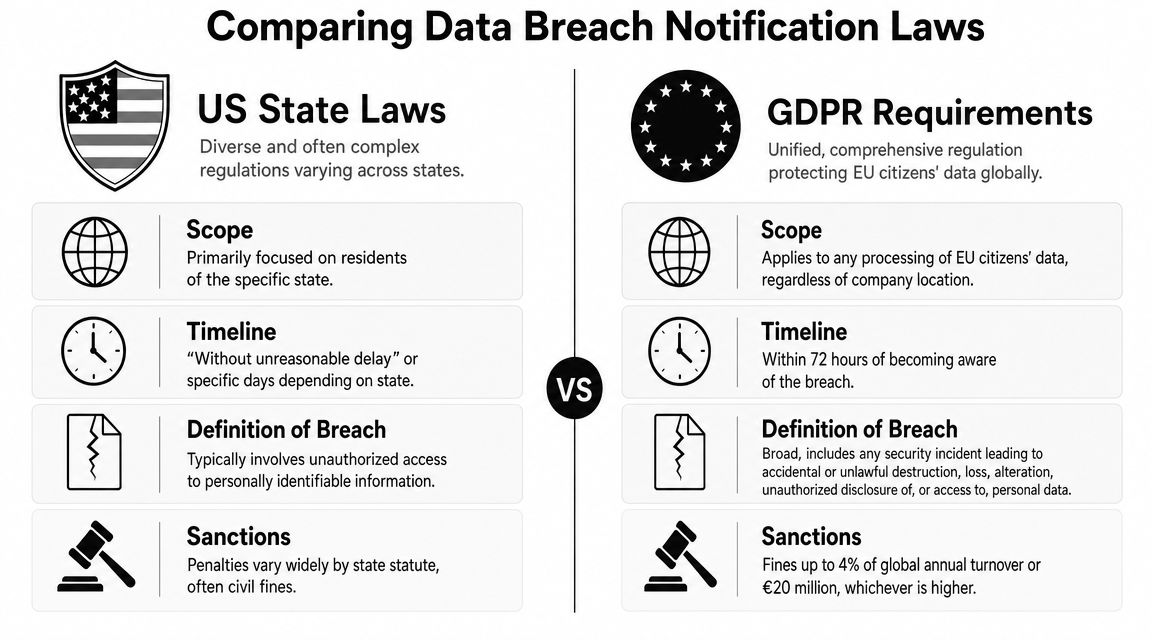
The core difference is simple. U.S. breach notification usually starts with location and state law. GDPR starts with whether a personal data breach creates risk to people, then asks how quickly you can assess and report it.
That distinction changes operations. A U.S. response often depends on jurisdiction mapping, data-element analysis, and state-specific notice rules. A GDPR response depends on rapid triage, documented reasoning, and a team that can decide quickly whether regulator notice is required.
Side-by-side comparison
| Issue | US state-law model | GDPR model |
|---|---|---|
| Legal structure | State-by-state variation | One overarching EU framework |
| Timing | Depends on the states involved and their standards | Authority notice within 72 hours after awareness in qualifying cases |
| Trigger analysis | Often tied to specific data types and, in some states, risk-of-harm tests | Focuses on personal data breaches and the risk to individuals |
| Response design | Requires residence mapping and state-law review | Requires fast classification and documented decisions |
A practical way to picture it is this: the U.S. model works like a route map with many exits, while GDPR works more like a countdown timer with fewer excuses for delay. Both can be demanding. They pressure different parts of your organization.
The U.S. creates complexity through variation. One state may define covered information differently from another. One may allow substitute notice in certain cases. Another may expect notice to a state regulator or consumer reporting agencies when a breach reaches a threshold. If your customer base spans several states, your team needs an intake process that identifies where affected people live, not just what systems were hit.
GDPR is more unified, but the speed requirement changes behavior. The European Commission explains that organizations must notify the supervisory authority without undue delay and, where feasible, within 72 hours after becoming aware of a qualifying personal data breach (European Commission guidance on personal data breach notification under GDPR). That deadline pushes companies to build decision paths before an incident. You do not want your first debate about roles, evidence, or approval authority to happen on day one of a live breach.
In this context, operational readiness becomes personal risk management too. If you miss the legal window, the problem is not only regulatory exposure. Customers, employees, and executives lose time they could have used to secure accounts, watch for fraud, or stop follow-on attacks. Digital Footprint Check fits into that race against time by helping businesses and individuals spot exposed information and suspicious activity early, before the breach response becomes a scramble.
Confusion often starts with control. If a vendor stores the data, a manager may assume the vendor owns the compliance burden. That assumption causes delays. This overview of ownership of data responsibilities is a useful reminder that custody, control, and legal responsibility do not always sit with the same party.
A working rule for mixed-jurisdiction businesses
Build for the hardest realistic case.
If you have users, customers, or staff in multiple regions, set up one response system that can handle both state-law variation and GDPR timing pressure. That usually means:
- Map jurisdictions in advance: Keep records that show where customers and employees reside.
- Set escalation rules before an incident: Security, legal, privacy, and communications should know who decides what, and by when.
- Record the awareness timeline: Write down when the organization became aware, what facts were known, and how the risk assessment changed.
- Use one investigation log: A single record reduces contradictory statements and missed deadlines.
- Monitor for downstream abuse early: Breach notification is only part of the response. Early monitoring gives both the business and affected people a better chance to catch account takeover, phishing, or identity misuse before the damage spreads.
A multi-jurisdiction breach usually does not go off course because the company lacked a policy. It goes off course because nobody converted legal rules into timed operational decisions.
The High Cost of Getting It Wrong Penalties and Risks
At 9:00 a.m., the incident looks technical. By 3:00 p.m., it is a legal problem, a customer support problem, a board problem, and for some people affected by the breach, a personal financial problem.
That is why notification mistakes are so expensive. The cost does not sit in one bucket. It spreads across forensic work, legal review, customer communications, downtime, contract fallout, regulatory scrutiny, and follow-up protection for affected people.
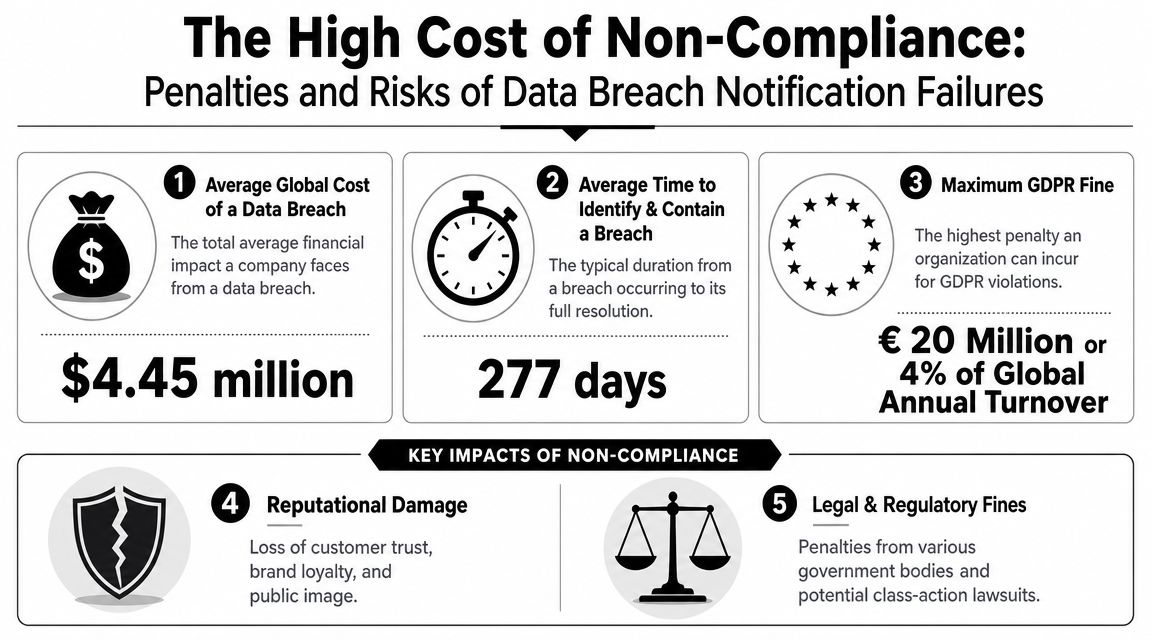
Industry research regularly puts the average global cost of a data breach in the millions, and IBM has reported that the average U.S. breach cost reached $10.22 million in 2024 in its Cost of a Data Breach report. Some summaries also project the global average to be about $4.44 million in 2025. The exact figure matters less than the pattern. Delays and confusion make almost every part of the response more expensive.
A breach response works like a fire response. The first minutes shape the final damage. If your team spends a day arguing about who approves the notice, which states apply, or whether a vendor is handling outreach, the bill usually grows while trust shrinks.
The losses that never appear on a penalty chart
Fines get attention because they are easy to picture. The quieter losses are often harder to repair.
A poorly written notice can trigger a flood of support calls, refund demands, media questions, and uncomfortable conversations with enterprise customers who now want proof that your controls are stronger than your competitors'. If employee data was exposed, HR may spend weeks answering anxious questions about payroll fraud, tax scams, and identity misuse. If your notice omits practical next steps, affected people are left to guess, which increases the chance that attackers succeed with follow-on phishing or account takeover.
This short video gives a useful overview of why response quality affects more than compliance.
Penalties are serious, but they are not the whole risk
For GDPR-covered organizations, regulators can impose fines of up to 4% of global annual turnover or €20 million, whichever is higher. U.S. exposure often looks different. State enforcement, consumer protection claims, contractual disputes, and class action litigation can all follow the same incident.
Managers should read that as an operational warning, not just a legal one. Every hour of uncertainty increases the chance of inconsistent statements, missed deadlines, and preventable harm to real people whose data is now in circulation. That is where proactive monitoring helps. A tool like Digital Footprint Check can help businesses and individuals spot exposed credentials, impersonation risk, or downstream misuse earlier, which gives your team more time to contain damage before it spreads.
For smaller organizations, preparation often determines whether costs stay painful or become existential. A short set of cybersecurity tips for small businesses can help teams tighten controls before an incident and reduce the odds that a notification failure becomes a much larger business crisis.
Your Practical Breach Response and Prevention Checklist
The best time to think clearly about a breach is before one happens. Once an incident starts, your team won't have the luxury of slow debate.
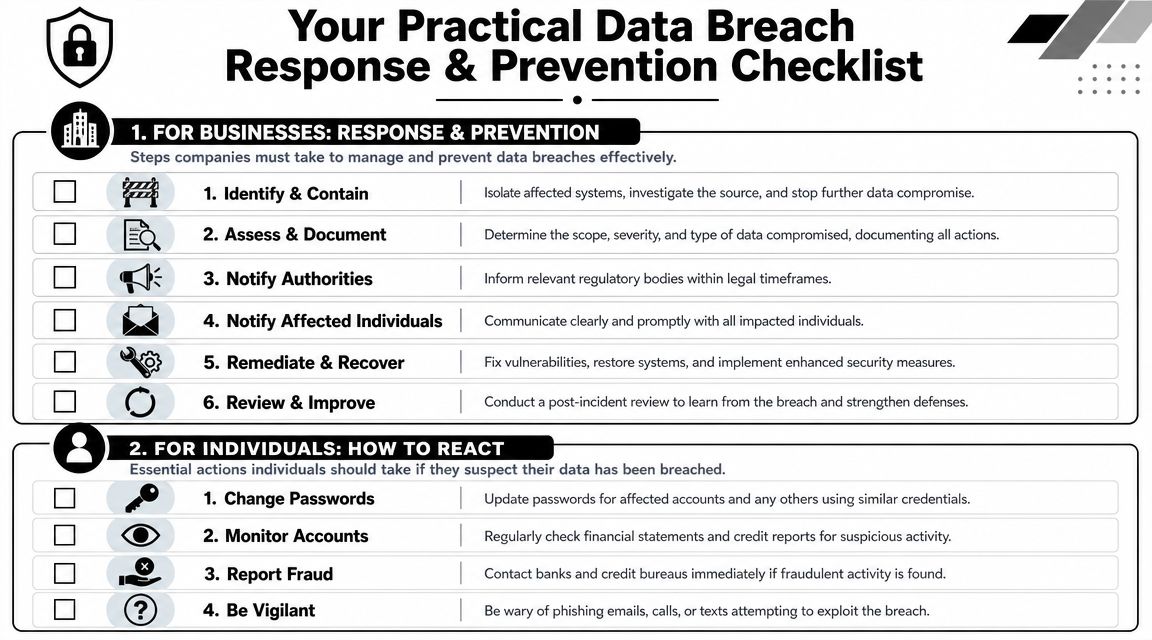
For businesses
- Contain first: Isolate affected systems, preserve logs, and stop further unauthorized access.
- Classify the data: Identify exactly what categories of personal information may have been exposed.
- Escalate fast: Pull in legal, privacy, security, HR, and communications early.
- Track decision points: Record when your organization became aware and what facts were known at each stage.
- Draft notices for real people: Write messages that tell affected individuals what they should do now.
- Review weak spots: After the incident, fix the control failures that made the breach possible.
For smaller teams, a practical preparation step is keeping a short incident binder with contacts, outside counsel details, regulator lists, and notice templates. This guide on cybersecurity tips for small businesses is a useful companion for that planning work.
For individuals
- Change passwords quickly: Start with the affected account, then update any reused passwords elsewhere.
- Watch financial and account activity: Look for unfamiliar transactions, resets, or login alerts.
- Expect follow-up scams: Attackers often use breach news to send convincing phishing emails or texts.
- Document suspicious activity: Save messages, screenshots, and account alerts in case you need to report fraud.
- Check broader exposure: If one account was exposed, others tied to the same email or username may also be at risk.
One practical tool in that process is Digital Footprint Check, which states that it scans for exposed information across breach databases and public records and can help users identify whether their personal data may already be circulating online.
The central lesson is simple. Notification law is about speed, judgment, and usefulness. The legal duty matters, but so does what the person on the receiving end can do with the notice.
If you want to see whether your email, usernames, or other exposed details may already be visible online, try the free checker from Digital Footprint Check. It gives individuals and businesses a practical way to spot exposure early and take action before a breach notice becomes a bigger identity or fraud problem.