· Digital Footprint Check · Content Marketing · 16 min read
A Guide to Data Breach Notification Services in 2026
Understand data breach notification services, from legal duties to choosing a provider. Learn how to protect yourself before the official alert arrives.
Nearly every major breach story shares the same hidden problem. People learn about the incident long after attackers have had time to use the data.
That delay matters more than the notice itself. A breach starts creating risk the moment an attacker gets access, not when a company sends an email or letter. For executives, that means fraud, account takeover, and reputation damage can already be in motion before legal and communications teams finish confirming what happened. For individuals, the official alert often functions less like an early warning and more like a smoke alarm that goes off after the fire has spread.
The most useful way to understand data breach notification services is to focus on that gap. Security teams still need time to investigate, confirm which records were exposed, and meet legal notice requirements. During that notification latency, stolen passwords may be tried on other accounts, personal details can be packaged for phishing, and exposed data from one service can be combined with information from another to make impersonation more convincing.
A practical comparison helps. Official breach notices work like a bank statement that tells you fraud has already occurred. Helpful, yes. Early enough to prevent all damage, no. If you want the plain-language basics before going further, this guide on what a data breach is gives useful context.
For businesses, notification services sit at the intersection of legal duty, customer communication, and trust repair. For consumers, they are only one layer of defense. A key question is what happens before the notice arrives, and what you can do in that window to reduce the fallout.
What Exactly Are Data Breach Notification Services
Data breach notification services are the systems, workflows, and specialist providers that help an organization tell the right people that their information was exposed. In plain English, they’re the digital version of a public safety alert system. If a company discovers that customer data, employee records, health information, or account credentials may have been compromised, someone has to determine who was affected, what laws apply, and how to notify people quickly and clearly.
That sounds simple until you look at what’s involved. A breach rarely produces a neat list of names and email addresses. Security teams first have to verify what happened, identify which data was touched, separate confirmed exposure from suspicion, and coordinate with legal, compliance, customer support, and executives. Many organizations use third-party notification firms because sending notices at scale is only one part of the job. The harder part is getting the message and timing right.
What these services actually do
A mature provider usually helps with several jobs at once:
- Audience identification: Figure out which customers, patients, employees, or partners may need notice.
- Message preparation: Draft plain-language notifications that explain what happened and what the recipient should do next.
- Delivery management: Send notices by email, postal mail, call center outreach, or a combination.
- Regulatory support: Track which agencies must be notified in which jurisdictions.
- Response handling: Manage inbound questions from anxious recipients who want immediate answers.
A good notification process isn’t just about legal compliance. It also gives affected people a usable warning so they can change passwords, monitor financial activity, protect online identity, and reduce follow-on harm such as phishing or impersonation.
Practical rule: If a notification only satisfies lawyers and doesn’t help people protect themselves, it’s incomplete.
Why executives often misunderstand them
Leaders sometimes assume their incident response plan already covers notification. It may not. An internal plan tells your team who makes decisions. A notification service handles the operational burden of turning that decision into thousands or millions of accurate, defensible, trackable communications.
That distinction matters because trust can break twice. First when the breach happens. Then again when the notice is confusing, late, or sent to the wrong people.
For a plain-language foundation on breach basics, see this overview of what a data breach is.
How Breach Notifications Work from Detection to Alert
Breach notification rarely starts with an email. It starts with uncertainty.
From the outside, people often assume a company sees a breach, confirms it, and sends a notice right away. Inside the business, the sequence is slower and messier. Security teams first need to determine whether they are looking at a false alarm, a small contained event, or a wider compromise involving personal data. A useful overview from Facctum’s breach notification overview describes the core workflow: detection, severity assessment, internal escalation, regulatory reporting, and customer communication.
The six-step journey in practice
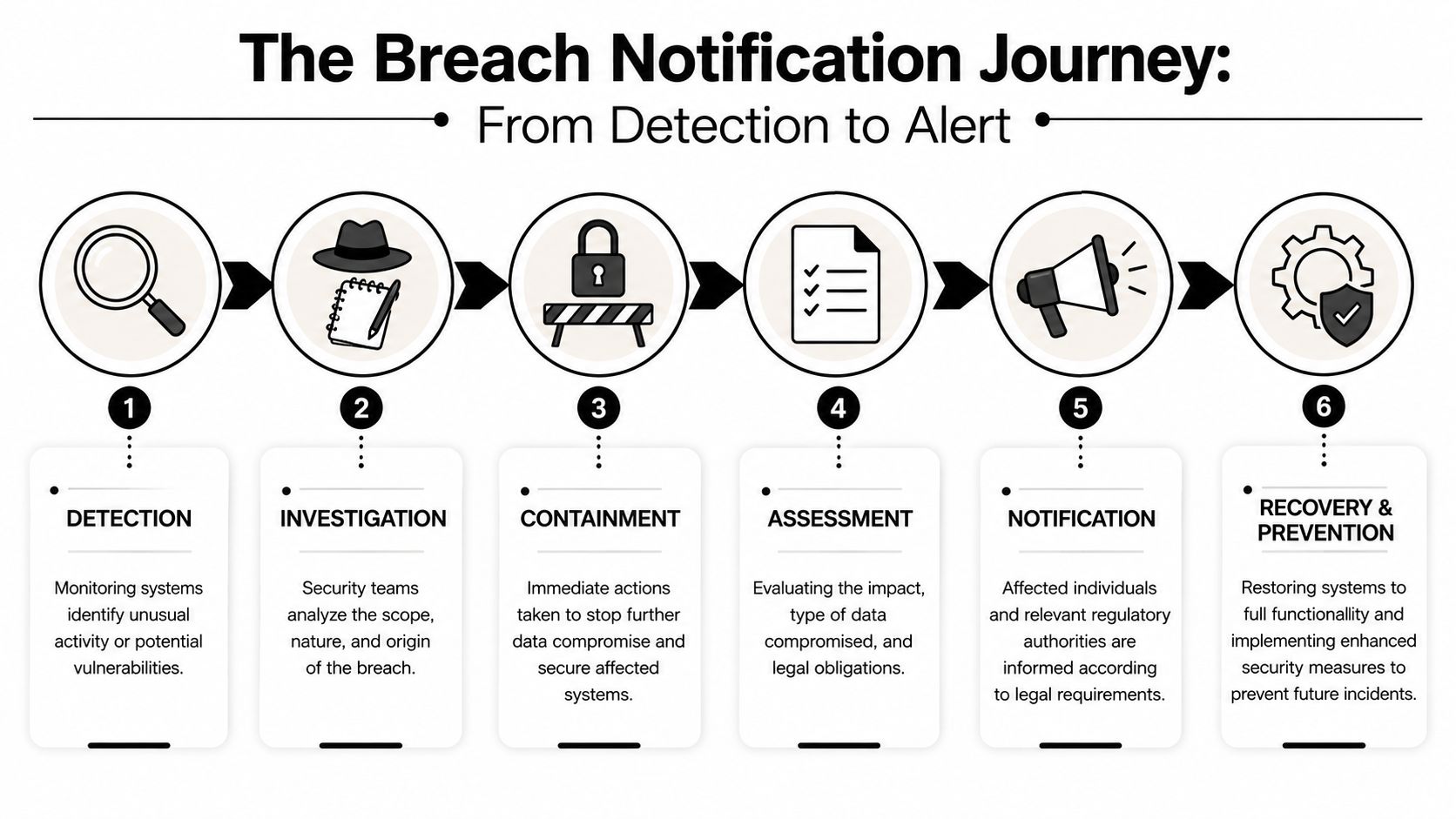
A breach moves through six practical stages. The order sounds tidy on paper. In real incidents, teams often loop back as new evidence appears.
Detection
Security tools, fraud teams, employees, or outside researchers spot unusual activity. Common triggers include impossible travel logins, large data transfers, suspicious password resets, or stolen credentials turning up in criminal marketplaces.Investigation Analysts work like fire investigators at a burned building. They are not just asking whether something happened. They are trying to determine how it started, what was touched, whether data was taken, and whether the intruder still has access.
Containment
The company cuts off the attacker’s path. That can mean isolating systems, disabling accounts, forcing password resets, blocking malicious connections, and preserving evidence for legal and forensic review.Assessment
During assessment, business impact becomes clearer. Exposure of email addresses creates one level of risk. Exposure of Social Security numbers, payment data, tax records, or medical details creates a very different level of harm. Legal and compliance teams begin mapping which people and jurisdictions are affected.Notification
Notices go out only after the organization has enough verified information to say something accurate. If the message goes out too early, it may be wrong. If it goes out too late, people lose valuable time to protect themselves.Recovery and prevention
The incident response does not end when the notices are sent. Systems are restored, monitoring is tightened, security controls are improved, and the organization updates its playbooks based on what failed.
Where the dangerous delay comes from
The biggest risk is often the gap between the breach occurring and the moment you hear about it. That gap is notification latency.
Notification latency works like smoke spreading through a building before the fire alarm reaches every floor. The damage may already be underway while affected customers, employees, or partners still believe everything is normal. During that window, stolen passwords can be reused, identity data can be packaged for resale, and attackers can prepare phishing messages that look convincing because they are built from real stolen details.
That is why the official notice should be treated as confirmation, not as your first and only warning sign.
For executives, the business lesson is straightforward. A notification date tells you when communication happened. It does not tell you when exposure began. Those are different clocks, and the first one often starts much earlier.
Why organizations cannot alert people immediately
Delay does not always mean negligence. It often reflects the reality of digital forensics and legal review.
A company may detect unusual behavior on Monday but still need days or weeks to answer basic questions: Was sensitive data only visible, or copied? Which records were involved? Were backup systems affected too? Did the attacker enter through one employee account, or several? If the company guesses wrong, it can notify the wrong people, miss affected groups, or describe the risk inaccurately.
That said, delay still creates real exposure for the people on the receiving end. The practical takeaway is to prepare for the gap instead of assuming the official message will arrive early enough to protect you.
What an individual alert usually means
A breach notice is not one generic warning. It is a risk signal tied to the kind of data involved.
- A password was exposed: Change it immediately anywhere it was reused, then review multi-factor authentication settings.
- Financial or identity data was exposed: Monitor bank and credit activity closely, and watch for fraud attempts that use your real details.
- Profile or account details were exposed: Expect impersonation, account recovery abuse, and targeted scam messages.
- Health information was exposed: Watch for medical identity fraud and unusually persuasive phishing tied to appointments, insurers, or prescriptions.
People who want earlier visibility can use services that monitor exposed credentials and breach listings before a formal notice lands in their inbox. If you are evaluating those tools, this guide to a breach monitoring tool beyond Have I Been Pwned offers a useful starting point.
Navigating the Legal Maze of Breach Notification Laws
The legal side of breach notification frustrates even well-established companies because there isn’t one universal U.S. rulebook. All 50 U.S. states have enacted data breach notification laws since 2002, yet there is no unified federal data breach notification law, creating a fragmented system of overlapping requirements, as summarized in this overview of U.S. breach notification laws.
That fragmentation creates practical confusion. One incident may trigger different notice timelines, agency reporting duties, and content requirements depending on the state where the affected person lives, the type of business involved, and the kind of data that was exposed. That’s why many organizations rely on specialists instead of trying to improvise during a crisis.
Why one-size-fits-all fails
A retailer, a hospital, and a telecom carrier may all experience unauthorized access, but they won’t face the same obligations. Sector-specific rules sit on top of state laws. Multistate operations then add another layer. International businesses face even more complexity.
Many internal teams freeze, knowing they must notify someone but not yet knowing who, when, and with what wording.
Sample Data Breach Notification Requirements
| Regulation | Notification Timeline to Individuals | Authority to Notify |
|---|---|---|
| HIPAA Breach Notification Rule | Without unreasonable delay and no later than 60 days after discovery | Affected individuals |
| Updated FCC rules for carriers | Without unreasonable delay after regulatory reporting, with a maximum allowable delay of 30 days unless law enforcement requests an extension | FCC, FBI, U.S. Secret Service, and affected customers in qualifying cases |
| State breach notification laws | Varies by state | Usually affected individuals, and in some states the attorney general or consumer reporting agencies |
Two concrete examples executives should know
Under the HIPAA Breach Notification Rule, covered entities must notify affected individuals of a breach of unsecured protected health information without unreasonable delay and strictly no later than 60 days after discovery, and the notice must include details such as the information involved, protective steps, and mitigation actions, according to the U.S. Department of Health and Human Services HIPAA breach notification guidance.
Carrier obligations are also strict. Under updated FCC rules, carriers must notify the FCC, FBI, and U.S. Secret Service within a specified timeframe for qualifying incidents, and customer notice must follow without unreasonable delay after that reporting. The exact trigger and timing matter enough that telecom firms usually shouldn’t handle this informally.
The biggest legal mistake isn’t always failing to notify. It’s assuming the same notice process works for every incident.
What this means for consumers
If your data is breached, your rights may depend on where you live and what type of entity held the information. A healthcare provider has duties that differ from a wireless carrier. A multistate company may tailor notices based on resident location. That’s one reason breach letters don’t always look the same, even when the underlying event feels similar.
If you want a plain-English starting point for this patchwork, review these data breach notification requirements.
How to Choose the Right Breach Notification Provider
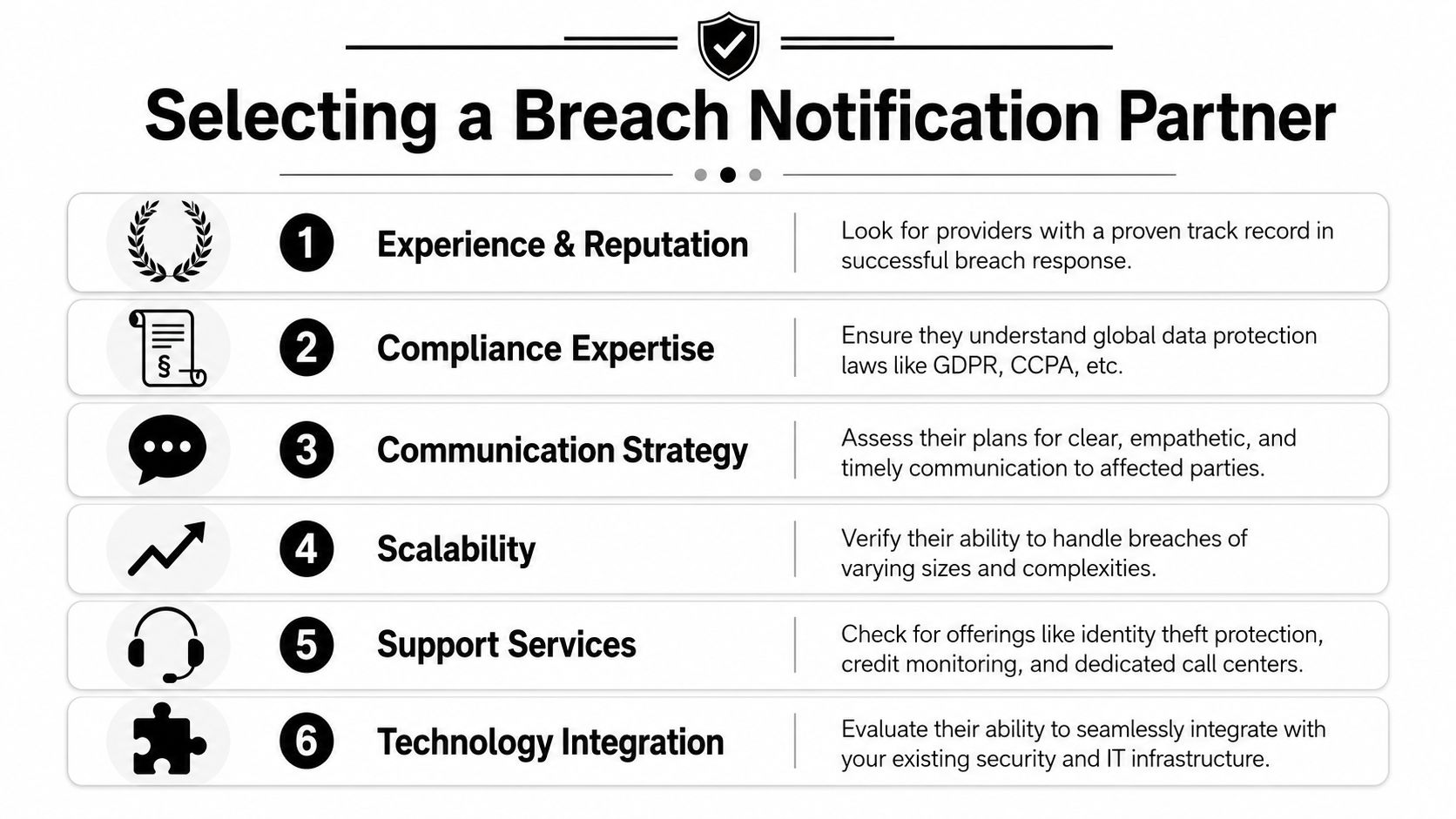
Choosing a provider is less about software features and more about crisis performance. When a breach happens, you need a partner that can interpret legal requirements, coordinate communications, and support frightened recipients without creating a second crisis through confusion.
Questions worth asking before you sign
- Can they handle regulatory nuance? Ask how they map notices across jurisdictions and regulated sectors. If they can’t explain how they deal with conflicting rules, keep looking.
- Do they support multiple communication channels? Email alone isn’t enough. Some recipients need mailed notices, staffed call centers, or multilingual support.
- Can they scale under pressure? A provider should be able to manage a narrow incident and a mass-notification event without rebuilding the process from scratch.
- What happens after the letter goes out? Inbound support matters. Recipients often need help understanding whether they should change passwords, freeze credit, or watch for phishing.
- How well do they integrate with counsel and forensics? The provider shouldn’t operate in isolation. They need to fit into your incident command structure.
One timing example that shows why expertise matters
Under the updated FCC rules, carriers must notify the FCC, FBI, and U.S. Secret Service within seven days when a breach impacts more than 500 customers or poses a risk of customer harm, and they must notify affected customers without unreasonable delay after that reporting, with a maximum allowable delay of 30 days unless law enforcement requests an extension, according to Woods Rogers’ summary of the FCC update.
That single rule illustrates why provider choice matters. A vendor that understands generic mailing logistics but not sector-specific timing can expose you to regulatory trouble.
What support services deserve attention
The best providers usually offer more than letter generation:
- Call center readiness: Your customers will have questions immediately.
- Template quality: Notices should be readable, specific, and calm.
- Audit trail reporting: You need defensible records of what was sent and when.
- Identity support coordination: Some incidents warrant credit monitoring or identity theft assistance.
For businesses comparing broader exposure-monitoring options alongside notification support, this review of dark web monitoring services helps frame the market.
Proactively Protect Your Identity Before the Official Alert
The most important shift for individuals is this. Don’t treat official notification as your first line of defense. Treat it as confirmation that an event has already been serious enough, and old enough, to complete investigation and reporting.
Research on healthcare breaches highlights the hidden delay well. The gap between exposure and public reporting often isn’t explained clearly, even though victims remain vulnerable during that period. One example cited in this research article on breach timing and exposure notes that Blue Cross Blue Shield patient data was publicly accessible for three months before detection.
That delay matters in ordinary life, not just in compliance reports. During that window, a stolen email-password pair might be reused against your streaming accounts, gaming profile, work logins, shopping platforms, or dating apps. An attacker doesn’t care whether the compromised account was your “important” one. They care whether you reused credentials, exposed recovery details, or left enough public information online to build a convincing phishing message.
What to do during the notification gap
If you want to reduce risk before any official letter arrives, focus on actions you control:
- Change reused passwords first: If one account is exposed, reuse turns a single breach into many compromises.
- Lock down recovery paths: Review backup email addresses, phone numbers, and security questions.
- Watch high-risk accounts: Banking, payroll, primary email, gaming accounts with stored payment methods, and dating apps deserve immediate attention.
- Monitor your public footprint: Exposed usernames, old bios, public friend lists, and archived posts can help attackers impersonate you.
- Take reputation seriously: Job seekers often forget that identity exposure can spill into professional life through impersonation, credential stuffing, or embarrassing account takeovers.
Consumer reality: By the time a breach notice reaches you, criminals may have already tested your credentials elsewhere.
A practical walkthrough on this topic helps:
Why this matters for dating, gaming, and reputation
This isn’t just about credit cards. A compromised gaming account can expose purchase history, linked payment options, and a username reused on social platforms. A breached dating profile can reveal private photos, location patterns, and enough personal detail to support catfishing or romance scam targeting. A hijacked social account can damage your reputation at exactly the wrong time, including during a job search.
For businesses, the lesson is similar. Employees and customers don’t live in separate digital boxes. Their exposed data crosses between work life, personal life, and public identity quickly.
Integrating Breach Response into Your Business Operations
Buying a notification service doesn’t create readiness. Operational discipline does. The companies that handle breaches best usually treat notification as one component of a wider response muscle that includes detection, decision-making, legal review, communications, and post-incident learning.
A documented plan is necessary. A tested plan is what works under stress.
Build a response process people can actually run
The strongest programs make breach response routine before it becomes urgent. Facctum’s guidance emphasizes practical elements such as tabletop exercises, updated contact databases, and embedding notification workflows into broader compliance and cyber resilience planning. Those are useful because they force teams to answer basic questions in advance, not in the middle of a crisis.
Here’s what that looks like inside a business:
- Run tabletop exercises: Simulate a breach and force leaders to make decisions with incomplete facts.
- Train frontline staff: Employees often spot the first signs of account abuse, phishing, or unauthorized access.
- Maintain current contact lists: Regulators, outside counsel, incident response vendors, and executives should never be looked up during an emergency.
- Pre-approve communications: Draft customer and employee templates before they’re needed.
- Connect security and communications teams: Technical containment and public messaging can’t operate as separate tracks.
Don’t separate compliance from customer experience
A legally valid notice can still be operationally poor. If the message is vague, support lines are unprepared, or remediation steps are unclear, recipients lose confidence fast. That’s especially true when the exposed data touches identity theft risk, healthcare records, or sensitive personal communications.
The FTC’s business guidance recommends that when financial information or Social Security numbers are exposed, organizations should consider offering at least one year of free credit monitoring or identity theft protection services and instruct affected individuals to place fraud alerts or credit freezes, according to the FTC data breach response guide for businesses.
Good breach response answers three questions quickly. What happened, what should I do now, and who can help me if I’m affected?
A useful operating mindset
Treat every breach as both a security event and a human event. Security teams contain systems. Notification teams support people. The best organizations design for both.
Take Control of Your Data Breach Exposure Today
Breach notification serves two very different audiences. For organizations, it’s a legal, technical, and reputational obligation. For individuals, it’s often a delayed warning that arrives after exposure has already had time to spread.
The business stakes are large. According to 2026 data, the average cost of a data breach in the United States has reached USD 10.22 million, and organizations that fail to contain a breach within 200 days see average costs rise by over USD 1.14 million, according to SentinelOne’s data breach statistics summary. Those numbers help explain why companies invest so heavily in detection, containment, and notification workflows.
For individuals, the lesson is simpler. Waiting for the official email is a weak strategy. If your credentials, dating profile details, social accounts, gaming identities, or public records are exposed, the practical risks show up in fraud attempts, impersonation, reputation damage, and account takeover. That can affect personal safety, scam exposure, and even career opportunities when public-facing accounts are compromised or misused.
The smart move is to act before the formal notice arrives. Audit password reuse. Review recovery settings. Monitor the parts of your digital life that attackers can exploit first. And if you want a direct way to check whether your information may already be exposed, use a free data breach checker.
Digital exposure rarely stays neatly contained. It spills into online identity protection, job prospects, gaming account security, dating app verification, scam prevention, and reputation management. If you want a practical first step, run a check with Digital Footprint Check. You can also start with the free scanner at www.digitalfootprintcheck.com/free-checker to see whether your email, usernames, phone details, or other publicly visible traces may already be circulating online.