· Digital Footprint Check · Content Marketing · 16 min read
Ownership of Data: Who Controls Your Digital Life?
Understand the ownership of data and learn who controls your personal info. Our guide explains how to discover, protect, and manage your digital footprint.

You apply for a new job, and the recruiter finds an old username tied to a forum post you barely remember writing. Or you search your name and notice your photo, phone number, or email on a site you’ve never used. Maybe a dating app profile screenshot shows up somewhere public. Maybe a gaming account tied to an old handle is still visible years later.
That moment usually triggers the same question: Who owns this data?
It sounds like a legal question, but for individuals it’s a practical one. You want to know who can see it, copy it, sell access to it, or remove it. You want to know whether an old post can hurt your job prospects, whether exposed personal details can affect your safety, and whether anything can still be done once information has spread across the internet.
The ownership of data matters because digital information doesn’t behave like physical property. A house has one address. A car sits in one garage. Your data can exist in dozens of places at once. That’s why the better question is often not “Who owns it?” but “Who controls it now?”
Your Data in Places You Never Imagined
A common version of this problem starts small. Someone searches their own name before a job interview and finds an abandoned social profile, an old marketplace account, or a cached image from years ago. Another person runs a background check while apartment hunting and sees a forgotten forum handle connected to their email address. A parent looks up a teenager’s username and finds it reused across gaming platforms, chat apps, and public comment sections.
None of that feels like “property” in the normal sense. It feels more like a trail.
When your digital trail outlives your memory
That trail accumulates. You create an account for a game, sign up for a newsletter, join a dating app, leave a review, post a comment, connect a social login, reset a password, or upload a profile photo. Years later, you may not remember those actions, but the systems that stored them often do.
The unsettling part is that the information doesn’t stay where you first put it. A profile can be indexed, copied, archived, aggregated, or linked to another dataset. A username becomes searchable. A public image gets mirrored. An email address appears in breach-related databases or account-recovery pages. What started as one action in one app can turn into a much wider exposure problem.
Practical rule: If you can’t name the main places your name, email, phone number, and usernames appear online, you don’t yet know the real size of your digital footprint.
That’s why people often start with a simple scan of their online presence, such as a digital footprint check. The point isn’t panic. It’s visibility. You can’t make good privacy decisions with partial information.
Why this matters beyond privacy
This isn’t only about embarrassment. Old or exposed data can affect employment, housing, dating safety, gaming accounts, and identity theft risk. A forgotten profile might look suspicious to an employer. A visible phone number can invite harassment. A reused username can help someone connect accounts you meant to keep separate.
Once you see data in places you never expected, the ownership question becomes urgent. But the answer is rarely simple.
What Is Data Ownership Really?
If you own a bicycle, that idea is easy to understand. You can lock it, lend it, sell it, or keep it in your hallway. If someone takes it, you no longer have it.
Data doesn’t work like that. If someone copies a file, posts a screenshot, stores your form submission, or backs up a database, the original often still exists. Digital information is copyable, distributable, and reusable in a way physical property isn’t.
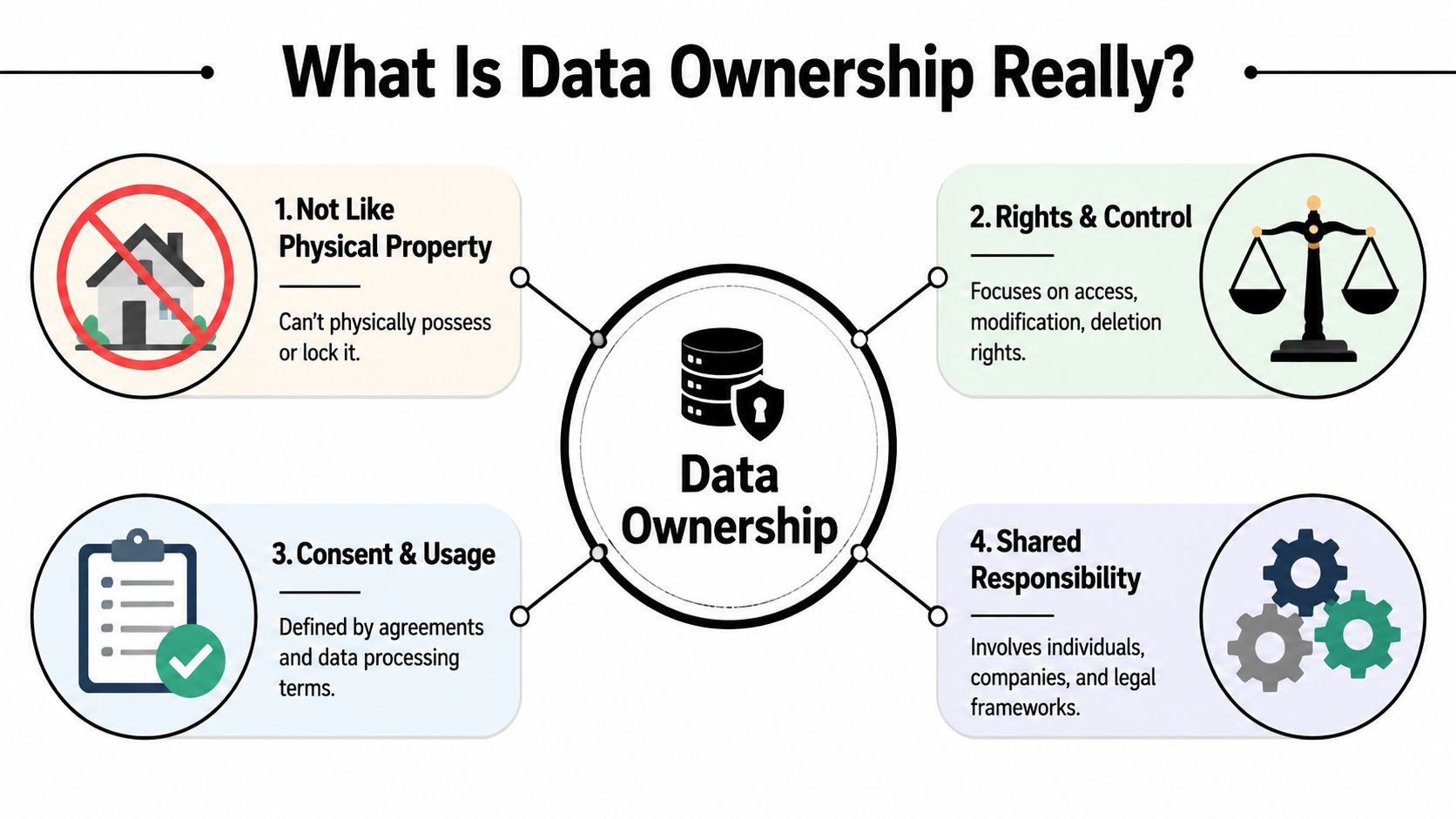
Ownership is often a shortcut word
When people ask about ownership of data, they usually aren’t asking a philosophy question. They’re asking who can:
- Access it
- Edit it
- Delete it
- Share it
- Profit from it
- Block others from using it
A review of data-sharing debates found that inquiries into ownership frequently center on who can control, delete, or profit from information. The same review argues that simple “private” versus “public” ownership models don’t resolve real-world problems well because multiple stakeholders often have legitimate interests at the same time, and access decisions should be managed by processes that weigh benefits and harms rather than by a simplistic owner model, as discussed in this review of data access and ownership frameworks.
A more useful way to think about it
There are three layers that help make sense of data ownership.
| Layer | What it means | Everyday example |
|---|---|---|
| Legal rights | What laws, contracts, and terms allow or restrict | A platform’s terms, privacy laws, deletion requests |
| Technical control | Who can store, copy, secure, or expose the data | A company database, backup system, admin panel |
| Practical control | Who can actually make changes happen | Support teams, vendors, platform moderators, you |
A lot of confusion comes from mixing these layers together. You may have a legal right to request deletion, but not direct technical access to the servers. A company may technically hold your data, but a vendor may process it. A public record may contain your details even though you never “agreed” to broad public visibility in the commonly understood sense of consent.
Data ownership is often less like owning a house and more like trying to control copies of a document after it has been emailed, printed, forwarded, and archived by different people.
Why control matters more than abstract ownership
Many debates often stall at this point. People want a clean answer, but digital systems rarely produce one. In real life, what helps most is identifying the levers you can still use: privacy settings, access permissions, deletion requests, account closure, search visibility controls, breach monitoring, and documentation.
If your goal is to protect your job prospects, your reputation, or your personal safety, control beats theory. You don’t need a perfect philosophical definition before you can start reducing exposure.
The Three Faces of Data and Who Claims Them
A lot of confusion disappears once you separate data into broad categories. The same email address can appear in more than one category at once, which is why people feel stuck. Your work email may be part of your employer’s records, your personal identity, and a third-party platform’s logs all at the same time.
ISACA notes that platforms such as Google and Facebook gather data from multiple sources, compile it, and make it available online. It also notes that once data is processed or stored in more than one database, the chance of multiple parties claiming ownership becomes high, creating overlapping claims of control, access, and responsibility across the internet, as described in this ISACA analysis of data rights.
Data Types and Typical Control Claims
| Data Type | Example | Primary Controller(s) |
|---|---|---|
| Personal data | Your selfies, email inbox, dating app profile, private messages | You, the platform hosting it, sometimes third-party processors |
| Corporate data | Customer lists, sales records, internal reports, employee files | Employer, business unit leaders, IT custodians, vendors |
| Public data | Court filings, company registries, public social posts | Government bodies, platforms, archives, search engines |
Why one piece of data can belong to several worlds
Take a profile photo. You upload it to a social app. The app stores it. Search engines may index the page if it’s public. Other users may screenshot it. A third-party service may process it for moderation or analytics. You created it, but several actors may now have some form of control over access, storage, or reuse.
That’s why the ownership of data often feels slippery. It isn’t always one clean relationship between one person and one asset.
For many people, the more useful distinction is the one between what you intentionally shared and what accumulates around you indirectly. That difference is at the heart of the gap between a visible online presence and a less obvious background trail, explained well in this guide to digital footprint vs digital shadow.
Where people get tripped up
People often assume:
- If I created it, I fully control it
- If it’s about me, I must own it
- If I deleted it once, it’s gone everywhere
- If it’s public, nobody is responsible for how it’s reused
Those assumptions break down fast online. Creation, possession, hosting, indexing, and redistribution are different things. That’s why a practical privacy strategy starts by identifying who holds what version of your data, not just who first made it.
Why Control Over Your Data Matters in Real Life
For most readers, this subject becomes real when data starts affecting ordinary life. A recruiter searches your name. A date reverse-searches your profile photo. A scammer links your gaming handle to your email address. A landlord or client finds an old account that doesn’t reflect who you are now.
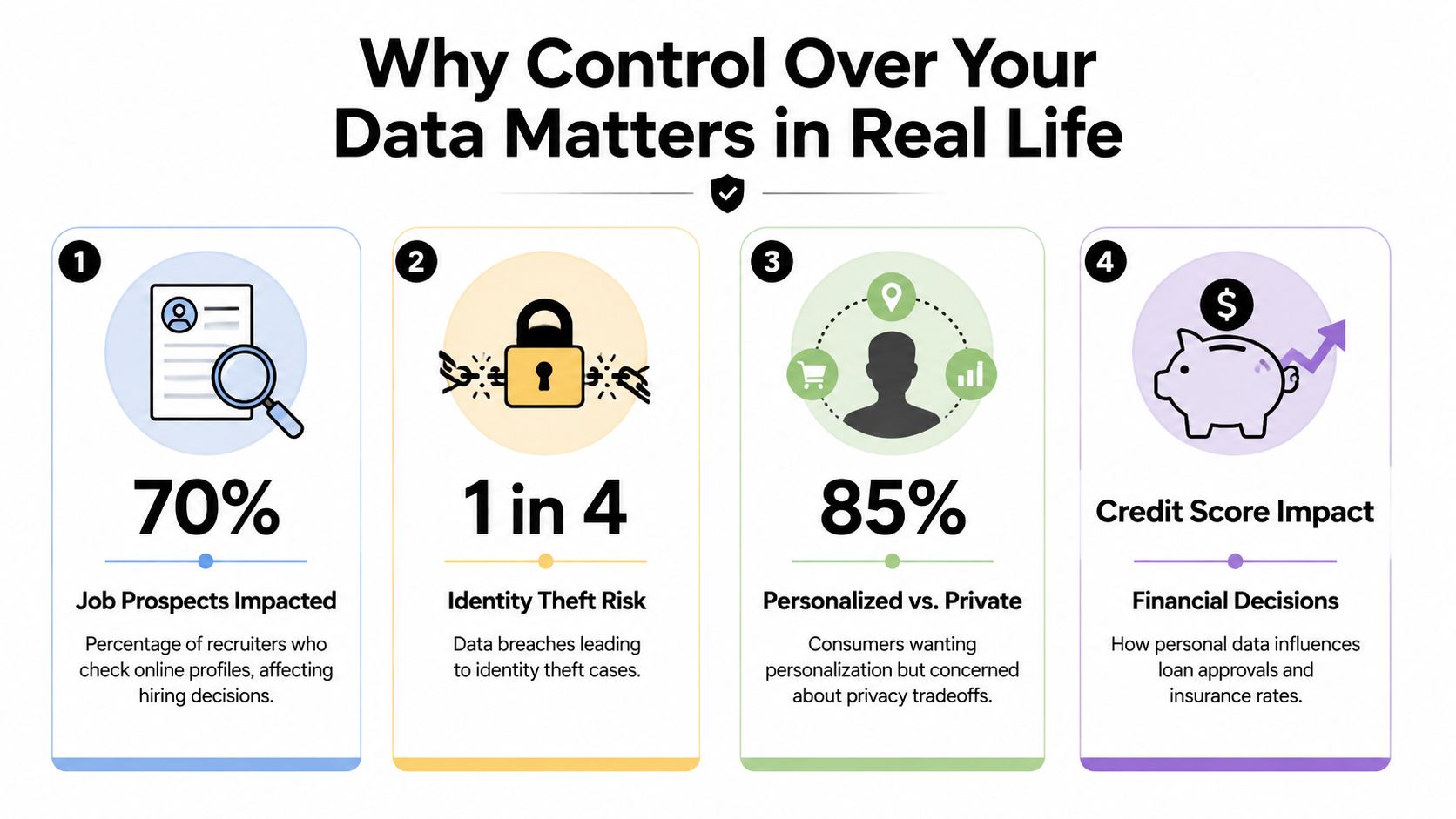
Job prospects and reputation
A job seeker can do everything right in the interview process and still lose momentum because of stale or misleading online information. It doesn’t have to be dramatic. An old joke, a niche forum argument, a public Venmo-style transaction trail, or a profile picture from a dormant account can create doubt.
Hiring teams don’t always have full context. If a search result raises questions, the burden often falls on you to explain it. That’s why online reputation management isn’t just branding. It’s part of employability.
Dating safety and personal exposure
Dating apps create a different kind of risk. People often share enough information to seem real, but not enough to stay protected. A first name, occupation, city, and a few photos can be enough for someone to identify a person elsewhere online. From there, they may find social profiles, workplace details, or contact information.
That’s where “ownership” becomes the wrong lens. The more urgent issue is whether someone can connect the dots and use your information in ways you didn’t expect.
Key takeaway: In everyday life, the most important question isn’t who owns a piece of data in theory. It’s who can act on it.
Gaming accounts and community identity
Gamers run into a similar problem from a different angle. Usernames often persist for years and travel across platforms, voice chat tools, forums, clip sites, and marketplaces. One reused handle can tie together a large amount of personal history. If credentials leak, someone may not just steal access to an account. They may gain access to a reputation, inventory, social circle, or long-standing identity.
Why the rules feel inconsistent
Part of the confusion is legal variation. Guidance in major markets distinguishes between legal, technical, and practical ownership, and some analyses note that Canada doesn’t recognize a free-standing ownership right in data. That means rights depend on the kind of data involved and the context in which it’s collected, stored, or reused, as explained in this overview of how data ownership differs across jurisdictions and data types.
That inconsistency is frustrating, but it also points to the practical answer. You can’t rely on one universal owner label. You have to work from the actual systems, permissions, and rights available in each situation.
How to Discover Who Holds Your Data
The first useful step is discovery. Before you ask for deletion, tighten privacy settings, or close old accounts, you need to know what’s out there. That means running a personal data inventory across the identifiers that follow you online.

Start with your core identifiers
Search using combinations of:
- Your full name
- Old names or aliases
- Primary and secondary email addresses
- Phone numbers
- Usernames and gamer tags
- Profile photos
- Home addresses you’ve used publicly
This isn’t just a search engine task. Check social media platforms, old marketplaces, forum archives, people-search sites, breach-related exposure pages, public records, and account recovery prompts.
In enterprise governance, a designated data owner sets access rules while custodians enforce them with controls such as audit logging. That model matters here because exposed personal data often spans multiple systems. In practice, discovery is what makes later remediation possible, a point reflected in this explanation of how data ownership works as a control framework.
Why manual searching misses too much
Manual searching helps, but it has limits. People forget old usernames. Data can be linked through reused emails or profile images. Some sites don’t surface well in normal search results. Others require knowing the exact identifier first.
A focused resource on privacy expectations can also help you judge how a service handles the data you submit during this process. If you want an example of what a privacy policy should address in plain terms, review our privacy practices from CoinPay and look at how data collection, use, and retention are described.
One practical option is to use a service designed for this kind of audit. Digital Footprint Check searches across many platforms to identify publicly accessible traces tied to names, emails, phones, and usernames. If you’re specifically trying to understand broker exposure, this guide on how to find what data brokers have on you is a useful next step.
What to record as you go
Build a simple tracking sheet with:
| What you found | Where it appears | Can you log in | Is removal possible |
|---|---|---|---|
| Old profile | Site name or platform | Yes or No | Request, edit, delete, unknown |
| Public mention | Search result or directory | Not applicable | Contact site, suppress, monitor |
| Exposed credential trail | Breach-related service or account notice | Yes or No | Reset, secure, monitor |
That turns a vague worry into a manageable action list.
Practical Steps to Assert Control Over Your Data
Once you know where your information appears, you can start shrinking the attack surface and reducing unwanted visibility. This works better when you treat control as a routine practice, not a one-time cleanup.
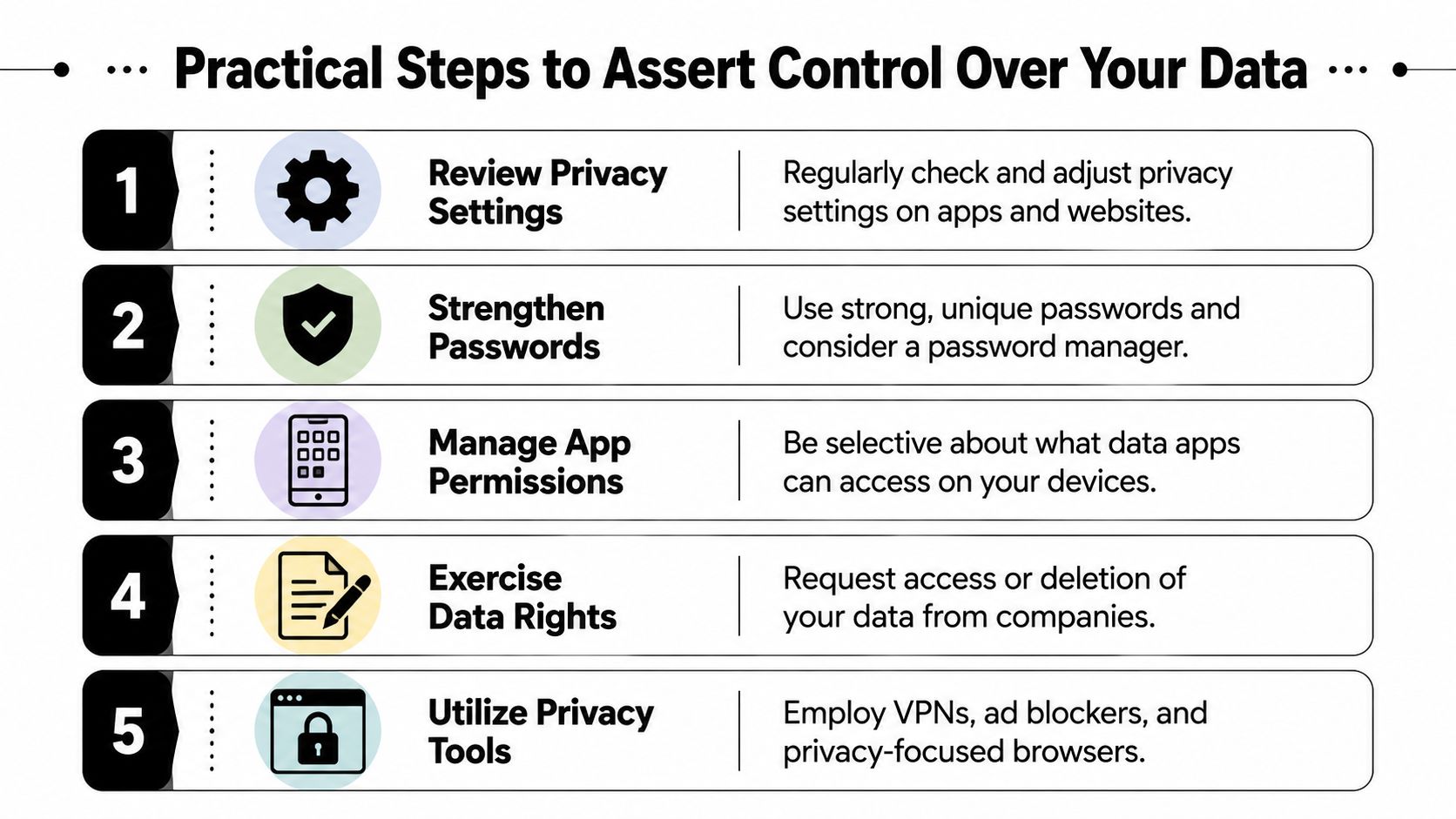
Brookings argues that assigning property rights to consumer data is the wrong approach and that the more useful framing is people’s ability to control, edit, manage, and delete information about themselves. It ties that view to policy trends that emphasize consent, secure transmission, and limits on third-party sharing, as outlined in this Brookings analysis of data control and privacy.
Tighten the places you still control directly
Start with accounts you can still access.
- Review privacy settings: Check who can see your posts, friends list, activity history, profile photos, and contact details on social media, gaming services, and dating apps.
- Remove stale details: Delete old bios, outdated employers, old cities, and public links that make cross-referencing easier.
- Limit discoverability: Turn off settings that let people find you by phone number or email when the platform allows it.
Clean up old accounts
This step matters more than people expect. Dormant accounts can still expose usernames, profile photos, or personal details long after you stop using them.
Try three buckets:
- Keep and secure accounts you still need.
- Delete accounts you no longer use.
- Anonymize accounts you can’t fully remove but can strip down.
If an account no longer serves you, it shouldn’t keep representing you online.
If broker exposure is part of the problem, a removal workflow matters more than the ownership debate. This practical guide to data broker removal can help you identify what to request and where.
Use your data rights where available
Depending on where you live and which company holds the data, you may be able to request:
- Access to the data they hold
- Correction of inaccurate information
- Deletion of certain personal data
- Limits on how data is shared or processed
Keep copies of requests and responses. If a company denies removal, ask why. Sometimes the reason is legal retention. Sometimes it’s a platform policy. Sometimes the answer is vague and needs follow-up.
Reduce future exposure
Control isn’t only about cleanup. It’s also about prevention.
- Use unique passwords and a password manager so one exposed login doesn’t compromise multiple accounts.
- Turn on multifactor authentication for email, gaming, social, and financial platforms.
- Review app permissions on your phone and connected accounts.
- Set alerts for your name, email, and core usernames when possible.
These steps won’t solve every ownership dispute. They do something more useful. They reduce how much of you is easy to find, connect, exploit, or misunderstand.
Building Your Proactive Data Protection Strategy
The most effective mindset shift is simple. Don’t treat privacy cleanup like spring cleaning. Treat it like account maintenance.
A digital footprint changes constantly. New posts get indexed. Old profiles resurface. Data moves between vendors, platforms, archives, and search systems. That means control has to be ongoing.
A simple long-term routine
A practical rhythm looks like this:
- Monthly: Check your main accounts, privacy settings, and security alerts.
- Quarterly: Search your name, email addresses, usernames, and profile photos.
- When life changes: Audit your visibility after a new job, breakup, move, business launch, or public event.
- After a breach notice: Change credentials, review linked accounts, and watch for impersonation or phishing.
For creators, freelancers, and small business owners, legal obligations can overlap with personal privacy habits. If you want a plain-language overview of how consent and data handling fit into that world, this creator guide to GDPR is a practical reference.
Think in cycles, not one-off fixes
A good strategy has three parts:
| Stage | What you do |
|---|---|
| Discover | Find where your data appears |
| Control | Adjust settings, delete, request removal, secure accounts |
| Monitor | Recheck regularly for new exposure |
If you want to build better habits around routine monitoring and privacy hygiene, this guide to ways to protect your online privacy gives a solid checklist.
The ownership of data will keep being debated by lawyers, regulators, and platforms. Your daily protection strategy doesn’t have to wait for that debate to be resolved.
Frequently Asked Questions About Data Ownership
Does data ownership mean I can sell my personal data?
Not in any simple, universal way. Information about you may involve platform terms, privacy law, public records rules, contract limits, and third-party processing arrangements. Even when people talk about “owning” their data, what they usually want is the ability to influence access, reuse, and deletion, not a clean asset they can package and sell like a bicycle.
What’s the difference between data ownership and data privacy?
Ownership of data is about claims of control, access, use, and responsibility. Data privacy is about whether information about you is collected, exposed, shared, or used in ways that respect your rights and expectations.
A person can have privacy concerns even where ownership is unclear. That’s why privacy tools, consent controls, and deletion rights are often more useful than abstract ownership language.
If a company is breached, who is responsible for my stolen data?
Responsibility is often shared, but not equally. The company that collected or stored the data usually carries obligations for security, notification, and response. At the same time, you may still need to act by changing passwords, securing linked accounts, and monitoring for abuse.
Legal responsibility can get complicated when vendors, processors, and multiple systems are involved. If you’re trying to understand how legal analysis tools are changing the way people review these questions, this overview of LegesGPT insights on legal AI offers useful context.
Can I force every website to delete information about me?
No. Some sites will comply with requests. Some are bound by legal retention rules. Some host public records. Some may remove part of the content but not all copies or references. That’s frustrating, but it doesn’t mean you’re powerless. Often the most realistic goal is a mix of deletion, deindexing, account closure, suppression, and monitoring.
Is “public” data fair game for anyone to use?
Not always in the way people assume. Public availability doesn’t erase all ethical, contractual, or legal limits. It also doesn’t mean reuse is harmless. Information that is technically accessible can still create safety, harassment, employment, or identity risks when aggregated or repurposed.
If you want to move from theory to action, start by seeing what’s already out there. Digital Footprint Check helps people identify publicly accessible traces tied to their names, emails, phone numbers, and usernames so they can take practical steps to reduce exposure, secure accounts, and manage their online reputation.