· Digital Footprint Check · Content Marketing · 13 min read
How to Find Someone's Tinder Profile: an Ethical Guide
Looking for ways how to find someone's Tinder profile? Our guide covers ethical search methods, privacy risks, and how to verify identities safely.

You’re probably here for one of three reasons. You want to check whether a new date is who they claim to be, you’ve spotted a detail that doesn’t add up, or you’re trying to protect yourself before you get emotionally or financially involved.
That instinct isn’t irrational. Online dating puts strangers into fast-moving, high-trust conversations. But searching for someone’s Tinder profile sits in an uncomfortable space between reasonable verification and invasive digging. If you’re going to do it, do it carefully, use only lawful open-source methods, and accept a hard truth up front. Many DIY searches fail even when the person really is on Tinder.
That’s the part most articles skip. They hand you a list of tricks without telling you whether those tricks are likely to work, what can go wrong, or where the ethical line sits. Knowing how to find someone’s Tinder profile matters. Knowing when to stop matters more.
Why We Search and the Privacy Tightrope We Walk
People search for Tinder profiles for understandable reasons. A woman wants to verify that the man she plans to meet hasn’t recycled someone else’s photos. A husband notices late-night app notifications and wants answers. A parent worries that a young adult relative is talking to a fake account. Sometimes the motive is safety. Sometimes it’s suspicion. Sometimes it’s plain curiosity.
The problem is that motives don’t automatically make methods acceptable.
A responsible search stays inside publicly accessible information, avoids deception, and keeps the goal narrow. You’re trying to confirm identity, spot signs of catfishing, or protect yourself from fraud. You’re not trying to surveil someone’s private life, bypass platform controls, or pressure a company into releasing account data that isn’t yours.
The good reason test
A simple rule helps. Ask whether your search would still feel justified if a neutral third party reviewed it later. If the answer is no, stop.
Practical rule: Use open information to answer a safety question. Don’t use it to harass, shame, threaten, or control someone.
That distinction matters because dating app searches can spiral quickly. A reverse image search leads to a username. The username leads to other accounts. Those accounts reveal workplace clues, relatives, and location patterns. That’s no longer a single-app check. That’s a broader online identity trail, or what privacy professionals call a digital footprint.
What an ethical search looks like
A legitimate search usually has these traits:
- Limited purpose. You’re checking whether a profile is real, current, and consistent.
- Public sources only. You stick to search engines, public web pages, and information the person has exposed themselves.
- No impersonation. You don’t create fake accounts to lure someone in.
- No coercion. You don’t demand passwords, device access, or account exports.
- A willingness to accept uncertainty. No result doesn’t prove innocence. A partial match doesn’t prove guilt.
That last point is often a source of confusion. Tinder isn’t built as an open directory of users. So even a careful search can produce weak evidence, misleading matches, or nothing useful at all.
Manual Search Techniques and Their Real-World Limits
If you’re trying to find someone’s Tinder profile manually, start with reused identifiers. Public profile photos, display names, usernames, email handles, and phone-linked aliases are the most practical entry points. A public-facing OSINT guide describes reverse image search as the highest-yield first step, recommends using more than one engine because indexes differ, and notes that searching exact names or handles in Tinder’s web interface is more effective than broad guessing because Tinder exposes limited searchability, making reused identifiers the only scalable route in many cases, as explained in this guide to finding someone on Tinder.
The methods people try first

Here’s the practical order I’d use.
Reverse image search
Upload a known profile photo to multiple image search engines. You’re looking for the same headshot on Instagram, LinkedIn, Facebook, X, old forum avatars, or cached profile pages elsewhere.
Username and handle checks
If the person uses a distinctive handle on social media, search that same handle in search engines and on Tinder’s public web pattern where relevant.
Search engine operators
Search combinations of the person’s first name, nickname, city, and known username. If they’ve exposed a public profile page, search engines may surface it.
Cross-platform profile correlation
Look for repeated bios, repeated photos, or the same unusual wording on public accounts. People reuse far more than they think.
If you need a broader workflow for correlating public accounts before narrowing in on Tinder, this guide on finding a person on social media is a useful companion.
What each method gets wrong
Manual methods sound simple because the steps are simple. The interpretation isn’t.
| Method | What can work | Common failure point |
|---|---|---|
| Reverse image search | Finds reused photos on other platforms | No result if images are cropped, compressed, or unique to Tinder |
| Username search | Surfaces repeated handles and public pages | Many people use different usernames across apps |
| Name plus city search | Can reveal public mentions and indexed pages | Produces false positives for common names |
| Bio comparison | Spots repeated phrases or emojis | Similar bios don’t prove the same person |
A reverse image hit is helpful, but it doesn’t confirm a Tinder account by itself. It may only show that the same photo appears somewhere else. A handle match is useful, but people often separate dating identities from public social identities. Name searches are the weakest of the bunch unless the name is unusual.
A bad Tinder search usually fails quietly. You don’t get a clear “not found.” You get ambiguity.
Why location guessing usually wastes time
A lot of DIY advice tells people to manipulate age, distance, and discovery settings, then swipe until the target appears. In practice, this is labor-intensive and unreliable. You may be outside the right area, outside the right age range, or never see the account in your feed even if it exists.
That means two things. First, a miss tells you very little. Second, broad guessing often consumes hours without giving you evidence strong enough to act on.
The most useful manual searches don’t begin inside Tinder. They begin with public clues the person already reuses elsewhere. Even then, you have to treat every match as provisional until other details line up.
Your Digital Footprint Is More Than Just Social Media
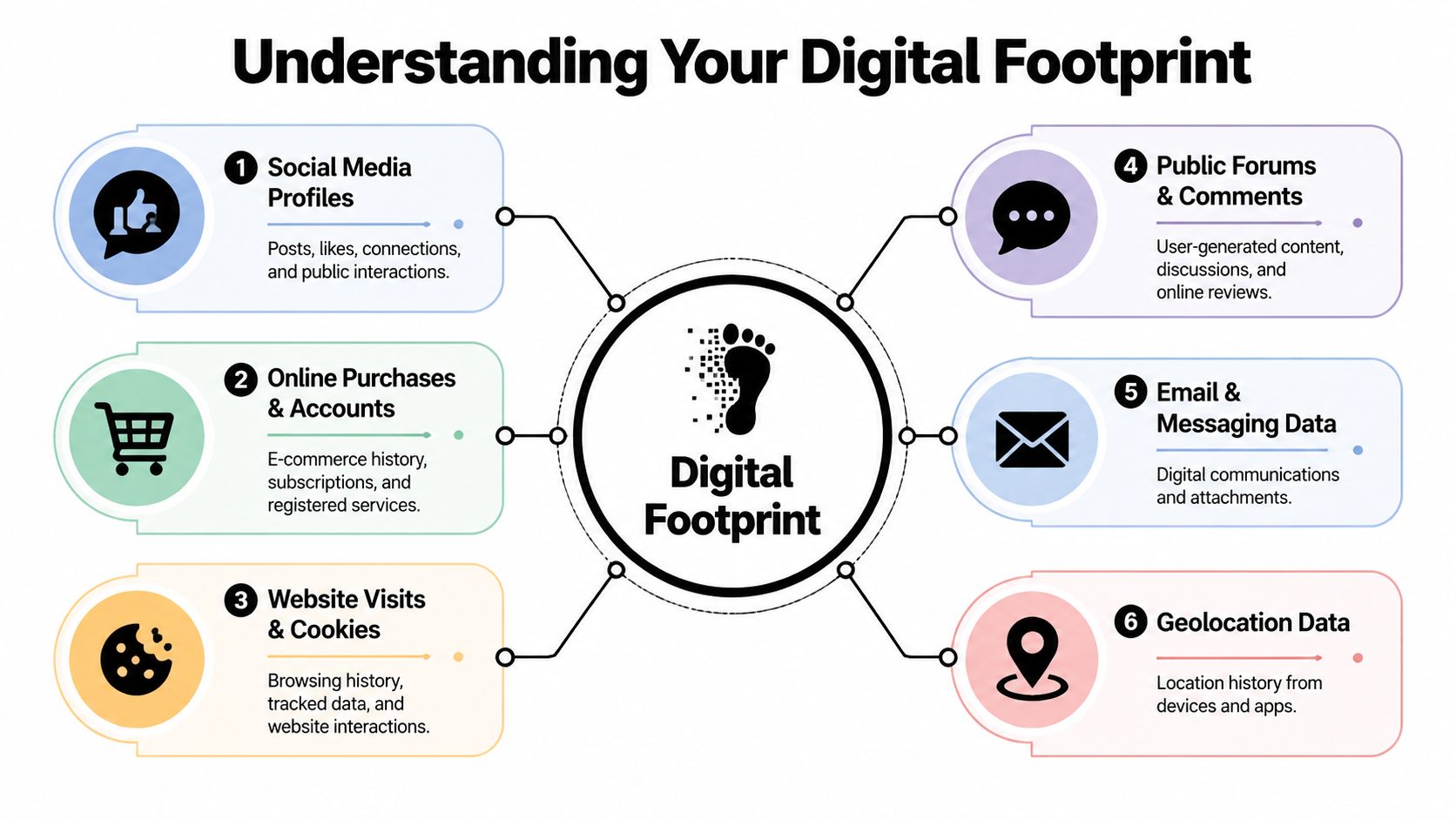
A Tinder search rarely stays about Tinder. Once you start connecting photos, usernames, cached pages, and profile fragments, you’re looking at a much larger picture. A digital footprint includes social media, comments, public-facing profiles, old usernames, forum posts, and details exposed by platforms themselves.
That’s why people underestimate how discoverable they are. They think in terms of apps. Investigators think in terms of identifiers.
Tinder can contribute to that footprint
In some cases, Tinder public web profiles can be indexed and searched by username because a profile URL may take the form tinder.com/@username, and searchers can use queries such as site:tinder.com plus a name or handle to surface matches. A forensic OSINT guide also notes that page source on public profiles may expose internal identifiers such as _id, along with fields like birth_date and image URLs in the HTML, which makes public-profile discovery possible even without app access, according to this forensic Tinder OSINT reference.
That doesn’t mean every Tinder user is openly searchable. It means some users leave a web trail, and search engines may preserve parts of it longer than they expect.
Why this matters beyond dating
A dating profile can connect to much more than dating. The same photo appears on a public Facebook account. That account reveals a workplace. A workplace page reveals a surname. A surname reveals public family links. Small fragments stack fast.
This isn’t just a dating issue either. Family lawyers have written about social media’s role in divorce cases because public posts, profile activity, and online behavior can become highly relevant once trust breaks down.
Here’s the operational takeaway:
- Photos are identifiers. A face, background, or repeated selfie style can connect accounts.
- Usernames travel. People often carry the same handle from gaming to dating to forums.
- Metadata matters. Even when a page looks sparse, the source code or indexed snippet can reveal more.
- Context closes the loop. A single clue is weak. Several consistent clues can be persuasive.
Key point: Most people don’t have one online identity. They have many fragments of one identity spread across services.
If you want to understand that broader map, not just one profile, start with your own digital footprint search process. It’s the best way to see how disconnected accounts become connected in practice.
Using Professional Tools for Compliant and Effective Searches
Manual searches break down for the same reason they sometimes work. They depend on public clues, but they depend on a human spotting patterns across too many places at once. Once you move beyond one photo and one guessed username, the work becomes repetitive, easy to misread, and hard to document cleanly.
That’s where professional OSINT tools make more sense for legitimate, safety-focused checks.
Why structured tools beat ad hoc searching
A compliant OSINT workflow does more than search faster. It keeps the process organized, limits guesswork, and creates a clearer distinction between public evidence and assumptions.
That matters when you’re trying to answer questions like these:
- Is this profile photo reused elsewhere under a different name?
- Does the same username appear across multiple services?
- Are there public traces tied to an email, phone-linked alias, or handle?
- Do multiple public records point to one consistent identity, or several unrelated people?
Individuals searching by hand often overvalue the first hit they find. Professional-grade tools reduce that tendency by presenting broader context. Instead of treating one matching username as proof, they help you compare patterns across platforms and decide whether the overlap is meaningful.
For readers who want a more systematic look at this category, these social media investigation tools show how OSINT workflows are usually structured.
What a responsible tool should do
A privacy-conscious search tool should not promise magic. It should help users work within public-data boundaries and understand uncertainty.
Look for these qualities:
| Feature | Why it matters |
|---|---|
| Multi-platform correlation | One handle or image rarely tells the full story |
| Clear reporting | You need to separate confirmed findings from possible matches |
| Public-data focus | This reduces legal and ethical risk |
| Identity context | Results should show how separate clues connect |
A good platform should also save time. Not because speed is the goal, but because fatigue leads people to sloppy conclusions. After enough tabs and screenshots, users start forcing patterns that aren’t there.
Here’s a closer look at how that kind of workflow functions in practice:
The real advantage is compliance
The strongest argument for professional tools isn’t convenience. It’s discipline.
A structured OSINT process helps you stay out of the gray areas that get individuals into trouble, such as impersonation, covert access, or collecting more information than the situation justifies. That makes professional tools the safer route when the concern is legitimate, such as verifying a date, checking for catfishing signals, or auditing what’s publicly exposed about you or your family.
Navigating the Ethical and Legal Boundaries of Your Search
There’s a clean line between a protective verification check and harmful monitoring. People cross it when they stop asking, “Do I need this information to stay safe?” and start asking, “How much can I uncover if I keep pushing?”
That’s where legal risk and ethical risk meet.

Acceptable checking versus intrusive conduct
A reasonable search might involve checking whether profile photos are stolen, whether a name matches public accounts, or whether a claimed profession appears consistent online.
An unreasonable search often includes behavior like this:
- Creating fake identities to provoke interaction
- Accessing someone else’s device without permission
- Trying to obtain private account exports that belong to another person
- Collecting personal details you don’t need for safety
- Using findings to threaten or shame someone
The platform itself gives a strong clue about where the boundary sits. Tinder provides a formal account-data access path through its Manage My Account tool. Users log in, choose Download My Information, and receive a copy of personal data by email. Tinder also states that the information is largely already available in-app, varies depending on account use, and isn’t available through that tool after the account is deleted, as described in Tinder’s personal data request process.
That matters because it shows Tinder treats account-linked data as controlled user information, not something available through open lookup.
A simple boundary test
If the method requires access that the subject themselves controls, it’s probably not your information to obtain.
Publicly visible information is one thing. Account-level data behind login and request workflows is another.
That’s why ethical OSINT stays in open sources. It also documents uncertainty instead of inflating suspicion. If your findings are weak, say they’re weak. If all you have is a reused photo and a similar username, that’s a lead, not a verdict.
When to stop searching
Stop when one of these becomes true:
- You’ve answered the safety question that started the search.
- The only remaining methods would invade privacy.
- Your motive has shifted from protection to obsession.
- You’re trying to prove a personal belief rather than test evidence.
If your concern involves infidelity, this broader discussion of how to catch a cheater online is useful because it frames the issue around evidence quality, consent, and personal boundaries instead of just tactics.
Beyond the Search How to Verify Identity and Move Forward
Finding a possible Tinder profile is only half the job. The next question is whether it’s real, current, and connected to the person you think it is.
Verification works best when you look for consistency across small details rather than one dramatic clue.
Signs a profile may be genuine or misleading
A more credible profile usually has aligned photos, a writing style that matches other public accounts, and identity details that don’t conflict across platforms. A riskier profile often has polished but context-free photos, inconsistent age or job details, evasive messaging, or obvious urgency.
If you want a primer on one of the most useful checks, this guide to reverse image search for dating apps gives a practical overview of how photo matching fits into identity verification.
Try this checklist before you draw conclusions:
- Compare profile photos carefully. Look for the same face, but also the same backgrounds, crops, and image quality patterns.
- Check timeline consistency. Does the claimed city, workplace, or lifestyle line up with public traces elsewhere?
- Use live verification. A short video call often answers more than an hour of searching.
- Watch for pressure tactics. Anyone pushing for money, secrecy, or immediate commitment deserves extra scrutiny.
If you find nothing, don’t overread it
This is the biggest mistake in the whole topic. People assume that no result means no profile. Tinder’s own help guidance says users cannot search for a specific person and can only adjust Discovery preferences, which means any search method is probabilistic and depends on factors like distance, age range, and whether the person is active enough to surface in the feed, as explained in Tinder’s page on searching for a specific person.
So if you don’t find them, you haven’t proved they’re absent. You’ve only learned that they weren’t discoverable through the methods you used.
The safest conclusion from a failed search is “inconclusive,” not “case closed.”
The healthier next move
Use online checks to inform judgment, not replace it. Ask direct questions. Prefer video calls before meeting. Meet in public. Keep first meetings low-pressure. Don’t send money. Don’t ignore inconsistencies because the conversation feels exciting.
And don’t forget the other side of this issue. The more you understand your own public trail, the better you can protect yourself from impersonation, oversharing, and unwanted discovery.
If you want to see what’s publicly exposed about you, a date, or your family through lawful open-source methods, try the free checker from Digital Footprint Check. It’s a practical way to audit online identity exposure, spot reused usernames and public account traces, and make better privacy decisions before a small concern turns into a bigger problem.