· Digital Footprint Check · Content Marketing · 11 min read
Find Social Media Profiles by Phone Number
Learn how to find social media profiles by phone number using OSINT methods, and discover practical steps to protect your digital privacy from unwanted lookups.

Typing a phone number into a social platform used to feel like a shortcut. Today, that assumption is usually wrong, because social media profiles by phone number are no longer exposed through a universal public search box on major platforms unless the target’s privacy settings allow it.
That shift matters because it changed the game from open lookup to gated discovery. If you want to understand what a number can still reveal, you have to think less like a browser user and more like a privacy auditor who checks contact syncing, recovery settings, and identity matching.
Why Phone Number Lookups Fail on Modern Platforms
A phone number may look like a simple search term, yet modern social platforms treat it more like a permission-controlled signal. The older advice belongs to a different era. In September 2019, Facebook patched a contact-importer issue that had enabled phone-number-based enumeration at scale. Large platforms such as Instagram and Facebook then moved further toward a privacy-restricted, contacts-based matching model (socialprofiler.com). A number generally cannot serve as a public lookup key by default.
Why direct searches usually fail
Entering a bare number often returns nothing because a platform may reveal an account only when its owner has enabled findability, or when the match occurs through synced contacts, mutual connections, or another platform-specific permission.
The confusion comes from treating a phone number like an email address in a search bar. Modern systems use it more like a badge checked at a guarded entrance. The platform compares that signal inside approved workflows and displays only what the account and platform settings allow. For broader caller-side research, check who called with these tools can help distinguish phone-number research from profile discovery.
Focus on which privacy gate blocked the search rather than why the search returned nothing. The gate may involve account discoverability, contact permissions, or matching rules. For a closer look at whether someone can track you by your phone number, review the tracking risks separately from profile visibility. A failed lookup does not prove that a number has no digital connections.
What changed in practice
Before privacy hardening, phone numbers could function like open doors. Now they behave more like keys that fit selected locks. Mutual contacts, sync permissions, and account settings determine whether a platform returns a profile, suggests an account, or shows no visible result.
The larger issue is cross-platform identity correlation. A number can connect accounts through separate privacy-gated systems even when it never appears as a public profile field. Modern research should therefore begin with realistic expectations and defensive privacy checks. Review where your number is stored, who can find you, and which apps can import your contacts.
How Contact Syncing Creates Hidden Links
A phone number can be invisible on a profile and still matter behind the scenes. That’s the key idea, it works like a hidden linkage key, a bridge that connects separate accounts without showing up as a public field.
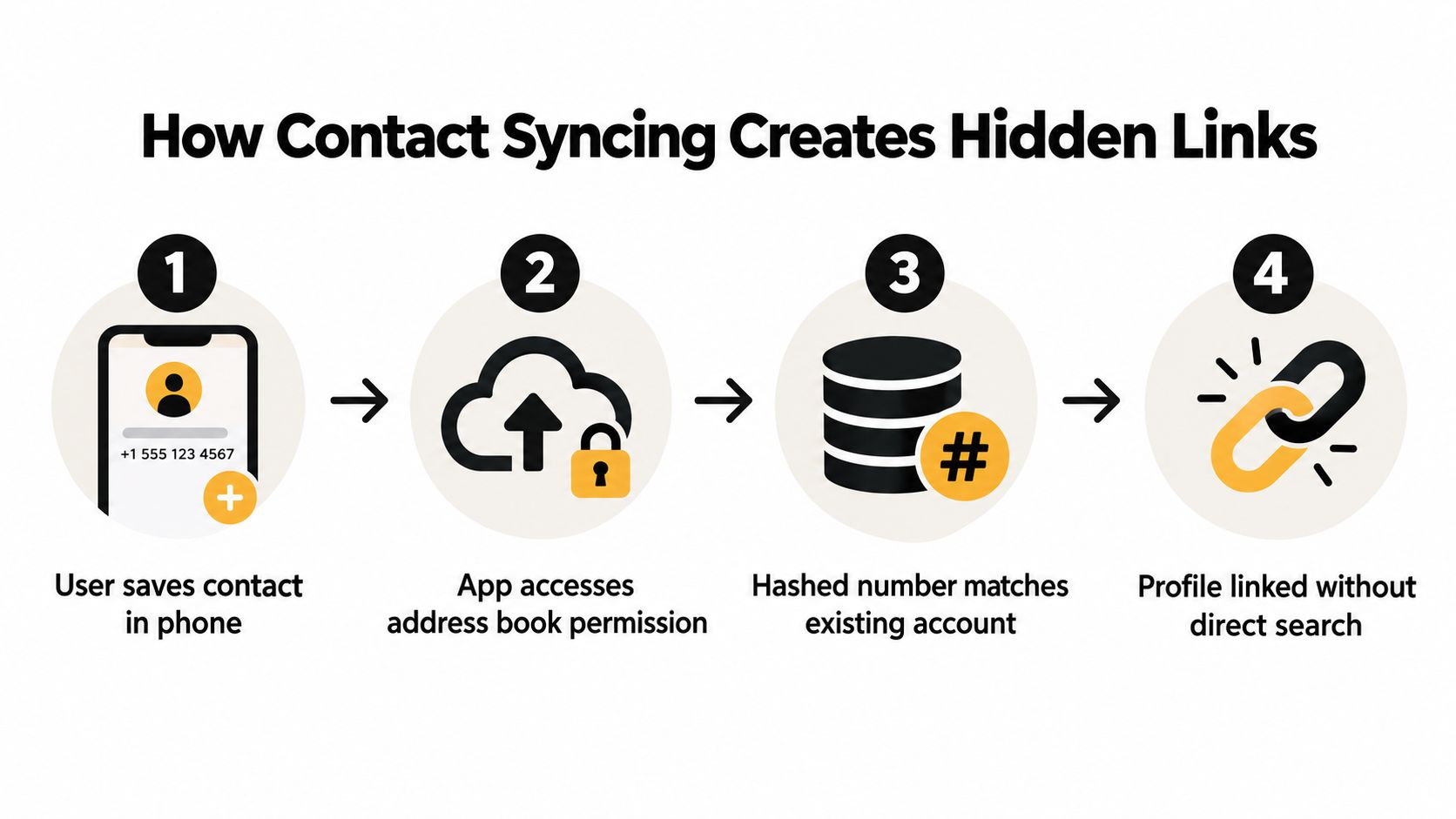
Public field versus backend identifier
A public profile field is what other people can see. A backend identifier is what the platform uses to match, sync, recover, or suggest accounts. Those two things are not the same, and that’s where a lot of people get surprised.
One 2025 guide reported that 60% of social media users link their phone numbers to at least one of the social sites they use most (lookupplainly.com). That doesn’t mean those numbers are visible on profiles. It means they often exist as hidden connectors, especially in verification, password recovery, and contact import flows.
Why users expose themselves without realizing it
People usually add a number for a sensible reason, such as account recovery or two-factor authentication. The tradeoff is that the same number can become a cross-platform anchor, letting apps suggest contacts or associate accounts that would otherwise stay separate.
This is why the phrase social media profiles by phone number can be misleading. The number may not “find” a profile in the public sense, but it can still influence what the platform links internally. For a practical example of how this looks on Facebook-style discovery paths, find FB with phone number is relevant because it reflects how lookup often depends on matching logic, not open search.
A phone number can be private to humans and still be highly useful to a platform.
That hidden role is exactly why privacy-conscious users should treat their mobile number as a sensitive identifier, not just a contact detail.
OSINT Methods for Cross-Platform Correlation
Open Source Intelligence, or OSINT, sounds technical, but the basic idea is simple. You take a small clue, like a phone number, and compare it across public and semi-public sources until patterns line up.
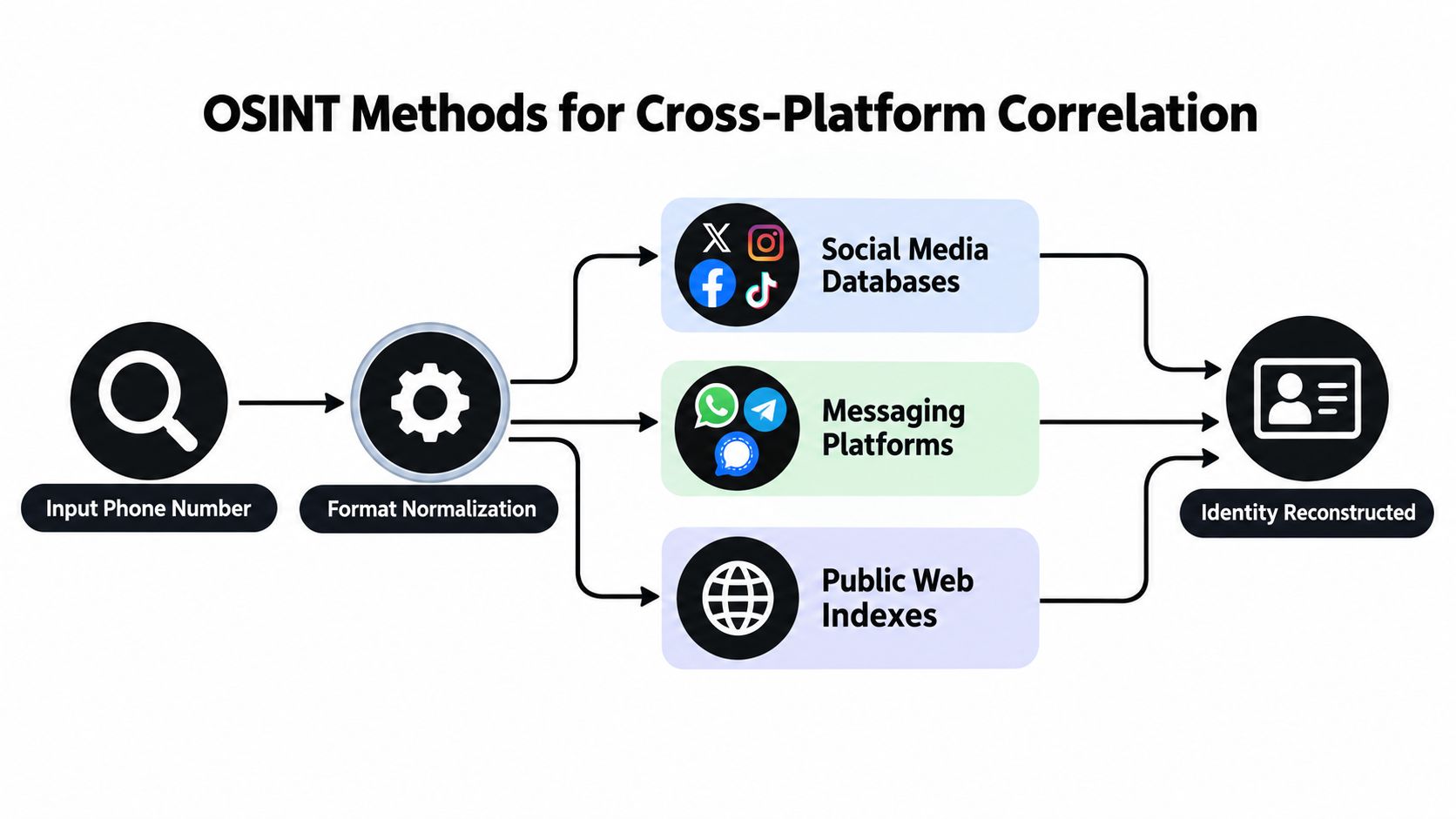
Start with clean input
A technically effective workflow standardizes the number to E.164 and then checks whether it resolves across messaging ecosystems and identity graphs, because lookups often return stronger signals in telecom metadata than on social networks themselves (shadowdragon.io). That step matters because formatting errors create false negatives before the search even begins.
The practical order is usually cleaner than people expect:
- Normalize the number. Strip out spacing, punctuation, and local-format ambiguity.
- Test contextual signals. See whether the number appears in messaging ecosystems, carrier metadata, or public directories.
- Compare identity fragments. Look for consistent usernames, profile names, or recovery links across platforms.
- Judge confidence carefully. A weak match should stay a weak match.
Why line type matters
A mobile number behaves differently from a landline or VoIP line. Line-type and carrier-routing information can help reduce false positives, especially when multiple people share similar naming patterns or recycled numbers appear in public records.
That also explains why modern discovery is often less about social feeds and more about supporting infrastructure. The number may surface in a messaging app, a directory, or an identity graph, then point back to a social profile only indirectly. If you want a privacy-focused overview of this style of research, instagram privacy tips are useful because they highlight the difference between discovery and exposure.
For a broader toolkit-oriented overview, OSINT tools and techniques is the right kind of companion reading for understanding how investigators think about cross-platform correlation.
A useful caution
If a result appears in one ecosystem only, treat it as a clue, not proof.
That caution matters because authenticated, privacy-bounded contexts can expose some data while public web searches show nothing. The bottleneck isn’t just search skill, it’s whether the platform exposes the number at all.
Real-World Risks of Exposed Contact Details
The old “magic search box” idea is the wrong mental model for phone-number exposure. A leaked number works more like a label attached to several records. If scammers find that label in one place, they may test it against dating profiles, messaging accounts, email addresses, or recovery flows elsewhere.
The FTC reported 64,003 romance scam complaints in 2023, with total losses of $1.14 billion and a median loss of $2,000 per person (FTC). The FBI IC3 received 6,740 reports from people age 60 and older who lost almost $357 million to Confidence/Romance scams in 2023 (FBI IC3).
The Cost of Digital Exposure
| Scam Category | Reported Losses | Key Demographic Impact |
|---|---|---|
| Romance scams | $1.14 billion in reported losses in 2023 | Older adults were hit hard in Confidence/Romance scam reporting |
| Confidence/Romance scams for age 60+ | almost $357 million lost in 2023 | People 60 and older reported substantial losses |
| Social media scams | $2.7 billion since 2021 | Anyone with publicly visible profiles or reused contact details |
These figures do not mean that every exposed number produces fraud. They show why the connection between visible profiles, reused contact details, and social engineering deserves attention. The FTC’s identity theft guidance provides further context for the risks associated with exposed personal information (FTC).
How the Damage Shows Up
A scammer may begin with only one confirmed detail. The phone number can serve as a matching key, helping connect an email address, dating profile, gaming account, or messaging identity. Each confirmed match gives the scammer a more convincing story for a romance approach, job-related scheme, or account-recovery request.
The same process can create reputation problems without any account being hacked. A number appearing beside a dating profile, gaming account, and public social page may cause others to treat those identities as belonging to one person. That conclusion could affect how employers, clients, or new contacts interpret the account history.
Exposure also creates practical security questions. Could the number reveal a recovery route? Does it appear beside a public name or profile photo? What hackers can do with your phone number explains why a phone number should be treated as an identity link, not merely a way to make contact.
Defensive Steps to Lock Down Your Privacy
Privacy protection starts by assuming the number can travel farther than you intend. The goal is not to disappear completely, it’s to reduce how easily a single phone number can connect your accounts.
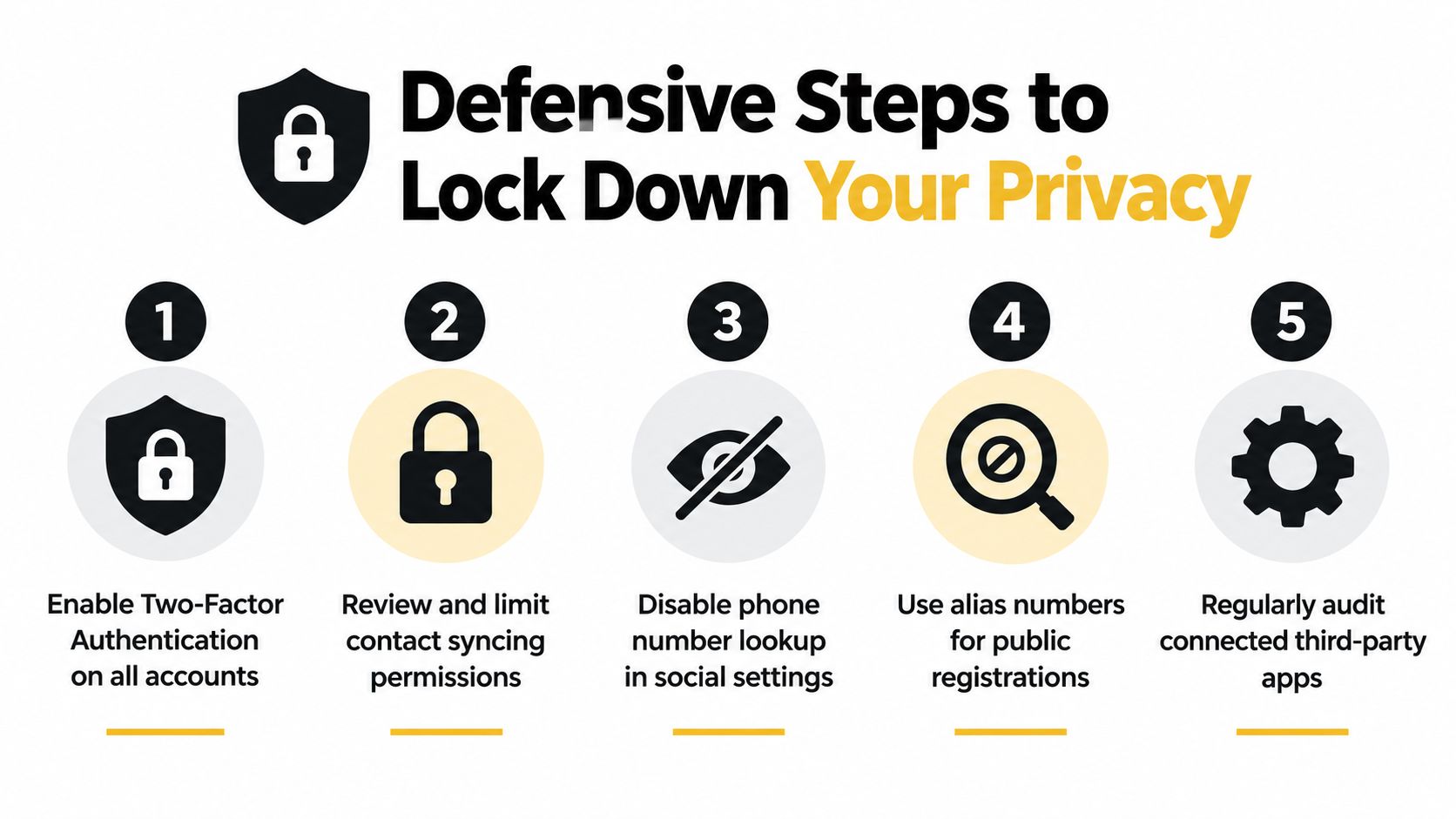
Tighten the settings that matter most
Recent guidance emphasizes number-locking, using secondary numbers, and disabling find-by-phone settings, which reflects the shift from simple lookup to exposure management (security.org). That advice is practical because the same number used for recovery is often the same number used for discovery.
A sensible defensive checklist looks like this:
- Enable two-factor authentication carefully: Use it, but prefer an authenticator app where possible so your primary number isn’t the only recovery anchor.
- Limit contact syncing permissions: Review whether apps can access your address book at all.
- Disable phone-number findability: Turn off any setting that lets others search for you by number.
- Use alias numbers for public signups: Keep your main mobile number off low-trust registrations.
- Audit connected apps regularly: Third-party services can keep stale links alive long after you forget them.
Why secondary numbers help
A secondary number works like a buffer between your public life and your core identity. It’s useful for marketplace accounts, forums, gaming services, and dating apps where you want verification without full exposure.
That doesn’t mean every secondary number is perfect. A VoIP number can still be linked back to you if you reuse usernames, recovery emails, or profile photos. The point is to reduce the number of places where your primary mobile line appears, because every extra link increases the chance of cross-platform matching.
For platform-level cleanup, social media privacy settings is a useful starting point because the settings you forget are often the ones that keep discovery alive.
The safest privacy move is usually to separate identifiers, not just hide them.
That separation matters across personal safety, online dating, gaming profiles, and professional reputation.
Auditing Your Complete Digital Footprint
A phone-number lookup is not a complete privacy audit. Your number is one thread in a larger identity pattern, alongside usernames, email addresses, profile photos, recovery links, and reused account details. Reviewing each thread separately can miss the connection between them.
A useful audit asks two questions: where does each identifier appear, and where could someone match it with another identifier? Public profiles and reused contact details can increase exposure to impersonation, unwanted discovery, and scams. For practical guidance on identity-related risks, consult the FTC.
What a serious audit should cover
Start with accounts you still use, then work backward through older ones. Check social profiles, gaming accounts, professional bios, dating apps, forum registrations, public directories, and known breach records. Search for variations of your name, usernames, email addresses, phone numbers, and profile images. An old username can act like a label on a box, connecting accounts even after the phone number has been removed.
A tool like Digital Footprint Check can help scan public exposure across social accounts, gaming profiles, and other identifier types. Use it to compare how a phone number, email address, or username may connect separate parts of your online life. Treat the results as leads to verify, not proof that every match belongs to you.
Make privacy a routine
Your digital footprint works like a home with several entrances. Closing the front door does little if an old side gate remains open, so repeat the audit after creating accounts, changing contact details, or discovering a breach.
Audit first, then lock down what you find.
Use the results to set priorities. Start with the primary mobile number, then address identifiers that appear across many accounts or connect personal and public profiles. Record what you changed and revisit the list periodically. That turns a one-time search into a practical privacy routine, focused on reducing unwanted discovery rather than chasing every possible mention.