· Digital Footprint Check · Content Marketing · 20 min read
A Practical Guide to Preventing Credit Card Fraud in the
Learn proven strategies for preventing credit card fraud. Our guide offers actionable tips to protect your financial data online and offline.

Preventing credit card fraud comes from smart digital habits and the right tools: strong, unique passwords for financial accounts, transaction alerts, and regularly scanning statements. The goal is to catch criminals before they damage your finances, job prospects, or safety.
Understanding Modern Credit Card Fraud Tactics
"Credit card fraud" can bring to mind a stolen wallet, but today's biggest threats are subtle and woven into daily online routines. It's no longer just about shielding your PIN at the ATM.
Connecting to free Wi-Fi at a coffee shop can expose your financial data to thieves on the same network. That's why fraud numbers keep rising.
The FTC reports consumer fraud losses up 25% year-over-year, over $12.5 billion. Financial institutions say account takeovers and identity theft are top threats, with 60% reporting a jump in fraud last year. The numbers make a clear case for being proactive.
Common Tactics and Their Real-World Impact
Criminals use many methods to get your information. Knowing how these scams work is the first step to a solid defense.
- Phishing: An urgent email that looks like your bank, complete with the logo, warns your account is locked and sends you to a fake site to "verify" your details. It's a trap for your login and card number. A romance scammer, after building trust, might send a phishing link disguised as a "gift," tricking the victim into entering card details on a fake retail site.
- Skimming: A fraudster attaches a tiny, nearly invisible device to an ATM, gas pump, or checkout terminal. When you swipe, it copies your card's magnetic stripe data.
- Account Takeover (ATO): A thief gets your login details — often from a data breach at a gaming platform or social site — and breaks into your banking or retail account. They change your password, lock you out, and use your saved card. Years of gaming progress and purchases can be wiped out in minutes.
The Hidden Costs of Fraud
The damage goes beyond the stolen money. A compromised card can hurt your credit score, making loans harder to get. For job seekers, a bad credit history on a background check can put an offer in jeopardy.
The personal toll is heavy too. Victims spend dozens of hours disputing charges, filing police reports, and rebuilding their financial identity — a stressful process that shows why prevention matters.
Once stolen, your information often ends up for sale on illegal marketplaces where criminals buy and sell personal data in bulk. See what the dark web is and how it works. Controlling your personal information is your best defense against these evolving threats.
Building Your First Line of Defense: Digital and Physical Security
Preventing credit card fraud isn't about complex, high-tech wizardry. It starts with simple, powerful habits you can weave into your daily life. Think of these practices as your personal security perimeter—the essential barriers that make it significantly harder for criminals to get their hands on your financial information, both online and off.
These foundational steps are often the most overlooked, yet they’re your most robust protection against common threats. Adopting them transforms you from a potential target into a much harder nut to crack.
Mastering Your Digital Defenses for Online Security
In the online world, your passwords and browsing habits are the keys to your financial kingdom. Leaving them unprotected is like leaving your front door wide open.
A classic mistake I see all the time is reusing the same password across multiple sites. Imagine this scenario: a gamer saves their credit card details on a gaming platform for easy in-game purchases. That platform gets hit by a data breach, and their simple, reused password is now in the wild. Within hours, fraudsters use those same credentials to log into the gamer’s primary email and banking app. Game over. Their gaming profile is stolen, and their finances are compromised.
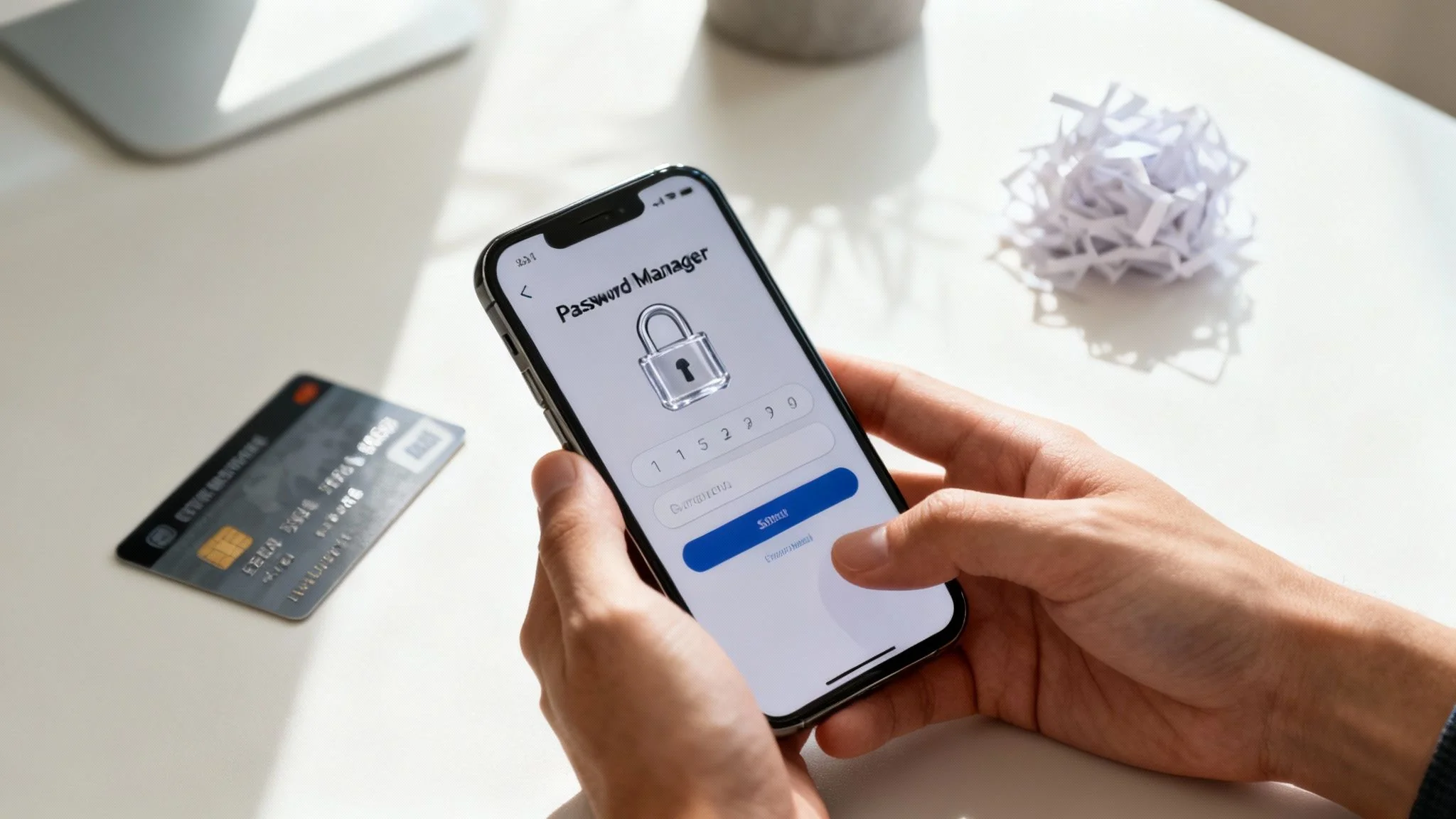
To avoid this, you need a unique, complex password for every account. This is where a password manager becomes non-negotiable.
- Generate Complexity: A good password manager creates long, random passwords (like
8*#gT$kL9@pZ!vF) that are nearly impossible for brute-force attacks to crack. - Secure Storage: It encrypts and stores all your credentials in a secure vault, so you only need to remember one master password.
- Auto-Fill Safely: It can automatically fill in your login details on legitimate sites, which helps you sidestep phishing scams that rely on you manually typing your password into a fake portal.
Building strong password habits is a cornerstone of digital security. You can dive deeper with our detailed guide on password manager best practices to get started.
Another crucial habit is to quickly verify a website’s security before you even think about entering payment information. Always look for "https" at the beginning of the URL and a padlock icon in your browser's address bar. This tells you the connection is encrypted, scrambling your data as it travels from your device to the website's server.
Don't Overlook Physical Security Measures
While digital threats grab all the headlines, old-school physical security measures are still relevant for preventing credit card fraud. Your physical mail and how you handle transactions in public can create huge vulnerabilities if you're not paying attention.
A discarded bank statement or a pre-approved credit card offer tossed in the trash can be a rich source for an identity thief. This practice, known as "dumpster diving," is still a surprisingly common way for criminals to gather enough personal information to open fraudulent accounts in your name.
Get into the habit of shredding all financial documents before you throw them away. This is non-negotiable.
This includes things like:
- Old bank statements
- Credit card receipts
- Expired credit cards (make sure you cut through the chip and magnetic stripe)
- Unwanted credit offers
This simple action disrupts a fraudster's ability to piece together your financial profile from your trash.
Finally, always be aware of your surroundings when you use your card in public. Shield the keypad with your hand when entering your PIN at an ATM or a checkout counter. This protects you from both wandering eyes and hidden cameras that skimmers might have installed to steal your PIN. These small, consistent actions create a formidable first line of defense, making you a much harder target.
Using Technology to Your Advantage for Fraud Prevention
Good habits are your first line of defense, but the most powerful tools for preventing credit card fraud are probably already in your pocket. Modern banking technology gives you an incredible level of control over your accounts, turning your smartphone into a financial security command center.
It's time to shift from being a passive account holder to a proactive defender of your money. The best part? These features are usually built right into your bank's mobile app. You don’t need to be a tech guru to use them; you just need to know they exist and flip the switch.
Activate Your Instant Security Alerts
One of the simplest and most effective ways to stop fraud in its tracks is by setting up real-time transaction alerts. These notifications ping your phone the moment a charge is made, giving you an immediate heads-up on all account activity.
Imagine you’re at home, and your phone buzzes with an alert for a $300 purchase at a store hundreds of miles away. You’ll know instantly that your card has been compromised and can take action right away, rather than discovering the fraud days or even weeks later on a paper statement.
Most banking apps let you customize these alerts. You can usually get notified about:
- All transactions: Get a ping for every purchase.
- Transactions over a certain amount: Set a threshold, like $50, to only hear about larger purchases.
- International transactions: This is a critical alert to have on, especially when you’re not traveling.
- Online or "card-not-present" purchases: Helps you keep a close eye on your digital spending.
The Power of the Card Lock Feature
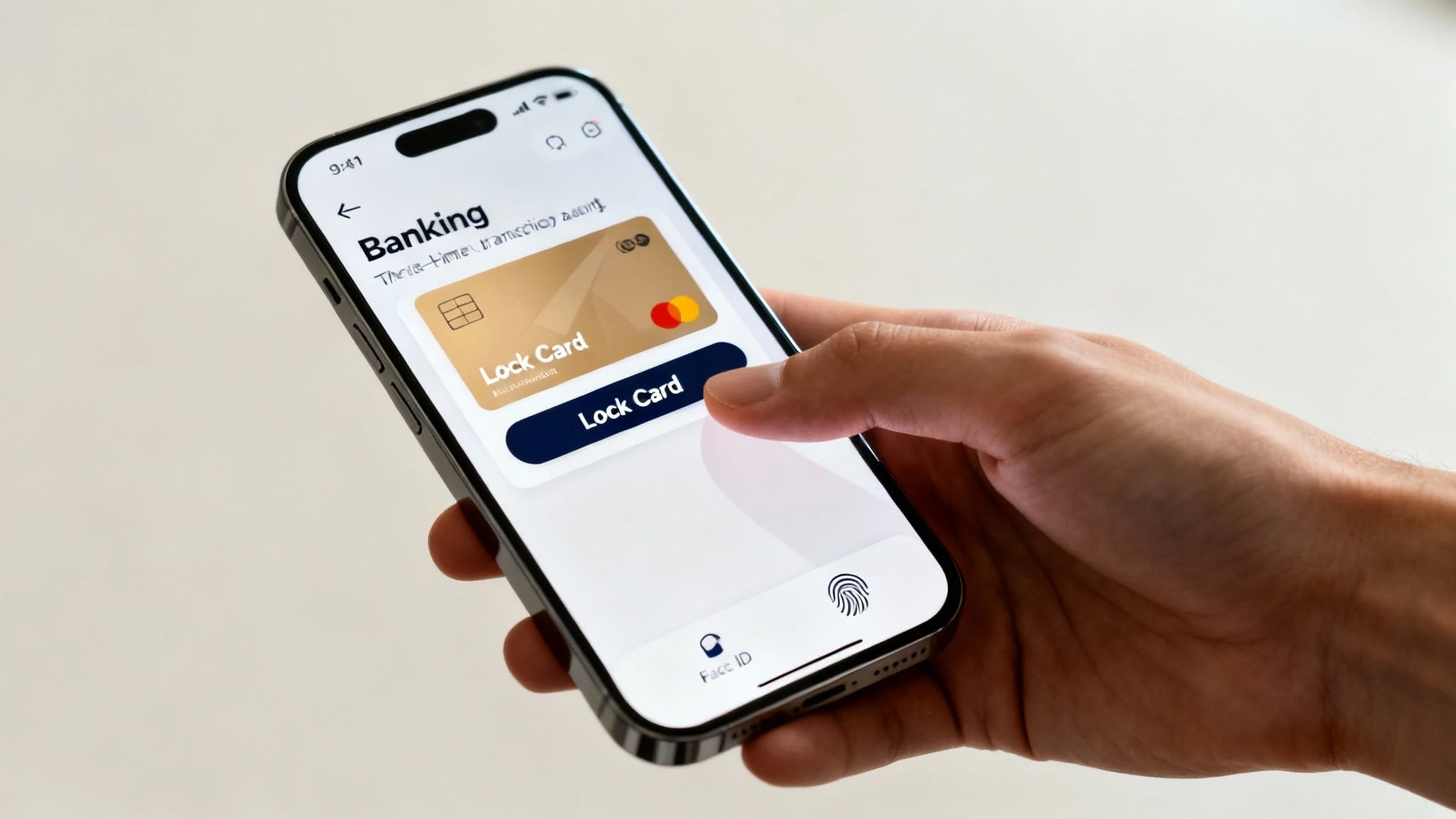
Losing your wallet is a uniquely stressful experience. But before you frantically call to cancel all your cards, check your mobile banking app. Nearly every major bank now offers a feature that lets you instantly lock or freeze your credit or debit card with a single tap.
Locking your card doesn't close your account; it just blocks new transactions from being approved. If you find your card safely tucked in your car’s center console a few minutes later, you can unlock it just as easily.
This simple tech tool transforms a potential financial disaster into a minor inconvenience. It puts the power to halt fraudulent activity directly in your hands, giving you control the moment you suspect a problem.
Let's take a look at some of the most common and effective tools you can start using today.
Comparison Table: Modern Fraud Prevention Tools
This table breaks down the key features that put you in the driver's seat on account security.
| Tool or Feature | What It Does | How It Protects You |
|---|---|---|
| Real-Time Alerts | Sends an instant notification (SMS, email, or push) for every transaction. | Immediately alerts you to unauthorized charges, allowing you to report fraud the moment it happens. |
| Card Lock/Freeze | Temporarily disables your card, preventing any new purchases or withdrawals. | Buys you time to find a misplaced card without leaving your account vulnerable. Perfect for lost-but-maybe-not-stolen cards. |
| Spending Limits | Allows you to set daily or per-transaction spending caps on your card. | Limits the financial damage a fraudster can cause if they do manage to get your card details. |
| Location-Based Controls | Uses your phone's GPS to approve transactions only when you're near the merchant. | Blocks fraudulent in-person transactions attempted in a different city or country from where you are. |
| Virtual Card Numbers | Creates a temporary, unique card number for online shopping. | Protects your actual card number from being exposed in a merchant data breach. You can lock or delete it after use. |
By familiarizing yourself with these tools in your banking app, you create multiple layers of defense that make a fraudster's job much harder.
Of course, your bank is also using powerful tech behind the scenes. The adoption of artificial intelligence has become a cornerstone in this fight, with research showing that AI-powered fraud detection tools achieve success rates between 87-94%. These systems analyze your spending patterns to spot anomalies—like a sudden purchase in another country—and can flag or block the transaction before the damage is done. You can learn more about how AI is revolutionizing credit card fraud detection from experts at FICO.
For businesses, implementing strong identity verification is a crucial part of the puzzle. This is especially true for platforms like dating apps, where verifying a user's identity is key to preventing romance scams and catfishing. Technologies like specialized KYC verification tools help confirm that a customer is who they claim to be, adding another critical layer of security to the process.
Even with the best technology, stolen card details sometimes end up for sale online. Monitoring these illicit marketplaces is an important part of a complete security strategy. For more on this, check out our guide on the best dark web monitoring services to see how these tools can alert you if your information is exposed.
Managing Your Digital Footprint to Reduce Identity Theft Risk
Your credit card details don't just float around in a void. They're tied to the massive web of personal information that makes up your digital footprint—that trail of data you leave every time you go online.
Every social media like, public profile update, or old forum comment adds to this trail, painting a picture of your life that fraudsters are masters at exploiting for identity theft.
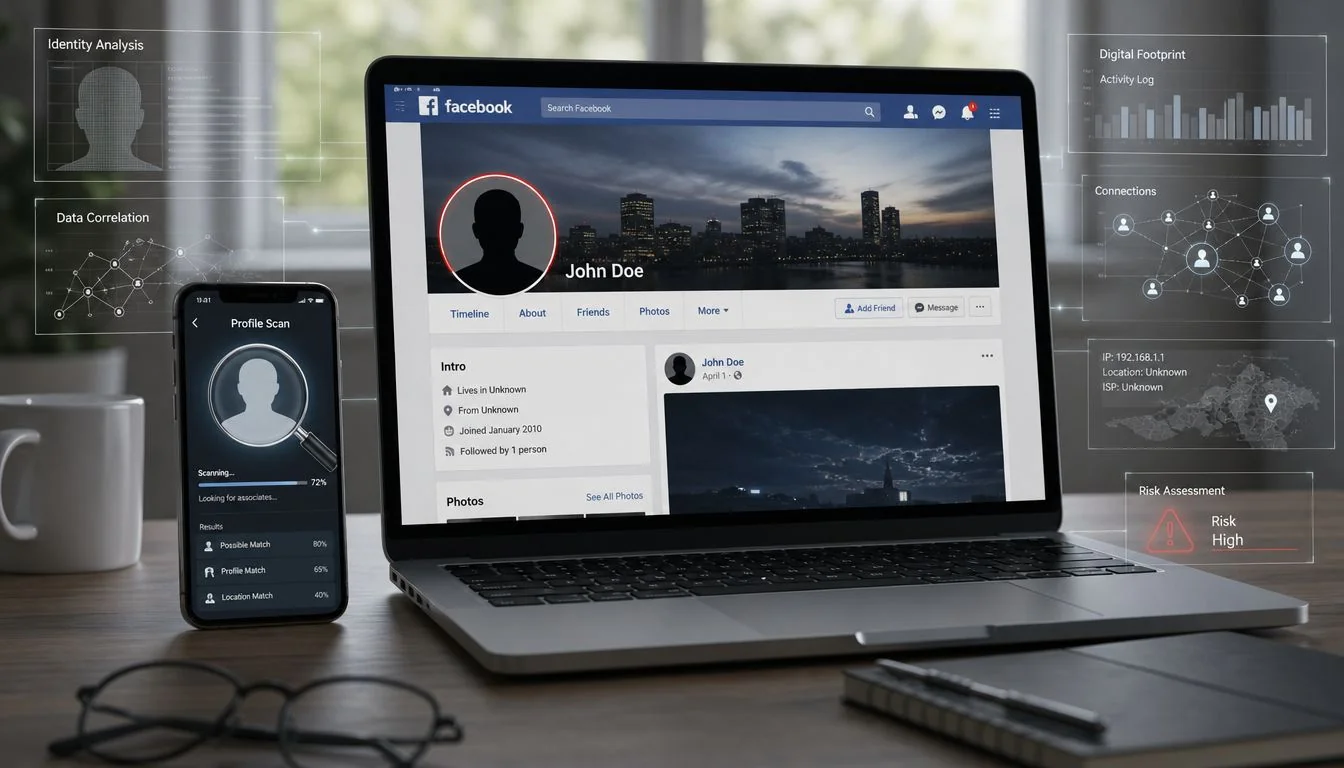
Criminals are good at using Open-Source Intelligence (OSINT) tools, which is just a formal way of saying they use publicly available info to piece together your identity. Your birthday on Facebook, your dog's name on Instagram, your high school on LinkedIn... these might feel like harmless details. To a fraudster, they're the keys to guessing your security questions and breaking into your accounts, which can damage your reputation and personal safety.
How Data Breaches Pour Fuel on the Fire
The risk gets worse when data breaches happen. When a company you use gets hacked, sensitive data—your name, email, date of birth, even passwords—gets stolen and dumped onto dark web marketplaces.
Fraudsters buy this info and combine it with the public details they've already scraped together about you. Now they have a powerful toolkit for some seriously sophisticated fraud.
For instance, armed with your email and a password from a breach, they'll try logging into your other accounts. With your phone number and mother's maiden name, they can try to trick a customer service rep into swapping your SIM card, letting them bypass two-factor authentication entirely.
Your digital footprint is the raw material for identity theft. The more that's publicly available about you, the easier it is for a criminal to impersonate you, open new credit cards in your name, or hijack your existing accounts.
This is exactly why actively managing your online presence is a core part of preventing credit card fraud. To get a handle on this, it's crucial to understand the essential tips for protecting personal information online.
A Practical Guide to Auditing Your Own Digital Footprint
You don't have to be a security pro to see what's out there about you. A few simple OSINT tricks can help you audit your own digital footprint so you can start cleaning it up. It’s all about seeing yourself through a fraudster’s eyes.
Think of it as a personal security check-up. Fire up a search engine and use a few specific search operators (often called "dorks") to get targeted results.
- Search for your full name in quotes:
"Jane Doe"will pull up exact matches. - Search for your common usernames:
"J doe123"can unearth accounts on old gaming sites or forums you forgot about. - Combine your name with other personal data: Try searches like
"Jane Doe" + "New York"or"Jane Doe" + "accountant"to see what connections pop up. - Use the
site:operator: A search likesite:facebook.com "Jane Doe"restricts your search to just that one platform.
These basic searches can quickly reveal old profiles with weak privacy settings, public comments you left years ago, and other data points you can then work on getting removed. For a more structured approach, you should follow a complete guide for a personal online audit to cleanse your digital footprint.
Take Back Control of Your Online Identity and Reputation
Finding out just how much of your life is public can be unsettling, but it’s the necessary first step toward reclaiming your privacy and protecting your finances. A clean digital footprint is crucial for online reputation management.
By actively managing your digital footprint, you make a criminal's job significantly harder. Regularly auditing your online presence, tightening up social media privacy settings, and deleting old, dormant accounts are powerful moves. This isn't a one-and-done fix; it's an ongoing habit that's essential for staying safe.
How to Respond When Fraud Happens: A Step-by-Step Guide
Even with the best defenses in the world, credit card fraud can still happen. The moment you spot an unauthorized charge, the key is not to panic. Instead, you need to act fast. That gut-sinking feeling is normal, but a clear, methodical response will shut down the fraudster and get you back on track quickly.
Your very first move, always, is to call your credit card company. Use the number on the back of your card or find it in your banking app—don't just Google it. Report the charge you don't recognize and ask them to walk through other recent transactions. They'll immediately cancel the compromised card and get a new one in the mail, stopping the thief in their tracks.
Your Immediate Action Checklist for Fraud Recovery
Once the bank has secured your account, a few more steps are critical to protect your credit and your broader identity. Don't wait on these—tackling them in the first 24-48 hours can prevent a much bigger headache down the road.
Here’s what to do next:
- File an Official Report: Go to IdentityTheft.gov and report the fraud to the Federal Trade Commission (FTC). This creates an official record that is essential for disputing charges and proving you were a victim.
- Contact the Credit Bureaus: You need to put the three major credit bureaus—Equifax, Experian, and TransUnion—on notice. We'll get into what to tell them in a moment.
- Review All Accounts: Log into every other financial account you have. Check your other credit cards, debit cards, and bank accounts to make sure the breach hasn't spread.
This sequence is a core part of digital safety: you scan for the threat, clean up the immediate damage, and then set up monitors to prevent future issues.
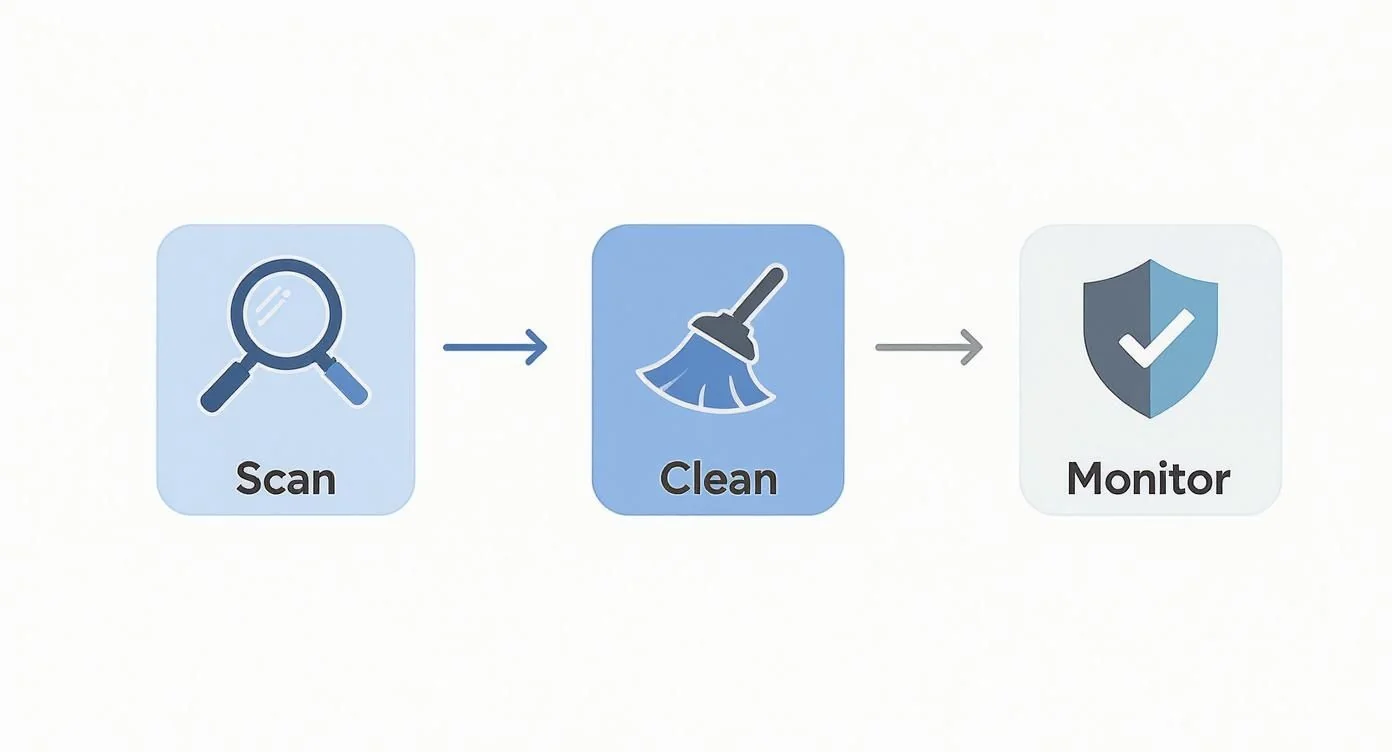
This simple flow—Scan, Clean, Monitor—is the fundamental cycle of good digital security. You're actively looking for exposed data, dealing with any vulnerabilities you find, and then watching your accounts to stay protected.
Deciding Between a Fraud Alert and a Credit Freeze
When you call the credit bureaus, they'll give you two main options to protect your file: a fraud alert or a credit freeze. Knowing the difference is crucial for picking the right tool for the job.
A fraud alert is like a sticky note on your file telling lenders to be extra careful, while a credit freeze is like putting a padlock on the door.
| Feature | Fraud Alert | Credit Freeze |
|---|---|---|
| What It Does | Adds a note to your credit file, warning lenders to take extra steps to verify your identity. | Restricts access to your credit report, blocking new accounts from being opened in your name. |
| Duration | Lasts for one year (or seven years if you have an official identity theft report). | Stays in place until you decide to lift it, either for a specific time or permanently. |
| Best For | A great first step after a single compromised card or as a general precaution. | The strongest protection available, best for when your Social Security number is exposed or after confirmed identity theft. |
| Accessibility | Lenders can still pull your report but are encouraged to call you to verify it's really you. | You, your existing creditors, and some government agencies can still see your report, but new lenders are blocked. |
For a simple case of a stolen credit card number, a one-year fraud alert is usually more than enough. If you have reason to believe more sensitive info like your Social Security number was stolen, a credit freeze is the way to go.
And if you're worried about broader identity theft, you might want to look into the best identity theft protection services that can do the work of monitoring for you.
Industry-wide efforts are also making a dent. In Europe, for example, the mandate for Strong Customer Authentication (SCA) has been a major advantage. As the latest report from the European Banking Authority shows, fraud rates for transactions that use multi-factor authentication are lower. It’s a clear reminder that combining smart technology with consumer awareness is our best defense.
By following these steps, you can take control of the situation, resolve the issue, and get your peace of mind back.
Common Questions About Credit Card Fraud
On credit card security, it's natural to have a lot of specific questions. Let's tackle some of the most common ones we hear. Think of this as your quick-reference guide to make sure you're feeling confident about your fraud prevention strategy.
Am I Liable for Fraudulent Charges on My Credit Card?
This is usually the first thing people worry about, and for good reason. The good news? Consumer protections are strong.
In the United States, the Fair Credit Billing Act (FCBA) legally limits your liability for fraudulent charges to just $50.
But it gets even better. Almost every major credit card issuer has adopted a "$0 liability" policy. As long as you report the bogus charges in a timely manner, you won’t be on the hook for a single penny. The key is to act fast. The second you spot a transaction that wasn't you, get on the phone with your bank.
Keep in mind that the rules for debit cards are much stricter. Your potential liability can jump significantly the longer you wait to report fraud, so immediate action is essential.
How Can I Protect My Children from Identity Theft?
Protecting a child's identity is a huge deal because their clean, unused credit history is a rich source for a crime called synthetic identity fraud. This is a nasty trick where criminals mix real and fake information—like your child's Social Security number with a made-up name and address—to create an entirely new, fraudulent identity.
The single most powerful move you can make is to place a credit freeze on your child's file with each of the three major credit bureaus: Equifax, Experian, and TransUnion. This step makes their credit file invisible to new lenders, stopping fraudsters in their tracks.
A credit freeze for a minor is one of the strongest preventative tools a parent has. It blocks anyone from opening new accounts in their name, shutting down the fraud before it can even start.
Beyond that, be protective of your child's Social Security number. For older kids, it's also smart to talk to them about online safety, especially on gaming platforms or social media apps where payment info might be requested or stored.
What Is the Difference Between a Fraud Alert and a Credit Freeze?
Both are excellent tools for preventing credit card fraud, but they work differently and are meant for different situations. Knowing the distinction helps you pick the right tool for the job.
-
Fraud Alert: This is like putting a "red flag" on your credit report. It signals to potential lenders that they need to take extra steps to verify your identity before approving any new credit. You only have to place it with one bureau, and they'll notify the other two. It typically lasts for one year.
-
Credit Freeze: This is the heavy-duty option. It locks down access to your credit report, making it impossible for new creditors to even see your file. If they can't see it, they can't open a new account in your name. You have to contact each bureau individually to place and lift a freeze.
So, when to use which? A fraud alert is a good proactive step if you’ve lost your wallet or think your data was exposed in a minor breach. A credit freeze is the way to go if you know your Social Security number has been compromised or you've already been a victim of identity theft.
Does a VPN Really Help Prevent Credit Card Fraud?
Absolutely. Using a VPN (Virtual Private Network) is a fantastic security habit, especially when you're on public Wi-Fi.
Think about the networks at coffee shops, airports, and hotels. They're notoriously insecure and a favorite hunting ground for hackers looking to snatch data. A VPN encrypts your entire internet connection, creating a secure, private tunnel for everything you do online. This makes it difficult for anyone snooping on the network to intercept sensitive info like credit card numbers, passwords, or banking logins when you're making a purchase or checking your accounts.
While a VPN isn't a magic bullet on its own, it’s a critical layer of defense for protecting your financial data when you're away from a trusted network. It’s an essential part of any modern fraud prevention strategy.
Your digital footprint is the raw material fraudsters use to piece together their scams. The first step in protecting yourself is knowing exactly what information about you is out there for them to find. This exposed data impacts everything from your financial security to your job prospects and personal safety online.
At Digital Footprint Check, we empower you to see your online presence through the eyes of a security expert. Use our free tool to start your scan and take back control of your personal data today.
Discover what information you have exposed with our free checker at www.digitalfootprintcheck.com/free-checker.