· Digital Footprint Check · Content Marketing · 15 min read
Spot Fake Profiles on Facebook: a 2026 Investigator's Guide
Learn to spot and report fake profiles on Facebook with our guide. Protect your privacy from scams, catfishing, and identity theft using OSINT steps.
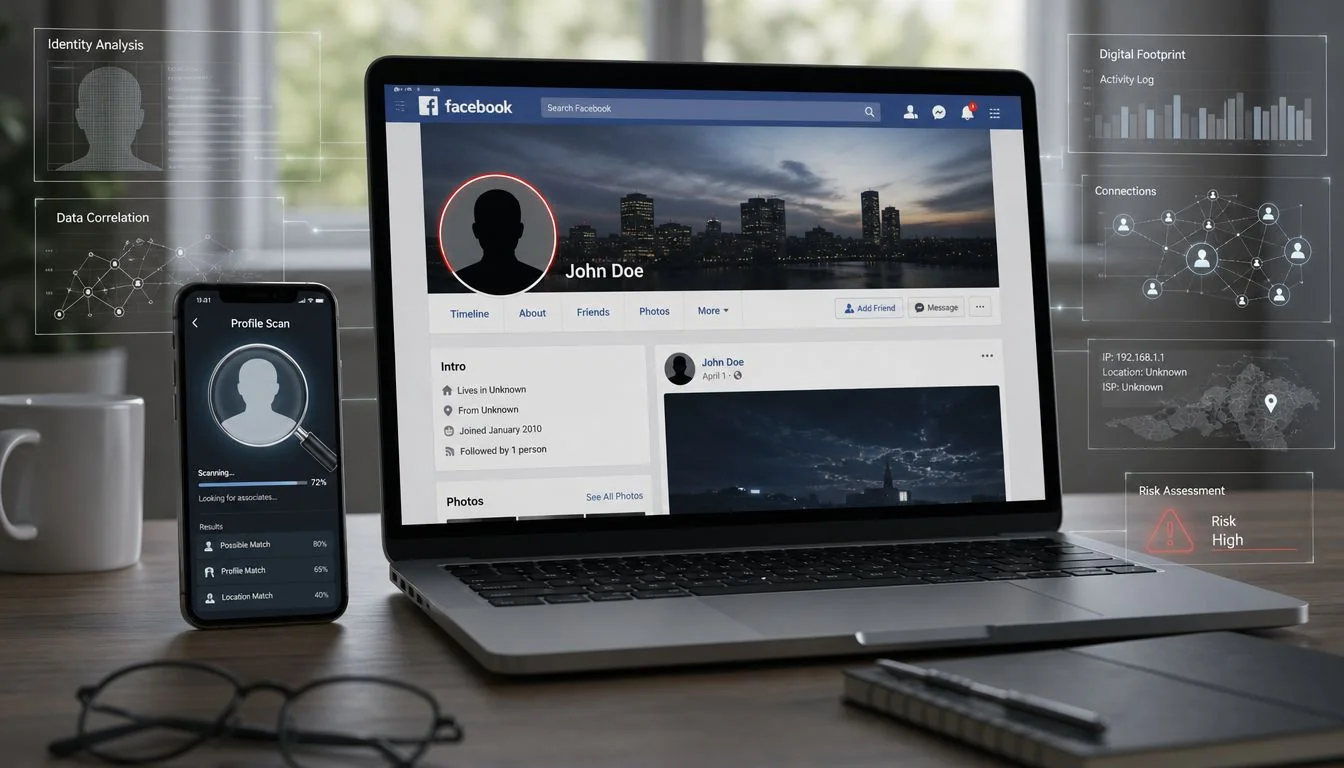
Facebook removed 2.2 billion fake accounts in a single three-month period, yet the company still estimated that about 5% of monthly active accounts were fake, which means over 100 million fake profiles may still be active at any given time according to Facebook fake account enforcement reporting summarized by Bitdefender. That should change how you look at a random friend request, a flattering message, or a profile that seems familiar but slightly off.
Many users still treat fake profiles on Facebook as a minor nuisance. They aren’t. A fake account can be a romance scam, a cloned profile of someone you know, a brand impersonator, a fake recruiter, a catfish, a burner account for harassment, or a surveillance tool sitting inside a local group. The practical problem is simple. Humans are bad at spotting deception when a profile looks normal enough.
The right response isn’t paranoia. It’s process. If a profile matters enough to click, message, hire, date, trust, or add to a family network, it matters enough to verify.
The Hidden Epidemic of Fake Facebook Profiles
Fake Facebook profiles are common enough that treating them as rare mistakes leads people into avoidable trouble. In investigations, I assume a suspicious account is unverified until it earns trust through evidence. That mindset catches more impostors than instinct does.
What counts as a fake profile
A fake profile is any account that misrepresents who is behind it or why it exists. Some are obvious scams. Others are built with patience and look ordinary for weeks or months.
On Facebook, that usually falls into a few patterns:
- A cloned identity pretending to be your friend, coworker, or family member
- A catfishing account built to create emotional attachment or extract money
- A reputation attack account made to harass, defame, or impersonate a person or business
- A bot-style account used to amplify posts, comments, or group activity
- A surveillance persona meant to watch communities, collect information, or steer discussion
The key question is not whether the profile looks polished. The key question is whether the identity, history, and activity line up in ways an outsider can verify.
Practical rule: Don’t ask whether a profile seems real. Ask whether the identity, history, and behavior can be independently verified.
Why casual judgment fails
People trust familiarity. A fake account that joins the right neighborhood group, comments on a school fundraiser, or adds a few mutual contacts can blend in fast. That is enough to get accepted into a private circle, and once it is inside, the account can watch conversations, collect names, and start direct outreach.
I see this mistake often. Someone accepts a request because the profile photo looks local and the name rings a bell. Later, the same account is messaging relatives for money, approaching job seekers with fake offers, or probing for personal details that support account recovery fraud. If your goal is account takeover prevention, this is one of the earliest points where a bad decision creates later damage.
The impact of fake Facebook profiles includes more than embarrassment. A copied identity can damage trust in a family, a volunteer group, or a business community. That matters in organizations where access to children, vulnerable adults, or donor information depends on screening and role verification, which is why some groups pair social vetting with a formal volunteer background check.
What makes this an epidemic is not just volume. It is how little evidence many users require before they treat an account as genuine. Human judgment helps, but it is inconsistent. A structured OSINT workflow works better because it forces you to check the same signals every time, document what matches, and note what does not. That manual process takes time, which is exactly why automated tools such as Digital Footprint Check have become useful for spotting impersonation patterns at scale.
Why Fake Profiles Are More Than Just an Annoyance
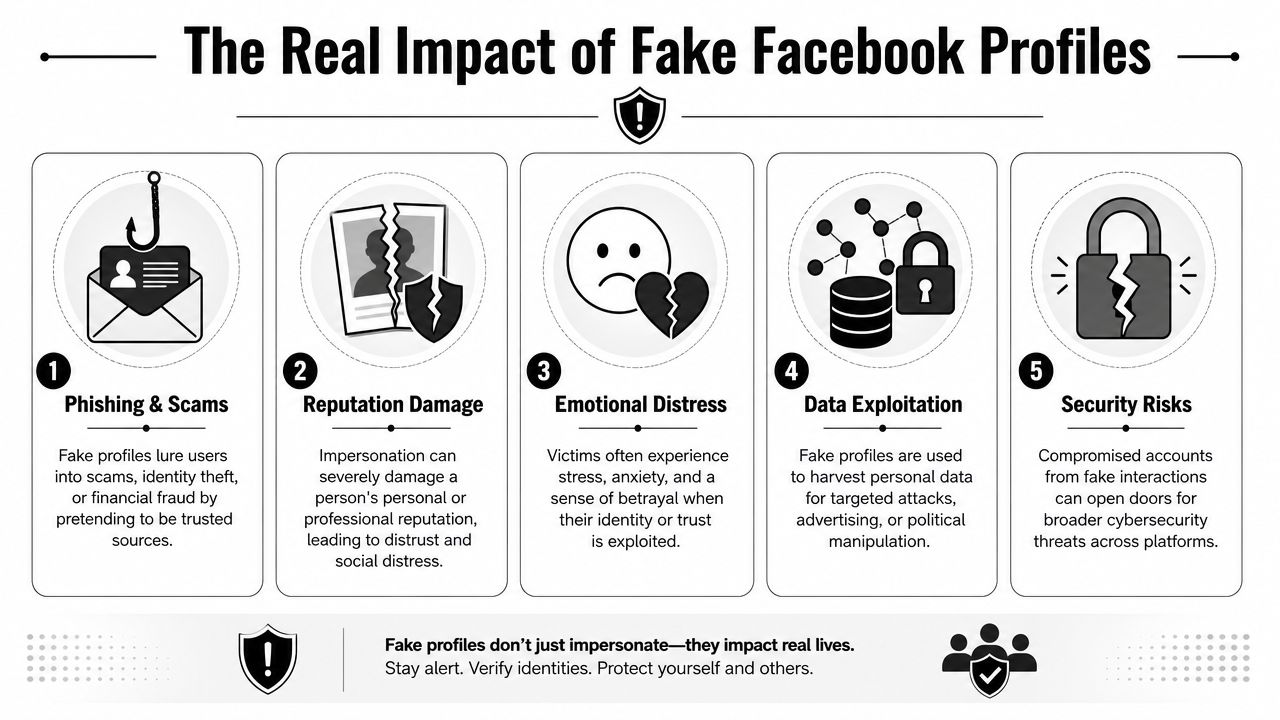
A fake profile becomes dangerous when it intersects with real life. Career, family, dating, volunteering, and community trust all sit on top of online identity now. That means impersonation isn’t just embarrassing. It can affect job prospects, personal safety, and access to other accounts.
The job seeker who thinks they’re talking to a recruiter
A fake recruiter profile usually doesn’t open with an obvious scam. It opens with praise. The account says your experience looks like a fit. It asks for a resume, then another copy in a different format, then a phone number, then identification details “for onboarding.” By the time the target feels uneasy, they’ve already handed over enough information for identity theft or follow-on fraud.
For employers, the same playbook works in reverse. A fake employee profile can message clients, post offensive content under a company name, or create confusion around who officially represents the business. That’s one reason teams responsible for hiring or community access often pair social screening with formal checks such as a volunteer background check when trust and public interaction are involved.
The parent who sees a harmless account in a teen’s orbit
Predators and manipulators rarely present as predators. They present as peers. The profile has age-appropriate photos, shared interests, and mutual group memberships. Messages start casually, then move private, then become persistent.
A related risk is account compromise. Once a teen clicks the wrong link or shares login details through a fake conversation, the problem shifts from impersonation to takeover. That overlap is why guidance on account takeover prevention matters in the same conversation as fake profiles.
The dater who mistakes consistency for authenticity
Catfishing works because many fake profiles are coherent. The photos match the story. The life details sound plausible. The account may even have some comment history and old-looking posts. A victim doesn’t need to be gullible. They only need to want the profile to be real.
The damage isn’t limited to money. Victims often lose time, trust, and confidence. In romance scam cases, the fake profile can also gather intimate photos, location clues, employer details, and contact information for later coercion.
The most convincing fake profile isn’t the one with the best photos. It’s the one that gives you just enough consistency to stop verifying.
The local resident who accepts a familiar-looking request
One of the least discussed risks is surveillance and narrative manipulation inside community spaces. Fake accounts aren’t only used for direct scams. Reports have highlighted that local officials and government agencies have been flagged for creating fake profiles with stolen identities to monitor citizens and steer online discussions, according to coverage of fake profiles used for surveillance and community manipulation.
That changes the stakes. A suspicious profile in a neighborhood group might not want your credit card. It may want visibility into your conversations, your politics, your habits, or your network.
Surface-Level Clues That a Profile Is a Fake
The first pass should take less than a minute. You’re not trying to prove anything yet. You’re trying to decide whether the account deserves deeper scrutiny.

Check the profile image first
A profile photo tells you more than commonly assumed. A stolen image often looks too polished, too generic, or disconnected from the rest of the account.
Use this quick diagnostic checklist:
- Too perfect: Studio-quality portraits, modeling-style shots, or images that look more like marketing assets than ordinary life photos deserve extra caution.
- Too thin: One profile image and one cover photo with no tagged photos, no event pictures, and no everyday snapshots is a weak identity trail.
- Visual mismatch: The profile picture suggests one age range or lifestyle, while posts and comments suggest another.
- No image at all: Blank or low-effort accounts still exist, especially when the goal is mass outreach rather than long-term impersonation.
If the image is central to your decision, run it through a proper reverse image search for people. That’s often the fastest way to find whether a photo appears under different names elsewhere.
Read the timeline like an investigator
Real people usually leave uneven but believable traces. Fake profiles often produce either a barren timeline or a strangely manufactured one.
Look for:
- Sparse history: Very few posts, long inactive stretches, or a timeline that starts abruptly
- Shared content overload: Endless memes, recycled videos, or generic inspirational posts with little personal context
- No social texture: Few meaningful comments from real people who seem to know the account owner offline
- Chronology problems: Life events, jobs, schools, and locations that don’t line up
A good fake can simulate activity. A weak fake usually can’t simulate believable history.
Here’s a useful explainer on how warning signs often show up in practice:
Audit the friends and interactions
Mutual friends help scammers because people over-trust them. But a mutual friend only proves that someone accepted a request.
Check for patterns such as:
- Suspicious network shape: Friends scattered across unrelated countries, industries, or age groups without any obvious real-world connection
- Low-quality engagement: Comments like “nice pic” or repeated emoji replies from accounts that also look questionable
- Group-heavy behavior: Active in many local buy/sell, dating, gaming, or political groups, but with little genuine personal interaction
- Fast intimacy: The account messages quickly, pushes for off-platform chat, or asks for help before trust is earned
Field note: Fake profiles often fail at one of three things. A believable photo trail, a believable friend graph, or a believable timeline. You don’t need all three to break before you get suspicious.
An Investigator’s Workflow for Profile Verification
Surface clues create suspicion. Verification requires evidence. When I vet fake profiles on Facebook, I don’t rely on a single red flag. I build a case from multiple small checks that either corroborate the identity or expose fractures.
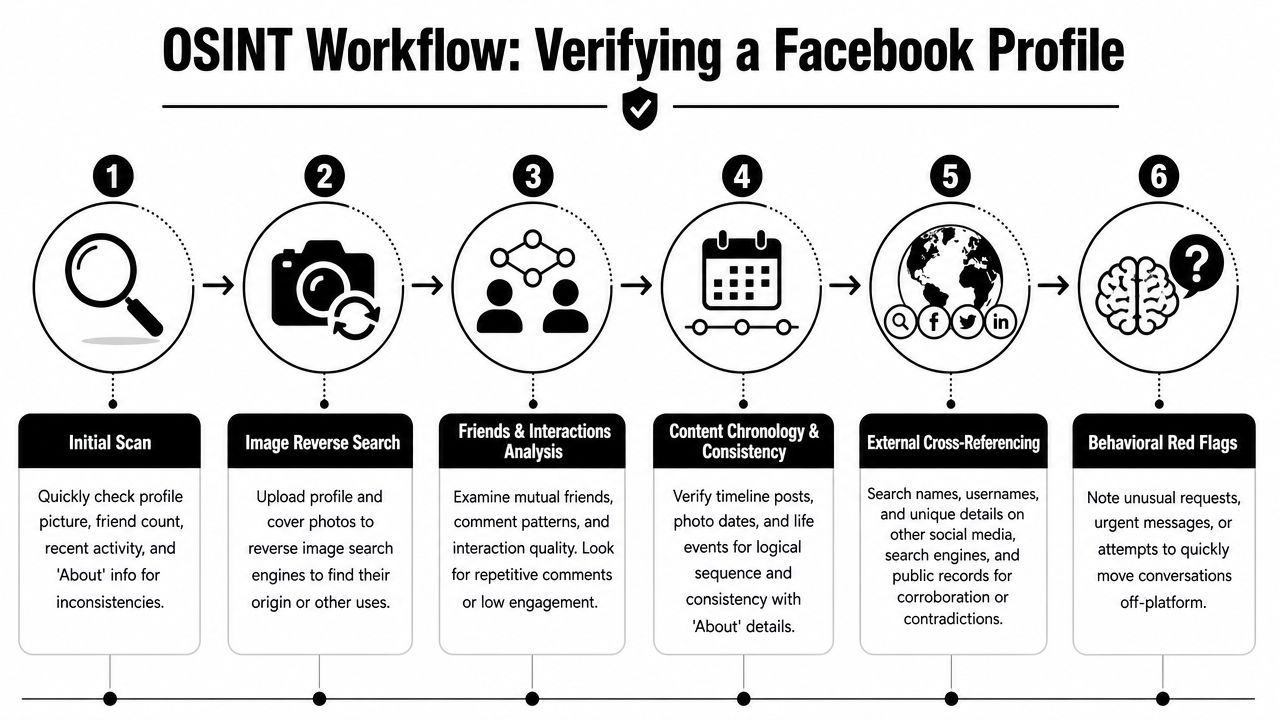
Verify the images before the words
Visual analysis comes first because it’s usually the strongest discriminator. Research on fake profile detection found that professional detection systems using an SVC classifier reached 98.0% accuracy, and that accuracy dropped by 44% to 54% when only text was analyzed, according to the FBChecker research on visual and textual profile analysis.
That matches practical experience. Text can be manufactured fast. Images leave evidence.
What to do:
- Run reverse image searches on the profile picture and cover photo.
- Crop and re-run if the full image produces weak results. Faces and distinctive backgrounds can surface better matches.
- Check for duplicates tied to different names, locations, or platforms.
- Inspect visual consistency across albums. Different lighting, ages, and settings can be normal. Completely different personas are not.
If the profile matters, broaden the work using methods from a social media investigation workflow so the image findings don’t sit in isolation.
Search the identity across platforms
A genuine person often leaves corroborating traces elsewhere. That doesn’t mean everyone should be easy to find. It means the details that are public should generally align.
Search combinations of:
- Full name plus city
- Username variations
- Employer or school listed on the profile
- Distinctive phrases from the bio
- Contact details if the person gave them to you directly
What you’re looking for isn’t volume. It’s consistency. If the same face appears on another platform under another name, that’s a serious warning. If the username exists everywhere except the platform where the person is actively messaging you, that’s also telling.
Map the social graph
The friend list and interactions tell you whether the account exists inside a real community or merely imitates one.
Useful checks include:
| Check | What supports authenticity | What raises concern |
|---|---|---|
| Mutual friends | People who plausibly know the person offline | Mutuals who accept everyone |
| Comment history | Specific references, inside jokes, normal conversation | Repetitive praise, generic comments |
| Tagged activity | Events, photos, and posts over time | No tags or suspiciously recent tags |
| Group behavior | Consistent interests and local relevance | Heavy posting with little real response |
A fake account can borrow a face. It’s much harder to fake a believable social environment over time.
Real identities usually create messy evidence. Fake ones often create neat surfaces.
Test the chronology
Read the account as a timeline, not a snapshot. Does the school history fit the age suggested by the photos? Do major life events appear in a sensible order? Did the account suddenly become active after a long silent period with a new identity style?
Many cloned profiles often fall short in this area. They copy enough public content to look familiar, but they don’t reproduce the subject’s real chronology cleanly.
Pay attention to behavioral pressure
Behavior often exposes the profile faster than visuals do. A fake account usually wants something. Your attention, your trust, your money, your personal data, or your movement off-platform.
Treat these as escalation indicators:
- Requests for money or gift cards
- Urgent emotional appeals
- Requests for codes, email addresses, or phone verification
- Pressure to move to WhatsApp, Telegram, text, or another app immediately
- Reluctance to take a simple verification action, such as a live reply from an established channel
By the end of this process, you shouldn’t be asking whether the account “feels off.” You should have a short list of contradictions you can point to.
How to Report and Remove a Fake Profile
Once you’ve confirmed the profile is fake or impersonating someone, speed matters. The account may already be messaging your contacts, watching your public posts, or testing whether you’ll respond.
Report with the right category
Facebook’s reporting flow gives you options that matter. Use the category that matches the problem most closely, such as fake account or impersonation. If the profile is pretending to be you, a friend, a family member, or your business, select the impersonation path rather than a generic complaint.
Keep your notes simple and factual:
- State the identity issue: Explain who the account is pretending to be.
- Point to the evidence: Mention stolen photos, copied biographical details, or contradictory timeline information.
- Preserve screenshots: Save the profile URL, visible messages, and any copied media before the account changes or disappears.
A major complication is that AI-generated fakes and elaborate impersonations can use stolen photos and highly accurate personal details, which is why OSINT-based verification is more reliable than basic checks alone.
Block first, then clean up exposure
Reporting helps the platform. Blocking helps you immediately. It cuts off direct contact and reduces the fake account’s ability to monitor your activity through routine interaction.
If the account targeted you through Messenger, review common patterns in Facebook Messenger scams and assume the profile may try again under a different identity.
Then do the practical cleanup:
- Tell close contacts: Warn friends, family, coworkers, or clients not to trust the fake account.
- Review privacy settings: Limit who can see your friends list, old posts, and personal details.
- Change passwords where needed: Especially if you clicked links or shared any credentials.
- Turn on stronger account protection: Use login alerts and app-based authentication where available.
If the fake profile targets your brand or professional identity
Individuals aren’t the only victims. Small businesses, creators, gaming streamers, and local professionals often get cloned because their public presence makes impersonation easier. When that happens, document the misuse carefully and notify your audience through your official channel.
For businesses that need a broader plan beyond one takedown, guidance on managing your brand’s social presence can help frame the response as a reputation problem, not just a platform complaint.
The point isn’t to win an argument with the impersonator. It’s to reduce their access, reduce their credibility, and protect the people around you.
Automating Your Defense Against Impersonation
Manual checks still matter. Tight privacy settings, cautious friend acceptance, limited public sharing, and periodic reviews of your visible information are good digital hygiene. They help with identity theft prevention, online dating safety, gaming account security, and professional reputation.
But manual work doesn’t scale well.
Humans miss things, especially when profiles look ordinary. Research summarized by CREST found that human accuracy in spotting fake profiles hovers around 50%, while Meta’s automated systems achieve over 90% accuracy and block billions of accounts, showing a 40%+ performance gap in favor of automation according to CREST’s discussion of fake profile detection limits and automated systems.
Where manual defense breaks down
A manual review is strongest when you already have a suspicious profile in front of you. It’s much weaker when you don’t know the profile exists yet.
That gap matters in cases involving:
- Identity theft: Someone creates a copy of your identity on another platform before you see it.
- Job prospects: A fake professional account can shape first impressions before a recruiter ever meets you.
- Dating app verification: A catfish can recycle names, usernames, and photos across services.
- Gaming profiles: Linked gamer tags, community handles, and public usernames can be repurposed for impersonation and scam outreach.
If you want to monitor your exposure more broadly, it helps to understand the wider context of free OSINT tools and where manual searching starts to become fragmented.
Manual vs Automated Profile Monitoring
| Feature | Manual Investigation | Digital Footprint Check |
|---|---|---|
| Discovery | Usually starts after a suspicious contact appears | Helps uncover profiles before someone sends you a message |
| Coverage | Limited to the platforms and searches you remember to run | Scans 500+ platforms using identifiers such as name, email, phone, and usernames |
| Speed | Slow, especially when checking multiple aliases and photos | Faster for broad discovery and repeat monitoring |
| Evidence gathering | Strong when done carefully, but labor-intensive | Organizes findings into a clearer footprint view |
| Best use case | Confirming whether one profile is fake | Ongoing online identity protection and broader exposure checks |
The trade-off is straightforward. Manual OSINT is precise but time-consuming. Automated monitoring is better at scale, especially when you want to find hidden profiles, exposed accounts, and impersonation risks before they become a personal or business problem.
For people managing digital privacy, scam prevention, reputation management, or family safety, that difference is practical. You can’t investigate what you never find.
If you want to see what identities, profiles, and public traces are already attached to you, run a free scan with Digital Footprint Check at their free checker. It’s a fast way to look for exposed accounts across social platforms, data breach databases, professional networks, gaming profiles, and other public sources before fake profiles on Facebook turn into a bigger identity problem.