· Digital Footprint Check · Content Marketing · 16 min read
Removing Hard Inquiries From Credit Report: Your 2026 Guide
Master the process of removing hard inquiries from credit report. Our 2026 guide details disputes, goodwill letters, and identity theft protection steps.

You pull your credit report for a routine check, maybe because you're applying for an apartment, trying to refinance, job hunting, or tightening up your digital privacy after a data breach. Then you see it. A hard inquiry from a lender you don't recognize.
That entry might be a harmless naming mismatch. It might be a duplicate. Or it might be the first visible sign that someone used your personal information without permission. Hard inquiries can lower scores by a few points and stay visible for up to two years, which is why removing hard inquiries from credit report files matters when the inquiry is wrong or unauthorized, according to Nav's summary of FCRA dispute rights.
The key is choosing the right path. If the inquiry is unauthorized, this is a legal dispute issue. If the inquiry came from an application you made, you're in goodwill territory, not legal-removal territory. Mixing those two paths often leads to wasted time.
Why That Mystery Inquiry on Your Credit Report Matters
A mystery inquiry isn't just a technical blemish. It's a signal. Sometimes it points to ordinary credit activity. Sometimes it points to identity theft, sloppy lender processes, or stale reporting that never should've stayed on file in the first place.

When I review inquiry disputes, the first question isn't "How do I remove this fast?" It's "Did you authorize this?" That answer determines everything that follows.
What a hard inquiry actually changes
A hard inquiry shows that a lender or creditor pulled your credit in connection with an application. That matters because lenders, landlords, and sometimes employers may look at the broader pattern on your file, not just a score.
A single unexplained inquiry can create three real-world problems:
- Loan friction. An unexplained pull can make you look like you recently sought new credit.
- Employment concerns. Some employers use credit-related background screening for certain roles, so unexplained activity can prompt questions.
- Identity theft clues. An inquiry can appear before any new fraudulent account shows up.
If you're already worried that your information is circulating online, review these signs your identity has been stolen. Unknown inquiries often show up alongside other exposure signals, such as leaked contact data, reused usernames, or public records that make impersonation easier.
The two paths people confuse
Removing hard inquiries from credit report files breaks into two very different tracks.
| Situation | Best approach | What to expect |
|---|---|---|
| You didn't authorize the inquiry | Formal FCRA dispute | Removal is possible if the inquiry can't be verified |
| You did authorize the inquiry | Goodwill request to the creditor | Possible, but discretionary and not legally required |
Practical rule: Treat unauthorized inquiries like evidence problems. Treat legitimate inquiries like relationship problems.
That distinction matters more than any template. A strong dispute sent on the wrong theory usually fails. A polite goodwill letter sent to the right department can occasionally work, but only when you're asking for courtesy, not demanding a legal remedy.
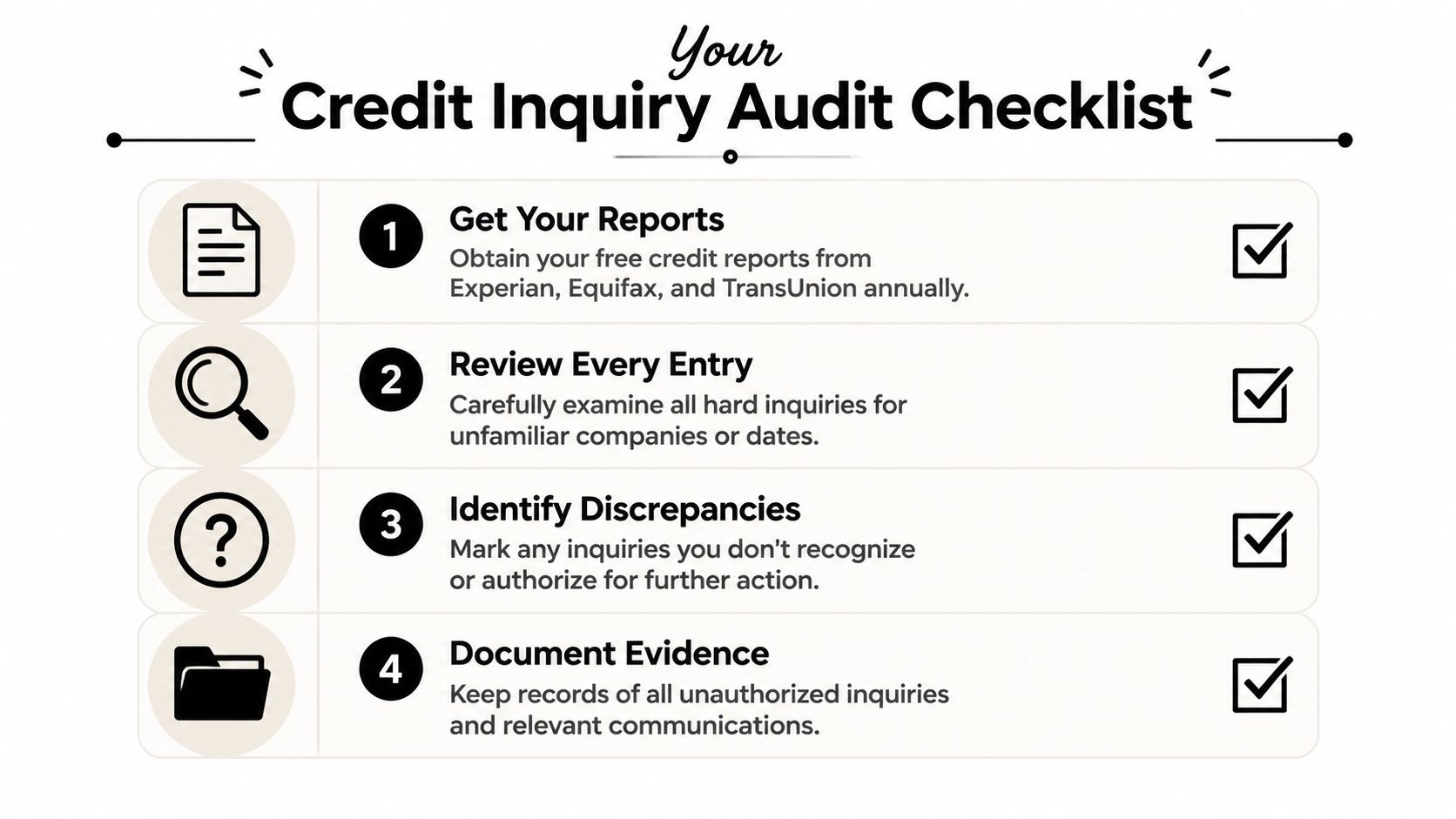
How to Audit Every Inquiry on Your Credit Report
Many consumers scan the inquiries section too quickly. They look for a familiar logo, don't see one, and assume fraud. That's risky. Lenders often appear under parent-company names, processing subsidiaries, or servicing entities that don't match the brand you remember.
The right approach is closer to OSINT work. You gather records, compare names, line up dates, and build a timeline before you challenge anything.
Pull all three reports and compare them
Don't rely on a single bureau. Check Equifax, Experian, and TransUnion. The same inquiry may appear differently across bureaus, or it may show on only one report.
Use a simple worksheet with these columns:
- Bureau
- Creditor name shown
- Date of inquiry
- Phone number or mailing address listed
- Did I apply
- Possible match from my records
- Needs dispute or goodwill request
Adopting an investigator's mindset proves useful. Search your email for lender names, common abbreviations, and application confirmations. Check text messages for one-time passcodes. Review browser history if you recently comparison-shopped. Search your password manager for saved accounts with lenders. If you use a budgeting app, check when a new financial institution first appeared.
A deeper digital review can also surface clues outside the credit file itself. If you need a wider privacy audit, this guide on how to check your digital footprint is useful because unauthorized inquiries rarely happen in isolation.
Categorize each inquiry before you act
Don't jump straight to disputes. Sort every inquiry into one of these buckets:
-
Clearly authorized
You applied for a card, loan, lease, or financing offer. The name may be unfamiliar, but the timing lines up. -
Authorized but possibly inaccurate
You recognize the event, but something looks wrong. The date may be off, the lender may be misidentified, or the same application may have generated a questionable duplicate. -
Unrecognized and suspicious
No application, no email trail, no text verification, no dealership visit, no retail financing attempt. These deserve immediate attention. -
Needs more research
The company name is unfamiliar, but you did submit an application somewhere around that time.
A lot of false alarms get resolved at category four. That's why I tell people to spend extra time there before filing.
Here's a quick visual walkthrough that pairs well with your manual review:
Use OSINT habits, not guesswork
Open source intelligence isn't just for investigators or security teams. It works well for personal credit review because it forces you to verify identity, source, and timing.
Useful checks include:
- Corporate name lookup. Search the lender's legal or servicing name.
- Archived emails. Look for preapproval or application receipts.
- Device history. See whether you visited the lender's site.
- Call logs. Match outreach from dealers, brokers, or loan officers.
- Mail scans. Check whether you received follow-up letters tied to a real application.
Unknown doesn't automatically mean unauthorized. It means unverified. Your job is to verify first, then dispute with confidence.
When you're done, you should know exactly which inquiries belong in a legal dispute package, which ones deserve a direct call to the creditor for clarification, and which ones are only candidates for goodwill removal.
Disputing Unauthorized Inquiries The Right Way
You review your report, spot a hard inquiry from a lender you never dealt with, and now the clock matters. An unauthorized inquiry is not a customer service annoyance. It is a factual dispute under the FCRA, and the quality of your evidence usually decides whether it gets deleted or verified.
The bureau has to investigate after it receives a proper dispute. In practice, that means you need to identify the exact inquiry, show that you are the consumer tied to the file, and give the bureau enough detail to contact the furnisher and test whether permissible purpose existed. If the inquiry cannot be verified, it should come off.
Build the dispute package before you submit anything
I tell clients to slow down here. Filing too fast with a vague statement like "not mine" often leads to a fast verification and no real progress. Filing once, with a tight package, gives you a cleaner record and a better chance of forcing a meaningful investigation.
A solid package usually includes:
- A short dispute letter with the creditor name, inquiry date, and bureau name
- A copy of your government ID
- Proof of current address
- The credit report page with the inquiry clearly marked
- Supporting records that help show you did not authorize the pull
Supporting records can be simple. If your earlier OSINT review turned up no application receipt, no site visit, no dealer worksheet, no call log, and no follow-up mail, say that plainly. If the inquiry happened while you were dealing with an account takeover, data breach, or fake rental listing, include that context.
If the inquiry came from a screening company rather than a lender, the legal framework is still about permissible purpose and consumer reporting compliance. VerticalRent tenant screening compliance gives useful background on how FCRA rules apply in screening settings.
File where the inquiry appears, and keep your own paper trail
Send the dispute to each bureau that shows the inquiry. One bureau means one dispute. Three bureaus means three separate disputes.
Written disputes usually give you the best record. Online disputes are faster, but some consumers end up with shorter submissions, fewer attachments, or limited confirmation of what was sent. Phone disputes are the weakest option if you later need to escalate, because you may have no clean copy of the exact claim you made.
Use a simple sequence:
- Mark the exact inquiry on your report.
- Draft a focused dispute letter.
- Attach ID, proof of address, and the marked report page.
- Add any evidence showing lack of authorization.
- Send it and save copies of everything.
- Track the date sent, delivery confirmation, and bureau response.
If the inquiry looks tied to a broader fraud problem, check whether your personal data has been exposed elsewhere before you file follow-up disputes. An identity theft checker for exposed personal information can help you decide whether this is one bad inquiry or part of a larger identity theft issue.
A dispute letter that stays on point
Keep the language plain and specific.
Sample dispute letter
I am disputing a hard inquiry on my credit report that I did not authorize. The inquiry is listed under [Creditor Name] and dated [Date]. I am requesting a reasonable investigation under the Fair Credit Reporting Act. If the inquiry cannot be verified or if there was no permissible purpose, please delete it from my credit file.
I have enclosed a copy of my identification, proof of address, and the relevant page of my credit report with the inquiry marked. Please send me the results of your investigation in writing.
That wording works because it does three jobs. It identifies the exact item. It states the legal basis. It asks for the right remedy.
What works, what stalls, and why
The strongest disputes are narrow. One inquiry. One date. One creditor name. One clear statement that you did not authorize it.
Here is the actual trade-off:
| Approach | Usually effective | Why |
|---|---|---|
| Written dispute with documents | Yes | Clear record, specific facts, easier to challenge if the response is weak |
| Online dispute with attachments | Often | Fast and convenient, but sometimes strips context or limits documentation |
| Phone dispute only | Rarely | Hard to prove what was said and harder to build on later |
| Broad fraud accusation with no evidence | Weak | Bureaus and furnishers verify details, not frustration |
Two mistakes come up over and over. First, disputing an inquiry before confirming whether the lender used a parent company, broker, or alternate trade name. Second, resending the same dispute after a verification result without adding any new evidence.
If the bureau verifies the inquiry, read the response carefully. If it names a creditor you can now trace to a real application, the inquiry may belong in the goodwill lane, not the dispute lane. If the response is thin and your records still show no authorization, strengthen the file and prepare to escalate with identity theft remedies only if the facts support that step.
Requesting Goodwill Removal for Legitimate Inquiries
This is the part many articles get wrong. If you authorized the inquiry, you usually don't have a legal basis to force removal.
Legitimate hard inquiries authorized by the consumer can't be removed unless there's a verifiable error, because the FCRA requires removal of inaccurate or unauthorized information, not valid inquiries that hurt your score, as reflected in this discussion of authorized hard inquiries.
That doesn't mean asking is pointless. It means your posture changes. You're not disputing. You're negotiating.
When a goodwill request makes sense
A goodwill request is best when the inquiry was real, the account relationship is real, and you have a reason the creditor might consider a courtesy exception.
Strong candidates include:
- Longstanding customer history with the bank or credit union
- Application confusion where multiple internal pulls happened around one event
- Rate shopping context where the lender may be sympathetic
- Clear admin error signs even if you initiated the process
Weak candidates include random cold applications, creditors with no existing relationship to you, or situations where you're writing as if the lender broke the law when they didn't.
How to frame the ask
Goodwill letters work better when they sound human, specific, and easy to approve.
Try this structure:
- Open by confirming the inquiry was tied to your application.
- State that you're requesting a courtesy review, not alleging fraud.
- Give a brief reason. Keep it factual.
- If relevant, mention your positive account history.
- Ask whether the creditor can request removal as a one-time accommodation.
You're asking for discretion. Courtesy requests fail when they read like legal threats.
A practical goodwill letter template
I'm writing to request a goodwill review of a hard inquiry associated with my application/account with [Creditor Name] on [Date]. I understand the inquiry was connected to my application and I'm not disputing that I authorized it. I'm asking whether your team would consider removing it as a courtesy based on [brief reason, such as longstanding customer history, duplicate application handling, or unusual circumstances].
I value my relationship with your company and would appreciate any help you can offer. If removal isn't possible, I would still appreciate confirmation that the inquiry was correctly recorded.
Where to send it
Don't send goodwill requests into a generic void if you can avoid it. Better targets include:
- Executive customer relations
- Office of the president
- Credit bureau reporting department
- Escalated customer advocacy teams
A short phone call can help you identify the right mailing or secure-message destination, but the request itself is usually better in writing. Keep your expectations realistic. Some lenders never grant these requests. Others do, but inconsistently.
The main trade-off is time. If the inquiry is valid and recent, you may spend effort for no result. If it's nearing its natural expiration, your energy may be better spent strengthening the rest of your profile and locking down your identity data.
Using Identity Theft Remedies for Stubborn Inquiries
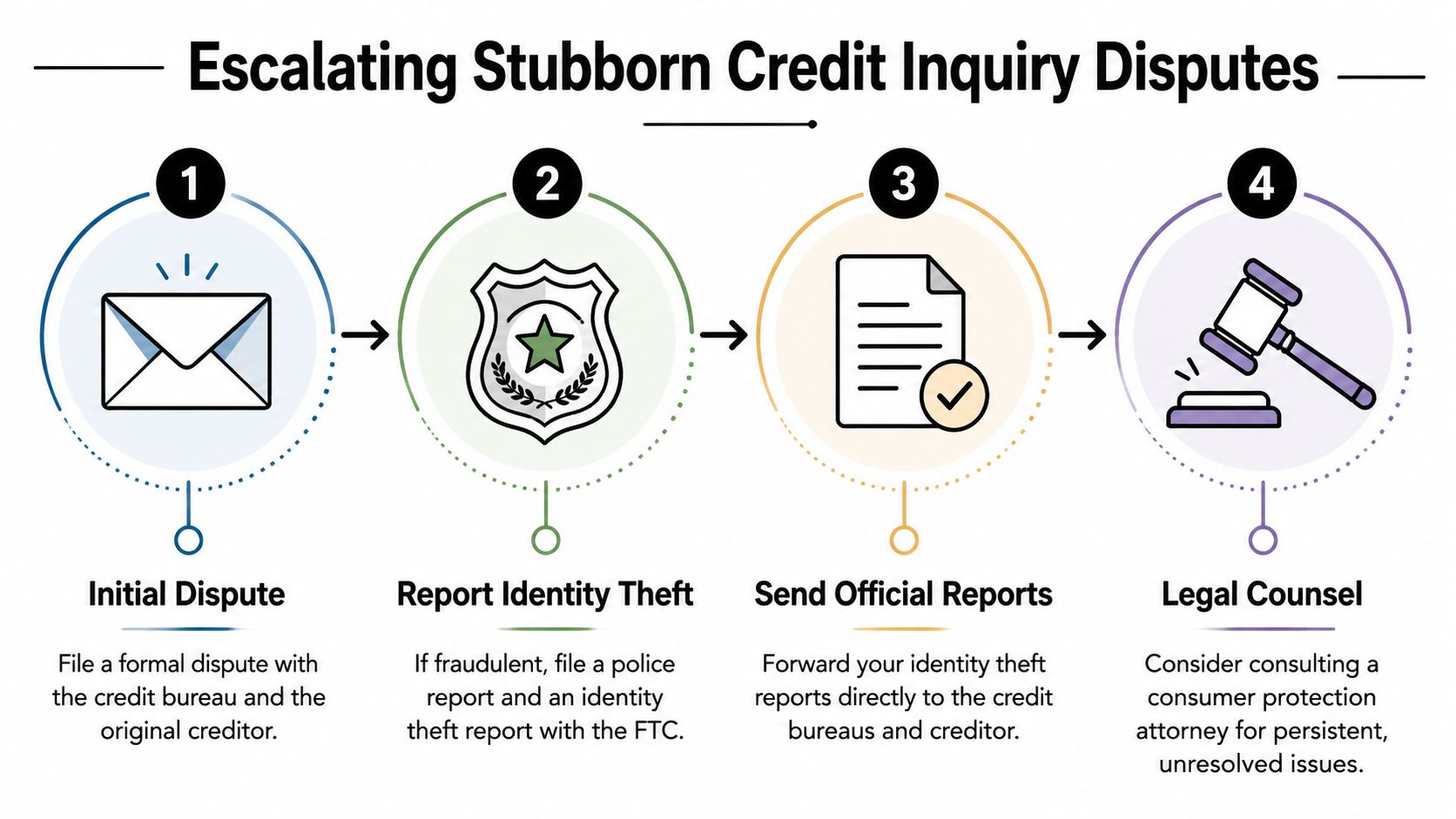
When a clearly fraudulent inquiry survives a normal dispute, stop repeating the same process. Move to the identity theft framework.
The strongest remedy for unauthorized inquiries without a legitimate account attachment is to invoke FCRA Section 605B using an FTC Identity Theft Affidavit. That route requires the bureaus to remove the prohibited information within 30 days, and expert analysis cited in a video explanation of the Section 605B method says success rates can exceed 90% when the affidavit is properly executed.
When to use this route
This isn't a shortcut for inquiries you regret. It's for confirmed or strongly supported identity theft.
Use it when:
- you didn't authorize the inquiry
- your standard dispute failed or stalled
- the inquiry has no legitimate account connection
- other fraud indicators are present
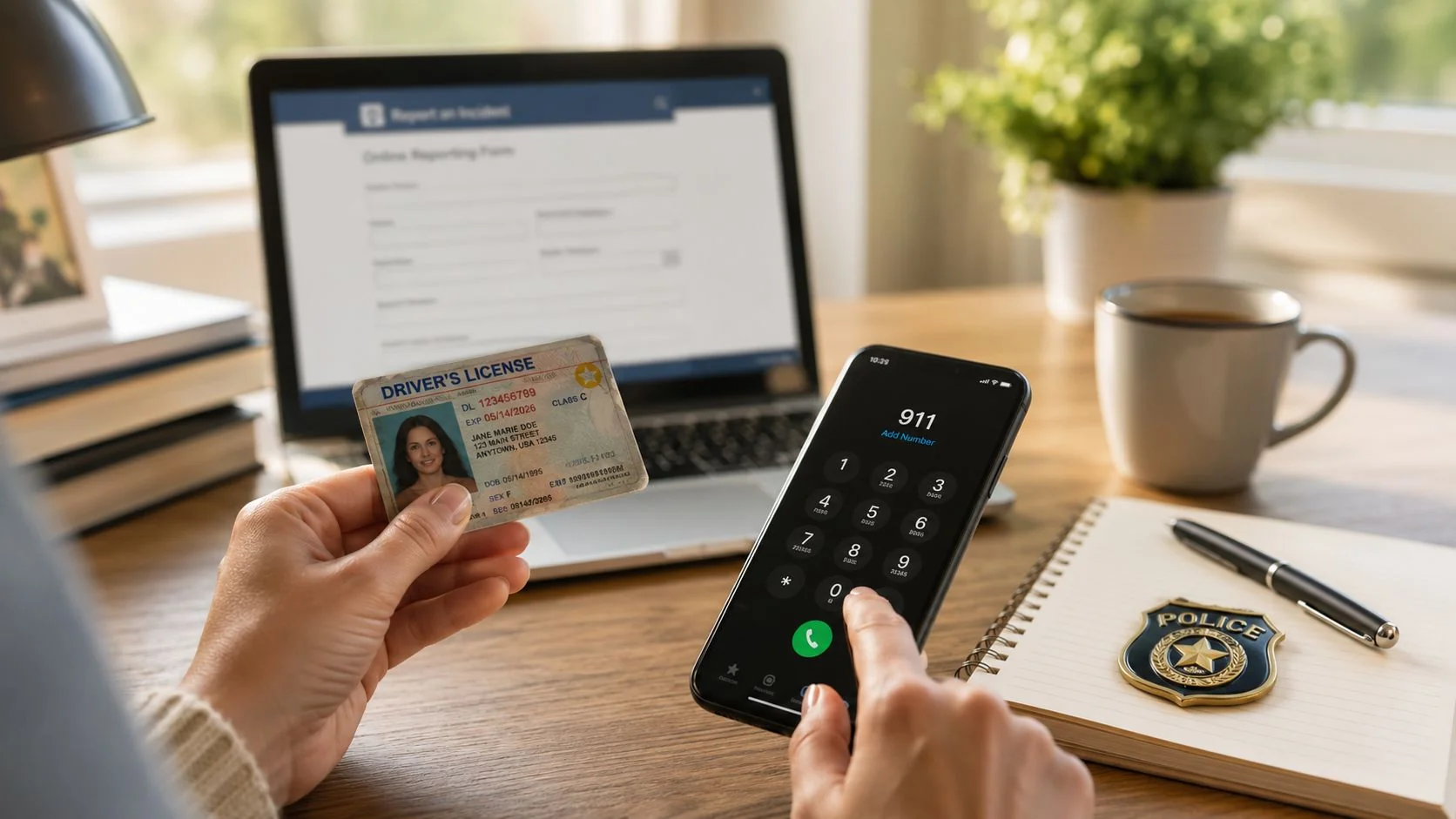
If a stolen license or exposed identity document may be part of the problem, this guide on how to report a stolen driver's license is worth reviewing before you send your final package.
What the escalation package looks like
The process is procedural. Do it cleanly.
- File at identitytheft.gov and generate the FTC affidavit PDF.
- Reference FCRA §605B in your written complaint.
- Attach certified copies of your driver's license and utility bill.
- Send the package to Equifax, Experian, and TransUnion if all three report the inquiry.
- Keep proof of submission and copies of the full packet.
Some consumers also add a police report to reinforce the identity theft record. It isn't the core legal mechanism described above, but it can strengthen the file when facts are contested.
Why this works better than generic fraud complaints
Generic "not mine" disputes often get routed into ordinary verification workflows. If the creditor responds loosely or the bureau treats the item as a standard challenge, the inquiry may survive.
Section 605B changes the posture. You're no longer making a casual objection. You're invoking a specific identity theft remedy with formal paperwork attached.
If you're escalating under identity theft rules, your paperwork matters more than your narrative.
That means no handwritten margin notes, no vague accusations, and no missing identity documents. Precision wins here.
Also take protective action outside the dispute itself. If someone used your data once, they may try again. Place fraud alerts or freeze your credit files if the facts justify it. Removing the inquiry solves the visible symptom. Locking down your reports helps stop the next attempt.
From Credit Monitoring to Protecting Your Digital Footprint
A hard inquiry can disappear from your report and the actual exposure can still be sitting untouched online.
I see this after successful disputes. Someone gets an unauthorized inquiry removed, then we trace the likely source and find an old email address in breach results, a recycled username on gaming forums, or a forgotten dating profile with enough personal detail to pass a basic identity check. The credit report showed the symptom. The digital footprint usually shows the opening the fraudster used.
Think broader than the bureau file
Credit monitoring helps you catch damage after it hits the file. It does not tell you where your data is exposed or how someone pieced together enough information to apply in your name.
That is why I separate credit cleanup from digital exposure review. After the bureau work is done, audit the identifiers tied to you: current and old email addresses, phone numbers, usernames, aliases, and public profiles. Basic OSINT methods help here. Search those identifiers across breach notifications, people-search listings, social platforms, old forum posts, marketplace accounts, and cached profile pages. You are looking for the trail that connects your identity to public or leaked data.
A practical routine looks like this:
- Review your credit reports for inquiries you do not recognize
- Check old email addresses, phone numbers, and usernames for breach exposure
- Remove or lock down unused accounts, especially dating, gaming, shopping, and social profiles
- Tighten login security with unique passwords and app-based two-factor authentication
- Reduce public-facing details such as birth month, city, employer, and family relationships
This matters outside lending. A visible trail of personal details makes impersonation easier in account recovery flows, scam outreach, and social engineering attempts. Recruiters, landlords, and potential partners may never see your credit report, but they can find the loose information that made the inquiry possible.
For readers who want a broader consumer-credit refresher alongside dispute work, Morgan & Morgan Attorneys at Law P.C. has a practical overview of credit-score improvement steps.
Build a repeatable protection habit
Use a monthly routine. Check your reports. Review breach exposure tied to old identifiers. Close accounts you no longer use. Search your name and usernames the way a stranger would.
If you want help comparing monitoring options, this roundup of best identity theft protection services is a useful starting point. These tools can alert you faster, but they do not replace the two removal paths covered in this guide. Use disputes when the inquiry is unauthorized. Use goodwill requests only when the inquiry is legitimate and you are asking for an exception.
That distinction matters. So does finding the source of exposure. If you only remove the inquiry, you may be back in the same position a few months later.