· Digital Footprint Check · Content Marketing · 13 min read
Why Online Reputation Management Is Important: Guide 2026
Discover why online reputation management is important for your job, safety, and finances. Protect your digital identity and understand risks & benefits in

A lot of people learn about online reputation management at the worst possible moment. A recruiter goes quiet after a promising interview. A landlord stops replying. A dating match suddenly backs away after asking for your last name. A gaming account gets targeted after someone pieces together your username, old posts, and exposed email from public sources.
That's why this topic matters to ordinary people, not just brands. Your online reputation isn't only what you posted on Instagram or LinkedIn. It's the full picture the internet builds about you from social media, search results, breach data, public records, gaming profiles, old forum comments, reviews, and everything else that can be found with a few searches or modern OSINT tools.
Many people still think reputation management means replying to reviews and posting polished content. That's only part of it. The bigger issue is that personal data exposure and online reputation are tied together. If your phone number, email, usernames, workplace history, or old accounts are easy to find, they don't just shape how people judge you. They also make you easier to impersonate, scam, dox, or socially engineer.
Your Online Past Can Cost Your Future
A strong candidate can lose an opportunity without ever being told why.
A hiring manager searches a name, finds an old comment thread, a public playlist with offensive jokes in the title, a forgotten profile on a niche forum, and a few social tags from college. None of those items may reflect who that person is now. But together they create a story. Employers, clients, dates, and even strangers often react to the story they can find, not the person standing in front of them.
That's part of why people ask whether employers check social media before hiring. They do more than glance at a profile. They often look for patterns. Is this person careful? Mature? Consistent? Safe to trust with customers, money, or confidential information?
It's not just about embarrassing posts
Traditional advice focuses on visible content: old tweets, public photos, bad reviews. Those matter, but they're only the top layer.
The deeper problem is data exposure. A leaked phone number can connect to messaging apps. An old username can link your gaming profile to a dating profile. A breach record can expose an email you still use for password resets. Once those pieces are connected, they can reshape how people see you and how attackers target you.
According to ALMCorp's guide on online reputation management, 71% of individuals cannot remove personal data leaked in breaches once it is published, and exposed information can remain searchable on 500+ platforms via OSINT tools. That changes the definition of reputation. It's no longer just image management. It's exposure management.
Your online reputation is partly what you publish, and partly what other systems publish about you.
The quiet damage of a messy digital trail
The hardest part is that unmanaged digital risk often looks harmless until someone connects the dots.
A decade-old meme post may seem trivial. A public Venmo history might feel social. A gamer tag reused across platforms may feel convenient. But when those details line up, they can reveal habits, location clues, friend networks, spending patterns, and identity markers. That can affect job prospects, personal safety, and trust.
So if you've ever thought, “I'm not famous, so this doesn't apply to me,” that idea is outdated. In 2026, online reputation management is part career hygiene, part privacy practice, and part basic cybersecurity.
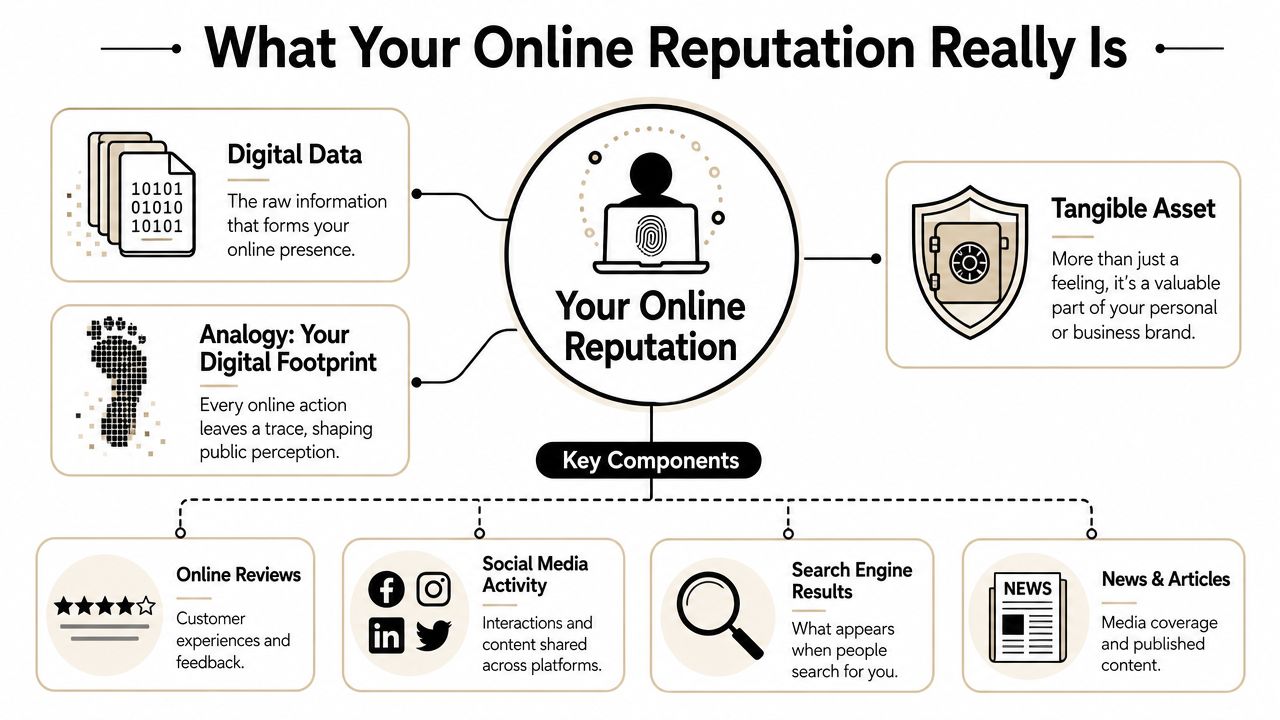
What Your Online Reputation Really Is
Your online reputation is easiest to understand if you separate two ideas: your digital footprint and your digital shadow.
Your footprint is what you knowingly leave behind. Posts, comments, bios, reviews, photos, resumes, portfolios, and public profiles. Your shadow is what forms around you without much attention from you. Old account data, broker listings, cached pages, breach entries, tagged photos, scraped directories, and search engine associations.
A digital resume built by other people and machines
While reputation is often viewed as opinion, online, it's more like a digital resume assembled by algorithms.
Search engines index your name. Social platforms suggest related accounts. Data brokers merge records. AI systems summarize what they believe is true about you. That means your reputation can be shaped by accurate information, outdated information, or flat-out misleading information. If the signals are inconsistent, machines can draw the wrong conclusion.
That's one reason structured identity matters so much. In business settings, a helpful guide to online reputation for businesses often starts with consistency across platforms. The same principle applies to individuals. If your professional identity is fragmented, vague, or mixed with unrelated accounts, people and tools may connect you to the wrong story.
What makes up your reputation
Your online reputation is a bundle of visible and hidden assets:
- Search results tell people what rises first when they look you up.
- Social media activity shows judgment, tone, interests, and associations.
- Gaming and community profiles can reveal usernames, behavior, and links to other platforms.
- Reviews and public comments shape how others rate your reliability.
- News mentions and blog posts can legitimize you or create long-term baggage.
- Data exposure can reveal contact details, breach history, and public records.
If you want a simple starting point, it helps to understand what a digital footprint is. Once you see how many small traces combine into one searchable identity, the idea of reputation becomes much less abstract.
A good online reputation doesn't mean looking perfect. It means making sure the public version of you is accurate, current, and hard to misuse.
The High Cost of a Compromised Digital Identity
An unmanaged online reputation creates three kinds of risk at once. It can limit your opportunities, weaken your safety, and cost you money.
Professional fallout
Employers don't only assess resumes. They assess risk.
According to Minc Law's online reputation statistics, 70% of job seekers report that their online search history or social media posts have negatively impacted their job prospects, and 57% of employers have rejected a candidate due to inappropriate online content. Those numbers should reset how people think about old posts, comments, and public profiles.
A recruiter may never tell you that your public activity raised concerns. A freelance client may choose someone easier to trust. A school admissions officer may move on to the next applicant. In each case, the consequence feels invisible from your side.
Personal safety and scam exposure
The second cost is more serious because it affects security, not just reputation.
Attackers use publicly exposed details to run romance scams, catfishing schemes, account takeovers, and identity theft. They don't need full access to your life. They just need enough fragments to sound believable. A breached email, a reused gamer handle, a visible friends list, and a public birthday post can be enough to build a convincing phishing message or fake identity.
If you want to understand the chain reaction, this guide on how identity theft happens online shows how small pieces of public data can turn into larger attacks.
Practical rule: If a stranger can map your accounts, habits, and contacts faster than you can, your digital identity is too exposed.
Financial and everyday consequences
The third cost shows up in daily life.
For a consultant, designer, coach, or seller, reputation affects whether people book a call. For a renter, it can affect whether a landlord feels comfortable moving forward. For someone using dating apps, public confusion or suspicious search results can block trust before the first meeting. For gamers, exposed account ties can lead to harassment, credential attacks, or theft of in-game assets.
Where the damage lands:
| Area of Life | Potential Negative Impact |
|---|---|
| Career | Rejected applications, lost promotions, reduced trust from employers or clients |
| Personal safety | Doxxing, catfishing, romance scams, stalking, impersonation |
| Finances | Lost freelance work, account fraud, delayed rentals, damaged side-hustle credibility |
| Relationships | Dating app distrust, family concerns, social conflict from old content |
| Gaming and online communities | Harassment, account targeting, cross-platform identity linking |
What makes this expensive is that people often treat these as separate problems. They aren't. The same unmanaged digital trail can hurt your reputation and feed a security breach.
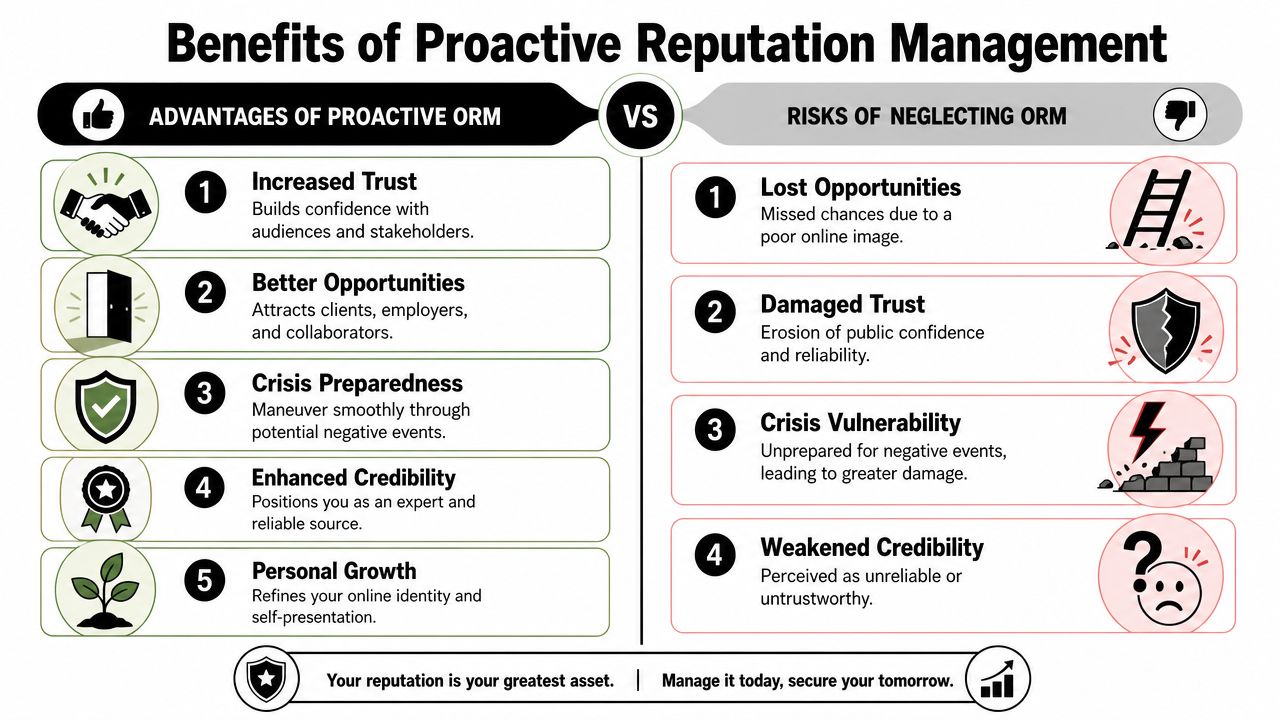
Benefits of Proactive Reputation Management
The upside of taking control is bigger than often anticipated.
Proactive management reduces risk and offers strategic benefits: a clearer professional identity, less scam exposure, and faster trust.
Trust becomes easier
People rarely research everyone they meet. They scan, search, and look for reassurance.
If your search results are current, your profiles are consistent, and your exposed data is limited, trust forms faster. That matters for hiring managers, clients, collaborators, and even people verifying you on dating apps before a first date.
A polished image alone isn't enough. What helps most is alignment. Your LinkedIn, portfolio, public bios, and account names should point in the same direction instead of creating friction.
Your digital presence starts working for you
A strong online reputation can function like a passive referral system.
Someone searches your name and finds a professional profile, thoughtful content, recent work, and no obvious red flags. That doesn't guarantee an opportunity, but it removes doubt. Doubt is what slows decisions.
From a financial perspective, Blue Ocean Global Technology notes that 63% of a brand's market value is tied to online reputation. For individuals, the same principle applies qualitatively. Your digital reputation shapes perceived value. When trust rises, earning potential and access to opportunities usually improve.
Security improves too
This is the part many articles miss. When you clean up your digital footprint, you also reduce attack surface.
Removing old accounts, tightening privacy settings, changing reused usernames, updating passwords, and limiting exposed personal details make it harder for scammers to impersonate you or target your accounts. The result is a better image and less stress.
- For job seekers: a cleaner public record supports credibility.
- For families: less exposed personal data means less risk from stalkers and impersonators.
- For gamers: reducing cross-linked profiles protects accounts and identity.
- For online dating: a consistent, verifiable presence makes catfishing easier to spot and your own identity easier to trust.
Your Action Plan to Master Your Online Reputation
A workable reputation plan has three stages. Discover. Analyze. Maintain. Many individuals skip straight to deleting old posts, but that's too narrow. You first need to know what's visible.
Discover what others can find
Start with basic searches of your name, usernames, email addresses, and phone number. Check image search results. Review old platforms you may have forgotten, including gaming services, forums, marketplaces, and dating profiles. Search for combinations that include terms like your city, employer, school, or niche hobby.
That manual process is useful, but it's incomplete. Search engines won't show everything, and many exposures sit inside places people don't routinely check. Tools that use OSINT methods can surface hidden links between accounts, breach data, and public traces. One option is Digital Footprint Check's free checker, which searches across 500+ platforms using identifiers such as email, phone, username, and social profiles to reveal publicly accessible exposure points.
Servicensure explains why this matters in security terms. In its discussion of online reputation, it notes that ORM acts as a preventative security layer against identity theft by helping identify exposed personal data that attackers can use for social engineering.
Analyze what matters most
Not every finding carries the same risk. A stale account with no personal details may be harmless. A breached email tied to your banking username isn't.
Sort your findings into three buckets:
-
High risk
- Exposed phone numbers
- Active breach records
- Public location details
- Accounts tied to financial or primary email credentials
-
High visibility
- First-page search results
- Public social media profiles
- Tagged photos
- Review or complaint pages tied to your name
-
High confusion
- Duplicate profiles
- Outdated bios
- Mixed personal and professional usernames
- Old community accounts that no longer represent you
If you're building a stronger professional presence after cleanup, a thoughtful LinkedIn strategy for creators and marketers can help you replace scattered signals with a clearer public identity.
The goal isn't to erase your entire online history. It's to reduce harmful exposure and make the visible version of you more accurate.
Maintain your digital baseline
Reputation management isn't a one-time purge. New mentions, breaches, tags, and data reposts keep appearing.
A light maintenance routine helps:
- Review monthly: Search your key identifiers and check core profiles.
- Watch breaches: Update passwords and remove old recovery methods when exposure appears.
- Limit reuse: Don't recycle the same username across sensitive and public accounts.
- Clean dormant accounts: Close what you no longer use, especially old gaming, dating, and forum profiles.
- Check privacy settings: Platforms change defaults often.
Privacy, cybersecurity, and reputation management finally meet. You're not just curating image. You're reducing attack paths.
Key Reputation Metrics You Should Be Watching
If you can't measure your online reputation, you'll manage it by guesswork.
The most useful metric is Search Result Sentiment. Forbes Advisor explains that online reputation management directly affects the ratio of positive, neutral, and negative results on the first page of Google. If negative or misleading results dominate that page, trust falls before you ever get a chance to explain.

A personal dashboard that matters
You don't need enterprise software to think like an analyst. Track a few practical indicators:
- Search result quality: What appears on the first page for your name and main usernames.
- Exposure points: Publicly visible email addresses, phone numbers, addresses, or breach references.
- Profile consistency: Whether your professional profiles match your current role and identity.
- Old account visibility: Whether forgotten forums, gaming tags, or dating profiles outrank useful results.
- Mention recency: New posts, tags, comments, or reviews that change how people see you.
For ongoing monitoring options, this roundup of tools for monitoring your digital footprint and keeping your data safe is a practical place to compare methods.
What good looks like
A healthy reputation doesn't mean every result is glowing. It means the visible evidence is coherent, current, and not easy to weaponize.
That standard helps in every environment. A job search. A freelance pitch. A gaming community. A dating app verification check. A family privacy review. The metric isn't perfection. It's whether someone searching you gets an accurate and safe picture.
Take Control of Your Digital Story Today
The reason why online reputation management is important is simple. Your reputation and your security now depend on many of the same data points.
Old advice treated ORM like public relations for businesses. Today it's much broader. It affects job offers, side income, housing, dating safety, gaming account security, scam resistance, and identity theft prevention. Reviews matter, but exposed personal data matters just as much. A clean image won't protect you if your digital life is easy to map and misuse.
That's also why modern monitoring has to go beyond vanity searches. You need to know what search engines show, what old accounts still expose, what breach data ties back to you, and what signals strangers or attackers can combine. If you want to go deeper into how people evaluate online tone and visibility, this piece on mastering sentiment analysis with AI adds useful context.
You don't need to panic, and you don't need to become a cybersecurity expert overnight. You do need a repeatable habit: discover what's visible, reduce what's risky, and maintain what matters. That habit protects your name and your safety at the same time.
A simple first step is to run a check on your public digital exposure. Digital Footprint Check offers a free checker that can help you see what personal information, profiles, and account links may already be visible online. If you want to improve job prospects, reduce identity theft risk, audit gaming or dating profiles, or understand what OSINT tools can uncover about you, that's a practical place to start.