· Digital Footprint Check · Content Marketing · 18 min read
Mastering Username Search: Protect Your Digital Identity
Learn how a username search can protect your online identity, find profiles, and safeguard your digital life.

That username you use for everything from gaming to social media isn’t just a simple handle. It’s a digital fingerprint, a unique identifier that ties your online life together. A username search is all it takes to connect those seemingly separate accounts, building a public profile you never intended to create—one that has very real consequences for your job prospects, personal safety, and reputation.
Why Your Username Is a Digital Fingerprint
Every time you register for a new app, forum, or social network, you leave a piece of yourself behind. For convenience, most of us reuse the same one or two usernames everywhere. Each instance becomes a breadcrumb.
On their own, these breadcrumbs don’t seem like much. But when someone gathers them, they form a trail that can paint a surprisingly detailed picture of who you are, what you do, and what you believe. This process is a cornerstone of Open Source Intelligence (OSINT).
This connected trail is your digital footprint. Your username is the thread tying it all together. While there isn’t hard data on username reuse, a recent study found that 73% of people reuse the same password. It’s safe to assume username reuse is even more common, making it easy for employers, data brokers, or even bad actors to connect the dots and build a profile on you.
The Real-World Impact of a Connected Username
Think about it this way: a heated comment you left on a political blog under your gaming tag, “PixelAvenger22,” could easily be linked back to your professional LinkedIn profile. A hiring manager doing a quick OSINT check suddenly sees a side of you that doesn’t fit their company culture. Just like that, a job opportunity disappears, and you’ll never even know why.
This isn’t just a hypothetical problem. The impact of a connected username can spill over into every part of your life:
- Personal Safety: An aggressive comment made in a gaming lobby could be traced back to your public Instagram or Facebook profile, exposing personal details to someone with a grudge. This is a common tactic in doxxing and online harassment campaigns.
- Financial Security & Identity Theft: Old, forgotten accounts created with that username often have weak, outdated passwords. They become easy targets for identity thieves looking for an entry point to your financial life. Once they have one password, they can try it on other accounts, a technique called credential stuffing.
- Reputation Management: An embarrassing photo on a MySpace or Photobucket account you haven’t touched in a decade can be found and resurface at the worst possible moment. This is why professional reputation management has become so critical in the digital age.
Your digital footprint isn’t just what you actively post. It’s also what others can find and piece together about you using OSINT tools. Running a username search is the first step to seeing your online identity the way a stranger does and protecting your digital privacy.
This guide is about using these search techniques defensively—to audit and secure your own digital life. Once you understand what’s out there, you can finally take control. You can start by learning more about how to check what information is online about me and begin the process of locking down your identity.
Your First Username Search Using Everyday Tools
You don’t need a suite of expensive, specialized software to start digging into a digital footprint. In fact, your first and most powerful tools for a basic username search are probably already open in another browser tab. The real trick is knowing how to wield them like an expert to see what’s hiding in plain sight.
A simple search engine is your ground zero. While Google still dominates with an 89.66 percent share of the search market, how people find information is changing. Google’s traffic actually dropped 7.91 percent between 2023 and 2024, and with nearly 24 percent of people now turning to social media as their go-to search tool, it’s clear you can’t just rely on one method. You can see more on these trends in this breakdown of Google search statistics and its emerging competition.
Mastering Search Engine Operators
Just typing a username into Google is a recipe for a mountain of irrelevant noise. The real magic happens when you use search operators—simple commands that force the search engine to look for exactly what you want, where you want.
Start by wrapping the username in quotation marks. Searching for “PixelAvenger22” instead of just PixelAvenger22 tells Google to find that precise phrase. This single tweak will instantly clean up your results, filtering out pages that only mention one part of the name.
Next, you can start connecting the dots by combining that with the site: operator to zero in on specific platforms. This is a basic OSINT technique anyone can use.
"PixelAvenger22" site:reddit.comwill instantly show you any posts or comments by that username on Reddit."PixelAvenger22" site:twitter.comcan surface tweets, even if the account uses a different display name."PixelAvenger22" site:github.commight uncover coding projects and a link to their professional life.
A username acts like a key. Search operators help you find all the doors that key might open across the internet, revealing accounts you might have forgotten about. This is a crucial step in online identity protection.
This infographic gives you a great visual of how a single username can be the thread that connects a whole web of different profiles, building out your digital footprint.
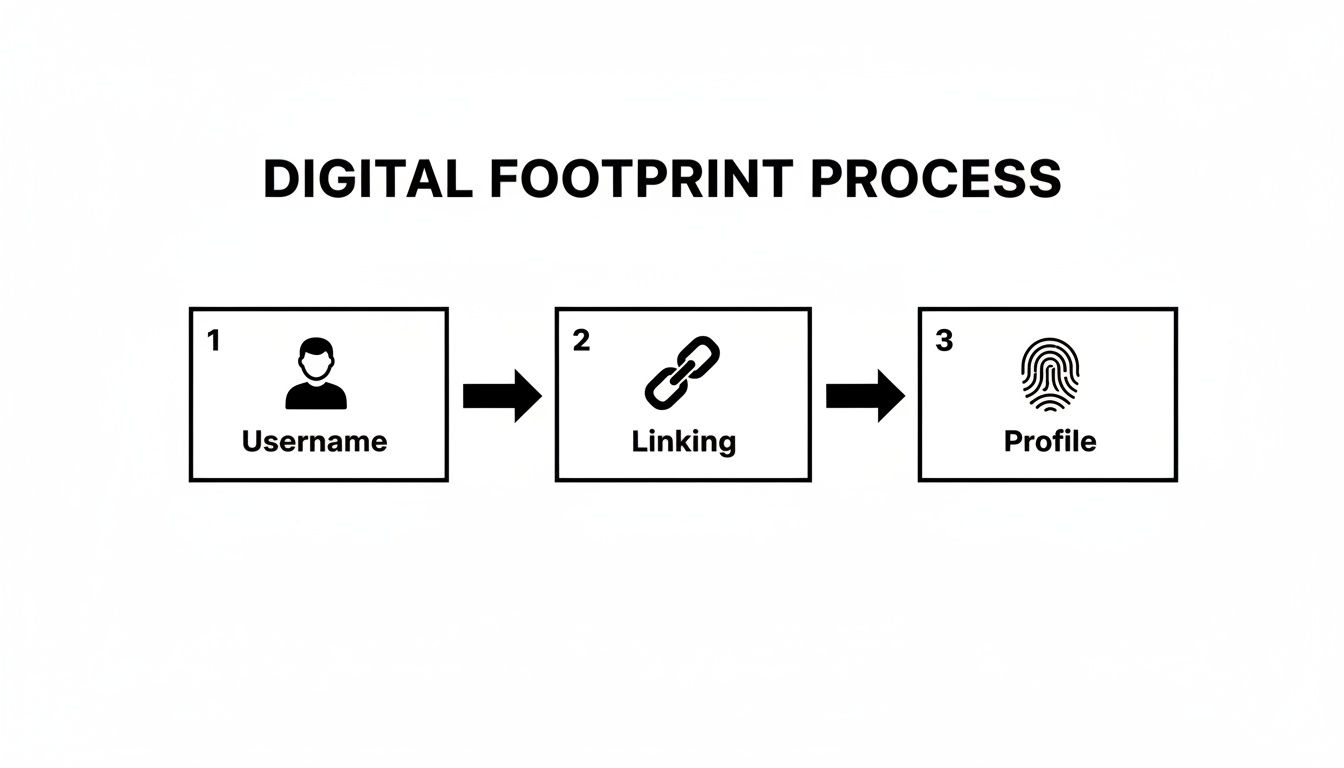
As you can see, a single identifier is often all it takes to start piecing together a much larger, more complex online identity.
Searching Within Social Platforms
Don’t stop at Google. Every social media platform has its own internal search engine, and they often turn up content and profiles that big search engines miss. This is an essential step for finding accounts and verifying who they belong to, whether for online dating safety or reputation management.
Platform-Specific Search Tips:
- Instagram and TikTok: Their search algorithms heavily favor usernames, but they also scan bios and display names. If a username search yields nothing, try searching for the person’s real name or any known nicknames.
- Facebook: Facebook’s search is surprisingly granular. After searching for a username, you can use the filters for “People,” “Posts,” “Photos,” and “Groups” to see every context where that name has appeared.
- LinkedIn: A username search here can be the missing link between a casual handle and a professional identity. Be sure to check both the “People” and “Posts” tabs to see if colleagues or connections have tagged that username.
These manual techniques are a fantastic way to get a feel for what’s publicly visible. But let’s be honest—they’re time-consuming and can easily miss things. To get a comprehensive picture across hundreds of platforms in just a few minutes, you can run a free scan with our digital footprint checker. An automated tool handles all the work, giving you a quick and thorough audit of your online presence.
Ready to move past basic Google searches and see what’s really out there? It’s time to dig into some powerful Open Source Intelligence (OSINT) techniques. These are the methods that separate a casual search from a professional investigation, helping you uncover connections that aren’t immediately obvious.
While manual searches are a decent starting point, you’ll eventually hit a wall. This is where advanced strategies and OSINT tools come into play, especially when you need to conduct a thorough reputation audit or verify an online identity with absolute confidence.
Uncovering Hidden Profiles with Username Permutation
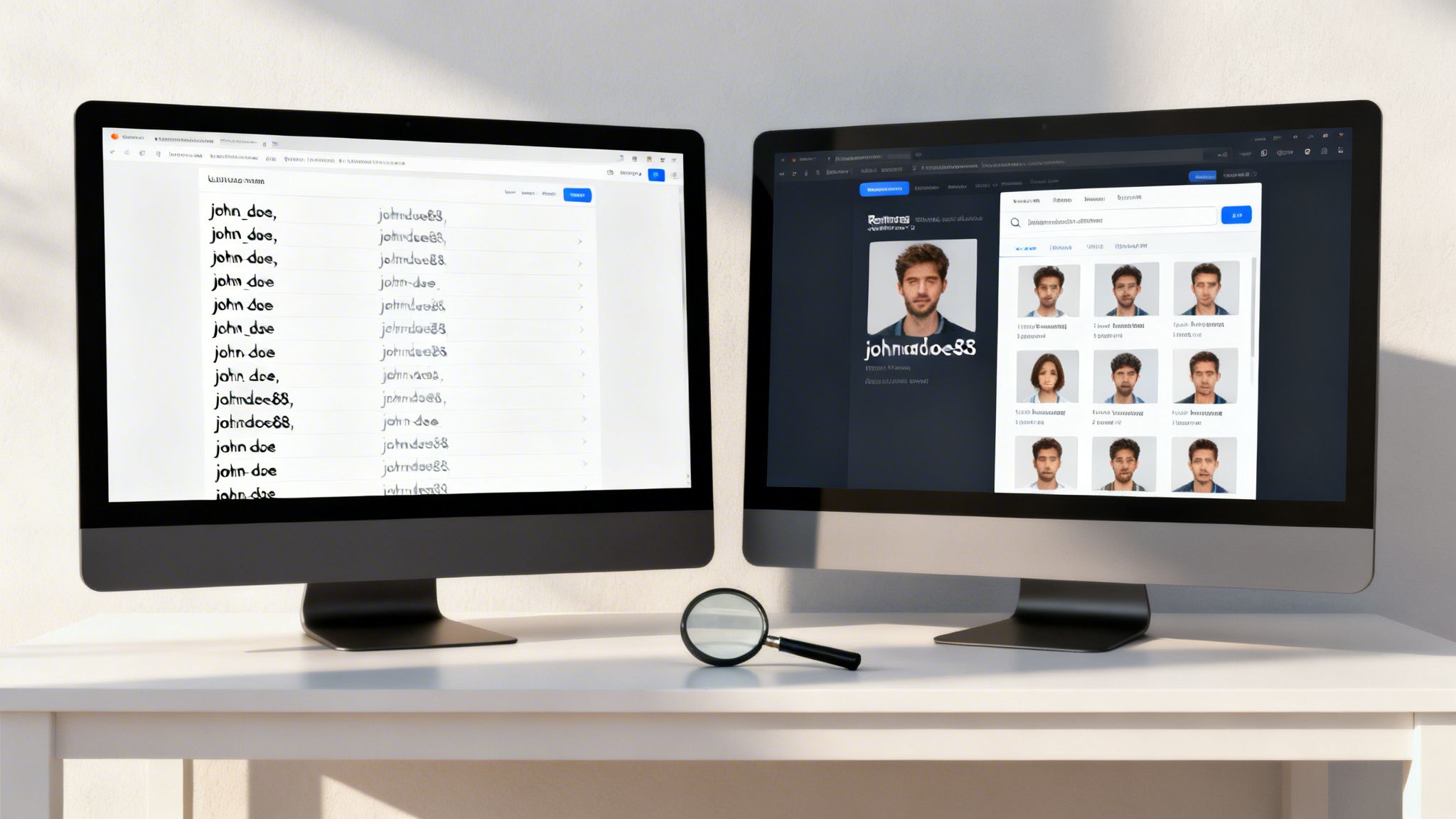
One of the first things you learn in this field is that people are creatures of habit, even when they’re trying to be anonymous. They rarely use a single, unique username across their entire online life. Instead, they add numbers, use underscores, or create slight variations for different platforms.
Username permutation is the art of systematically guessing and searching for these variations. It’s a core investigative technique used in both cybersecurity and OSINT.
If your target username is “PixelAvenger,” you can’t just stop there. A seasoned investigator knows to look for common patterns people use to create new accounts.
PixelAvenger22(adding a birth year or favorite number)Pixel_Avenger(using an underscore)Pixel-Avenger-88(adding a dash and another number)ThePixelAvenger(adding a common prefix)
By running searches for these permutations, you cast a much wider net. You might unearth an old gaming forum account, a forgotten blog, or a social media profile they thought was disconnected from their main identity. This is a fundamental concept in OSINT, and you can learn more by checking out this comprehensive guide on background checking using OSINT.
A single username is just one key. Permutation is like trying a whole ring of related keys, increasing your chances of unlocking hidden doors across the web. This is essential for effective catfishing detection and online identity protection.
The Power of Reverse Image Searching
What happens when someone uses a different username on another platform? This is where their profile picture can become your most valuable clue. A reverse image search takes an image and scours the internet to find every other place it has been posted. This is a powerful OSINT tool for verifying identities.
Tools like Google Images, TinEye, and PimEyes are indispensable here. You just upload a profile picture or paste its URL, and the service will show you other sites where that same image—or a visually similar one—appears.
This technique is powerful for a few key scenarios:
- Detecting Catfishing & Romance Scams: If a dating profile picture shows up on a stock photo site or on another social media profile with a different name, you’ve found a huge red flag. This simple check can prevent you from falling for a romance scam.
- Connecting Anonymous Accounts: You might find an anonymous forum account that uses the same avatar as a public Twitter profile, instantly linking the two and revealing the person behind the pseudonym, which is key for reputation management.
- Verifying Identity for Dating App Verification: Confirming that a professional headshot on LinkedIn is the same one used on a dating app adds another layer of confidence that you’re looking at the right individual, enhancing online dating safety.
When you combine username permutation with reverse image searching, you have a powerful, two-pronged attack. You’re no longer just hunting for a name; you’re tracking patterns of behavior and digital assets that create a much richer, more complete picture of a person’s online life.
Connecting the Dots to Build a Complete Picture
Finding a handful of accounts with the same username is a great start. But the real detective work begins now: proving they all belong to the same person.
This is where you shift from discovery to verification. You’re piecing together scattered clues from different platforms to build a single, reliable digital identity. If you skip this part, you risk creating a wrong picture based on a few unlucky coincidences.
The secret is hunting for overlaps. It’s one thing for two people to have the same username; it’s another for them to also have the same friends, photos, and unique way of writing. These connections are like digital DNA, linking one profile to the next with growing certainty. This cross-verification is a critical step in any OSINT investigation.
Cross-Referencing Your Findings
Think of yourself as an investigator standing in front of an evidence board. Each profile you’ve found is a clue, but its real value comes from how it connects to the others. Some signals are strong, while others are just noise.
When comparing profiles, you need to focus on these key areas for effective online identity protection:
- Biographical Details: Check the “About Me” sections for consistency. Does the city, job, or school listed on one profile match another?
- Friend and Follower Lists: This is a rich source. If a Twitter profile and an Instagram account with the same username share 20-30 mutual friends, the chances they belong to two different people are practically zero.
- Shared Content: People are creatures of habit. They often post the same vacation photos, life updates, or links to articles across different accounts. A photo from a trip to Miami on both Facebook and Flickr is a powerful link.
- Writing Style: Everyone has a unique “voice.” Pay close attention to their slang, recurring grammar mistakes, emoji usage, or specific phrases. This written fingerprint is often consistent even when they try to stay anonymous.
A single matching detail, like a shared username, is just a lead. A pattern of matching details—friends, photos, and personal data—is what turns a lead into confirmation and solidifies your understanding of a digital footprint.
If you want to go even deeper on these investigative techniques, our guide on how to find a person on social media offers more advanced strategies for connecting the dots.
Evaluating Profile Correlation Signals
Not all evidence carries the same weight. An identical, unique profile picture is a much stronger signal than a generic bio that just says, “Loves coffee and dogs.” When you’re trying to figure out if two profiles belong to the same person, you have to weigh what you’ve found. This comparison table helps you evaluate the strength of different OSINT signals.
| Signal | Description | Reliability Score (1-5) | Verification Tip & Real-World Impact |
|---|---|---|---|
| Identical Profile Picture | The exact same photo is used across multiple platforms. | 5 (Very High) | Use a reverse image search to ensure it’s not a stock photo. A strong link for catfishing detection and dating app verification. |
| Username + Number Pattern | Usernames like “janedoe92” and “janedoe1992” appear on different sites. | 4 (High) | The number often corresponds to a birth year. Look for other clues that can help verify this. Useful for connecting professional and personal profiles. |
| Overlapping Friend/Follower Lists | Multiple shared connections exist between two accounts. | 4 (High) | The more mutual connections there are—especially non-public figures—the stronger the link. Excellent for verifying dating profiles. |
| Consistent Bio Details | Specific job titles, locations, or personal mottos are repeated. | 3 (Medium) | Bio details can be outdated. Specifics like “Marketing Manager at Acme Corp” are better than “Loves marketing.” Affects job prospects. |
| Similar ‘About Me’ Text | The bio text has a similar tone or phrasing but isn’t identical. | 2 (Low) | This is a weak signal on its own but can be good supporting evidence. Helps build a fuller picture for reputation management. |
By learning to recognize and score these signals, you move beyond simple searches and start building a accurate and complete picture of a person’s digital footprint.
Username Search in Real-World Scenarios
Knowing the technical steps of a username search is one thing. But the real power comes from using those skills in situations you actually face—turning a bunch of digital clues into insights that can protect your personal safety, your career, and even your bank account.

Let’s get practical and walk through a few common scenarios where these search techniques and OSINT tools become essential.
Protecting Yourself in Online Dating: Romance Scams & Catfishing Detection
In the world of online dating, a healthy dose of skepticism is your best friend. A username search is one of the most powerful tools for verifying that a potential partner is who they say they are. It’s your first line of defense against romance scams and catfishing, which bilked victims out of over $1.3 billion in 2022 alone according to the FBI.
Imagine you match with someone using the username “Traveler_Jake89.” A quick search shows that name is clean. But using what you know about username patterns, you try “TravelerJake” and find a gaming forum profile full of aggressive rants. Another search for “Jake_Travels89” pulls up a photography site with a different set of photos. These inconsistencies are huge red flags, giving you a chance to step back before you get emotionally or financially entangled in a romance scam. This is a practical example of online dating safety in action.
This kind of digital due diligence is the new normal. With 5.17 billion social media users worldwide, the average person is active on about 6-7 different platforms a month. Younger generations are leading the charge, with 64 percent of Gen Z adults in the U.S. using platforms like TikTok as their go-to search engine. Social media has become a primary source for information, and a username search is just a modern way of looking before you leap.
Safeguarding Your Career Prospects and Job Opportunities
Before you hit “submit” on your next job application, take a minute to think like a recruiter. An estimated 90% of employers use social media to screen candidates, and an old, unprofessional post tied to a forgotten username could sink your chances before you even get an interview.
Think about it: Your professional LinkedIn profile uses the handle “JDoeCreative.” But what about that Reddit account you made ten years ago as “JDoe_C” to complain about a former boss and post cringey memes? A sharp hiring manager using basic OSINT could connect those two profiles through username permutation analysis. This could have a direct negative impact on your job prospects.
Auditing your own digital footprint with a thorough username search helps you find and clean up these skeletons in your digital closet before a recruiter does. It’s all about proactive reputation management and making sure the person they see online is the professional you want them to see.
Securing Your Gaming and Online Assets: Gaming Account Security
For gamers, a username is more than a login—it’s an identity. It’s tied to valuable in-game assets, a network of friends, and a hard-earned reputation. If you’ve reused that same gaming tag on other sites with weaker security, you’ve created a serious vulnerability that threatens your gaming account security.
A hacker doesn’t need to breach a high-security gaming platform if they can get your password from an old, forgotten forum account that uses the same username and a simple password. This is a common entry point for identity theft.
By running a search on your own gaming handle, you can map out every account linked to it. This allows you to go back and update passwords, enable two-factor authentication, and shut down old profiles that are just security risks waiting to happen. Protecting your “PixelAvenger22” identity is just as critical as protecting your real-world one.
A great place to start is with a free scan at Digital Footprint Check. It’s a quick way to see where your own usernames are exposed online.
Frequently Asked Questions About Username Searches
Once you start looking into your own online presence, you’ll naturally have some questions. It’s a complex topic. We’ve gathered some of the most common queries we get and provided straightforward answers from our experience in digital privacy and cybersecurity.
Is It Legal to Search for Someone’s Username?
Yes, in almost all cases, it’s perfectly legal to search for a username. The whole practice is based on finding information that’s already publicly available. This is a fundamental part of what’s known as Open Source Intelligence, or OSINT.
The real question isn’t about legality, but intent. Using these search techniques to check up on a suspicious online dating profile, vet a potential business partner, or simply audit your own digital footprint for reputation management is above board. Where you cross the line is when you use that information to harass, stalk, discriminate against, or harm someone. That’s illegal and unethical, and it’s something we strictly condemn.
How Does a Username Search Prevent Identity Theft?
Think of it as a proactive defense for your online identity protection. By regularly searching for your own usernames, you can spot weak points in your digital armor before criminals do. You might uncover old, forgotten accounts with weak passwords or find out your username was exposed in a data breach you never knew about.
Discovering these weak points before a criminal does allows you to take control. You can close risky accounts, update weak passwords, and remove personal information that could be exploited. This is a crucial cybersecurity practice.
This simple bit of digital hygiene is a massive step in reducing your “attack surface.” The harder you are to find and exploit, the less likely you are to become a victim of identity theft.
Why Can’t I Just Rely on Google?
Google is an amazing tool, but it has its limits. It simply doesn’t index everything. The vast majority of social media sites, niche forums, gaming platforms, and the deep web remain largely invisible to a standard Google search.
Many user profiles and posts are intentionally kept out of Google’s reach by the platforms themselves. For a deep search, you need specialized OSINT tools built for the job. These platforms are designed to query hundreds of sources that Google can’t, giving you a much more complete and accurate picture. To see how this works, you can learn about the capabilities of a dedicated username search engine and how it goes far beyond what a normal web search can offer.
Ready to see what’s out there? Digital Footprint Check provides the tools to conduct a comprehensive search across hundreds of platforms. Uncover your complete digital footprint and take the first step toward securing your online identity, protecting your job prospects, and ensuring online dating safety with a free check today.