· Digital Footprint Check · Content Marketing · 14 min read
Digital Footprint Risks: What You Need to Know
Understand digital footprint risks, from identity theft to reputational damage, and learn practical strategies to protect your online identity and privacy

In 2025, the United States recorded 3,322 data compromises, a record high and a 79% increase over five years, according to the Identity Theft Resource Center's 2025 Annual Data Breach Report. That figure describes organizational incidents, but it also reveals a personal reality: your online exposure can grow even when you rarely post.
A digital footprint isn't one embarrassing photo or one leaked password. It's the connected trail created by your email addresses, phone numbers, usernames, gaming accounts, dating profiles, public records, old posts, location clues, and breached credentials. Attackers, scammers, data brokers, recruiters, and curious strangers can combine those fragments into a profile that says far more about you than any individual disclosure.
Why Digital Footprint Risks Are Growing Faster Than Ever
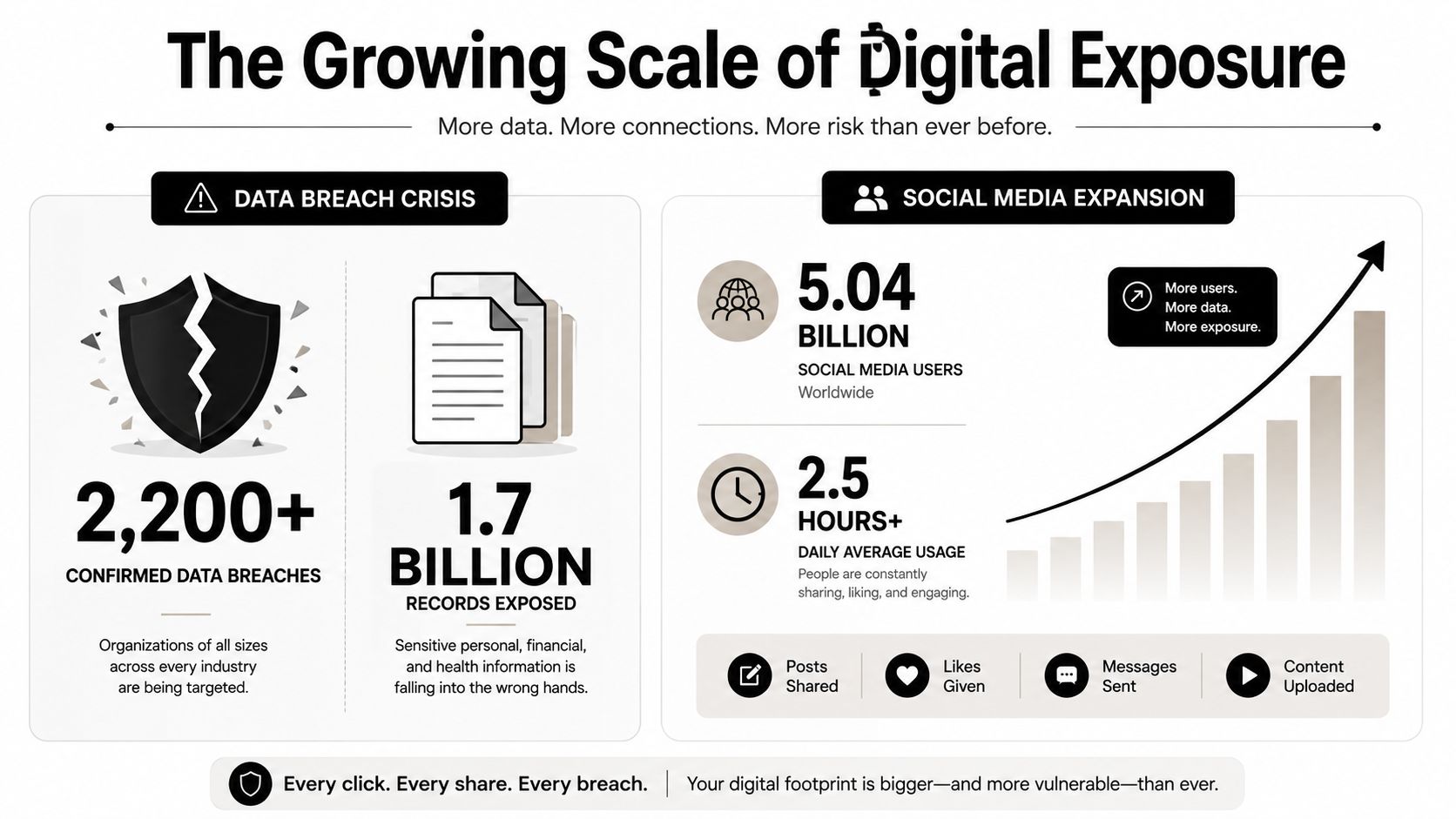
The risk is growing because more services connect the same identifiers. An email address used for a shopping account may also appear on a gaming profile, a professional network, a dating app, and a breached forum. A phone number can connect a social profile to a messaging account, while a tagged photograph may reveal friends, routines, or a familiar location.
One exposed email address is useful to an attacker. The same email address combined with a leaked phone number, a public birthday, a tagged photo, and a reused password becomes much more useful. The attacker doesn't need one dramatic secret. They need enough matching clues to make a phishing message believable, guess which accounts matter, or impersonate someone you trust.
The central risk: Small disclosures become dangerous when they can be linked across contexts.
Three forces accelerate this process:
- Data broker aggregation: Data brokers collect and combine information from public records, commercial sources, online activity, and other available datasets. Their profiles can make a scattered footprint easier to search and reuse.
- OSINT fusion: Open-source intelligence techniques help investigators and attackers connect usernames, photos, domain records, breach information, public posts, and relationship clues. Ethical OSINT can support security audits, but the same methods can be abused.
- Automated correlation: Software can search many platforms quickly and compare names, handles, images, locations, and contact details. This makes cross-platform matching less dependent on a person manually browsing the web.
The wider breach pattern reinforces the concern. The Privacy Rights Clearinghouse 2025 Data Breach Report recorded 8,019 breach notification filings, representing 4,080 unique breach events affecting at least 375 million individuals. Healthcare represented 66% of affected individuals, while eight of the twenty largest breaches occurred at service providers and together affected 231 million people.
You don't need to disappear from the internet. You need to reduce the number of identifiers that can be connected. A personal audit informed by AI for Ethical Hacking concepts can help you understand how defenders map exposed assets without crossing privacy or authorization boundaries. You can also explore how the digital footprint of the future may change privacy protection as platforms and automated profiling continue to evolve.
Understanding Your Digital Footprint and Digital Shadow
A digital footprint is the trail of information created by your online activity. It includes the profile fields you complete, messages you send, reviews you publish, websites you visit, applications you use, and records held by services that process your information.
The footprint has two useful parts:
- Active footprint: Information you intentionally share, such as social posts, comments, profile details, uploaded images, marketplace listings, forum replies, and public reviews.
- Passive footprint: Information collected or generated in the background, such as location metadata, cookies, browsing logs, app telemetry, device signals, and records exposed through a breach.
A library analogy makes the distinction easier. Your active footprint is like the books you check out yourself. You choose them, present your library card, and understand that the transaction exists. Your passive footprint is like the list kept behind the counter, including which branch you visited, when you arrived, and what the system recorded about your account.
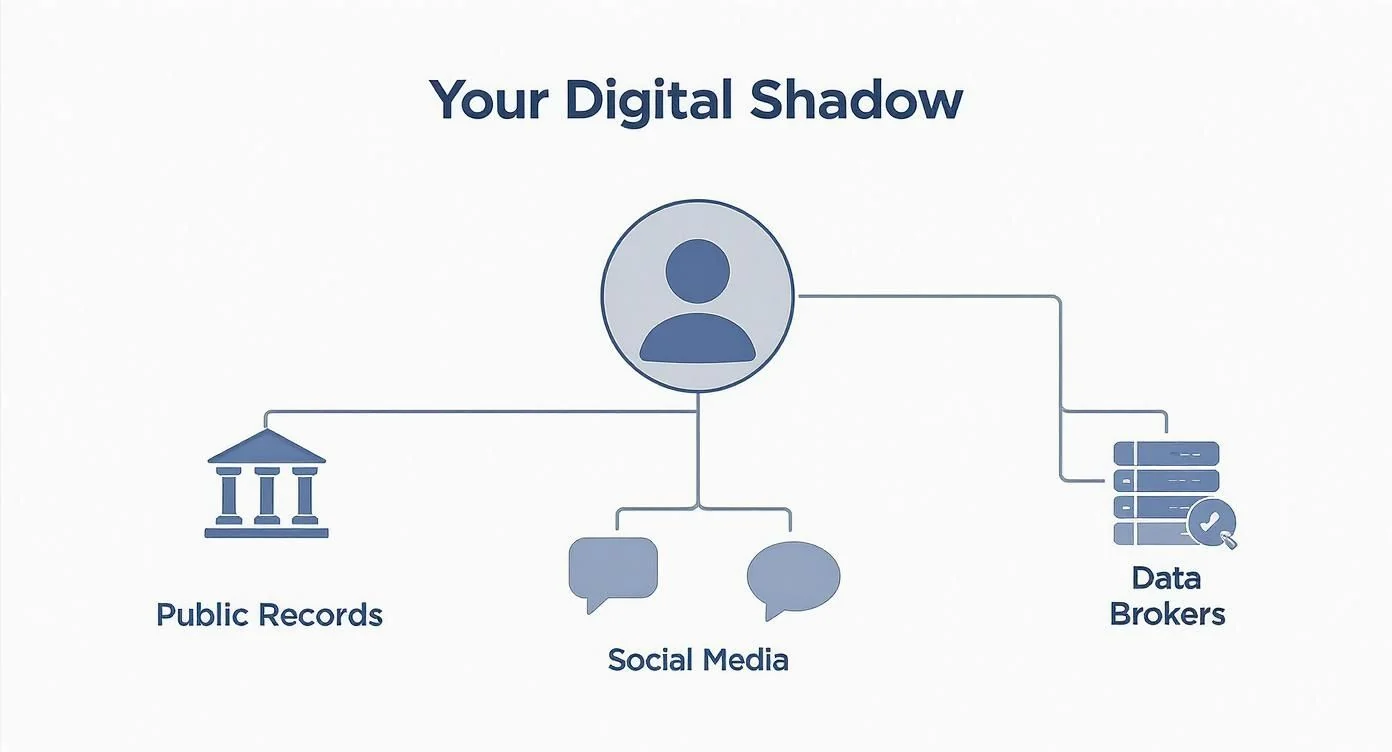
Your digital shadow goes further. It includes information you didn't knowingly publish, such as facial-recognition matches, leaked credentials, inferred relationships, location patterns, and data broker profiles assembled from public records and commercial information. A person might never post their home address, yet an address can still appear in a people-finder listing or a public filing.

Tracking systems can also connect activity across devices and accounts. Businesses that need to measure engagement across devices illustrate a legitimate version of cross-platform measurement, while privacy-conscious users should understand what signals make that linking possible.
The distinction matters because different exposures create different harms:
- Identity theft draws on credentials and personal identifiers.
- Financial fraud uses payment, banking, or account information.
- Reputational damage follows old posts, comments, and photos.
- Employment harm arises when professional or personal traces affect screening.
- Social engineering turns personal context into convincing manipulation.
- Doxxing combines addresses, routines, relationships, and location clues.
The same piece of data can feed several categories. A public phone number may support account takeover, targeted phishing, impersonation, or unwanted contact. That overlap is why a footprint audit should focus on connections, not only individual posts.
For a deeper explanation of how habits create hidden exposure, see what your digital shadow reveals about you.
The Six Main Categories of Digital Footprint Risk
Digital footprint risks don't all deserve the same response. A leaked gaming username may be inconvenient on its own, while a reused password connected to that username can threaten several accounts. The priority should reflect both how often a pathway appears and how severely it can affect your money, safety, identity, or opportunities.
| Risk Category | Likelihood | Impact | Common Trigger |
|---|---|---|---|
| Identity theft | High | Severe | Leaked credentials, names, phone numbers, and account identifiers |
| Financial fraud | High | Severe | Exposed card details, banking access, or identity records |
| Social engineering | High | High | Public relationships, work details, travel plans, and personal interests |
| Employment and professional harm | Moderate | High | Old posts, public arguments, misleading profiles, or inappropriate images |
| Reputational damage | Moderate | High | Archived comments, screenshots, impersonation, and context collapse |
| Doxxing | Lower for many users, serious when targeted | Extreme | Aggregated addresses, routines, family details, and location clues |
Identity theft ranks first because credentials and personal identifiers travel well. The FTC and related agencies received 1,358,253 identity theft complaints in 2025, alongside roughly 3 million related fraud complaints, with total reported losses exceeding $15.8 billion, as summarized by Experian's identity theft statistics. Hijacked or newly opened bogus credit card accounts were the most common identity-theft category, generating 597,770 complaints, up 33% from 2024.
Financial fraud often begins with an identity problem. A stolen password, exposed email account, or convincing impersonation can give an attacker the access needed to change payment details or open an account. This is why credential compromise deserves attention even when no card number appears in the initial exposure.
Social engineering thrives on context. A scammer who knows your employer, travel plans, favorite game, or relationship network can make a message feel familiar. Social media is a major starting point for reported scams. The FTC's online dating guidance says nearly 30% of people who reported losing money to a scam in 2025 said it started on social media, while nearly 60% of people who reported losing money to a romance scam said it began on a social platform.
Employment and reputation risks are harder to measure with one universal score. Recruiters may encounter an old joke, a political argument, a copied portfolio, or a public gaming identity without the original context. Doxxing affects fewer people than mass fraud, but the consequences can be immediate and personal when someone combines a home address with routines or family information.
Real-World Examples That Show How Exposure Turns Into Harm
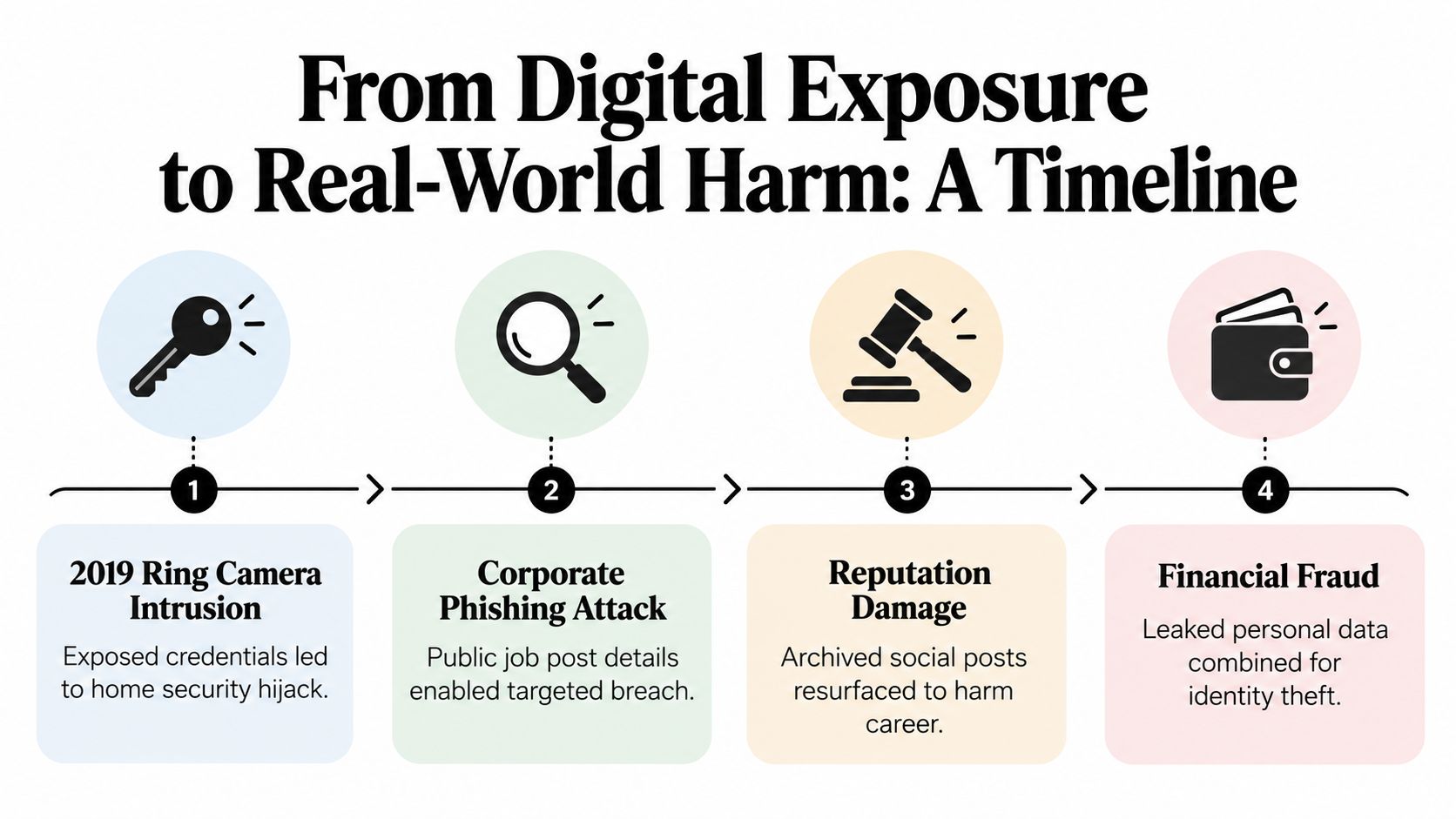
Digital footprint risks become easier to understand when the chain is visible. In each example, the harm comes from connecting ordinary pieces of information to an account, person, or real-world location.
The Ring camera intrusion
In the 2019 Ring camera intrusions, attackers used exposed credentials that had been reused across sites. The important lesson isn't limited to one camera brand. A username and password that seem unimportant on an old service can become a route into a home device when the same combination protects another account.
The footprint chain looks like this:
- Credentials appear in an earlier exposure or are guessed from reused information.
- An attacker tests those credentials against another service.
- The connected device reveals private spaces or enables direct harassment.
- The victim experiences a physical sense of intrusion, not merely a compromised login.
The Buffalo Discord situation
The 2022 Buffalo shooting situation demonstrated how private Discord material can become searchable or discoverable outside the original conversation. A post made for a limited audience may be copied, leaked, indexed, or discussed elsewhere.
That creates a context problem. Search results may surface fragments without the surrounding conversation, while screenshots preserve content after the original author deletes it. The footprint risk comes from assuming that “private” means permanently contained.
Old tweets and professional harm
The 2019 firing of a journalist over old tweets showed how dormant content can return during a public or professional review. A person may have created a post years earlier for a different audience, with different expectations and a different identity context. A hiring manager, client, or colleague may still judge the visible artifact without sharing that history.
The practical concern extends beyond controversial posts. Public profiles can also expose inconsistent employment dates, copied work, aggressive disputes, or contact details that make impersonation easier.
Romance scams and trusted-person impersonation
An Instagram profile can reveal travel habits, tagged locations, friends, favorite places, and the names of people who regularly appear in photos. A scammer can use those details to imitate a trusted travel companion or create a story that sounds plausible.
Romance scams often depend on emotional timing rather than technical sophistication. The attacker studies what the target shares, establishes familiarity, and then introduces urgency, money, secrecy, or a crisis. The credit card fraud examples show why personal information can become financially consequential after it is combined with account and payment clues.
The same pattern appears in gaming. A public gamer tag linked to a real name, birthday, team, and streaming schedule can help an attacker target the account, impersonate the player, or locate the person behind the profile.
Likelihood and Impact Analysis Across Risk Categories
A likelihood-impact framework helps you avoid spending all your effort on low-signal content while ignoring exposed credentials, recovery details, or location information. The ratings below are a practical prioritization tool, not a prediction for any one person.
Some supplied planning assumptions cannot be treated as verified facts, including claims about employer screening rates and older complaint totals. The matrix therefore uses qualitative evidence that is documented in the verified breach, fraud, and privacy sources.
| Risk Category | Likelihood (1-5) | Impact (1-5) | Aggregate Score | Key Evidence |
|---|---|---|---|---|
| Identity theft | 5 | 5 | 25 | FTC complaint volume and widespread breach exposure |
| Financial fraud | 4 | 5 | 20 | Credit-account identity theft and reported fraud losses |
| Social engineering | 5 | 4 | 20 | Phishing, smishing, business email compromise, and social-media scam pathways |
| Employment and professional harm | 3 | 4 | 12 | Public profiles, archived posts, and reputation screening concerns |
| Reputational damage | 3 | 4 | 12 | Persistent copies, screenshots, impersonation, and context loss |
| Doxxing | 2 | 5 | 10 | Aggregated location, address, family, and routine information |
The strongest first targets are credentials, recovery channels, financial identifiers, and location data. An exposed password can grant access to multiple services if reused. An exposed recovery email or phone number can help an attacker reset accounts. Location clues can create personal safety concerns even when they have no direct financial value.
Organizational exposure deserves a separate lens. A Bitsight study covering 27,458 companies and 2,671 publicly disclosed breach events found that organizations with a security rating of 400 or lower were five times more likely to experience a publicly disclosed breach than organizations rated 700 or higher. The Bitsight security ratings and breach correlation supports a practical conclusion: externally visible weaknesses, exposed services, and poor controls can signal greater breach risk.
Individual audits should follow the same logic. Search for identifiers that connect accounts, then inspect what those connections reveal. Don't treat a harmless profile photo, an old username, or a public employer listing as equally dangerous. The question is whether an attacker can use the item to authenticate, persuade, locate, impersonate, or damage trust.
Practical Mitigation Strategies You Can Use Today
Begin with the exposures that can lead to other exposures. A practical audit doesn't require deleting your entire online life. It requires identifying the few data types that create the most dangerous links.
Secure identity and money first
- Protect account access. Use a password manager to create unique passwords for email, banking, gaming, shopping, and dating accounts. Turn on multifactor authentication, preferably through an authenticator app or security key where available.
- Freeze credit when appropriate. A credit freeze can restrict access to your credit file and make fraudulent new-account activity harder. If you're concerned about tax-related identity theft, review the IRS Identity Protection PIN process through official IRS channels.
- Remove stored payment data. Close old shopping, subscription, and gaming accounts you no longer need, then remove saved cards from services you keep. An inactive account can still hold personal and billing details.
- Check breach exposure. Search your email addresses with Have I Been Pwned and review whether any exposed password was reused elsewhere. Change reused passwords immediately, beginning with your primary email account.
Australia's national fraud data shows why detection speed matters. In 2024-25, an estimated 1.0% of people aged 15 and older, about 220,400 people, experienced identity theft, and 81% notified or were notified by an authority. Banks and financial institutions were the most common authority notified, at 40%, according to the Australian Bureau of Statistics personal fraud release.
Reduce reputation, job, and social-engineering exposure
Search your full name in quotation marks, then repeat the search with old usernames, email variants, phone numbers, and employer names. Set Google Alerts for your name and important email variants. Review public profiles, tagged photographs, gaming bios, dating-app details, and professional pages from the perspective of someone who doesn't know you.
For social engineering, remove unnecessary birth details, family names, home-area clues, travel timing, and direct contact information from public bios. Review app permissions and disconnect services you no longer use. For doxxing, check WHOIS records for domains you control, people-finder sites, and data broker listings, then submit opt-out requests where available.
Use a weekly exposure check for breached credentials and a quarterly OSINT self-search in an incognito browser window. Digital Footprint Check is one option for reviewing exposure across 500+ platforms, including social networks, gaming profiles, breach databases, professional networks, and public records. You can also follow personal cybersecurity best practices when turning those findings into account and privacy changes.
Common Misconceptions and a Sustainable Protection Mindset
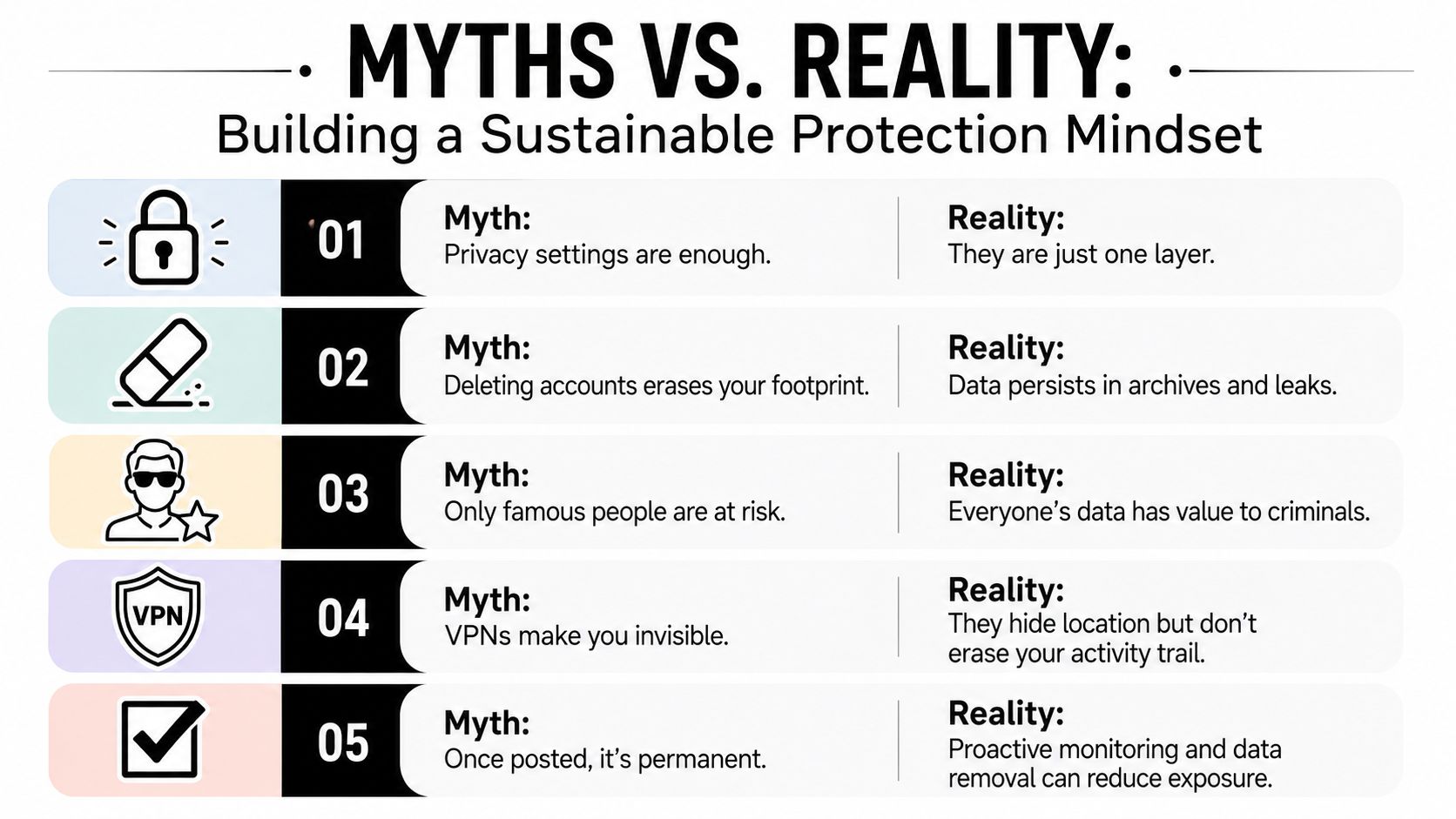
Myth one, privacy settings are enough. Privacy settings reduce visibility on a platform, but they don't control screenshots, copied posts, breached databases, search-engine caches, or information held by other people. Treat settings as one protective layer, not a complete privacy strategy.
Myth two, deleting an account erases the footprint. Deletion can remove content from the original service, but archived pages, screenshots, data broker records, quoted posts, and breach copies may remain. Before closing an account, remove unnecessary personal information and revoke connected applications.
Myth three, only public figures face serious exposure. Every person has information that can help an attacker. A regular user's email, phone number, workplace, gaming identity, or family connections can support phishing, impersonation, account takeover, or unwanted contact.
Myth four, a VPN guarantees anonymity. A VPN can conceal your network location from some observers, but it doesn't erase your account activity, public posts, browser records held by websites, or data already collected by services. It also won't fix reused passwords or exposed recovery details.
Myth five, minimal posting eliminates risk. Passive collection, old accounts, app telemetry, breached records, and other people's posts can still create a shadow. Even an uploaded image can contain metadata or visual clues that reveal more than its caption.
A sustainable protection mindset looks more like dental care than an emergency visit. Schedule quarterly self-audits, set alerts for name and email variants, rotate important passwords, and review app permissions twice a year. Treat every new signup as a deliberate exposure decision, especially when a service asks for information it doesn't clearly need.
The Monro Cloud guide to website security best practices can help organizations think beyond individual accounts and examine the systems, permissions, and services connected to their public presence.
The goal isn't perfect invisibility. It's controlled exposure, fewer linkable identifiers, stronger account boundaries, and faster detection when something changes.
Digital Footprint Check helps you discover exposed information across social media, gaming profiles, breach databases, professional networks, data brokers, and public records, then provides practical guidance for reducing that exposure. Visit Digital Footprint Check to run a free check and identify the digital footprint risks that deserve your attention first.