· Digital Footprint Check · Content Marketing · 17 min read
What Can Scammers Do With Your Address in 2026
What can scammers do with your address? See mail diversion, package scams, and impersonation risks, plus steps that limit exposure.
Search the phrase what can scammers do with your address and you'll meet the same advice in a dozen fonts: scrub yourself from every people-search site, never type your street name anywhere public, treat every listing as an emergency. It sounds responsible. It's also why so many people quit halfway through. Treat all address exposure as equally dangerous and the job becomes impossible, so nothing gets done.
The narrower framing is more useful. An address is not a key that opens your life. It's a targeting signal that tells a stranger which household, which mailbox, and which delivery pattern to work on, and it only gets expensive when something else is attached to it. Sort exposure into low, medium, high, and urgent, and you can finally decide what to do this week instead of panicking about all of it.
What Scammers Can Actually Do With Your Address
An address on its own is a weak credential. It won't pass a lender's identity check, and it won't reset a password. What it does is point a criminal at a door, a mailbox, and a household name worth dropping into a message.
The damage scales with whatever the address is attached to. The table sorts the common misuses by the extra ingredient each one needs.
| Misuse | Extra data that makes it work | What you can lose |
|---|---|---|
| Fraudulent postal change of address | Name plus enough detail to file or bypass a check | Checks, replacement cards, tax and insurance mail |
| Address change at a bank or retailer | Name plus account clues or a convincing call | Statements and new cards sent elsewhere |
| Mailbox or porch theft | A visible address and a predictable delivery window | Cards, checks, and parcels |
| Brushing and fake-review parcels | Address found online or in leaked data | A fake buyer profile tied to your name |
| Local impersonation | Address plus phone, employer, or relatives | Passwords, payment data, or ID images |
| Linking public records | Name already on people-search sites | Relatives, old addresses, and more contact points |
| Harassment or stalking | Address plus routines or household names | Personal safety, not only money |
Read the third column closely and a pattern appears. Only the first two rows can cost you money without the scammer ever coming near your house. Everything else needs a second fact, a predictable routine, or a piece of your mail.
An address sitting on a voter file or a data-broker page mainly makes a phone call sound local. Someone who knows your street can open with "I'm calling about the service at 14 Ashgrove Terrace" and sound like a utility, a landlord, or a council office. The Postal Service classifies a name, address, birth date, and Social Security number as personally identifying information that gets acquired for impersonation, which puts the address in the role of connector rather than key (USPS identity theft guidance).
An address doesn't open every lock. It shows a stranger which door to try.
Control of incoming mail is a different problem entirely. When a criminal can redirect delivery, checks, replacement cards, insurance letters, tax correspondence, and account statements stop arriving at your home and start arriving at theirs. Combine an address with a name and a plausible date of birth and the postal system itself becomes the tool.
The same street name pasted into a gaming bio, a dating profile, or a résumé PDF that search engines still index connects a username to a residence. From there, relatives, a workplace, and a rough daily schedule often follow without anyone paying for a report.
How a Change of Address Steals Your Mail
A forwarding order can turn a mailbox into a collection point for someone else's mail. For example, a criminal who can submit a change-of-address request may redirect your bank statements and replacement cards before you realize anything is missing. An address alone usually does not give someone control of your mail; the risk rises when they can also provide enough personal information to pass identity checks.
The U.S. Postal Service Office of Inspector General's report on change-of-address fraud describes how redirected checks, credit cards, insurance documents, tax correspondence, and account statements can support identity theft or financial fraud.
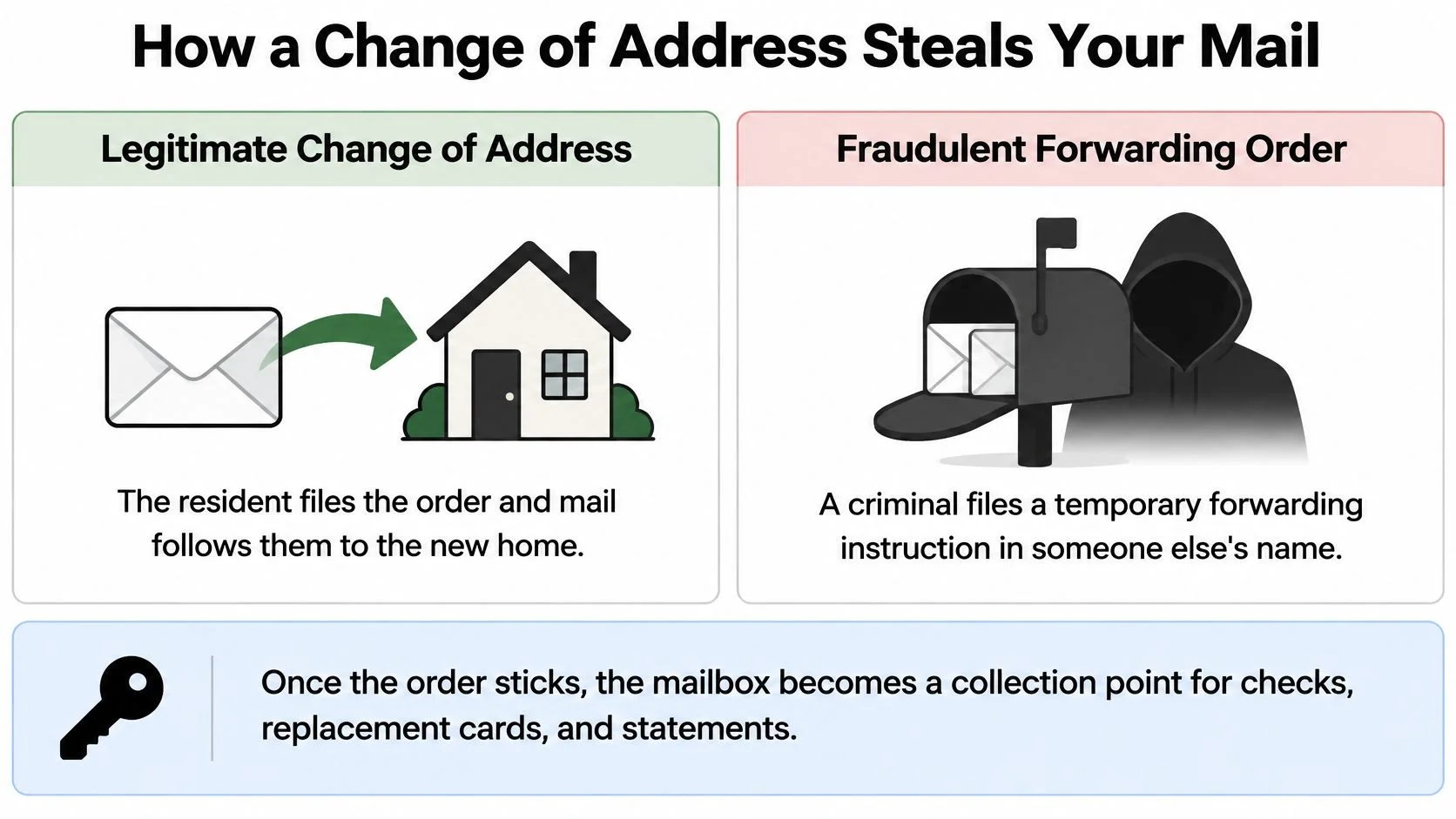
The process is ordinary, which can make unauthorized forwarding hard to spot. The OIG report found that online change-of-address fraud and attempted identity theft rose from 8,857 cases in 2020 to 23,606 in 2021, a 167 percent increase. In 2021, the Postal Service processed nearly 36 million change-of-address requests, and roughly 20 million, or 56 percent, were completed online.
USPS reported more than 33 million change-of-address transactions in fiscal year 2022. Its Inspection Service has described fraudulent filings as identity-theft schemes aimed largely at financial mail, particularly cards and checks (USPS Inspection Service announcement on postal crime).
Why victims miss the warning
A missing letter can look like a routine delay. A police bulletin on mail-forwarding schemes describes criminals redirecting mail so that new credit cards, bills, and purchase deliveries never reach the victim. In those cases, the criminals already had more sensitive details, such as dates of birth and Social Security numbers. The forwarding order helped hide the activity.
An address can point a scammer toward your mail. Personal details or credentials may help them redirect it.
What changed after the crackdown
Stronger identity verification for online and in-person submissions reduced fraudulent filings. The added checks make postal change-of-address fraud harder, but other organizations may still accept address changes through their own processes. A scammer who has enough information could try to redirect mail through a bank, card issuer, or retailer instead.
If you are moving, use official channels and keep your confirmation. A guide to how to update your address after moving covers notifications beyond the postal service, including those for banks and government records.
Watch for a confirmation or validation letter you did not request. It may mean someone has tried to change where your mail goes.
Unexpected Packages and Porch Theft Risks
A box arrives with your name and address on it and you didn't order anything. Inside is a phone charger, a cheap bracelet, a bag of seeds. You might shrug, keep it, or bin it. The parcel deserves a closer look, because four very different things produce the same doorstep delivery.
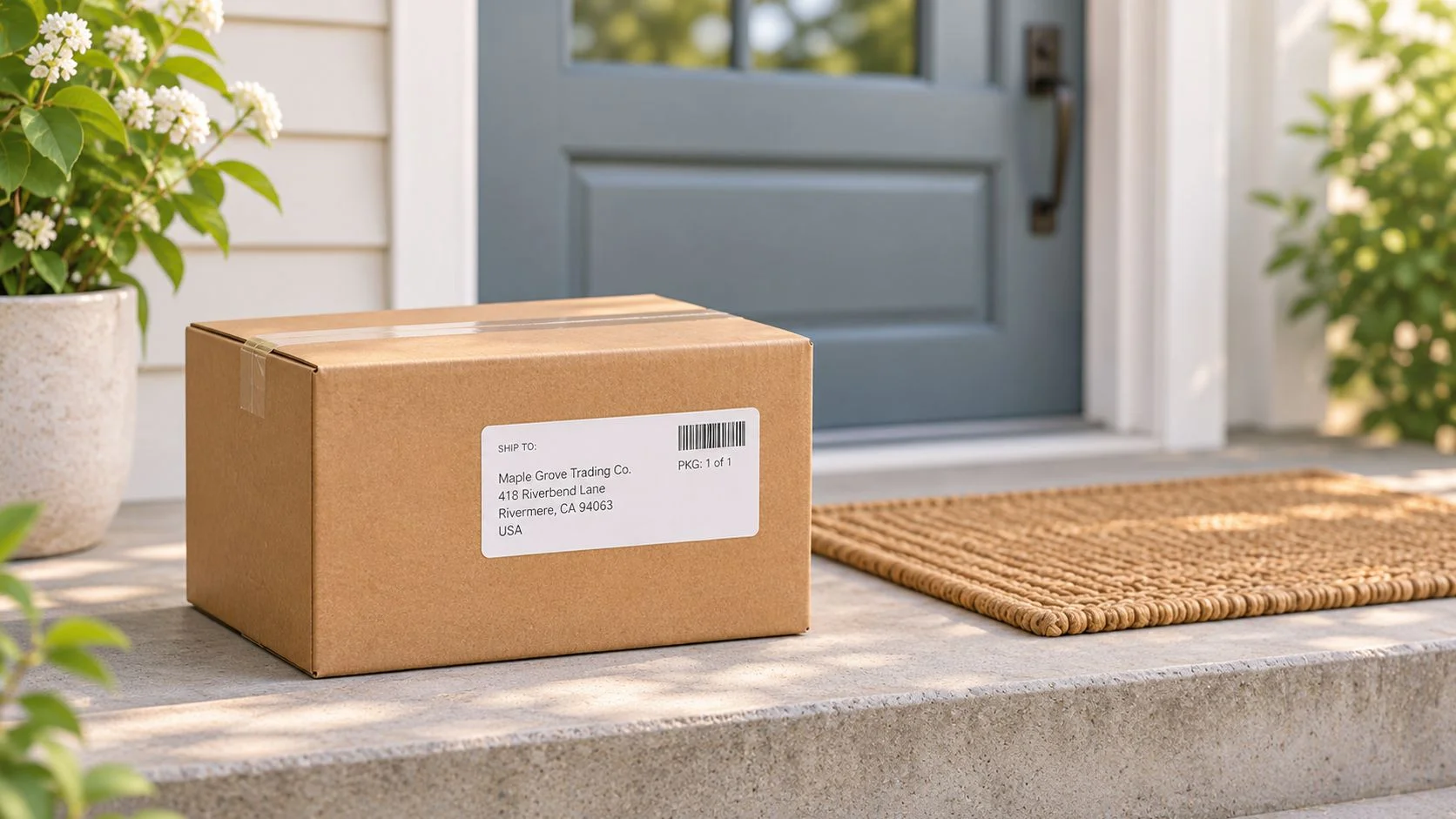
Reading the four cases
A misdelivery or a genuine gift is the harmless reading, and it's the one you can confirm. If the label names a neighbor, a relative, or a retailer you bought from, check with that person before you treat it as fraud.
Brushing is the fake-review case. In January 2025 the FTC's warning about unordered packages described sellers shipping merchandise to real addresses so they can post reviews in the recipient's name, and noted that locating the address online or in compromised data is part of how the scheme works. The same guidance cites 2025 USPS Office of Inspector General estimates of at least 58 million stolen packages and up to $16 billion in U.S. losses during 2024.
A phishing setup uses the box, or a lookalike delivery notice, to push you toward a QR code, a small redelivery fee, or a phone number printed only on the label. The parcel is bait for a payment or a credential.
A compromised shopping login looks different again, because the order exists inside an account you use.
| What you see | Likely reading | What to check |
|---|---|---|
| A box from someone you can name offline | Misdelivery or a gift | Confirm with that person before treating it as fraud |
| Merchandise you did not order and no matching login order | Brushing and fake reviews, as the FTC warned in January 2025 | Report it to the retailer and the FTC; the address may have come from the web or leaked data |
| A QR code, a fee, or a phone number that appears only on the label or a lookalike notice | Phishing | Do not scan, pay, or call the label |
| The same order visible inside a retailer account you use | Compromised shopping login | Change that password and review recent charges |
| A package that never arrives | Porch or mail theft | 2025 USPS OIG estimates cite at least 58 million stolen packages and up to $16 billion in U.S. losses in 2024 |
Check the account before you check the box. If the order doesn't exist inside a login you own, the parcel is a message, not a purchase.
Clues that aren't financial
Not every address risk touches a bank balance. Names left on discarded labels, a delivery window that repeats every weekday, and a porch that's visibly empty between nine and five all describe a household's routines to anyone watching. Renters, families, public-facing workers, and people dealing with a stalker often face a physical risk long before an account is opened, and a stolen parcel is sometimes the least of it.
If an unexpected delivery arrives with a tracking link in a text message, the link is the thing to distrust. There's a breakdown of the pattern in this guide to the UPS delivery scam that shows how the fake notice mimics a real carrier page.
For a parcel you didn't order, do three things once. Look for the order in the shopping accounts you use, avoid contacting any sender whose details appear only on the surprise label, and report brushing to the retailer and the FTC.
Impersonation That Sounds Local Because of Your Address
A message that opens with your street name lands differently than a generic one. It sounds internal. That's the entire function of an address in a social-engineering sequence: it establishes familiarity so the next request feels routine.
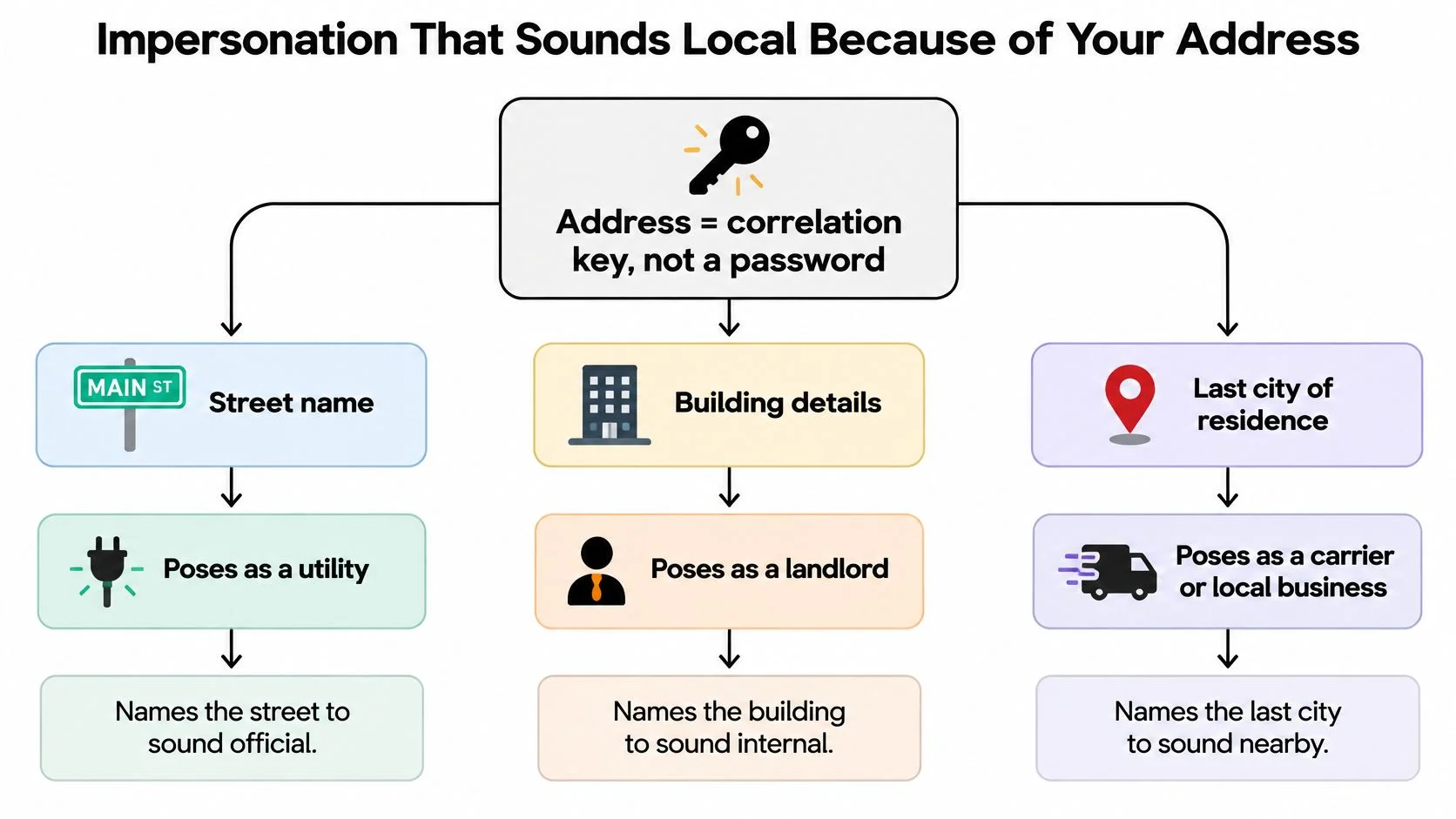
Four pretexts that use a street name
The utility shutoff is a phone call that reads out the service address, claims the account is past due, and offers to keep the power on if you pay by card in the next twenty minutes. The address is the proof they offer.
A missed-delivery text arrives with a link, a small redelivery fee, and a QR code to "confirm" your details. It doesn't need your account, only your curiosity.
The landlord message asks you to update your details through a portal link, which is a credential harvest dressed as administration. It works because the sender names the building.
A tax or benefits notice arrives with the home address already filled in, which makes the form look pulled from a government database rather than typed by a stranger.
In a 2025 warning, the FBI said spoofed websites can be used to collect a person's name, home address, phone number, email address, and banking information, and that threat actors often make small changes to legitimate domain characteristics so a counterfeit page appears credible.
The verification trap
Some account checks still ask which address you've used before, or which street a previous card was registered to. A public address history answers that question for a caller who never lived there. This is why old listings matter more than the current one: they turn a guess into an answer.
Synthetic media raises the stakes on the same trick, because a local-sounding call can now arrive with a familiar face attached. The rules on AI-generated videos differ by jurisdiction, which is worth knowing before you try to report one to a platform or a regulator.
If you want the upstream question answered, this explanation of how scammers get your information covers the breach lists, brokers, and public records that supply the opening line.
The defense here is one habit and no nuance. Hang up, close the message, and contact the organization using a number or address you looked up yourself, never one supplied by the contact.
When an Address Moves From Public to Urgent
A street address on its own rarely gives someone everything needed to steal an identity. The risk rises when the address connects to other details or when someone gains access to mail, identification, or account credentials.
| What is exposed | Risk level | First action |
|---|---|---|
| Street address alone on a public page or listing | Lower | Remove it where you can and watch for misuse |
| Address plus phone, relatives, employer, or a username | Medium | Cut public links and stop real-time location posts |
| Missing statements or an unexpected address-confirmation letter | High | Contact the bank and USPS through official numbers the same day |
| Unordered parcel plus an order inside your shopping login | High | Secure that account and review recent charges |
| Address plus SSN, date of birth, license images, or pay stubs requested | Urgent | Freeze credit and lock financial accounts |
Lower means an address appears by itself, such as on an old public listing. That can help a scammer make a message sound familiar, but it does not provide access to your mail or prove your identity. The FTC's analysis of rental scams describes a more serious step: a property-related conversation can lead to requests for Social Security numbers, driver's-license images, or pay stubs. The address makes the request seem relevant; the added documents create a greater risk.
Medium describes linkability. For example, a public page might pair your home address with a phone number, relative's name, employer, or username. Those connections can help a caller build a convincing pretext or answer a weak account-security question. The address is still a clue, not a complete identity-theft key.
Treat an address as an attack-enablement signal, not a complete identity-theft key. Mail access, government ID, or account credentials can change the response from monitoring to urgent action.
High begins when mail may have been diverted or interfered with. Missing statements, an unexpected address-confirmation letter, or a sudden stop in mail you expect are reasons to contact your bank and USPS using numbers you find independently.
Urgent means someone is asking for sensitive documents or credentials, especially after a rental or government-style pitch. If a stranger requests your Social Security number, date of birth, license image, or pay stub, treat the request as a warning. A credit freeze and account locks may be appropriate. If identity theft has already occurred, follow an identity theft response guide.
A home address in a dating bio or game profile can connect a handle to a residence. An old résumé PDF can do the same for an employer, recruiter, or stranger searching online. If exposed credentials are linked to the address, the concern is no longer just public visibility: someone may be able to try those credentials against your accounts.
How to Reduce Exposure and Catch Problems Early
One routine, in order, for anyone who has matched their situation to the table above. Each step comes with the slip that wastes it.
The Postal Service's own guidance points the same way: diverted financial correspondence can expose account numbers, routing details, partial Social Security numbers, and authentication clues, and USPS warns that identity thieves may skip postal controls entirely by changing an address directly with a bank, vendor, or financial institution (USPS Postal Inspection Service).
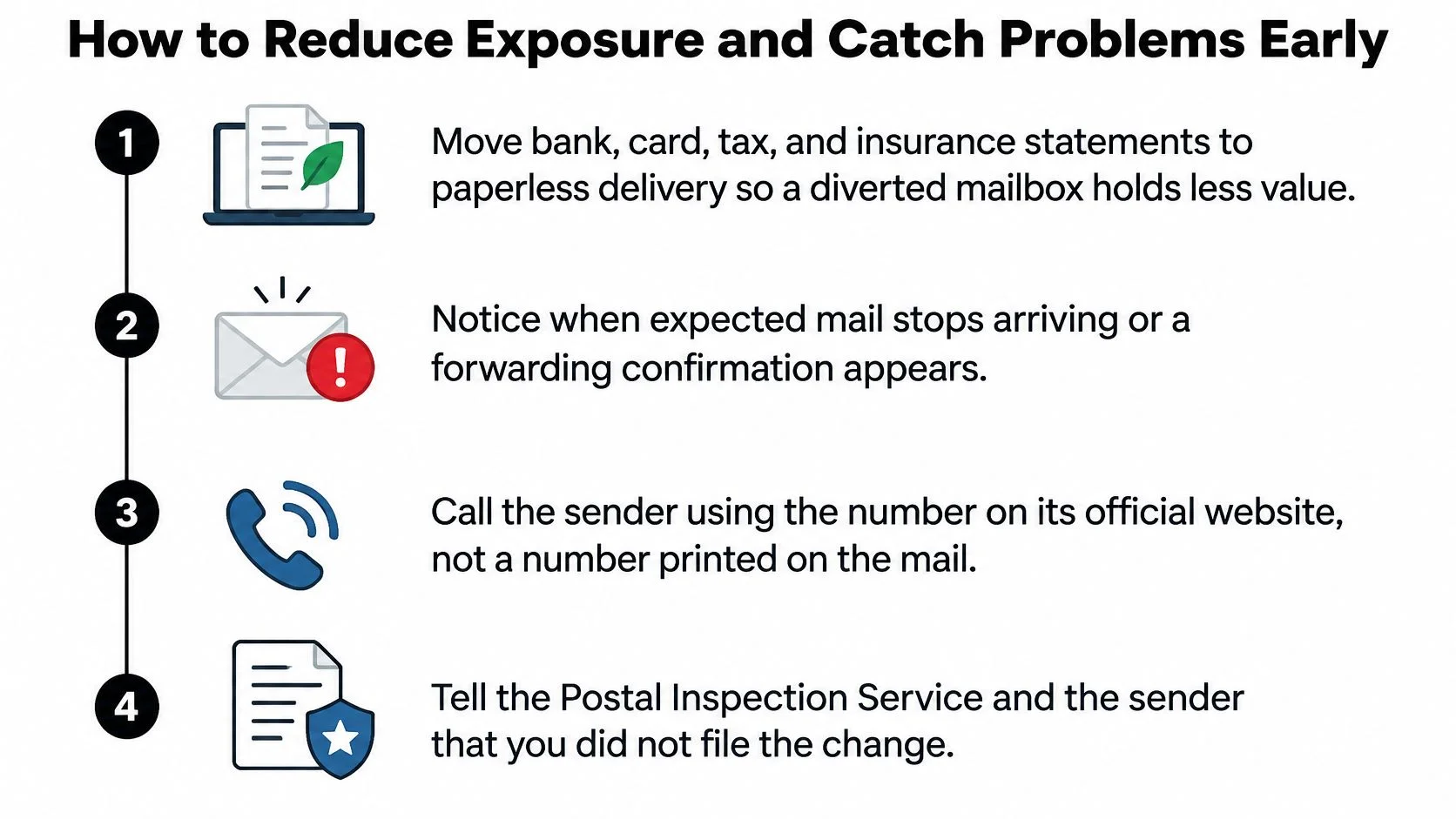
- Move bank, card, tax, and insurance statements to paperless delivery. A diverted mailbox then holds very little worth stealing. The slip: leaving one thick statement running because switching feels tedious, which leaves the whole mechanism intact.
- Open every postal confirmation or validation letter instead of recycling it. These letters exist to tell you an order was filed. The slip: assuming a piece of official-looking post is junk and letting the one warning you get go in the bin.
- Call the bank and the Postal Service through numbers you looked up yourself. Use the number on the back of your card or the official website. The slip: calling the number printed inside a suspicious text or letter, which routes you to the person who sent it.
- Place a fraud alert or a security freeze the moment a new account or an address change appears. It's free and it blocks most new credit being opened in your name. The slip: waiting for a second event to confirm the first, which gives the account time to be used.
- Take the street address off public social profiles, gaming bios, dating profiles, and résumé files. Search engines index PDFs, so an old CV can outlive the job you sent it to. The slip: cleaning four profiles and leaving the fifth, which is enough to relink everything. There's a working method in this guide to remove yourself from people search sites.
- Stop posting real-time location and delivery photos. A picture of a parcel on the mat shows a stranger the door, the mat, and the hour. The slip: posting the same day you tightened your privacy settings, which makes the settings pointless.
- Shred labels and statements before they leave the house. Household names and partial account numbers in the trash tell a picker exactly which envelope is worth opening next time. The slip: shredding the statement and dropping the intact shipping label in the same bag.
- Read your credit reports for addresses and accounts you don't recognize. Old addresses are one of the first signs of an application you didn't make. The slip: checking the score and not the history, which is where the tell sits.
If you sell online or move often, keep the addresses attached to your storefront and courier accounts current, since a stale one invites delivery disputes and confusing correspondence. This guide to address management for online retailers covers the housekeeping side.
Practical rule: these steps lower linkability. They don't erase a record that already sits in someone else's mail pile, so treat the routine as maintenance rather than a clean slate.
See Which Address Details Are Already Public
The useful next move is a check rather than another round of guessing. Find out whether the same name, email, or username that sits beside your address is already on public profiles, breach lists, gaming accounts, or people-search style records. An address becomes far more serviceable to a scammer when those pieces join easily, which is why cleaning one listing while a dating profile, a game handle, and an old forum post still tie the identity together leaves the job half done.
Digital Footprint Check is a free starting point, not a removal service. Our free tools are a Profile Checker, a Username Search, a Data Breach Checker, and a Reverse Email Search. The workflow runs in three steps: search a username or email, review the potential matches, then take action using step-by-step guides. We don't remove information for you; the guides explain how to contact a site and request changes yourself, which keeps you in control of what gets deleted and what gets answered.
If you'd rather see the broker side first, this walkthrough on how to find what data brokers have on me shows where the listings usually sit and what a removal request needs to say.
Run the free check at www.digitalfootprintcheck.com/free-checker, then come back to the risk table with the results in hand. If the only finding is a public address, remove it and monitor. If the results show breach exposure or ID-related data sitting next to that address, move straight to the urgent actions. Either way, what you learn also shapes how you show up to an employer, a date, or a stranger who already knows your street.
An address only becomes expensive when it's paired with something else, and finding out which pairing applies to you starts with a look at what's already visible. Digital Footprint Check gives you that starting point with a free profile check, username search, breach checker, and reverse email search, so you can see whether your address is sitting alone or sitting next to credentials and personal records. Visit Digital Footprint Check to run your first search, then use the guides to file removal requests yourself and work through the risk levels in the order that fits what you find.