· Digital Footprint Check · Content Marketing · 15 min read
How Do Scammers Get Your Information? Stay Safe in 2026
Learn how do scammers get your information through data breaches, phishing, and social engineering. Discover how to protect yourself and check your exposure.
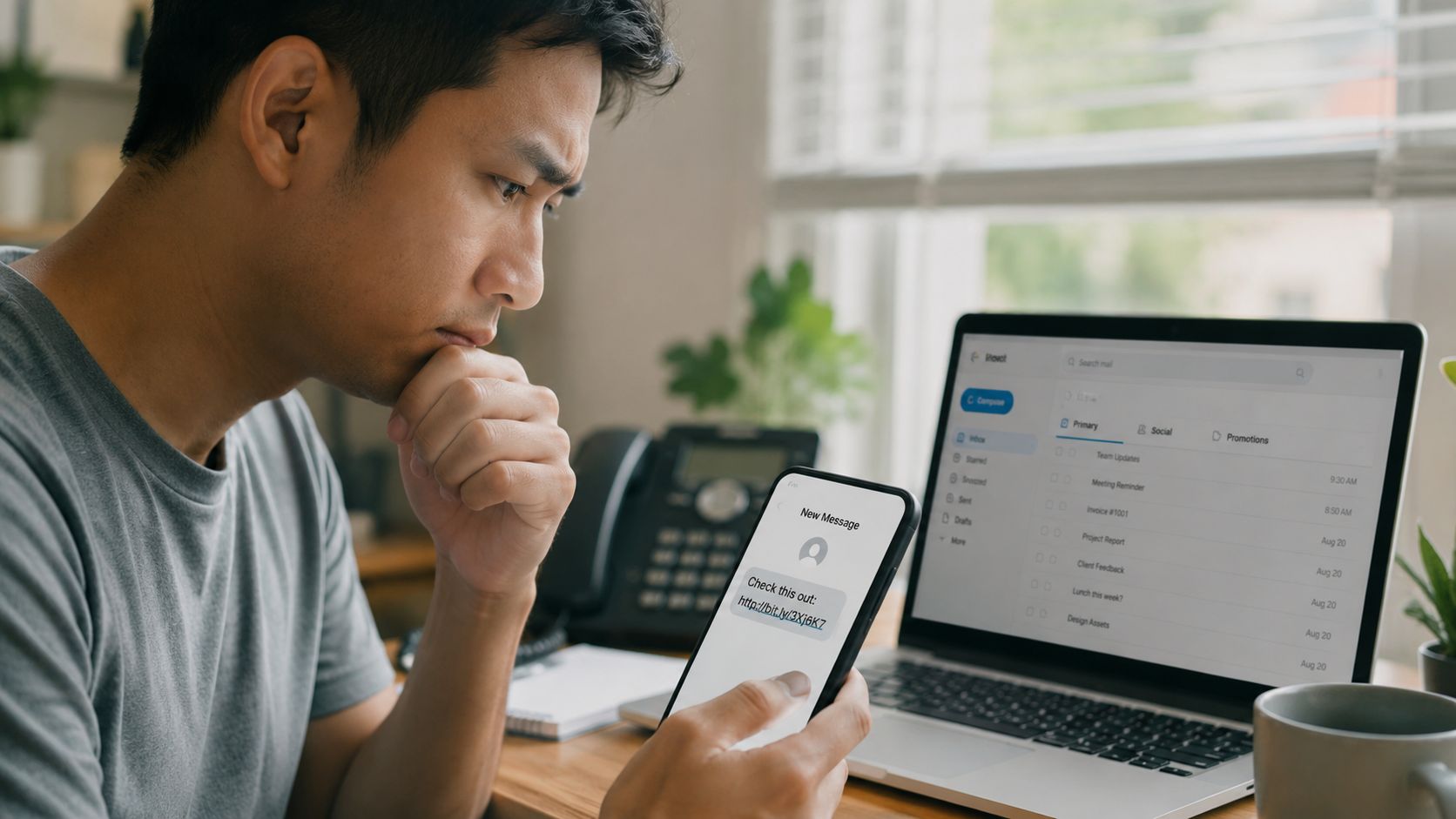
A text lands on your phone: “Your package couldn’t be delivered. Confirm your address now.” It uses your first name. It looks polished. You weren’t expecting a delivery, but for a second, it still feels plausible.
That moment is where a lot of people get stuck. They assume the scammer got lucky.
Most of the time, they didn’t.
Scammers rarely work from a blank page. They build attacks from scraps of real information: an old email from a breached account, a phone number from a people-search site, a birthday from social media, a password reused years ago, a home address pulled from public records. They chain those pieces together until the message feels personal enough to lower your guard.
That’s the answer to how do scammers get your information. They collect it, buy it, infer it, and connect it.
If you’ve ever received a fake bank alert, a suspicious job offer, a romance scam message, a gaming account recovery prompt you didn’t request, or one of those “you won a gift card” texts, you’ve seen part of that playbook in action. A scam doesn’t need to know everything about you. It only needs enough to sound believable. If you’ve seen one of those prize-style texts, this breakdown of the fake Walmart gift card text scam shows how a simple message can be dressed up to look trustworthy.
The good news is that scammers follow patterns. Once you understand those patterns, you stop seeing scam attempts as mysterious. You start spotting the building blocks. That helps protect your money, your accounts, your job prospects, your dating app safety, your gaming profiles, and in some cases your physical safety too.
That Suspicious Text Was Not Random
A scam message often feels oddly specific because it usually is built from real fragments. Maybe your email leaked in a breach years ago. Maybe your phone number sits on a data broker site. Maybe your public Instagram tells strangers your pet’s name, city, and workplace.
Scammers take those fragments and do what a good investigator would do. They assemble a profile.
How the chain usually starts
A fake delivery text is a simple example. The scammer may only need:
- Your phone number from a public listing, leaked contact database, or old signup
- Your first name from social media or a marketing list
- A current trend like parcel delays, tax refunds, job recruiting, or account verification
- A convincing pretext that creates urgency before you have time to think
That’s why scam messages can feel “close enough” to reality. They aren’t random guesses sent into the void. They’re built from pieces of your digital footprint.
Practical rule: If a message feels personal, that doesn’t mean it’s legitimate. It may just mean the scammer had better raw material.
Why people fall for them
People don’t click because they’re careless. They click because the message arrives at the wrong moment. You’re busy. You’re waiting for a package. You’re applying for jobs. You’re using dating apps. You’re trying to recover a gaming account. The scammer only needs to overlap with something already happening in your life.
That overlap matters. A person worried about their online reputation may respond to a fake “employer background check” email. Someone active in crypto may react to a wallet security alert. A gamer may panic over an account lock notice. A person dating online may trust someone who seems to know their city, workplace, or mutual interests.
The common thread is simple. Scammers don’t win by knowing everything. They win by knowing just enough.
The Foundation Data Breaches and Dark Web Marketplaces
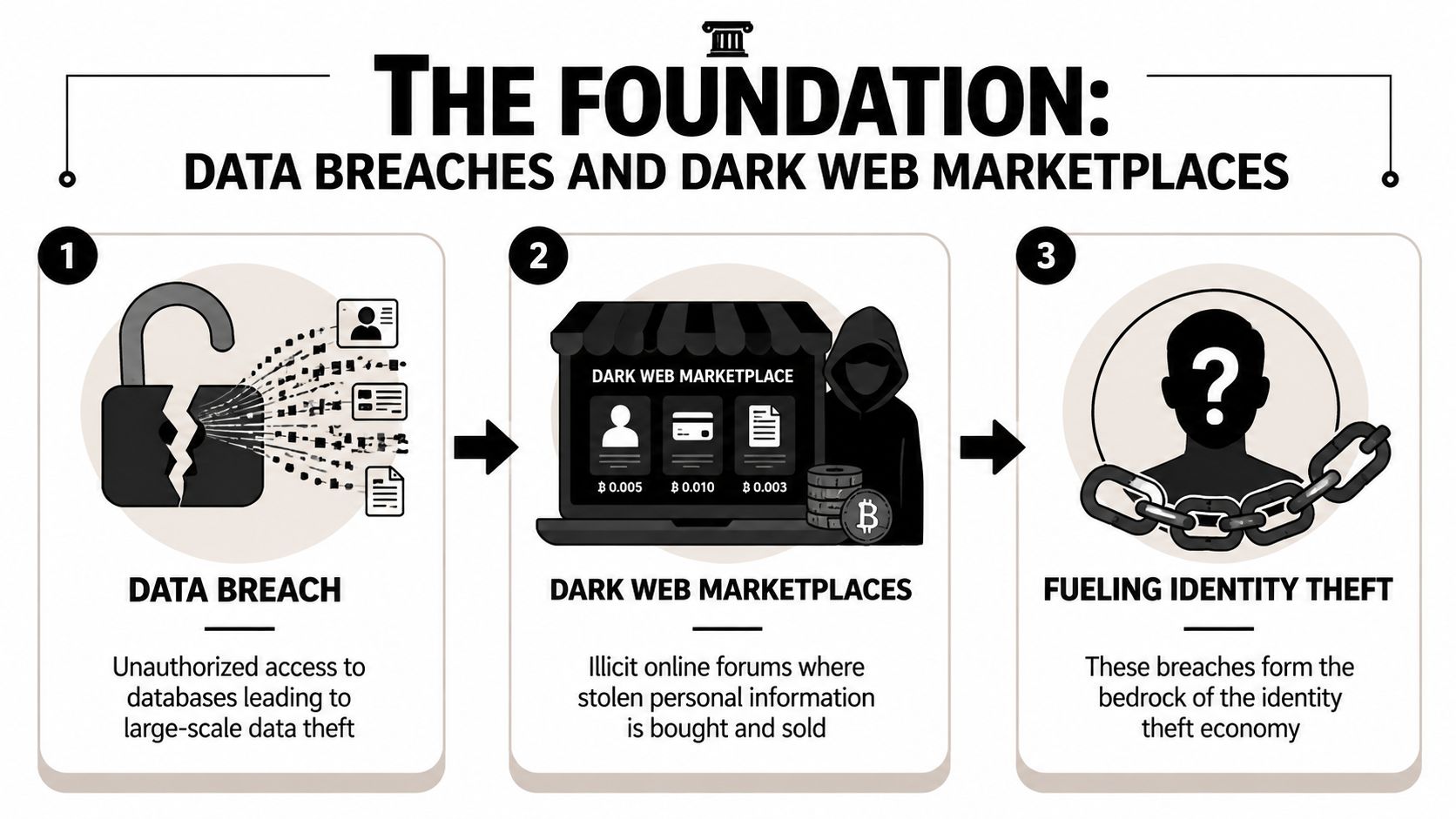
A lot of scam campaigns start long before the first text or email arrives. The raw material often comes from a data breach, which is when attackers get unauthorized access to a company database and copy customer information.
That information might include email addresses, usernames, passwords, phone numbers, billing details, or identity documents. If you’ve created accounts over the years for shopping, work tools, gaming, dating apps, forums, or newsletters, your information may already be sitting in places you no longer remember using.
Why breaches matter so much
The scale is the first shock. Over 3.2 billion records were exposed globally in 2023, according to the Identity Theft Resource Center, as cited by Surfshark’s breakdown of how scammers get your information. The same source says scammers buy leaked data on dark web marketplaces, with prices ranging from $0.001 per email address to $10 per full identity profile.
That price range tells you something important. Basic contact data is cheap because there’s so much of it. Richer identity packages cost more because they’re more useful for fraud, account takeovers, and impersonation.
What the dark web really is
People often hear “dark web” and picture something mysterious. In practice, think of it as a hidden set of forums and marketplaces where criminals trade stolen data, credentials, and fraud tools.
A scammer doesn’t need to steal your details personally. They can buy them.
That changes how you should think about risk. The breach at a company you used years ago may have nothing to do with the scam message you receive today, yet it may still be the reason the scammer knows your old password pattern, phone number, or recovery email.
| Data type | How scammers use it | Why it matters |
|---|---|---|
| Email address | Spam, phishing, account targeting | Opens the door to direct contact |
| Password or old password | Credential stuffing on other sites | Reused logins put multiple accounts at risk |
| Phone number | Smishing, vishing, SIM-related targeting | Makes scams feel immediate and urgent |
| Full identity profile | Identity theft and impersonation | Supports more convincing fraud |
Why old breaches still hurt
A breach doesn’t expire just because you forgot about it. People reuse usernames. They keep old recovery emails alive. They answer security questions with information that never changes.
That’s why breaches form the base layer of the scammer’s playbook. Everything else gets easier once criminals have a pile of real personal data to work with. If you want to understand that underground economy better, this guide to dark web monitoring services gives useful context on how exposed information gets tracked.
The most dangerous data isn’t always the most dramatic. Sometimes an old email and reused password are enough.
The Direct Attack Phishing and Social Engineering
Once scammers have raw data, they need a delivery method. That’s where social engineering comes in. It means manipulating people into handing over information, clicking a link, or approving access.
Phishing emails, scam texts, fake calls, and fraudulent job messages all sit in this category.
The three levers scammers pull
A useful way to read suspicious messages is to look for the pattern identified in USSFCU’s explanation of how scammers use personal information. It says scammers rely on three core tactics: impersonation, urgency, and emotion. The same source notes that phishing messages often use urgent requests, threats, prize promises, fake sender details, generic greetings, or suspicious links.
That describes a huge share of modern scams.
A fake bank alert uses impersonation. “Your account will be suspended today” creates urgency. Fear does the rest.
A fake job offer works similarly. The scammer may know you’re job hunting from LinkedIn activity or a public resume. They send a polished email, promise remote work, and push you to “verify” your details quickly. The target thinks, “This could be real.” The scammer thinks, “That’s enough.”
What a chained attack looks like
Here’s a realistic pattern:
- A breached email address tells the scammer where to contact you.
- A social profile tells them your employer, city, or interests.
- A text message references something plausible, like payroll, package delivery, or account verification.
- A fake login page captures your password or payment details.
- A follow-up call pressures you to read back a code.
Each step builds on the last. The scam feels personal because the attack is assembled from multiple sources.
If a message pressures you to act before you verify it, slow down first. Urgency is often the scam.
Why this hits certain accounts harder
Crypto accounts, gaming profiles, and dating app logins are common targets because they combine emotional value with quick monetization. A scammer who takes over a gaming account can steal rare items or payment details. A scammer who compromises a dating profile can catfish other people or blackmail the victim. A scammer who gets into a crypto account may move funds fast.
If you want a good example of how these manipulation techniques show up in a high-risk setting, The Coin Course has a practical guide on protecting crypto assets that breaks down how social engineering tricks users into handing over access.
The Public Domain Data Brokers and OSINT
A lot of people assume scammers need advanced hacking skills to profile them. Often, they don’t. Public information can do a surprising amount of the work.
Data brokers and OSINT, short for Open Source Intelligence, contribute to this process. Data brokers collect and sell personal information. OSINT is the practice of gathering and connecting information from public or accessible sources.
How scammers connect the dots
The key idea isn’t that one source reveals everything. It’s that multiple harmless-looking sources become powerful when combined.
A scammer might start with your name on Facebook. Then they connect it to a phone number, home address, and past addresses using genealogy tools, whitepages-style directories, and public records. That pattern is described in this discussion of how scammers use OSINT and public information, which notes that scammers can map relationships and trace past locations without hacking private databases.
That matters because context creates credibility. If a scammer knows where you lived before, your relatives’ names, and your workplace, they can sound far more believable in a call or message.
Why this affects more than money
OSINT exposure doesn’t just increase fraud risk. It can shape how other people see you.
- Job prospects: Employers, recruiters, or clients may find old usernames, forum posts, photos, or public profiles that don’t reflect who you are now.
- Online dating safety: Catfishers and romance scammers can mirror your interests, hometown, or values after reviewing your public footprint.
- Gaming account security: Usernames reused across Twitch, Discord, Steam, Xbox, PlayStation, Reddit, or older forums can help attackers tie accounts together.
- Personal safety: Publicly searchable addresses, family links, and routines make stalking, harassment, or impersonation easier.
Public data versus breached data
These two sources work differently, and scammers often use both:
| Source | What it gives scammers | Typical use |
|---|---|---|
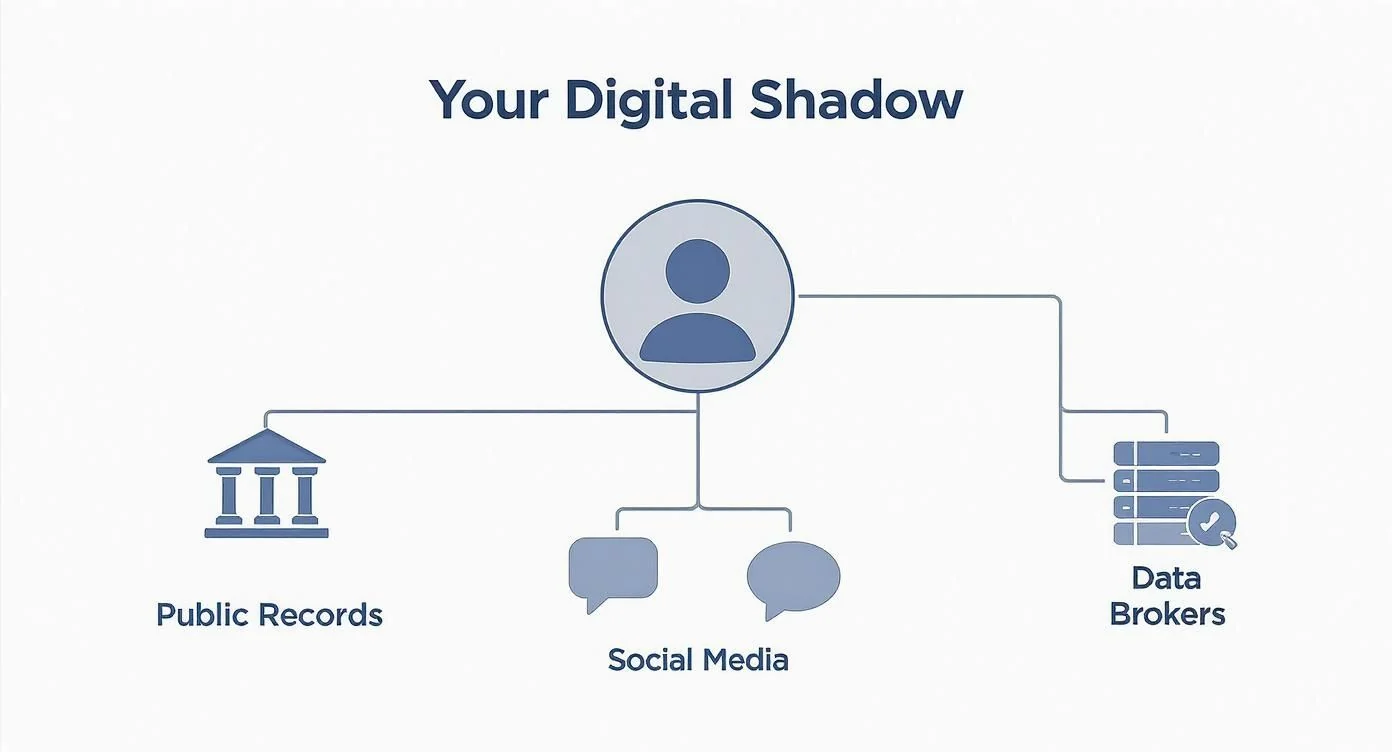
| Public records and social media | Identity clues, relationships, locations | Impersonation and pretext building |
| Data brokers | Aggregated contact and profile data | Faster target lookup |
| Breach data | Credentials and private account info | Account takeover and phishing setup |
Public information feels low risk because you shared it yourself. The risk appears when someone else combines it with data from elsewhere.
If you’re curious what’s sitting in that ecosystem, this walkthrough on finding what data brokers have on you is a practical place to start.
Targeting Your Devices and Accounts
A strong password helps, but it doesn’t solve every problem. Some attacks skip the password entirely. Others go around it.
One of the most overlooked examples is SIM swapping. Instead of breaking into your account directly, the scammer tries to take control of your phone number.
Why your phone number matters so much
Many accounts still use text messages for login codes, password resets, and identity checks. If a scammer convinces your mobile carrier to move your number onto a SIM card they control, your security texts and calls go to them instead of you.
That’s why First Lockhart’s warning about SIM swap scams matters. It explains that once the new SIM is activated, SMS authentication codes are received by the scammer. It also points out the weak spot many people miss: strong passwords and two-factor authentication aren’t enough if your carrier account itself is easy to change. Setting a carrier PIN adds an important barrier.
A common misunderstanding
People hear “use 2FA” and assume any 2FA is equally strong. It isn’t.
If your second factor is tied to your phone number, a scammer who gains that number may be able to intercept recovery codes. That’s especially serious for:
- Banking and payment apps
- Crypto wallets and exchanges
- Gaming accounts with stored payment methods
- Primary email accounts, which often control resets for everything else
Other ways scammers grab information directly
Not every attack is high tech. Some are painfully simple.
- Shoulder surfing: Someone watches you enter a PIN or password in a public place.
- Mail theft: Physical documents reveal account numbers, health information, or verification details.
- Unsecured devices: A phone left unattended can expose email, texts, saved passwords, or app sessions.
These methods work because people focus on malware and forget the physical layer. If you want a clearer sense of how phone-based identity attacks work, this guide on how SIM card cloning scams are discussed and prevented gives helpful background.
How to Discover Your Exposed Information
The hardest part of protecting yourself is visibility. You can’t secure what you can’t see.
Individuals often know only a small slice of what’s publicly accessible about them. They know their active social accounts. They may know whether an old email was breached. They usually don’t know which old usernames still connect back to them, which people-search sites list them, or what a scammer can infer by linking scattered details together.
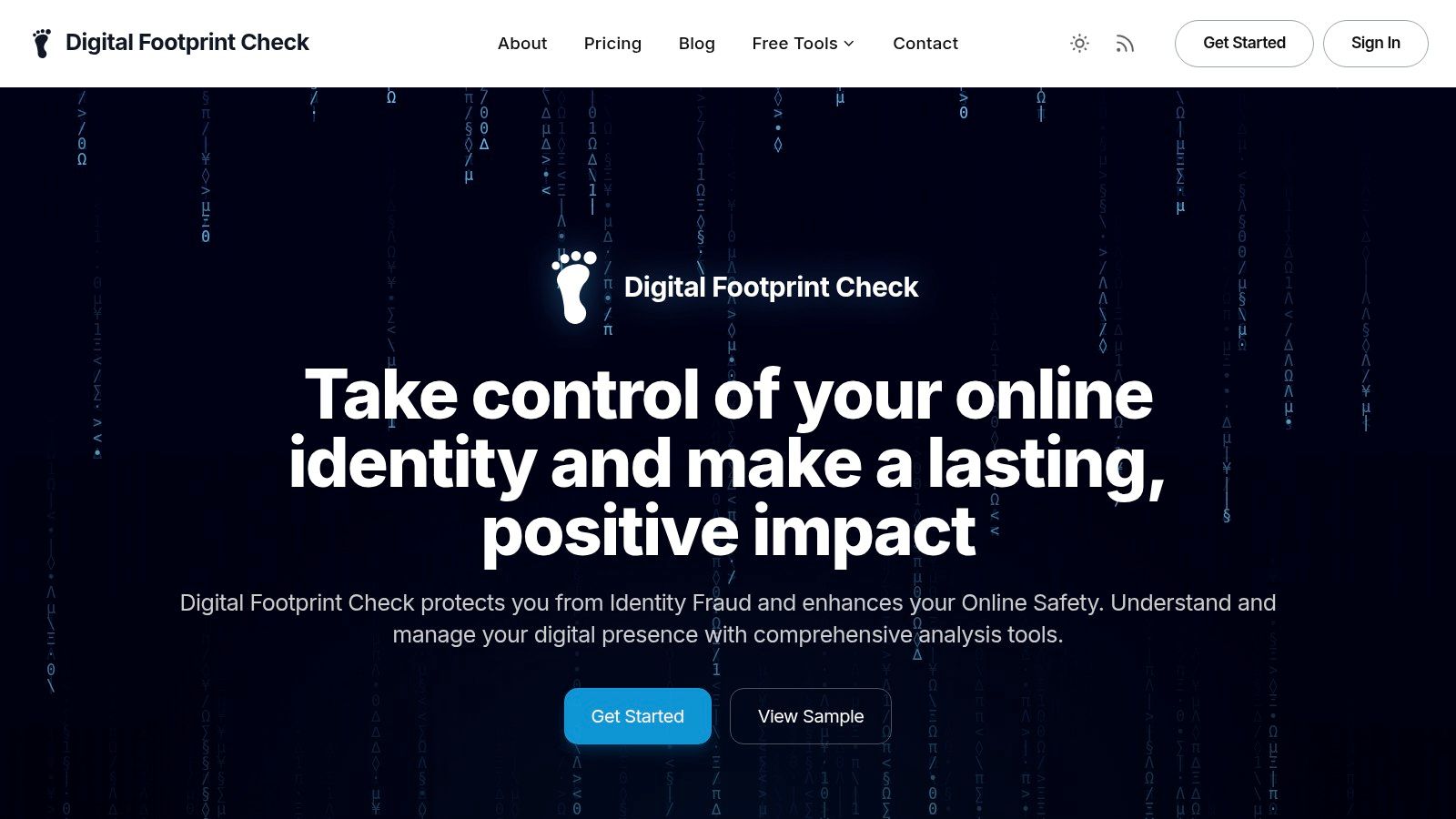
Near the start of any self-audit, it helps to see what a professional footprint scan looks like.
The manual approach has limits
You can start by searching your name, phone number, email addresses, and common usernames. Check social platforms, search engines, public people-search listings, breach alerts, gaming handles, and dating usernames you may have forgotten.
That’s useful, but it has obvious gaps:
- You won’t remember every old account
- Search results change based on location and personalization
- Some exposure sits across many smaller platforms
- A single clue, like a username, can branch into dozens of linked profiles
That’s why digital footprint audits work best when they look at identity the way a scammer does. Not as isolated accounts, but as a connected graph.
What a broader audit should reveal
A proper review should help you answer questions like these:
| Question | Why it matters |
|---|---|
| Which emails, phone numbers, and usernames are publicly tied to me? | Attackers use these as lookup keys |
| Are old gaming, forum, or social profiles still visible? | They may reveal habits, contacts, or recovery clues |
| What reputation risks could an employer or date find? | Exposure affects trust, safety, and opportunity |
| What personal details make impersonation easier? | Birthdays, locations, relatives, and routines all help scammers |
A visual walkthrough can make that process easier to grasp:
If you want a faster starting point, use the free checker at Digital Footprint Check. It’s designed to help people uncover where their information appears online so they can spot chained exposure before a scammer does.
Your Action Plan for Digital Self Defense
You don’t need to disappear from the internet to reduce your risk. You do need a routine.
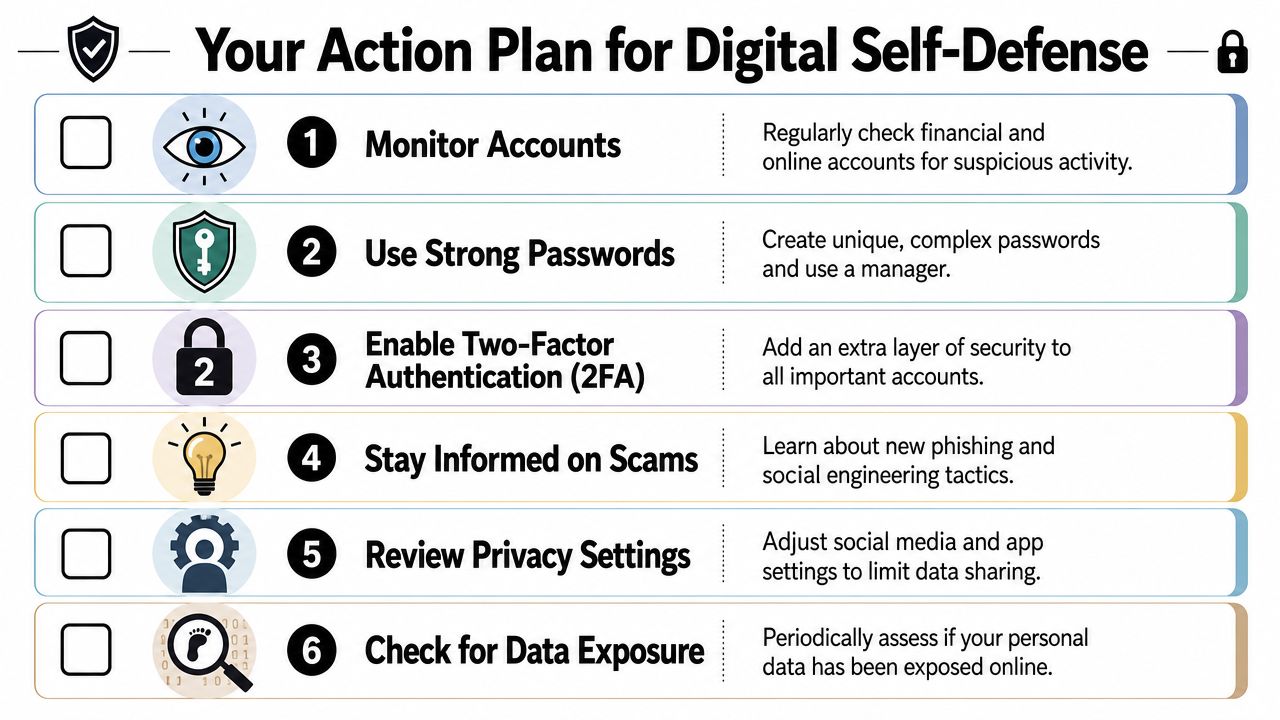
The best defense is to make yourself a harder target at every stage of the scammer’s playbook. Limit what they can collect. Reduce what they can verify. Block easy account takeovers. Catch exposure early.
Start with the accounts that matter most
Focus first on your primary email, bank logins, phone carrier account, gaming platforms, dating apps, cloud storage, and any service that can reset the rest.
Use this checklist:
- Switch to unique passwords: A password manager helps you stop reusing logins across sites.
- Strengthen multi-factor authentication: Prefer stronger methods where available, and review whether SMS is your fallback on sensitive accounts.
- Set a carrier PIN: This is one of the simplest steps you can take against phone-number hijacking.
- Audit recovery options: Old email addresses and phone numbers can become hidden weak points.
- Review privacy settings: Lock down public profile details that expose your location, workplace, family, or daily routine.
Your email account is the master key. If it falls, many other accounts can follow.
Reduce what strangers can learn
Scammers don’t just attack accounts. They study people.
That means digital self-defense includes reputation management and privacy cleanup. Remove old bios that reveal too much. Check which social profiles are public. Revisit dating app photos and profile prompts that expose workplace details, neighborhood clues, or repeatable routines. If you’re active in gaming communities, separate usernames when possible instead of tying every platform to one identity.
It also helps to protect your data against loss or device compromise. If an infection, theft, or account lockout hits, backups matter. This practical guide on how to backup computer files is worth bookmarking because recovery is part of security too.
Keep monitoring instead of doing a one-time cleanup
Privacy isn’t a one-and-done task. New accounts appear. Old posts resurface. Fresh breaches happen. Public records update. People-search sites republish listings.
A simple ongoing plan looks like this:
- Check account activity regularly for unfamiliar logins or changes.
- Search your core identifiers such as name, primary email, phone number, and main usernames.
- Watch for reputation issues that could affect work, relationships, or dating safety.
- Review takeover risks on email, phone, and payment-linked accounts.
If you want to go deeper on protecting logins from fraud, this guide to account takeover prevention covers the habits that make attacks harder.
The goal isn’t perfection. It’s friction. Every extra layer of verification, privacy control, and monitoring makes the scammer’s chain weaker.
If you want to see what a scammer, recruiter, catfisher, or identity thief could already learn about you, try the free scan from Digital Footprint Check. It helps you uncover exposed profiles, linked accounts, public records, and other pieces of your online footprint so you can fix weak spots before someone else uses them against you.