· Digital Footprint Check · Content Marketing · 14 min read
Social Media Screening Policy: a 2026 Guide
Learn how to write a compliant social media screening policy that protects candidates, reduces bias, and stands up to audits.

You already know the pattern. A hiring manager spots an old post, feels uneasy, and the candidate disappears from the shortlist. Nobody logs why. HR never sees the decision until the requisition is closed, and by then the only record is a manager’s memory and a half-remembered screenshot.
That’s a key problem with a social media screening policy. Most companies treat it like a side note in recruiting, then act surprised when the process becomes inconsistent, unreviewable, and hard to defend. Industry survey data says about 70% of U.S. employers use social media to screen candidates, and 54% have rejected a candidate based on what they found online Randstad USA. If that much decision-making is happening online, the process can’t be a casual Google search followed by a gut call. For job seekers, that also means their digital footprint can affect opportunities in ways they never see, which is why understanding what employers really look for matters before anyone writes policy.
Why Most Social Media Screening Policies Fail Before They Start
A recruiter once told me about a Friday afternoon search that went sideways. A hiring manager found a candidate’s political post, decided the person looked “not aligned,” and killed the hire on Monday. No one told HR. No one documented the reason. The candidate got a generic rejection and never knew a post from years ago had become the hidden reason.
That’s how these programs fail in real life. Not with malice, usually, but with informality. One manager checks LinkedIn, another checks Instagram, a third never screens anyone at all. The result is not just uneven treatment, it’s an audit trail with holes big enough to drive a discrimination claim through.
The business risk is already normal
This isn’t an edge case anymore. Social review is embedded in hiring behavior across the market, and that means the policy has to be operational, not decorative. If the team can’t answer who screened, what was screened, and what rule guided the decision, then the organization has no serious control over the process.
A policy changes that. It forces the team to stop treating social media like a casual background habit and start treating it like a controlled part of candidate evaluation. That’s the difference between a defensible process and a liability that sits in the ATS waiting for a complaint.
Practical rule: If a hiring manager can make the decision alone after a five-minute search, the policy is already broken.
The candidate experience matters too. Qualified people notice when an employer feels like it’s trawling their personal life without a clear boundary. A disciplined process protects privacy, keeps decisions consistent, and tells candidates the company respects their time and their public presence.
Defining the Purpose and Scope of Your Policy
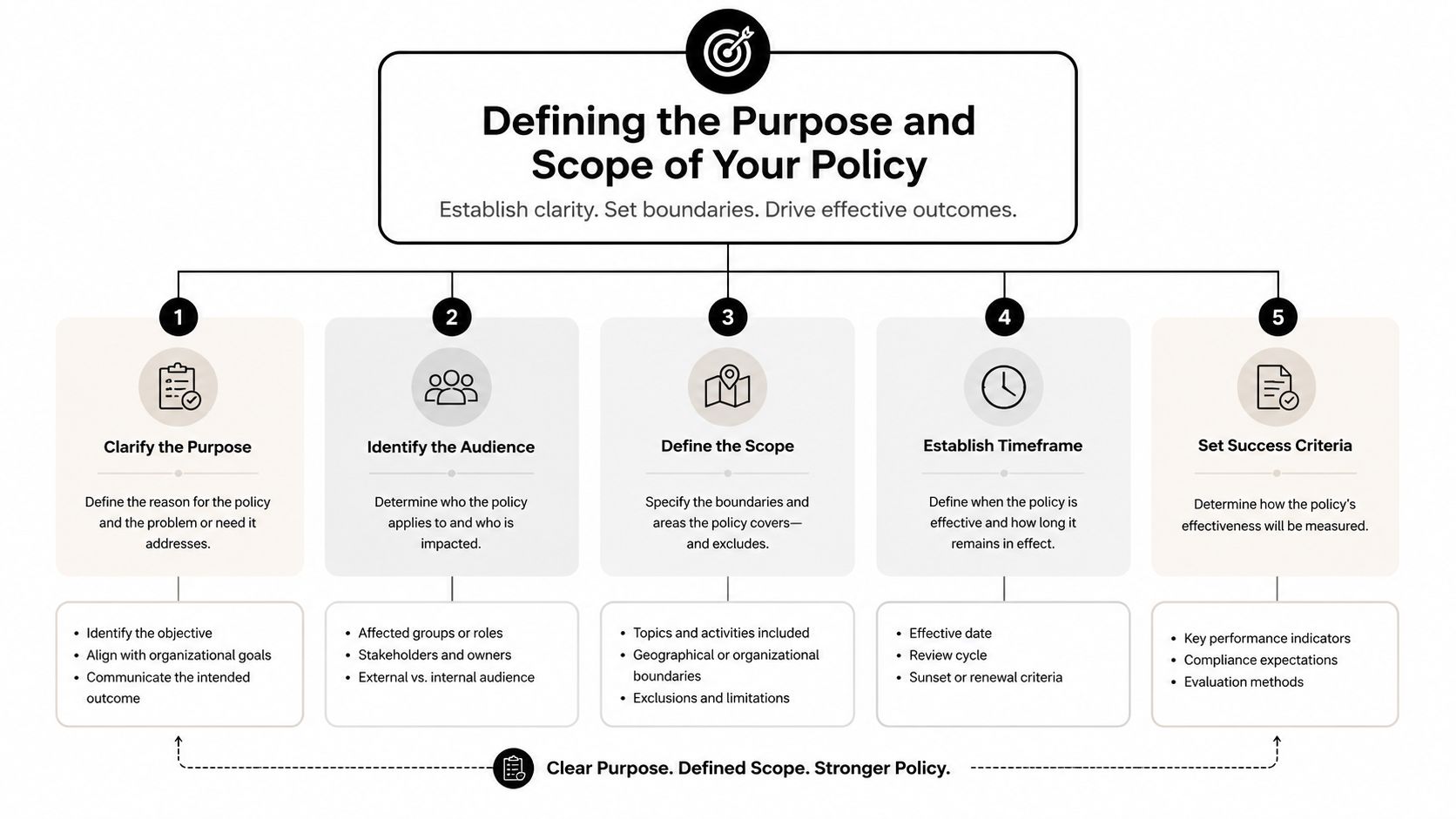
A good policy starts with scope, not legal jargon. If the company can’t say why it screens, whose roles it covers, when the review happens, and what content is off-limits, the policy will drift the first time a manager asks for “just a quick look.”
Lock the purpose to job-related risk
The purpose should be narrow. Safety, fitness, fraud risk, and other job-related concerns are the only reasons to screen. If the policy reads like a reputation management shortcut or a personality sniff test, it’s too broad. That invites bias and sends reviewers hunting for whatever makes them uncomfortable.
Write the purpose in plain language. Something like: “The company reviews public social media content only when a role presents a defined safety, trust, or conduct risk that cannot be assessed through standard hiring steps alone.” That language keeps the program tied to business need instead of personal taste.
Define the roles and the timing
Don’t apply the same screen to every job. High-risk functions may justify review, while routine roles may not. The policy should name the role families or seniority levels that qualify, then specify that screening happens post-conditional-offer, pre-start so the team isn’t collecting extra information too early.
That timing matters because it limits the population being processed and keeps the process proportional. It also avoids the mess of social review happening before interview evidence, references, or skills tests have already done their job. If you want a candidate-facing process that supports that timing, align the policy with your pre-employment screening process so HR, recruiters, and hiring managers stop improvising.
Draw a hard boundary around data
The scope statement should say publicly available content only. No private profiles. No friend requests. No fake accounts. No asking candidates to log in or hand over passwords. If a reviewer has to cross a privacy line to do the job, the policy is wrong.
The policy should also live inside the rest of HR documentation, not float on its own. Put it in the recruitment SOP, cross-reference it in the employee handbook where appropriate, and record it in the data processing register. That way, the policy isn’t a one-off memo that disappears after launch.
Legal and Privacy Constraints You Cannot Ignore
The biggest mistake leaders make is assuming that public content means safe content. It doesn’t. Public posts can still reveal protected traits, and once a reviewer sees them, the process is contaminated even if the policy says those traits shouldn’t matter.
Protected-class exposure is the hidden trap
A candidate’s public post can expose religion, disability, pregnancy, political views, or national origin. The reviewer can’t unsee that. That’s why separating collection from decision-making is the control that matters most. One person or team gathers the content using a defined checklist, while another person sees only a structured finding report with job-related issues already filtered and contextualized.
That separation is the only way to keep protected-class clues from leaking into the decision. Most policies say “use public content only” and stop there. That’s not enough. Public access is not the same thing as fair use, and it’s certainly not the same thing as bias control.
For a practical privacy frame that sits closer to employee-side risk, Nick Norris, P.A. on employee privacy is a useful read because it reinforces how quickly workplace privacy questions turn operational once data is collected.
Review the legal gates before launch
A policy needs legal review against anti-discrimination rules, data protection requirements, and jurisdiction-specific hiring limits. In the U.S., that means looking hard at EEOC risk and any screening workflow that might drift toward consumer-report-style handling. In Europe and other regions, privacy obligations raise the stakes further.
The policy should also ask a blunt question. Do we need to see this content to make a hiring decision? If the answer is no, don’t collect it. If the answer is yes, then the process has to be narrow, documented, and consistent.
Operational truth: The legal risk rarely comes from the existence of a policy. It comes from a reviewer seeing something irrelevant and acting on it.
For teams that process candidate data through external vendors, the contract and data handling terms have to match the workflow. A simple data processing agreement should fit the actual collection scope, retention rules, and access controls you intend to use.
Building the Screening Criteria and Workflow
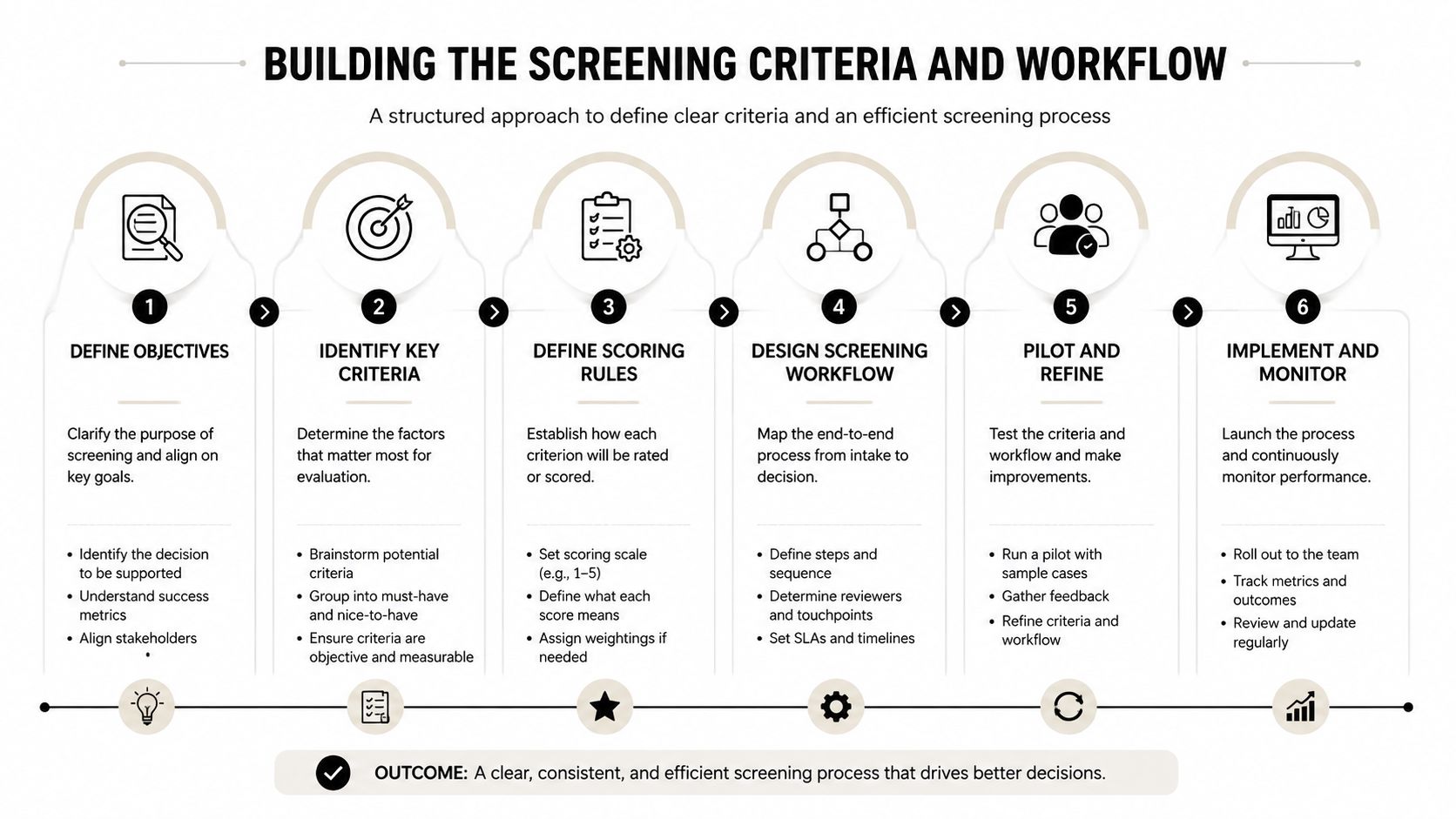
A policy becomes real only when it turns into a repeatable workflow. If the reviewer is left to “look for anything concerning,” the organization has already invited inconsistency.
Start with role-specific risk categories
Use a narrow set of content categories tied to actual workplace risk. In vetted sectors, one federal privacy assessment for the U.S. Secret Service described four buckets, unlawful sexual deviant behavior, unlawful violent behavior, unlawful racist acts, and information depicting acts of terrorism and/or membership in an organization dedicated to terrorism DHS privacy PIA. Civilian employers can adapt that model by translating it into job-related risk language, not by wandering into general character judgments.
That’s the key. You’re not screening for whether someone is likable online. You’re screening for content that maps to a defined risk in the role. If a finding doesn’t connect to that risk, it doesn’t belong in the decision.
Run the workflow in a fixed sequence
The sequence should never change by recruiter or by mood. First, define the risk categories. Second, restrict collection to public data. Third, keep the reviewer separate from the hiring manager. Fourth, use the same platform set for every candidate in that role. Fifth, produce a structured report before any hiring decision is made.
That structured report needs to record the scope, sources, raw observation, contextual assessment, and recommendation. If the content is ambiguous, write that down and escalate it instead of guessing. Ambiguity is not a license to invent meaning.
Here’s where many teams go wrong. A manager wants a yes or no answer, and the reviewer obliges. That shortcut creates the worst kind of record, a confident conclusion built on thin evidence.
Keep your documentation disciplined
Use the same decision rules every time. If the content is threatening, document the exact public post and the specific rule it triggers. If it’s a borderline issue, send it to a second reviewer or HR for contextual review. If it’s irrelevant, note that it was reviewed and dismissed.
If you’re comparing tools or formats for candidate analysis, a resource like check resume for ATS robots is a useful reminder that structured evaluation beats gut feel. The same logic applies here, clear criteria beat subjective browsing every time.
Practical rule: A finding that can’t be written as a clean report probably shouldn’t drive a hiring decision.
Choosing Tools and Running Consistent Reviews
Manual review sounds simple until the team grows. Then the cracks show. One recruiter checks everything carefully, another skims, and a third forgets to save evidence. Consistency falls apart fast.
The adoption trend makes that a real management issue. The share of U.S. organizations using social media to screen job applicants rose from 11% in 2006 to 70% in 2018 SAGE cybervetting research. Once a process becomes that common, your review method has to survive turnover, scaling, and manager pressure.
Manual review has a place, but only in narrow settings
Manual screening can work for low-volume roles if the reviewer is trained, the checklist is tight, and the evidence is saved the same way every time. It fails when the reviewer is also the hiring manager, because the person making the decision ends up seeing raw content without any filtering.
OSINT platforms change that by standardizing what gets collected and how the result is packaged. A platform like Digital Footprint Check searches public footprint data across social media, breach databases, gaming profiles, professional networks, and public records, which matters when a company needs a uniform view of what’s publicly exposed. It’s an option when the goal is consistency, not casual browsing.
Compare the operating model, not the marketing
| Dimension | Manual Review | OSINT Platform |
|---|---|---|
| Consistency | Depends on the reviewer | Built around the same workflow every time |
| Audit trail | Easy to lose or omit | Usually structured and repeatable |
| Bias exposure | Higher if the reviewer sees raw content | Lower if reports filter protected traits |
| Scale | Weak as volume rises | Better for repeatable screening |
| Interpretation | Often subjective | Easier to standardize by role |
A platform shouldn’t force legal to interpret every output. If the report can’t be read by HR and the recruiter without translation, it creates more work, not less. Look for public-data-only architecture, role-based templates, and audit logs that show who reviewed what and when.
For teams exploring software options, social media investigation tools are worth evaluating against the same control questions you’d use for any other HR system.
Candidate Communication, Consent, and the Audit Trail
Candidates don’t hate screening. They hate surprise screening. If you bury the disclosure until the end or deliver it in a suspicious tone, you create friction before the review even starts.
The disclosure should be short and direct. State that the company may review publicly available online content for a defined job-related purpose, and that the candidate will get a chance to address disputed findings. Don’t oversell it, and don’t make it sound like an interrogation.
Put the notice in the right place
Send the disclosure after the candidate has progressed far enough in the funnel for the review to be relevant, not as an early fishing expedition. The language should be consistent with the rest of the process and should never imply that the company is trying to inspect private behavior.
The consent form should do three things. It should tell the candidate what will be reviewed, confirm that only public data is in scope, and explain how they can challenge an error. Anything beyond that tends to scare qualified people or create unnecessary legal noise.
Keep records that support repeatability
The audit trail has to show the notice, the consent, the reviewer, the date, the scope, the findings, and the final disposition. Access should be limited to the people who need it. If every hiring manager can browse the file, the policy has no real control value.
Retention should be long enough to support review and challenge, but not so long that the company builds a shadow archive of personal data. If the team can’t explain why a record is being kept, it should be deleted. That’s the standard I use when I’m asked to clean up messy hiring files.
The audit trail is not just legal armor. It’s the only way the process survives a manager change, a recruiter departure, or a complaint six months later.
For a simple starting point on the candidate side, background check consent forms are a practical reference because they force the same clarity your policy needs.
Bias Mitigation, Training, and the Rollout Checklist
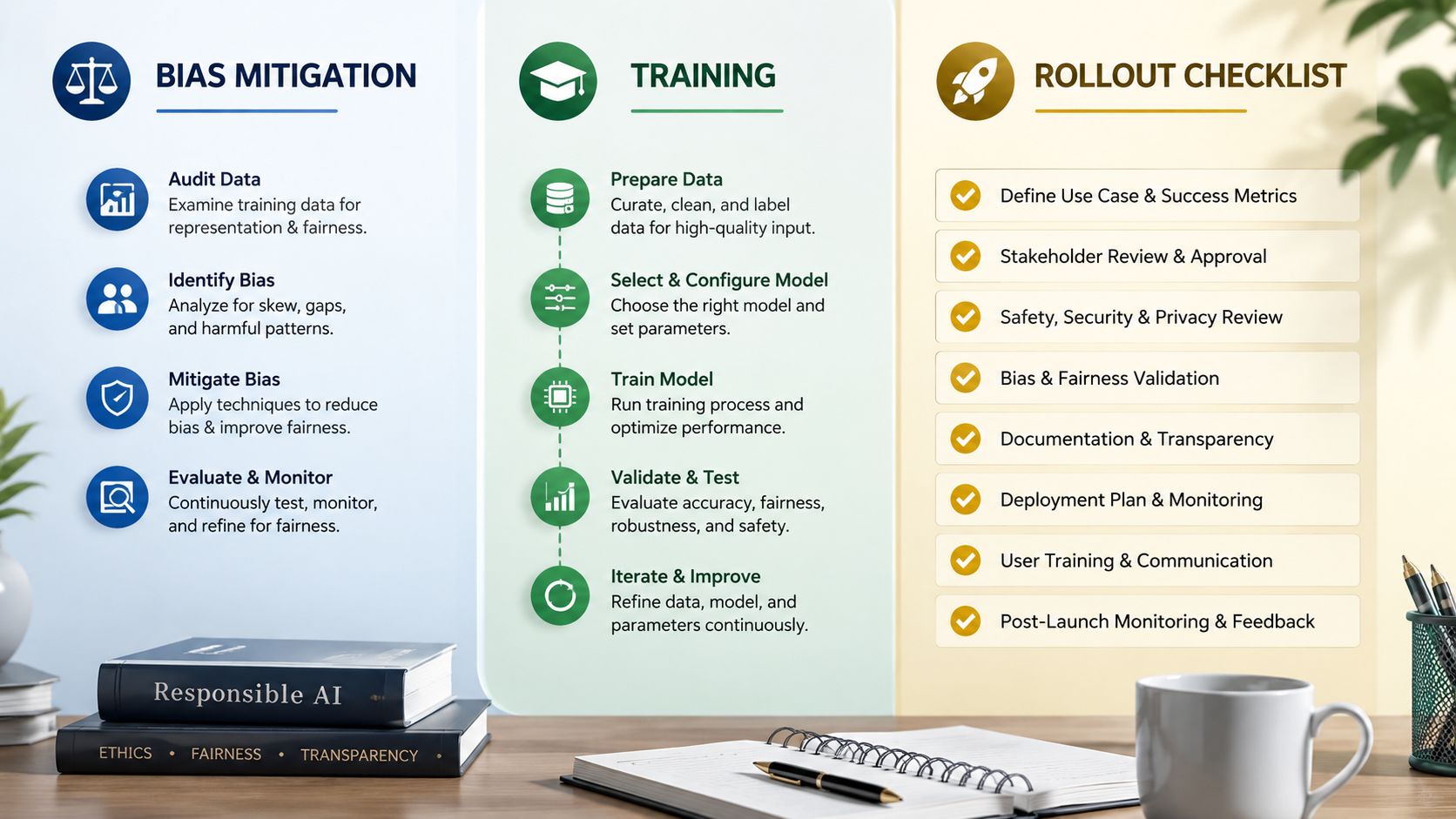
A written policy doesn’t reduce bias by itself. People do. That means the rollout has to control what reviewers see, how they’re trained, and how quickly the program expands.
Build bias controls into the workflow
Use reviewer anonymization where possible, and strip out protected-class clues from reports before they reach the decision-maker. That doesn’t mean pretending the internet doesn’t reveal personal facts. It means the decision-maker shouldn’t receive the raw feed.
The broader research gap is still there. Public content can reveal protected traits, but organizations still need to validate findings against traditional hiring evidence instead of letting online impressions dominate the file. The policy should say that social findings never override the rest of the selection record without documented, job-related rationale.
Train the people who touch the process
Train recruiters, hiring managers, and any third-party reviewer on three things, scope, bias, and escalation. They need to know what is in bounds, what is out of bounds, and when to stop and escalate instead of deciding on instinct.
Refresh training when the workflow changes, not just on a calendar. A policy update without retraining is how inconsistent habits sneak back in.
Roll out in sequence, not everywhere at once
Start with one role family or one business unit. Run the process, gather feedback, fix the pain points, then expand. That is the only sane way to discover whether the consent language, report format, and escalation path work.
Before first use, verify six things:
- Policy document: The scope, timing, and data boundary are written clearly.
- Consent flow: Candidates receive notice at the right stage.
- Workflow: Reviewers and hiring managers are separated.
- Tooling: The system or checklist produces a structured report.
- Training: Everyone touching the process knows the rules.
- Audit checkpoint: HR can review a sample file without hunting for missing evidence.
If you want a quick look at how public footprints can appear before you finalize the rules, run a free check at www.digitalfootprintcheck.com/free-checker. It gives you a realistic view of what an online identity can expose, which is exactly the kind of reality check teams need before they publish policy.
A strong policy only works when the workflow works. Digital Footprint Check helps teams review public online presence in a structured way, so HR can see what candidates, employees, or contractors are exposing before a decision gets made. If you’re building or fixing your screening process, use it to pressure-test your criteria, tighten your documentation, and stop ad hoc searches from becoming your default hiring system.