· Digital Footprint Check · Content Marketing · 15 min read
2026 Guide: Is Identity Theft Protection Worth It?
Many ask: is identity theft protection worth it? Our 2026 guide covers costs, benefits, free alternatives, & a checklist to help you decide.

Identity theft isn’t a niche problem anymore. In 2023, the U.S. Federal Trade Commission recorded over 1.1 million identity theft reports, with total fraud and identity-related losses exceeding $10 billion. While many victims lost under $500, a critical 12% lost over $10,000, which shows how quickly a bad situation can turn into a financial crisis for a household (FTC identity theft loss figures summarized by McAfee).
That’s why so many people ask the same question in 2026. Is Identity Theft Protection Worth It? The honest answer is: sometimes yes, sometimes no. It depends on whether you need help with recovery and monitoring, or whether you’d be better off focusing on prevention steps you can handle yourself.
A lot of confusion comes from marketing. Many services sound like they “protect” your identity in the way antivirus protects a laptop. That’s not really how most of them work. In practice, most products are better at spotting trouble after your information is exposed than stopping the exposure in the first place.
That gap matters if you care about online privacy, job prospects, personal safety, gaming account security, dating app verification, romance scam prevention, and your wider reputation online. Your digital identity isn’t just your credit file. It can also include old social profiles, breached logins, gaming usernames, public records, people-search listings, and dating app traces that strangers can piece together. A quick review of your digital footprint exposure can make the problem feel much more real.
The Billion-Dollar Question of Your Digital Identity
A simple way to think about identity theft is this: one stolen password might be annoying, but one stolen identity can spill into your finances, your reputation, and your daily life.
For a job seeker, it can mean a fake profile tied to your name. For a gamer, it can mean an account takeover that exposes payment details and connected email accounts. For someone using dating apps, it can mean catfishing, impersonation, or a scammer using personal details scraped from multiple profiles. For a parent, it can mean worrying that an elderly relative will miss the warning signs until the damage is already done.
Why this question feels harder than it should
People usually expect a clean yes-or-no answer. They want to know whether paying a monthly fee solves the problem.
It rarely works that way.
Practical rule: If a service mostly sends alerts, it’s helping you react faster. It isn’t making you impossible to target.
That distinction is what makes this a strategy decision, not just a shopping decision. You’re weighing convenience, risk tolerance, budget, and how much time you’re willing to spend securing your own accounts.
What’s really at stake
Identity theft is often discussed as a money issue, but its actual impact is broader:
- Financial disruption: Fraudulent accounts, payment disputes, and cleanup.
- Emotional strain: Stress, confusion, and a constant feeling that you need to check everything.
- Professional fallout: Old or fake profiles can affect how employers, clients, or recruiters see you.
- Personal safety concerns: Publicly exposed address history, phone numbers, and family connections can make targeting easier.
- Social and dating risks: Scammers use fragmented personal data to sound credible fast.
If you’re trying to answer whether identity theft protection is worth it, the useful question isn’t “Is this product good?” It’s “Do I need paid monitoring and restoration, or do I need better prevention habits?”
What Do Identity Theft Protection Services Actually Do
Most identity theft protection services bundle four things together: monitoring, alerts, restoration help, and some form of insurance or reimbursement support.
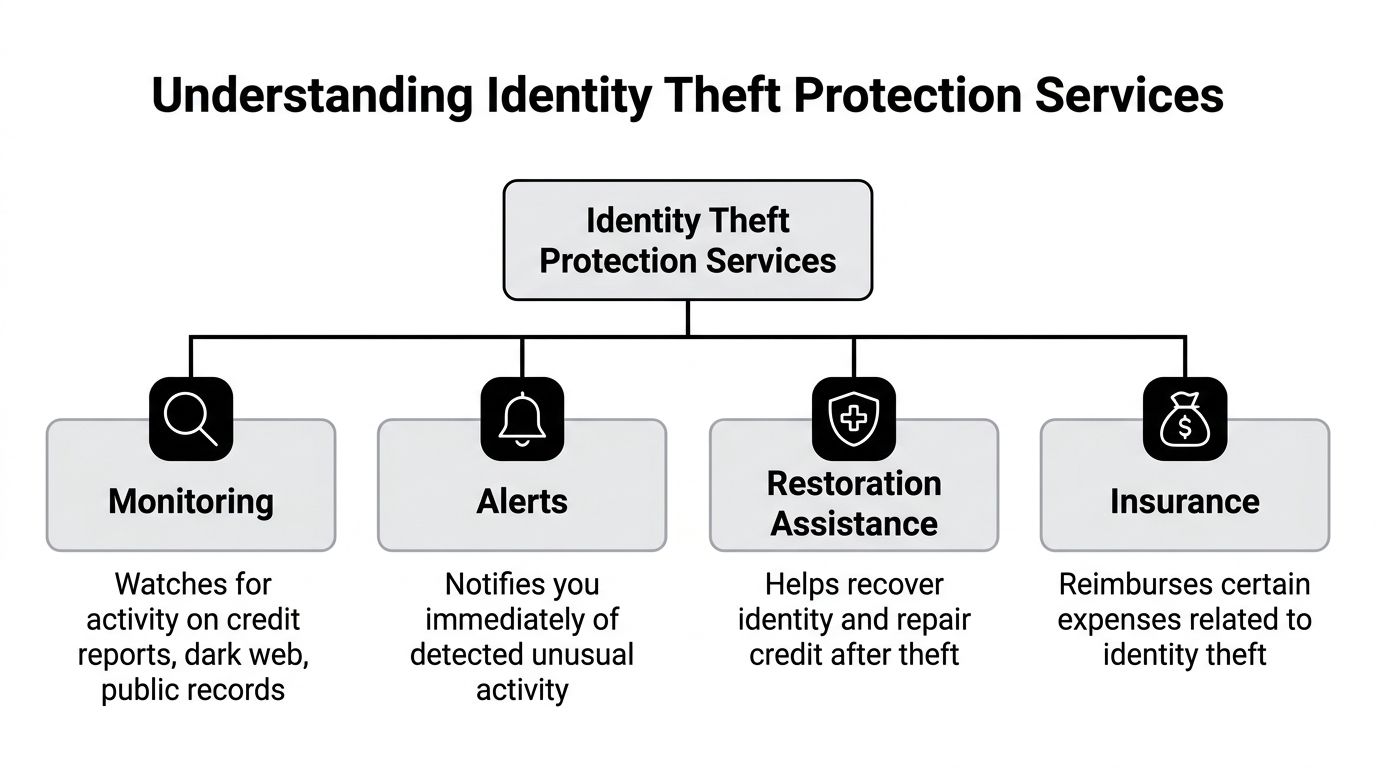
Compare it to a home security system. It can watch, notify you, and help you respond. It doesn’t make your house impossible to break into.
Monitoring is the front end
The monitoring part looks for signs that your identity data is showing up where it shouldn’t. Some services only watch one credit bureau. Better ones watch all three. Some also scan places beyond a credit file.
According to Experian, stronger identity theft protection services go beyond basic credit monitoring by scanning the dark web for compromised credentials, people-finder websites for public data, and offering lost wallet assistance (Experian on what identity theft protection includes).
That’s an important difference. A basic alert from a bank may tell you about suspicious card activity. A broader service may also flag that your email, phone number, or username is showing up in places that could lead to account takeovers or impersonation.
You can compare that broader category with a more detailed breakdown of how identity theft protection services work.
Alerts are only useful if you act on them
An alert is a signal, not a solution.
If a service tells you that someone tried to open an account in your name, that’s useful. But you still need to respond, confirm what happened, lock down the affected accounts, and start cleanup if fraud occurred. Fast action matters. Ignored alerts don’t protect anyone.
Restoration is where paid services can earn their keep
The most valuable part of many plans isn’t the monitoring. It’s the restoration support.
That may include:
- Case guidance: Someone helps you contact institutions, document fraud, and organize next steps.
- Recovery support: Help disputing fraudulent accounts and repairing damaged credit.
- Practical extras: Lost wallet assistance and support replacing cards or ID documents.
A good service is less like a magic shield and more like a response team you can call when something goes wrong.
For people who hate paperwork, panic under stress, or manage family accounts for multiple relatives, that support can be worth more than the alerts themselves.
The Critical Gap Between Monitoring and Prevention
This is the part most ads blur on purpose. Monitoring and prevention are not the same thing.

A monitoring service tells you that your information may be misused. Prevention makes misuse harder in the first place. If your Social Security number, email, old passwords, or phone number are already circulating online, a paid service usually won’t remove that risk. It will mostly watch for signs that someone is acting on it.
The strongest defense is boring and free
Consumer law experts emphasize that “freezing your credit” is the single most effective prevention method against new account fraud, and paid services can’t do that step for you. Their core point is simple: with personal data widely available to criminals, the best defense is proactive prevention, not just reactive monitoring (consumer guidance on credit freezes and prevention).
That often surprises people because “freeze your credit” sounds technical or extreme. It isn’t. It’s one of the clearest ways to stop someone from opening new credit in your name.
Why people misunderstand this
The word “protection” implies a barrier. In many cases, the product is really a watcher.
That’s also why account security has to go beyond credit files. Identity thieves and impersonators often start with account access, reused passwords, or lookalike websites. Businesses dealing with brand abuse should also understand typosquatting threats for businesses, because fake domains can trick staff, customers, and job applicants into handing over credentials or personal data.
For individuals, the same pattern shows up in phishing pages, fake login screens, scam dating profiles, and account recovery fraud. That’s where practical habits like stronger sign-ins and account takeover prevention steps matter more than any monthly dashboard.
Monitoring still has a role
None of this means monitoring is useless.
It means you should buy it for the right reason. Monitoring helps you discover and respond. Prevention helps you avoid or block. If you confuse those jobs, you’ll overpay for convenience and underinvest in the actions that reduce risk.
Breaking Down the Cost of Paid Protection in 2026
Price is where the decision starts to feel concrete.
According to Security.org, in 2026, the average cost for an individual identity theft protection plan ranges from $14 to $16 per month, while family plans typically cost between $20 and $30 per month, with pricing shaped by features such as triple-bureau monitoring (2026 identity theft protection pricing ranges).
What you’re paying for
The monthly fee usually covers a mix of convenience features rather than a single breakthrough protection tool.
| Plan type | Typical cost range | What usually changes |
|---|---|---|
| Individual plan | $14 to $16 per month | More complete monitoring, broader alerts, better restoration support |
| Family plan | $20 to $30 per month | Coverage for multiple people, often useful for households managing shared risk |
The jump in price often reflects things like:
- Three-bureau coverage: More complete than one-bureau monitoring.
- Broader scans: Dark web and public-record style monitoring.
- Recovery support: Better hands-on help after identity misuse.
- Family convenience: One service managing multiple people.
If you’re price-sensitive, compare the monthly cost against what free tools already cover in your life. Some banks and credit card issuers already provide fraud alerts and account monitoring. Some insurance policies or employers include related support as a perk. If you’re exploring budgets, a separate look at digital privacy and monitoring plan options can also help you think through what kind of online visibility you want to track.
The hidden cost question
The actual cost isn’t just the subscription. It’s whether the service replaces habits you should still keep.
If paying for monitoring makes you less likely to review statements, use unique passwords, or lock your credit, that subscription may create false confidence. That’s a bad trade.
Who Truly Benefits from an Identity Protection Service
Paid identity protection isn’t for everyone. But for some people, it makes sense fast.
The clearest group is previous victims. Research shows that people who have already experienced identity theft are 28% more likely to be victimized again, which suggests that repeat targets may benefit more from added support and structured recovery help (research on repeat victimization risk).
People who are more likely to get value
A paid service is often easier to justify if you fit one of these profiles:
- You’ve been hit before: Past fraud changes your risk and your stress level. Many repeat victims want a second set of eyes.
- You manage family complexity: Adult children helping parents, couples merging finances, or households with several users may prefer one central service.
- You have a high-visibility online life: Professionals with a public profile, creators, streamers, recruiters, and business owners are easier to research and impersonate.
- You value guided recovery: Some people don’t want to figure out disputes, forms, and support calls while under pressure.
People who may not need to pay
If you’re disciplined, organized, and comfortable handling your own security basics, a paid service can be redundant.
You might not need one if:
- You already use strong prevention habits: Credit freezes, MFA, unique passwords, regular account review.
- Your banks already alert you well: Many people get enough warning from institutions they already use.
- You’ll ignore the dashboard anyway: Buying alerts you won’t read is just another subscription.
- You mainly want prevention: The strongest prevention steps are usually free and under your control.
Some people are buying peace of mind. Others are buying a task they could handle themselves in a few minutes a month.
That’s not a criticism. It’s the actual buying decision.
Where this matters outside banking
Identity misuse isn’t limited to loans and credit cards. It can affect:
| Area of life | How identity exposure shows up |
|---|---|
| Job search | Recruiters find outdated, fake, or risky profiles tied to your name |
| Gaming | Account takeovers expose purchases, linked email accounts, and friend networks |
| Dating apps | Catfishers and romance scammers use personal details to build trust quickly |
| Personal privacy | Public records and people-search sites make targeted scams easier |
If those risks worry you more than credit fraud alone, look closely at what any service monitors. Some plans are much narrower than their branding suggests.
Powerful and Free DIY Alternatives You Can Use Today
The strongest identity defense starts with habits, not subscriptions.
If you’re asking whether identity theft protection is worth it, this is the baseline every person should build first. Even if you eventually pay for a service, these steps perform the essential prevention work.
Freeze your credit before you need to
A credit freeze is one of the most practical moves you can make against new-account fraud. It puts a barrier in front of lenders trying to open new credit in your name.
That matters because many people assume monitoring is enough. It isn’t. A freeze shifts you from “tell me after something happens” to “make this harder to do at all.”
Use a password manager and stop reusing passwords
A reused password is often the bridge between a small data leak and a full identity mess.
If one old login from a shopping site or gaming platform gets exposed, attackers try that same password on email, banking, cloud storage, and social accounts. A password manager helps you create a different strong password for each service without trying to memorize them.
A few places where this matters more than people expect:
- Gaming accounts: They often store cards, digital purchases, and linked communication accounts.
- Dating apps: A compromised account can reveal private conversations, photos, routines, and location hints.
- Professional accounts: A hijacked LinkedIn or work-adjacent profile can harm job prospects and reputation.
Turn on MFA wherever it’s offered
Multifactor authentication adds a second check after the password. That can interrupt account takeover attempts even when a password leaks.
This won’t solve every form of fraud. But it blocks a lot of low-effort abuse, especially on email and primary social accounts. Since email controls password resets for so many other services, start there first.
Secure your email first. If someone controls your inbox, they often control the reset path to everything else.
Review your digital footprint, not just your credit report
A lot of identity risk starts with publicly exposed information, not a credit event.
That includes old usernames, forgotten accounts, people-search listings, breached credentials, public posts, gamer tags, and social profiles that reveal enough to answer security questions or build believable scams. OSINT-style self-audits are particularly useful in this context. They show you what strangers, recruiters, scammers, or impersonators can learn by connecting publicly available dots.
For a hands-on walkthrough of why that matters, this short video gives useful context:
Keep your own lightweight system
You don’t need a complicated setup. A simple routine works:
- Freeze credit unless you’re actively applying for something.
- Check bank and card activity regularly.
- Use unique passwords with a password manager.
- Enable MFA on email, financial apps, social media, and gaming platforms.
- Audit your exposed online presence and remove what you can.
- Watch for breach signs and suspicious logins with whatever free tools your providers already offer.
If you want a starting point that fits a do-it-yourself approach, compare your options for free identity monitoring tools and habits.
For many people, that stack is enough. If you later decide to pay for a service, you’ll be adding convenience and recovery support on top of a strong base instead of paying for false reassurance.
Your Decision Checklist Is It Worth It for You
A clean decision usually comes down to this: Are you paying for needed help, or paying to outsource habits you could build yourself?
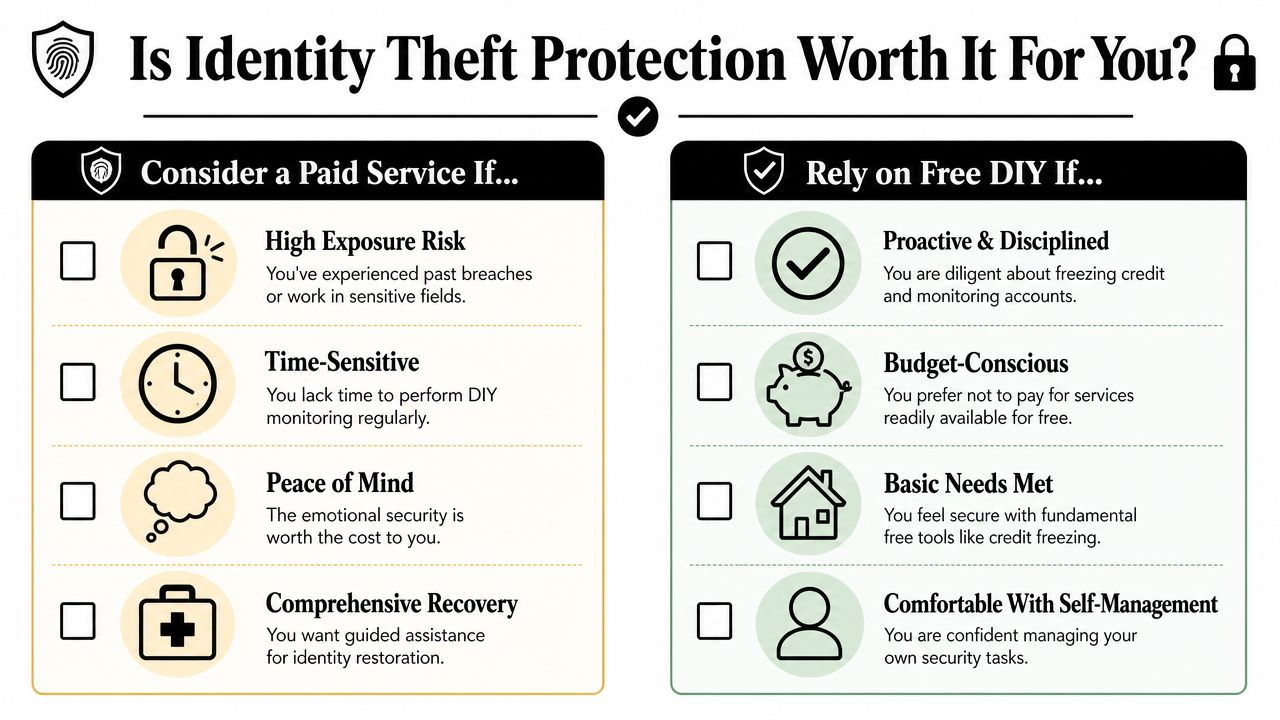
A side-by-side way to decide
| Consider a paid service if… | Rely on free DIY methods if… |
|---|---|
| You’ve dealt with identity theft before and want guided recovery support | You’re comfortable freezing credit and managing your own account security |
| You don’t have time to monitor multiple accounts and records consistently | You already review accounts and respond quickly to suspicious activity |
| You manage security for parents, children, or a whole household | You prefer not to pay for alerts that overlap with your bank or card issuer |
| You want convenience and reassurance more than pure prevention | You want to focus on preventive steps that directly reduce risk |
The shortest honest answer
Choose paid protection when recovery help, centralized monitoring, and convenience are worth the monthly cost to you.
Skip it when you’re disciplined enough to handle credit freezes, password hygiene, MFA, and regular account checks on your own.
Neither choice is necessarily smarter. The mistake is buying a monitoring product while expecting prevention.
Frequently Asked Questions
Is paid identity theft protection better than the free alerts from my bank?
Sometimes, but not automatically. Banks and card issuers often do a good job catching suspicious transactions tied to their own accounts. Paid services may watch a broader set of signals, such as credit activity, dark web exposure, or public data sources. The question is whether that wider view solves a real problem for you.
Does a credit freeze stop all identity theft?
No. It’s strongest against new account fraud. It doesn’t stop every kind of account takeover, phishing attack, tax-related fraud, romance scam, social engineering attempt, or misuse of an existing account. That’s why passwords, MFA, and careful account habits still matter.
What’s the value of identity theft insurance?
Its value is usually in the recovery process, not in prevention. It may help with certain expenses and support tasks after identity misuse. That can be useful if you want backup during a stressful cleanup. It doesn’t replace the basics.
If I’ve never been a victim, should I still pay for a service?
Maybe, but start with prevention first. If your main concern is stopping future abuse, free steps often do more than a subscription alone. If your main concern is convenience or guided restoration, a paid plan may still appeal to you.
What about online reputation, dating safety, and gaming account security?
Those areas often fall outside the narrow way people think about identity theft. A fake dating profile, a hijacked gamer account, or an old public post tied to your real name can create privacy, safety, and reputation problems even when no new credit line is opened. That’s why a broader view of your online footprint matters.
Your identity isn’t just a credit report. It’s your public records, breached logins, social profiles, gaming accounts, dating app traces, and the fragments strangers can piece together about you. If you want to see what’s already exposed, run a check with Digital Footprint Check or try the free checker at Digital Footprint Check. It’s a practical first step for protecting your privacy, reducing scam risk, and spotting the online details that could affect your finances, reputation, job prospects, or personal safety.