· Digital Footprint Check · Content Marketing · 15 min read
Employee Background Check Laws and Osint
Master employee background check laws with our 2026 guide. Learn FCRA compliance, adverse action steps, and how to ethically integrate OSINT tools.

You’ve found the person who seems ideal for the role. The interviews went well, references were positive, and the hiring manager is ready to move. Then a quick online search produces conflicting information: an old profile under a different name, an incomplete court record, or a public post that may belong to someone else. The instinct to investigate is understandable. Acting on that information without a defined process can create a legal problem.
Employee background check laws now govern more than a criminal database search. They shape how employers obtain consumer reports, evaluate conviction information, handle personal data, and respond to public digital records. The practical challenge is balancing legitimate risk management with candidate privacy, accuracy, fair treatment, and job relevance. A useful overview of how online information can influence hiring decisions is TheBestReputation hiring impact guide.
A compliant program should distinguish between a formal consumer report and an informal search, document why a check is relevant to a role, and apply the same process to similarly situated candidates. Employers building that workflow can use a structured pre-employment screening process rather than leaving individual hiring managers to browse social media on their own.
The Modern Reality of Pre-Employment Screening
A growing company often reaches this point without malicious intent. A recruiter searches a candidate’s name on a professional network, notices a second account, and asks a manager to investigate. The manager finds a public post that appears offensive, but the identity is uncertain and the context is missing. Before anyone verifies the information, the candidate is removed from consideration.
That sequence is risky because it combines unverified identity, inconsistent treatment, and an undocumented decision. It may also expose protected characteristics that the employer never needed to see. A public profile can reveal religion, disability, national origin, age, family status, or political activity. Once a decision-maker sees that information, the company may struggle to prove it played no role.
The legal framework developed in response to exactly this kind of uncontrolled discretion. Cornell’s labor history review explains that background screening “barely existed” in private hiring before the 1970s, and identifies the Consumer Credit Protection Act of 1968 and the Fair Credit Reporting Act of 1970 as milestones that helped turn screening into a regulated practice. The Cornell review of criminal background searches in employment also places notice, permission, accuracy, and anti-discrimination safeguards at the center of that transition.
What counts as screening now
A third-party report about a candidate’s character, reputation, personal characteristics, or employment history can fall within the FCRA’s consumer-report framework. That may include criminal records, employment verification, education checks, or investigative interviews. A direct review of public information may not automatically be an FCRA consumer report, but it still creates privacy, discrimination, defamation, and recordkeeping concerns.
The technology has expanded the available information. Public social media, professional networks, breach databases, gaming profiles, usernames, and data-broker pages may reveal a broader digital footprint than a conventional report. More data doesn’t automatically produce a better decision. It often produces more ambiguity, especially where names are common, accounts are incomplete, or old information has been copied across websites.
A sustainable policy therefore separates three questions:
- Identity: Can the employer reliably establish that the information belongs to the candidate?
- Accuracy: Is the information current, complete, and supported by a reliable source?
- Relevance: Does it relate directly to the duties, risks, or legal requirements of the role?
Informal online snooping fails because it rarely answers all three. A structured process does, while limiting access to information the company has a legitimate reason to consider.
Federal Compliance and the FCRA Workflow
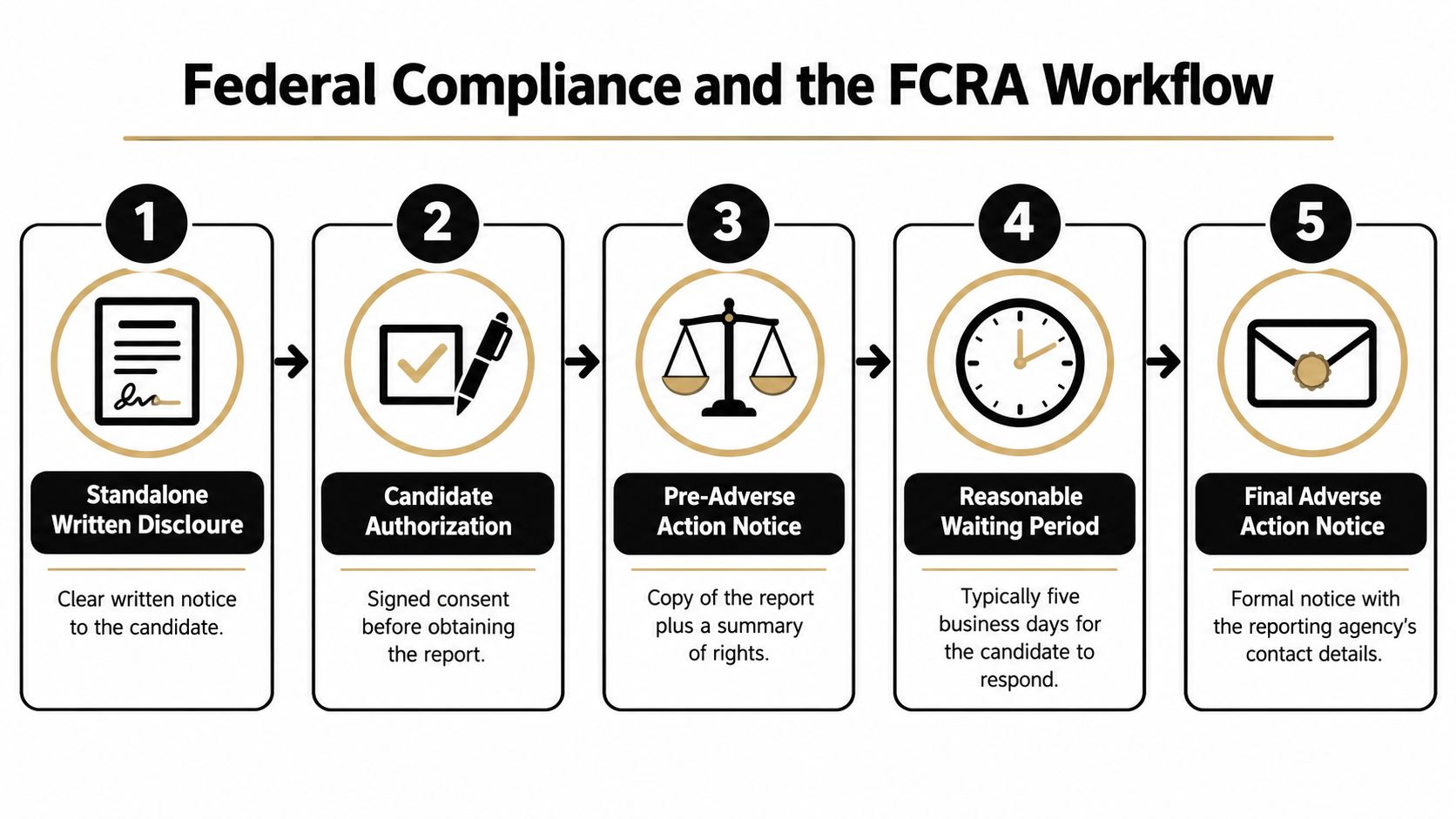
When a third-party screening company supplies a report for employment purposes, the FCRA creates a technical sequence. Treating vendor compliance as the vendor’s problem isn’t enough. The employer remains responsible for using the report lawfully and making sure its documents and decisions follow the required process.
Start with disclosure and authorization
Before ordering the report, provide a standalone written disclosure stating that a consumer report may be obtained for employment purposes. The disclosure must be clear and conspicuous. Don’t bury it inside an employment application, liability waiver, or general release.
Next, obtain the candidate’s written permission. The authorization should correspond to the checks the employer intends to conduct and should be retained with the screening record. Employers that use vendor templates should still have counsel review them, because a technically defective form can undermine an otherwise careful process. Teams standardizing this stage can review background check consent forms before implementation.
Treat adverse action as a pause, not a shortcut
If the report may contribute, even partly, to a negative decision, the employer must issue a pre-adverse-action notice. That package includes:
- Notice of proposed action: Tell the candidate that the employer is considering an adverse decision.
- Report copy: Provide the consumer report that influenced the proposed decision.
- Rights summary: Include the FCRA summary of rights so the candidate understands the dispute process.
- Review opportunity: Allow the candidate time to identify errors, mistaken identity, missing context, or other relevant information.
The FTC’s employer guidance describes this cause-and-effect sequence in its background-check compliance guidance. The final decision shouldn’t be issued immediately after the pre-adverse notice. A reasonable waiting period gives the candidate a meaningful opportunity to respond. The candidate has the right to dispute inaccuracies and request a free copy of the report within 60 days, according to the federal process described by the FTC.
Only after reviewing the response should the employer issue a final adverse-action notice, if the decision remains unchanged. That notice must identify the consumer reporting agency, provide its contact information, explain that the agency didn’t make the employment decision, and tell the individual about the right to obtain another free copy and dispute inaccuracies.
Federal reporting limits also matter. Arrest records cannot be reported after seven years, while criminal convictions can be reported indefinitely under the FCRA baseline, subject to other applicable law. The FTC’s plain-language background-check guide notes that Texas imposes additional restrictions on certain older criminal-history items and that salary-based exceptions can apply when pay exceeds $75,000 a year. Those rules don’t eliminate the need to check state and local requirements before ordering a report.
Navigating State and International Jurisdiction Rules
Federal law is only the floor. A candidate’s work location, the employer’s location, the role, and the type of information being collected can all change the workflow. Ban-the-box and fair-chance rules may delay criminal-history questions until after a conditional offer. Other rules limit which records an employer may consider, require individualized review, or impose additional notices.
A national policy that runs the same criminal check at the same stage for every applicant is efficient, but efficiency can become a compliance trap. A global policy can be even more dangerous. The EU’s GDPR doesn’t create one universal hiring checklist. It regulates the processing of personal data, and criminal-conviction data receives especially strict treatment.
Build a jurisdiction matrix
For each hiring location, record the permitted timing, data categories, notices, retention rules, and decision standards. Then add a role-based analysis. A fiduciary position, a safety-sensitive role, and a general office role may justify different checks, but the justification should be written before the candidate’s results arrive.
| Jurisdiction | Primary Constraint | Employer Action Required |
|---|---|---|
| United States federal baseline | FCRA notice, authorization, accuracy, and adverse-action requirements apply when a third-party consumer report is used | Use a standalone disclosure, obtain written permission, and complete the two-step adverse-action process |
| U.S. states and cities | Ban-the-box, fair-chance, lookback, credit-history, and notice rules vary by location | Map the candidate’s work location and role before ordering or using a report |
| European Union | GDPR limits processing, with criminal-conviction data subject to Article 10 and specific legal authorization requirements | Establish a lawful basis, minimize data, and confirm that local law authorizes conviction-data processing |
| Multijurisdictional hiring | One workflow may be lawful in one location and prohibited in another | Use country- and state-specific screening matrices rather than a universal checklist |
GDPR changes the question
For ordinary screening data, employers may often consider legitimate interests or a legal obligation, but that doesn’t mean every available data source is fair game. Under GDPR Article 10, criminal-conviction data requires both a valid Article 6 lawful basis and specific authorization in EU or Member State law. A routine process in one member state may therefore be unlawful in another.
The practical answer is data minimization. Collect only what the role requires, limit access, define retention, and document the reason for each category. A data processing agreement can support vendor governance, but it doesn’t replace the employer’s obligation to choose a lawful purpose or assess local requirements.
Handling Arrest Records and Incomplete Data
An arrest is not a conviction. That distinction sounds obvious, yet it remains one of the most damaging sources of poor screening decisions. An arrest can reflect an allegation, a mistaken identity, an incident that never led to prosecution, or a case resolved without a finding of guilt.
The EEOC’s federal guidance on arrest and conviction records in employment warns employers not to rely on arrest records alone. It also emphasizes that conviction records should be reviewed for accuracy and job relevance instead of treated as automatic disqualifiers.
Separate the record from the decision
A defensible reviewer asks what the record establishes. Is it an arrest, a pending charge, a dismissed case, a conviction, or a data entry with no clear disposition? Does the name match other identifiers? Is the date plausible? Does the record contain enough information for a fair review?
A practical review file should capture:
- Record type: Identify whether the information concerns an arrest, charge, disposition, or conviction.
- Verification status: Record the source, identifiers checked, and any unresolved mismatch.
- Role connection: Explain which specific duty or risk is relevant.
- Individual context: Consider information the candidate provides, including evidence of rehabilitation or correction.
- Decision rationale: State why the record does or doesn’t affect the role.
Practical rule: If the reviewer can’t explain the job connection without referring to a stereotype, the record probably isn’t a defensible basis for exclusion.
The same discipline applies to incomplete digital information. A username linked to an old forum account isn’t proof of ownership. A screenshot without a date or source isn’t a complete record. A search result that combines several people with the same name should trigger verification, not rejection.
Employers should also avoid treating “recent” as a complete decision rule. Recency may matter, but its significance depends on the duties, the nature of the conduct, the time elapsed, and applicable local law. The better standard is individualized, documented relevance, applied consistently to candidates for the same role.
Teams that need a structured starting point for criminal-history review can consult a criminal record check for employers, then adapt the process to the governing jurisdiction and role.
Integrating OSINT and Digital Footprint Analysis
Traditional consumer reports answer narrow questions. They may confirm an identity, locate a record, or verify employment. They won’t necessarily show that an employee’s email appears in a breach database, that several public accounts use the same username, or that a professional profile conflicts with information supplied during hiring.
OSINT, or Open Source Intelligence, fills that context gap only when used carefully. It means analyzing publicly available information from sources such as social networks, professional platforms, public records, breach notifications, and gaming communities. The objective shouldn’t be to collect everything about a candidate. It should be to identify role-relevant risk while protecting the person’s privacy.
Use a bounded research method
Start with a defined question. For a security administrator, compromised credentials may warrant a different response than public political commentary. For a customer-facing role, identity misrepresentation or threats directed at customers may be relevant, while lawful off-duty beliefs generally aren’t.
A disciplined OSINT workflow looks like this:
- Define the purpose: Write the job-related risk the search is intended to assess.
- Limit the sources: Use public, lawful sources and avoid deceptive access, private groups, or attempts to bypass privacy controls.
- Verify identity: Match multiple non-sensitive identifiers before attributing an account to a candidate.
- Separate facts from interpretation: Preserve the source and date, then describe what it shows without exaggeration.
- Escalate carefully: Send potentially adverse information through HR or legal review rather than to a hiring manager’s inbox.
- Give the candidate a response path: If the information may affect the decision, address accuracy and context through a fair process.
Scraping tools can help researchers understand how public professional data is organized, but they require careful attention to platform terms, privacy rules, and purpose limitation. A technical overview of the best LinkedIn scraper is useful for understanding capabilities, not as permission to collect unrestricted candidate data.
What OSINT should and shouldn’t do
OSINT can identify exposed credentials, duplicate identities, impersonation, and public conduct that directly conflicts with a documented role requirement. It should not become a search for embarrassing content, protected characteristics, or reasons to confirm an unconscious preference.
Digital Footprint Check is one option for this type of research. Its platform searches 500+ platforms, including social networks, data-breach databases, gaming profiles, professional networks, and public records, to help users identify publicly accessible information. Employers should still apply their own lawful-purpose, verification, access-control, and adverse-action rules. A practical overview of how to use OSINT can help teams define those boundaries before searching.
The ethical advantage of a defined tool and workflow is consistency. Every candidate in the same role receives the same type of review, and the company can show what it searched, why it searched, and how it handled uncertainty.
Building a Compliant Screening Policy Checklist
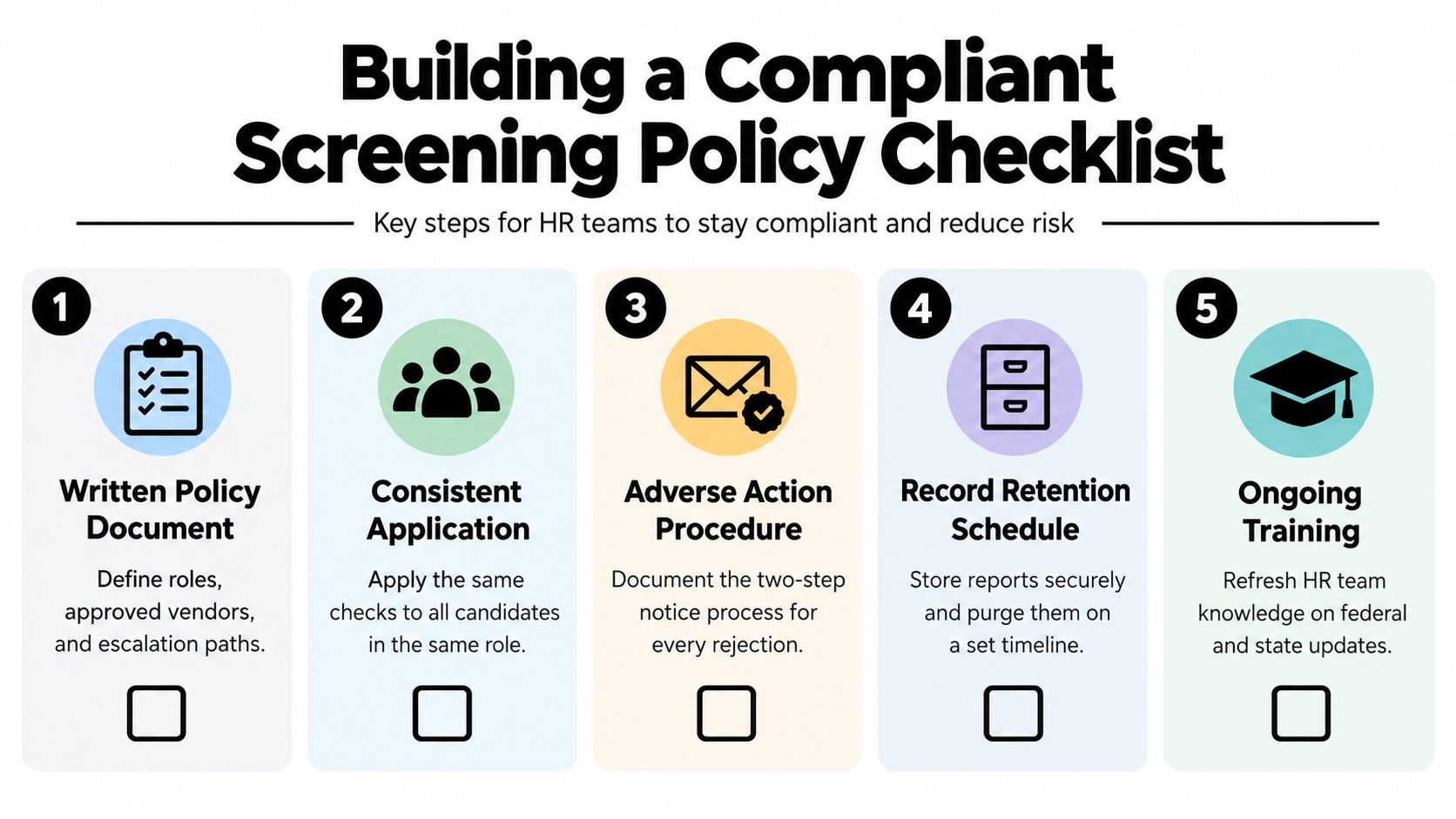
A policy becomes useful when a different HR specialist can follow it without asking a hiring manager what they “usually do.” Write the process before a difficult candidate file arrives. That prevents exceptions from becoming the actual policy.
Define the operating rules
1. Written policy document. Specify which roles may receive which checks, name approved vendors, assign decision authority, and define escalation paths. Include separate rules for consumer reports, public OSINT, candidate disputes, and sensitive information discovered accidentally.
2. Consistent application. Apply the same screening package to candidates for the same role, unless a documented legal or business reason supports a difference. Recruiters shouldn’t conduct personal searches for one applicant while skipping them for another.
3. Adverse-action procedure. Put the standalone disclosure, authorization, pre-adverse notice, report copy, rights summary, review period, and final notice into a controlled workflow. Assign ownership so the hiring manager can’t skip the pause because a start date is approaching.
Control the records
4. Record retention schedule. Store reports and research notes securely, restrict access, and purge them according to a defined schedule and applicable law. Don’t keep sensitive reports in shared recruiting folders or personal email accounts.
5. Ongoing training. Refresh HR and recruiting teams when federal, state, local, or international rules change. Training should include realistic examples, such as mistaken identity, arrest-only information, a disputed social account, and a candidate who asks what data was used.
Before launch, test the policy with a sample role matrix:
- Low-data role: Confirm the minimum identity and work-authorization checks required by law and business need.
- Sensitive-access role: Document why access to money, systems, confidential data, or vulnerable people justifies additional review.
- International role: Identify the governing data-protection rules before collecting criminal-conviction information.
- Remote role: Determine which location’s fair-chance and privacy rules apply, rather than relying only on headquarters location.
Finally, audit outcomes. Look for inconsistent timing, missing notices, unexplained overrides, and decisions based on information outside the approved scope. A policy that exists only in a handbook won’t protect the company if actual practice happens in private browser tabs.
The Shift Toward Relevance-Based Assessment
The most durable change in screening is a move away from blanket exclusion and toward job relevance. Federal guidance allows background checks in general, but employers still must avoid discriminatory use, including practices that create unlawful disparate impact. State and local rules increasingly narrow older proxies for trustworthiness, including broad use of credit history, distant convictions, and automatic criminal-record exclusions.
New York provides a clear example of that pressure. Restrictions taking effect in 2026 limit employment credit checks except in defined circumstances, as described in reporting on New York’s employment credit-check restrictions. The practical question isn’t whether a company prefers more information. It’s whether the employer can explain why that information is necessary for this role, at this stage, and under this jurisdiction’s rules.
Replace exclusion with evidence
A relevance-based model doesn’t mean ignoring risk. It means identifying the actual risk, selecting the narrowest lawful check, verifying the information, and giving the candidate a meaningful chance to correct or contextualize it.
That approach works better than a blanket rule for several reasons:
- It improves accuracy: Reviewers examine disposition, identity, dates, and context instead of treating a database hit as a conclusion.
- It supports consistency: A role-based matrix gives recruiters a shared standard.
- It reduces bias exposure: The employer avoids collecting unnecessary personal characteristics and applying vague judgments.
- It creates an audit trail: Decision-makers can show how the record connected to the job.
- It preserves flexibility: The company can respond to legitimate risk without excluding people based on information that has little bearing on performance.
Continuous monitoring also needs restraint. Monitoring should be limited to a defined purpose, lawful sources, access controls, and a documented response process. It shouldn’t turn employment into unrestricted surveillance.
The strongest screening programs combine FCRA discipline, jurisdiction-specific rules, careful record analysis, and bounded OSINT research. They don’t ask whether a candidate has a perfectly clean digital history. They ask whether the available, verified information reveals a material risk for the role and whether the company can defend the way it reached that conclusion.
Digital Footprint Check helps employers and individuals discover publicly accessible information across social media, professional networks, gaming profiles, public records, and data-breach databases, supporting a more structured view of digital identity. Visit Digital Footprint Check to review your available footprint and assess how an ethical OSINT process could fit alongside your employee background check laws workflow.