· Digital Footprint Check · Content Marketing · 21 min read
What Can Someone Do With Your Ssn: Protect Yourself Today
what can someone do with your ssn and how to protect yourself from identity theft, financial fraud, and tax scams. Learn practical steps to stay safe.

A stolen Social Security number is valuable to criminals: it's a master key to your financial life. With it, they can open credit cards, take out loans, file a bogus tax return for your refund, or commit crimes while posing as you. The damage can take years of stress, paperwork, and legal work to undo.
Your SSN Is the Master Key to Your Identity
Your SSN is a skeleton key. A regular key opens one door; your SSN unlocks most critical parts of your life. Banks, government agencies, employers, and your doctor's office all use it as an identifier.
That nine-digit number is the foundation of your official identity. When a thief steals it, they steal the power to impersonate you.
The Power of a Nine-Digit Number
What can someone actually do with your SSN? Because the number is the gateway to a large network of personal data and financial services, a criminal can bypass the security questions and verification checks meant to protect you.
The table below breaks down the most common types of fraud and what they could mean for you.
Quick Overview of Potential Damage from a Stolen SSN
| Type of Fraud | What a Thief Does | Potential Impact on You |
|---|---|---|
| Credit & Financial Fraud | Opens new credit cards, applies for personal loans, or sets up new bank accounts using your identity. | You're left with mountains of debt you didn't create, and your credit score can be wrecked. |
| Tax Identity Theft | Files a fraudulent tax return with your SSN to claim your tax refund before you have a chance to file. | The IRS rejects your legitimate return, leading to long delays and a complicated verification process to get what's rightfully yours. |
| Employment Fraud | Uses your SSN to get a job, especially if they aren't authorized to work in the U.S. | The IRS sees undeclared income under your name, creating a messy tax situation and potential audits. |
| Medical Identity Theft | Receives medical care or fills prescriptions using your SSN and health insurance information. | Your medical records get contaminated with incorrect information, and you're stuck with massive bills for services you never received. |
| Government Benefits Fraud | Applies for benefits like unemployment or disability in your name. | You could be denied benefits when you actually need them because someone else has already claimed them. |
The damage isn't only financial. It can reach every corner of your life, from credit and taxes to health and employment.
Since your SSN is a master key, protecting it matters. A good start is to secure your identity with an IRS Identity Protection PIN, which adds a lock to your tax account and stops one of the most common forms of SSN misuse.
Understanding just how vulnerable this number makes you is the first—and most important—step toward protecting yourself.
How a Stolen SSN Becomes a Thief's Payday
Let's be clear: when a criminal steals your Social Security number, they aren't just taking a nine-digit number. They're stealing your financial identity—your good name, your hard-earned credit score—and turning it into a weapon for a quick cash grab. This isn't random; it's a calculated assault on everything you've worked for.
It all starts with a few key pieces of data. Your name, date of birth, and SSN are often all a thief needs to start impersonating you. They buy this information on dark web marketplaces and start walking through digital doors that should be locked tight, presenting themselves as you to banks and lenders. The damage starts small, but it snowballs fast.
The Financial Fraud Playbook
The first, and most common, move is to open new lines of credit. Think of your solid credit history as their personal blank check. A thief uses your SSN to apply for high-limit credit cards online, and because your record is clean, they get approved almost instantly.
The cards are shipped to a drop house or a P.O. box you've never heard of. From there, it's a race to max them out on luxury items, untraceable gift cards, and electronics they can flip for cash.
Next, the attacks get bolder. They might apply for personal loans, car loans, or even a mortgage in your name. To the lender, everything looks legitimate. Your SSN matches, the name checks out, and your credit history is solid. The loan gets approved, the criminal vanishes with the money, and you're left holding the bag for a massive debt you didn't even know existed.
The fallout is devastating. Victims often report tanked credit scores (19%), being forced to delay major life goals (24%), and even needing to borrow money from family just to stay afloat (20%). With credit card fraud being the most common type of identity theft, it accounted for 416,582 reported cases in a single recent year.
Draining What You Already Have
It's not just about opening new accounts. A determined thief can also go after the money you already have. Using your SSN and other stolen data to bypass security questions, they can break into your online banking portal.
Once they're in, they can wire your life savings to their own accounts, change your contact info to lock you out, and leave you with nothing. Imagine waking up to find your checking and savings accounts wiped out. The money you had for rent, for bills, for an emergency—gone.
The chilling reality is that a criminal can dismantle your entire financial life in a matter of hours. They build a mountain of new debt in your name while simultaneously draining your existing assets, forcing you to fight a two-front war to reclaim your stability.
The Long Road to Recovery
The damage goes far beyond the initial fraudulent charges. Every missed payment on those bogus accounts slams your credit score, potentially dropping it by hundreds of points. A once-great score becomes toxic, making it nearly impossible to get approved for a real car loan, a mortgage, or even just to rent an apartment.
Cleaning up the mess is a long, grueling process. It's a marathon of phone calls, paperwork, and stress. You'll have to:
- File Police Reports: You need official documentation to even begin proving you're a victim.
- Dispute Every Charge: This means contacting each bank and lender one by one to fight every fraudulent transaction.
- Deal with Collection Agencies: Prepare for the phone to start ringing with debt collectors demanding payment for accounts you never opened.
- Monitor Everything: You'll need to watch your credit reports like a hawk for years to make sure new fraud doesn't pop up.
The emotional and financial toll is immense. Understanding how does identity theft occur is the critical first step in recognizing the weak points and protecting yourself from this nightmare scenario.
Unseen Dangers: Government and Employment Fraud
While credit card fraud gives you that immediate, stomach-dropping feeling, some of the worst identity theft happens in the shadows. When a scammer gets ahold of your SSN to swindle the government or an employer, the damage is often invisible—until a shocking letter arrives in your mailbox.
What follows is a bureaucratic nightmare. Untangling these messes can take years of phone calls, paperwork, and persistence. This isn't just about money; it's about someone corrupting your official records, tarnishing your work history, and even putting the benefits you've earned over a lifetime at risk.
Tax Identity Theft: The Refund Heist
One of the most frequent plays in a thief’s playbook is tax identity theft. Picture this: You've finally gathered all your W-2s and are ready to file your taxes, looking forward to that refund. But when you hit "submit," the IRS rejects your return. The reason? A return has already been filed under your Social Security number.
This is the classic refund heist. A criminal used your SSN, probably cooked up some fake income info, and filed a bogus tax return in your name as early as possible. They have the refund sent to their own account and then they're gone, leaving you to clean up the mess.
Now, the burden of proof is on you. You have to convince the IRS that you are who you say you are and that the first return was a fraud. It’s a frustrating process that involves:
- Filing a paper tax return by mail.
- Filling out an IRS Identity Theft Affidavit (Form 14039).
- Waiting. And waiting. Sometimes it takes more than a year for the IRS to sort things out and send you the refund you're rightfully owed.
All that time, the money you were counting on is trapped in limbo. All because your identity was just a tool for a quick score.
Employment Fraud: Working Under Your Name
Another sneaky and damaging scheme is when someone uses your SSN to get a job. This is a common tactic for people who aren't legally authorized to work in the country or are trying to fly under the radar with a criminal record. They give your SSN to their new boss, who then reports all their earnings to the IRS—under your name.
You probably won't have a clue anything is wrong for months, maybe even a year. The first sign is often a notice from the IRS or the Social Security Administration (SSA). The IRS might send a letter claiming you owe a massive tax bill because you "forgot" to report thousands in income from a company you've never even heard of.
The real danger here is the long-term hit to your Social Security record. The imposter’s earnings don’t count toward your future benefits. This can directly lower the amount you receive in Social Security retirement or disability payments down the road.
Fixing this means fighting a two-front battle with both the IRS and the SSA. You’ll have to prove you never worked at that company and get the fraudulent income scrubbed from your records. It’s an exhausting process to clear your name for work you never did and money you never saw. It really shows how a stolen SSN can ripple through your life, affecting not just your bank account today, but your financial security for years to come.
The Rise of Synthetic and Medical Identity Theft

While we often think of credit card fraud and phony tax returns, thieves have cooked up far more sinister ways to use a stolen Social Security number. These next-generation schemes, like medical and synthetic identity theft, are a whole different beast. They create uniquely dangerous problems that are tougher to spot and a nightmare to fix.
These attacks aren't about simple impersonation. Instead, criminals either poison your most sensitive health information or build entirely new, fraudulent identities from the ground up, using your SSN as the skeleton key. The fallout can be devastating, putting your physical health at risk and creating phantom debts that are nearly impossible to trace.
Medical Identity Theft: Your Health on the Line
When a criminal uses your SSN and other personal details to get healthcare, that’s medical identity theft. They might see a doctor, get pricey procedures, or pick up prescriptions—all in your name and billed to your insurance. The most obvious problem is financial; you could get slapped with massive bills for care you never got.
But the real danger runs much deeper: the corruption of your medical records. Suddenly, the thief's health conditions, allergies, and blood type are mixed in with yours. This can lead to life-threatening situations down the road.
- Incorrect Diagnoses: A doctor could make a critical decision based on false information in your file.
- Dangerous Prescriptions: You might be given a drug that triggers a severe allergic reaction, all because the thief's data is in your chart.
- Delayed Care: In an emergency, doctors could waste precious time treating you for a condition you don't even have.
Untangling a corrupted medical history is an agonizing process. You have to work with doctors, insurance companies, and credit bureaus to prove which parts of your record are real and which are fake. Cleaning up the financial mess is one thing; restoring the integrity of your health information is another battle entirely.
Synthetic Identity Fraud: The Frankenstein Persona
Synthetic identity fraud is one of the most clever and fast-growing types of identity theft out there. Instead of just stealing your identity wholesale, a criminal builds a brand-new, fake one from scratch. Think of it as assembling a "Frankenstein" identity.
They start with a real, legitimate Social Security number—often one belonging to a child, a recent immigrant, or someone who has passed away, because it isn't tied to an existing credit file. Then, they stitch on fabricated details: a fake name, address, and date of birth. With this hybrid identity, they start building a credit history from the ground up.
This new "person" looks real to credit bureaus. The criminal can spend months or even years nurturing this synthetic identity, taking out small loans and paying them off to build a solid credit score before going in for the kill.
This scam is hard to detect because there's no single victim to sound the alarm. The person whose SSN was swiped often has no clue it’s happening, especially if it’s a child who won’t need to check their credit for years. By the time anyone catches on, the criminal has already "busted out"—maxing out huge lines of credit and vanishing without a trace.
This type of fraud is a serious menace. In fact, synthetic identity fraud now accounts for about 30% of all identity fraud cases. With over 70% of these schemes happening online and an identity theft attempt occurring every 14 seconds in the U.S., the risk has never been higher. You can explore more about these trends and discover more insights about identity fraud statistics on snappt.com. Understanding what can someone do with your SSN is crucial to recognizing these advanced threats.
Warning Signs Your SSN Is Being Misused
Identity theft isn't like a car alarm blaring in the night; it often starts as a whisper. A criminal can quietly use your Social Security number for months, even years, before you have any idea what’s happening. But they always, always leave a trail. The trick is knowing what to look for so you can stamp out the fraud before it spirals.
Think of these warning signs as smoke detectors for your financial life. A single weird bill or a strange letter in the mail might seem like a simple mistake, but it could be the first sign that something is seriously wrong. Learning to spot these red flags is how you go from being a potential victim to an active defender of your identity.
Financial Red Flags You Cannot Ignore
The most obvious and immediate signs of SSN misuse pop up in your finances. After all, thieves are usually after a quick payday, making your credit and bank accounts their first targets. Ignoring these warnings just gives them more time to do more damage.
Your alarm bells should start ringing if you see any of these things:
- Unfamiliar Accounts on Your Credit Report: You pull your credit report and spot a credit card or a loan you never, ever opened. This is the classic move: a thief using your SSN to get new lines of credit in your name.
- Collection Calls for Debts You Don't Recognize: Suddenly, debt collectors are hounding you for overdue payments on accounts that aren't yours. This is a big deal. It means a fraudulent account has already gone into default, which is actively tanking your credit score.
- Sudden Denials for Credit or Loans: You apply for a car loan or a new credit card—something you’d normally get approved for—and you're unexpectedly denied because of a poor credit score. This often means a criminal has been maxing out fraudulent accounts behind your back, wrecking your good name.
- Mail for a Stranger at Your Address: You start getting credit card statements or official-looking bills addressed to someone you've never heard of. Thieves sometimes use their victim's real address to get an account approved before changing it later.
These aren't just minor glitches; they're direct evidence that someone is exploiting your identity for their own financial gain.
Government and Official Notices That Spell Trouble
Beyond your financial statements, weird communications from government agencies like the IRS or the Social Security Administration (SSA) are massive red flags. These often point to more complex types of fraud that can create bureaucratic nightmares that take ages to untangle.
One of the most common signs of tax identity theft is getting a notice from the IRS that says more than one tax return was filed in your name. This is a direct signal that a criminal has already filed a fake return to try and steal your refund.
Pay very close attention to these official warnings:
- An IRS Notice About a Suspicious Tax Return: You get a letter from the IRS about a tax return you haven't filed yet. Or worse, it mentions income from an employer you've never worked for. This points directly to employment or tax fraud.
- A Notice from the SSA: You receive a statement from the Social Security Administration showing earnings on your record that don't match your work history. That's a clear sign someone else is using your SSN for employment.
- You're Denied Government Benefits: You apply for unemployment or other benefits, only to be told you're already receiving them.
This table breaks down the key warning signs. If you find yourself checking off any of these boxes, it's time to act immediately.
Red Flag Checklist: Is Your SSN at Risk?
| Warning Sign | What It Could Mean | Immediate Action to Consider |
|---|---|---|
| New accounts on your credit report | A thief has opened new lines of credit in your name. | Freeze your credit with all three bureaus (Equifax, Experian, TransUnion). |
| Debt collection calls for unknown debts | Fraudulent accounts have gone into default, damaging your credit. | Dispute the debt in writing and report the identity theft to the FTC. |
| Unexpected credit denial | Your credit score has been damaged by fraudulent activity. | Pull your full credit reports to investigate the cause immediately. |
| IRS notice about a duplicate tax return | Someone has filed a fraudulent tax return to steal your refund. | File an Identity Theft Affidavit (Form 14039) with the IRS. |
| Incorrect earnings on your SSA statement | An unauthorized person is using your SSN for employment. | Contact the SSA to correct your earnings record and report the fraud. |
| Denied unemployment or other benefits | A criminal has already claimed benefits using your identity. | Report the fraud to your state's unemployment agency and the FTC. |
Catching these issues early is everything. One of the most effective ways to do that is by actively monitoring your personal data. To protect yourself, consider using some of the top tools for monitoring your digital footprint and keeping your data safe. Staying vigilant helps you spot unauthorized activity before it blows up into a full-blown crisis.
Your Step-by-Step Recovery Plan After SSN Theft
That sinking feeling when you realize your Social Security number has been stolen is terrifying. It can feel like your whole life has been hijacked in an instant. But this is not the time to panic.
Instead, you need to channel that adrenaline into immediate, focused action. What you do in the next few hours and days can make all the difference in shutting down the fraud and starting your recovery. Think of this as your roadmap to taking back control.
Immediately Lock Down Your Credit
First things first: you need to freeze your credit. Immediately. A credit freeze is like putting a digital padlock on your credit reports. It stops thieves from opening new credit cards, getting loans, or opening other financial accounts in your name. It is, hands down, the most powerful first move you can make.
You have to contact each of the three major credit bureaus to do this. It’s a right guaranteed by federal law, and it’s free.
- Equifax: You can place a freeze online or call their dedicated number.
- Experian: Use their online portal to get your security freeze in place.
- TransUnion: Freeze your credit right on their website or over the phone.
Let me be clear: you must freeze your credit at all three bureaus. If you only lock down two, a savvy thief will just exploit the one you missed.
File Official Identity Theft Reports
Once your credit is safely frozen, the next step is to create an official paper trail. This documentation is your best weapon on disputing fraudulent accounts and proving you’re the victim here.
Start by visiting the Federal Trade Commission’s (FTC) website to file an Identity Theft Report. The site walks you through every detail of the incident and generates an official affidavit and a personalized recovery plan. This report is the cornerstone of your entire cleanup effort.
Next, take that FTC report to your local police department and file a police report. Some creditors and banks will specifically ask for a police report before they’ll remove fraudulent debts from your name. Having both documents just makes your case that much stronger.
This process flow infographic shows some of the common red flags that should trigger these recovery steps.
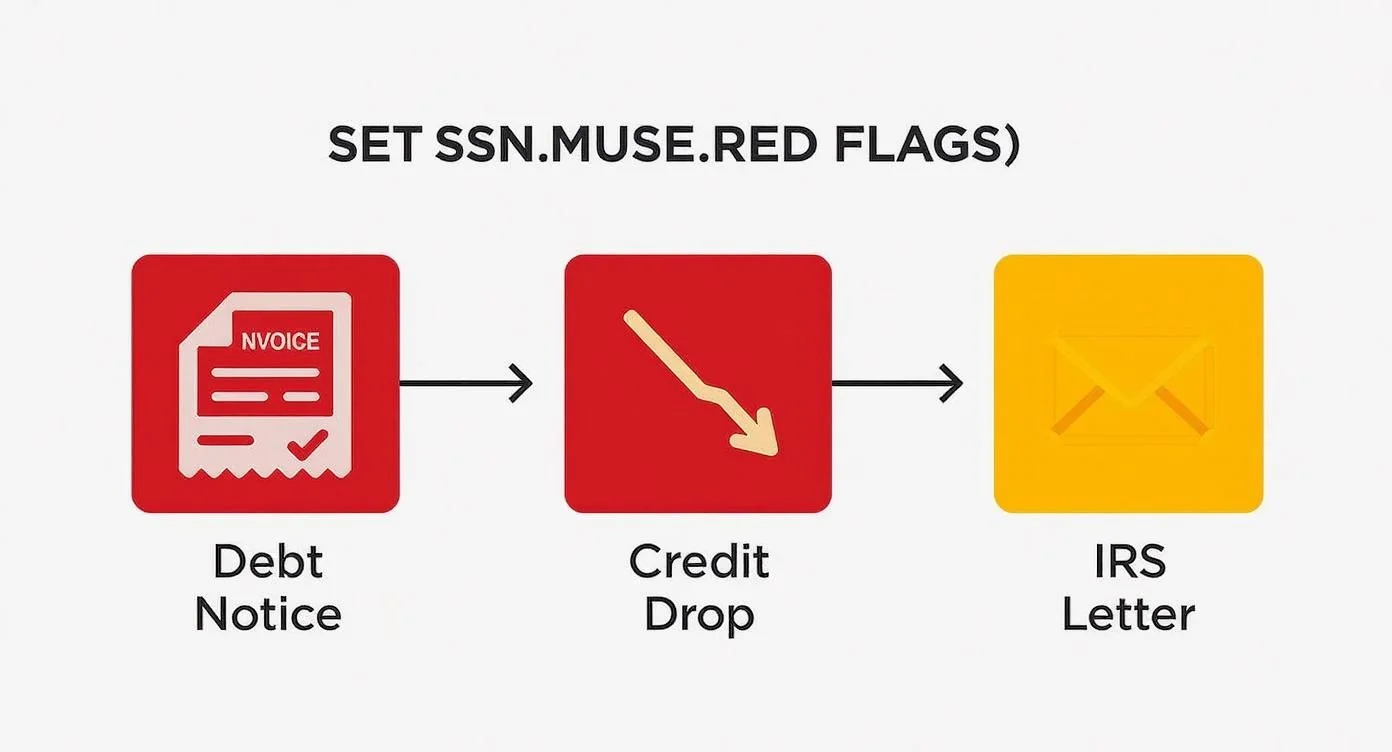
As you can see, getting weird debt notices, watching your credit score suddenly tank, or receiving a strange letter from the IRS are all massive warning signs that demand immediate action.
Begin the Cleanup and Monitoring Process
With your official reports in hand, it’s time to start cleaning up the mess. Call the fraud departments of any company where a thief opened an account in your name. You'll need to send them a copy of your FTC report and the police report to formally dispute the charges.
It’s important to understand that recovery is a marathon, not a sprint. Be persistent, keep detailed records of every phone call and letter, and don't get discouraged.
A huge part of this process is fixing the damage done to your credit. Learning how to improve credit score fast will be a major asset as you work to get your financial life back on track. For an added layer of security, you should also set up fraud alerts. While a freeze locks things down, a fraud alert tells businesses they need to take extra steps to verify your identity before issuing new credit.
Finally, you have to stay vigilant for the long haul. To get a better handle on ongoing protection, take a look at our guide on identity theft protection and the significance of conducting an online digital footprint check. By following these steps methodically, you can reclaim your identity and start rebuilding your financial future.
Frequently Asked Questions About SSN Theft
Even after you get a handle on the risks, it's natural to have some specific questions pop up, especially when you're worried about your own SSN. Let's tackle some of the most common ones head-on.
Can I Change My Social Security Number?
This is one of the first things people ask, but the short answer is almost always no. Getting a new Social Security number is rare and only happens in the most extreme situations.
The Social Security Administration (SSA) has a very high bar for this. You can't just request a new number because the old one was stolen. You'd need to prove one of the following:
- Ongoing Harm: This means you have clear evidence that a criminal is actively using your number and causing you significant, continuous damage that other measures can't stop.
- Abuse or Harassment: In tragic cases of domestic violence or stalking, a new number might be issued if your old one puts you in direct physical danger.
- Religious Objections: In rare instances, a person may be assigned a new number if the digits conflict with held religious beliefs.
Unfortunately, even if you're dealing with the headache of financial fraud, the SSA will likely tell you that a credit freeze and fraud alerts are the proper solution, not a new number.
How Do I Protect My Child's SSN?
A child's Social Security number is like a blank check to an identity thief. It has no credit history, which makes it the perfect tool for a crime called synthetic identity fraud. Thieves can use it to build a fake identity from scratch, and the damage can go unnoticed for years—often until your child applies for their first loan or job.
The best defense is getting ahead of the problem. Here’s what every parent should do:
- Freeze Their Credit: This is the single most powerful step you can take. You have the right to contact all three credit bureaus (Equifax, Experian, and TransUnion) and place a security freeze on your child's credit file. It's free and stops anyone from opening new accounts.
- Store Documents Securely: Treat their Social Security card like cash. Keep it, along with their birth certificate and other sensitive documents, in a locked file cabinet or a home safe.
- Question Forms: When a school, doctor's office, or sports league asks for your child's SSN, ask why they need it. More often than not, it isn't legally required, and you can offer a different identifier or simply leave the field blank.
The best defense is a proactive one. Freezing a child’s credit file locks the door before a thief can even try to pick it, protecting their financial future long before they need to use it.
Are you concerned about where your personal information, including your SSN, might be exposed online? Digital Footprint Check provides real-time alerts and comprehensive scans to help you monitor and secure your data. Take control of your digital identity today by visiting https://www.digitalfootprintcheck.com.