· Digital Footprint Check · Content Marketing · 14 min read
What Is Criminal Identity Theft: Protect Yourself
Understand what is criminal identity theft, its distinction from financial fraud, key warning signs, and vital protection strategies in our 2026 guide.

A lot of people think identity theft means a stranger opening a credit card in your name. That’s bad. But criminal identity theft is often worse because it can attach someone else’s crimes to your life.
You might not notice it when your data is stolen. You notice it later, when a job offer vanishes after a background check, when a court notice shows up for a place you’ve never been, or when an officer tells you there’s a warrant connected to your name. That’s when an abstract privacy problem becomes a threat to your freedom, income, and reputation.
The Nightmare Scenario You Never Saw Coming
You apply for a role you’ve worked toward for years. The interviews go well. The hiring manager sounds enthusiastic. Then the email arrives. You didn’t pass the background check.
At first, you assume it’s a clerical error. Then you learn the report shows a missed court appearance tied to a traffic stop in another state. You’ve never lived there. You’ve never even driven through it.
That kind of shock is often how people first encounter what is criminal identity theft in real life. It’s not just about stolen money. It’s about someone using your name, Social Security number, driver’s license details, or other identifying information as a shield while they commit an offense.

One common version is simple and brutal. A person gets stopped by police, gives your information instead of theirs, signs paperwork, then never appears in court. The legal system keeps moving. The missed appearance becomes a warrant. The record sits there until your life collides with it.
Another version starts online. A criminal collects scraps of your identity from breaches, public profiles, or overshared accounts, then uses that information to build a believable impersonation. Today, people also need to think about digital impersonation beyond paperwork. AI-generated voice and video scams can make a fake identity feel more convincing, especially in social engineering attacks tied to impersonation deepfakes.
Criminal identity theft hits harder than ordinary fraud because it can make you look guilty before you even know there’s a problem.
The damage isn’t limited to court records. A false criminal history can affect housing, professional licenses, travel, and your standing with employers who won’t wait for a long dispute process to play out.
Criminal Versus Financial Identity Theft
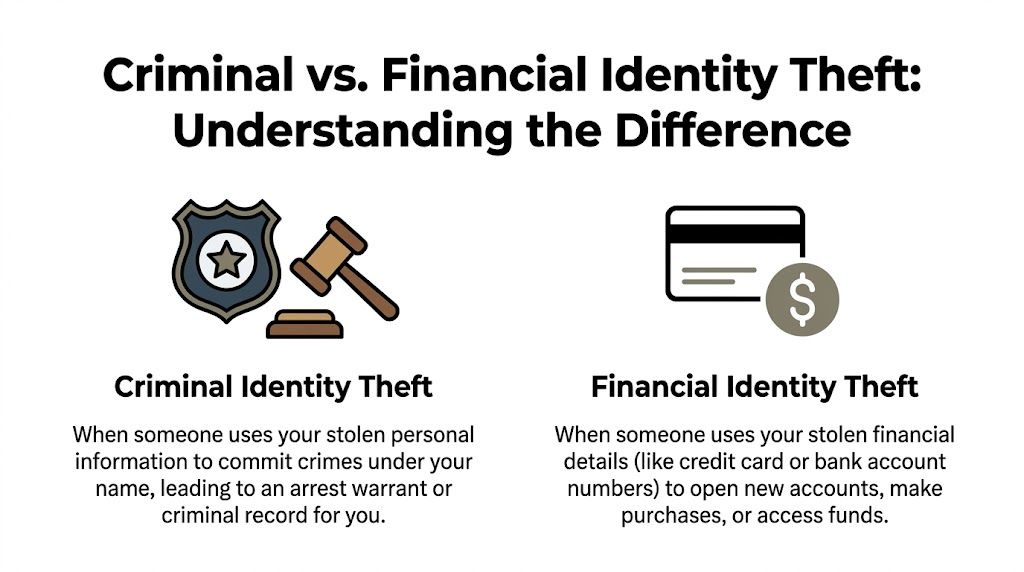
Financial identity theft is widely understood. Someone steals account details, opens credit, or makes purchases. Criminal identity theft is different. The thief isn’t trying to buy a television with your card. They’re trying to use your identity as an escape route.
A simple analogy helps. Financial identity theft is like someone stealing your wallet to spend your money. Criminal identity theft is like someone stealing your driver’s license to leave your name at the scene.
Why the distinction matters
When financial fraud happens, banks and card issuers often generate alerts quickly. You may see suspicious charges, get a text, freeze an account, and start a dispute.
Criminal identity theft is quieter. The record may sit in a court system, law enforcement database, or employment file until you apply for something important. That delay is what makes it so dangerous.
The law treats it as a serious offense. The U.S. Department of Justice states that criminal identity theft is prohibited under the Identity Theft and Assumption Deterrence Act of 1998, 18 U.S.C. § 1028(a)(7), and penalties can include up to 15 years in prison, fines, and forfeiture of property according to the Justice Department’s identity theft overview.
Criminal vs. Financial Identity Theft At a Glance
| Attribute | Criminal Identity Theft | Financial Identity Theft |
|---|---|---|
| Primary goal | Avoid responsibility for a crime by using your identity | Steal money, credit, or account access |
| Common data used | Name, date of birth, Social Security number, driver’s license details | Card numbers, bank credentials, loan details, account logins |
| Typical first sign | Court notice, failed background check, warrant, license issue | Unauthorized charge, account alert, new account notice |
| Immediate impact | Legal trouble, reputational harm, job or housing problems | Financial loss, damaged credit, account disruption |
| Detection difficulty | Often delayed because no bank alert appears | Often faster because transactions create signals |
| Fixing the damage | Usually involves police reports, court records, agencies, and proof of identity | Usually involves banks, credit bureaus, charge disputes, and fraud alerts |
Why readers often confuse them
People hear “identity theft” and assume the solution starts and ends with freezing credit. A credit freeze is useful, but it doesn’t erase a wrongful arrest record or fix a missed court appearance entered under your name.
Key distinction: financial theft targets your accounts. Criminal identity theft targets your identity itself.
That’s why the phrase what is criminal identity theft matters so much. It describes a threat that can alter how employers, landlords, and law enforcement systems see you.
How Criminals Turn Your Data Into Their Alibi
Criminal identity theft often begins with ordinary fragments of personal information. A breached email account. An old résumé. A public gamer tag tied to the same username you use elsewhere. A driver’s license image sent in a hurry. Alone, each piece seems minor. Together, they can form a usable identity.

According to Norton LifeLock’s explanation of criminal identity theft, fraudsters acquire high-value personal data like Social Security numbers, used in 69% of cases, and driver’s licenses, used in 42% of cases, often from breaches and dark web markets. The same source explains that criminals may use counterfeit IDs or give a victim’s information verbally to police, which can spread wrongful warrants across jurisdictions through systems like NCIC.
Scenario one: the traffic stop
A person gets pulled over and doesn’t want the stop connected to their real name. They hand over a fake ID built from stolen details, or they recite your information convincingly enough to pass an initial check.
If they sign the citation and skip court, the failure to appear can trigger consequences under your name. You’re not present. You don’t know there’s a hearing. The paperwork keeps moving anyway.
Scenario two: the job you never worked
Employment-related identity theft blurs financial and criminal harm. Someone uses your Social Security number to get hired. On paper, the wages look like yours. Later, the tax mismatch lands on your desk.
This kind of exposure is one reason people should pay attention to what data is circulating in breach forums and underground markets. If you want to understand that side of the risk, this guide to dark web monitoring services is a practical place to start.
A short explainer helps show how these cases unfold in practice.
Scenario three: the synthetic identity problem
Some criminals don’t use your identity exactly as-is. They blend real details with fake ones. That hybrid can slip through systems because parts of the profile appear legitimate.
This is one reason digital footprint exposure matters. Criminals don’t need your whole life story. They need enough verified pieces to make their lie survive first contact.
Warning Signs Your Identity Has Been Compromised
Criminal identity theft rarely announces itself with a fraud alert from your bank. It shows up sideways. The signs can feel random until you connect them.
One major clue comes from employment-related misuse. In 2024, the United States recorded 37,556 reported cases of employment-related identity theft, a 20% year-over-year increase, and victims often discover it years later when they face tax problems or fail a background check, according to Security.org’s identity theft statistics.
Red flags that deserve immediate attention
- A background check fails for no clear reason. If an employer, staffing firm, or licensing board flags criminal history you don’t recognize, treat it as urgent.
- You receive court mail tied to a stranger’s event. Summons notices, hearing letters, or collections related to fines you never incurred can point to identity misuse.
- A traffic citation arrives from a city you’ve never visited. That can happen when someone gives your details during a stop.
- Your driver’s license is suspended unexpectedly. Administrative penalties can flow from violations entered under your identity.
- Tax records don’t make sense. Wages from an unfamiliar employer may suggest someone used your Social Security number to work.
- A landlord or employer asks about a record you’ve never heard of. This is often the first external sign because screening systems surface problems before you do.
Why these signs are easy to dismiss
Each warning can look like a bureaucratic mistake. People assume the court mixed up a file or the employer ran the wrong report. Sometimes that’s true. But waiting is risky.
Strange legal or employment paperwork is never something to “watch for a while.” Verify it fast.
If you want an early sense of whether your details may already be exposed in ways that raise identity risk, run an identity theft exposure check. It won’t solve a court record by itself, but it can help you spot the kind of exposure criminals rely on.
A practical habit
Keep a folder for anything that seems off. Save letters, screenshots, rejection notices, dates, and names of agencies or employers involved. When you need to dispute a false record, organized documentation saves time.
Your Step-By-Step Plan to Reclaim Your Name
Finding out that someone may have committed a crime under your identity feels disorienting. The fix usually isn’t one phone call. It’s a paper trail, and you need to build your side of that trail carefully.
The stakes can be severe. Americans lost an estimated $196 billion to fraud in one recent year after accounting for underreporting, and for criminal identity theft the damage can include legal fees, missed opportunities, and major losses. The Identity Theft Resource Center reporting cited by Fraud.org’s 2025 fraud statistics says over 20% of victims in 2025 lost more than $100,000.

Start with official documentation
Your first priority is to create a formal record that you’re disputing the identity misuse.
File a police report.
Ask for a copy or report number. You need proof that you reported the fraud promptly.Create an FTC identity theft report.
Use IdentityTheft.gov to document what happened. This is especially useful if the criminal misuse overlaps with tax or employment fraud.Gather identity proof.
Keep government ID, proof of address, and any evidence showing where you were when the incident occurred. In some cases, fingerprint comparison or other biometric evidence may help separate you from the offender.
Contact the agencies that hold the bad record
A false record can live in more than one place. That’s why victims often feel like they fix one file only to see the issue appear again elsewhere.
- Court clerk’s office: Ask what case is tied to your name and how to dispute it.
- Law enforcement agency: Find out whether a report, citation, or warrant is attached to your identity.
- State motor vehicle agency: If license suspensions or traffic violations are involved, request your record.
- Background screening companies: If a job rejection exposed the issue, ask for the report and dispute process in writing.
Practical rule: Always ask for names, dates, case numbers, and mailing addresses. Memory is weak. Paper wins.
Protect the rest of your identity while you clean up
Criminal identity theft and financial identity theft often overlap. While you’re working on the legal side, also lock down the basics.
- Place fraud alerts or freeze credit files where appropriate.
- Change passwords for email and any account that stores identity documents.
- Review tax records and wage statements for unfamiliar employers.
- Check whether old profiles reveal date of birth, address history, or license details.
Running a background check on yourself can help you see what an employer or screening service may already be surfacing.
Stay organized for the long haul
Some records are corrected quickly. Others take persistence. Build one timeline that includes every letter sent, every call made, and every response received.
Use one folder for official documents and one for your notes. If a lawyer becomes necessary, that file will speed up the process and reduce costs.
How to Prevent Criminal Identity Theft Proactively
The best defense starts long before you become a victim. Criminals build false identities from real fragments. Your job is to reduce the fragments they can collect and connect.
That means thinking beyond passwords. It means looking at your digital footprint the way an investigator or fraudster would. Where does your name appear? Which old usernames tie back to your real identity? Which gaming, shopping, dating, and social accounts expose clues you forgot you shared?
Treat personal data like house keys
You wouldn’t leave spare keys in a pile outside your front door. But many people leave identity clues scattered across the internet.
Common examples include:
- Old social profiles that still show full birth date, hometown, or school history
- Gaming accounts that reuse the same handle as email or professional profiles
- Marketplace and forum posts that reveal phone numbers or personal photos
- Cloud folders and inboxes storing scans of IDs, tax forms, or onboarding paperwork
A growing threat makes this even harder. Aura’s overview of criminal identity theft notes the rise of synthetic identities, where criminals combine real personal information like a stolen SSN with invented details. The same source says this tactic is outpacing traditional theft by 35% and is fueled by gaming profile breaches and other online leaks.
Build a prevention routine
Prevention works better as a routine than a one-time cleanup.
Lock down your highest-value data
Protect your Social Security number, driver’s license details, and tax documents more aggressively than ordinary contact info. Don’t upload identity documents to random portals without verifying who runs them and why they need them.
Audit your old accounts
Look at the forgotten places first. Forum accounts, abandoned apps, old esports profiles, niche communities, and unused email addresses often hold the exact crumbs criminals need.
Separate identities where possible
Use different usernames across sensitive and public-facing accounts. If your gamer tag, Instagram handle, email prefix, and professional portfolio all match, you’re making correlation easier for anyone investigating you, including criminals.
Watch for hidden exposure
Breaches and scraped databases can circulate your details long after you’ve cleaned up the original profile. That’s why ongoing monitoring matters more than a one-time search.
Some people think privacy is about secrecy. In practice, it’s often about reducing linkability.
If you want a deeper playbook for the defensive side, this guide on how to prevent identity theft online covers practical habits that shrink your exposure.
Why digital footprint management matters
Criminal identity theft often begins with boring data, not dramatic hacks. A stale résumé, a reused username, a leaked credential pair, or a public profile photo can all support impersonation.
That’s the overlooked connection. What is criminal identity theft isn’t just a legal question. It’s also a digital footprint question. The more exposed and linkable your information is, the easier it becomes for someone else to wear your identity long enough to cause damage.
Take Control of Your Identity Today
Criminal identity theft is one of the most misunderstood forms of identity abuse because the first damage often appears far away from where the theft started. A small leak of personal data can become a failed background check, a suspended license, tax trouble, or a legal mess attached to your name.
That’s why prevention has to include visibility. You can’t protect what you can’t see. Public records, old usernames, breach data, social accounts, gaming profiles, and data broker listings all contribute to the identity trail others can piece together.
Cleaning up that trail won’t eliminate every risk, but it makes impersonation harder and gives you a better chance of spotting problems before they grow. For people who want to reduce exposure at the source, data broker removal steps are worth adding to their privacy routine.
The threat is serious. It’s also manageable if you act early, document issues fast, and treat your digital footprint like part of your personal security.
Want to see what parts of your identity may already be exposed online? Try the free checker from Digital Footprint Check. It helps you discover publicly accessible personal data across the web so you can reduce exposure before it turns into a background check problem, an impersonation attempt, or something far harder to unwind.