· Digital Footprint Check · Content Marketing · 14 min read
What Are Data Broker Sites and How to Remove Your Data
What are data broker sites? Learn how they collect and sell your personal information, the real risks involved, and how to find and opt out of your listings.

Data broker sites are businesses that collect personal information from many online and offline sources, combine it into consumer profiles, and sell or license those profiles to other companies. The FTC’s 2024 Consumer Sentinel Network Data Book recorded 845,806 reports of imposter scams, including 22% with reported financial loss totaling $2.95 billion, while the FTC reported $470 million lost in 2024 to scams that began with text messages. (FTC data summarized in NIST guidance)
You might discover the problem while searching your own name before a job interview, checking an old gaming username, or looking up a phone number that keeps receiving suspicious texts. A page you’ve never visited may display your approximate age, previous address, relatives, or email address. It feels less like finding a profile and more like opening a shadow file assembled without your consent.
The page is only the visible endpoint. Behind it may be a chain of collection, enrichment, resale, and inference involving brokers, advertising companies, analytics providers, and business customers. Understanding that supply chain changes how you respond. Removing one listing can help, but it won’t necessarily remove every copy or stop a new profile from appearing later.
Finding Your Name on a Site You Never Joined
You search for your full name and city. The result looks ordinary at first, perhaps a directory page with a familiar name. Then you see an address, an age range, possible relatives, or a previous town. You didn’t create the account, submit a profile, or agree to publish that information there. Feeling exposed or confused is a reasonable reaction.
The plain answer to what are data broker sites is this: they’re public-facing or business-facing intermediaries that gather information about individuals from multiple sources, build profiles, and sell or license the results. They aren’t limited to people-search pages. A people-search site is often the storefront where you notice the system, not the whole system itself.
The FTC’s description of the data broker industry shows why the distinction matters. Its May 2014 report examined nine brokers and found that they commonly gathered information from purchases, social-media activity, warranty registrations, magazine subscriptions, public records, Census data, property records, and motor-vehicle records, often without consumers’ knowledge.
The page isn’t the whole profile
Suppose a broker links your current name to an old address, a phone number, a username, and a public property record. Another company may add an inferred interest based on browsing or app activity. A third party may use the resulting segment for advertising, fraud screening, recruitment, or another decision process.
That doesn’t mean every listing leads to immediate harm. It does mean you should ask two separate questions: What information is exposed? And what could someone do with the combined profile?
This guide follows that path. You’ll learn how the invisible file is assembled, why a single name search misses important connections, which exposures deserve the fastest response, and why deletion is usually an ongoing maintenance task. For a broader look at usernames and connected accounts, try this free deep username search as one part of your personal audit.
Understanding How Data Broker Sites Work
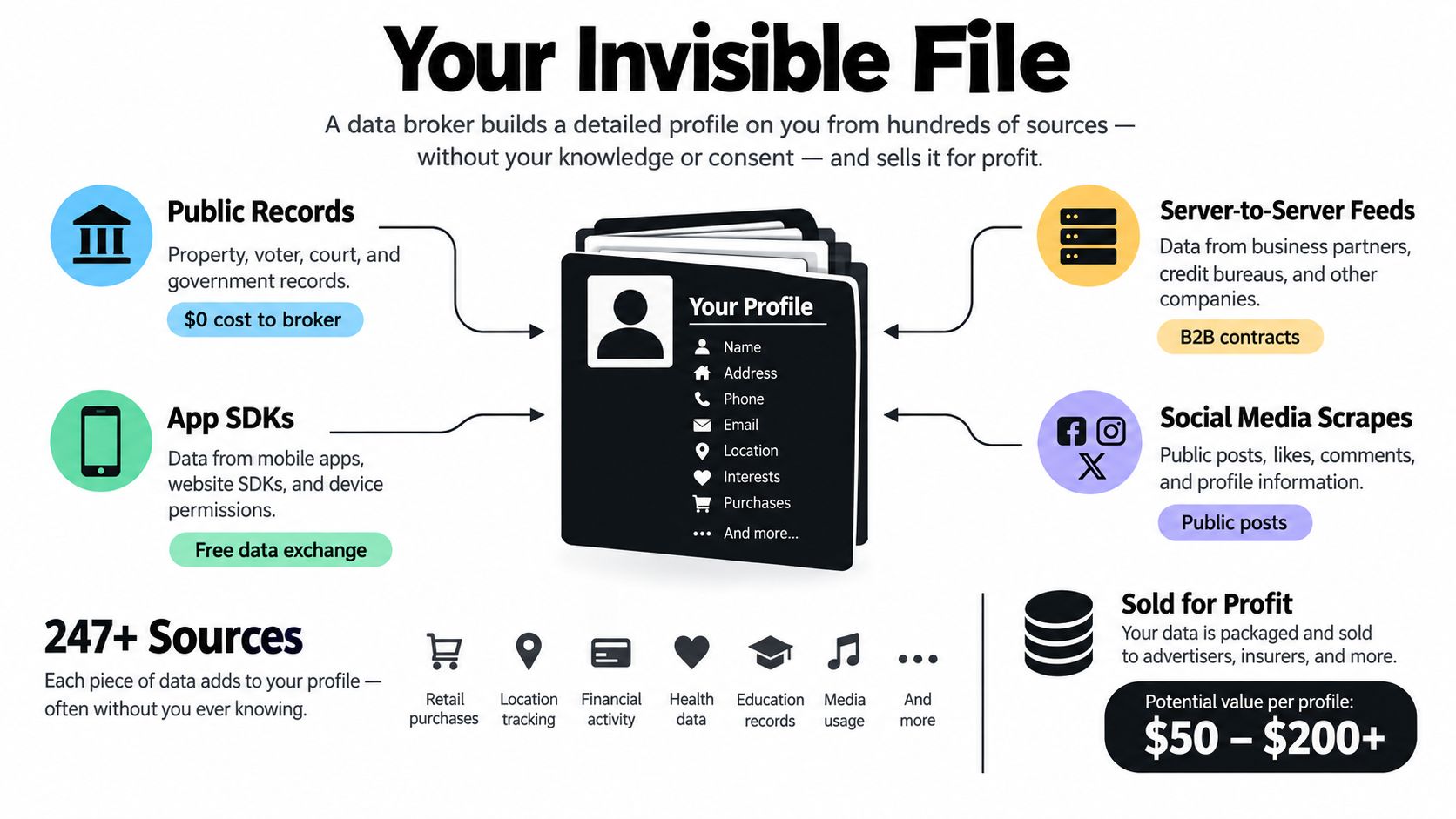
A data broker builds a record about you from small pieces you may never have handed over in one place. One company gets a purchase history. Another sees a public filing. An app shares an identifier. A marketing platform matches those bits to an email address or phone number. What shows up on a people-search page is often just the front end of that process.
The business model usually follows three steps:
- Collect: The company gets information from online and offline sources.
- Combine: It links those fragments into a consumer profile.
- Sell or license: It provides the profile, a data segment, or an insight to another business.
The profile can hold name, address, income, ethnicity, age, children’s ages, health-related interests, religion, political leanings, hobbies, and purchasing behavior. Some details come from direct records. Others are inferred. If a broker can connect enough identifiers, one ordinary-looking data point can pull in several others.
What happens after collection
The messy part is not just gathering data. It is the way records move. A broker may package a profile for one customer, append extra fields from another source, then pass a refreshed version along again. The FTC’s May 2014 examination described the industry as having a “fundamental lack of transparency,” and that phrase gets to the heart of the problem.
You usually cannot see who first supplied a wrong phone number, an outdated address, or an inferred attribute that does not belong to you. You also cannot easily see who bought a copy before you found the listing. That is why a broker page should be treated as one visible outlet in a larger supply chain.
Practical rule: Treat every broker listing as one output of a wider network, not as a standalone webpage.
This also explains why one successful opt-out often does not stick. If the same identifiers still circulate elsewhere, another broker can repopulate the record later. Removal is less like erasing a chalkboard and more like pulling one mislabeled folder from a cabinet while copies still sit in other offices.
Why the storefront analogy helps
A directory page works like a shop window. It shows enough to catch attention, but it hides the stockroom, suppliers, and delivery routes behind the glass. Data broker sites work the same way. The public page may show a name and address, while paying customers get audience segments, identity links, risk signals, or other profile data through less visible channels.
That is why understanding who owns and controls your data matters. Deleting one people-search result may reduce nuisance exposure, but triage means asking a better question first: which connected records could affect safety, scams, screening, or other uses that matter more than another round of targeted ads?
Where Your Personal Information Comes From
The collection process rarely looks like one company asking you a direct question. It looks more like many small pipes feeding a larger system.
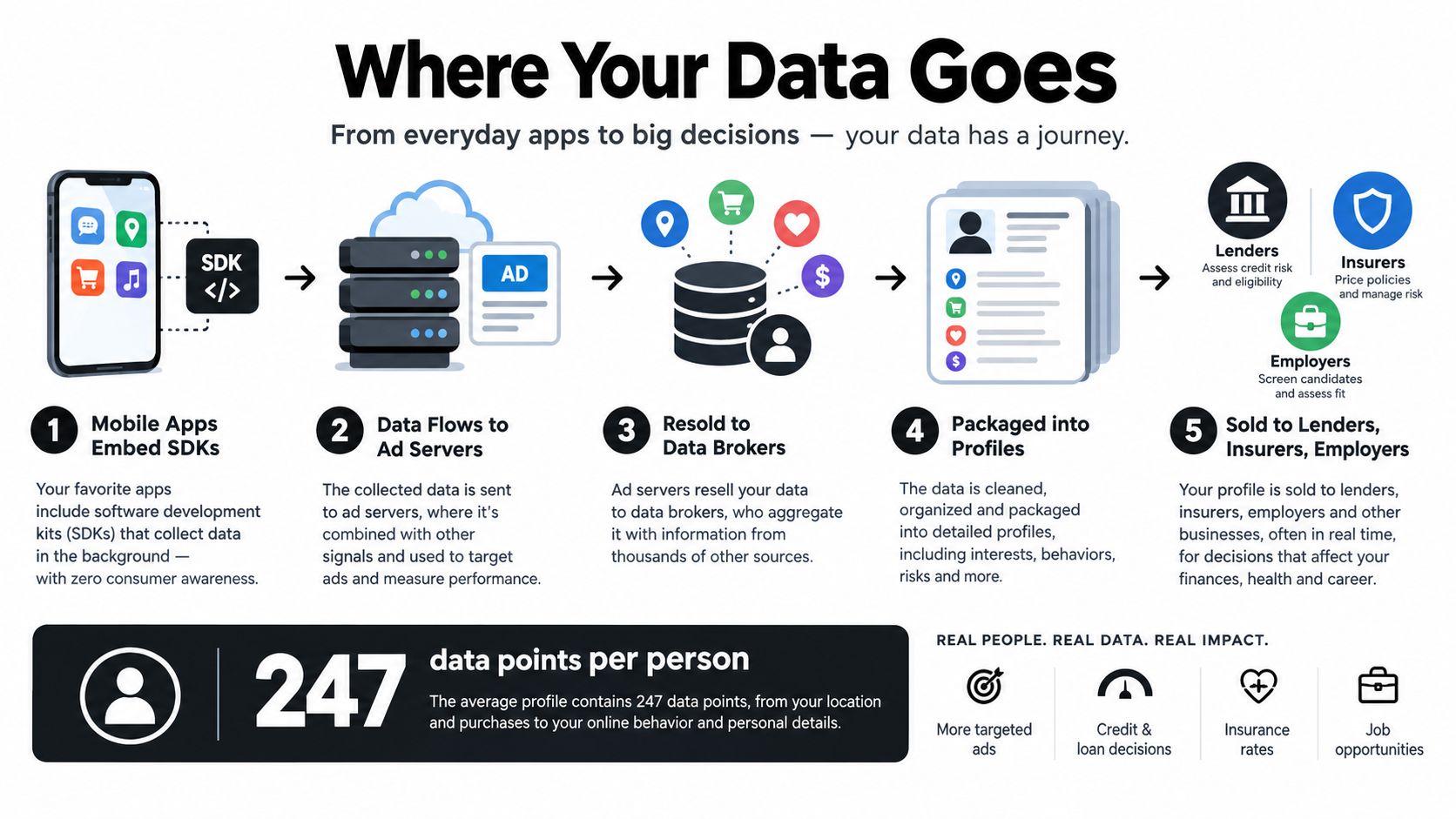
A mobile app may include a software development kit, or SDK, that sends information to an analytics or advertising service. A business may transfer records directly to another company through a server-to-server feed. Advertising systems can pass signals through real-time bidding infrastructure. Public records can be scraped, while purchased datasets fill gaps that a broker can’t obtain elsewhere.
How small signals become a profile
Consider three ordinary fragments:
- A loyalty program records a purchase connected to an account or card.
- A mobile app sends a device identifier and location-related signal to a third-party service.
- A property record connects a name with an address.
Each item may seem limited by itself. When joined with a phone number, username, employer history, or email address, the combined record can become much more identifying and predictive.
The Duke researchers’ analysis of data brokerage describes brokers obtaining data directly through services and SDKs, indirectly through public records and advertising infrastructure, then reselling, licensing, or deriving marketable insights from it. This is a cause-and-effect problem: innocuous signals can become sensitive when databases connect them.
A location signal might reveal a recurring routine. A username might connect a professional account to a gaming profile. A purchase pattern might contribute to an inferred interest. None of those conclusions needs to appear in the original source for a broker or customer to derive them.
One name search is only one key
Search systems need linkage keys. Your full name is one key, but it may match many people or fail to connect an older record. Your phone number may reveal a different listing. An old email address, former street address, username, employer, or breached identifier may lead to another profile.
That makes a public-records guide for understanding your digital footprint useful alongside broker searches. Search each identifier separately, then compare the results cautiously. The goal isn’t to collect every page you can find. It’s to understand which fragments connect to you and which ones create the greatest practical risk.
The Real Risks of Brokered Data
Not every exposure has the same consequence. An advertising segment may produce irritatingly accurate promotions. A combined profile containing a phone number, relatives, employment details, and location clues can support a convincing impersonation attempt. A record used in an eligibility decision may affect a job, loan, insurance application, or housing opportunity.
Start with the lower-stakes layer. Brokers can use profiles for targeted advertising, audience selection, and contact enrichment. These uses can feel invasive without immediately threatening your livelihood or safety.
The higher-stakes question is different: Could this data influence a decision about access, eligibility, trust, or physical security? Regulators have examined broker data in relation to consumer reporting, sensitive location information, and bulk transfers of sensitive personal or government-related information. The FTC has also acted against a broker that sold precise location information linked to sensitive places such as hospitals, religious sites, and military facilities. (Regulatory developments summarized by Loeb)
Exposure risk levels
| Type of Exposed Data | Who Uses It | Potential Impact |
|---|---|---|
| Name, interests, browsing segments | Advertisers and audience platforms | Targeted advertising, profiling, and unwanted contact |
| Phone number and email address | Marketers, scammers, and account attackers | Spam, phishing, impersonation, and recovery manipulation |
| Address, relatives, and household links | People-search services and fraudsters | Stalking concerns, credible social engineering, and unwanted contact |
| Employment history or inferred finances | Businesses making eligibility-related assessments | Possible effects on employment, credit, insurance, or housing |
| Precise location linked to sensitive places | Data buyers and malicious actors | Personal-safety risks and exposure of sensitive routines |
The FTC’s 2024 Consumer Sentinel Network Data Book recorded 845,806 imposter-scam reports. Twenty-two percent included a reported financial loss, with total reported losses of $2.95 billion. Consumers also lost $470 million in 2024 to scams that began with text messages. (FTC figures in NIST’s digital identity guidance)
Those numbers don’t prove that every broker listing causes fraud. They show why exposed contact and identity details deserve security attention. A scammer who knows your employer, a relative’s name, or an old address can make a message sound personal instead of random.
Separate collection, inference, and use
These are three different problems:
- Collection: A company holds information about you.
- Inference: A company derives a conclusion from several signals.
- Decision use: Someone applies the information to advertising, access, eligibility, or safety.
Accuracy complicates all three. Broker records can be stale, duplicated, or inferred rather than verified. An older study found that two-thirds of respondents considered their information less than 50% accurate, as summarized in the regulatory discussion cited above. Check the record before treating it as proof that an account, person, or event belongs to you.
How to Find Your Data Broker Listings
A useful search starts with several linkage keys, not just your name. Work through them separately so you can see which identifiers expose different versions of your profile.
- Search your full name with your city or region. Compare current and former locations, and watch for similar names.
- Check every email address you still remember. Include old school, work, shopping, and gaming addresses.
- Search phone numbers in more than one format. An old number may remain attached to a stale directory entry or breach-related record.
- Review usernames. A gaming handle or dating-app alias can connect accounts that don’t display your legal name.
- Add past street addresses and employer names. Historical details often link records that a current-name search misses.
Don’t assume a match is yours because a page contains your name. Confirm at least two independent details, such as a location and an email domain, before requesting removal or reporting a problem. A similar name, duplicated record, or outdated profile can send you down the wrong path.
A match is a lead, not proof of identity.
Keep a simple spreadsheet with the site, URL, identifiers shown, date checked, request status, and follow-up date. If you also need to identify hidden subscriptions, separate that task from broker removal because forgotten subscriptions can expose different account and payment relationships.
A free checker at Digital Footprint Check can scan 500+ platforms, including social media, breach databases, gaming profiles, and public records, to surface exposure in one pass. Use an automated result as a starting map, then verify individual matches manually before acting.
For a deeper manual process, see this guide on finding what data brokers have about you. Discovery comes first because you can’t prioritize an exposure you haven’t identified.
Why Opting Out Is Harder Than It Looks
The familiar advice is simple: find the opt-out page, submit your details, confirm an email, and move on. In practice, legal rights and opt-out forms don’t always produce practical control.
A 2025 empirical study of all 543 data brokers registered in California found that more than 40% didn’t respond at all to legally valid consumer access or deletion requests. Researchers also found inconsistent identity-verification procedures and other forms of friction. (Study of California-registered data brokers)
That friction creates a difficult tradeoff. A broker may ask for enough information to locate your record, and the removal process itself can require you to disclose additional information. One site may accept an email request, another may require identity verification, and a third may use a form that changes without warning.
Deletion isn’t the same as suppression
Deletion means the company removes the record or data covered by the request. Suppression means the company stops displaying or using a record under particular conditions. Neither outcome necessarily prevents another supplier from recreating the profile later.
A broker can remove today’s record and receive a fresh copy from public records, a commercial partner, or another broker. That’s why a one-time cleanup often feels successful at first and disappointing later. The supply chain can repopulate the storefront.
A realistic routine looks like this:
- Map first: Record the identifiers and categories exposed before submitting requests.
- Batch carefully: Handle related sites together, but don’t send more information than a form requires.
- Keep evidence: Save confirmation emails, screenshots, dates, and ticket numbers.
- Re-check: Search again periodically and after major life changes, such as moving or changing jobs.
- Escalate important errors: If inaccurate data could affect employment, credit, housing, insurance, or safety, document the error and ask how the information is used.
People who want a broader checklist for how to delete their online footprint should still treat removal as an audit cycle, not a single event. Verify that the page is gone, that search results no longer expose the same record, and that a later check doesn’t show a newly recreated version.
The most useful question after an opt-out isn’t “Did I click submit?” It’s “Can I confirm what changed, and do I know when I’ll check again?”
Taking Back Control of Your Digital Footprint
The practical goal isn’t perfect invisibility. It’s reducing the information that can connect your identity, accounts, routines, and contact channels, then responding quickly when new exposure appears.
A sustainable privacy routine has three parts:
- Review: Search your name, phone numbers, email addresses, usernames, and old addresses on a recurring schedule.
- Prioritize: Deal first with records exposing home location, phone numbers, relatives, sensitive places, or information that could affect eligibility decisions.
- Protect accounts: Use unique passwords, multifactor authentication, and controlled recovery methods. A public profile or username match is not proof that someone owns an account.
NIST’s identity-proofing guidance describes three identity-assurance levels and emphasizes that verification should reach a stated level of certainty rather than being treated as an all-or-nothing judgment. (NIST identity-proofing guidance) That principle applies beyond financial services. A dating app badge, an employer verification process, or a gaming-platform recovery check should explain what evidence it uses and how strongly it links that evidence to a person.
Use the same logic for your own exposure. An old username may be a useful risk signal, but it isn’t proof of account ownership. A stale address may be inaccurate, but it can still help a scammer sound credible. A broker listing may be harmless advertising data, or it may combine with a phone number and relative information to create a safety concern.
For removal support, personal information removal works best when paired with monitoring. Check after a cleanup, respond to breach notifications, review old gaming and dating accounts, and update recovery details before an attacker needs them.
Your digital footprint is an evolving record, not a one-time project. Start by running the free exposure check at www.digitalfootprintcheck.com/free-checker, review the findings by risk, and create a short list of records to verify or remove.
Digital Footprint Check helps you discover exposed information across data broker sites, breach databases, social platforms, gaming profiles, professional networks, and public records. Visit Digital Footprint Check to run a practical exposure check and turn scattered online traces into a clearer privacy action plan.