· Digital Footprint Check · Content Marketing · 13 min read
Address History Lookup: a Practical Osint Guide
Learn how to conduct an address history lookup using OSINT methods, public records, and digital sources. Protect your privacy and verify identities effectively.

The popular advice is simple: search more databases. That sounds thorough, but it often produces a longer list of contradictions, stale addresses, duplicate entries, and records belonging to someone else. A reliable address history lookup isn’t a scavenger hunt for the largest number of results. It’s a structured process for identifying a person, comparing records created for different purposes, resolving conflicts, and recording how confident you are in each conclusion.
That distinction matters in employment screening, identity verification, fraud prevention, online dating safety, and personal privacy. A wrong address can attach the wrong person to a background report, weaken a fraud check, or give a scammer false confidence about someone’s identity. Address history is useful because it reveals how records connect over time, but it should never be treated as proof only because a database displayed it.
Why Most Address History Searches Fail
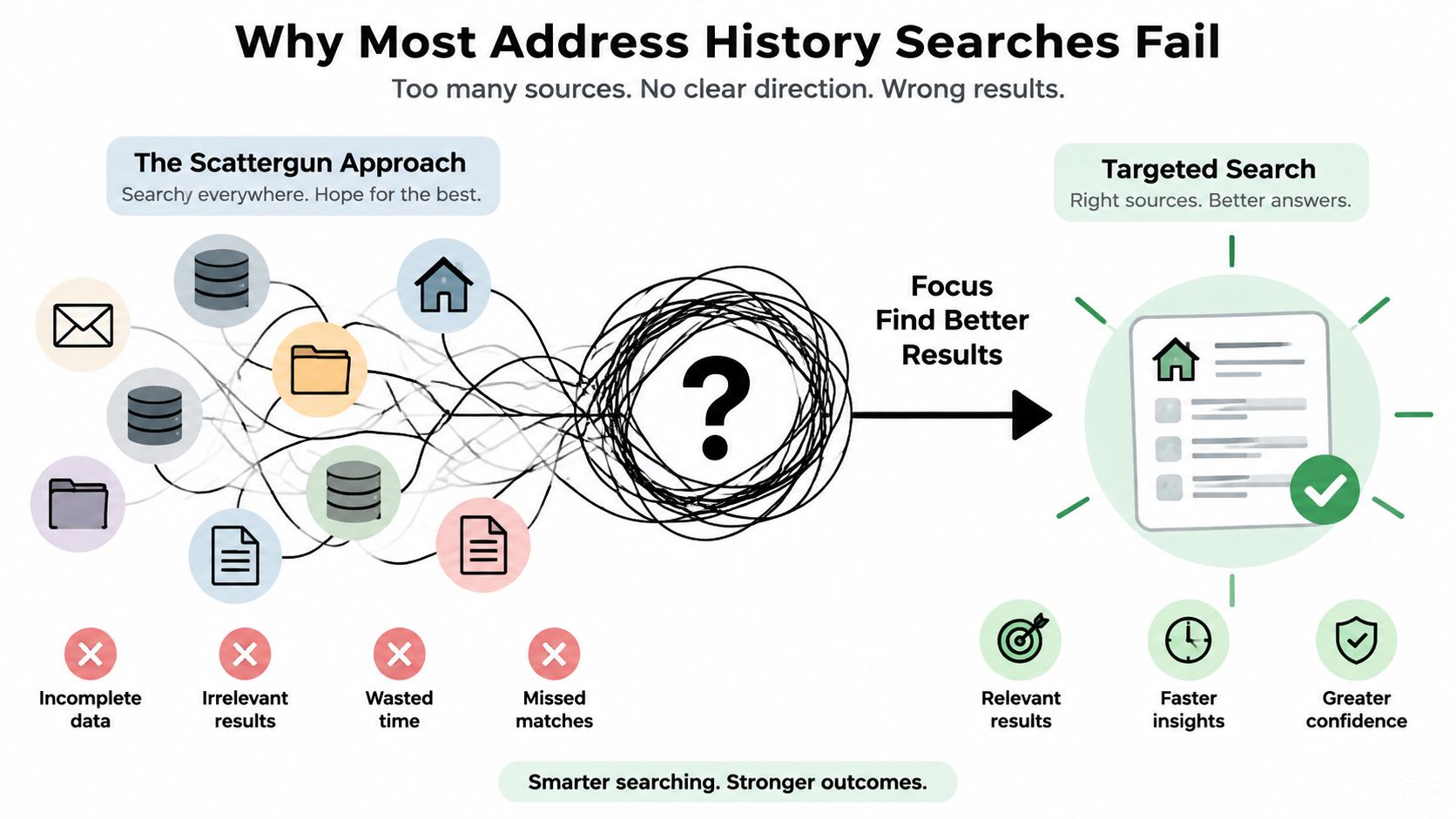
More sources don’t automatically create better accuracy. They create more raw material. A property record may reflect ownership, a court filing may reflect a mailing address, a voter record may reflect registration, and a business filing may show where someone accepted official notices. These records were created for taxation, elections, property ownership, legal proceedings, licensing, or administration, not to produce a clean residential timeline.
That’s why address history is an aggregation and reconciliation problem. One major U.S. public-records provider says it scans more than 350 million public records across all 50 states to match people to addresses, illustrating the scale of the underlying data environment rather than guaranteeing that every result is current or correctly matched (see how public-record address history is assembled). A person can appear in property records at one point, court filings at another, and tax or motor-vehicle records somewhere else.
The first result is only a lead
People-search services often combine owner names, aliases, relatives, ages, and address history, while other services show previous addresses only when public records contain them (review how address records are presented in consumer searches). Neither format tells you automatically whether an address was a home, a temporary mailing location, a relative’s property, or a record attached through a mistaken identity match.
Common failure points include:
- Name collisions: A common name can produce several unrelated people in the same region.
- Date ambiguity: A record’s filing date may not equal the date someone moved in or out.
- Formatting differences: “Apartment 4B,” “#4-B,” and a missing unit number may refer to the same location.
- Stale records: A database may continue displaying an address after the person has moved.
- Short-term appearances: A brief stay, correspondence address, or administrative filing can look like a residence.
A defensible search starts with identity anchors, such as a confirmed full name, known city, age range, phone number, email address, username, or associated relative. It then expands toward authoritative records before using open-web traces to fill gaps. The practical workflow described in this guide to public records and digital footprints is useful because it treats matching, timelines, and gaps as separate analytical tasks.
Practical rule: Treat every unverified address as a hypothesis. Promote it only after an independent record supports the same person and time period.
The aim isn’t to collect every address a system can display. It’s to determine which records belong to the subject, what each record proves, and where the timeline remains uncertain.
Key Data Sources for Residential History
A strong investigation ranks sources instead of placing them in one undifferentiated list. Government and court records usually provide stronger identity context, but they can still represent a limited event rather than continuous residence. Commercial databases offer speed and breadth, while open-web sources can explain connections that formal records leave unclear.
What each source can and cannot establish
Property deeds and assessor records can connect a person to ownership, parcel history, and recorded transactions. They don’t necessarily show that the owner lived there. Court filings may contain a service or mailing address tied to a specific proceeding, but that address may be old by the time the case appears online.
Voter registration records can provide a useful location anchor where access is lawful, although availability and update practices vary. Business registrations and professional licenses may reveal an address associated with a company or license holder, but a business address isn’t automatically residential.
Tax records, DMV records, and county clerk files are often valuable because they were created at different points in a person’s administrative life. Guidance on finding previous addresses also identifies tax returns, IRS transcripts, DMV records, and online accounts as possible sources, while warning that the records can disagree (compare common routes for finding previous addresses).
| Source Category | Reliability Tier | Access Method | Typical Data Freshness |
|---|---|---|---|
| Property deeds and assessor files | Higher for ownership, variable for residence | County assessor or clerk portals, paid databases | Often tied to transactions or assessment updates |
| Court filings | Higher for a dated legal contact | Court portals, courthouse records | Tied to filing or service events |
| Voter registration files | Useful identity and location anchor where lawful | Election offices and authorized records systems | Depends on registration updates |
| Tax and motor-vehicle records | Potentially strong, access restricted | Authorized requests or regulated providers | Linked to administrative updates |
| Business registrations and licenses | Strong for professional or business linkage | State registries and licensing portals | Usually tied to renewal or filing events |
| Public directories and utilities | Moderate, often incomplete | Directory searches and public listings | Can be stale or inconsistent |
| Archived pages and social profiles | Contextual, not authoritative | Search engines, web archives, platform searches | Depends on posting and archive dates |
| People-search databases | Broad aggregation, variable accuracy | Commercial services | Varies by vendor and source refresh |
Build a tiered search plan
Start with records that contain a date, jurisdiction, and identity detail. Then use directories, archived pages, forum posts, and social profiles to test whether the location makes sense. A profile mentioning a neighborhood can support a timeline, but it shouldn’t override a dated government record without additional corroboration.
For investigators comparing vendors, browse AutoProv data sources for a useful view of how automated data products organize source categories. For people-search options and their practical differences, the 12 best people finder websites provides another starting point.
The best source depends on the question. If you need ownership, start with property records. If you need a dated contact point, court filings may help. If you need to understand whether two records refer to the same individual, combine official identifiers with independent digital context.
Search Operators and Query Crafting Techniques
Search quality depends on query design. A broad name search usually returns celebrities, directory pages, unrelated social profiles, and duplicated aggregator content. A targeted query combines identity variants with a location, document type, or associated identifier.
Start with structured variations
Use quotation marks around an exact name when the name is distinctive:
"Jordan Lee" "Columbus" address
Add a second identity anchor when the name is common:
"Jordan Lee" "Columbus" "Harrison County"
Search alternate formats because records often reverse names or omit middle names:
"Jordan A Lee" address "Lee, Jordan" property "Jordan Lee" "J Lee" court
Use site: when you know the likely record host:
site:.gov "Jordan Lee" property site:.us "Jordan Lee" court site:county-example.gov "Jordan Lee"
The point isn’t to force a result. It’s to narrow the search to a source category that has a reason to contain residential information.
Bridge gaps with associated identifiers
When a name search stalls, search a known phone number, email address, or username. These identifiers can connect an old forum post, marketplace listing, gaming profile, or archived page to a location clue:
"555-0100" address "name@example.com" city "nightowl77" apartment "nightowl77" "Denver"
Combine terms with Boolean logic where the search engine supports it:
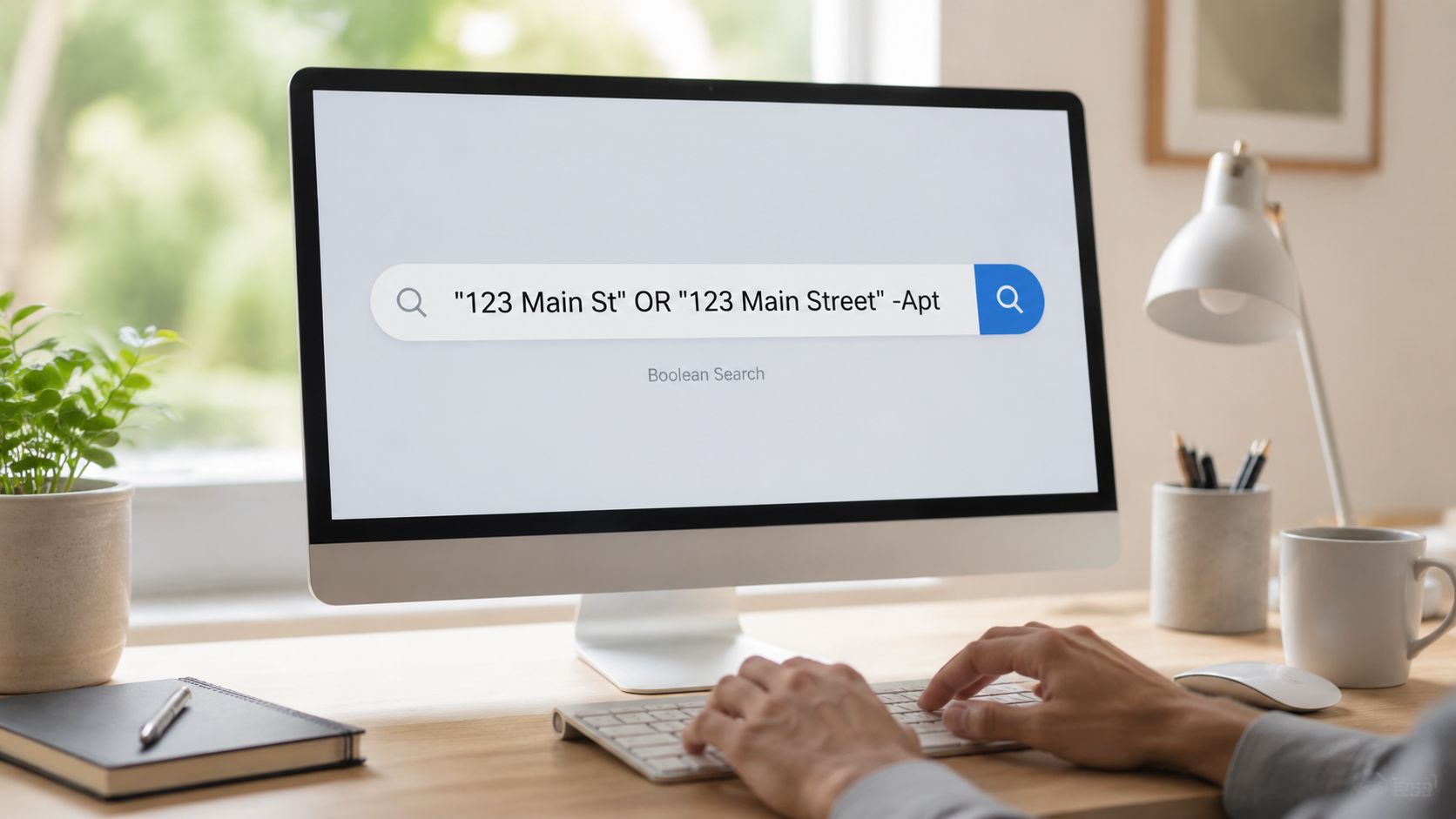
"Jordan Lee" (address OR residence OR apartment) ("Jordan Lee" OR "J A Lee") ("Phoenix" OR "Mesa") "Jordan Lee" -obituary -celebrity
Use date terms for archived material:
"Jordan Lee" "2019" "Seattle" "name@example.com" "2020" address site:example.com "username" "2018"
Search for context, not just addresses
A result mentioning an address isn’t enough. Look for surrounding details, such as an employer, relative, school, property parcel, phone number, or consistent username. Search the address separately to determine whether it appears in a property record, a business listing, a rental advertisement, or a news report.
The practical OSINT guide approach is useful here: collect the original page, note its date, preserve the query that found it, and separate direct evidence from inference. Search operators surface leads. Verification determines whether those leads belong in the final timeline.
Verifying and Reconciling Conflicting Records
Conflicting records aren’t an exception. They’re the normal condition of residential-history work. The investigator’s job is to explain the conflict, not hide it.
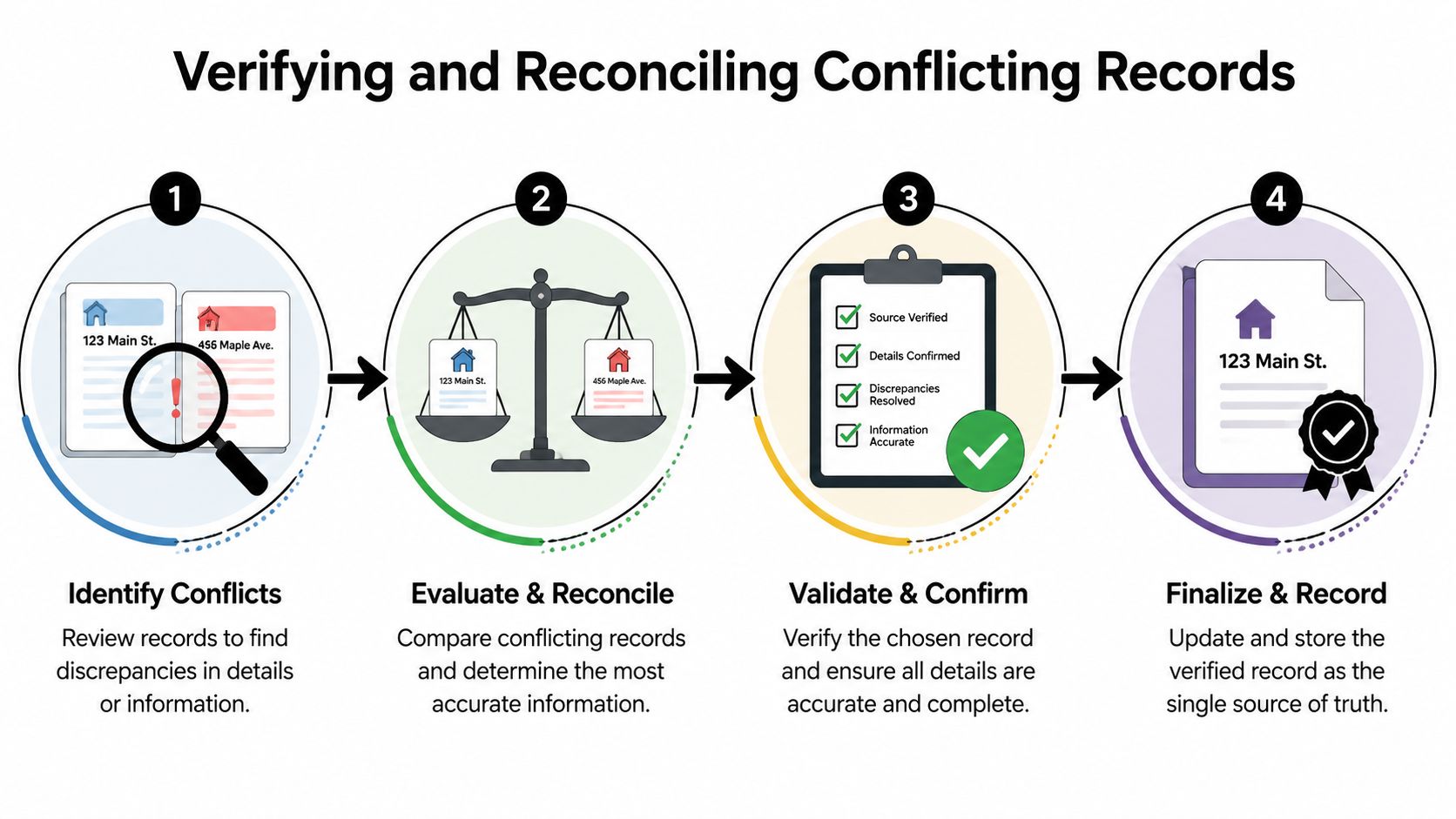
Suppose a tax record points to one city, a voter file points to another, and a social profile shows a third location. First, confirm that the records describe the same person. Compare full name, middle initial, age or birth information where lawfully available, relatives, phone numbers, email addresses, employer, parcel ownership, and known locations. A location match without identity support is weak evidence.
Use a repeatable reconciliation sequence
A practical sequence is:
- Identify the record event. Determine whether it reflects ownership, registration, filing, service, licensing, mailing, or an actual residential statement.
- Normalize the address. Standardize street abbreviations, directional markers, postal codes, apartment numbers, and common spelling variations.
- Place the event on a timeline. Record the source date, event date if different, and the earliest and latest period the record could reasonably represent.
- Compare independent sources. Look for a second source that supports the same person and location, not merely a duplicated copy of the first.
- Classify the result. Mark the address as confirmed, probable, possible, disputed, or unsupported.
Approximate matching matters because exact text joins fail on typos, abbreviations, unit formatting, and inconsistent city names. A peer-reviewed evaluation of residential-history generation found that a basic service recovered 72% detailed address matches and 68.2% overall record matches, while an enhanced service reached 87% detailed address matches and 86.6% overall record matches. City and state matches were 77% and 90%, and the evaluation identified approximate string matching as necessary for handling errors and abbreviations (review the peer-reviewed residential-history evaluation).
Score confidence without pretending to create certainty
A confidence score should summarize evidence, not disguise judgment as mathematics. Use a written rubric such as:
- High confidence: Multiple independent, authoritative records support the same person and overlapping period.
- Medium confidence: One strong record and one contextual source align, but a key identifier or date remains incomplete.
- Low confidence: The address appears in an aggregator or isolated web page without sufficient identity linkage.
- Unresolved: Records conflict materially, or the subject cannot be separated from another person with the same name.
Document why the score was assigned. A tax address and a social profile may both be real but represent different periods. A property record may establish ownership while a court filing establishes a mailing location. Combining those facts without defining their meanings creates a misleading timeline.
Evidence should be weighted by authority, identity linkage, date quality, and independence. A longer report isn’t necessarily a stronger report.
This is especially important when a mistaken address could affect a job decision, dating safety assessment, account recovery process, or fraud investigation. The OSINT background-checking guide offers useful context for keeping public-record research focused and responsible.
Documenting Provenance and Maintaining Compliance
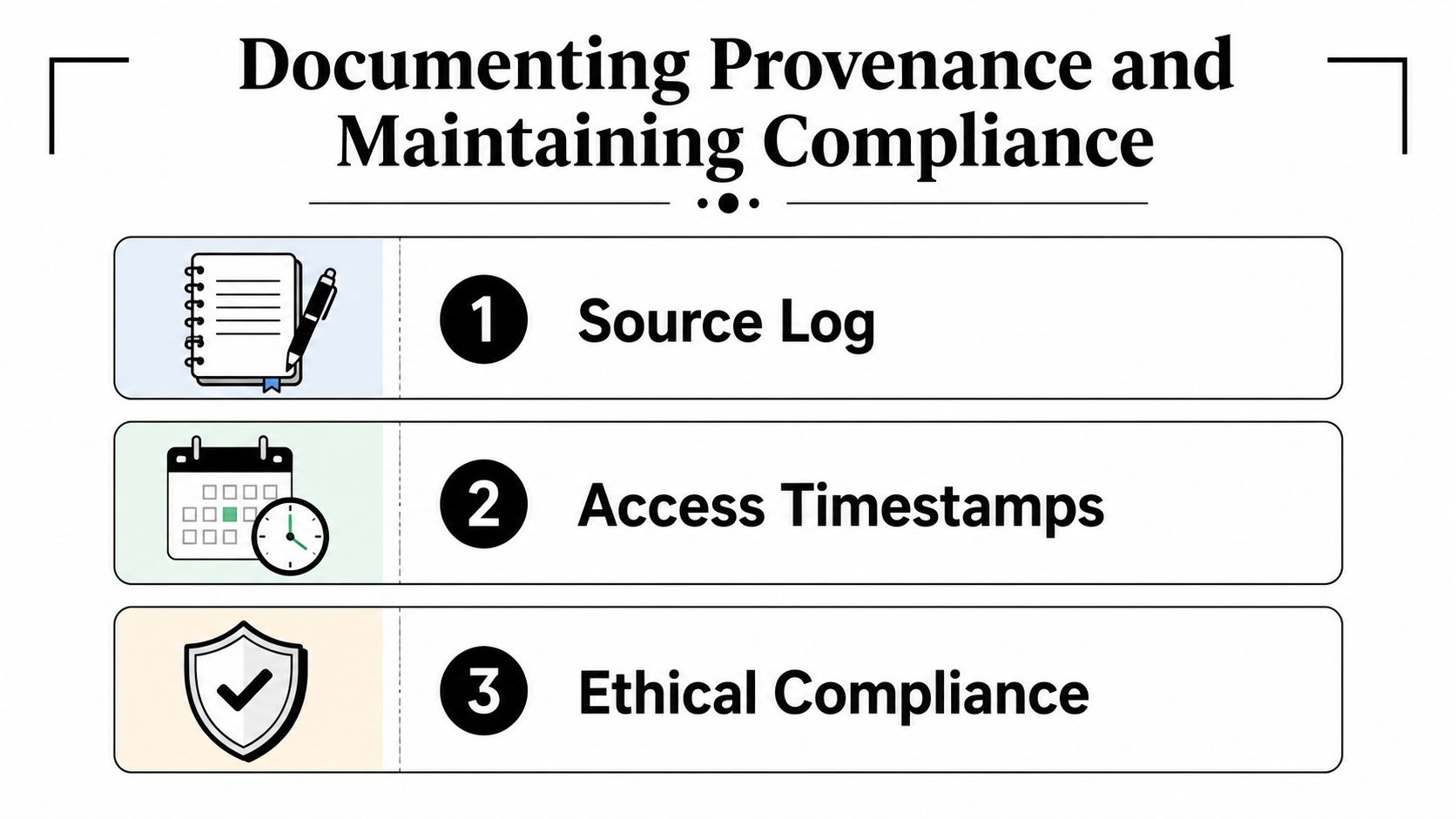
A result that can’t be traced back to its source is difficult to defend. Save the source URL, page title, record type, access timestamp, search terms, visible date, jurisdiction, and the exact address format shown. If the page is dynamic or likely to change, preserve a lawful screenshot or downloaded record according to your organization’s retention rules.
Keep an investigation log
A simple log can use these fields:
- Source identity: Agency, database, platform, or page owner.
- Acquisition details: URL, query parameters, access date, and account or permission context.
- Record meaning: Ownership, mailing address, residence claim, business address, or other event.
- Identity basis: Name, phone, email, relative, parcel, username, or combined identifiers.
- Time interpretation: Exact date, date range, or unknown.
- Confidence and gaps: Why the record was accepted, downgraded, or excluded.
- Handling decision: Retain, redact, escalate, or delete.
Separate public availability from lawful use. Information visible online may still be sensitive, inaccurate, restricted by platform rules, or unsuitable for a particular decision. Employment screening can trigger obligations under the Fair Credit Reporting Act, especially when a consumer report is obtained or used for employment purposes. Consent, permissible purpose, notice, dispute rights, and adverse-action procedures may apply, so a general web search isn’t a substitute for compliance advice.
Use the same discipline in property and business research. Guidance on how to avoid flip deal paperwork risks reinforces a broader principle, documentation protects the decision-maker when records are incomplete or challenged.
A privacy-focused subject can also request access or deletion from organizations where applicable. The explanation of what a DSAR is can help individuals understand how to ask a company what personal data it holds and how that data is being used.
Don’t publish private residential details merely because you found them. Restrict access, minimize copied data, redact unnecessary identifiers, and escalate threats or suspected stalking to qualified professionals and appropriate authorities.
Complete Workflows and Troubleshooting Common Issues
A manual investigation works best when the scope is narrow. Start with the subject’s confirmed name and one independent identifier, then search county property or court portals, state registries, authorized voter-record sources, and carefully selected open-web pages. Record each candidate address immediately, normalize the formatting, and stop expanding when new results only duplicate an existing source.
For example, a common-name search produces two people in the same city. One record links to a parcel, a relative, and a matching professional license. The other has only an aggregator entry. The first becomes the working identity, while the second remains excluded until an independent identifier connects it. If records span multiple states, repeat the same source sequence in each jurisdiction rather than relying on a national summary.
The manual process breaks when a subject uses a common name, moves between counties, rents rather than owns, or keeps little public activity. Search phone numbers, emails, usernames, old employers, relatives, and associated organizations, but label each bridge as supporting evidence rather than proof. If a record shows a new location without a clear move date, preserve the uncertainty instead of forcing a neat sequence.
A platform-assisted workflow follows the same logic but reduces repetitive collection. An OSINT SaaS tool can aggregate public-record and digital-footprint signals, apply matching logic, and present candidate addresses alongside related identifiers. Digital Footprint Check offers an address and phone history feature that can surface previous addresses, phone numbers, and contact information from public records and people-search databases. Treat its output as an investigative starting point, then review the underlying evidence and confidence before making a consequential decision.
Escalate to a licensed investigator, attorney, compliance specialist, or safety professional when the purpose involves employment action, litigation, stalking, domestic abuse, or a serious fraud concern. A complete address history report can still contain gaps. The professional standard isn’t claiming perfect coverage. It’s showing what was searched, what matched, what conflicted, and what remains unknown.
Use an address history lookup to audit your own exposure, investigate identity signals responsibly, and identify records that may need correction or removal. Digital Footprint Check can help you review public records, social profiles, breach exposure, gaming accounts, and other online identity traces, so visit the platform and run a free check before a stale address or exposed identifier creates a larger privacy or security problem.