· Digital Footprint Check · Content Marketing · 16 min read
Identity Theft Protection Comparison Guide
Read our identity theft protection comparison to evaluate monitoring scope, breach alerts, and recovery services for complete digital privacy in 2026.
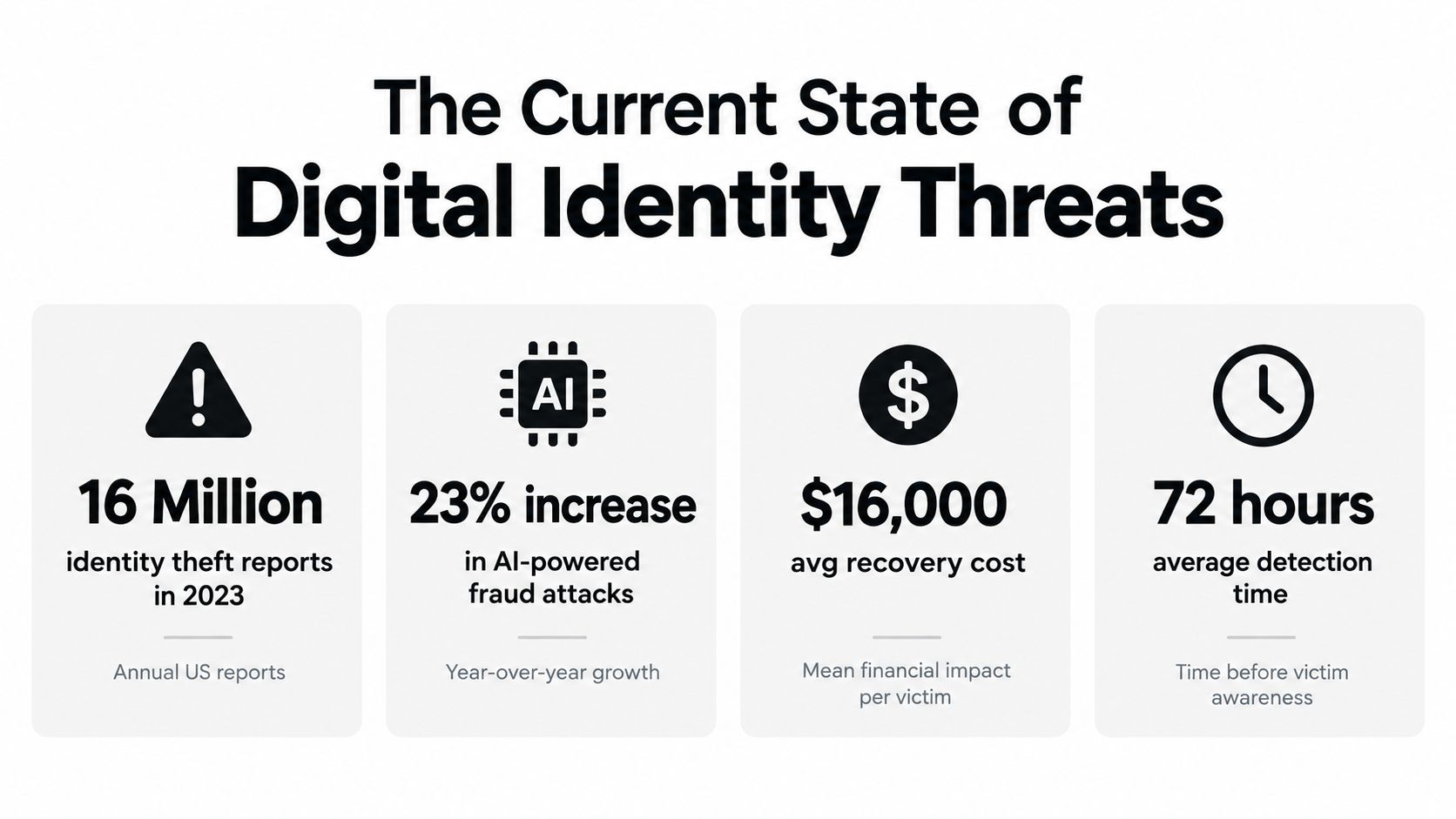
Identity theft occurs every 4.9 seconds in the United States, and more than 6.4 million identity theft and fraud reports were sent to the Federal Trade Commission over a year, according to Security.org’s identity theft statistics. That changes the question consumers should ask. An identity theft protection comparison shouldn’t focus only on which service displays a credit score. It should examine which parts of your digital identity a provider can monitor, how quickly it can surface exposure, and whether anyone will help when recovery becomes administrative, slow, and exhausting.
Credit monitoring still matters, but it covers only one part of the attack surface. Criminals can exploit reused credentials, exposed session cookies, public profiles, gaming accounts, employment information, and social-engineering clues without opening a new credit account. The most useful protection plan therefore combines financial monitoring, digital-footprint visibility, credential intelligence, preventative controls, and practical recovery support.
The Current State of Digital Identity Threats
The Identity Theft Resource Center recorded 3,322 U.S. data compromises in 2025, up from 3,152 in 2024, generating 278,827,933 victim notices, according to its 2025 Annual Data Breach Report. Those figures broaden the meaning of identity theft. A person can be affected without applying for a fraudulent loan. Their email address, password, phone number, or account recovery details may already be circulating among attackers.
Consumer exposure varies by location. California recorded 139,665 FTC identity theft reports in 2024, followed by Texas with 116,484 and Florida with 115,840, based on the identity theft statistics analysis. The same Security.org analysis reported 903 reports per 100,000 population in Miami-Fort Lauderdale, compared with 690 in Atlanta, 573 in Houston, and 570 in Las Vegas. Location does not determine an individual’s risk, but the variation shows that threat exposure is not distributed evenly.
Why frequency changes the buying decision
A protection service is useful only when its monitoring reflects how information is misused. Breach monitoring can identify exposed credentials, while credit alerts can reveal a new application. Bank-account monitoring may flag activity against an existing relationship. Public-source and OSINT checks can identify profiles, aliases, phone numbers, and employment information that support convincing scams. A guide to how identity theft occurs helps map these attack paths beyond the credit file.
The Bureau of Justice Statistics reported that in 2021, about 23.9 million U.S. residents aged 16 or older, or 9% of that population, experienced identity theft during the prior 12 months. About 59% of victims suffered financial losses totaling $16.4 billion, while 76% of the most recent incidents involved misuse of only one existing account, according to the FTC’s summary of the BJS findings. Existing email, bank, gaming, and payment accounts therefore deserve attention alongside new-account fraud.
Privacy controls matter when a service requests sensitive identifiers. Providers should explain retention, access, deletion, and permitted uses before collection begins. LineVerifier’s data handling for verification provides a reference for assessing those practices before sharing information with an identity-related service. A plan that monitors more data is not automatically safer if its collection and response processes remain unclear.
Core Features to Evaluate in Protection Services
A feature list does not show whether a service reduces meaningful risk. Evaluate what gets monitored, how often checks run, what triggers an alert, and what the customer can do next. Comparison guides separate plans by monitoring breadth and reporting cadence. Higher tiers commonly combine three-bureau credit monitoring with dark-web scanning, bank-account monitoring, social-media checks, and investment or retirement-account alerts, as outlined in Forbes Advisor’s identity theft protection comparison.
The feature matrix
| Feature Category | Basic Tier | Standard Tier | Premium Tier |
|---|---|---|---|
| Credit-file coverage | One bureau or limited alerts | Multiple bureaus with regular updates | Three-bureau monitoring with more frequent reporting |
| Breach and credential exposure | Email or basic breach notifications | Broader credential checks | Dark-web and compromised-credential intelligence |
| Financial accounts | Limited or absent | Selected bank and card alerts | Bank, card, investment, and retirement monitoring |
| Digital footprint | Minimal public-data visibility | Some personal-information scans | Broader OSINT, social, username, and public-record checks |
| Alerts | Event-based notifications | Credit and identity alerts | Prioritized alerts across several exposure types |
| Recovery support | Self-service guidance | Access to specialists | Dedicated assistance and broader case coordination |
| Best fit | Users seeking basic visibility | Consumers with moderate exposure | People with complex or high-value digital identities |
These categories help compare services, but providers may define them differently. “Premium” usually signals broader coverage, not better detection. A plan can advertise dark-web monitoring without specifying which sources it checks, how often it scans, or whether it separates an old password from an active credential or session token.
Cadence and coverage are operational differences
Weekly, monthly, and daily reporting tiers exist across the market. The Forbes Advisor comparison cited above shows why reporting cadence deserves separate scrutiny. A monthly credit view may suit general awareness, while people facing active financial exposure may need more frequent signals. Even daily reporting remains retrospective: it can reveal a change sooner, but it does not stop an attacker from using a stolen login or hijacked session.
Coverage also needs an OSINT test. A service should indicate whether it searches exposed email addresses, usernames, phone numbers, public profiles, and related records. A clear explanation of what identity theft protection covers provides useful context for separating identity monitoring from broader digital-footprint surveillance.
A notification is an observation, not a preventive control. It may identify an event, yet it cannot automatically close every account, reverse every transfer, revoke every active session, or block a phishing message. Review the provider’s response workflow before treating a large feature list as protection.
Ask these questions before paying:
- Coverage: Does the service monitor one credit bureau, multiple bureaus, or all three?
- Scope: Does it include existing accounts, credentials, public records, social profiles, investment accounts, and exposed usernames?
- Timing: Are checks continuous, daily, weekly, monthly, or event-triggered?
- Alert quality: Does each alert explain the event, its likely significance, and the response path?
- Privacy: What information must you submit, and how does the provider handle retention, access, and deletion?
- Recovery: Do specialists perform remediation work, or do they only provide instructions?
- Session risk: Can the service identify exposed credentials or active-session indicators, or does it only report password breaches?
The appropriate plan closes a specific exposure gap. Paying for unused features creates subscription accumulation, not layered defense.
Traditional Credit Monitoring vs OSINT Tracking
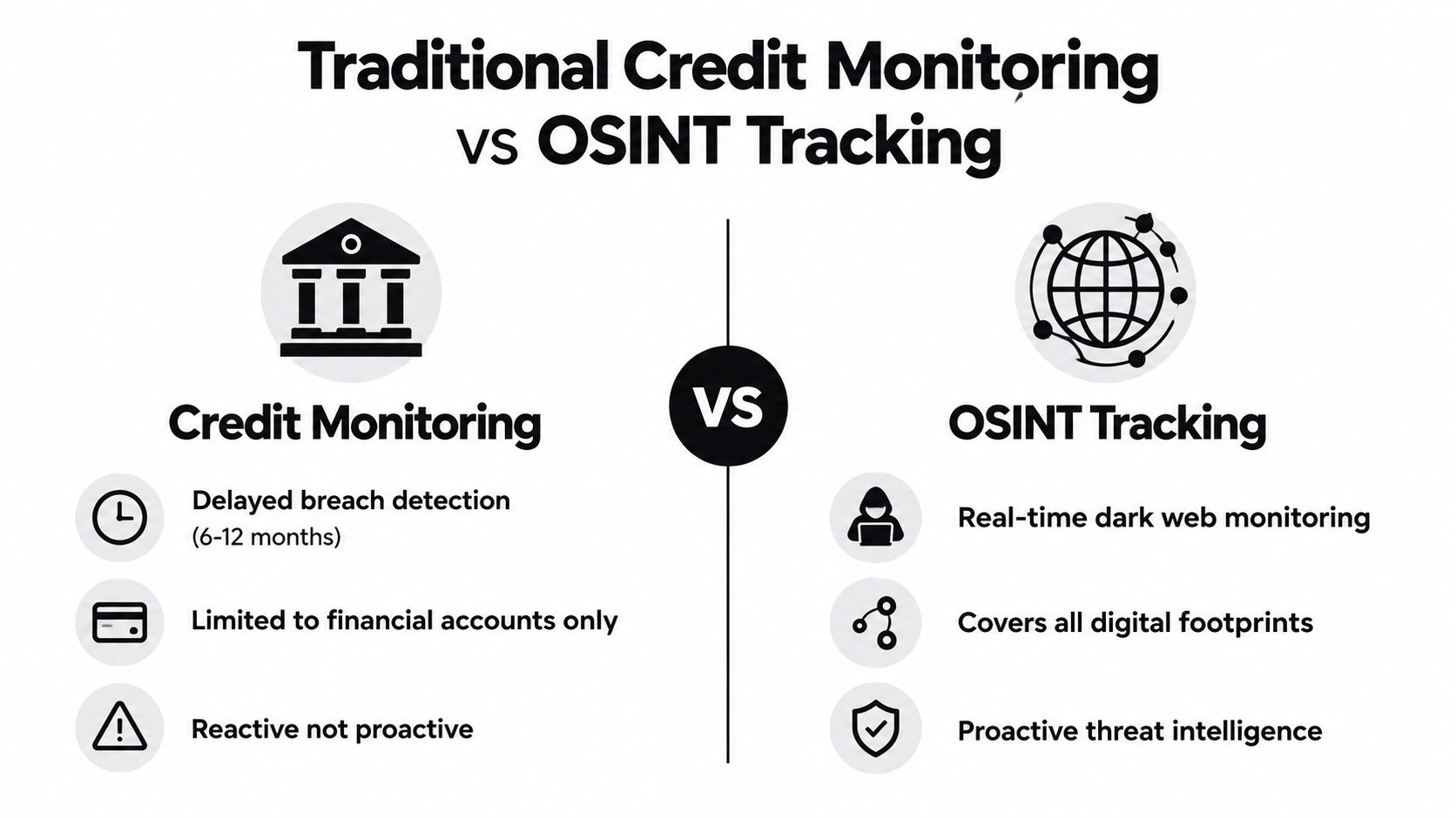
Credit monitoring answers a narrow question: did something change in a credit file? OSINT tracking examines what information about a person is visible, connected, exposed, or useful to an attacker. The two functions overlap, but they detect different stages of identity abuse.
That difference matters because many incidents begin with existing accounts, stolen credentials, or hijacked sessions rather than newly issued credit. The Identity Theft Resource Center reported an 11% increase in existing account takeovers and a rise in fraudulent employment reports in Q1 2025. Recorded Future found 50% more credentials in the second half of 2025 than in the first half, including 276 million credentials containing active session cookies, according to the ITRC Trends in Identity report.
What credit monitoring misses
A credit bureau may show a new inquiry or account. It generally will not show that an attacker found a gaming username, linked it to a public email address, identified an employer, and used those details in a convincing support impersonation. It may also miss credential reuse against a streaming account, marketplace, social profile, or gaming platform.
Credential stuffing demonstrates the scale of this exposure. Akamai recorded more than 100 billion credential-stuffing attacks from July 2018 to June 2020, with nearly 10 billion directed at the gaming sector, according to data summarized by the Insurance Information Institute. The attacks use previously exposed username and password combinations. A criminal does not need to open a credit account first.
OSINT provides context, not magic
OSINT tools collect and correlate legally accessible information from social networks, public pages, usernames, breach records, professional profiles, and gaming communities. Their value lies in connections. An exposed email may present limited risk alone, while that address linked to a public phone number, reused handle, and employer profile creates a more actionable identity map.
That capability also requires restraint. Responsible services should minimize unnecessary collection, explain why information appears, and let users understand the data being surfaced. Organizations assessing credential exposure can review dark web monitoring for SMEs as part of their security process.
For consumers, dark-web credential monitoring complements credit alerts. Credit monitoring is strongest for new financial activity. OSINT and credential monitoring address exposure discovery, account correlation, social engineering risk, and early password-reset decisions. Credential session theft makes this distinction especially important: an active session can give an attacker access without creating a new credit event or triggering a conventional bureau alert. A sound identity theft protection comparison should therefore assess both financial-file monitoring and digital-footprint visibility, rather than treating a credit dashboard as complete identity defense.
Evaluating Recovery Services and Insurance Coverage
Insurance is straightforward to compare because providers display a headline coverage figure. Recovery quality depends on less visible operations: staff expertise, escalation paths, documentation support, and whether one specialist stays responsible for the case.
A reimbursement policy may cover eligible expenses, yet it does not restore an identity by itself. Misuse can require communication with banks, credit bureaus, tax authorities, employers, government agencies, and account providers. The affected person may also need to preserve evidence, dispute inaccurate records, replace compromised credentials, and watch for repeated abuse. A high coverage limit does not complete those tasks.
The operational value of a recovery team
Assess the service through practical questions:
- Case ownership: Does one specialist coordinate the incident, or must you repeat the explanation to each representative?
- Remediation scope: Can the team assist with creditors, government agencies, employers, and online account providers?
- Documentation: Does it help organize notices, dispute records, reference numbers, and an incident timeline?
- Escalation: Can a stalled case reach a specialist beyond the standard support script?
- Coverage terms: Which expenses qualify, and which exclusions, limits, or deductibles apply?
Recovery also depends on process discipline. After filing an identity theft report with the FTC, the victim generally needs to document the incident, use the resulting report and recovery plan when contacting affected companies, and retain each response. A provider that helps assemble this record can reduce administrative errors and make escalation easier.
Federal remediation may remain slow after discovery. The reporting cycle referenced earlier recorded a substantial number of IRS tax-related identity theft cases still open as of July 25, 2026, according to the ITRC Annual Data Breach Report referenced earlier. The broader lesson is operational: case coordination may matter more than an impressive insurance figure, particularly when the underlying incident involves compromised credentials or account sessions rather than a new credit inquiry.
For risk planning, ABS Insurance Brokers’ cyber advice helps distinguish insurance considerations from the everyday controls that reduce exposure. Read the policy wording carefully. Reimbursement usually depends on defined losses, documentation, eligibility rules, and exclusions.
After an incident, secure existing accounts, preserve evidence, report the misuse, contact affected institutions, and record every reference number. A practical guide to what to do after identity theft can help organize those actions into a controlled case file.
Practical rule: Treat insurance as a financial backstop. Evaluate recovery support as an operational service, and judge each on its own terms.
Situational Recommendations for Different User Profiles
Protection priorities depend on the attacker’s likely entry point. A retiree with investment accounts, a job seeker with a public professional profile, and a gamer with valuable digital items require different monitoring and response controls. Credit alerts address only part of that exposure. OSINT review and session monitoring often provide earlier warning when the risk begins with public identifiers or an already authenticated account.
Job seekers and public-facing professionals
Job seekers should prioritize reputation visibility, professional-account protection, breach alerts, and public-data review. A credit-only plan will not show that an old social profile contains an inflammatory post, that a forgotten username connects to a personal account, or that a public phone number exposes a wider identity trail.
Employers and recruiters may review publicly available information before an interview. Search results can be incomplete, outdated, or misleading, so candidates should audit their own public footprint rather than assume a clean result. Separate professional and personal identifiers where appropriate, remove unnecessary exposure, and secure accounts connected to a résumé or professional profile.
The practical test is whether a service detects identity links that credit files cannot see. Username reuse, exposed contact details, and breached professional credentials can create reputational or account risks before they produce a financial alert.
Gamers and account-heavy users
A stolen gaming account with stored payment methods, tradeable inventory, and established social connections can be resold within hours on gray markets. That makes session revocation and account recovery more relevant than a credit alert when the compromise affects an active login. The credential-stuffing volume covered earlier provides context, but the profile-specific question is whether a service can help identify and contain an account session after access is obtained.
The priority order is different here:
- Unique credentials: Use a separate password for every gaming platform, email account, and payment service.
- Session protection: Sign out of unfamiliar devices, revoke active sessions, and treat unexpected login prompts as possible compromise.
- Recovery security: Protect the email address and phone number that control account recovery.
- Profile audit: Search usernames across platforms to identify linked accounts and social-engineering clues.
- Payment review: Check stored payment methods and transaction alerts after suspicious access.
A free or low-cost plan may suit someone with limited financial exposure. A broader service is more appropriate for users with public profiles, multiple aliases, valuable inventories, or a history of credential reuse. Compare whether the provider monitors public exposure and compromised accounts, rather than counting credit features that do not address session theft.
A short visual guide can help users recognize how account exposure connects across platforms:
Online daters and privacy-conscious households
Online dating creates a difficult balance. Users may want to verify that a person is real, but collecting or exposing sensitive information can create another privacy risk. Ethical checks can compare a claimed name, public profile history, image reuse, location consistency, and communication patterns. These signals cannot prove someone’s character or guarantee safety.
For families, combine account security with age-appropriate privacy rules. Parents may need to identify exposed usernames, public school references, location clues, and reused profile photos. Adults managing several household members should choose plans that support separate identities and clear notification controls.
People seeking an initial, no-cost baseline can review free identity theft protection options. Digital Footprint Check is an OSINT-based option that searches public-facing sources, breach databases, gaming profiles, professional networks, and other online platforms for exposed information. Assess it alongside credit monitoring, password management, and provider privacy terms, not as a replacement for them.
Building a Layered Defense Strategy Beyond Subscriptions
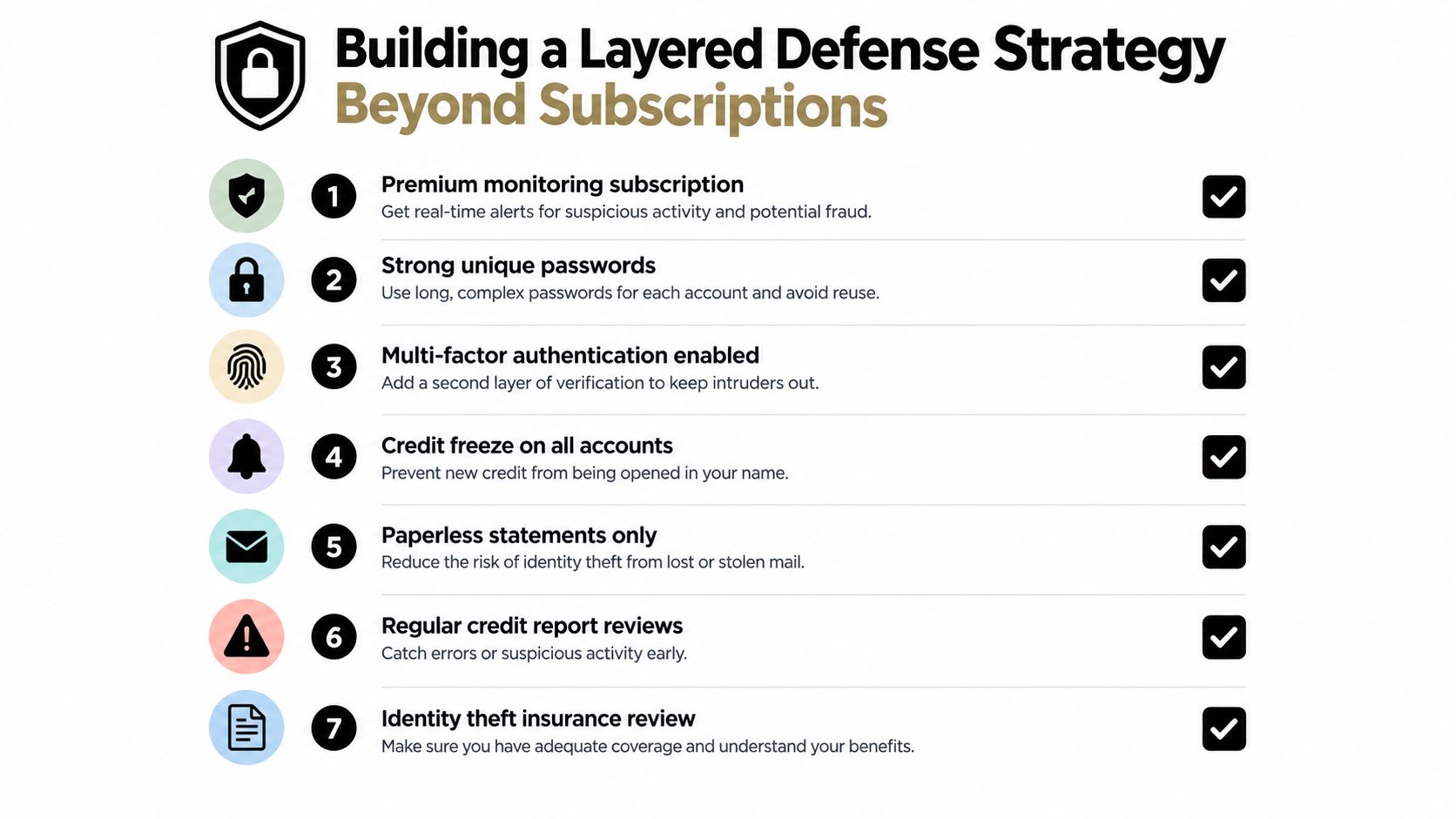
A subscription cannot freeze credit, select unique passwords, or investigate an unfamiliar login. Effective protection divides these tasks among controls. Paid monitoring adds visibility and escalation, while user-managed safeguards reduce the opportunities attackers can exploit across credit files, public profiles, credentials, and active sessions.
Build the baseline first
Start with controls that limit unauthorized access and reduce exposure:
- Freeze credit files: A freeze can make it harder for criminals to use your information to obtain new credit. Store the steps required to lift it temporarily.
- Enable fraud alerts: Ask lenders to apply additional identity-verification steps before opening new credit.
- Create unique passwords: A password manager limits reuse across email, financial, social, and gaming accounts.
- Turn on MFA: Use app-based or hardware-based authentication where available. A hijacked valid session can still bypass MFA, so session security requires separate attention.
- Reduce public exposure: Remove unnecessary phone numbers, addresses, birth details, and recovery clues from public profiles.
- Review statements: Check bank, card, payment, and investment activity for unfamiliar events.
- Document incidents: Keep notices, timestamps, support contacts, and case numbers in one protected location.
The control only works if it remains enabled and maintained. The ITRC’s 2025 Consumer Impact Report found that credit-freeze adoption fell from 38.1% in 2024, while 80% of respondents had received a breach notice in the previous 12 months, according to the Consumer Impact Report.
Assign monitoring jobs deliberately
Use credit monitoring for inquiries, new accounts, and file changes. Apply breach and credential monitoring to exposed authentication data, then use OSINT review for public profiles, aliases, social-engineering clues, and professional or gaming exposure. This division matters because a credit file cannot show every compromised credential or hijacked session.
Choose an alert cadence you can maintain. Unread notifications provide little protection. Set channels carefully, suppress duplicate messages, and define the response for each category. A compromised password should prompt a reset and session revocation. A suspicious credit inquiry should prompt a file review and creditor contact.
A protection service should reduce decision time, not merely increase notification volume.
Review recovery and insurance terms after a new job, relocation, marriage, business launch, or increase in investment activity. These changes can alter your exposure faster than a subscription’s default settings. A layered plan remains useful only when its controls, monitoring scope, and response instructions reflect the identities and sessions you use.
Final Verdict and Next Steps for Your Digital Privacy
A useful identity theft protection comparison doesn’t declare one universal winner. It identifies the threat a service can see, the threat it can’t see, and the work it performs after an alert arrives.
Traditional credit monitoring remains valuable for new-account activity and credit-file changes. It isn’t sufficient for existing account takeover, credential reuse, session-cookie exposure, public-profile correlation, or social engineering. Modern buyers should therefore compare three-bureau coverage, monitoring cadence, breach intelligence, bank and investment alerts, OSINT visibility, privacy practices, and recovery execution.
The first purchase shouldn’t always be a subscription. Establish a baseline of your exposed emails, usernames, public profiles, gaming accounts, professional information, and breach-related credentials. Then place that visibility beside your credit controls. If your public footprint is expansive but your chosen plan watches only a credit file, the comparison has exposed a coverage gap. If you have strong preventative controls but no recovery assistance, you may still face unnecessary administrative risk after an incident.
Choose tools according to your identity architecture, not marketing volume. A person with one financial profile may need a different mix from a gamer with multiple aliases, a public-facing professional, or a household managing several identities.
Digital Footprint Check helps individuals and organizations discover exposed information across social platforms, breach databases, gaming profiles, professional networks, and public records. Start with the Digital Footprint Check to understand your current exposure, then use that evidence to choose monitoring and recovery controls that address your actual risk.