
· Digital Footprint Check · Content Marketing · 14 min read
What Is a Dsar? a Complete Guide to Data Subject Access
Learn what is a DSAR, your rights under data privacy laws, and how to submit a request with practical tips and templates.

A DSAR is a formal request that lets you ask an organization what personal data it holds about you, why it's using it, who it's shared with, and how long it keeps it. Under GDPR and many GDPR-based regimes, the usual response window is one month.
You've probably felt that tiny jolt of surprise before. Maybe you logged into an old account and saw a profile you forgot existed, or an ad seemed to know something about you that never felt public. That's the moment most people start asking the real question, not whether a company has data, but how much it has, where it got it, and who else might have seen it.
A Data Subject Access Request, or DSAR, is the legal tool that answers that question. It's not a loophole, a hack, or a customer service favor. It's a recognized privacy right in major data protection regimes, and for many people it's the first serious step toward understanding their online identity, protecting their job prospects, checking dating or gaming accounts, and spotting misuse before it turns into a bigger problem.
The Moment You Realize a Company Knows Too Much
A recruiter once looked at a candidate's profile and found old details the candidate had never meant to keep active. A gamer has opened a forgotten account and discovered that their childhood email was still tied to a live profile. A parent has seen how much data a child's app activity can leave behind. None of those situations starts with a legal form. They start with a feeling, that a company knows more than it should.
That's where a DSAR comes in. It gives you a formal way to ask, what do you have on me? and to force a real answer instead of guessing. In plain English, it's the official privacy request that lets you see the personal data an organization holds, how it uses it, and where it sends it, which is why it matters for identity exposure, reputation management, and scam prevention. If you're trying to understand what may already be visible about you online, this overview can help you map the starting point before you ask for anything.
Practical rule: if a company can profile you, market to you, or make decisions about you, it may also hold more personal data than you expect.
The key thing to understand is that a DSAR isn't a technical workaround. You're not trying to break into a system. You're using a right that privacy law already gives you, so the company has to search, review, and respond properly. That makes the process less about curiosity and more about control.
For anyone worried about job screening, dating-app history, or exposed personal details across old accounts, that shift matters. A DSAR moves the conversation from “I wonder what they know” to “show me what you hold.” That's a very different position, and it's often the first moment people feel they can manage their own digital footprint.
What a DSAR Actually Is and What You Can Request
Think of a DSAR like asking a landlord for the full file they keep on you, not just the lease. You're not asking for a favor, you're asking to see the records that shape how they deal with you. In data privacy terms, a Data Subject Access Request is the formal request an individual makes to an organization for access to the personal data it processes about them, including what it holds, why it processes it, who it shares it with, how long it keeps it, and where it got it from. A plain-language glossary can help if you keep running into terms like “PII” and want the difference spelled out clearly.
The rights bundled into the request
A good DSAR response should be more than a pile of raw files. Under GDPR-based guidance, you can ask for confirmation that your data is being processed, the purposes of processing, the categories of data, recipients, retention periods, sources, and whether automated decision-making is involved. That's why the answer often includes explanation, not just export.
The form also matters. If you submit the request electronically, organizations generally must respond electronically unless you ask for something else. Reputable guidance also says the response should be structured and clear, and when appropriate, machine-readable. That's why some companies deliver a PDF for general review and a CSV or JSON export for technical data.
Why this is a legal right, not a courtesy
A DSAR is part of the accountability structure around privacy law. Companies don't get to ignore it just because it's inconvenient. They're expected to search relevant systems, redact third-party information, and provide a usable response within the deadline set by the applicable regime. In practice, that means email, HR software, archives, cloud storage, and similar systems can all be in scope when they contain your personal data.
A lot of confusion comes from people expecting a DSAR to produce a neat “everything file.” It's better understood as a legal disclosure process with boundaries. That distinction saves time, prevents unrealistic expectations, and helps you ask for the right thing the first time.
Jurisdictional Differences Between GDPR, UK GDPR and CCPA
The rules aren't identical everywhere, and that matters the second you decide where to send your request. Under GDPR-based regimes, the standard response window is one month, while the CCPA uses a different structure with acknowledgment and fulfillment timelines that are longer. The legal right is similar in spirit, but the mechanics shift depending on where you live and where the company operates.
| Framework | Response Window | Fee Allowed | Scope of Access |
|---|---|---|---|
| GDPR | Generally one month, with a possible extension for complex requests | Usually no fee for a standard request | Broad access to personal data and related processing details |
| UK GDPR | Generally one month, with a possible extension for complex or high-volume requests | Usually no fee for a standard request | Broad access to personal data and related processing details |
| CCPA | A different consumer-request timeline applies, and companies also have to confirm receipt within a shorter period | Generally no fee for a standard consumer request | More focused “right to know” style access, with narrower scope than GDPR |
The practical difference is that GDPR and UK GDPR are designed around a broad access right, while CCPA is more tightly framed around consumer knowledge and control. California also lets people use authorized agents in some situations, which can matter if you're handling a family issue, an account dispute, or a privacy matter on someone else's behalf.
If your request sits outside the EU, UK, or California, that doesn't automatically mean you're out of options. Many global companies have built DSAR-style processes because they serve users across regions and don't want separate workflows for every country. That's especially common when the company handles finance, HR, retail, or dating and gaming data that crosses borders.
For extra background on terms that often appear in privacy policies, this privacy policy resource from Ares uses language that's useful when you're trying to decode security and disclosure wording. If you're also worried about what happens when data gets exposed through a breach, this overview helps connect access rights to notification duties.
Step-by-Step Guide to Submitting Your First DSAR
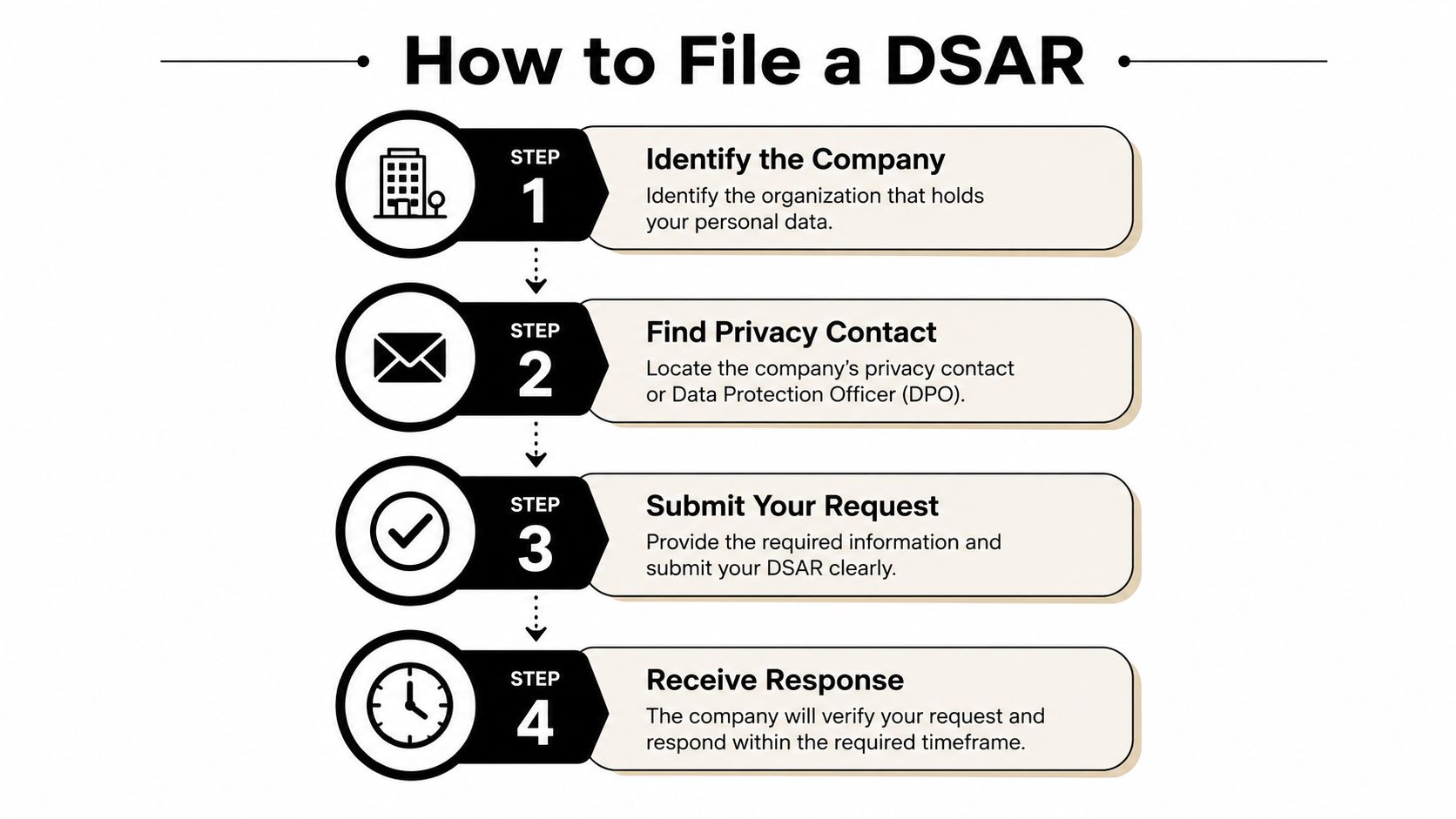
The best DSARs are specific enough that the company can't pretend it doesn't know what you mean. Start by identifying the organization most likely to hold your data, then look for its privacy contact, DPO address, or a web form for privacy requests. If you've got multiple accounts with the same brand, mention the email addresses, usernames, or customer numbers that tie you to those records.
A simple request you can adapt
A short request works well:
Hello, I'm making a Data Subject Access Request for the personal data your organization holds about me. Please confirm whether you process my data, provide a copy of it, and include the purposes of processing, categories of data, recipients, retention periods, and sources. If you need identity verification, please tell me what information is necessary. Please respond electronically unless I ask otherwise.
That wording keeps the request broad enough to capture the full legal right without drifting into a fishing expedition. It also gives the company enough context to search the right systems without asking for unnecessary personal details. If the request came through email, the response should generally come back through that same channel unless you ask for a different format.
What companies are expected to do
Operationally, the response process should follow four steps. They verify the requester, search relevant systems, remove other people's information where necessary, and deliver the result in a usable format, often PDF, CSV, or JSON. That workflow is why a DSAR can take coordination across legal, HR, IT, customer support, and compliance teams.
A few practical guardrails
- Give enough detail to identify yourself: include the account name, the email tied to the account, and any reference number you already have.
- Don't overshare identity documents: if a company asks for more proof than needed, push back and ask why the extra detail is necessary.
- Save every message: keep a dated record of the request, replies, and attachments.
- Escalate if they ignore you: if the deadline passes without a proper answer, follow the company's complaint route and then contact the relevant regulator if needed.
If you're trying to confirm which public traces already exist before you send the request, this guide to checking your digital footprint can help you target the right company first. For a privacy issue that also overlaps with social platforms, this piece on Instagram comment privacy risks in 2026 is useful context when you're auditing how much a social profile can reveal.
Common Exemptions Refusals and Pitfalls
A DSAR is powerful, but it doesn't force a company to hand over everything it has. Data about other people can be withheld, and organizations may also refuse requests they consider manifestly unfounded or manifestly excessive. That nuance matters because a lot of people still assume the request is a universal data dump.
What can be withheld
If an email thread mentions another customer, that third party's details may be redacted. If a company is handling a legal dispute, privileged communications can be excluded. If the request is written in a way that clearly abuses the process, the organization may push back.
The most common mistake is asking for “all data” and expecting the company to guess what you meant. A better request names the account, the channels used, and the time period if you know it. That narrows the search without shrinking your rights.
Some refusals are legitimate, but the company still has to explain them clearly.
If part of the request is denied, don't stop at the first no. Ask which parts were withheld, why they were withheld, and what complaint path exists. If the company still won't respond properly, the next step is usually the data protection regulator in the relevant jurisdiction.
The practical lesson is simple. A DSAR helps you see your own data, not everyone else's. Once you understand that boundary, the response makes more sense, and the company has less room to hide behind vague language.
Real-World Examples of What DSARs Uncover
A journalist who asks for app records might discover location history tied to a service they barely remember installing. A job seeker may find internal recruiter notes attached to a profile, which can explain why a hiring process stalled. A gamer can uncover old accounts linked to childhood email addresses and then clean up the overlap before someone else uses it to reset passwords.
The same logic applies in dating and romance-scam cases. If someone seems too familiar with your habits, your workplace, or your online routines, a DSAR can help you see whether a service has shared or stored data in ways that made the pattern possible. It won't prove intent by itself, but it can reveal the records behind suspicious behavior.
Examples people often miss
- Parents checking children's data: app sign-ups, location traces, and old profile fragments can still exist long after a device changes hands.
- Dating-app users reviewing profile logic: access requests can help people understand how interactions were stored, scored, or used in moderation.
- People managing their reputation: archived messages, support notes, and profile history can matter when a future employer or client is reviewing a name online.
- Anyone worried about identity theft: access disclosures can show how far personal details spread after a breach or a data-sharing event.
The value of the request isn't just in the documents themselves. It's in the surprises. A DSAR can reveal that a company still links an old phone number, keeps a canceled account in backup systems, or has shared your data with parties you never expected. Those are the kinds of details that turn privacy from a vague concern into something concrete enough to act on.
Using Digital Footprint Check Before and After Filing
A DSAR works better when you know what you're looking for before you hit send. A free OSINT scan of public profiles, breach databases, and data-broker listings can show you which companies are most likely holding your data, so your request is focused instead of blind. That matters for people who've changed jobs, switched phones, used old emails for gaming, or signed up for dating apps under multiple usernames.
The other half comes after the response arrives. You can compare what the company disclosed with what still appears in public traces, archived pages, or broker listings, then decide whether more cleanup is needed. That's the real value of pairing legal access with discovery tools, you don't just learn what exists, you can check whether it's still circulating.
Digital-footprint discovery is most useful when you want to understand hidden exposure before filing and verify cleanup afterward. The reason this works is that the scan looks across 500+ platforms, including social media, breach databases, gaming profiles, professional networks, and public records, using ethical OSINT methods rather than guesswork.
If you're comparing your own traces with platform behavior, this discussion of Instagram comment privacy risks in 2026 is a useful example of why public activity can be more revealing than it looks. That kind of context helps you decide whether the issue is a single account, a wider identity trail, or a pattern across several services.
A good workflow is to scan first, request second, verify third. That way, you're not guessing which company has your data, and you're not relying on memory alone when you check the response. If you're serious about understanding your online identity, use the free profile check as the starting point, then send DSARs where the data trail points.
Your Privacy Action Plan After the DSAR
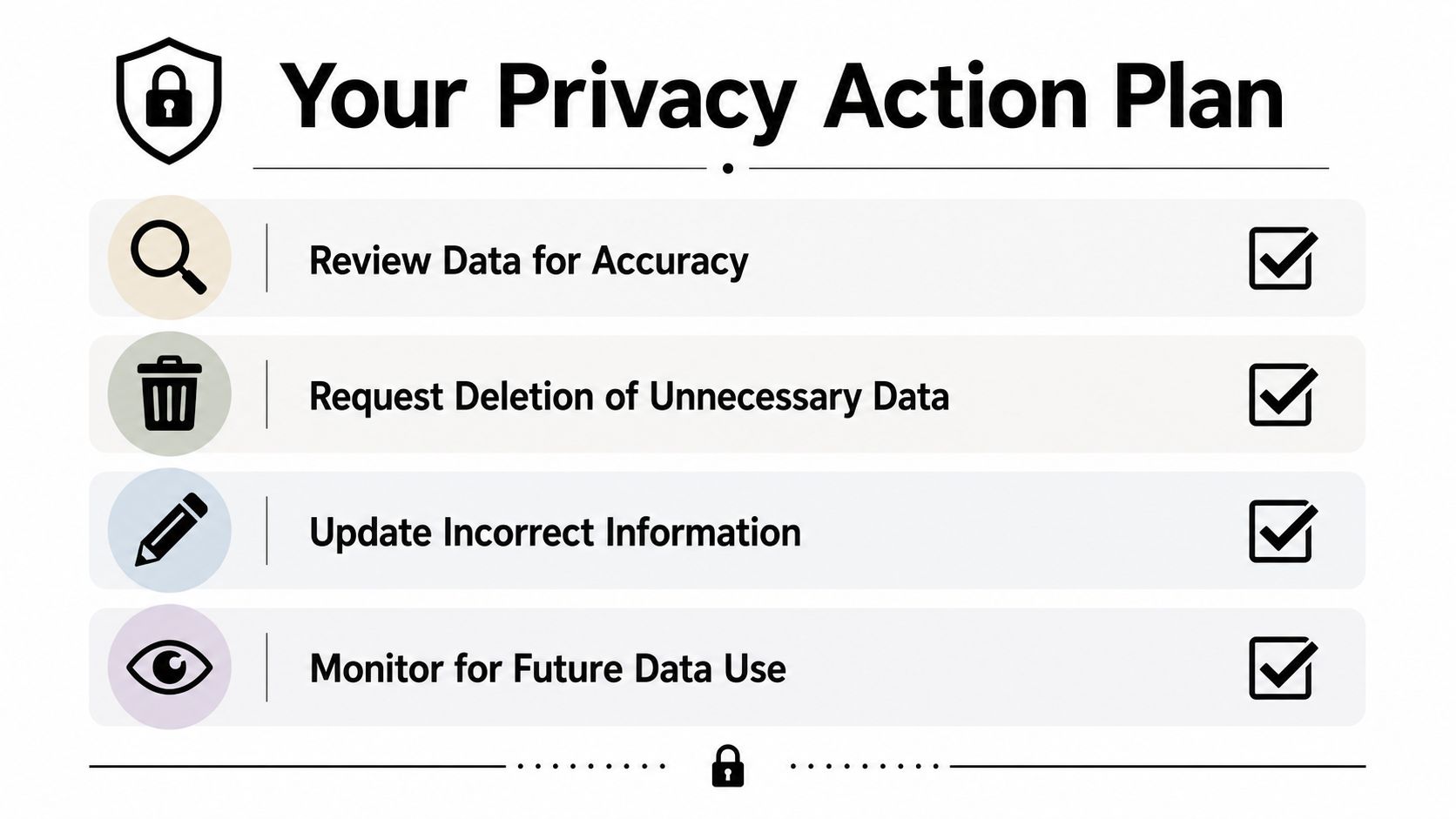
A DSAR response is a snapshot, not a permanent fix. Once it arrives, review every item for accuracy, look for old accounts or unexpected sharing, and ask for deletion or correction where the law allows it. If the company keeps marketing to you, move into opt-out requests and data-broker cleanup instead of assuming the first response solved everything.
That's also the moment to harden your accounts. Update passwords, turn on stronger sign-in protections, and review recovery emails and phone numbers so a forgotten profile can't be reused against you. If you're managing family privacy, a child's app history or a shared device can create new exposure even after the DSAR is over.
The habit that keeps privacy intact is repetition. Recheck after major life events, after a breach, after a job change, or when you open new online accounts. Privacy works best when it's treated like routine hygiene, not a one-time crisis response. If you want to remove lingering records from broker ecosystems, this removal resource is a practical next step.
Keep a clean record of what you asked for, what the company gave you, and what still needs work. Then use ongoing footprint monitoring to make sure new exposure doesn't creep back in. A DSAR gives you the facts, but regular checking is what keeps those facts from turning into a lasting problem.
A CTA for Digital Footprint Check.