· Digital Footprint Check · Content Marketing · 14 min read
Area Code 877 Scams: How to Spot and Stop Them in 2026
Uncover how area code 877 scams work. Learn to identify spoofed calls, verify legitimate numbers, and protect your identity from toll-free fraud.
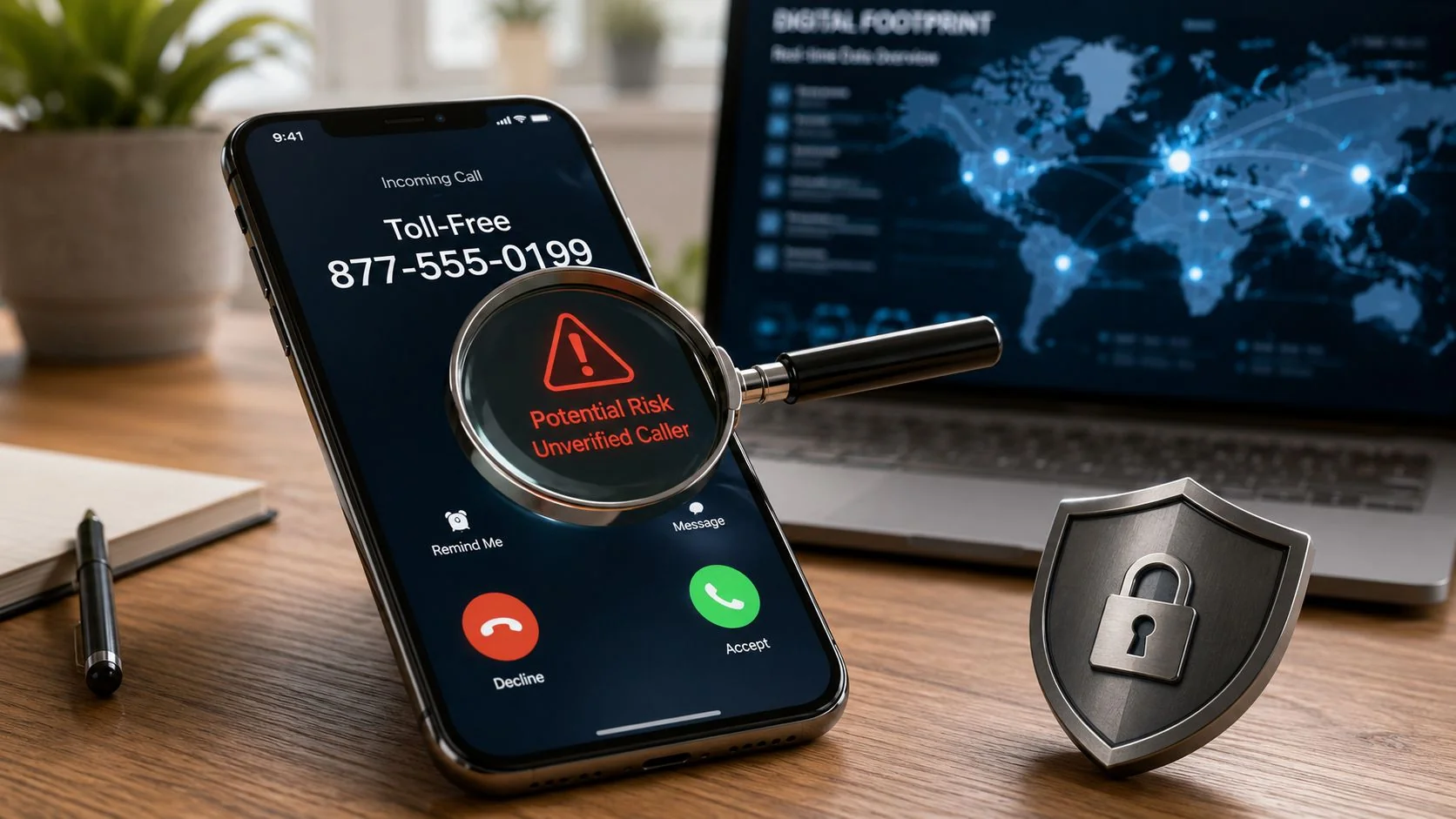
Your phone lights up with an unfamiliar 877 number. You pause. It could be your bank, an airline, a doctor’s office, or a scammer borrowing the look of a trusted business.
That uncertainty is exactly why area code 877 scams work.
A real 877 number is a toll-free number, and many legitimate organizations use them every day. But scammers know that toll-free numbers are associated with customer service, billing departments, and official hotlines. They use that trust as cover. The result is a type of fraud that feels more believable than the classic “unknown mobile number” scam.
What makes these calls tricky isn’t just the number itself. It’s the combination of a familiar-looking caller ID, a convincing script, and pressure to act before you can think clearly. If you understand those moving parts, you’re much harder to fool.
That Unexpected 877 Call What You Need to Know
An unexpected 877 call often lands in the middle of real life. You’re working, driving, helping your kids, or clearing notifications. The caller says they’re from fraud prevention, customer support, a government office, or billing. They sound organized. The number looks official. That’s when people start second-guessing themselves.
This isn’t a niche problem. In the United States, around 60 million Americans received or reported a phone scam in 2021, according to reporting that cited FCC data in FOX 9’s coverage of scam-heavy phone prefixes. That scale matters because it tells you something simple. Scam calls aren’t rare mistakes. They’re part of a mass, repeatable system.
Why 877 numbers feel trustworthy
An 877 number doesn’t point to a city or state the way a local number does. It’s a toll-free prefix, which makes it common for national companies and support lines. That familiarity lowers your guard.
Scammers exploit that gap between “this looks normal” and “this may be fake.” They don’t need you to believe every detail. They just need you to stay on the line long enough to answer a few questions, click a link, share a code, or call back.
Practical rule: Treat an unexpected 877 call like an uninvited person at your front door. A polite voice doesn’t prove identity.
What confused callers usually ask first
Many individuals want quick answers to three questions:
| Question | Short answer | Why it matters |
|---|---|---|
| Is 877 a scam area code? | No. It’s a legitimate toll-free prefix. | The danger comes from impersonation, not the prefix alone. |
| Can caller ID prove who’s calling? | No. | Scammers can fake what appears on your screen. |
| Should I call back? | Not unless you verify the number independently. | Some scams are built around getting you to return the call. |
If you’re already trying to identify a suspicious number, this guide on how to find out unknown numbers can help you start with basic checks before you engage.
The key mindset is simple. An 877 number can be real, but the call can still be fake. Once that clicks, the rest of the scam becomes easier to spot.
How Scammers Weaponize Toll-Free Numbers
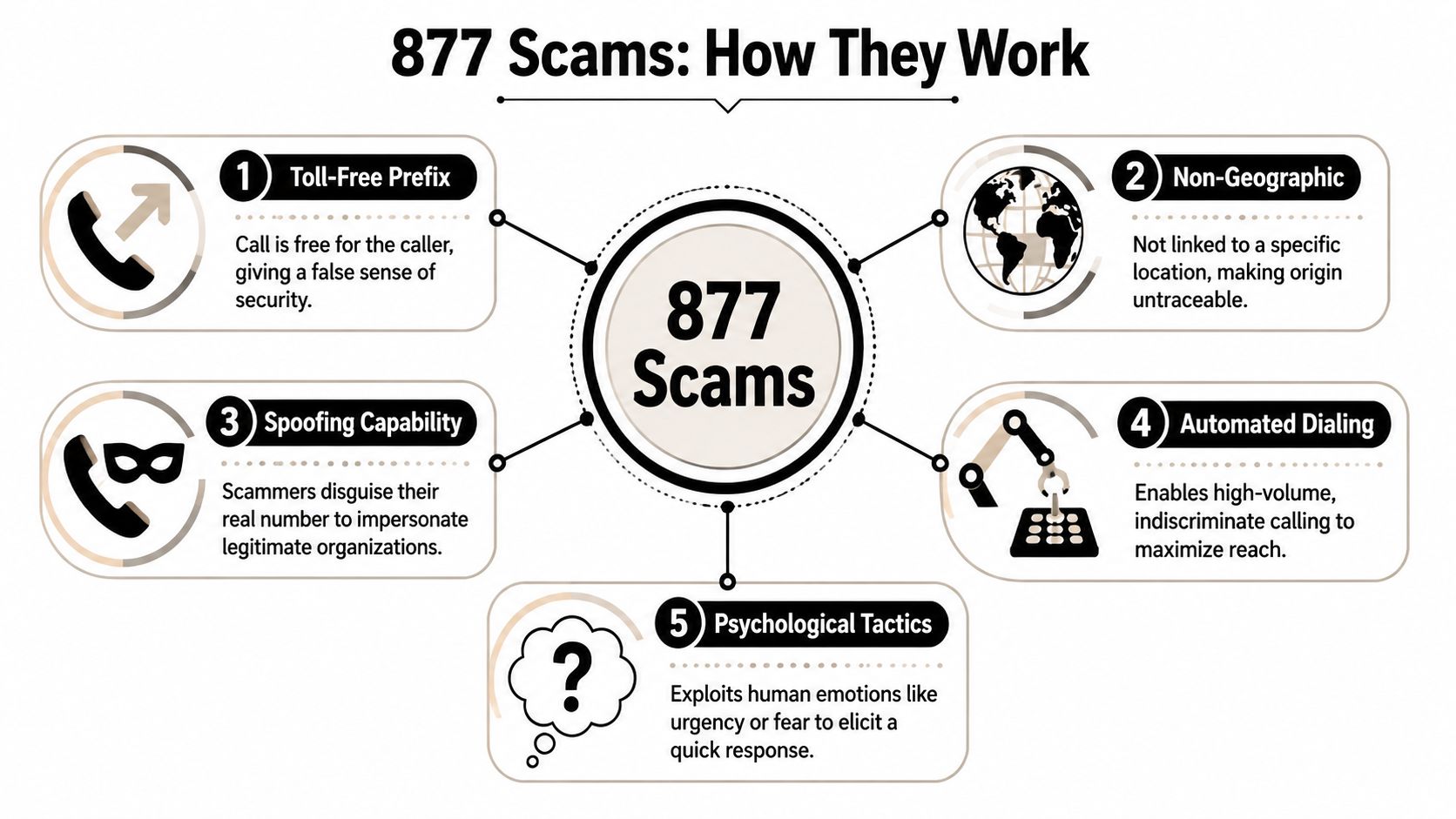
Area code 877 is one of the North American toll-free prefixes. It isn’t tied to a particular town, region, or state. That’s useful for legitimate organizations that serve customers nationally. It’s also useful for scammers because the number doesn’t carry obvious geographic clues.
If a local number appears on your screen, you might wonder why a “bank headquarters” is calling from a random town. With 877, that friction disappears. The number already looks like it belongs to a call center or help desk.
The fake return address problem
The technical trick behind many area code 877 scams is caller ID spoofing. It operates like receiving a dangerous package with a trusted company’s return address printed on the label. The label looks familiar. The sender isn’t.
The FTC has warned that criminals can fake any number on caller ID. In one documented case, fraudsters spoofed the FTC Consumer Response Center number 877-382-4357 to ask people for sensitive information such as Social Security numbers and bank details, as reported by WFTV’s write-up of the FTC impersonation warning.
That single example changes how you should read caller ID. It’s not proof. It’s only a claim.
Why toll-free numbers are still useful
Toll-free lines exist for good reasons. If you want a quick primer on the benefits of toll-free calls, Call Loop has a helpful overview of why businesses use them for support, sales, and customer access. That legitimate use is exactly what scammers hide behind.
A fake 877 call works because it borrows the visual style of a real business interaction. The scammer doesn’t need advanced hacking to start the conversation. They just need your phone to display a familiar type of number.
The two layers of the scam
When people say “877 scam,” they often focus only on the number. The better way to understand it is as two separate layers working together:
The number layer
The 877 prefix suggests a business, hotline, or official support channel.The identity layer
The caller claims to be from a bank, agency, online store, or fraud team.The pressure layer
The scammer pushes urgency so you won’t verify anything.
That’s why your phone number itself is so valuable to attackers. Once they have it, they can combine calls, texts, and account recovery tricks in ways that feel personal. This overview of what hackers can do with your phone number explains why a single number can become the starting point for broader fraud.
Caller ID tells you what the caller wants you to see, not necessarily who’s actually calling.
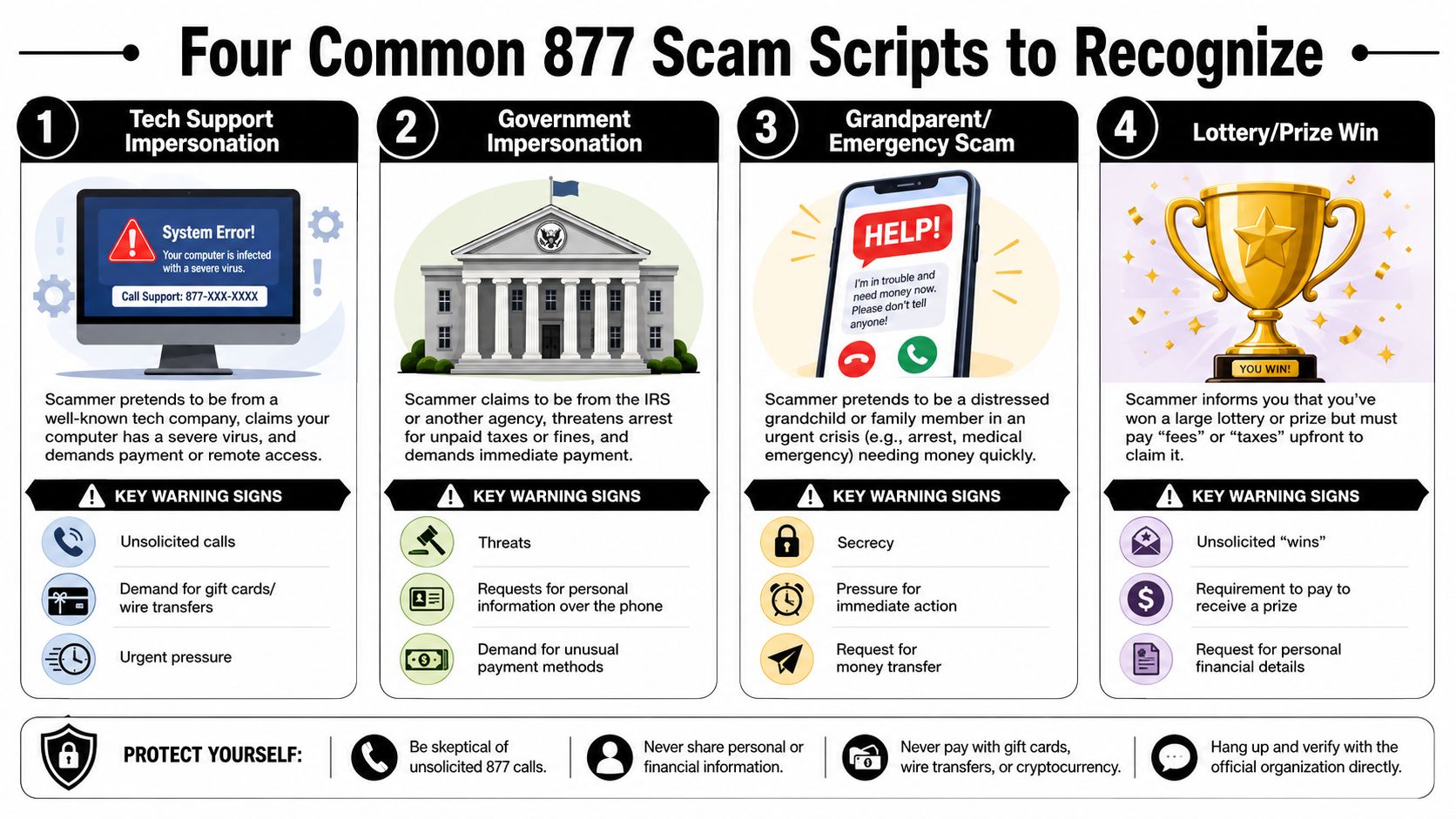
Four Common Area Code 877 Scam Scripts to Recognize
Some scam calls sound different on the surface, but the structure underneath is often the same. A trusted identity. A sudden problem. A narrow time window. A request that benefits the scammer.
The examples below aren’t word-for-word transcripts. They’re the patterns people hear most often.
The bank fraud department call
This one usually starts with tension, not panic. The caller says there’s suspicious activity on your account, a pending transfer, or a possible card breach. They want to “verify” your identity before they can “secure” the account.
The script works because it mixes fear with relief. First, they introduce a threat. Then they present themselves as the solution.
Common warning signs include:
They ask for secrets your bank shouldn’t need from an inbound call
That can include full card details, account credentials, one-time passcodes, or unusually broad identity data.They keep you from hanging up
A scammer may say the matter is urgent and that disconnecting could delay account protection.They redirect you fast
You may be told to move money, install an app, or confirm codes sent to your phone.
The government impersonation threat
This version leans hard on authority. The caller claims to represent the IRS, Social Security, Medicare, or another official office. The tone is sharper. They may mention unpaid fines, account suspension, legal consequences, or missing paperwork.
The goal isn’t accuracy. It’s compliance.
A real agency process usually gives you time, written notice, and clear instructions. A scammer wants immediate obedience. If they demand gift cards, wire transfers, or fast “verification” of personal identifiers, you’re not dealing with routine government business.
Reality check: Urgency is often the product being sold. The scammer needs your panic more than your information.
A short consumer-safety video can help you hear how these calls are framed in the wild:
The tech support or retailer refund trap
Here the caller sounds helpful. They say your computer has a security problem, your account has been compromised, or a recent purchase qualifies for a refund. Instead of threatening you, they try to recruit you into a “fix.”
You may be told to install remote access software, log into an account while they stay on the phone, or read back a code to “confirm” the refund. Once they gain access, they can pivot into password theft, fake transaction screens, or pressure for payment.
This script catches people because it feels service-oriented. It resembles the kind of call many companies would make, at least in theory.
The callback trap that looks free but isn’t
This is the version many people don’t expect. The incoming call appears to come from an 877 number, and the main trick is getting you to call back. While a genuine 877 number is free to call, scammers can spoof an 877 display and route the callback into a high-cost premium line. Verified data provided for this article notes that victims can be charged $5 to $10 per minute in these setups.
That breaks the common assumption that “it’s toll-free, so calling back is harmless.”
A simple comparison helps:
| Scenario | What you see | What actually matters |
|---|---|---|
| Legitimate toll-free call | 877 number | The number belongs to the organization |
| Spoofed scam call | 877 number | Caller ID is only a disguise |
| Premium callback trap | 877 number on missed call | The callback route may lead somewhere entirely different |
If a voicemail pushes you to return the call quickly, especially for billing, fraud, or legal trouble, stop there. Verify the organization through a number you find yourself.
Your Action Plan for Verifying Suspicious 877 Calls
When a suspicious 877 call comes in, your job isn’t to solve the mystery during the call. Your job is to control the interaction.
That means slowing things down, breaking the scammer’s script, and checking facts outside the channel they chose.
Start with the behavior, not the number
People often get stuck asking, “Is this 877 number real?” A better first question is, “Is this caller behaving like a legitimate organization?”
Here are the clearest red flags:
Immediate payment demands
If someone wants gift cards, wire transfers, or another hard-to-reverse payment method, treat it as a scam.Pressure to act before you verify
Scammers hate delays. Verification gives you distance, and distance weakens their control.Requests for sensitive information
Be especially careful with Social Security numbers, bank details, security codes, and account recovery information.Instructions to stay on the line That’s often a tactic to stop you from contacting the actual organization.
Use the hang up and call back rule
The safest move is simple. Hang up. Then find the company’s official number yourself from its website, app, bank statement, insurance card, or prior correspondence.
This sounds basic, but it works because it breaks the spoofing trick. The scammer only controls the interaction while you stay inside their call path.
A useful way to think about it is the same way professionals verify licenses and credentials in other industries. The logic behind HomeProBadge’s verification process is a good parallel. You don’t trust the claim itself. You check the claim against an independent source.
Best habit: Never use the number a suspicious caller gives you. Find the official one yourself.
Move from simple checks to deeper checks
If the call still bothers you, use a layered approach.
Search the number carefully
Look for reports, business listings, and patterns. Don’t treat a single result as proof, but do use it as context.Check your own account directly
If the call claimed a banking issue, log in through your normal app or website. If it claimed a delivery problem, check your actual order history.Preserve details before deleting anything
Save the number, the time of the call, the voicemail, and the main claim the caller made.Tell the actual organization what happened If a scammer impersonated your bank or insurer, their fraud department may want the details.
The advanced step most people miss
You can’t trace an 877 number to a city, but you can often trace it to a carrier or billing entity. Verified data provided for this article states that over 40% of 877 scam calls originate from a small group of VoIP aggregators, and a reverse carrier lookup can reveal the provider behind the number.
That won’t always identify the scammer directly. But it can give you an investigative clue that ordinary reverse lookups miss. Instead of asking, “Where is this number located?” you ask, “Who is providing the number infrastructure?”
That shift matters because toll-free numbers are non-geographic by design.
If the suspicious call may involve an overseas callback route or number masking, this guide to a reverse international phone number lookup is a practical next step.
A quick decision grid
| If the caller says | Your response |
|---|---|
| “Your account is at risk.” | Hang up and call the official number from your statement or app |
| “You must pay right now.” | End the call immediately |
| “Read me the code we just texted.” | Refuse. That code may unlock your account |
| “Call us back at this number.” | Don’t use it until you verify it independently |
The goal isn’t to become a phone-forensics expert. It’s to make sure no stranger can rush you into handing over money, access, or identity data.
Proactive Prevention and Reporting Scams
Good scam defense starts before the phone rings. If your number is widely exposed, if your voicemail gives away too much, or if you answer every unknown call on reflex, scammers have more room to work.
The strongest defense is a combination of friction and visibility. Friction makes it harder for scam calls to reach you or pull you in. Visibility helps you understand where your number may already be exposed.
Reduce exposure and reduce engagement
The tactics here are simple, but they’re effective because they cut off easy wins for scammers.
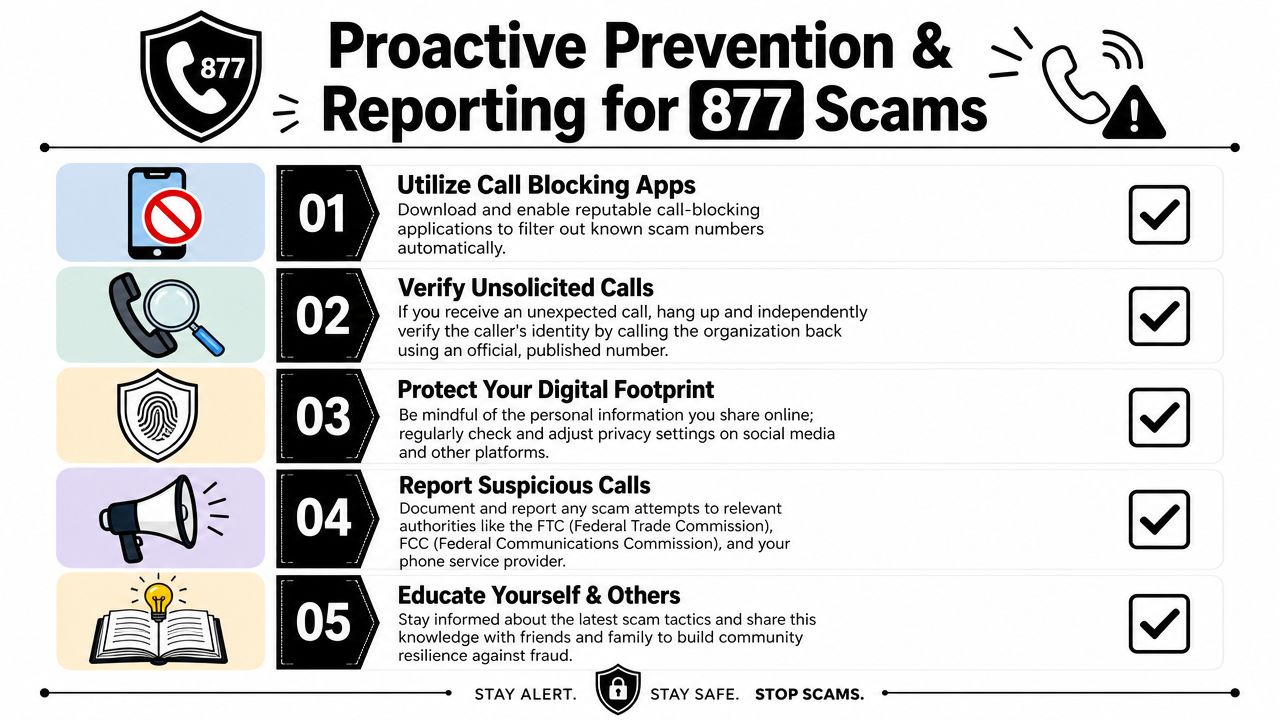
Use built-in call filtering
Most smartphones and major carriers offer some form of spam filtering or call labeling. Turn those tools on and review the settings.Let unknown calls go to voicemail
A legitimate caller can leave a clear message. A scammer often relies on catching you live.Share your number more selectively
Public profiles, old business listings, giveaway forms, and casual account signups all increase exposure.Review what your voicemail says
A voicemail that includes your full name or employer can help a scammer tailor the next call.
Know the payment red flag
Scams using 877 numbers often rely on urgency and payment pressure. Consumer guidance summarized by Ajoxi’s discussion of 877 toll-free scam patterns notes that requests for immediate payment through gift cards or wire transfers are a major warning sign, and that suspicious calls like these should be reported.
That advice is worth remembering because it cuts through the details. It doesn’t matter whether the caller claims to be from tech support, government, or a retailer. If they want untraceable payment fast, the script has already collapsed.
Reporting helps more than you think
Many people ignore scam calls and move on. That’s understandable, but reporting still matters. A report can help phone providers, regulators, and investigators identify reused scripts, spoofed identities, and clusters of suspicious activity.
Keep your report short and factual:
- What number appeared on caller ID
- What the caller claimed
- What they asked for
- Whether they requested payment or sensitive data
- Whether you called back or clicked anything
If spam calls keep piling up, this article on why you keep getting spam calls can help you connect repeated calls to the broader issue of number exposure and data sharing.
Report the behavior, not just the number. Scammers can switch numbers quickly, but their methods often stay recognizable.
Stop Scammers Before They Call with Digital Footprint Check
Scammers don’t always find targets by chance. They often work from data that’s already floating around online. That can include old account records, public profiles, brokered contact details, leaked signup data, and phone numbers posted years ago and forgotten.
That’s why phone scam prevention isn’t only about what you do when the phone rings. It’s also about reducing how visible your personal data is across the web.
A good privacy habit is learning how to keep your phone number private so it doesn’t keep showing up in places strangers can scrape or buy. That kind of cleanup lowers the chance that your number ends up in the hands of fraud operators building call lists.
Digital Footprint Check approaches the problem at that earlier stage. Instead of waiting for the next spoofed 877 call, you can use it to see where your personal information is exposed online and where your number may be discoverable. If you want to audit that exposure, start with the Digital Footprint Check tool.
That changes the conversation from “How do I react to one scam?” to “How do I become a harder target overall?” For privacy, identity protection, and everyday scam resistance, that’s the better long-term question.
If you want to reduce the chances of scam calls, identity theft, or unwanted contact, run a free scan with Digital Footprint Check. It helps you find where your phone number and other personal details are exposed online so you can take action before scammers use that information against you.