· Digital Footprint Check · Content Marketing · 12 min read
My Identity Stolen? Step-by-Step Recovery Plan for 2026
Suspect my identity stolen? Lock down accounts, freeze credit and report fraud in the right order with this step-by-step recovery plan.

You check your banking app over morning coffee and there's a charge you don't recognize. An email lands from a store you've never shopped at, welcoming you to a new account. A login alert pings from a city you've never visited.
That jolt is the moment "my identity stolen" stops being something that happens to other people. What you do in the next hour matters more than almost anything that follows. The order matters as much as the actions.
A recovery works best as a sequence, not a scramble. It typically runs weeks to months, and it goes smoothest when a dated evidence log starts on day one: what you saw, the time, the account, and every person you contacted. I recommend one rule before you send money or personal information to any helpful-sounding caller, email, or text. Find the company's number yourself, then call that number. A contact who already knows your details can still be part of the same theft.
Triage What Was Exposed and How Urgent It Is
A charge you do not recognize and an unfamiliar login alert call for different responses. Triage starts by separating signs of active misuse from information that may only be exposed. If someone has used an account, act today. If your details appear in a breach notice but there is no sign of access, prioritize securing accounts that reused those credentials.
The Bureau of Justice Statistics estimated that about 23.9 million U.S. residents aged 16 or older, roughly 9% of that population, experienced identity theft in the 12 months before its 2021 survey. In 76% of cases, the most recent incident involved misuse of just one existing account, such as a credit-card or bank account. That pattern makes a small unfamiliar charge worth checking promptly. The same survey found that 2% of people aged 16 or older experienced misuse of an existing email or social-media account.
| Warning sign | What it may indicate | Priority and first action |
|---|---|---|
| Login alert from a place you do not recognize | Someone may have accessed your account | Act now: review account activity and secure the account |
| Unfamiliar charge on a card or bank account | Possible card or account misuse | Today: contact the issuer using a number you find independently |
| Email forwarding rule you did not create | Someone may be monitoring messages or account resets | Act now: remove the rule and secure your email account |
| Account opened in your name | Possible new-account fraud | Today: contact the relevant institution and begin its fraud-reporting process |
| Your email appears in a breach notice | Your information may be exposed, without proof of account misuse | This week: replace reused passwords and enable multifactor authentication |
| An old profile displays your birthday or phone number | Personal details are publicly available for impersonation | This week: remove the details or restrict the profile |
Treat signs of account access, unauthorized transactions, or accounts opened in your name as urgent. A breach notice or visible personal detail calls for prompt protection, but does not by itself prove that someone has used your identity.
Keep a dated evidence log as the case develops over the coming weeks. Record what you found, when you found it, and whether it indicates active misuse, exposure, or an unresolved question. Before sending money or personal information to anyone offering help, verify the contact using a phone number you find independently. If you need advice before signing documents, consult a qualified attorney in your jurisdiction. You can also get confidential legal help in Singapore if that is where you need assistance.
For a closer look at possible warning signs, read this guide to signs your identity has been stolen. Start by listing what you have found and marking each item active, exposed, or unknown. Tackle the active items first.
Your First 24 Hours and Account Lockdown
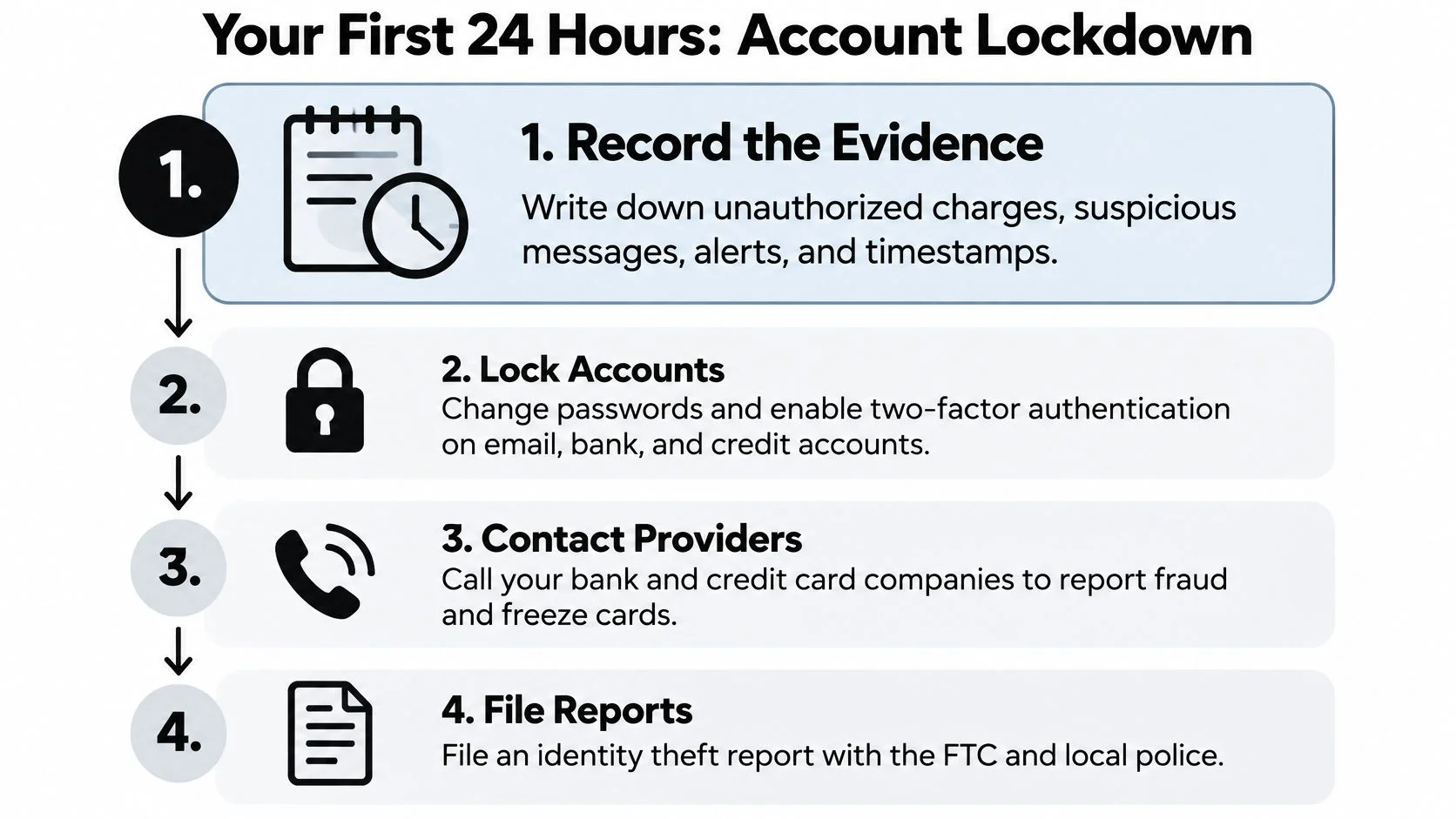
1. Record the evidence before you touch anything
Write it all down first. Unauthorized charges with amounts and posting dates, suspicious messages with sender addresses, alert screenshots, and the account identifiers involved. Screenshot before you close, delete or dispute anything, because once a transaction is reversed the original details can vanish from your view.
This step is visually the loudest in the whole sequence for a reason. The Federal Trade Commission's identity theft guidance puts evidence preservation first, before contacting institutions, changing credentials or freezing anything. Its recovery workflow can generate a personalized plan and a creditor-dispute letter, which carries far more weight than an informal account of what happened. The FBI's advice runs in the same direction: notify every financial institution involved immediately, file an Internet Crime Complaint Center report, contact an FBI field office, and notify local law enforcement when appropriate.
2. Call the bank on the number printed on your card
Never call a number that arrived in a message, an email signature or a pop-up. Those are the attacker's channels. Use the number on the back of the card or the top of your statement, the one you've verified independently. Fraud departments can freeze a card, reverse pending charges and flag the account while you're on the call.
3. Secure your email before anything else
Your email account is the master key. Whoever holds it can reset the password on your bank, your shopping accounts, your cloud storage and your phone bill. Change that password first, from a clean device, meaning one you've rebooted or one you trust, not the laptop you suspect.
Then look for what the attacker left behind: recovery email addresses and phone numbers you don't recognize, forwarding rules that send copies of your mail elsewhere, and delegated or connected app access you never granted. A forwarding rule is the quietest attack in the playbook. Mail keeps arriving, nothing looks broken, and someone else is reading password resets as they land.
4. Protect your phone number with your carrier
Ask your mobile carrier for port-out protection or a SIM-change lock. A SIM swap moves your number to another device, and every one-time code sent by text then goes to the attacker. This takes one call and closes a gap rarely considered.
5. Replace every reused password
Not just the compromised one. If your banking password matched your password on three shopping sites, all four need replacing. Use a password manager to generate and store unique strings, and choose an authenticator app or a hardware security key over text-message codes wherever a service offers it. SMS codes fail the moment your number is compromised.
The session trap: A new password doesn't end the attack if the intruder's session is still live. Sign out of all other devices on every account you touch, then check again the next day for unfamiliar sessions.
6. Confirm recovery addresses on financial accounts
Go into each banking, brokerage and shopping account and check that the recovery email and phone number are still yours. Attackers change them so the next password reset goes to them. The pattern that catches people out is this. The password gets changed, the card gets replaced, and three weeks later a new credit line appears because nobody checked where the recovery codes were landing.
If you suspect credential reuse across many sites, the mechanics of a credential stuffing attack explain how one leaked password becomes a dozen broken accounts.
Your hour-24 check
By now every account you touched should have a new password, a second factor, and a dated log entry. If three of those entries are missing, you're not done. Continue to the next stage with the evidence log in hand.
Freeze Credit and File the Reports That Make Disputes Work
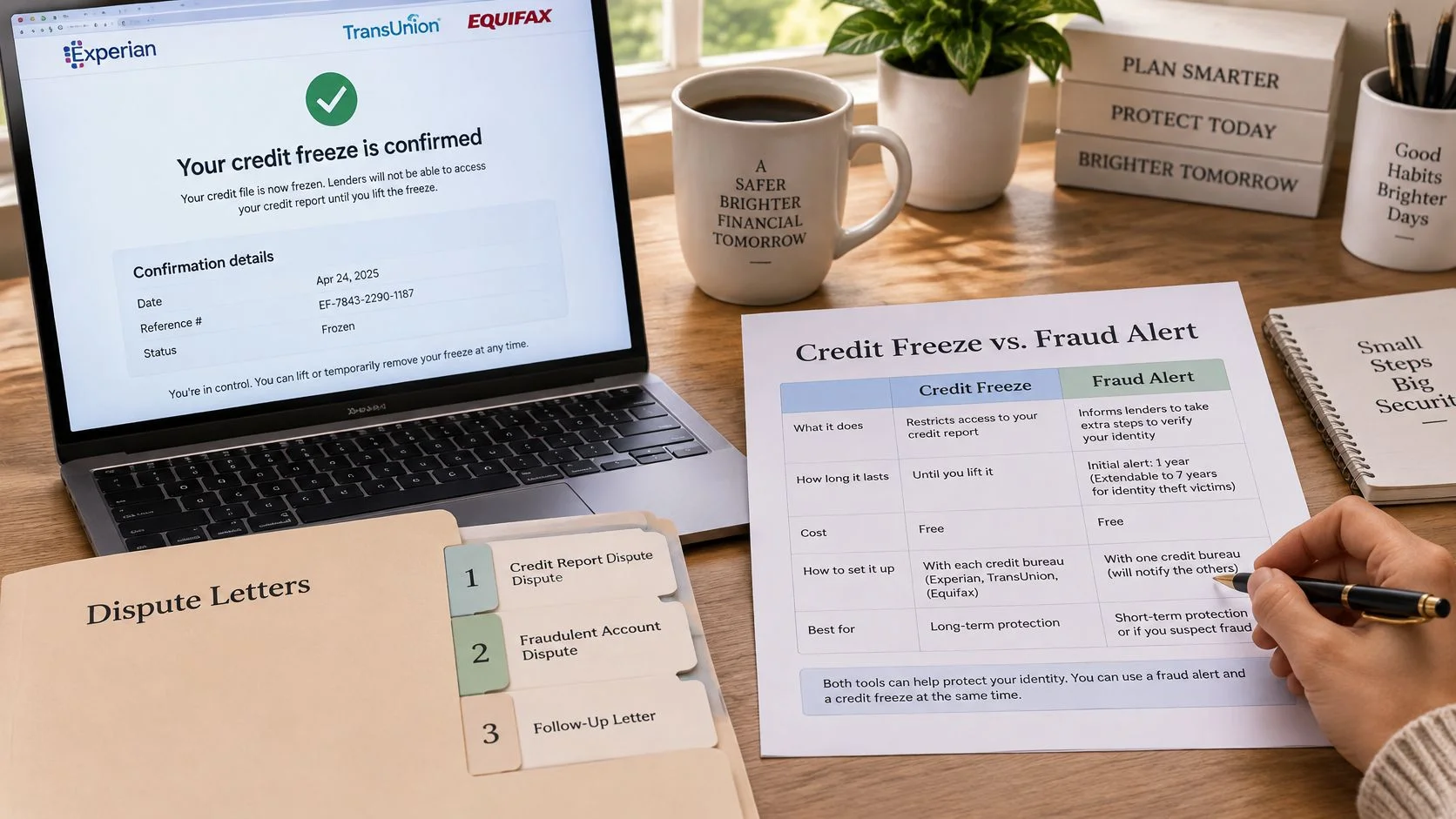
A freeze can block lenders from accessing your credit file to open new accounts, but it will not stop misuse of accounts you already have. The table separates the main protections and records so you can choose the right filing for each problem.
| Tool | Who can use it | Cost | What it does |
|---|---|---|---|
| Credit freeze | Anyone | Free at each bureau | Blocks new credit checks until you lift the freeze |
| Initial fraud alert | Anyone who suspects fraud | Free | Asks lenders to verify your identity; lasts one year |
| Extended fraud alert | Victims with an identity theft report | Free | Asks lenders to verify your identity; lasts seven years |
| Active duty alert | Military members away from home | Free | Asks lenders to verify your identity; lasts one year |
| Identity theft report | Anyone affected | Free at IdentityTheft.gov | Provides a record for disputes, blocking requests and creditor letters |
- Freeze your file at all three credit bureaus. Equifax, Experian and TransUnion maintain separate files, so submit a request to each. Save the login details or PINs securely. You will need them to lift the freezes when applying for credit.
- File an identity theft report at IdentityTheft.gov. It records your account of the theft and can generate dispute letters for creditors.
- Request an extended fraud alert once you have the report. It lasts seven years, compared with one year for an initial alert.
- Report online theft to the Internet Crime Complaint Center, and contact each affected financial institution. Do not stop after calling the institution that first alerted you.
- Ask for a police report number. Record the number and filing date in your evidence log. A creditor may ask for the report when reviewing a fraudulent account dispute.
What a freeze does not cover: It does not stop misuse of existing accounts or protect utility, phone, insurance and email accounts. Keep handling those with the relevant providers.
Keep a dated log of each filing, its reference number, your bureau credentials and the steps for lifting each freeze. If a lender finds a freeze when you apply for credit, the application may stall while you lift it. Record which bureau file needs to be thawed.
If an unauthorized hard inquiry appears, follow the process for disputing and removing a hard inquiry from your credit report. If a separate court or agency matter is also on a deadline, check what Family Code 263.301 requires directly, and keep its dates separate from your credit dispute timeline.
Spot Second-Wave Scams Before They Cost You
A caller says they can recover your stolen money, knows which bank you use, and wants a fee before the end of the call. Treat that as a new fraud attempt until you verify the caller independently. Recovery scams often target people who have already reported a theft or searched for help.
The caller may know your name, part of an account number, or the amount that was stolen. That information can come from the original incident. It does not prove the caller represents your bank, an agency, or a recovery service.
Watch for these warning signs:
- Urgency: A demand to act in minutes is a reason to stop and verify.
- Secrecy: Someone telling you to keep the contact from your family or bank is trying to isolate you.
- Remote access: Do not install software or hand over control of your screen to someone offering to recover money.
- Unusual payment requests: Treat demands for cryptocurrency, gift cards, or wire transfers as a warning. Verify any fee through the provider's independently found contact details before paying.
- One-time codes: Never read a code aloud to an inbound caller. It could let them access your account.
The callback test: Hang up. Find the organization's number yourself, such as on the back of your card or on a website address you entered directly. Call that number and ask whether the contact is genuine. Verify every helpful-sounding offer this way before sharing information or sending money.
A dated evidence log helps keep a multi-week case in order. Record the time, number, name the caller gave, what they asked for, and how you verified the contact. If you cannot confirm it through an independently found number, send nothing and keep the entry. Guidance on the warning signs of collection scams can help you recognize similar pressure tactics from callers claiming you owe a debt. Learn more about recognizing social engineering tactics so you can spot how a caller uses personal details to win your trust.
Schedule Your Monitoring Check This Week
A fraudulent account may appear long after the first cleanup. Set a weekly review for bank and card statements, schedule credit report checks, and keep your evidence log open until every dispute is resolved. Financial and personal consequences can continue well beyond the day you discover the theft.
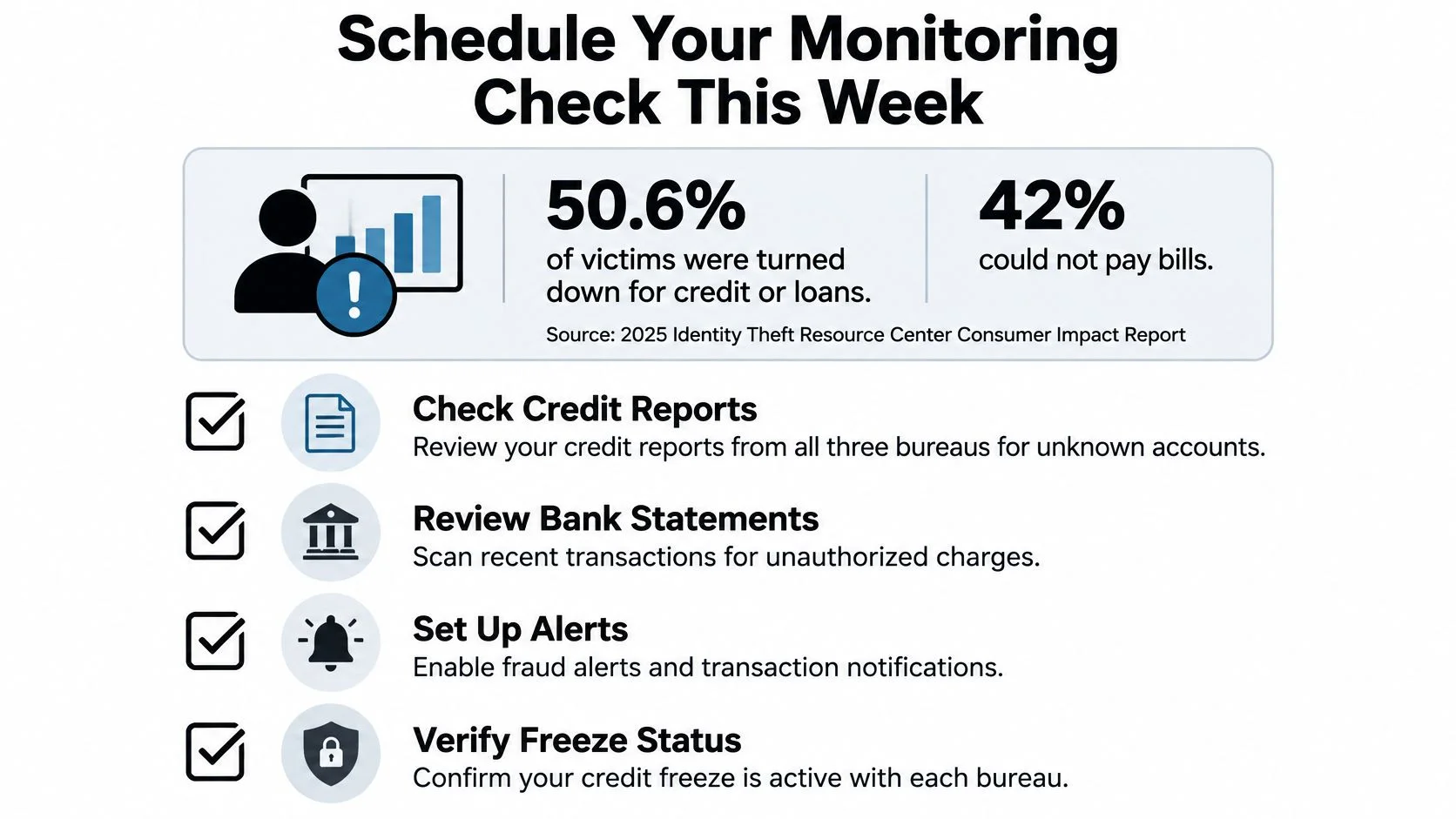
Use dates and reference numbers to make the case easy to follow. Record when you contacted each institution, what it agreed to do, and when you plan to check back. If a dispute remains open, keep copies of the correspondence and note each follow-up.
| Stage | Actions | Tracking |
|---|---|---|
| Day 1 | Freeze credit at three bureaus, contact each institution, open the evidence log | Log each call with date and reference number |
| Week 1 | Complete the triage table, confirm the identity theft report and recovery plan, send creditor dispute letters | Record each dispute and the date it was sent |
| Month 1 | Review credit reports and statements, follow up on open disputes | Escalate unanswered disputes in writing and keep copies |
| Months 2 to 6 | Review statements weekly, recheck credit reports on schedule, watch for new exposures | Keep the log open until every dispute closes |
Calendar checks catch activity in the accounts and reports you review. Continuous monitoring of data breaches and dark web activity can alert you to potential identity theft risks that a calendar reminder will not surface. Exposure alone does not prove misuse, and no service can guarantee absolute security. Learn what identity theft monitoring can help you watch for.
If it becomes a crisis: Thoughts of self-harm during this process are a signal to stop and get help now. Contact local emergency services or a crisis line, and ask a victim support organization to take over part of the case.
Today, confirm the freezes are active at all three bureaus and book a 30-day monitoring check. You can also use the free checker at www.digitalfootprintcheck.com/free-checker to review what is publicly visible about you.
Treat recovery as a case file that may stay open for weeks or months. Keep the evidence log current, and verify every helpful-sounding contact by finding its phone number yourself before sharing information or sending money. Digital Footprint Check checks for breach exposure, online profiles, gaming identities, phone numbers and social network activity, with reports drawing on more than 500 data sources. Start with a free check at Digital Footprint Check to review your digital footprint.