· Digital Footprint Check · Content Marketing · 17 min read
Social Media and Intelligence: How It Works Ethically
Learn how social media and intelligence work together, what public profiles reveal, and how to use OSINT methods responsibly and ethically.

Somewhere this week, someone typed your name into a search bar and pressed enter. It might have been a recruiter with your CV already open, a date checking you were real, or a stranger who saw your comment under a public post. Within a minute they had a photo, a city, a job title and a rough guess at what you care about.
None of that required hacking. It came from things you published yourself, plus a few details platforms inferred and stored. The gap between what is visible and what is true is where social media and intelligence work begins, and it's also where most privacy advice goes wrong. Learning how professionals read public information is the fastest way to see what your own profile is saying, and to change the message.
What Social Media Intelligence Means in Practice
A hiring manager has fifteen minutes before an interview. She types the candidate's name into a search engine. A professional profile appears, then a public account with a photo, a city and an employer she didn't see on the CV. In a quarter of an hour she has formed a second impression that will shape the conversation.
That everyday check is social media intelligence, usually shortened to SOCMINT: collecting and analyzing information from publicly available platforms to answer a specific question. It sits inside open-source intelligence, which also covers company registries, news archives, public records and websites. If you want the wider map of where those sources begin and end, our guide to what open source intelligence covers lays out the categories.
What separates social platforms from other sources is authorship. People publish their own details, relationships, opinions and movements, often within minutes of an event happening.
Think of a public profile as a shop window. A passer-by sees what's on display. An investigator reads the window closely: what was chosen for display, what changed recently, which shelves are conspicuously empty and why. The display is deliberate, and the deliberate choices are the interesting part.
The same collection-to-conclusion loop runs through commercial research, where a defined question and cross-checked sources matter just as much; this walkthrough of cómo analizar el mercado B2B applies that method to market analysis and shows how raw public signals become a decision.
The rest of this guide follows the loop. You'll see how analysts turn posts into findings, what individual signals can and cannot prove, how to audit your own footprint, and where responsible research stops and intrusion begins. By the end you'll be able to judge what's visible about you or anyone else, and where the line sits.
How Analysts Turn Public Posts into Intelligence
Scrolling produces impressions. Analysis produces findings. The gap between the two is a repeatable process, and it's the same one whether the subject is a job candidate, a brand or a protest movement.
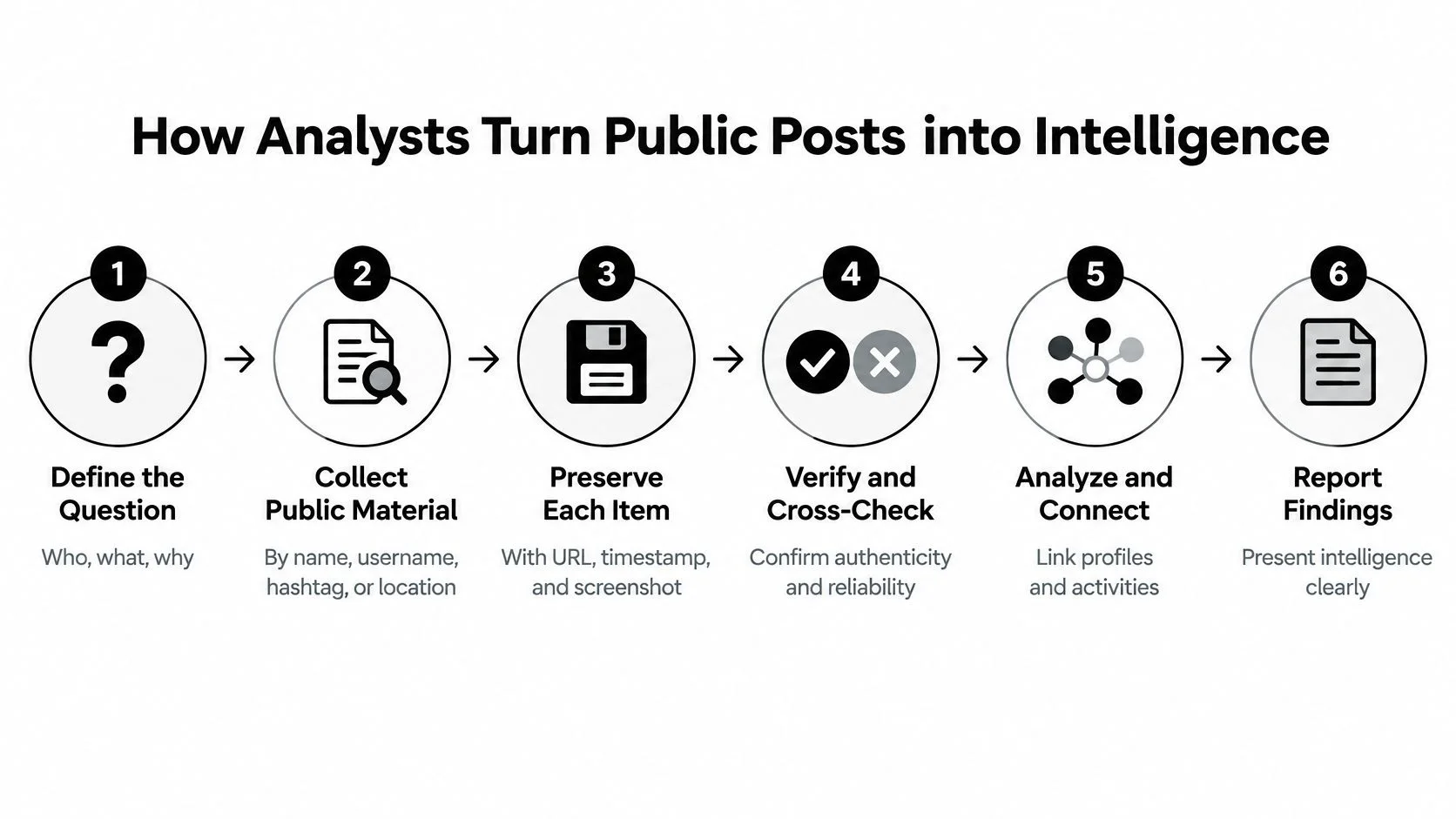
The Six Steps From Post to Finding
- Define the question before you search. Who, what, why. "Is this one person or several accounts?" is answerable. "Find everything about them" isn't, and it's the request that pushes people into unethical territory.
- Collect public material. Search by real name, username, hashtag or location. Save the exact search strings you used, because someone will ask you to reproduce them.
- Preserve each item. Record the URL, the post's timestamp, the date you captured it and a screenshot. Posts get deleted, edited or made private, and an unsaved finding can't be defended.
- Analyze what you have. Line up a timeline, map which accounts interact with each other, compare locations and look at language patterns. Our breakdown of open source intelligence techniques covers the individual methods.
- Verify every claim. One source is a lead. Two sources with different origins is a finding.
- Report with confidence levels. Separate what you observed from what you concluded, and name the evidence behind each line.
The flow below is the version many teams settle on after a few messy attempts.
Why Networks Beat Single Posts
Classifying posts one at a time misses the strongest signal. Coordinated campaigns share propagation patterns, overlapping engagers and community-level behavior that a text model never sees. Community-aware models that combine content features with network structure reached weighted F1 scores above 90% on benchmark sets such as Twitter15, Twitter16 and MiDe22, according to research on community-aware misinformation detection, even when the user communities involved were small.
Two cautions ride along with that result. Evaluate on time-based, source-separated splits, because random splits leak the same users and phrases into training and test data and inflate the numbers. And report precision and recall per class, since these datasets are lopsided: MiDe22 contains more than twice as many false-labeled as true-labeled tweets.
The same logic shows up in crypto research, where tracking which wallets and accounts move first tells you more than reading any single post; StalkChain's Solana KOL tracker walkthrough shows the tracking mindset applied to a completely different feed.
The Spike That Made the Case
The founding example came from the Arab Spring of 2010 to 2011. Researchers analyzed more than 3 million tweets, gigabytes of YouTube material and thousands of blog posts across Tunisia, Egypt and neighboring countries, and found that surges in online conversation often came before developments on the ground rather than after them, as the University of Washington summary of the study reports.
Egypt supplied the number analysts still quote. In the week before President Hosni Mubarak resigned in February 2011, tweets about political change in Egypt rose from about 2,300 a day to 230,000 a day.
That's a hundred-fold rise in attention. It isn't a hundred-fold rise in protesters, and it says nothing about whether the movement would succeed. Volume measures communication, not participation. Hold that distinction and you avoid the field's most common error, which is treating a loud online signal as a confirmed real-world fact.
A Practice Question
Write down one question you'd like answered about a public account. List three public sources that could answer it. Then note what would make you distrust each one. Doing that once teaches more than reading ten case studies.
What Public Profiles Reveal About a Person
A public profile works like a witness statement. A single detail proves little on its own, but details that agree with each other start to carry weight. Analysts read the signals as a set for exactly that reason: each one is weak alone, and strength comes from corroboration.
| Signal | What It Reveals | How Analysts Use It | Main Limit |
|---|---|---|---|
| Profile name and bio | Real name, employer, location and interests | Confirms identity across platforms | Self-declared and often unverified |
| Username reuse | The same handle on several sites | Links accounts to one person | Common usernames collide |
| Post timing | Active hours and likely time zone | Estimates routine and location | Schedules vary and can be curated |
| Photos and metadata | Places, people and events | Geolocates scenes and checks dates | Most platforms strip metadata |
| Followers and friends | Associates, employers and communities | Maps relationships | A follow is not proof of a relationship |
| Likes, comments and replies | Interests, affiliations and opinions | Builds an interest profile | Engagement is noisy and often incidental |
| Tagged or check-in posts | Where someone was and with whom | Reconstructs events and timelines | Depends on what others chose to post |
Read the last column twice. Every row has a built-in failure mode, and most bad conclusions in this work come from ignoring one of them.
Sorting what you find into categories helps too. Visible facts are what a profile states outright: the bio, the photos, the follower list. Inferred attributes are what you deduce from them, such as a likely time zone drawn from posting hours. Third-party material, like photos friends tag someone in, tells you things the person never chose to publish. Only the first category is fully under the person's control, and only the second depends on your reasoning being right.
The Two-Signal Rule in Action
Say a profile claims to belong to a photographer in Manchester. The bio says so, which is the first signal and worth almost nothing alone because anyone can type it. The photos show street scenes with signage consistent with the city, which is signal two. The account's active hours line up with UK evenings, which is signal three. Now you have a working hypothesis about where the person probably is. You still don't have their identity, and you shouldn't claim to.
Popularity signals need the same caution. False news tends to spread faster than accurate reporting on social platforms, so a high share count says more about how striking a claim sounds than about whether it is true. A post that looks viral can reflect a handful of unusually active accounts rather than broad belief, which is why retweet totals belong in the weak-signal column of your notes.
What a Polished Profile Still Leaks
Someone building a false persona will copy photos, invent an employer and keep the story straight. Cross-platform comparison earns its keep here, because people slip on small things: a graduation year that differs between two networks, a timezone that doesn't match the claimed city, a friend group that never overlaps.
Images need their own caution. Deception often lives in the mismatch between a caption and its visual context rather than in the picture itself, which is why multimodal testbeds exist. OmniFake holds roughly 127,000 samples combining human-curated misinformation with newly synthesized AI examples, as described in this multimodal misinformation benchmark. A photograph can look authentic and still be attached to a false claim.
Working rule: The most informative detail in a polished profile is usually the seam, the one element that doesn't match the same person's version elsewhere.
Identity and intent are separate questions. Signals can support a view about who someone probably is. They rarely prove what that person intends to do, and treating them as if they do is how ordinary research turns into a false accusation.
Ethical and Legal Limits for Responsible Research
Every method in this article can be used well or badly, and the difference is rarely technical. It comes down to four commitments made before the first search, not after it.
Four Principles That Keep Research Clean
Purpose comes first because it decides everything else. Write the question down before you open a tab. A search that begins with "let me see what I can find" has no natural stopping point.
Proportionality keeps the collection narrow. If the question is whether a candidate's stated employer matches their public work history, you need the professional profile, not the family holiday album.
Transparency matters wherever a decision affects someone's life. Pre-employment screening, disciplinary review and due diligence should be disclosed, and the person should know what was reviewed and why.
Minimization covers the end of the process. Delete the working notes once the question is answered. A folder that keeps growing after the decision has been made stops being research and becomes something else.
| Research Activity | Generally Acceptable | Off-Limits |
|---|---|---|
| Reviewing public posts for a defined purpose | Yes | Watching people with no legitimate reason |
| Checking a candidate's public professional profiles | Yes, if job-related and disclosed | Using private information or protected traits |
| Verifying a match with reverse image search | Yes | Creating fake profiles to gain trust |
| Viewing content a user made public | Yes | Accessing locked or private accounts |
| Keeping notes limited to the question | Yes | Building dossiers that grow beyond the purpose |
| Tracking a partner's location or accounts | No | Any covert monitoring of an adult |
The legal boundary shifts as well. Data protection rules, employment screening requirements and workplace monitoring rules differ by country and often by state, so a practice that's routine in one jurisdiction can be actionable in another. Anyone running high-stakes checks should bring in a qualified legal adviser rather than relying on a blog post, including this one; our overview of whether OSINT is legal sketches the general shape of those rules, and Nick Norris's notes on privacy and employees covers the obligations employers take on when they monitor staff accounts and devices.
If you'd be uncomfortable explaining the method to the person you researched, it's probably out of bounds.
How Social Intelligence Shows Up in Scams and Hiring Checks
The messages start innocently. A stranger compliments a photo, mentions a shared interest and asks a question that invites a reply. Over the following weeks the conversation becomes daily. Then comes the emergency: a hospital bill, a customs fee, a frozen account. Sometimes no emergency arrives at all, and the contact recommends a trading platform with remarkable returns.
That sequence isn't improvised. The Federal Trade Commission found that nearly 60% of people who said they lost money to a romance scam in 2025 reported the scam began on a social-media platform, with reported losses from romance scams originating on social media totaling $298 million, per the FTC's social media spotlight report. The same report describes how scammers study a victim's profile, build a relationship, invent a crisis and steer the target toward fake investment platforms.
The Pattern, Stage by Stage
| Scam stage | Warning sign | Check that exposes it |
|---|---|---|
| Study the profile | Copied photos and public family or job details | Reverse image search and account age check |
| Build rapport over weeks | Fast affection and reluctance to meet | Ask for a live video call |
| Invent a crisis | Sudden emergency that needs money | Refuse any urgent payment request |
| Move to investment | Trading or crypto advice from a romantic contact | Treat as a major warning sign and stop sending money |
Read the table from the bottom up. The final stage is where money leaves, and it's the easiest to refuse if you've already run the checks above it. A live video call costs nothing and rules out a large share of copied-photo personas. An account opened three weeks ago with forty friends is not evidence of a long life.
Synthetic media raises the stakes without changing the logic. In a U.S. survey conducted in March 2025, 60% of respondents were concerned about misleading AI-generated video and audio, and in the United Kingdom 67% of adults said AI-generated content contributed to misinformation online, according to Statista's tracking of social media and artificial intelligence. Concern is reasonable. It still isn't the same thing as harm. Detecting whether a face is synthetic answers a narrow question, and it doesn't answer whether the person on the other side intends to take your money.
Losses pile up across every category, not just romance. The FBI's 2024 Internet Crime Complaint Center report logged 859,532 complaints and more than $16 billion in reported losses, a 33% increase on 2023, with phishing and spoofing, extortion and personal-data breaches the three most frequently reported categories, per the FBI's annual internet crime release. If you suspect a scam, stop sending money, keep the messages and profile links, and report the case.
Employers run the same reading skills in a different direction, and the fairness question follows from the four principles above: keep the check job-related and documented, and give the candidate a chance to explain. A single screenshot without context proves very little, and treating it as decisive is the same error as treating a viral post as public opinion. A written policy settles most of this before a search begins; ours sets out how a social media screening policy should be built.
Auditing Your Own Footprint and Running a Check
An audit that leaves you feeling vaguely worried has failed. The output should be a short list of exposures, each with a fix and a date attached. The work is mostly clerical, which is exactly why it gets skipped, and exactly why it pays off.

The Four-Step Self-Audit
- List every account you've opened. Email, social, gaming, dating, forums, old professional profiles, the shopping account you made in 2014. Search your inbox for welcome messages and check your password manager for saved logins, because memory will miss half of them.
- Search for what's public. Run your name, your main usernames and your email addresses through a search engine, then through a dedicated checker. Our free checker starts from a username or email and returns profile, username, data breach and reverse email results drawn from more than 500 sources. Review the matches before acting, since a common name produces false positives.
- Rank each finding by risk, not by how embarrassing it feels. The table below orders exposures from most to least dangerous and names the first fix for each.
- Fix the highest-risk item first, then set a date for the next one. Our guide to managing your digital footprint walks through the fix order account by account.
Why Reused Passwords Come First
A reused password works like one key cut for every door you own. Steal it once and every lock is open.
Verizon's analysis of infostealer-malware credential logs found that, in the median case, only 49% of a user's passwords were distinct from one another, according to Verizon's 2025 credential-stuffing research. The same analysis measured credential stuffing at a median 19% of daily authentication attempts, rising to 25% at enterprise-sized companies and 12% at small businesses. Attackers do not need to guess anything. They feed stolen credentials into automated tools that test them across thousands of sites, which is why unique passwords plus multifactor authentication outrank almost every other item on this list.
| Exposure | Example | Main Risk | First Fix |
|---|---|---|---|
| Reused password | Same password on email and gaming accounts | Account takeover | Unique passwords, password manager and MFA |
| Email in a data breach | Address appears in a leaked database | Targeted phishing | Change passwords and enable MFA |
| Public phone or email | Contact details on an old profile | Scam calls and impersonation | Hide or remove from public view |
| Abandoned accounts | Old forum, dating or gaming profiles | Forgotten attack surface | Delete or close accounts you no longer use |
| Inferred attributes | Age, gender or interests guessed from activity | Profiling and targeted manipulation | Review ad and data settings on each platform |
| Third-party copies | Data broker listings and archived pages | Persistent exposure | Submit opt-out and takedown requests |
| Location clues in photos | Home, workplace or daily routes | Physical safety risk | Remove geotags and review old photos |
Third-party exposure is the reason a single account cleanup is never enough. Verizon's 2025 Data Breach Investigations Report examined more than 22,000 security incidents including 12,195 confirmed breaches, and found credential abuse behind 22% of breaches and vulnerability exploitation behind 20%, with third-party involvement doubling from 15% to 30%, per the 2025 DBIR executive summary. Your personal profile and a vendor's system can sit on the same chain of trust without you ever connecting them.
Visible Facts, Inferred Attributes and the Difference
The distinction matters more than many expect. Something you typed is a fact you published. An estimate of your age, gender or interests built from engagement patterns is somebody else's inference, and you never agreed to it in those terms.
Worry alone doesn't fix it. A 2025 meta-analysis found only a small negative relationship between privacy concern and self-disclosure (ρ = −0.12), which suggests that people who care about privacy don't automatically change what they post, as reported in the Journal of Computer-Mediated Communication. Platforms run the same inference in the other direction: engagement data goes in, guessed attributes come out, and the person being profiled rarely sees or controls the result.
That's why step three of the audit asks you to sort findings by type. A leaked password is urgent because it's exploitable today. An inferred attribute is slower and quieter, and the fix is a settings review on each platform rather than a password change.
A practical walkthrough helps here, because the order of operations is where many readers stall.
No tool finds everything, so pair any automated report with the manual review you did in step two. Platforms hide profiles from searches, data brokers add and remove listings constantly, and archived copies outlive the page they came from. Treat the report as a baseline, not a verdict.
Routine that works: repeat the search every three months and after any breach notice, and log what changed.
Pick one account this week. The one with the reused password, the dating profile you forgot, the gaming handle that shows your real name. Fix it, then set a re-check date in your calendar. The audit is finished only when each high-risk item has a fix and a date, not when the report looks tidy.
Digital Footprint Check does the discovery work behind that routine: a search from a username or email returns publicly discoverable profiles, gaming accounts, forum activity, breach exposure and data broker listings, with step-by-step guidance on which fix to make first. Run it before a job search, after a breach notice, or when a new online relationship starts asking for money, then repeat it every three months so you can see what changed. Start at Digital Footprint Check and give yourself a baseline you can measure against.