· Digital Footprint Check · Content Marketing · 13 min read
Is Osint Legal? a Practical Guide to Staying Compliant
Is OSINT legal? Learn the difference between lawful open-source intelligence and illegal activity, key laws, and practical rules for staying compliant.

Yes, OSINT is generally legal when you collect public information through lawful methods and for a legitimate purpose. But the legal position can change sharply when collection involves personal data, access controls, aggregation, or consequential decisions.
You may be asking because you want to check a dating profile, investigate a suspicious gaming account, review your online reputation, or see what a recruiter or stranger can discover about you. The confusing part is that “public” describes how information can be viewed, not automatically how it can be collected, stored, combined, shared, or used. OSINT legality depends on the method, the purpose, the data, and the jurisdiction.
What OSINT Actually Is and Why the Legal Question Is Harder Than It Looks
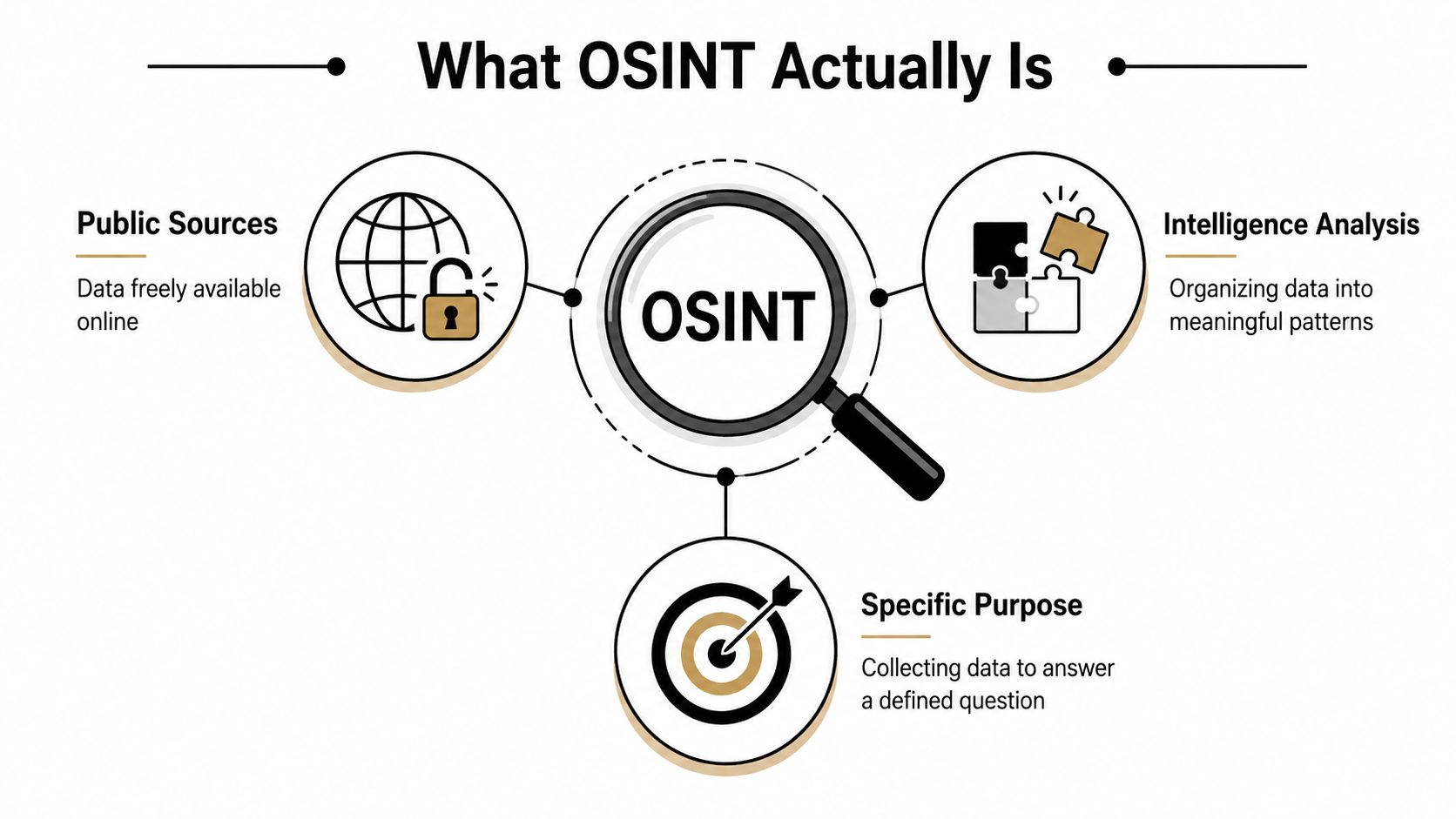
Open-source intelligence, or OSINT, means producing intelligence from publicly available sources. The Office of the Director of National Intelligence formally described OSINT in U.S. intelligence doctrine as intelligence produced from public sources, collected, exploited, and disseminated for a specific intelligence requirement. That definition is useful because it presents OSINT as a method of gathering and analyzing information, not as a special category that automatically overrides privacy law. The legal analysis on OSINT and privacy explains why public-source collection can still raise privacy concerns when personal information is processed.
A simple example helps. Looking at a public LinkedIn profile is similar to viewing information displayed in a shop window. You can observe what the owner has deliberately placed where passersby can see it. That doesn’t necessarily mean you can enter a staff-only area, photograph customers inside, or combine every visible detail into a permanent dossier for an unrelated purpose.
Publicly accessible isn’t the same as lawfully usable
Ask four questions before collecting anything:
- Publicness: Can an ordinary visitor view the page without logging in, joining a group, or using special permission?
- Method: Are you browsing normally, or bypassing a login, defeating a technical restriction, or impersonating someone?
- Purpose: Are you protecting your family, investigating your own exposure, conducting journalism, or making a decision about another person?
- Scope: Are you gathering a small amount of relevant information, or assembling an extensive profile about an identifiable individual?
These questions matter in privacy, cybersecurity, dating safety, gaming-account protection, and reputation management. A public username can help you find your own forgotten accounts, but that doesn’t give you permission to take over the account, expose private messages, or publish the person’s location.
For organizations, the same principle applies to monitoring. A brand team might track brand mentions across channels to identify impersonation or customer concerns. That purpose is different from compiling personal details about commenters unrelated to the brand issue. People who want a deeper explanation of OSINT’s common applications can also review what OSINT is used for.
Practical rule: Treat public information as a starting point for a defined question, not as a blank check to collect everything connected to a person.
Where the Legal Line Sits Between Lawful OSINT and Unlawful Activity
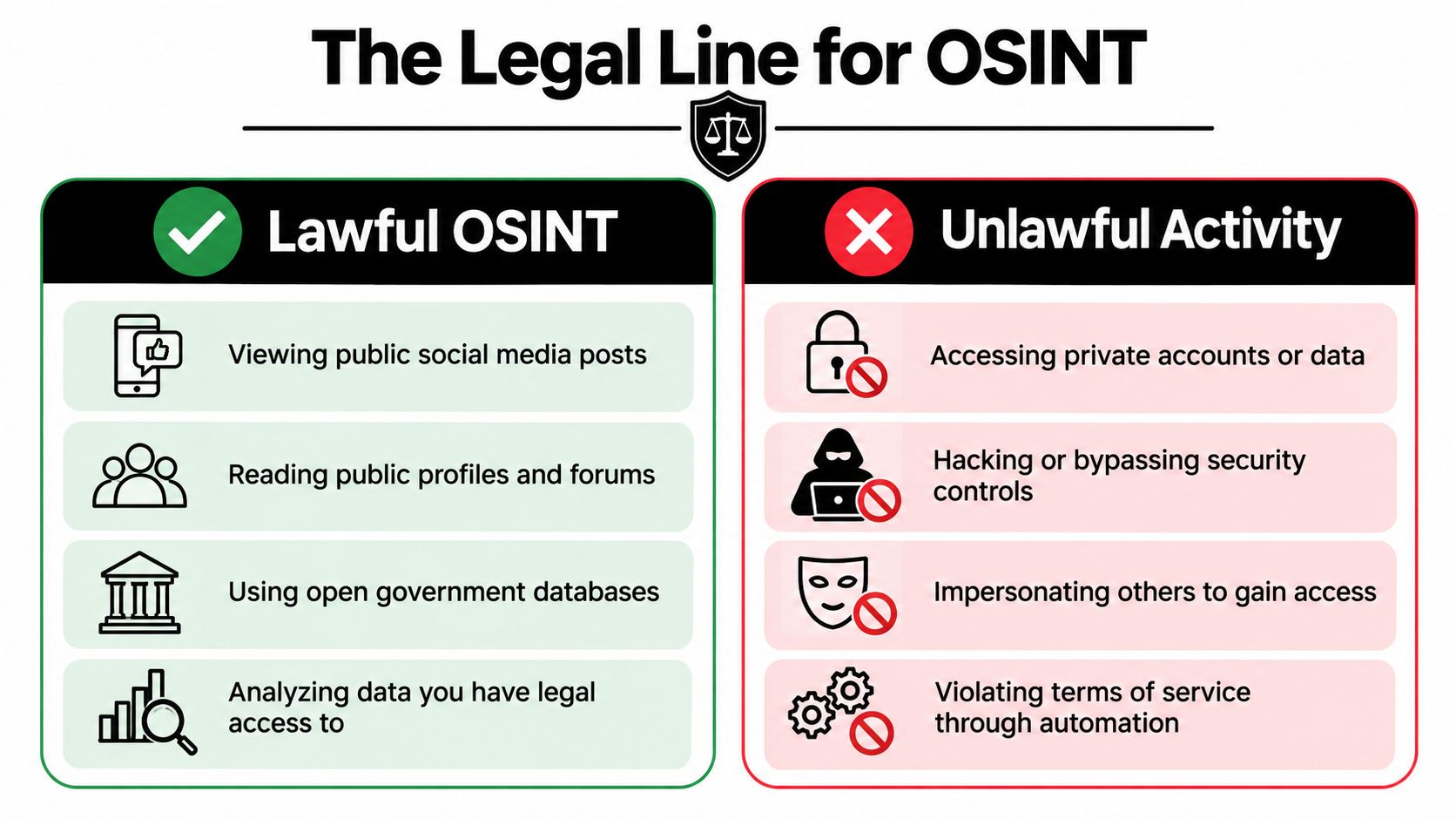
The practical boundary is easier to understand as a distinction between observation and intrusion. Reading an open social-media post, reviewing a public forum, checking an open government record, or analyzing a webpage available without authentication will generally sit on the lawful side, subject to privacy and purpose limits.
The line moves when the investigator must defeat a barrier. Guessing passwords to read private messages, accessing an account after finding a reused credential, creating a fake identity to enter a restricted community, or automating collection in a way that bypasses access controls can create serious exposure. The fact that a person once posted related information publicly doesn’t authorize access to their private account.
A working boundary for everyday investigations
Usually lower risk, when conducted responsibly:
- Public profiles: Viewing a profile that anyone can access without authentication.
- Open records: Using government databases or published filings that are legally available.
- Public reporting: Comparing news articles, archived pages, and official statements.
- Your own footprint: Searching your usernames, email addresses, gaming profiles, and public posts to identify exposure.
High-risk or potentially unlawful conduct:
- Private access: Entering accounts, forums, cloud folders, or messages that require authorization.
- Security bypass: Circumventing authentication, access controls, rate limits, or other technical barriers.
- Deception for entry: Impersonating a person to obtain access to restricted information.
- Harmful use: Using information for stalking, harassment, doxxing, discriminatory screening, or fraud.
Scraping deserves special care. Public-facing scraping may be treated as lower risk in some U.S. access-law disputes, but the legal result can depend on the website, the account state, the technical method, the data collected, and the purpose. A site’s terms may also prohibit automated access. A breach of terms might be a contractual or civil issue rather than a criminal offense, but it can still lead to account termination, litigation, or evidence that your method wasn’t authorized.
Before using an OSINT tool, record the page’s access state, avoid login-only areas, respect published restrictions, and collect only what answers your defined question. A practical guide to how to use OSINT can help organize a lawful workflow, but no tool can remove the user’s responsibility to assess access and purpose.
Key Laws That Shape OSINT Compliance in Major Jurisdictions
No single global “OSINT law” answers every case. Different rules may apply at the same time, especially when a public source contains personal information and the result will affect someone’s employment, housing, credit, insurance, safety, or reputation.
In the United States, the Computer Fraud and Abuse Act, or CFAA, is commonly discussed in relation to unauthorized computer access. A useful analogy is a “do not trespass” sign on a computer system. An open door doesn’t necessarily mean every room is authorized. Public browsing and authenticated access are legally different situations, and bypassing a technical barrier creates a substantially greater risk.
The UK Computer Misuse Act addresses unauthorized access and related computer misuse. In the European context, GDPR governs the processing of personal data, while Article 8 of the European Convention on Human Rights protects privacy. Public availability doesn’t automatically eliminate those protections. European legal analysis emphasizes lawful basis, legitimate aim, necessity, and proportionality. Brazil’s LGPD similarly makes the purpose and legal basis for personal-data processing central questions.
The Fair Credit Reporting Act, or FCRA, can add requirements when information is used for certain consumer reports and decisions, including employment screening. An employer shouldn’t assume that a public search avoids screening obligations because the information came from a social network.
| Law / Regime | Region | Core OSINT-Relevant Rule | Main Risk For Users |
|---|---|---|---|
| CFAA and related computer-misuse rules | United States | Unauthorized or bypass-based computer access can create legal exposure | Treating public visibility as permission to enter authenticated areas |
| UK Computer Misuse Act | United Kingdom | Unauthorized access and interference with computer systems may be unlawful | Accessing accounts or systems without authorization |
| GDPR | European Union and covered processing contexts | Personal data processing requires a lawful basis and appropriate safeguards | Collecting, retaining, enriching, or sharing public personal data without a valid basis |
| ECHR Article 8 | European human-rights context | Privacy interference must pursue a legitimate aim and be lawful, necessary, and proportionate | Building intrusive profiles through aggregation or excessive monitoring |
| LGPD | Brazil | Personal-data processing must fit an applicable legal basis and purpose | Reusing public information for an incompatible purpose |
| FCRA | United States, covered screening uses | Certain consumer-reporting and employment uses carry procedural duties | Making hiring or other consequential decisions from informal research |
Organizations that extract information from social platforms should document authorization, minimize collection, and examine both platform rules and privacy requirements. Guidance on responsible Instagram data extraction offers useful context for thinking about method and authorization, but a vendor’s workflow doesn’t automatically make every intended use compliant. Individuals dealing with data held by an organization may also need to understand what a DSAR is, especially in jurisdictions that provide access rights.
The takeaway is layered compliance. Start with access law, then examine privacy law, sector-specific rules, platform terms, retention, sharing, and the decision that follows.
Why Lawful Collection Can Still Become Unlawful Use
Suppose an HR team reviews a candidate’s public professional profile, published work, and open social posts. The initial viewing may be lawful. The analysis changes when the team stores unrelated personal details, combines them with brokered data, infers sensitive characteristics, shares the dossier internally, and uses it to reject the applicant.
That sequence shows why “Can I see it?” is only the first question. Privacy rules can apply after collection. The organization may need a lawful basis, a defined purpose, data minimization, retention limits, transparency, and a way to handle the person’s rights. A public post can be relevant to a specific role, but relevance shouldn’t be assumed merely because a tool surfaced it.
Aggregation changes the character of information
One public data point may reveal little. A collection of usernames, family connections, location references, photographs, employment history, gaming identities, and dating profiles can create a much more intimate picture. Recent legal scholarship highlights the privacy implications of aggregation, large-scale analysis, advanced inference, and commercially available information, even when individual inputs were publicly viewable. This discussion of OSINT, aggregation, and privacy captures the central concern: scale and inference can intensify intrusion.
A responsible workflow therefore asks:
- Necessity: Do you need this specific detail?
- Compatibility: Does the new use match the reason for collection?
- Sensitivity: Could the information reveal health, beliefs, relationships, family details, or another sensitive aspect?
- Impact: Could an error affect employment, safety, access to services, or reputation?
- Control: Who can access the record, and when will it be deleted?
For employers, informal OSINT research can also create fairness and documentation problems. If a candidate is rejected based on an inaccurate identity match, a parody account, an old post, or a protected personal characteristic, the organization may face consequences beyond ordinary privacy concerns. Teams considering screening should use background-check consent forms where applicable and obtain legal advice about the relevant screening regime.
A clean collection method doesn’t sanitize an unfair purpose.
The same reasoning applies to dating investigations and identity protection. Checking whether your own email, phone number, username, or gaming alias appears publicly can support safety. Publishing another person’s gathered profile to shame them, pressure them, or encourage contact from strangers is a different act with a different risk profile.
Real-World Examples of OSINT Going Right and Wrong
A parent checking an online contact connected to a child’s gaming account may begin with open social searches. The parent can compare a public username, public profile details, and openly shared community information without attempting to enter private accounts. The safest result is modest: identify inconsistencies, preserve public evidence, and involve the platform or authorities if a safety concern appears.
A journalist investigating a public figure may similarly compare public records, official biographies, and archived news. Verification matters because OSINT doesn’t guarantee truth. A public page can be outdated, satirical, copied, or attached to the wrong person.
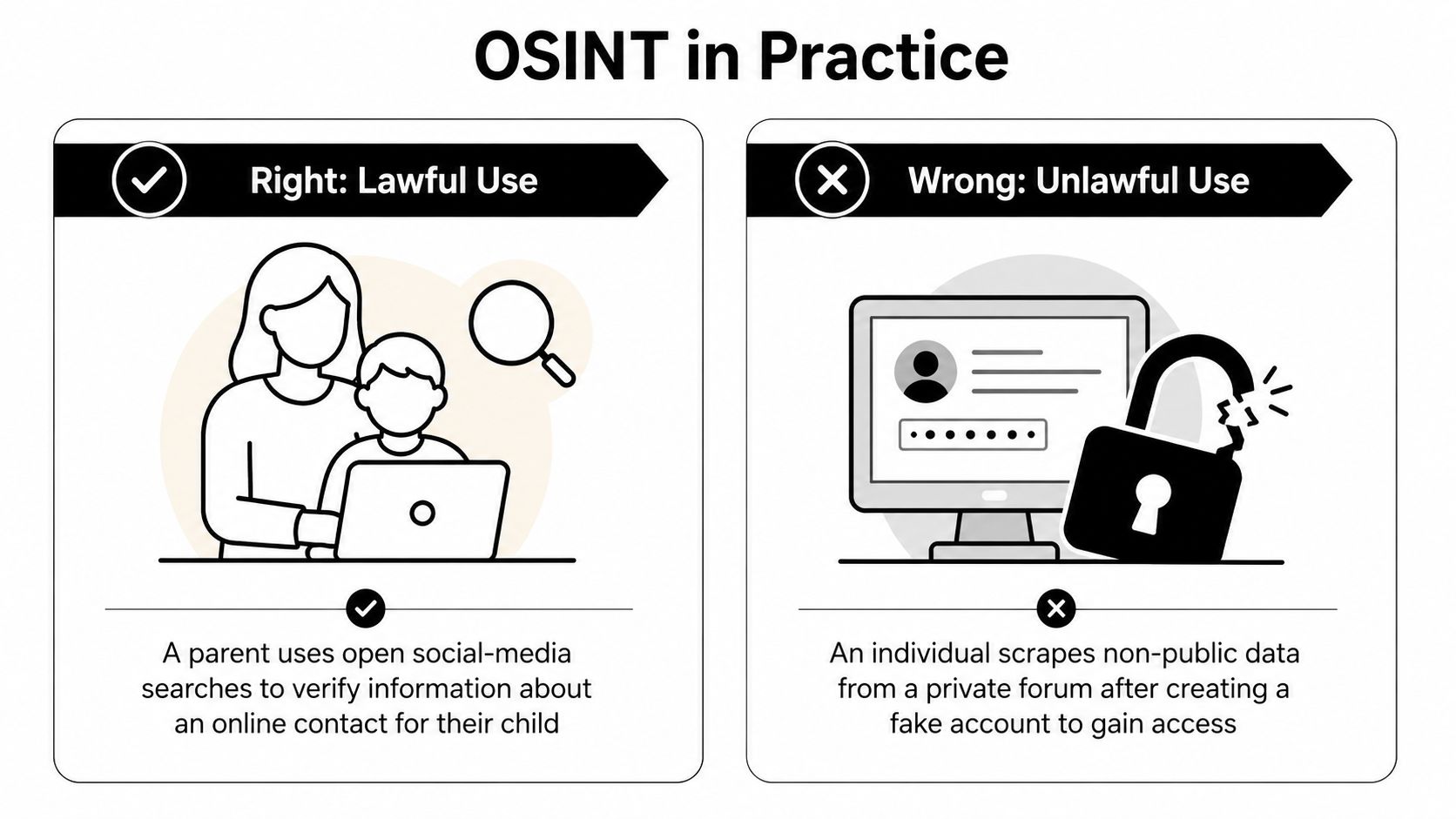
When the same skills cause harm
A private investigator who logs into a target’s email using a recovered password has crossed beyond public-source research. The investigator isn’t merely reading information that anyone could see. They’re using a credential to enter a protected account, retrieve private material, and potentially expose the account owner to further harm.
Romance-scam recovery creates another dangerous setting. A victim may hire an online “recovery expert” who promises to identify the fraudster, then asks for credentials, private screenshots, or an upfront payment. An operator who scrapes victims’ private data without consent can compound the original privacy violation. Promises to recover funds aren’t proof of legitimacy.
The financial and personal consequences of romance scams are substantial. FTC data reported 55,604 romance-scam complaints in the first nine months of 2025, with reported losses exceeding $1.16 billion, and the median loss per victim in the third quarter of 2025 was $2,218. The same reporting showed that nearly 60% of people who lost money to a romance scam in 2025 said the scam began on social media. The FTC-related romance-scam reporting helps explain why ethical boundaries matter in catfishing detection and fraud prevention.
Before trusting an investigator, ask what sources they’ll access, whether they need your password, how they handle evidence, and whether they can explain their process without promising certainty.
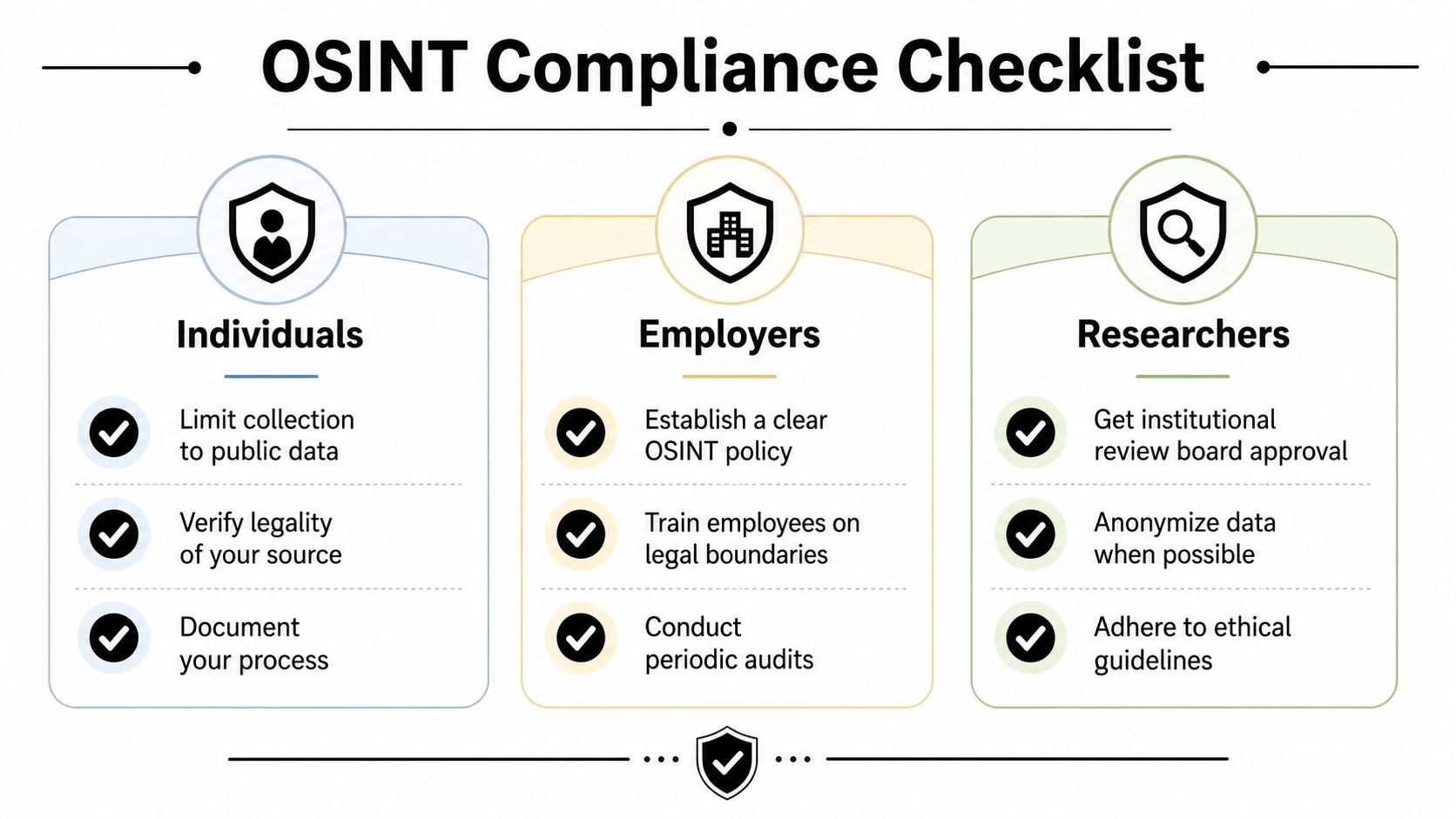
A Practical Compliance Checklist for Individuals, Employers, and Researchers
A useful policy should be specific enough to follow during a stressful investigation.
Individuals
- Stay with public access: Use pages that an ordinary visitor can view without logging in.
- Define the reason: Checking your own digital footprint is different from profiling a stranger.
- Keep records proportionate: Save relevant evidence, not every personal detail you discover.
- Protect what you find: A report about exposed accounts can become harmful if shared carelessly.
For a personal audit, a service such as Digital Footprint Check can search publicly visible information across social, professional, gaming, breach, and public-record contexts. Review this social media screening policy before designing an organizational process.
Employers
- Write the purpose first: State what screening can and cannot assess.
- Separate research from decisions: Don’t let informal searches become undisclosed employment screening.
- Train reviewers: Staff should recognize identity mismatches, sensitive information, and prohibited access methods.
- Document retention: Set access, correction, and deletion rules before collecting data.
Researchers
- Use authorized environments: Prefer sandbox accounts, honeypots, and test data where possible.
- Minimize publication: Remove personal details that aren’t necessary to support the finding.
- Explain methodology: Readers should understand what was public, how it was verified, and what remains uncertain.
- Seek review: Consult institutional ethics processes or legal counsel when research involves people, sensitive data, or foreseeable harm.
Red Flags, Gray Zones, and How to Stay on the Right Side of the Line
Buying a pre-built OSINT dossier isn’t automatically unlawful, but it creates immediate questions about provenance, lawful basis, accuracy, retention, and intended use. If the seller can’t explain where the data came from or why you’re permitted to use it, the low-friction purchase may create more risk than a careful public search.
Using scraped data for romance-scam recovery is another gray zone with a simple safety answer. Don’t hand over account credentials, private messages, identity documents, or payment to an operator promising guaranteed recovery. Share relevant evidence with your bank, the platform, and appropriate authorities instead.
Background-checking a dating match requires restraint. Reviewing public information to verify whether basic identity claims are consistent can support personal safety, but collecting sensitive details, contacting relatives, publishing findings, or treating an uncertain match as proof can create privacy and safety problems.
Stop when you see these warning signs
- “Full profile dumps”: The seller promises private or hidden information.
- Crypto-only payment: The operator demands payment that is difficult to reverse.
- No provenance policy: Nobody can explain the source, collection method, or deletion process.
- Authentication bypass: The tool advertises access to private accounts or restricted pages.
- Guaranteed conclusions: The service claims it can prove identity, intent, or guilt from scattered online clues.
OSINT legality isn’t a binary label attached to a tool. It’s a discipline of method, purpose, proportion, and accountability. For your own identity, start by checking what strangers can already see, then remove unnecessary exposure, secure accounts, and correct misleading profiles.
Digital Footprint Check helps individuals and businesses review publicly accessible information across social, professional, gaming, breach, and public-record sources. Visit Digital Footprint Check to run a free check of your online footprint and identify exposure you can address without bypassing private accounts or access controls.