
· Digital Footprint Check · Content Marketing · 14 min read
What Is Open Source Intelligence and Why It Matters
What is open source intelligence? A plain guide to public sources, the intelligence cycle, ethical limits, and false matches.

Open source intelligence is the systematic collection, verification, analysis, and dissemination of intelligence drawn from publicly accessible information, a discipline the U.S. government put on an official footing on February 26, 1941, when it created a service to monitor foreign shortwave broadcasts. By the end of 1942 that operation was translating approximately 500,000 words per day from 25 broadcast stations in 15 languages, and the analysts doing it were not stockpiling facts. They were reading intent.
The advice you'll meet most often is far simpler than that. Search your own name, open the first few results, try a couple of usernames, maybe run an email through a breach lookup, and consider the job done.
That advice gets two things wrong at once. It confuses finding with knowing, and it treats a public page as if it were a proven fact. Availability is not truth, and it is not permission either. A verification discipline has an unusual consequence that most guides skip: sometimes the responsible move is to read something accurate and decide not to use it, not to keep it, and not to repeat it.
What Open Source Intelligence Is Beyond a Google Search
Open source intelligence is the systematic collection, verification, analysis, and dissemination of intelligence drawn from publicly accessible information.
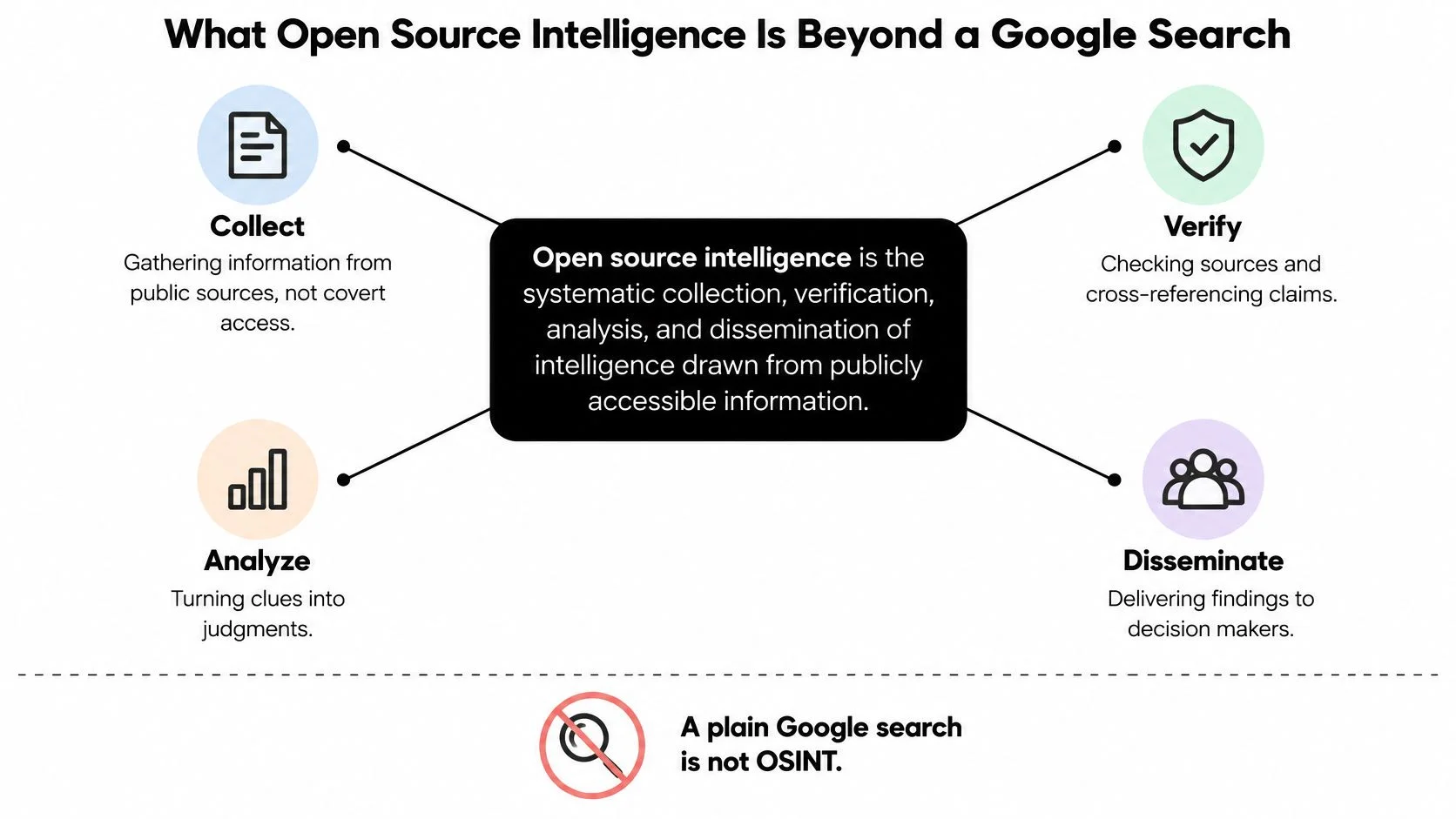
The internet is only one place to find open source information. A search engine can surface a clue, but a plausible result is not yet a reliable conclusion. Intelligence takes shape when a specific question meets evidence that has been checked, dated, and weighed against other evidence.
Three practices that look alike and aren't
| Practice | Access | Method | Result |
|---|---|---|---|
| Casual web search | Public pages that rank | Read the first plausible hits | An unverified impression |
| Open source intelligence | Publicly accessible information chosen to answer a question | Collect, validate, corroborate, and report confidence | Intelligence for a specific decision |
| Closed or classified collection | Non-public or restricted access | Restricted analysis under special authority | Not OSINT |
A journalist piecing together a company's ownership from filings, a parent checking whether a game account is being shared, and an analyst mapping a supply chain may all use OSINT. Their questions differ, but each needs to judge whether the available material supports a conclusion.
The method predates the internet. Radio monitoring shows why collecting information is only the beginning: analysts must interpret material in context before it can support a judgment. Today, sources may include websites, news archives, social media, public records, satellite imagery, and breach disclosures. A paid board seat search with SeatSignal, for example, can draw on filings, announcements, and named officers rather than rumor.
Even accurate public information is not automatically true, current, or appropriate to use. A name on a page may refer to someone else; an old record may no longer describe the present. OSINT requires verification, and sometimes responsible analysis means refusing to use information that is accurate but unfair or irrelevant.
How the Intelligence Cycle Turns Clues into Judgments
An OSINT search becomes useful when it answers a defined question. A published treatment of the OSINT workflow describes a process of collecting, processing, validating, analyzing, and delivering publicly available information for a specific requirement. Without a clear question, browsing can become an afternoon of clicking.
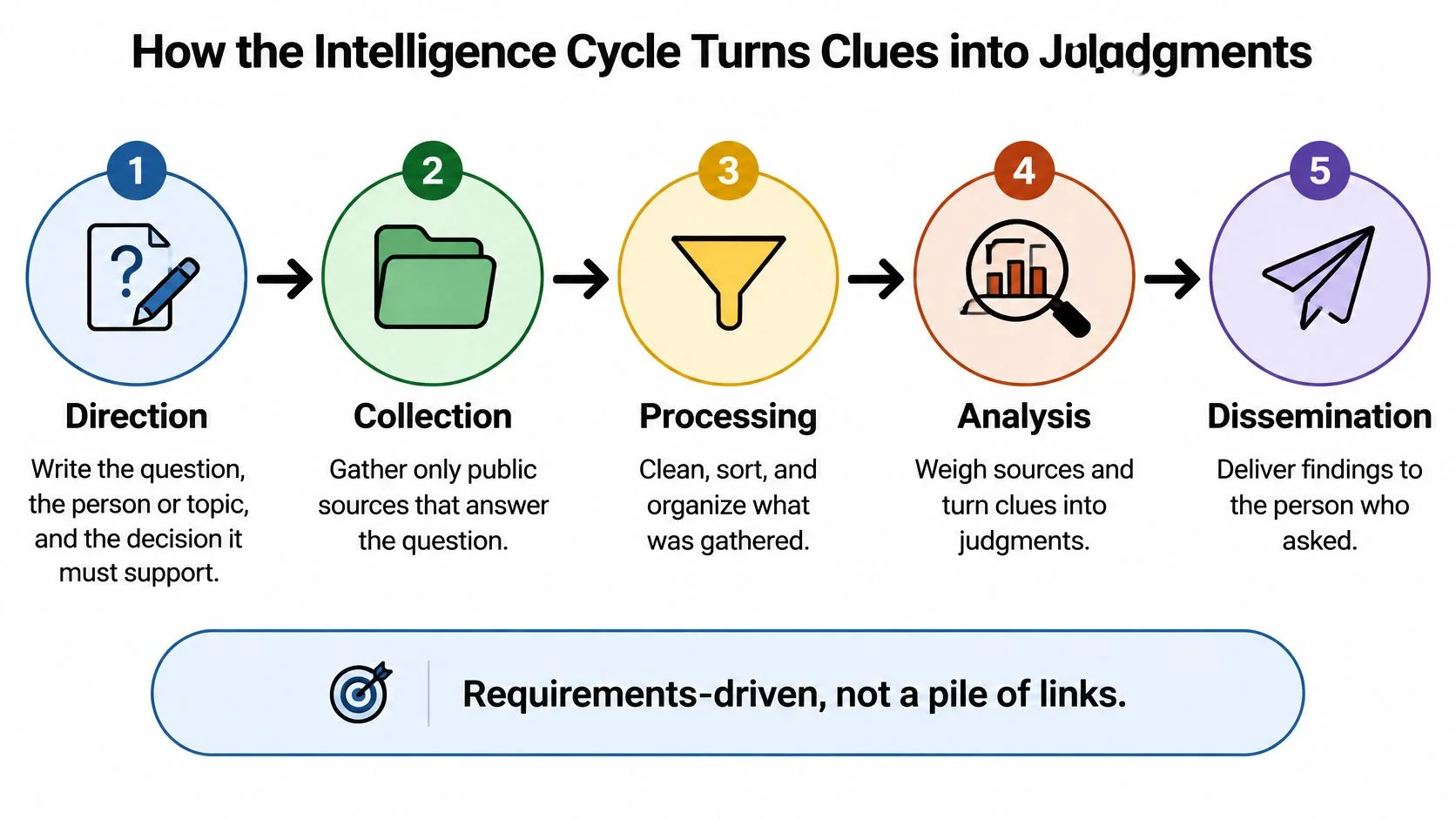
The six stages, and why each one exists
- Direction. Define the question, the person or brand, the time window, and the sources you will accept before searching. A clear scope keeps the work focused.
- Collection. Gather material that could answer the question, such as government records, news, commercial datasets, imagery, expert writing, and social posts. Interesting information is still noise if it cannot help answer the question.
- Processing. Put information into a consistent format, remove duplicates, and record each URL and retrieval time. Note how much confidence the source deserves. An undated screenshot, for example, is difficult to assess.
- Analysis. Compare independent identifiers and timestamps. A username match alone may be coincidence; other details and a compatible timeline can strengthen the link. A plausible match is still not proof.
- Dissemination. Give the reader a concise report that separates what you found from what you inferred and what remains unknown.
- Feedback. Check whether the report answered the original question or only led to more browsing. Many footprint projects stall here without anyone noticing.
Each stage shapes the next. A defined question and a clear standard for corroboration can reduce irrelevant collection and mistaken attribution. Unfocused searching produces more material, but volume alone does not make a judgment sound.
The loop is easier to follow in a walkthrough:
Consider an audit of your own digital footprint before a job search. First choose the goal: exposure discovery asks what is visible, reputation risk asks what an employer or client might find damaging, breach awareness asks whether credentials have leaked, and account attribution asks whether a profile using your name is yours. For each finding, record four things: URL, timestamp, identifier, and confidence. That ledger makes it easier to revisit the reasoning if a page changes or disappears, much as a due diligence investigation requires a clear record of how conclusions were reached.
Public Sources and When a Match Is Not Proof
A phone book can list the right name and still introduce the wrong person. Public pages work the same way. A username, a city, or a court filing can be real and still fail to prove who you found, or whether you should use what you found.
A Springer chapter on OSINT method names the problem as data fusion under uncertainty. Public sources differ in reliability, structure, freshness, access conditions, and naming conventions. The practical response is to log every observation as an evidence record, not as a conclusion.
Three words worth keeping apart: an observation is what the page shows. An inference is the link you think you see. An accusation needs independent proof, a standard no single page meets.
Entity resolution is the technical name for deciding whether two records describe one person. It works by combining stable and semi-stable features: a username, email address, phone number, profile image, organization, geography, and activity dates. A match gets stronger only when independent attributes agree and the timelines fit together. A handle like "coffeelover91" on four platforms is weak evidence, because many people could choose it. That same handle beside a distinctive avatar, a linked domain, a matching city, and a posting history that runs continuously through the same period is a different proposition.
Where each source type misleads
| Source type | Typical content | Useful for | Main trap |
|---|---|---|---|
| Social profiles | Posts, bios, photos, connections | Intent and cross-account links | Shared or abandoned handles |
| Public records | Court, property, and company filings | Stable official identifiers | Same name, different person |
| Breach disclosures | Exposed emails, usernames, and passwords | Credential-exposure risk | Does not prove the person still controls the account |
| News and archives | Reported events and dates | Context and timelines | Repetition is not independent confirmation |
| Imagery and maps | Location context | A check independent of self-description | Misread coordinates or old imagery |
| Forums and gaming profiles | Usernames and activity history | Linking accounts across platforms | Common names are weak signals |
Repetition catches careful people. Five headlines repeating one wire story look like five sources. They are one. A paper in the European Journal of Public Health makes the point that OSINT cuts both ways: it can protect people, and it can also hand adversaries material for profiling and disinformation. Automated tools remain weak at contextual reasoning, so human oversight still decides what a match means. A matching photograph, a shared city, or a breach record may be coincidence. It may also be a decade stale. Either way, availability is not truth, and truth is not permission.
Disconfirming evidence deserves the same energy as confirming evidence. Look for a different age, a clashing timeline, a school or employer the person never mentioned, an account run by a namesake, or a profile the person plainly does not control. If the theory survives that test, it is a candidate rather than a conviction. If it does not, refuse the finding even when one detail was accurate.
Provenance keeps the rest honest. Capture publication and retrieval times. Keep the original context of a post so deleted or edited content is not misrepresented. Hash downloaded files when a formal record has to hold up. Keep source reliability separate from claim credibility. A serious publication can repeat an unverified claim, and an anonymous forum account can hand you a lead worth chasing. "This outlet is trustworthy" and "this specific sentence is proven" are different judgments.
Families who want to understand how UK nanny agencies work when background checks are involved hit the same wall. A public record confirms that a name appeared. It does not confirm that the filing belongs to the person standing in front of you. A shared name across two counties is a common false positive. The same caution applies when you follow how to do a free people search on yourself or weigh what you found about someone else.
Automated matching raises the stakes rather than settling them. AI-assisted collection widens coverage, and it also widens the cost of a bad link, because a wrong match now travels through aggregation at speed.
Why Available Information Is Not Always Fair to Use
Public does not mean ethical, lawful, or safe to act on.
That sentence runs against almost everything written about this subject. Most introductions define the discipline as collecting what anyone can access, then stop, as if visibility settled the matter. A U.S. government ethical framework for OSINT keeps privacy law, necessity, and non-malicious use inside the definition rather than bolted on afterward. The reasoning is straightforward once you see it: a page can be visible because of a leak, an illicit recording, or someone circulating it without consent. Context and power decide whether using it is fair, and a search result decides nothing.
Four situations show how differently the same technique lands.
- Your own exposure. The purpose is self-protection, the scope is your own identifiers, and there's no consent problem because it's you. This is the simplest legitimate case.
- An employer screening a candidate. The purpose must be job-related and stated in advance. A check that drifts into health, religion, family circumstances, or relationship history has left screening behind and entered dossier building.
- A parent worried about a child. Concern is a legitimate motive, but proportionate collection means enough to answer the safety question, not a permanent archive of a teenager's private life.
- Someone tempted to profile a date. Verifying that a person exists is reasonable. Compiling their movements, friendships, and family from scattered posts is surveillance with extra steps.
Run five tests before you collect anything: is there a specific legitimate purpose, is the collection limited to what that purpose needs, was consent required or already given, how long will copies be kept, and can the person correct a mistake. A professional identity someone publishes on purpose, a portfolio or a work profile that affects their job prospects, is fair to read. A behavioral file assembled from fragments across a dozen platforms is not, even when every fragment is accurate.
The restraint rule: aggregating harmless facts can create a profile far more intrusive than any single source intended, so responsible practice sometimes means ignoring accurate information because using it is unnecessary or foreseeably harmful.
Which is why the legal and ethical boundaries of OSINT matter more in routine personal checks than in newsroom work, where editorial oversight usually catches the worst instincts.
Document purpose and uncertainty. Don't retain, share, or accuse beyond the original need. That's the entire governance model, and it fits on an index card.
Everyday Risks from Hiring Screens to Stolen Accounts
A public profile can help someone find a job, or give a recruiter a reason to pause. The same information can also help a scammer impersonate a relative. OSINT makes these details easier to connect, but a match is still a clue, not proof, and public availability is not permission to use information for every purpose.
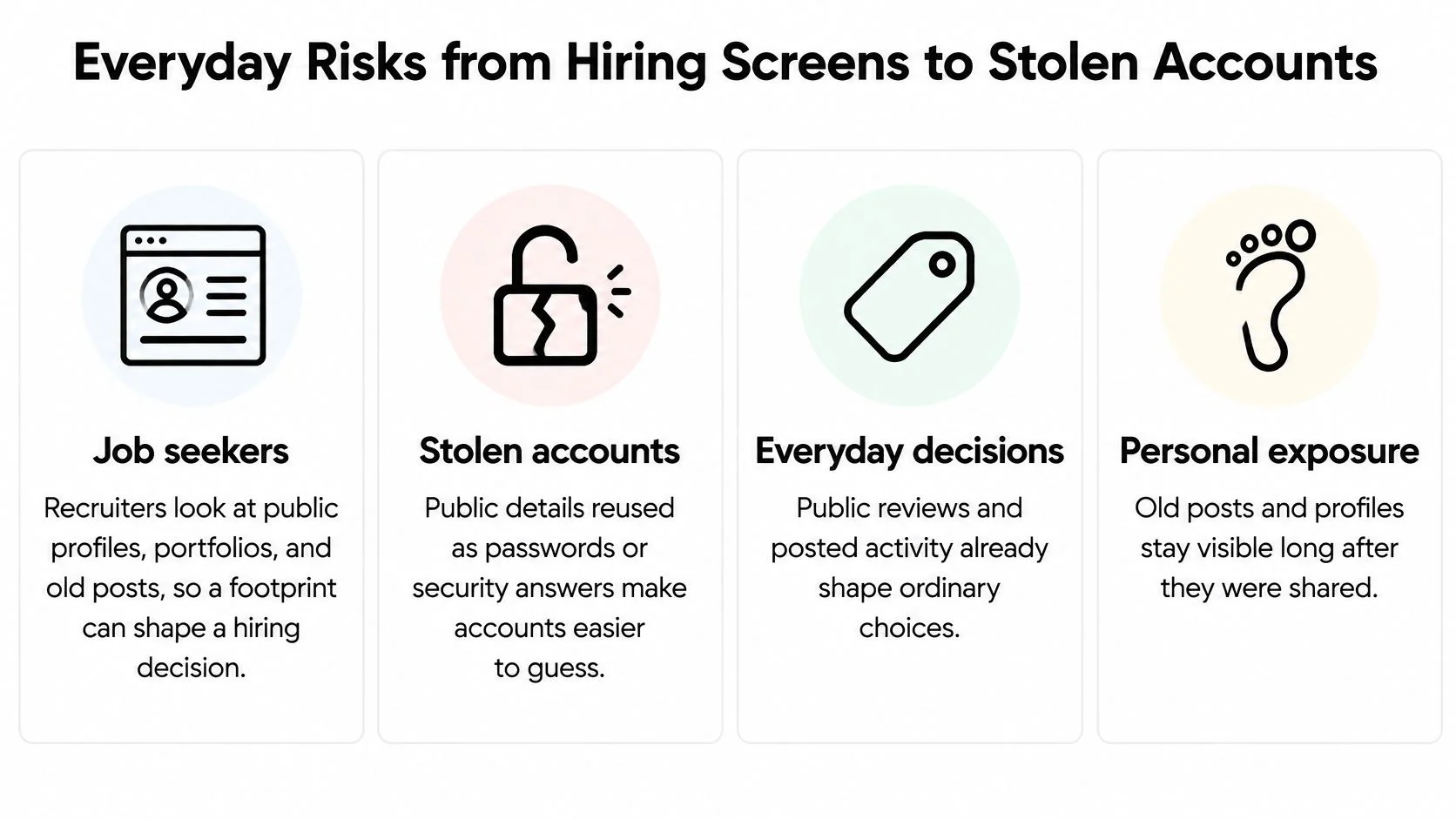
For job seekers, public profiles and portfolios can show relevant work, while old posts may create an impression that no longer reflects who they are. Recruiters should keep screening tied to a stated, job-related purpose. A written social media screening policy can help HR teams apply consistent limits rather than letting curiosity shape a hiring decision.
In dating, a photo, city, or username may help check whether details are consistent. None confirms identity on its own, and none justifies sending money. A reused gaming handle or email can also connect accounts that someone intended to keep separate. For scammers, those connections can help make phishing or impersonation more convincing.
The numbers behind the risk
Verizon's 2025 Data Breach Investigations Report analyzed more than 22,000 security incidents, including 12,195 confirmed data breaches. Credential abuse accounted for 22% of initial attack vectors and vulnerability exploitation for 20%. Third-party involvement in breaches doubled to 30%, while vulnerability exploitation rose 34% compared with the prior reporting period, according to the 2025 DBIR small business snapshot. The same report found that, in the median case, only 49% of passwords observed in information-stealer logs were unique across services. Reused passwords can let one exposed credential put several accounts at risk.
Verizon's credential-stuffing research found that leaked secrets discovered in a GitHub repository took a median of 94 days to remediate. Credential stuffing accounted for a median 19% of daily authentication attempts in the single-sign-on logs examined, rising to 25% at enterprise-sized companies.
The FBI's 2024 Internet Crime Report recorded 859,532 complaints of suspected internet crime and reported losses exceeding $16 billion, a 33% increase from 2023. Phishing or spoofing, extortion, and personal-data breaches were the three most frequently reported categories. Cryptocurrency investment fraud produced losses exceeding $6.5 billion, and people aged 60 and over reported nearly $5 billion.
The Federal Trade Commission's 2024 Consumer Sentinel data ranked identity theft as the second-largest complaint category at 18% of all reports, with imposter scams at 13%. The data included 845,806 reports, 22% of those reporting a loss, and $2.95 billion in aggregate losses. Imposters may pose as romantic interests, relatives, government officials, businesses, or technical support. Details such as an employer, hometown, or family names can make a false story sound familiar, but their public presence does not make it fair to exploit them.
For account security, use a different password for each service and turn on multifactor authentication for email. If you hire people, keep screening focused on information relevant to the role and apply the policy consistently. Candidates looking to browse entry-level security openings can also review how their public profiles present their professional work.
Audit Your Own Public Trail the Right Way
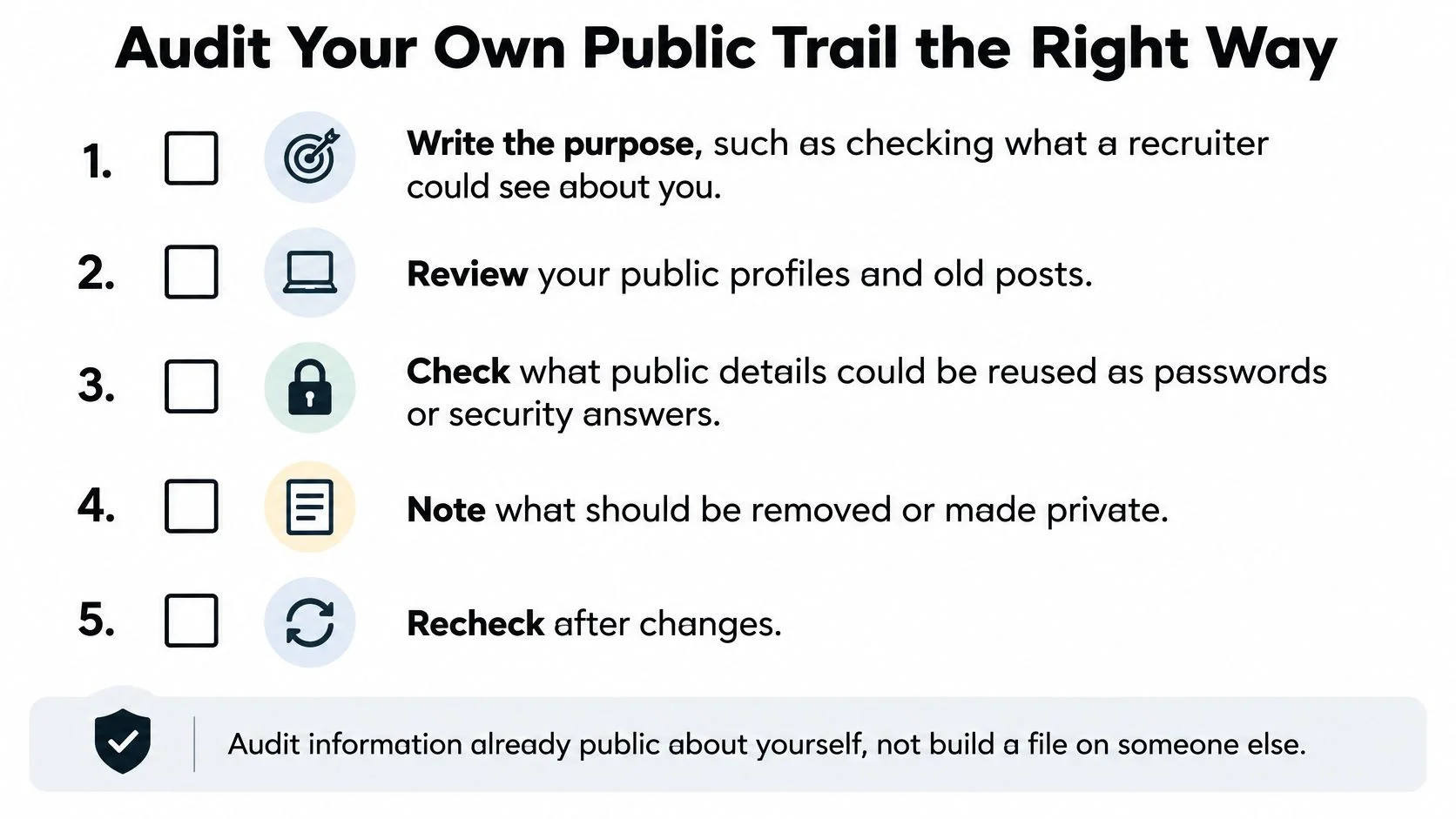
Point the method at yourself, not at someone else. Five steps, one sitting.
- Write the purpose. Job-image cleanup, breach awareness, or locking down gaming and email accounts. One of those, not all three at once.
- Search only your own identifiers. Your username or email, with a note of the URL, the date, and whether the hit is current.
- Sort observation from guess. Anything sensitive that doesn't serve the purpose gets ignored rather than saved.
- Change what's reused. New passwords, multifactor authentication on, and close or privatize accounts you no longer want public.
- Recheck later. No search is a complete picture of the internet, and new pages appear.
Step two is the one that benefits from tooling. Our guide to checking your digital footprint covers the manual version in detail.
A search here starts with a username or email and looks for publicly discoverable information across more than 500 sources, returning a preview of your footprint rather than a guaranteed full biography. The free tools are a Profile Checker, a Username Search, a Data Breach Checker, and a Reverse Email Search, and the free digital footprint checker gives you a limited preview to start from. Results depend on what you enter and which sources are available, so treat the report as a map of what's discoverable, not a verdict. Paid plans exist for people who need more searches and ongoing monitoring after that preview.
Use whatever you find to protect your own privacy, reputation, and accounts. That's the only outcome that matters.
Digital Footprint Check does the discovery work for you: enter a username or email and we scan more than 500 public sources for social profiles, gaming accounts, forum activity, breach exposures, and records that mention you. It's the same OSINT process described here, pointed at your own name and built into a report you can act on today. Start with the free check at Digital Footprint Check and see what a recruiter, a scammer, or a curious stranger can already find.