· Digital Footprint Check · Content Marketing · 13 min read
What to Do if Social Security Number Compromised in 2026
Wondering what to do if social security number compromised? Freeze credit, check reports, report fraud and set a follow-up schedule.

You open a breach letter and find the sentence you were hoping not to see: your Social Security number was involved. There's no unfamiliar charge, no collection notice, and no obvious sign that anyone has used it. You're left wondering whether to freeze your credit, report identity theft, or request a new number.
An exposed SSN is a reason to act, not proof that identity theft has occurred. If you're working out what to do if your Social Security number is compromised, start by identifying your situation. Then protect your credit, check government records, and report any actual misuse through the right channels.
Sort Your Situation Before You Act
An unfamiliar account, a rejected tax return, and a changed benefit deposit point to different problems. Separate what was exposed from what someone may have used before choosing where to report it.
Scams, stolen documents, and unauthorized access to a device can expose personal information. The FTC's guidance on identity theft risks covers risks beyond credit accounts.
Your situation, first move and where to report
| Situation | What it looks like | First move | Report to |
|---|---|---|---|
| Exposed, no misuse | SSN appeared in a breach notice, with no unfamiliar activity | Keep the notice and check for signs of misuse | No report is required for exposure alone; continue monitoring |
| Suspected credit misuse | Unknown inquiry, collection notice, or account you never opened | Check the underlying account and preserve the notice or report | FTC at IdentityTheft.gov if the activity is unauthorized |
| Tax-related misuse | IRS letter, rejected e-filed return, or duplicate return | Contact the IRS and ask about an Identity Protection PIN | IRS; report confirmed identity theft to the FTC |
| Employment or earnings fraud | SSA earnings record lists an employer you never worked for | Review the entry and keep a record of it | SSA; report confirmed identity theft to the FTC and local police |
| Benefits or account takeover | Benefit or direct-deposit change, or password reset you did not request | Contact the agency and your bank promptly | Relevant agency, the SSA Office of the Inspector General if SSA benefits are involved, and your bank |
An unfamiliar inquiry needs checking before you label it fraud. A lender may use a name you don't recognize, or a collection company may be pursuing a legitimate debt. Verify the account using contact details you find independently. If the activity is unauthorized, report it through the appropriate channel.
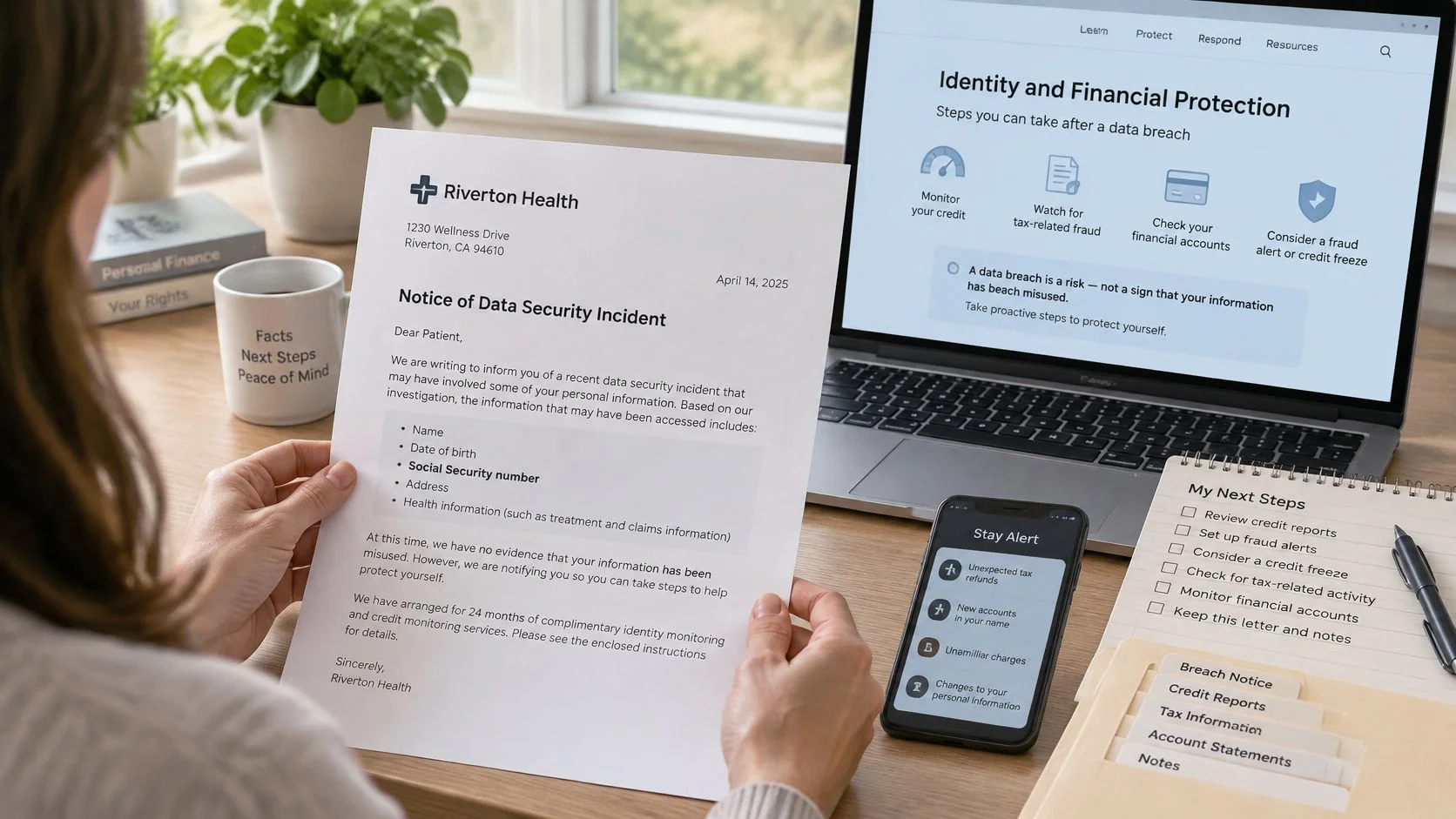
Use the breach notice as a starting point. It shows what may have been exposed, not whether anyone has misused it.
Look beyond your credit file
Credit records won't show every kind of SSN misuse. Someone might use your information to file a tax return, obtain employment, interfere with benefits, or apply for telephone service or a loan. An unfamiliar earnings entry deserves attention even if no credit account is involved.
The combination of exposed details matters. An SSN paired with your email, phone number, birth date, or employer information can make impersonation and account-recovery attempts more convincing. Read about what someone can do with your SSN to assess possible risks without treating exposure as proof of misuse.
A message naming your employer after a breach may still be deceptive. Accurate personal details don't prove the sender is legitimate. The Nerds 2 You Edmonton phishing guide explains how to recognize phishing while you're receiving breach-related messages.
Keep three categories distinct: information exposed in a breach, information visible publicly, and activity you can confirm as fraudulent. A match in one category doesn't establish another.
Public profiles can also give an impersonator context for messages or account-recovery attempts. A visible profile, gaming account, or forum post does not prove that someone has accessed an account or acted fraudulently.
Write down what was exposed and what, if anything, looks wrong. If you have no sign of misuse, record that too. This helps you choose the right reporting path without treating every possible risk as a confirmed theft.
First-Day Containment Steps in Order
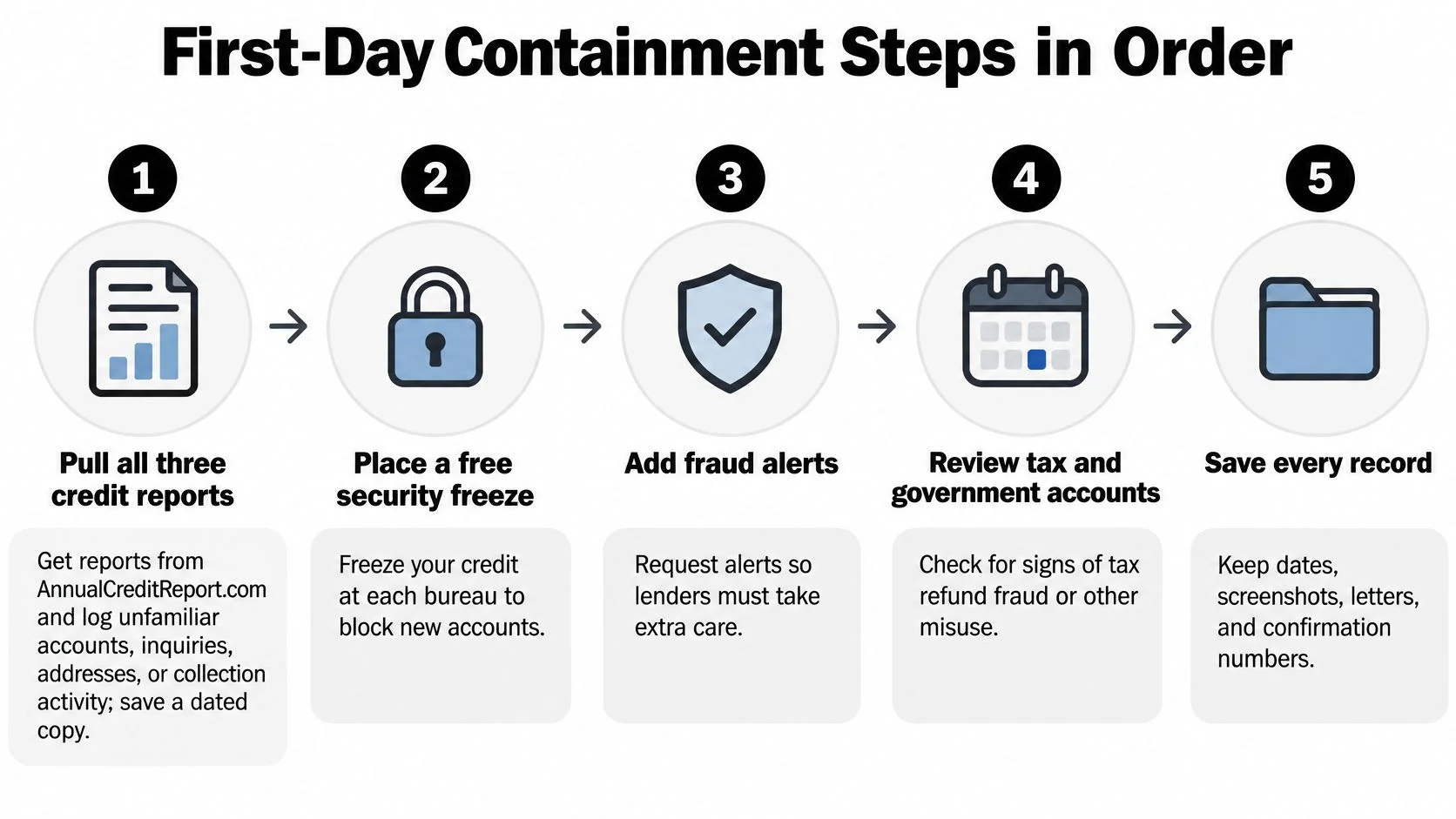
Start with records you can preserve and protections you control. Don't spend your first day chasing a replacement SSN or responding to every breach-related email.
The workflow below gives you a practical order for containment.
Secure credit and government records
-
Pull your credit reports and preserve them. Obtain reports from Equifax, Experian, and TransUnion through AnnualCreditReport.com, then save dated copies and record unfamiliar accounts, inquiries, addresses, or collections. The FTC's data-breach response guide recommends reviewing reports for unfamiliar accounts or charges; checking a credit score alone won't show you the underlying entries.
-
Place a free security freeze at each bureau. Complete the process separately with Equifax, Experian, and TransUnion, and save each confirmation in your recovery folder. The common mistake is freezing one file and assuming every bureau is covered.
-
Consider a free, one-year fraud alert as an additional precaution. Contact a nationwide credit bureau to request it; that bureau must notify the others, and businesses must take steps to verify your identity before issuing new credit. An alert isn't a substitute for completing your freezes.
-
Create or secure your personal my Social Security account. Review your earnings record for employers you don't recognize, and protect the associated email account with a unique password and multifactor authentication. Don't treat an uneventful bank statement as evidence that your government records are also correct.
-
Request an IRS Identity Protection PIN. This six-digit control authenticates federal tax returns, and checking credit, freezing bureau files, securing your SSA account, and obtaining the PIN are part of the SSA Office of the Inspector General's SSN-protection workflow. Keep the PIN secure and available when you prepare your return.
-
Enable transaction alerts and schedule follow-up checks. Turn on bank and card notifications, review recovery email addresses and phone numbers, and record your next review dates. Alerts help you notice activity, but they don't replace opening statements and checking government correspondence.
Make the protections usable
Keep a short completion log: bureau name, freeze status, date, confirmation location, and any unresolved question. Don't put your full SSN or account passwords in a casually shared document.
For additional context on protecting your credit after a breach, LifeBack Law Firm's Equifax breach guidance discusses credit-focused precautions. Our identity-theft action guide can help organize the broader account-security work.
A freeze makes new-account credit fraud harder; it doesn't stop tax, employment, or benefits misuse. Likewise, a clean credit score doesn't prove your SSN is safe. Plan to lift the relevant freeze before a legitimate loan or card application, rather than discovering the restriction while the lender is processing it.
If you prefer a video explanation alongside your written checklist, use this overview.
How to Report Confirmed Identity Theft
Report the specific misuse you can document. An account you didn't open, an unauthorized benefits change, or an earnings entry for work you didn't do gives you a concrete issue to investigate and correct.
The SSA's identity-theft guide supports a documented recovery process involving the FTC, affected companies, police, and the relevant government agencies. Your aim is to create a consistent evidence trail, not to make several calls.
Follow a documented reporting sequence
-
File at IdentityTheft.gov. Create an FTC Identity Theft Report and a recovery plan. Describe what happened accurately, distinguishing confirmed facts from activity you're still investigating.
-
Contact each affected creditor or service provider. Use contact information from an official website or an existing statement, not a suspicious letter or text. Ask for the fraud department, dispute unauthorized accounts in writing, and request written confirmation that the accounts aren't yours and have been removed.
-
File a local police report. Bring your FTC report and supporting records, and retain the report number. For qualifying online crime, also submit an IC3 complaint, preserving messages, payment details, and relevant account information.
-
Notify the relevant government agency. Contact the IRS about suspected tax fraud and review SSA earnings for unauthorized employment. If someone changed benefit payment details, contact the administering agency and your bank immediately.
-
Maintain a single recovery folder. Save case numbers, dates, call summaries, letters, screenshots, and delivery records. Keep freezes or fraud alerts active while you resolve the disputes.
Avoid sending every organization an unfiltered archive. Give each recipient the evidence relevant to its account, retain the originals, and record exactly what you sent. If a company asks for additional identification, verify its submission process before uploading sensitive documents.
Build a usable dispute letter
A phone call can start the investigation, but written correspondence gives you a record of what you disputed and requested. Use this structure:
- Your details: Full name and mailing address.
- Date: The date you send the letter.
- Recipient: The creditor's or provider's fraud department.
- Account reference: The disputed account number and when you first noticed the problem.
- Statement of nonauthorization: State that you didn't open or authorize the account.
- Requested correction: Ask for removal, written confirmation, and a copy of any application submitted in your name.
- Enclosures: List the FTC report, police report, and relevant supporting documents.
- Signature: Sign the letter and retain a complete copy.
Send the letter using a trackable method and preserve delivery confirmation. Treat the FTC Identity Theft Report as your central supporting document, while recognizing that a creditor or agency may need evidence specific to its records.
Ask for a case number before ending each call. Record what the representative agreed to do and how you'll receive confirmation.
If the misuse involves someone giving your identity to law enforcement, ordinary credit disputes won't correct that record. Our guide to criminal identity theft explains that distinct problem and why you need to identify the agency holding the inaccurate information.
Don't mark an issue resolved because a representative said it was handled. Keep the written outcome and check that the affected record reflects the correction.
Follow-Up Timeline for the Next Twelve Months
Someone who obtains your SSN doesn't have to use it immediately. Tax misuse may become apparent when you file, while unauthorized employment may appear when you review earnings records. A quiet initial check is a baseline, not an all-clear.
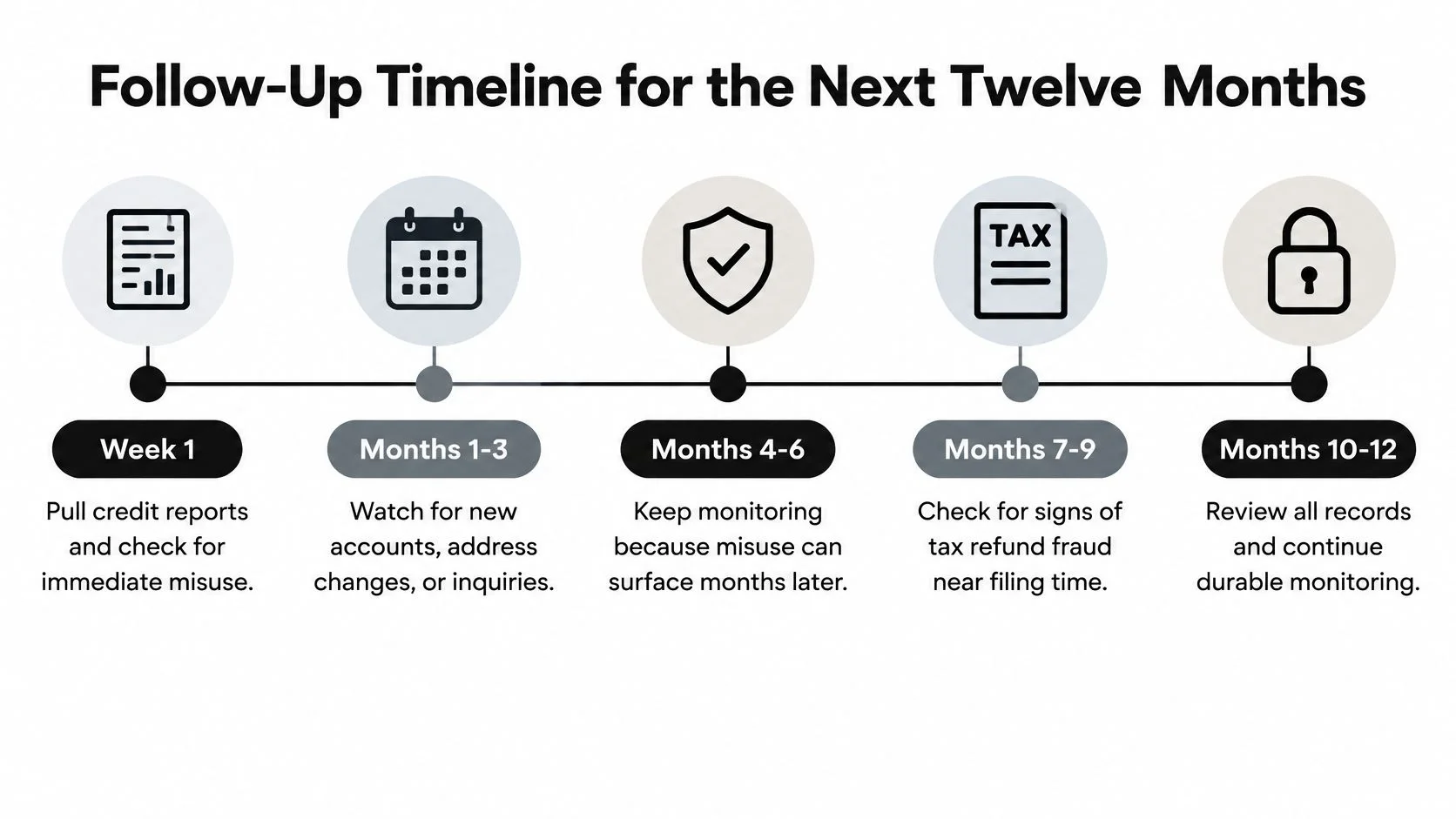
Use the schedule below as a practical monitoring plan, not a promise that misuse follows predictable dates.
Monitoring schedule after an SSN exposure
| When | What to check | Why it matters |
|---|---|---|
| Week 1 | Three credit reports and your SSA earnings record | Helps identify unfamiliar accounts and unknown jobs |
| Month 1 | Bank, card and benefit statements; confirm the freezes still hold | Helps find small test charges and unexpected account changes |
| Every 3 months in year one | Credit reports from all three bureaus | Helps detect misuse that becomes visible after the initial review |
| Before each tax filing deadline | IRS account status and your Identity Protection PIN | Helps identify filing problems and ensure your return uses the PIN protection |
| Yearly after year one | SSA earnings statement and whether the credit freeze is still active | Keeps monitoring light but durable |
The timeline provides a reminder to check different records, rather than repeatedly looking only at your credit score.
Change the plan when a check fails
An unfamiliar account should trigger investigation and, once confirmed as unauthorized, the reporting process. An incorrect earnings entry calls for SSA follow-up; an unexpected return or tax notice calls for IRS follow-up. Don't wait for the next scheduled review when you discover a problem.
If you lift a freeze for a legitimate application, confirm its status afterward and reinstate protection promptly when needed. The FTC's identity-theft guidance explains that freezes are free, must be placed with each nationwide bureau, and can be lifted when you need to apply for credit.
For eligible identity-theft victims, an extended fraud alert can last seven years, while a freeze remains until you lift or remove it, according to the FTC's breach-recovery guidance. Keep the protection you chose active while disputes remain unresolved.
Calendar rule: Add a reminder before every tax filing deadline and before every credit application.
There's a reasonable point to reduce the checking workload. If every bureau has shown no unfamiliar activity throughout your monitoring year, your SSA earnings match your work history, and your IRS account shows no unexpected returns, consider moving to an annual review while keeping your freeze and Identity Protection PIN protections in place.
That's a maintenance decision, not proof that exposed information has disappeared. Keep transaction alerts and respond immediately to new warnings. Our guide to what to do after identity theft can help you maintain the correction records you may need later.
Decide Whether a New SSN Is Worth Requesting
For most exposures, keep your current SSN and protect it. Requesting a different number isn't the routine response to a breach, and it isn't a shortcut around correcting fraudulent records.
SSA treats a replacement number as an exception. You'll need evidence that problems continue despite your attempts to resolve them, together with documentation establishing identity, age, and citizenship or immigration status. A replacement card is also different from receiving a new number.
The decision concerns persistent, documented harm, not just how alarming the breach notice sounds.
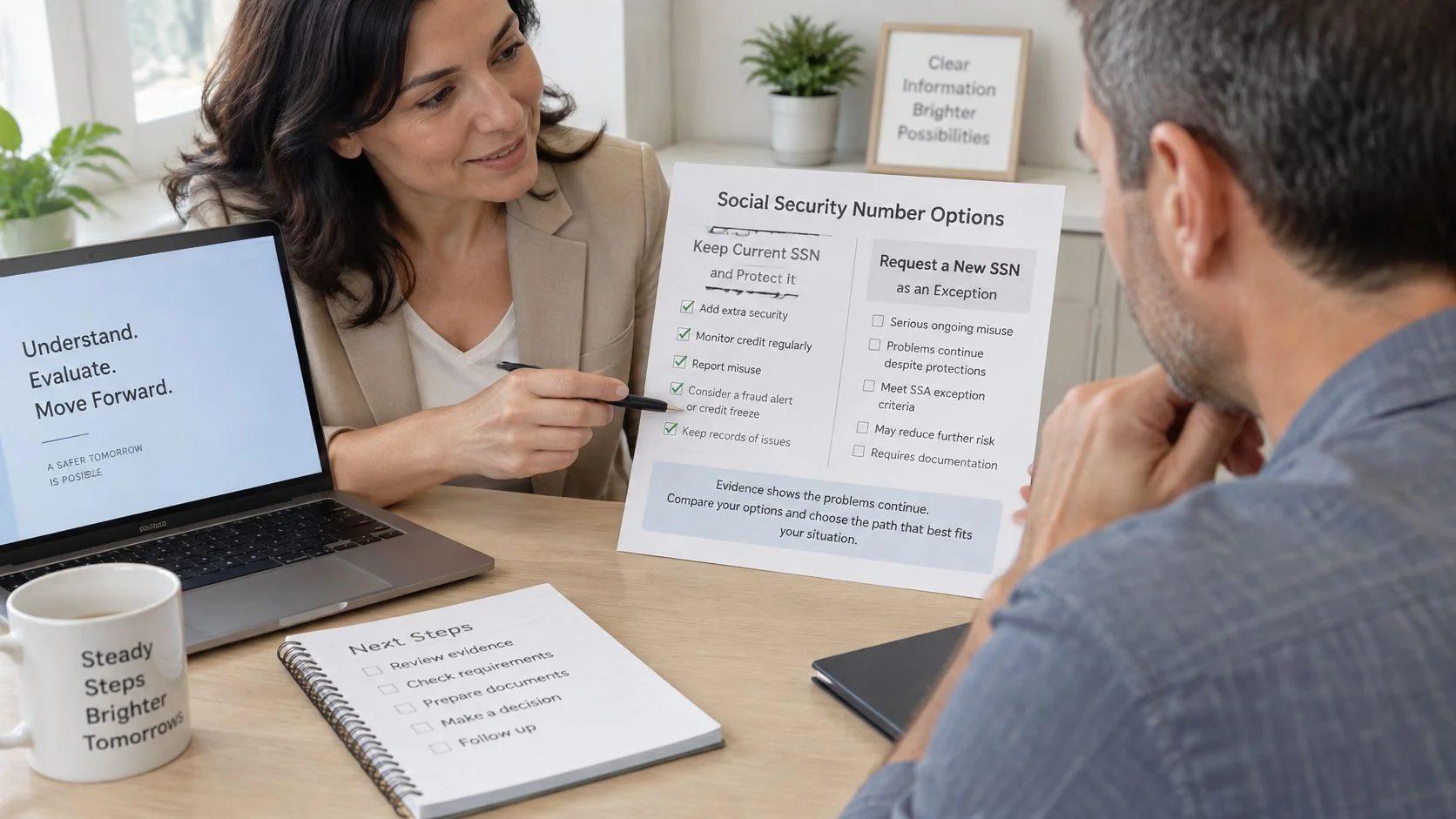
Test whether replacement addresses the problem
Before approaching SSA, work through these questions:
- Containment completed: Have you secured the affected accounts and finished the reporting process?
- Continuing misuse: Has unauthorized activity continued after those measures?
- Evidence available: Can you show your reports, disputes, outcomes, and required identity documents?
- Problem identified: Are the remaining issues tied to continued use of the old number, rather than uncorrected records or compromised account credentials?
If you've completed containment, misuse continues, and you have supporting documentation, talk to SSA about your circumstances before deciding. Otherwise, concentrate on the unresolved accounts, your PIN protection, and your monitoring calendar.
A new SSN doesn't erase old records. Unresolved creditor, tax, and employment records still require separate correction, and you'll have another record trail to manage. If an attacker controls your email or recovery phone account, changing a government identifier won't remove that access.
Reduce the exposure you can control
Keep your Social Security card stored securely, avoid sending the number through ordinary email, and question requests that don't explain why it's necessary. Our guide to protecting your Social Security number provides additional habits for limiting future disclosure.
Then examine the surrounding information an impersonator could use. Check whether your email, phone number, or usernames connect to breach exposure or public profiles at our free exposure checker. Our free Data Breach Checker checks email addresses for known breach exposure, and our profile tools help identify potential matches; continuous breach and dark web monitoring alerts users to potential identity-theft risks.
Our process is straightforward: search a username or email, review potential matches, then act using step-by-step guides. Review matches carefully before treating them as yours, especially with common usernames.
We report what we find, but we don't remove information on your behalf. Our guides explain how to contact sites or request changes yourself. Public-profile discoveries can help you assess professional reputation, gaming-account exposure, or dating-profile impersonation, but they don't establish identity theft or replace official records.
Visit Digital Footprint Check to identify exposed account connections and review practical steps for reducing your online exposure. Start with the email or username connected to the breach, assess the potential matches, and use the guides to address what you can control while keeping your credit and government-record protections active.