· Digital Footprint Check · Content Marketing · 14 min read
How Can I Protect My Social Security Number: 2026 Guide
Learn how can i protect my social security number with our 2026 guide on prevention, detection using OSINT, and recovery. Includes checklists and expert tips.
You usually find out your Social Security number is exposed long after the leak happened. The warning sign might be a bill for an account you never opened, a tax filing problem, or a login alert from a government account you didn’t touch. By then, the problem isn’t theoretical. Someone is trying to use one of the most powerful identifiers tied to your name.
If you’re asking how can i protect my social security number, the answer isn’t “buy one product” or “watch your credit.” It’s a layered defense system. You need to reduce exposure, lock down official accounts, look for leaks before criminals act on them, and know exactly what to do if something goes wrong.
Why Your Social Security Number Is a Master Key
A Social Security number isn’t just another piece of personal data. Criminals use it to connect the rest of your identity. Once they have your SSN plus basic details like your name, address, or date of birth, they can try to open accounts, interfere with tax filing, or impersonate you in systems that still rely on SSN-based verification.
That’s why I treat an SSN as a master key, not a routine identifier. A stolen password can often be changed quickly. A stolen SSN is different. It tends to stay valuable for years because you can’t easily replace it, and many institutions still use it in background processes you never see.
A practical way to think about SSN protection is through three jobs:
- Prevention: share it less, store it better, and lock down the accounts that use it.
- Detection: look for signs it has leaked or is being used where it shouldn’t be.
- Recovery: act fast when something looks wrong so you limit damage.
Many individuals focus only on recovery. They wait for a fraud alert, a rejected tax return, or a collections notice. That’s late. Good SSN protection starts earlier.
Working rule: If you wouldn’t hand a stranger the keys to your house, don’t hand over your SSN just because a form includes a blank line.
The other mistake is treating identity theft as only a banking problem. It can affect taxes, employment records, benefit accounts, and your broader digital footprint. If you want a plain-language look at the kinds of abuse that can follow, this guide on what someone can do with your SSN is useful context.
The First Line of Defense Knowing When to Say No
The easiest SSN theft to stop is the one that never gets an opening. Most exposure happens through ordinary paperwork, lazy intake forms, oversharing, or accounts that never needed the number in the first place.
Some requests are legitimate. Many are not.

When you usually need to provide it
There are situations where giving your SSN is normal and necessary:
- Employment paperwork: employers may need it for wage reporting and tax forms.
- Tax filings and IRS-related processes: your SSN is part of identity and filing verification.
- Credit applications: lenders may require it when checking credit history.
- Some government benefit systems: identity matching often depends on it.
In those settings, the better question isn’t “should I refuse?” It’s “how is this being stored, and who can access it?”
Ask direct questions. Don’t apologize for it.
When you should push back
Many businesses ask for SSNs because their forms have always asked for them. That doesn’t mean they need yours. Common examples include doctor’s office intake packets, school systems, apartment interest forms, gym memberships, and non-financial online signups.
Use plain language:
- At a front desk: “Is my Social Security number legally required for this, or is there another identifier you can use?”
- On a form: “I’m not comfortable putting my SSN here unless it’s mandatory. Can you mark this as declined and proceed another way?”
- For online accounts: “I don’t provide SSNs for non-credit services.”
That short pause matters. Staff often reveal that the field is optional, or they offer another route.
If the person requesting your SSN can’t clearly explain why they need it, how they’ll protect it, and what happens if you refuse, don’t provide it.
Family exposure is where people get blindsided
Parents and caregivers often guard their own SSNs more carefully than the numbers tied to children or older relatives. That’s a gap criminals exploit. School enrollment files, medical records, youth sports databases, gaming platforms, and family-shared email accounts all create extra points of exposure.
Recent 2025-2026 data shows gamers are three times more likely to have SSNs exposed via profile hacks, and 70% of parents are unaware of their children’s digital footprints. This also highlights that 25% of identity thefts are tied to family data, according to SSA-related guidance cited here.
That changes how families should think about risk. A child’s SSN can sit misused for years before anyone notices. An elderly parent may hand over personal details to a caller who sounds official. A gamer may reuse an old email and password on a platform tied to recovery data that reveals more than expected.
What works better than generic caution
A good household rule is simple: centralize sensitive records, limit who has access, and audit the odd places where family data appears.
A quick comparison helps:
| Situation | Bad habit | Better move |
|---|---|---|
| Doctor’s office form | Filling every blank automatically | Ask if SSN is required and leave it blank unless necessary |
| School or youth activity portal | Reusing parent credentials across family accounts | Use separate logins and store records securely |
| Gaming signup | Using personal identifiers in profiles or recovery fields | Keep profiles minimal and review account recovery settings |
| Elder care paperwork | Letting documents pile up in email or mail | Secure physical copies and monitor shared access points |
If oversharing is already a pattern in your home, this piece on the hidden dangers of oversharing on social media is worth reading next.
Fortifying Your Identity with Official Safeguards
A stolen SSN becomes far more dangerous when an attacker can pair it with an unprotected credit file, an unclaimed SSA account, or a tax filing path you never secured. Official safeguards close those gaps. They are free, and they do more than careful behavior alone.
Freeze your credit before you need to
A credit freeze is the best default control for stopping new-account fraud tied to your SSN. If a lender cannot pull your credit file, an identity thief has a much harder time opening cards, loans, or other accounts in your name.
Set freezes with all three bureaus:
- Equifax
- Experian
- TransUnion
You should also pull your free reports through AnnualCreditReport.com and check for accounts, addresses, or inquiries you do not recognize. Fraud alerts are available too, but I treat them as a lighter control. A freeze puts the burden on access. That is what you want.
There is a trade-off. You will need to thaw your file before applying for credit, some rentals, or certain utility accounts. That inconvenience is minor compared with cleaning up fraudulent accounts for months.
Claim and harden your my Social Security account
Create your my Social Security account before someone else tries to register it first. That simple step removes an easy opening for account takeover and benefit fraud.
The Social Security Administration explains account setup, stronger sign-in controls, and identity verification options on its official my Social Security account security page. If you have reason to believe someone is trying to misuse your record, the SSA also allows you to ask for Block Electronic Access through its support channels listed on the same official guidance.
Use a strong password. Turn on multi-factor authentication. Review recovery options so an old email address or stale phone number cannot be used against you later.
That last point matters more than many people realize. Multi-factor authentication stops a large share of automated account attacks, and Microsoft’s security research states that MFA can block more than 99.2% of account compromise attacks.
The official safeguards that matter most
Use this checklist:
- Freeze your credit at all three bureaus. Do it before there is a problem.
- Create your my Social Security account first. Do not leave that registration opportunity open.
- Turn on multi-factor authentication everywhere it is offered. Start with SSA, your primary email, and financial accounts.
- Check your account recovery settings. Old phone numbers and inactive email accounts create easy bypass points.
- If compromise is suspected, contact SSA and ask about blocking electronic access. The SSA contact number is 1-800-772-1213, with TTY at 1-800-325-0778.
- Get an IRS Identity Protection PIN if you qualify or want stronger tax filing protection. The IRS IP PIN program adds friction where refund fraud often starts.
Don’t ignore tax fraud controls
Tax identity theft is one of the hardest SSN messes to clean up because victims often learn about it only after a return gets rejected. The IRS IP PIN helps by tying your return to a number a criminal should not have. Pair that with a secured IRS account and regular transcript checks.
If you want a broader walkthrough, these strategies to combat tax season identity theft give useful context on preventing refund fraud and filing abuse.
Government safeguards are one layer. They should sit alongside credit monitoring, breach alerts, and periodic scans of your public exposure. If you are comparing paid tools, this guide to the best identity theft protection services helps sort out which services provide protection and which ones just send alerts after the damage starts.
Find Your Leaked SSN Before Criminals Do
Traditional SSN advice has a blind spot. It assumes you’ll discover fraud after a bureau alert, a rejected return, or a suspicious letter. That’s reactive. In 2026, that isn’t enough.
You need a way to look for exposure before misuse becomes visible.
What OSINT means in plain English
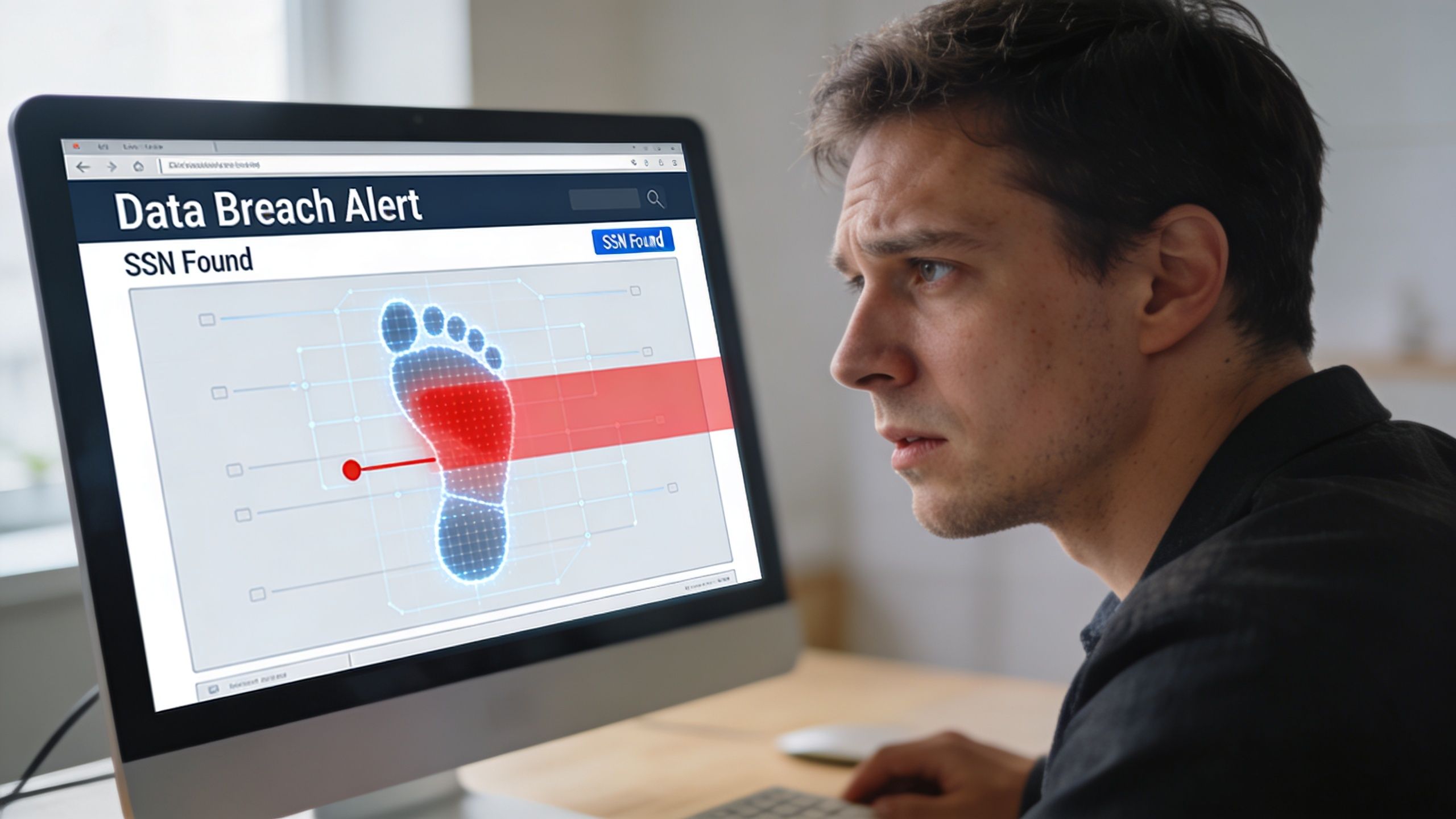
OSINT stands for open source intelligence. For ordinary people, that means searching publicly accessible digital traces to see what personal information is exposed online. It can include old forum accounts, breach data, public profiles, cached pages, gaming usernames, people-search listings, and other records that reveal more than they should.
An SSN compromise often starts with fragments. A criminal might first find your email on a breach list, then your birth year on social media, then your address from a public record aggregator. If your SSN appears in the wrong place too, the pieces connect fast.
Why this belongs in modern SSN protection
A 2025 FTC report noted 1.2 million SSN exposures in data breaches last year, with 40% discoverable via public OSINT searches. Users who proactively scanned their digital footprints for leaks reduced their identity theft risk by 65%, according to Javelin Strategy data, as cited in this discussion of proactive SSN exposure scanning.
That’s the strongest argument for adding footprint scanning to your routine. If a leak is discoverable in public-facing places, waiting for a bank problem means you’re already behind.
Detection works best before the fraud attempt, not after the paperwork arrives.
What to check for
The useful question isn’t “Is my SSN on the dark web?” It’s broader than that. Check for:
- Old accounts tied to old emails
- Profiles that reveal full legal names and recovery clues
- Breach exposures involving credentials you still reuse
- Family profiles that expose school, gaming, or workplace context
- Public records or posts that contain sensitive identifiers
If you haven’t done that kind of review before, start with a free data breach checker. A quick scan won’t solve every problem, but it can show whether your exposure is larger than you think.
Your Immediate Response Plan for an SSN Compromise
A suspicious tax notice, a denied loan you never requested, or a password reset email you did not trigger usually means the fraud attempt started before you noticed it. Treat any SSN compromise like an active break-in. The goal in the first few hours is containment.
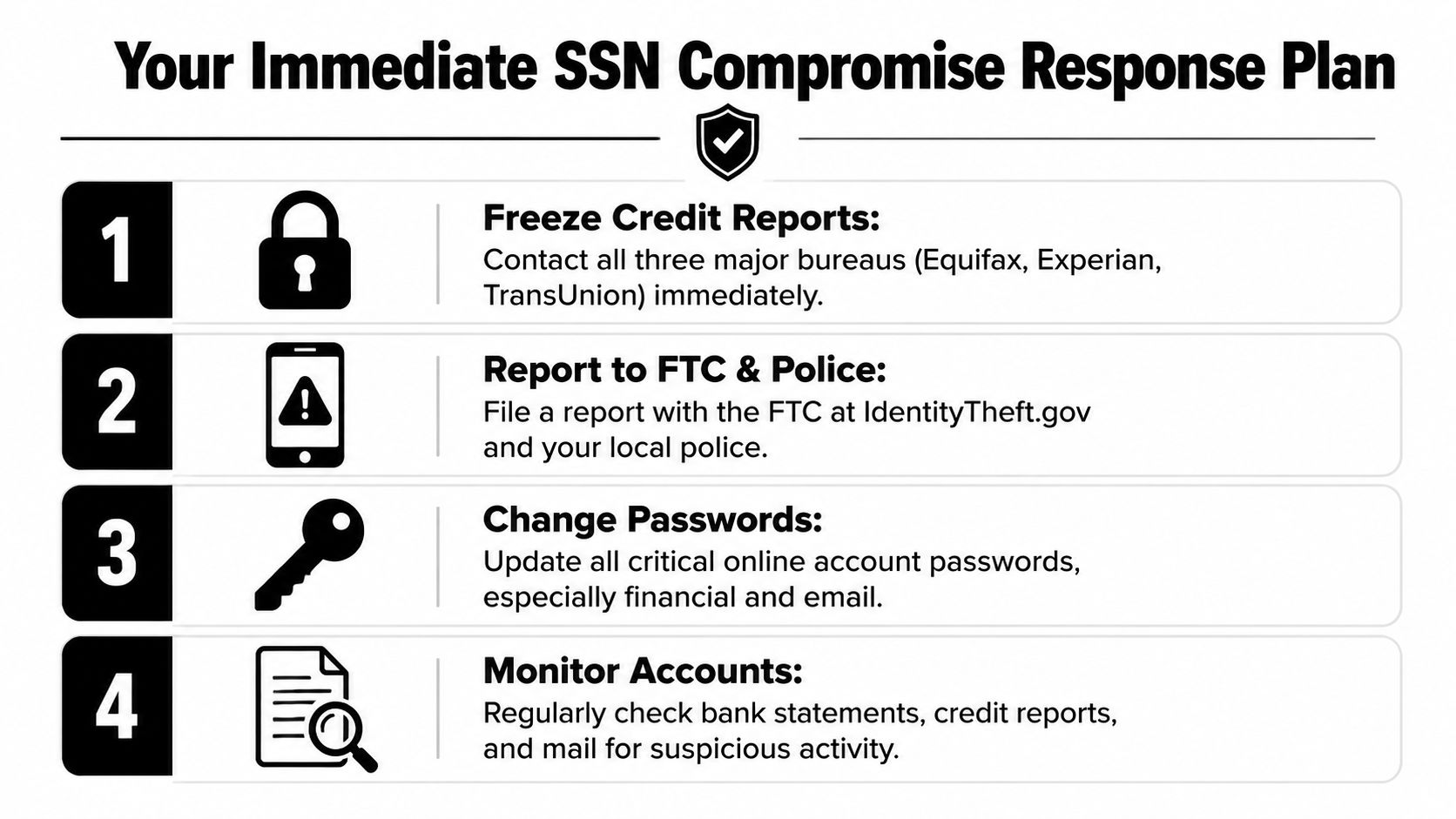
First hour priority: Freeze your credit, secure your email, and change the passwords that control resets for everything else.
Step 1 Lock down the accounts criminals use to spread
Start with email. If an attacker controls your inbox, they can reset banking, tax, shopping, and cloud accounts in minutes. After that, secure financial and government logins.
Use this order:
- Primary email account
- Banking and credit card logins
- SSA and IRS accounts
- Password manager and cloud storage
- Retail accounts with saved payment methods
Change passwords to unique ones. Turn on multi-factor authentication anywhere it is offered. Authenticator apps or hardware keys are better than text messages, but SMS is still better than leaving the account protected by a password alone.
Step 2 Freeze credit and create a paper trail
Place a credit freeze with Equifax, Experian, and TransUnion. A freeze is what stops new lenders from pulling your file without your approval. If you only place a fraud alert, some identity thieves can still get through if a creditor’s verification process is weak.
Then document everything.
Keep an incident log with:
- Who you contacted
- Date and time
- Case or confirmation numbers
- What changed on the account
- What follow-up you were told to complete
That record matters later if you need to reverse fraudulent accounts, correct reporting errors, or show that you acted quickly.
Step 3 Report the misuse where it creates the most protection
File a report at the FBI’s Internet Crime Complaint Center if the compromise involved online fraud, account takeover, or impersonation. For tax-related SSN misuse, contact the IRS identity theft line at 1-800-908-4490 and follow its instructions for tax identity theft cases.
If fraudulent accounts make it onto your reports and later turn into collection activity, this guide on removing collections from credit can help you clean up the damage.
Do one more thing that many recovery checklists skip. Reduce what attackers can still learn about you from public sources. Use a personal information removal service for public-facing data broker listings so your address history, relatives, aliases, and other matching clues are harder to use in follow-up fraud. In 2026, SSN protection is not just about freezing credit. It is also about cutting off the open-source intelligence that helps criminals pass verification checks.
A short explainer can also help if you’re doing this under stress:
Step 4 Watch for second-wave fraud
The first blocked attempt rarely ends the problem. Criminals test one path, then switch. Check bank and card activity, benefit notices, mail, credit reports, and any alerts tied to your email or phone number.
Save every letter, screenshot, and confirmation email. Good records shorten recovery time and make disputes much easier to win.
Answering Your Toughest SSN Protection Questions
Can I get a new Social Security number
Sometimes, but it’s not a normal cleanup step and it usually isn’t the first solution. A new number can create a long tail of administrative problems because your records, benefits history, tax documents, and prior files still connect to the old one in various systems.
In practice, the better move is usually to harden the existing identity. Lock down SSA access, secure tax filing, freeze credit, and keep records of misuse. A new number doesn’t automatically erase the old fraud trail.
How do I protect the SSN of a deceased family member
Treat it as an active identity risk, not a closed chapter. Notify institutions that need to know, keep death-related documents secure, and watch for mail, tax notices, or account activity that shouldn’t exist.
Posthumous identity theft often succeeds because surviving relatives assume nobody would target a deceased person’s data. Criminals know the opposite. They look for gaps in oversight, old records, and unattended accounts.
What’s the difference between a credit freeze and a fraud alert
The simplest distinction is this:
| Tool | What it does | Best use |
|---|---|---|
| Credit freeze | Restricts access to your credit file | Stronger protection against new account fraud |
| Fraud alert | Signals lenders to verify identity more carefully | Useful added friction, especially after suspicious activity |
If you want the stronger default, choose the freeze. It’s more restrictive, and that’s why it works better. A fraud alert can help, but it depends more on how the creditor handles it.
Should I still worry if I never carry my Social Security card
Yes. Physical card security matters, but most SSN misuse now starts through exposed records, bad account hygiene, family data leaks, old breaches, and weak online verification paths.
Protecting your number today means controlling both the paper trail and the digital trail. Ignore either one, and you leave an opening.
If you want to know whether your personal data is already exposed online, run a scan with Digital Footprint Check. Its free checker helps you spot public-facing risks tied to your digital footprint so you can act before an exposed record turns into identity theft.