· Digital Footprint Check · Content Marketing · 15 min read
Financial Services Compliance a Complete 2026 Guide
Explore the essentials of financial services compliance. Our guide covers AML/KYC, data protection, and how OSINT tools help manage digital risk and screening.

Compliance used to be treated as a support function. That view no longer fits the facts. Deloitte reports that operating costs spent on compliance have increased by over 60% compared with pre-financial-crisis spending levels for retail and corporate banks, reflecting broader obligations around supervision, reporting, monitoring, and controls, as outlined in Deloitte’s review of the cost of compliance.
For a fintech leadership team, that number should change the conversation. Financial services compliance isn’t just about avoiding a fine or satisfying an examiner. It’s about proving that your company knows who it serves, protects sensitive data, keeps records that hold up under scrutiny, and doesn’t let digital blind spots become regulatory failures.
The part many teams still underestimate is where risk now shows up. It’s not confined to your core banking system, CRM, or payments stack. A public profile, a leaked credential, a vendor’s sloppy online security behavior, or an employee’s undisclosed side business can all become compliance issues once they touch customer data, transaction integrity, or auditability.
The Soaring Stakes of Financial Compliance
The old model of compliance was inward-looking. Write the policy. Train the staff. Archive the documents. Respond when a regulator asks. That still matters, but it’s no longer enough.
Today, firms operate in a public digital environment where risk signals appear outside internal systems first. A suspicious customer identity might be easier to spot across open web profiles than in a scanned ID file. A fraud pattern might emerge through mismatched online personas. A vendor may look sound on paper while exposing weak controls in public-facing channels. That’s why financial services compliance now overlaps with digital identity, privacy, fraud prevention, and operational resilience.
Why the pressure keeps rising
Leadership teams often ask why compliance feels so much heavier than it did a decade ago. The answer is simple. More rules, more scrutiny, more data, more systems, and more expectation that controls will be provable rather than merely described.
A modern compliance function has to demonstrate that it can:
- Verify identities consistently: You can’t onboard customers on trust alone.
- Protect regulated data: Customer information has to stay controlled across systems and partners.
- Reconstruct events: Examiners want a defensible trail, not a vague summary.
- Monitor at scale: Manual review breaks down fast once transaction volume, communication volume, and third-party exposure rise.
That shift explains why a digital event can become a compliance event. A leaked account credential may start as a security issue, but if it affects customer records, account access, or reporting accuracy, compliance inherits it. A practical way to think about the fraud side of that overlap is to review recognizable patterns like these credit card fraud examples, because they show how quickly external behavior can turn into internal control failures.
Practical rule: If your compliance program only sees what lives inside your own systems, it’s already missing part of the risk picture.
What the rules of the game look like now
The game has changed from policy ownership to evidence ownership. Regulators increasingly expect firms to show not just that a control exists, but that it works, that it’s monitored, and that exceptions are captured in a form someone can audit later.
For fintechs, this is especially important. Growth models built on speed, partnerships, APIs, and embedded experiences can widen the gap between what the business launches and what compliance can observe. The firms that handle this well don’t treat compliance as a brake. They treat it as infrastructure.
Understanding the Core Pillars of Compliance
A useful way to understand financial services compliance is to picture a fortified city. You need someone at the gate, guards watching for suspicious activity, secure vaults for sensitive information, a written log of what happened, and trusted allies outside the walls. If any one of those fails, the whole defense weakens.
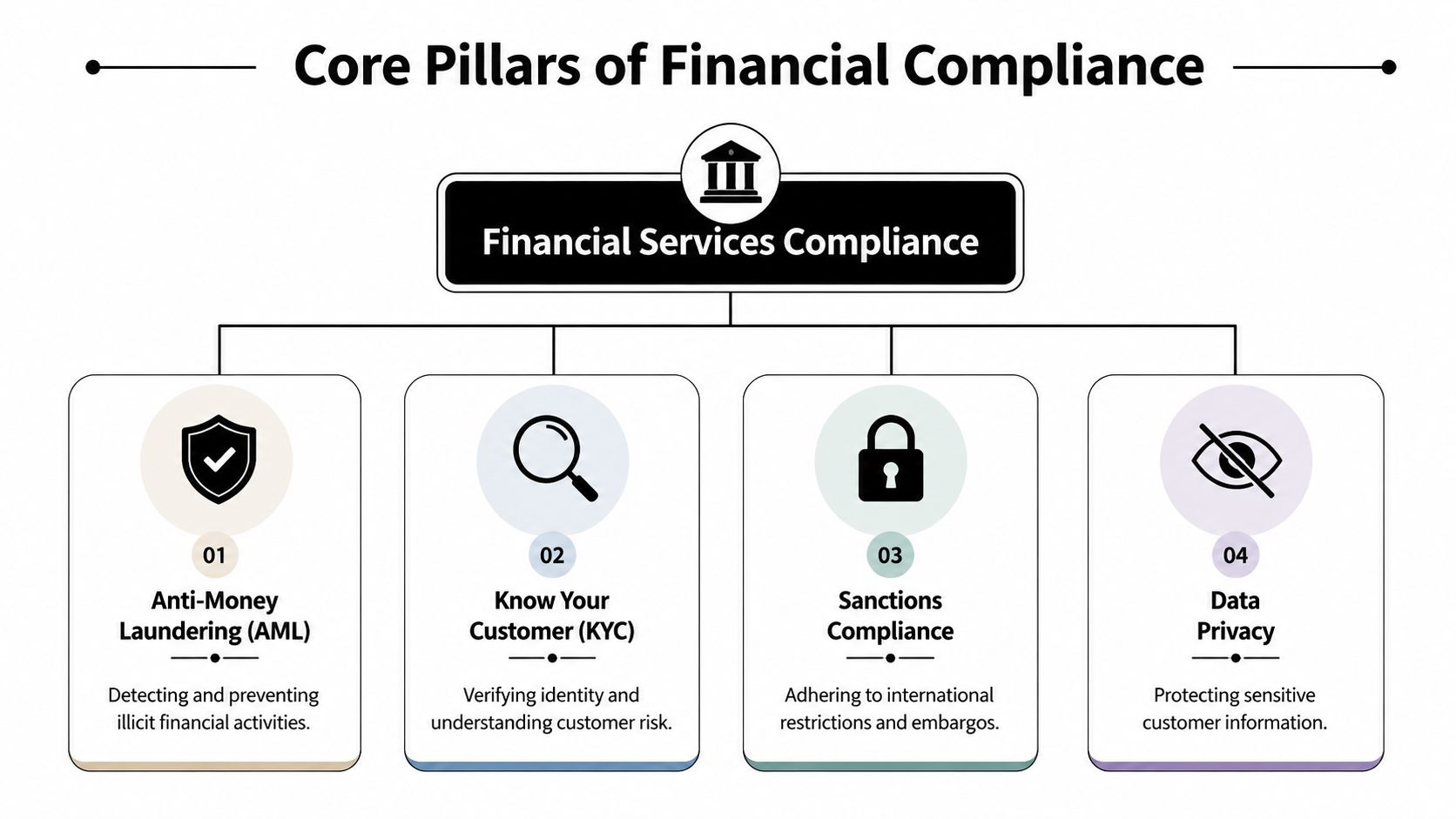
AML and KYC as the gatekeepers
Anti-Money Laundering (AML) and Know Your Customer (KYC) sit at the front door. Their job isn’t only to check identity. They also help a firm understand risk before money starts moving.
KYC asks basic but important questions. Is this person or business real? Are the documents consistent? Who ultimately benefits from the account or transaction? Does the declared activity make sense? AML takes that further by looking for suspicious patterns, unusual flows, and signs that the firm could be used to move illicit funds.
In plain language, KYC is the gate check. AML is the ongoing watchtower.
Data privacy as the vault
Once you collect customer information, you become responsible for protecting it. That responsibility covers more than passwords and encryption. It includes who can access data, where data moves, how long it stays, and whether the firm can justify its use.
Many executives often misunderstand this point: Privacy law isn’t separate from compliance operations. It is part of them. If your onboarding process collects identity documents, proof of address, risk notes, and transaction history, then privacy obligations shape how those records are stored, reviewed, shared, and deleted.
Recordkeeping as the official ledger
Recordkeeping is where compliance becomes testable. In major regulatory regimes, firms must retain KYC records for at least five years, and the enforcement backdrop is severe. The SEC’s 2022 recordkeeping actions totaled $1.3 billion across 16 firms, while GDPR penalties have reached €1.2 billion in a single case, according to Egnyte’s financial compliance guide.
That matters because a control you can’t document is a control you often can’t defend.
A sound recordkeeping program should preserve:
- Identity evidence: Documents, verification outcomes, and risk assessments
- Decision history: Why a customer was approved, escalated, or rejected
- Activity records: Transactions, communications, and review notes
- Audit context: Who did what, when, and under which policy
Keep this distinction clear. Security protects systems in real time. Recordkeeping proves what happened after the fact.
Third-party risk as ally management
The final pillar is third-party risk management. Many fintechs depend on vendors for onboarding, communications, cloud storage, fraud tools, and banking connectivity. That can increase speed, but it doesn’t transfer accountability.
If a partner handles customer data badly, fails to preserve records, or introduces hidden screening gaps, your firm still has to answer for the outcome. That’s why compliance leaders need to assess not only whether a vendor offers a useful service, but whether that vendor can support auditability, resilience, and lawful data handling.
Here’s the core lesson. Financial services compliance works as a system. AML, KYC, privacy, recordkeeping, and third-party oversight reinforce each other. If one is weak, the others become harder to prove.
Common Gaps in Traditional Compliance Programs
Most compliance failures don’t begin with bad intentions. They begin with outdated operating models.
A firm writes a policy that looks solid in a board packet. Then reality arrives. Analysts work from spreadsheets. Alerts live in one tool, customer documents in another, communications in a third. Staff perform reviews manually because automation feels expensive or complicated. The result is a program that appears controlled on paper but struggles under live volume.
Where traditional programs break down
One of the biggest gaps is overreliance on manual review. Financial-services compliance programs increasingly rely on automated surveillance and reporting systems because manual controls do not scale across trading, communications, AML, and regulatory-reporting workflows, as noted in Xantrion’s discussion of regulatory compliance operations.
That single point explains a long list of common weaknesses:
- Fragmented data: Customer files, transaction data, and communication logs sit in separate systems.
- Slow investigations: Analysts spend too much time collecting evidence instead of assessing risk.
- Inconsistent decisions: Two reviewers may handle similar cases differently because the workflow isn’t standardized.
- Weak follow-through: Firms screen at onboarding, then fail to revisit customer, employee, or vendor risk when circumstances change.
The checkbox problem
Traditional programs also suffer from a checkbox mindset. Teams verify that a document exists, but they don’t ask whether the surrounding story makes sense. They confirm a vendor signed the right clause, but they don’t test whether the vendor can support an investigation. They complete employee onboarding, but they don’t watch for later digital red flags.
That’s where modern digital risk enters. Public information can reveal conflict indicators, impersonation patterns, exposed credentials, or reputation issues long before they appear in a formal incident report.
A control isn’t strong because it happens once. It’s strong because the firm can repeat it consistently and revisit it when risk changes.
What leadership should look for
If you want to spot structural weakness quickly, ask these questions:
| Warning sign | Why it matters |
|---|---|
| Reviews depend on spreadsheets and inboxes | Evidence gets lost, duplicated, or delayed |
| Teams can’t trace a decision end to end | Auditability is weak |
| Third-party oversight ends after contract signing | Outsourced risk keeps evolving |
| Public digital signals are ignored | The firm misses context that internal systems won’t show |
A mature program doesn’t just collect compliance data. It connects it.
Modernizing KYC with Digital Footprint Monitoring
Standard KYC checks are necessary, but they’re often static. They tell you whether a document was submitted, whether a name matched a database, and whether a form was completed. They don’t always tell you whether the broader identity story holds together.
That’s why more firms are adding digital footprint monitoring and OSINT, or open-source intelligence, to enhanced due diligence. Used properly, these methods review publicly available information to give analysts more context around a person or business. They don’t replace regulated screening. They make it more complete.
A visual summary helps show how this shift works.
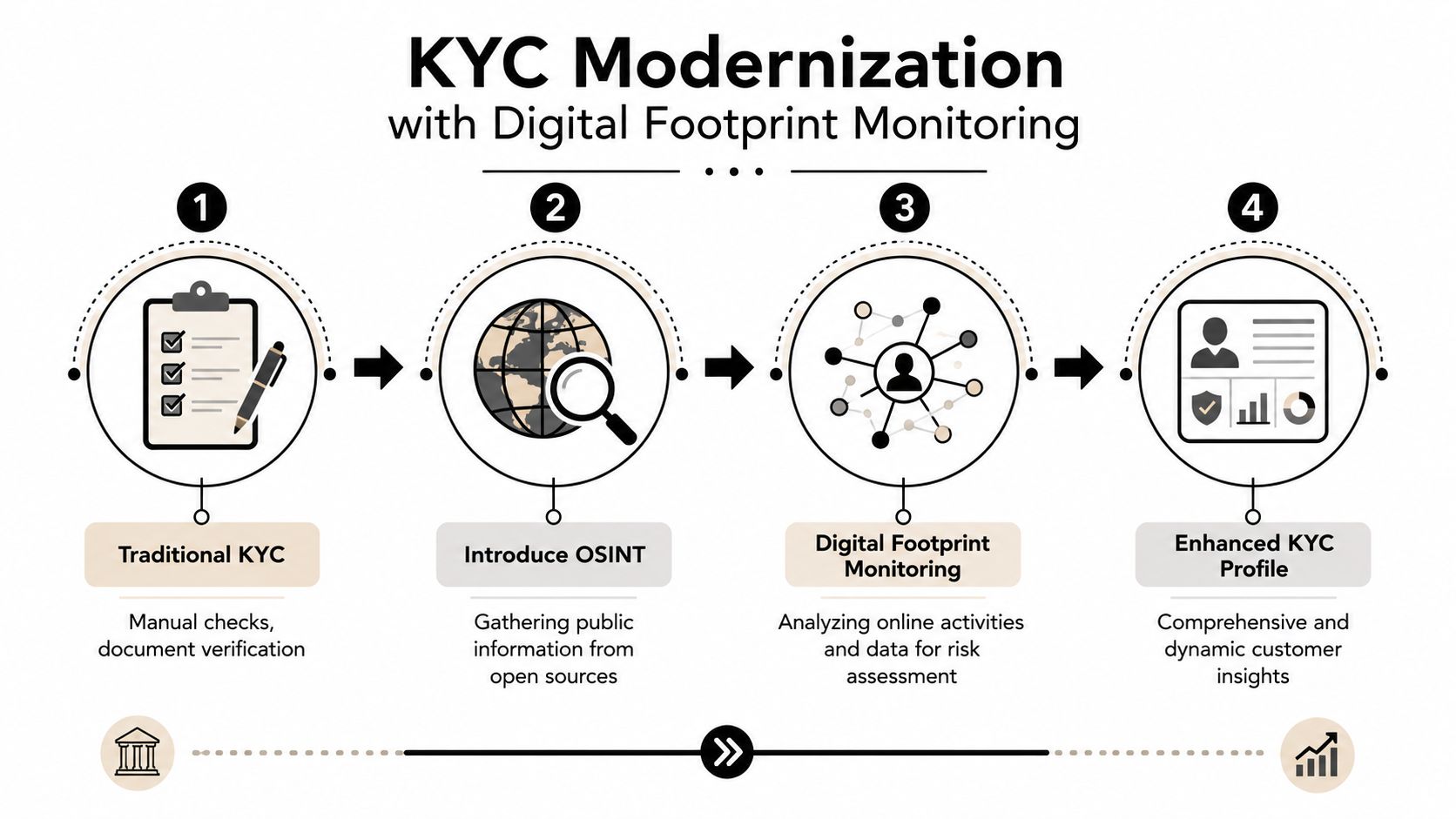
What OSINT adds to KYC
OSINT uses public sources such as professional profiles, business websites, public records, forum activity, breach exposure indicators, and other open web signals. The goal isn’t gossip or intrusion. The goal is to identify material inconsistencies and undeclared risk indicators.
A few examples make this concrete:
- Undisclosed affiliations: A customer declares a simple consulting business, but public professional profiles suggest ties to several entities not mentioned in onboarding.
- Identity inconsistency: Usernames, profile data, or business references don’t line up with the submitted identity narrative.
- Reputation and fraud context: Open web signals suggest account takeover exposure, impersonation, or repeated use of recycled contact details.
- Beneficial ownership clues: Public references can point analysts toward relationships worth validating further.
For teams working in property, lending, escrow, or commercial transactions, KYC and KYB in real estate is a useful example of how customer and business verification become more complex once multiple parties and entities are involved.
Traditional KYC vs OSINT-enhanced KYC
| Aspect | Traditional KYC | OSINT-Enhanced KYC |
|---|---|---|
| Identity review | Focuses on submitted documents and database checks | Adds public identity context and corroboration |
| Risk visibility | Often point-in-time | More dynamic when monitored over time |
| Business understanding | Limited to declared information | Can reveal public affiliations and external signals |
| Fraud detection | Strong on known rule sets | Better at spotting narrative inconsistencies |
| Investigator workflow | Often siloed | Better suited to layered due diligence |
Later in the workflow, video training can help operational teams see how a more modern process fits together:
Where to use digital footprint checks carefully
Not every applicant needs the same level of review. That’s an important control point. Retail onboarding might use lighter checks and escalation triggers. Higher-risk accounts, complex legal entities, politically exposed persons, or unusual transaction models may justify deeper public-data review.
One practical tool category in this area is a digital footprint lookup, which can help investigators see what public-facing identity signals exist beyond the documents submitted during onboarding.
Used well, OSINT doesn’t turn KYC into surveillance. It turns KYC into context-aware verification.
Screening Employees and Vendors in the Digital Age
A compliance program that only screens customers is incomplete. Employees and vendors can create just as much regulatory exposure, especially when they handle funds, sensitive data, investigations, or customer communications.
Think about a new operations hire with privileged access to onboarding systems. Their resume checks out. Their references are fine. But public information suggests an undisclosed outside venture that overlaps with your customer base. That may not prove misconduct, but it does raise a conflict-of-interest question your standard hiring workflow might miss.
Employee screening beyond the resume
For regulated roles, public digital signals can help firms assess judgment, disclosure, and risk alignment. The key word is public. Compliance teams should stay within lawful, documented review practices and focus only on information relevant to the role.
Useful review areas often include:
- Conflict indicators: Side businesses, public affiliations, or advisory roles that should have been disclosed
- Security hygiene clues: Publicly exposed contact data or evidence of risky online behavior
- Reputation concerns: Patterns that may affect trust in customer-facing or highly privileged roles
- Identity consistency: Whether public professional history aligns with the application
For employers formalizing this process, background check services for businesses can help frame how digital screening fits alongside traditional employment verification.
Vendor risk now lives in public view too
Third-party oversight has changed even more dramatically. Recent industry guidance stresses that banks remain responsible for compliance even when activities are outsourced, and that third parties must provide audit-ready documentation, clear risk transparency, and contingency exit plans, as discussed in Ankura’s guidance on third-party compliance in financial services.
That means vendor due diligence can’t stop at the contract file.
A practical vendor review should ask:
- Can this partner support an audit? If an issue occurs, can they produce usable records quickly?
- Do public signals contradict their control claims? Marketing language may sound mature while visible behavior suggests weak discipline.
- What happens if the relationship ends suddenly? Exit planning matters because regulated obligations don’t pause when vendors fail.
Outsourcing a process doesn’t outsource the regulator’s expectations.
A resilient compliance team treats employees and vendors as living risk profiles, not one-time approvals.
The Guide to Ethical OSINT and Privacy Safeguards
OSINT makes some leaders uneasy because they associate it with hacking, scraping without limits, or covert surveillance. That’s the wrong model. Ethical OSINT means collecting and analyzing publicly available information for a legitimate purpose under a defined policy.
In a compliance setting, that legitimate purpose could include identity verification, fraud review, employee conflict checks, vendor due diligence, or breach exposure assessment. The legal and ethical line is crossed when teams collect irrelevant data, ignore privacy law, apply inconsistent criteria, or use intrusive methods that the firm can’t defend.
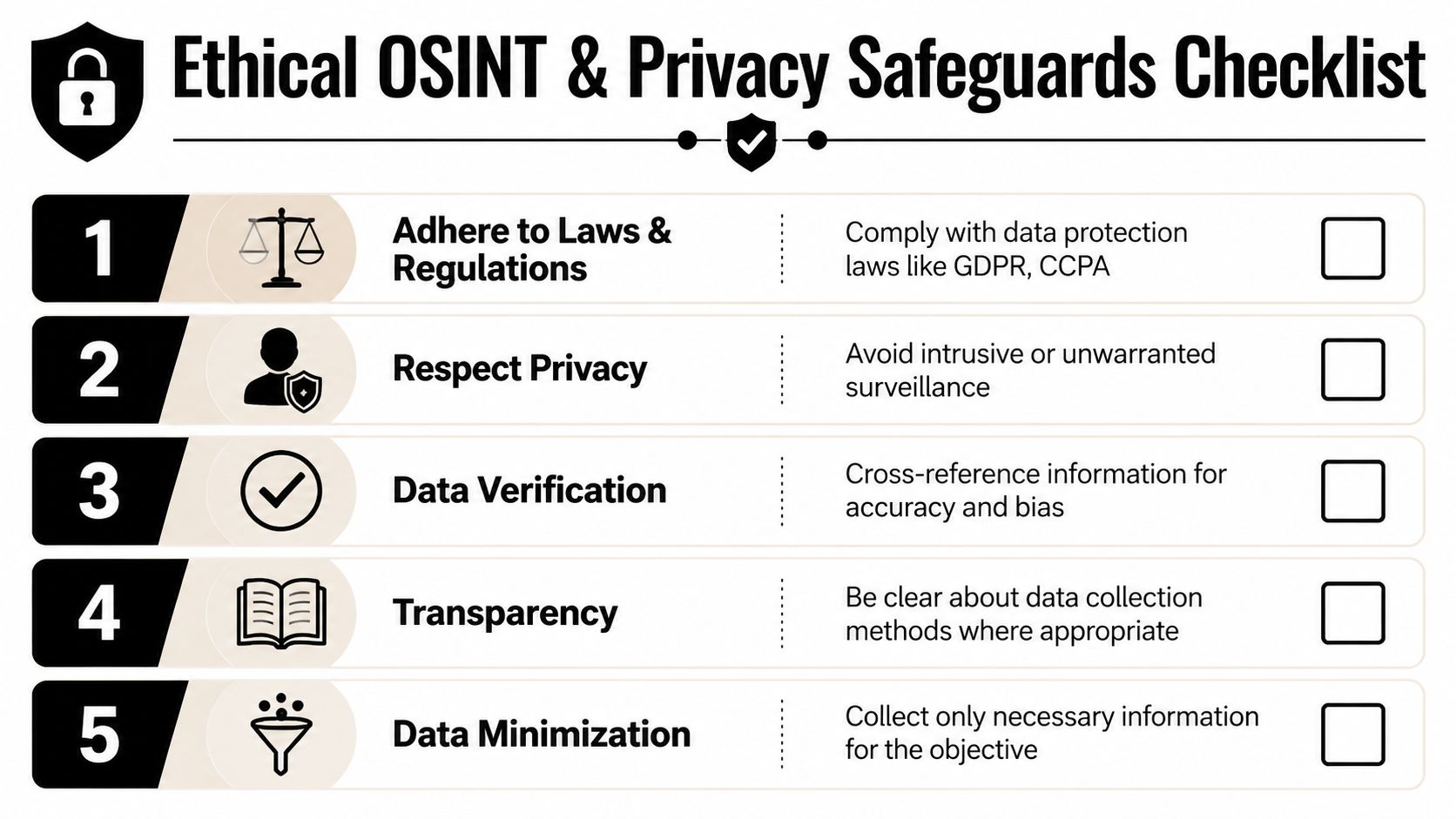
What ethical OSINT looks like in practice
A defensible OSINT process usually includes a few essential elements:
- Lawful purpose: The review must tie directly to a real compliance, security, or fraud objective.
- Data minimization: Teams should collect only what they need for that purpose.
- Consistency: Similar cases should be reviewed under similar criteria.
- Verification: Public information can be wrong, outdated, or misleading. Analysts need corroboration.
- Documentation: If a public-data review influences a decision, that reasoning should be recorded.
Where teams get this wrong
The most common mistake is collecting too much because the internet makes it possible. The second is treating raw public information as truth. A username match, social post, or forum reference may be relevant, but it still needs context.
Another mistake is weak governance. If your analysts can perform public-data reviews but no one has defined approved sources, escalation thresholds, retention standards, or fairness controls, you’ve created a new compliance risk while trying to solve another one.
Public doesn’t mean unrestricted. It means the information is visible. Your use of it still has to be lawful, proportionate, and documented.
A useful way to educate teams on this distinction is to review simple examples of public-data discovery, such as methods discussed in guides like finding someone’s email on Facebook. The compliance lesson isn’t the tactic itself. It’s understanding how easily public fragments can reveal identity connections, and why firms need clear rules for when and how that information may be used.
A practical governance checklist
| Safeguard | Why it matters |
|---|---|
| Written OSINT policy | Defines purpose, scope, and approved methods |
| Role-based access | Limits who can perform and review searches |
| Relevance standards | Prevents curiosity-driven collection |
| Review and appeal path | Supports fairness in adverse decisions |
| Retention controls | Aligns public-data use with privacy obligations |
If you’re building this capability, start with governance first and tooling second.
Building a Resilient Compliance Framework for 2026
The strongest financial services compliance programs now operate as hybrid systems. They keep the traditional pillars intact, but they also monitor the public digital environment where identity, fraud, privacy, and third-party risk increasingly surface first.
That means KYC can’t remain a static document exercise. Employee and vendor screening can’t be treated as one-time events. Recordkeeping has to support real reconstruction, not just file storage. And OSINT needs policy guardrails so it strengthens compliance without creating fresh privacy risk.
Leadership teams should also remember that compliance resilience includes internal reporting culture. When employees raise concerns about controls, retaliation risk becomes part of governance quality. For organizations thinking about speak-up frameworks and accountability, this overview of whistleblower guidance for Mississippi workers is a useful example of how legal protections fit into the broader control environment.
One more practical area often overlooked is incident response disclosure. If a breach touches regulated data, your compliance posture depends in part on whether your team understands data breach notification requirements before the crisis starts.
The firms that handle 2026 well won’t be the ones with the most policies. They’ll be the ones with the clearest evidence, the best visibility, and the discipline to connect digital risk to regulatory obligation before an examiner does.
If you want to see what public information may already be visible about you, your team, or a business contact, try the free checker from Digital Footprint Check. It offers a practical starting point for understanding digital exposure in a way that supports privacy awareness, screening discipline, and better-informed compliance decisions.