· Digital Footprint Check · Content Marketing · 14 min read
Online Reputation Management Benefits
Discover the top online reputation management benefits for career growth, business trust, and personal safety. Learn how to protect your digital footprint

You search your name before a job interview and find an old account you forgot existed. A public photo, an angry comment, or a username connected to a breached email sits several pages away from the profile you carefully maintain today. At the same time, a hiring team, potential client, or new dating connection may be forming an opinion from exactly those scattered traces.
That’s why the online reputation management benefits go beyond looking polished. Reputation work can protect consumer confidence, reduce career risk, improve personal safety, and help you understand what automated systems and strangers can discover about you.
The Hidden Cost of an Unmanaged Digital Footprint
A candidate has prepared thoroughly for a final interview. Their current LinkedIn profile is professional, their references are strong, and their work history is accurate. During a routine online search, however, the employer finds an old public account using the same username as the candidate’s gaming profile. The account contains hostile comments posted years earlier. The employer doesn’t know whether the material reflects the candidate today, and the candidate never gets the chance to explain.
A similar problem can affect personal relationships. Someone may appear trustworthy through messages and video calls, yet a reverse-image search reveals that their profile photos belong to another person. In both situations, the important detail isn’t the amount of positive information available. A single unresolved warning sign can carry more weight than many ordinary signs of good behavior.
Your digital footprint is a living, searchable record, not a box of old posts. It includes profiles, comments, public records, cached pages, breach exposure, usernames, photos, reviews, and mentions created by other people. Search engines and people who use open-source intelligence techniques can connect details that you may consider unrelated.
Practical rule: Treat every public account, reused username, and exposed email address as part of the same identity map until you’ve checked the connection.
The risk is asymmetric. A clean profile may not guarantee a job, sale, relationship, or safe interaction, but one visible red flag can create immediate doubt. You can learn more about the risks involved through this guide to digital footprint risks.
Online reputation management addresses that imbalance. It doesn’t mean pretending to be perfect or trying to erase every criticism. It means finding exposed information, correcting inaccuracies, securing accounts, responding responsibly, and making sure the public record reflects your current identity as fairly as possible.
Understanding Online Reputation Management
Online reputation management is the ongoing practice of monitoring, evaluating, and influencing information connected to a person or organization online. It combines privacy checks, review monitoring, account security, search visibility, content decisions, and thoughtful responses to public feedback. A useful explanation of the broader process appears in this guide to what online reputation management means.
Start by separating two kinds of exposure.
Your active digital footprint includes information you choose to publish. Social posts, professional profiles, forum comments, product reviews, public wish lists, gaming identities, and dating profiles all fall into this category. You can often edit, delete, limit, or secure these items.
Your passive digital shadow contains information collected or published without a direct decision from you. Data broker records, archived pages, public documents, breach databases, tagged photos, and mentions on someone else’s website may remain visible even when you no longer use the related service.
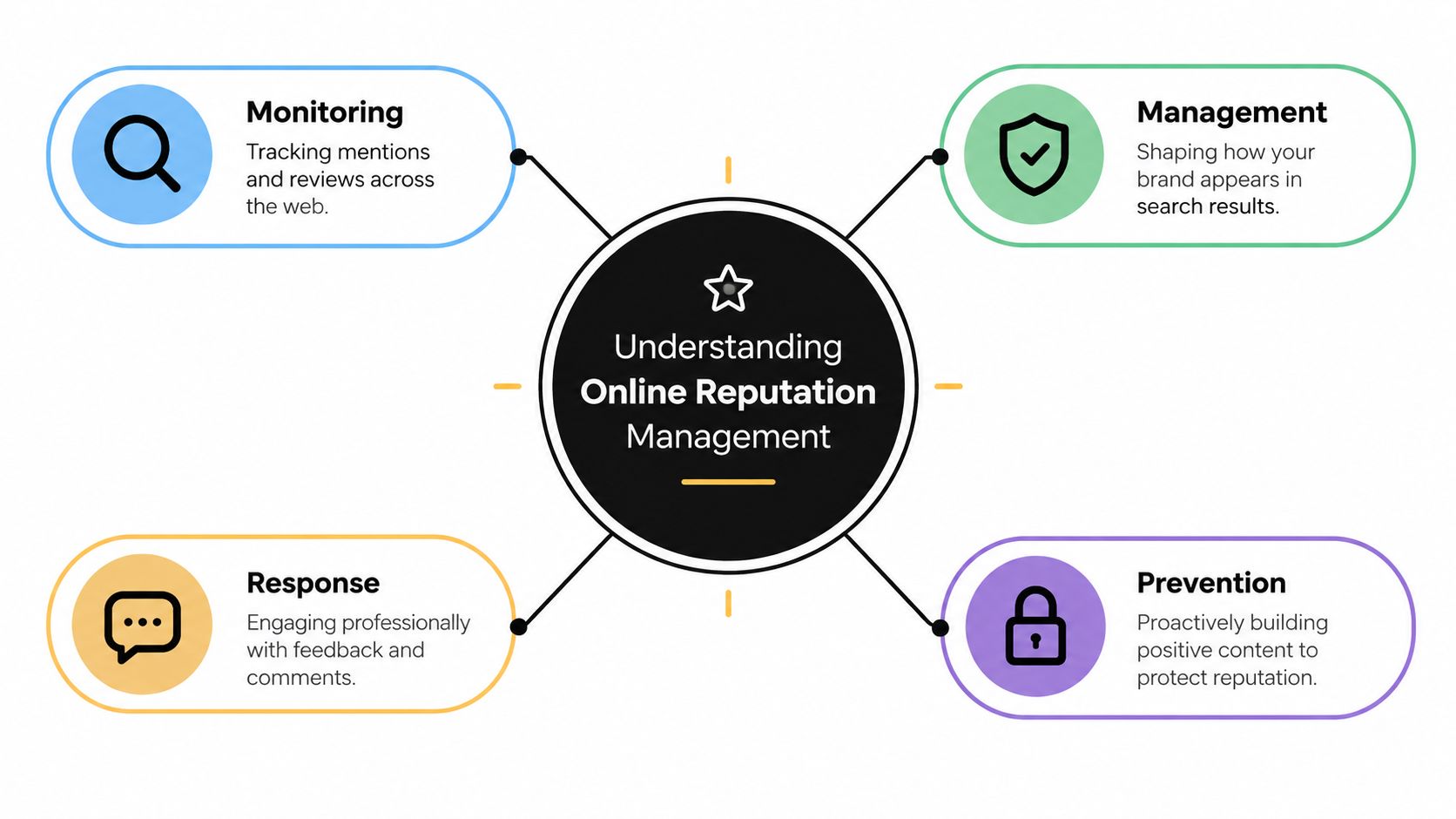
Four actions make the process practical
- Monitor: Search your name, usernames, email addresses, phone numbers, and public mentions. Look for both obvious results and connections that only appear when several identifiers are combined.
- Manage: Remove abandoned accounts, update inaccurate profiles, tighten privacy settings, and separate professional identities from casual ones where appropriate.
- Respond: Address legitimate criticism calmly, report impersonation, and avoid escalating arguments in public comment threads.
- Prevent: Use unique passwords, multifactor authentication, cautious sharing habits, and regular checks so new exposure doesn’t accumulate unnoticed.
OSINT, or Open Source Intelligence, describes the ethical collection and analysis of publicly available information. An OSINT tool may search multiple platforms for a username, compare profile details, identify breach exposure, or organize scattered results into a report. The tool isn’t automatically proof that every result belongs to you. Matching names and reused usernames can create false positives, so you need to verify context before acting.
Think of your online identity as a house. Public profiles are the front door, search results are the windows, and old accounts or breached credentials may be weak back doors. Reputation management doesn’t involve demolishing the house. It involves checking each entrance, deciding what visitors can see, and closing access points that create unnecessary risk.
Building Consumer Trust and Business Authority
A customer may see a business for the first time in a search result, review page, or AI-generated summary. Before making contact, that person can compare reviews, read responses to complaints, check listing details, and look for consistent descriptions across platforms. Advertising earns attention, but public evidence often determines whether attention becomes a purchase. An outdated listing or impersonator can create doubt before the business has a chance to explain itself.
Pew Research Center reported that 82% of U.S. adults at least sometimes read online ratings or reviews before buying something for the first time, while 40% said they always or almost always do so. The same 2016 survey found that 46% of Americans said ratings and reviews help consumers feel confident about purchases “a lot,” compared with 25% who said government regulations help that much. These findings are summarized in Pew survey coverage on online reviews.
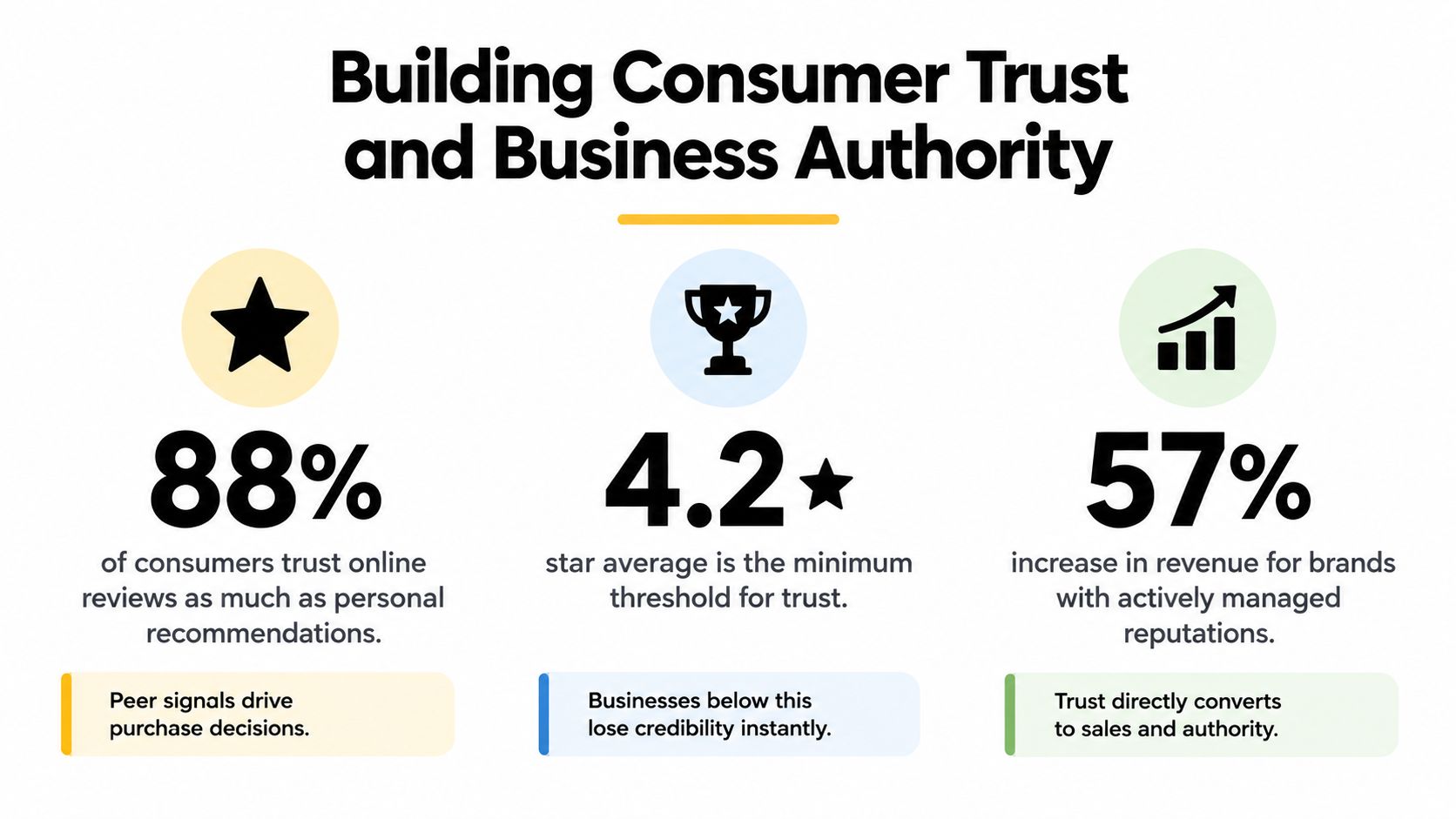
Why review signals change buying behavior
Reviews reduce uncertainty. A buyer cannot fully inspect a service before purchasing it, and may not know whether the company handles mistakes fairly. Recent, specific feedback acts like evidence from other customers, helping the buyer judge reliability before spending money.
An October 2024 survey reported by Reputation found that 54% of consumers said they trust online reviews first, ahead of friends and family at 24%, company claims at 18%, and social media influencers and media reviews at 2% each. The survey also found that 77% described online reviews as “mostly” trustworthy. The detailed source is available in this survey publication on online review trust.
These figures do not prove that every review is accurate or that advertising has no value. They show why reviews should be treated as operational feedback rather than decoration. A calm response to a legitimate complaint can demonstrate accountability to everyone reading the page, not only to the original reviewer. Businesses can use recurring complaints to identify unclear policies, service failures, or information that needs updating.
AI summaries add another reputation layer
People increasingly ask AI systems such as ChatGPT, Gemini, and Perplexity to summarize companies and recommend options. Guidance on emerging ORM practices describes improved performance in AI-generated search results as a major projected benefit for 2026, while warning that measurement and optimization remain less established than traditional search tracking. You can review that discussion in this 2025 reputation statistics analysis.
AI systems combine reviews, forums, company pages, and other public sources. Conflicting descriptions, old complaints, or an impersonator can therefore produce an incomplete summary. A business can improve the information available to those systems by keeping listings accurate, encouraging genuine feedback, responding to recurring issues, and publishing clear service explanations. These practical online reputation management tips can help turn that work into a repeatable process.
Reputation also affects more than visibility. Research on reviews and small-business performance connects stronger ratings and favorable sentiment with customer satisfaction, loyalty, and sales performance. Businesses should track qualified inquiries, repeat customers, complaint themes, and the accuracy of public information instead of trying to create an artificial appearance of perfection. The goal is a public record that remains understandable and credible when a customer, search engine, or AI assistant examines it.
Career Impact and Hiring Realities
A recruiter searches your name the evening before an interview. An outdated post, an impersonator, or a confusing work history can shape the first impression before you can explain the context. Employers may also examine their own public reputation while candidates decide whether to accept an offer. Knowing what employers see when they Google you helps job seekers identify visible risks early.
One survey reported by Staffing Industry Daily found that 70% of employers check job candidates on social media, while 57.5% had found content that caused them not to hire a candidate. Those findings appear in this report on employer social media screening.
The Hiring Reputation Gap
| Perspective | Primary Risk | Reputation Management Benefit |
|---|---|---|
| Job seeker | Old public posts, impersonation, offensive material, or inconsistent work history can create doubt before an interview. | Find and address visible red flags, secure abandoned accounts, and present accurate professional information. |
| Employer | Candidates may reject an offer because the organization appears unethical, unstable, or unresponsive. | Monitor public feedback and communicate workplace standards with consistency. |
| Recruiter or HR team | Unverified online information can lead to mistaken identity or inconsistent screening. | Use documented, lawful processes and verify context before making decisions. |
| Executive or public-facing professional | A personal controversy can affect clients, colleagues, and organizational confidence. | Separate private information from public leadership identity and prepare a response plan. |
A small polish project cannot offset a serious warning sign. Removing an impersonation account, correcting a false claim, or closing a breached profile may protect a candidate more than creating another attractive profile. Reputation work should prioritize exposure and accuracy, not cosmetic activity.
Employer reputation influences hiring from the other side of the table. A 2023 to 2024 survey summarized in a recruiter-focused report found that 69% of people are likely to reject an employment offer from a company with a bad reputation. The same report cites Harvard Business Review data saying poor reputation can increase cost per hire by at least 10%. The figures appear in this analysis of reputation and recruiting.
For candidate evaluation, organized evidence can reduce inconsistent decisions. A useful discussion of how Synopsix improves hiring decisions explains impression management and structured evaluation. Employers still need consent, relevance, privacy safeguards, and human review. A search result is a lead to verify, not a verdict.
Personal Safety and Scam Prevention
Reputation management becomes a safety practice when strangers can assemble your identity from public fragments. An old username may connect a professional profile to a gaming account. A public photo may reveal a location or routine. An exposed email can help an attacker create a convincing password-reset message. Each detail may seem harmless alone, but OSINT techniques help malicious actors combine them.

Romance scams show the financial stakes. FTC-linked data summarized in a 2026 dating-safety article reported that, during the first nine months of 2025, Americans lost $1.16 billion across 55,604 romance-scam reports. The summary also reported nearly $1.2 billion across more than 59,000 reports in 2024, with a median loss of $2,000 per victim. It found that only 19% of romance scams began on a dating site or app, while 40% began on social media. The source is this romance-scam safety summary.
That pattern matters because checking only a dating profile isn’t enough. A scammer may move conversations to social media, use copied photographs, create a backstory from public information, and pressure the target to keep the relationship private.
Signs that deserve verification
- Profile inconsistency: The person’s age, location, work history, or timeline changes across accounts.
- Photo reuse: Their images appear under different names or on unrelated profiles.
- Fast emotional pressure: They request secrecy, urgent help, gift cards, cryptocurrency, or money before you’ve independently verified them.
- Limited live evidence: They repeatedly avoid spontaneous video calls or refuse reasonable identity checks.
- Account history gaps: A profile is new, lightly populated, or disconnected from the person’s claimed community.
Verification systems can reduce risk, but a badge isn’t proof of good intentions. A 2026 dating-report summary states that identity-verification adoption rose from 22% to 28% of monthly active profiles. It also says apps where 90% or more of active profiles are verified report harassment incidents at roughly one-third the rate of apps where fewer than 40% are verified. See the dating verification and safety report for those findings.
The problem extends beyond dating apps. A catfishing-focused summary reports that women and 38% of men said they had been catfished by users pretending to be someone else. It also reports that approximately 15 million Americans have been targeted by catfishing scams at least once and that about 23% of dating app users have experienced catfishing. The source explains why reverse-image searches, profile comparisons, and account cross-checks matter in catfishing detection research.
When reputation work exposes a privacy weakness, fix the weakness rather than confronting a suspected scammer. Block and report the account, preserve evidence, tell someone you trust, and contact the relevant financial institution or authorities if money has changed hands. For job seekers who need to repair the professional side of their public identity, an AI resume builder can help create accurate, consistent career materials, but it shouldn’t be used to hide or falsify history.
Auditing Your Digital Footprint with OSINT Tools
A useful audit begins with identifiers, not assumptions. Write down the names, email addresses, phone numbers, usernames, and profile names you’ve used. Include gaming handles, old forum names, dating aliases, and professional variations. Search each one separately, then compare the results for shared photographs, bios, locations, or links.
A practical audit sequence
- Map public exposure. Use search engines and platform searches to locate profiles, mentions, cached pages, public records, and reviews. Record the URL, what it reveals, and whether the result is yours.
- Check account security. Look for breach exposure involving old credentials or email addresses. Change reused passwords, enable multifactor authentication, and close accounts you no longer need.
- Find forgotten identities. Search old usernames and email addresses across social networks, gaming services, forums, professional platforms, and marketplaces. An abandoned account can reveal more than a current profile because you may no longer monitor it.
- Classify the risk. Mark each result as inaccurate, sensitive, impersonating, professionally damaging, or merely outdated. Prioritize items that expose access credentials, home details, identity documents, or information that could be misinterpreted.
- Take the appropriate action. Delete what you control, request corrections where possible, report impersonation, adjust visibility settings, and document unresolved pages for follow-up.
Digital Footprint Check is one option for organizing this work. Its platform searches 500+ platforms, including social networks, data breach databases, gaming profiles, professional networks, and public records, then produces actionable intelligence reports. You can compare that approach with other OSINT tools for beginners and choose a method that fits your privacy needs.
Not every unwanted result can be deleted. A page may belong to another person, reflect a legitimate complaint, or remain outside your control. In those cases, accurate public information, consistent professional profiles, and responsible responses can help searchers understand the context.
Businesses can also look for mentions that never link back to their websites. SemDash offers practical unlinked mention recovery tips for finding those references and requesting appropriate attribution. The same principle applies to individuals: identify where your name appears, verify the context, and avoid contacting people in ways that reveal unnecessary personal information.
Securing Your Online Identity Today
The strongest online reputation management benefits come from combining three forms of protection. Consumer trust improves when businesses maintain accurate information and respond to genuine feedback. Career protection improves when job seekers identify red flags, separate identities thoughtfully, and correct misleading results. Personal safety improves when people reduce exposed data that scammers can use for impersonation, phishing, or manipulation.
Treat the work as a cycle rather than a one-time cleanup. Review active accounts, search old identifiers, check breach exposure, and revisit privacy settings when you change jobs, move, begin dating, or create a public-facing project. AI-generated summaries and automated screening make context increasingly important, so keep your public information accurate and consistent.
Start with the highest-risk items. Secure exposed credentials before polishing a bio. Report impersonation before adding new content. Remove abandoned accounts before creating another public profile. A clear record won’t eliminate every unfair judgment, but it gives you better visibility and more control over the information others use to evaluate you.
Digital Footprint Check helps you search public exposure across social, professional, gaming, breach, and public-record sources, then organize findings into an actionable report. Visit Digital Footprint Check to run the free checker, identify the accounts and data connected to you, and decide which privacy or reputation fixes deserve attention first.