· Digital Footprint Check · Content Marketing · 15 min read
Identity Theft Protection for Children: a Parent's Guide
Complete identity theft protection for children. Learn how child identity fraud works, how to freeze credit, monitor digital footprints, and keep your kids

During the July 2021 to July 2022 period, 915,000 U.S. children were victims of identity fraud, approximately 1 in 80 children, and reported losses reached $688 million, according to Javelin Strategy & Research’s child identity fraud study. A child can have no bank account, no credit card, and no income, yet still carry an identity that a criminal can use for years.
That delay makes child identity theft different from ordinary account fraud. Parents aren’t only protecting a credit score. They’re managing a constantly changing collection of identifiers, profiles, passwords, school records, gaming accounts, family posts, and breach exposures. A credit freeze is important, but it’s only one layer of identity theft protection for children.
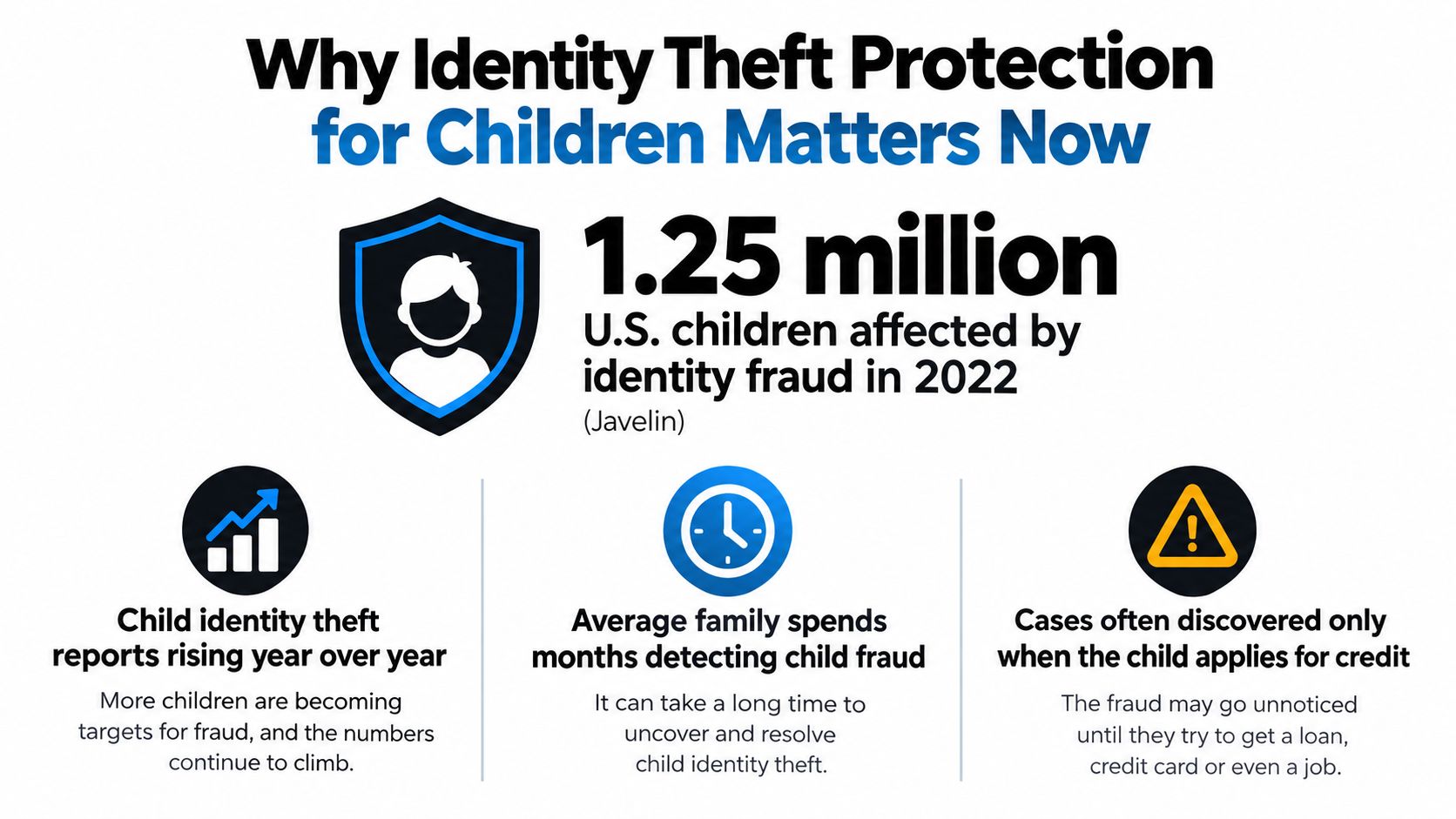
Why Identity Theft Protection for Children Matters Now
Children often have little legitimate financial activity, so suspicious accounts can remain unnoticed. A criminal may use a child’s identifying information to apply for credit, utilities, loans, housing, employment, or government benefits, then leave the family to discover the problem much later. The U.S. Government Accountability Office explains that synthetic identity theft can be especially damaging to minors because a fraudster may combine a child’s Social Security number with fabricated personal details, harming the child’s ability to obtain credit later.
Javelin reported 915,000 victims, down from 1.25 million in the previous comparable period, while losses declined from $918 million to $688 million. The average fraud loss per household with a child victim still rose from $737 to $752, showing why a lower overall victim count doesn’t make the remaining cases minor. More than half of reported cases involved children aged 9 or younger, and over 70% of victims knew the perpetrator, so the threat can exist inside a trusted household or family network, not only in an anonymous online attack.
The detection gap
A child may not have an ordinary credit file at all. That creates a confusing situation for parents: a clean search might mean the child is safe, or it might mean no file exists for a monitoring service to watch. The Federal Trade Commission advises parents to request a manual search from each nationwide credit bureau rather than assuming that no visible credit report means no risk.
Effective protection combines several controls:
- Credit controls: Search for a file and freeze it where appropriate.
- Exposure awareness: Check breach notifications, exposed email addresses, usernames, phone numbers, and passwords.
- Household hygiene: Secure documents, limit Social Security number disclosures, and review forms before sharing them.
- Account security: Use unique passwords, multifactor authentication, and strong recovery settings.
- Family communication: Teach children what information should stay private without turning safety into secret surveillance.
A freeze blocks a particular type of new-account fraud. It won’t tell you whether a gaming login was exposed, whether a fake social profile is impersonating your child, or whether a school document is circulating where it shouldn’t. That’s why the right mindset is continuous exposure management, not a one-time administrative task.
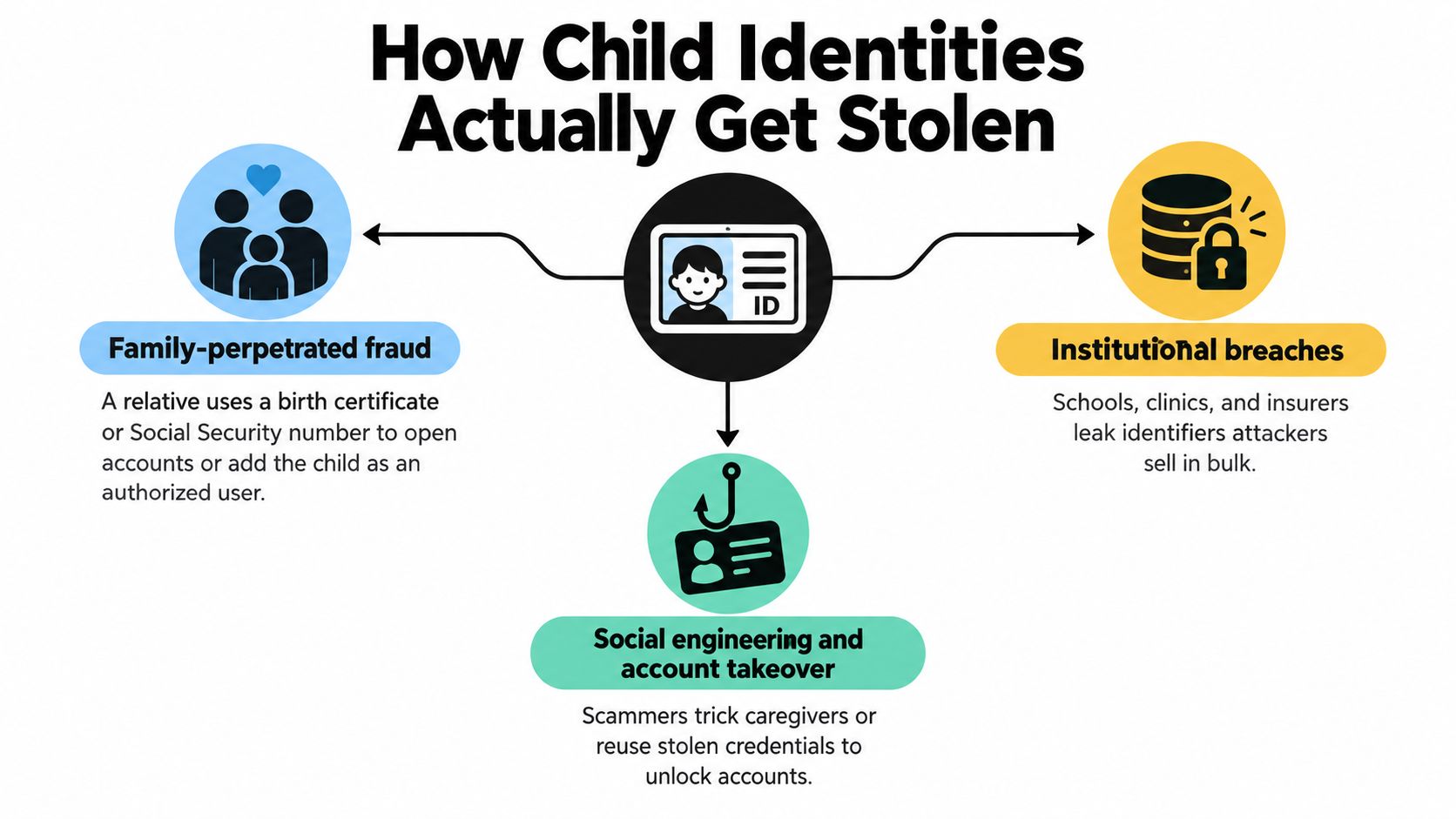
How Child Identities Actually Get Stolen
Child identity theft usually starts with access. Someone obtains a document, a database record, a reused password, or enough public clues to make a convincing request. The source may be close to home, embedded in a service the family trusts, or built from details that parents and children shared casually.
Access through family and trusted adults
Javelin’s research found that over 70% of reported victims knew the perpetrator, which changes how parents should think about document security. A relative, caregiver, or another trusted adult may have access to a birth certificate, Social Security card, medical form, or school record. In a difficult financial situation, that person might use the child’s details to open an account or add the child as an authorized user.
The warning sign may not be a dramatic online event. It could be a credit offer addressed to a child, a collection notice, or a lender asking questions about an account the child never opened. Families should keep identity documents in a location that isn’t accessible to every visitor or relative, and they should ask organizations why a full Social Security number is necessary.
Exposure through institutions and breaches
Schools, healthcare providers, insurers, activity programs, and online services all handle personal information. A breach can expose identifiers even when the child did nothing wrong and the parent followed sensible household rules. Javelin reported that 1.7 million U.S. children, about 1 in 43, had personal information exposed in a data breach during the year covered by its 2022 research, as described in its child data breach announcement.
For example, a parent might receive a breach notice involving a pediatric provider. That notice doesn’t prove that someone has opened an account, but it changes the family’s next steps. The parent should preserve the notice, determine which information was exposed, search for a credit file, review related account credentials, and watch for convincing follow-up phishing.
Social engineering and account takeover
Public posts can supply a child’s school, birthday, team, location, pet name, or family relationships. A scammer can use those details to impersonate a school administrator, send a realistic password-reset message, or guess answers to knowledge-based security questions. A caregiver’s compromised email account can then become a route into shared family services.
The FTC’s guidance on child identity theft is useful for the credit-file process, but parents also need a broader digital review. Learn more about the information attackers seek in how scammers get your information.
The practical lesson is simple: don’t ask only whether a child’s Social Security number has been stolen. Ask where the child’s identifying details, account credentials, and family connections are visible, duplicated, or recoverable.
The Credit Freeze Layer and What It Really Does
A credit freeze is the strongest first control against new-account fraud in the United States, but parents need to understand its boundaries. Start by contacting Equifax, Experian, and TransUnion separately. Request a search for the child’s Social Security number, then document whether a file exists and review every inquiry, account, address, and collection entry.
If a file exists, dispute unfamiliar entries with the bureau and the creditor. Include the identity and guardianship documents each organization requests, and report suspected theft to the FTC. If no file exists, a parent or legal guardian can still request a freeze for an eligible minor through the bureaus’ manual process.
The Michigan Attorney General’s explanation of child identity theft confirms that a parent or legal guardian can request a free freeze for a child under 16. The freeze remains until the bureau is instructed to remove it. The GAO’s report on security freezes states that federal law requires the nationwide bureaus to place a freeze within one business day after a qualifying telephone or electronic request, and lift it within one hour after a qualifying request. Keep confirmation details and copies of submitted documents because each bureau administers its process separately.
What the freeze covers
A freeze restricts prospective lenders from accessing the child’s credit file. That makes it substantially harder for a fraudster to obtain new credit through ordinary underwriting, even if the attacker has the child’s personal information.
| Function | What Happens | What Does Not Happen |
|---|---|---|
| New credit applications | A lender generally can’t access the frozen file for a new account | The freeze doesn’t close an account that already exists |
| Credit-file protection | New-account underwriting becomes substantially more difficult | It doesn’t remove fraudulent debts or correct inaccurate records by itself |
| Future access | The parent can request a lift when legitimate credit access is needed | It doesn’t protect gaming, email, social, healthcare, utility, or other non-credit accounts |
| Discovery | A file search can reveal whether a child has an unexpected credit history | A freeze doesn’t scan public posts, breach records, or impersonation profiles |
A freeze isn’t a monitoring service. It doesn’t remove an exposed identifier, stop account takeover, or prevent a scammer from using personal information outside credit underwriting. For a broader explanation of the difference between prevention and monitoring, review this guide to free identity theft protection.
Digital Footprint Risks Beyond Credit Files
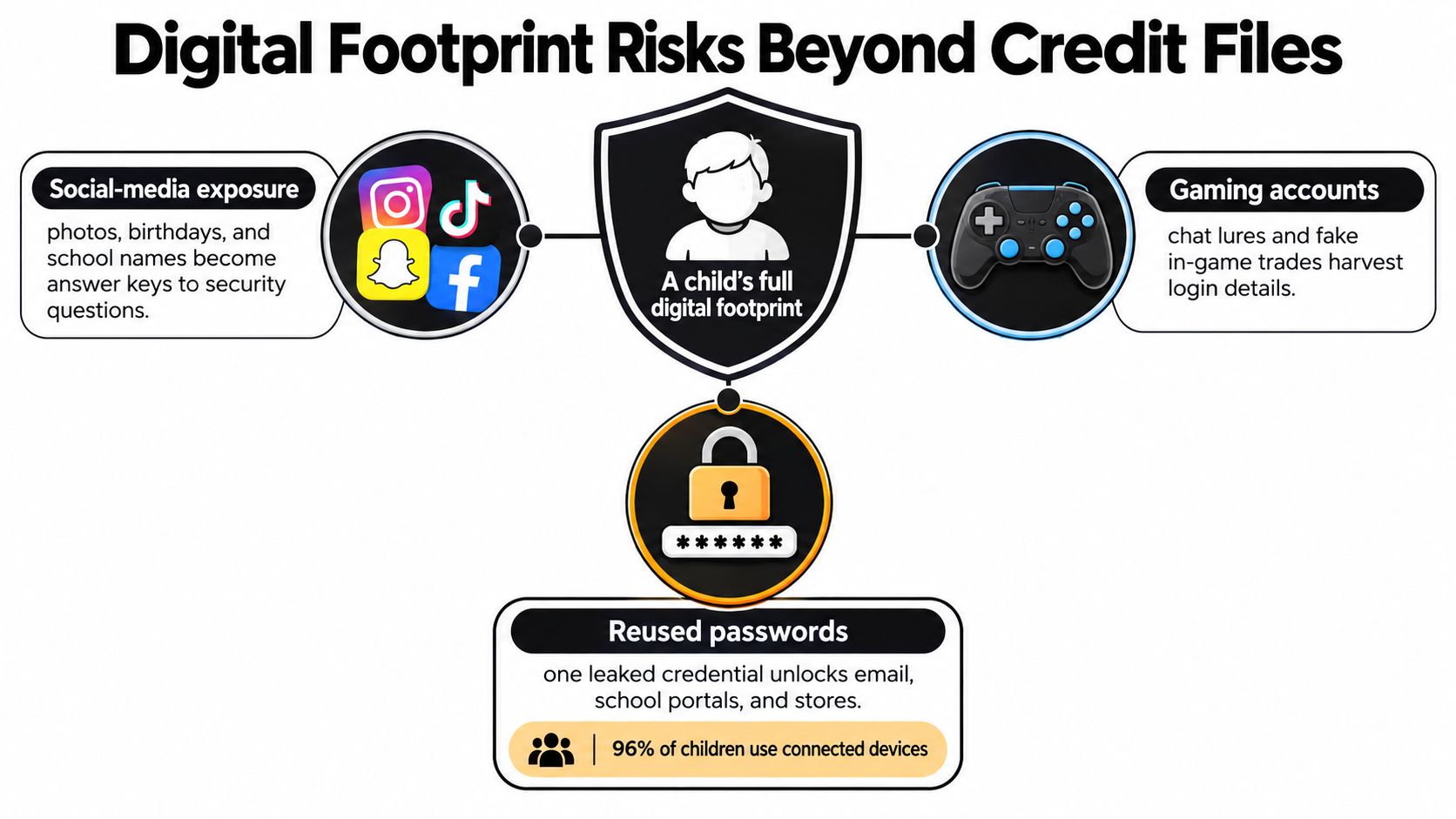
A credit file is a relatively narrow record. A child’s digital footprint is much wider, and it changes whenever the child joins a game, creates a username, posts a photo, uses a family email address, or signs in through a shared device.
Javelin reported that 96% of children who experienced identity theft and later financial losses were active social-media users when their identities were compromised, based on the period examined in its research on social media and child identity theft. That doesn’t mean social media caused every incident. It shows why parents should treat public profiles, private messages, reused credentials, and connected accounts as part of the same risk picture.
One exposed detail can support another attack
A public birthday may help a scammer personalize a message. A school name can make an impersonation attempt sound credible. A pet’s name may still be used as an account recovery answer. A leaked email and password pair from a parent’s account may work against a family-shared streaming, shopping, school, or gaming login.
Gaming accounts deserve special attention because they combine identity, social interaction, virtual items, and sometimes payment information. A fake in-game trade or chat message can direct a child to a convincing login page. If the same password appears elsewhere, the attacker may try it against email or family accounts.
Practical rule: Treat every username and password as reusable personal data unless it has been made unique and protected with multifactor authentication.
Public information can also be copied, indexed, combined, and republished. A parent may delete an old post while a copy remains in another location, or a username may connect a gaming profile to a public social account. A digital-footprint review can identify exposed emails, public profile data, breach-linked credentials, and suspicious account connections that credit bureaus will never show.
For age-appropriate family education and privacy boundaries, see children and digital footprints. The aim isn’t to inspect every private conversation. It’s to remove high-risk identifiers, secure accounts, and give teenagers a visible role in decisions about their online identity.
Comparing the Tools That Watch Your Child’s Identity
Parents often ask which service they should use. The more useful question is what part of the attack chain each tool can see. Credit monitoring, identity monitoring, and OSINT-based digital-footprint scanning detect different signals, so treating them as competing solutions creates an avoidable coverage gap.
| Tool Type | What It Detects | What It Misses | Best Use |
|---|---|---|---|
| Credit monitoring | New accounts, inquiries, collections, and changes on an existing credit file | Exposure before a Social Security number is used, public impersonation, gaming compromise, and non-credit misuse | Detecting activity after an identity enters the credit system |
| Identity-monitoring service | Some combinations of credit events, breach records, email exposure, and identity alerts | It may not show every public profile, username connection, or context around exposed information | Adding alerts across financial and breach-related signals |
| OSINT digital-footprint scanning | Public profiles, exposed emails, usernames, leaked credentials, and accessible identity information | It can’t prove that a particular credit account exists or replace bureau verification | Finding exposure before it becomes a confirmed financial incident |
A parent might receive no credit alert because the child has no established file. At the same time, a public gaming username could be connected to an exposed email and a reused password. Credit monitoring would miss that early signal, while a broader identity service or OSINT scan may identify the exposure.
OSINT findings also need judgment. A matching name can belong to another person, and a breach listing doesn’t automatically prove that a current password still works. Confirm matches, change credentials rather than testing stolen passwords, and use bureau verification for credit questions.
For readers who want more background on identity checks and the information organizations use, this identity verification page from Nerds 2 You Edmonton offers useful context. Families can then compare that kind of verification process with the narrower signals provided by credit tools and the broader visibility offered by a digital-footprint scan.
A practical comparison of coverage options appears in this identity theft protection comparison. The right setup depends on the child’s age, guardianship status, country, existing accounts, and known breach exposure.
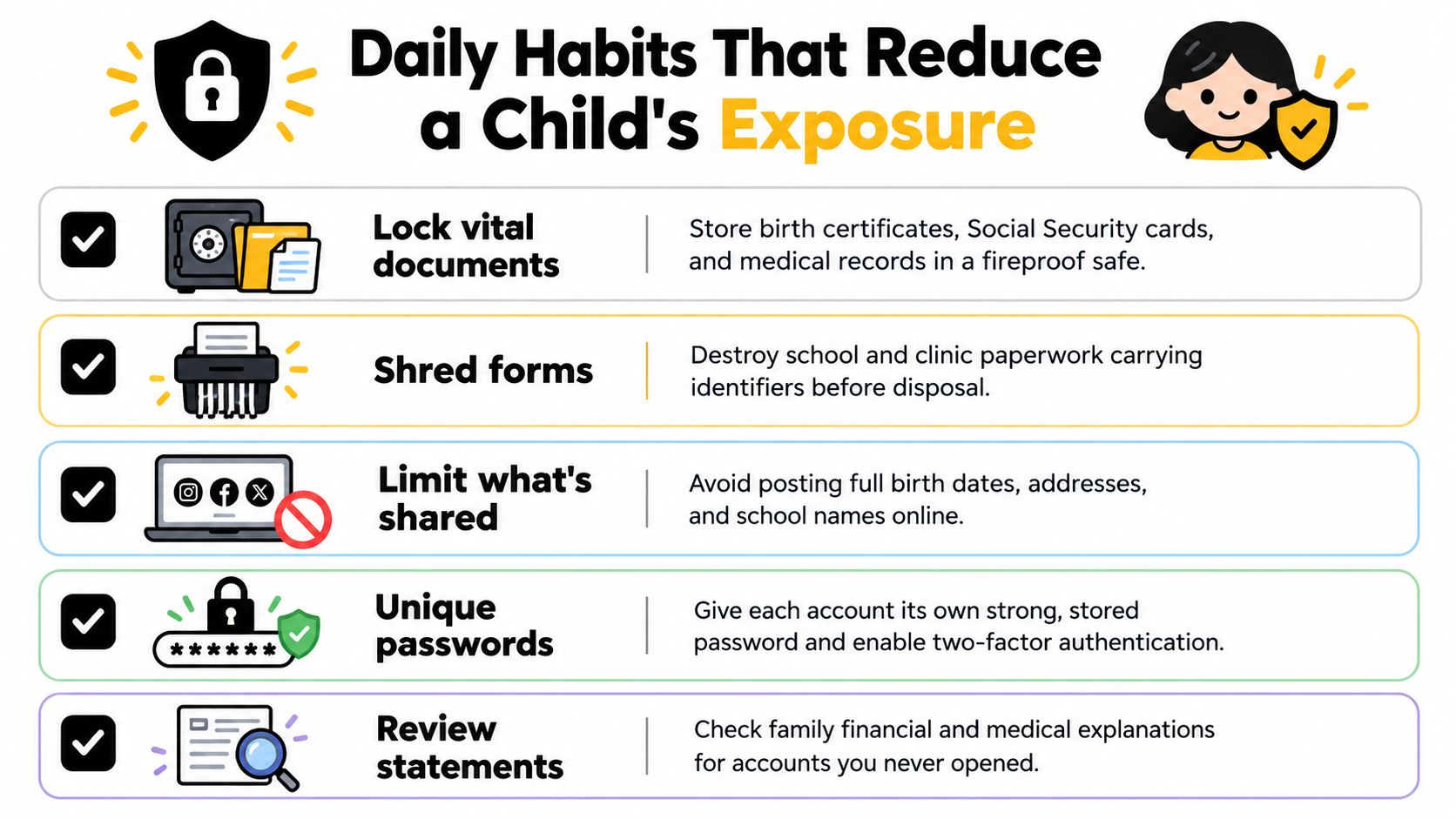
Daily Habits That Reduce a Child’s Exposure
The strongest household routines are often ordinary. They reduce the number of identity fragments an attacker can collect and make unusual activity easier to recognize.
Secure documents before they leave the house
Keep birth certificates, Social Security cards, passports, medical records, and benefit documents in a locked, fire-resistant container. If you store digital copies, use an encrypted vault rather than an unprotected photo folder or shared drive. Shred old school and clinic forms that contain identifiers instead of putting them intact in household recycling.
Before giving a school, camp, doctor, sports organization, or service provider a full Social Security number, ask:
- Purpose: Why is the full number required?
- Protection: Who can access it, and how will the organization store it?
- Alternative: Can the organization use another identifier or only the last digits?
- Retention: How long will the form be kept, and how can it be securely destroyed?
The Identity Theft Resource Center’s discussion of child identity theft notes that children commonly know the person who misuses their information. That doesn’t mean families should suspect every relative. It does mean sensitive forms deserve controlled access, even inside a trusted household.
Reduce public clues
Review school directories and permission forms before signing. Ask what information will be shared, whether directory information can be restricted under FERPA, and whether a public team page needs a full name, school, schedule, or location. Avoid posting a complete birth date, home address, daily routine, or real-time location.
Set boundaries with grandparents and family group chats too. A well-meaning relative may forward a birthday photo or school announcement to a wider audience without realizing that the image contains a name badge, address, or schedule.
Make account recovery harder to abuse
Give every account its own password and store those passwords in a reputable password manager. Enable app-based or device-based multifactor authentication where available, review recovery email addresses and phone numbers, and replace knowledge-based questions that use public facts such as a pet’s name or school.
Talk with older children about why these controls exist. Teenagers need privacy and growing autonomy, so parents should focus on high-risk identifiers and account security rather than secretly reading unrelated conversations.
A Family Plan for Responding to a Child Identity Incident
A notification from a credit-monitoring service can feel unreal when it names an eight-year-old. One mother in that situation found a delinquent account connected to her child’s Social Security number. Her first task wasn’t to solve the entire case in one evening. She separated immediate containment from the longer recovery process.
She first saved the alert, account details, letters, and dates. Then she contacted the creditor, stated that the account was fraudulent and belonged to a minor, requested closure, and asked what documents and fraud affidavit were required. She contacted Equifax, Experian, and TransUnion to request the child’s file, dispute the account, and place freezes. She also filed a report through IdentityTheft.gov, which created documentation for the creditor and bureau disputes.
The family changed passwords on related accounts, enabled multifactor authentication, and checked recovery settings. Because the child’s school had provided identity documents for enrollment, the mother notified the school and asked whether any forms had been exposed or whether documentation needed to be reissued. She reviewed breach notices and reduced public sharing of the child’s full name, school information, birthday, and routine.
Separate containment from recovery
The first response should focus on stopping additional access:
- Preserve evidence: Save alerts, letters, account numbers, dates, messages, and breach notices.
- Contact the creditor: Request closure, written confirmation, and removal of fraudulent information.
- Contact each bureau: Request a manual file search, dispute inaccurate entries, and place freezes.
- Report the theft: Use the FTC report and provide the resulting documentation when appropriate.
- Secure related accounts: Change reused credentials, protect the parent’s email, and review recovery methods.
- Limit further disclosure: Ask schools, clinics, and organizations what information they hold and why.
Recovery takes longer. The family may need to replace documents, follow up with creditors, correct bureau records, and watch for new inquiries or accounts. The parent should keep a case file and continue checking the child’s identity signals over the following 12 to 24 months, because a single discovered account may not reveal every misuse.
The steps to take after identity theft can help organize that response, but no online checklist replaces direct communication with the creditor, bureau, school, healthcare provider, or relevant authority.
Print a one-page family plan with the child’s legal name, the parent or guardian’s authority documents, bureau contact records, creditor details, reporting information, and a list of accounts to secure. Add a short digital-footprint routine: review breach alerts, search exposed emails and usernames, remove unnecessary public details, and discuss findings with the child in an age-appropriate way. That combination gives the family both a rapid response and an ongoing method for reducing exposure.
Digital Footprint Check can scan public online information, exposed emails, usernames, gaming profiles, and breach-linked data to help families identify risks that a credit freeze won’t reveal. Start with the Digital Footprint Check free checker, review the findings with your child, and turn the results into concrete steps such as deleting public identifiers, changing reused passwords, and strengthening account recovery.