· Digital Footprint Check · Content Marketing · 13 min read
What Is Data Breach Coverage and Why You Need It
What is data breach coverage and how does it protect your business? Learn key benefits and what to look for in a cyber insurance policy.

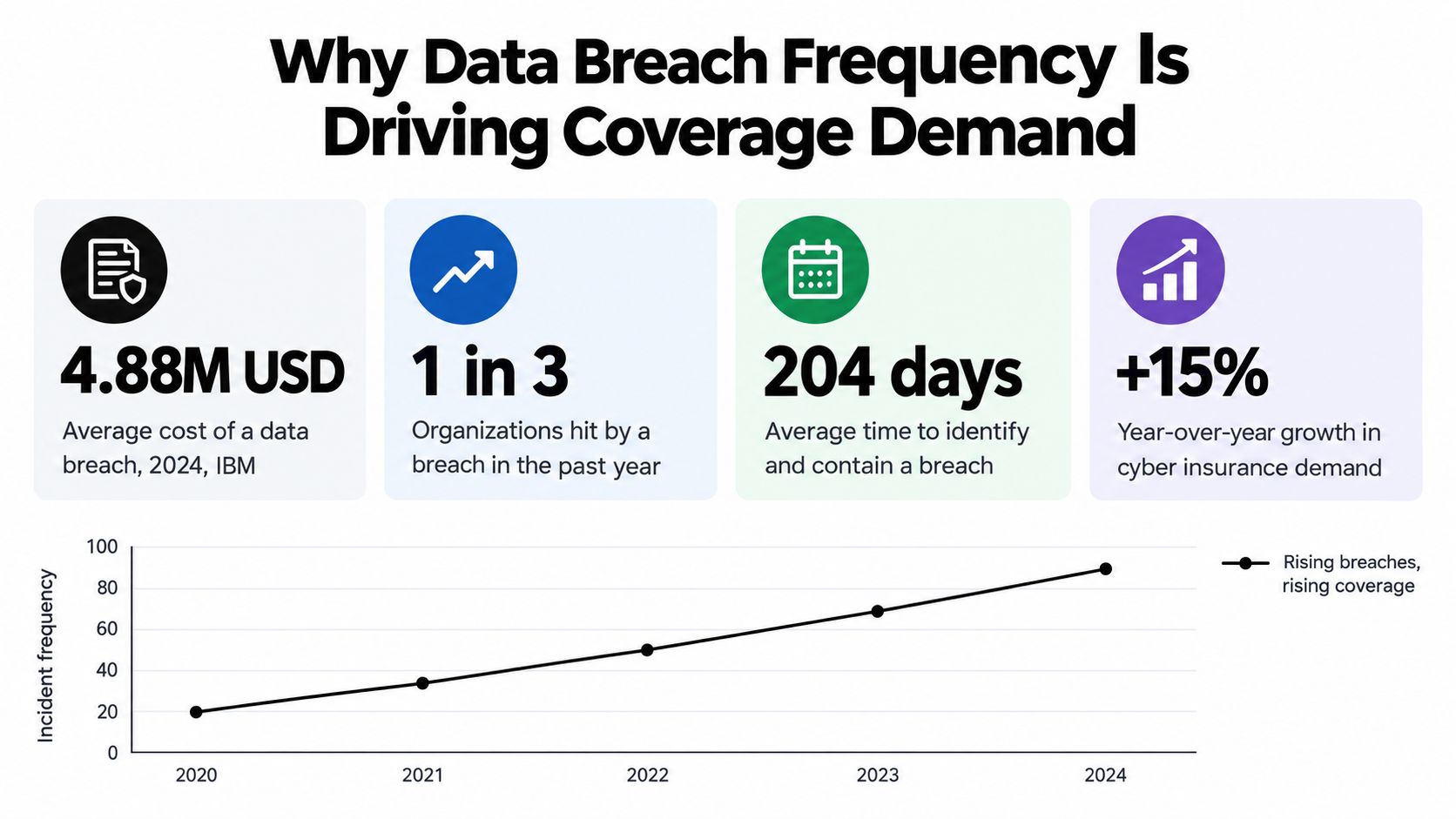
The average data breach now costs USD 4.88 million, and data breach coverage is specialized insurance designed to pay eligible response, legal, notification, and recovery costs after a qualifying incident.
That distinction matters because a breach doesn’t end when the attacker is removed. A business may still need forensic investigators, legal advice, customer communications, regulatory support, public relations, data restoration, and protection for people whose information was exposed. Those expenses arrive quickly, often before anyone knows the full cause or scope of the incident.
Defining Data Breach Coverage in a High-Risk World
IBM’s 2024 Cost of a Data Breach report placed the average breach cost at USD 4.88 million. That financial pressure helps explain why breach coverage has shifted from a niche privacy product to a broader commercial risk-transfer tool, while WiseGuyReports describes continued growth in the insurance market.
Data breach coverage is insurance that helps pay specified costs arising from the unauthorized access, loss, theft, or disclosure of sensitive information. Depending on the policy, it can support the organization’s own response and address claims from customers, regulators, employees, partners, or other affected parties.
The coverage does not make a network secure. Firewalls, multifactor authentication, endpoint detection, secure backups, employee training, and vulnerability management reduce the likelihood or impact of an incident. Insurance helps fund the response after the organization discovers that personal, financial, health, payment, employee, or commercially sensitive information may have been compromised.

A financial response layer
Building insurance provides a useful comparison. Locks and alarms may reduce the chance of a fire or break-in, but the policy addresses eligible repair costs after the event. Breach coverage works similarly. Security controls reduce exposure, while insurance may finance the investigation, communications, legal work, and recovery activities that follow a security failure.
Standard commercial liability or property policies may not be written for privacy events, notification duties, forensic investigation, cyber extortion, or compromised electronic records. Some broader policies include limited cyber protection, but the trigger, sublimits, retentions, and exclusions determine what the insurer will consider.
Underwriting has therefore become conditional on security posture. Insurers may ask how an organization protects accounts, patches systems, limits access, tests backups, and responds to suspicious activity. Weak or inaccurately described controls can affect eligibility, pricing, or a claim.
The product label still does not settle the question. Policies called “cyber,” “privacy,” or “data breach” can provide materially different protection. A retailer handling payment information, a medical practice holding patient records, and a software company processing customer data may require different combinations of first-party and third-party cover.
Practical rule: Treat data breach coverage as a financing plan for a coordinated incident response, not as a replacement for prevention.
Before choosing a policy, review the response panel, insurer-appointed counsel, notification support, territorial scope, vendor incidents, business interruption wording, and reporting deadlines. An independent overview can help businesses find affordable cyber liability options, but the policy schedule and endorsements control the outcome.
For a plain-language explanation of what a data breach means, examine the event itself and then the policy trigger. A confirmed intrusion alone may not activate coverage. The specific event must fit the insuring agreement, and the resulting expenses must fall within its terms.
How Data Breach Coverage Is Structured
Most policies divide protection into first-party coverage and third-party coverage. The simplest way to remember the difference is this: first-party protection addresses the policyholder’s own costs, while third-party protection addresses demands made by others.
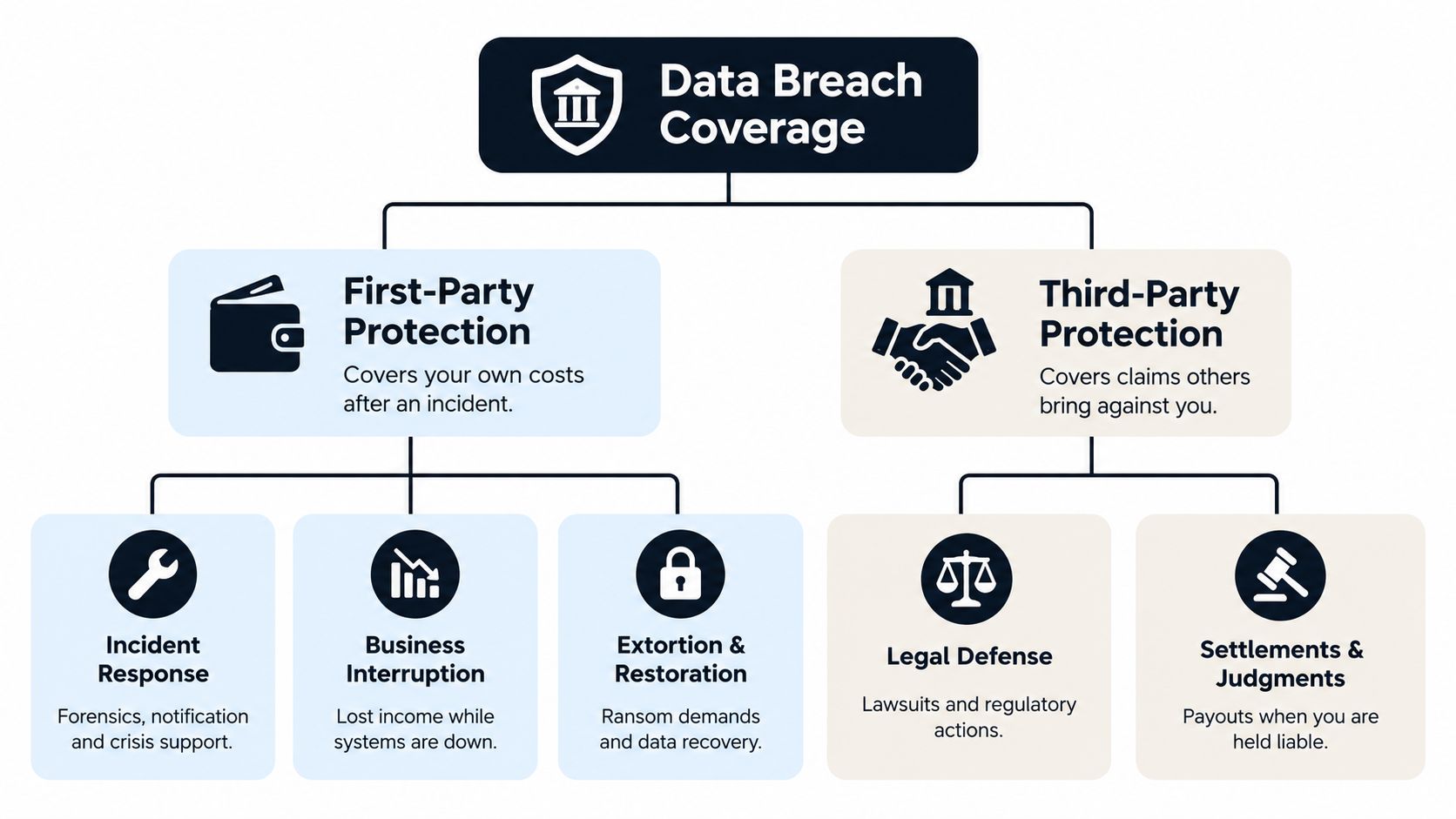
First-party protection
These expenses usually begin as soon as the organization suspects a serious incident:
- Forensic investigation: Specialists examine systems, accounts, logs, and devices to determine what happened, which information may be affected, and whether unauthorized access continues.
- Legal assessment: Counsel helps determine notification, privacy, contractual, and regulatory obligations.
- Customer notification: The policy may pay for preparing and sending notices, establishing call-center support, and handling questions from affected people.
- Credit monitoring: Where appropriate and covered, the organization may provide monitoring or related assistance to individuals whose information was exposed.
- Crisis management: Public-relations and communications support can help the organization explain the incident accurately without making unsupported promises.
- Data recovery: Some policies contribute to restoring corrupted or inaccessible information.
- Cyber extortion: A policy may address certain extortion demands and the specialist costs connected with negotiating or responding to them.
- Business interruption: Coverage may apply when an insured event disrupts operations, but this usually depends on detailed wording, waiting periods, proof of loss, and specific sublimits.
These costs are front-loaded. A company may need to retain lawyers and investigators before it knows whether customers will sue or a regulator will open an inquiry. That timing is why access to an approved breach-response panel can be as important as the headline limit.
Third-party protection
Third-party coverage responds to allegations or claims from people and organizations outside the policyholder. A customer might allege that the company failed to protect personal information. A regulator might investigate compliance. A commercial partner might claim that the incident caused contractual or financial harm.
This side of the policy can include legal defense, regulatory investigation costs where permitted, settlements, and judgments. It doesn’t mean every fine, penalty, lawsuit, or contractual demand is automatically covered. Intentional misconduct, known circumstances, unapproved payments, and excluded regulatory penalties may fall outside the agreement.
The distinction also affects recordkeeping. First-party losses require invoices, investigation reports, notification costs, restoration records, and evidence of interruption. Third-party matters require prompt forwarding of complaints, subpoenas, regulatory correspondence, and legal demands.
A business continuity plan should connect these two parts. Guidance on business continuity management is useful because insurance can fund eligible costs, but it won’t decide who has authority to shut down systems, communicate with customers, preserve evidence, or approve emergency spending.
Data Breach Insurance vs Monitoring Services and Identity Protection
Monitoring and insurance solve different problems. A monitoring service can alert you that an email address, username, credential, or other identifier appears in a known exposure. Identity-protection software may help an individual watch accounts, receive alerts, or respond to signs of misuse. Neither is automatically a substitute for a policy that pays covered organizational response costs.
A breach can also exist before monitoring detects it. An attacker may access files without publishing them, a lost laptop may contain unencrypted records, or an employee may send sensitive information to the wrong recipient. The policy trigger, not the presence of an online alert, controls whether insurance responds.
| Feature | Data Breach Insurance | Breach Monitoring Services | Identity Protection SaaS |
|---|---|---|---|
| Primary purpose | Funds eligible response, liability, and recovery costs after a covered event | Detects signs that information or credentials may be exposed | Helps individuals monitor identity misuse and account-related risks |
| What triggers action | A qualifying incident reported under the policy | A match, alert, or observed exposure in the service’s data sources | A monitoring signal or user-reported identity concern |
| Pays for forensic investigation | May cover it when included in the policy | Generally no | Generally no |
| Pays legal defense or regulatory response | May cover eligible costs under the policy | No | No |
| Provides alerts | Usually not the central function | Yes | Yes |
| Replaces security controls | No | No | No |
| Main user | A business or other insured organization | Businesses, researchers, and individuals | Primarily individuals or employee-benefit users |
The practical difference is financial. Monitoring tells you that you may have a problem. Insurance may help pay for the professional work required to investigate and manage that problem, subject to the policy terms.
For an explanation of how exposure alerts work, review data breach monitoring. A sensible program can use both: monitoring as an early-warning layer, and insurance as a contractual source of funds for a covered incident.
Neither tool should create false confidence. An alert doesn’t prove that a claim will be accepted, and the absence of an alert doesn’t prove that no breach occurred. Businesses still need access controls, tested backups, incident procedures, vendor oversight, and accurate insurance applications.
Why Data Breach Frequency Is Driving Coverage Demand
Reported U.S. breaches rose from 136 in 2005 to more than 1,800 by 2021, with later reporting placing the total above 3,300 in 2025. This more than tenfold increase helps explain why breach coverage has shifted from a specialist purchase to part of operational planning. Businesses are not only insuring against a rare technical failure. They are preparing for a recurring business disruption, while insurers are making coverage increasingly dependent on the applicant’s security posture. (Munich Re)
The scale of a single incident reinforces that change. Yahoo’s 2013 breach ultimately affected all 3 billion accounts, making it one of the largest confirmed breaches by account count. One compromise can trigger forensic work, legal advice, communications, customer support, and reputational repair. The initial intrusion may be technical, but the response becomes an organization-wide expense.
From niche product to operating safeguard
Insurance purchasing has expanded with concern about breach exposure. Munich Re reported a USD 15.3 billion global cyber insurance market in 2024, while the NAIC reported global cyber insurance premiums of nearly USD 15 billion in 2024, up 7% from the prior year. Market estimates can vary because organizations define and measure the category differently. The broader direction is clear: cyber insurance is now a substantial market, as also reflected by WiseGuyReports.
That growth does not mean every organization needs the same policy limit. It means each buyer must decide who would fund the response if systems, records, or customer information were compromised.
A small business may face notification costs, legal advice, and operational recovery. A healthcare provider may have greater exposure because of privacy obligations and sensitive records. An online retailer may need to address payment information, customer accounts, and third-party platforms. Coverage can transfer some financial risk, but the buyer first needs to identify the data and dependencies that could turn an incident into a claim.
Rising frequency has also changed underwriting. Insurers increasingly evaluate whether stated controls are documented and operating, rather than accepting security as an informal promise. Applications therefore ask how the organization authenticates users, detects threats, manages privileged access, protects email, patches systems, and preserves recoverable backups. Those answers can influence both eligibility and the terms available.
The Reality Gap Between Policy Wording and Claim Payouts
A breach does not automatically produce a payout. The insurer will examine whether the event matches the policy trigger, whether the application answers were accurate, whether an exclusion applies, and whether the business followed notice and cooperation requirements. Policy wording functions like a set of operating instructions. If the incident falls outside those instructions, the claim may be reduced or denied.

Security posture affects eligibility
Cyber underwriting now examines security controls in greater detail. In 2025, 99% of applications asked about multifactor authentication, alongside endpoint detection and response, privileged access management, immutable backups, email security, and patching cadence. These questions help insurers price the risk and verify whether the controls described in the application are in operation. (SWIF)
A company that reports multifactor authentication may face questions if administrator accounts still use only passwords. A business that reports tested backups may need to show that those backups are isolated, recoverable, and tested in practice. An inaccurate answer can affect a claim when the missing control relates directly to the incident.
The loss category matters as well. Business email compromise and funds transfer fraud together represented 60% of claims in one 2025 cyber claims report, while ransomware made up a smaller share but produced a higher average loss. A business should not assume that cyber insurance covers every fraudulent transfer, social-engineering event, or ransomware expense. The insuring agreement and endorsements must address that specific exposure.
Coverage can differ substantially between products. A breach policy may focus on privacy events, while a broader cyber policy may add system damage, interruption, fraud, or extortion protection. Some breach-only products cover stolen electronic or paper records, procedural errors, compromised employee or customer information, vendor-caused incidents, and events in other territories. Equipment repair or broader interruption losses may remain excluded unless added.
The cheapest policy can become the most expensive choice when its trigger doesn’t match the incident your business is most likely to face.
Report suspected incidents through the method stated in the policy. Before hiring counsel, promising payment, notifying customers, or negotiating with an attacker, check the insurer’s consent requirements unless delay creates a greater legal or safety risk. Keep a written timeline of detection, decisions, communications, and expenses.
Use a checklist for data breach notification requirements. Under GDPR Article 33, a controller must notify the relevant supervisory authority without undue delay and, where feasible, within 72 hours of becoming aware of a personal data breach. The notice should describe contact details, likely consequences, and measures taken or proposed. A late notice requires an explanation. (GDPR Article 33)
Who Needs Data Breach Coverage and When to Act
The strongest candidate is any organization that stores, receives, transmits, or can access information that would create cost or liability if exposed. That includes small businesses, professional practices, retailers, online services, schools, charities, contractors, and organizations that rely heavily on cloud providers or outsourced processors.
A useful decision test is to ask what happens in the first hours after discovery:
- Who investigates the event? If no internal employee can preserve evidence or identify an approved forensic provider, response costs may begin without a clear process.
- Who determines notification duties? Privacy rules differ by location, data type, and affected population. A business needs legal advice before making a public statement.
- Who pays for customer communication? Notices, call-center support, translation, monitoring, and crisis communications may be expensive even when no lawsuit follows.
- Who handles a regulator or claimant? Third-party allegations can arrive after the technical incident appears closed.
- What happens if operations stop? A company should know whether its policy addresses interruption, restoration, and the evidence required to calculate a loss.
Healthcare providers and organizations handling health information face a particularly sensitive response environment. E-commerce companies manage customer accounts and payment-related information. Professional firms may hold tax, employment, legal, or financial records that criminals can use for fraud or extortion. A smaller organization may have fewer records than a multinational, but it may also lack an internal legal, security, and communications team.
The GDPR’s 72-hour supervisory-notification requirement makes preparation especially important for covered controllers. The European Data Protection Board says notification is generally required for personal data breaches unless the event is unlikely to present a risk to individuals, and the United Nations Office on Drugs and Crime notes that the rule concerns unauthorized access, use, and distribution of data, with processors notifying controllers within the same period. (European Data Protection Board guidance) (United Nations Office on Drugs and Crime guidance)
Coverage should sit beside prevention and exposure management. An organization can review public information, exposed credentials, employee accounts, vendor access, and known breach records with ethical OSINT methods. Digital Footprint Check offers breach and online-presence checks that can help identify exposed email addresses or usernames, but those checks don’t replace insurance, incident response, or legal advice. For people or organizations already affected, data breach victim guidance can provide a practical starting point for reviewing exposure and next steps.
Don’t wait for an incident to reveal missing limits, exclusions, or response contacts. Gather your data inventory, review the security controls stated in the application, ask how vendor incidents are handled, confirm notification and reporting duties, and have a broker or qualified adviser compare the wording against your actual risks.
Digital Footprint Check helps individuals and businesses search for exposed information across breach records and the wider public web, including email addresses, usernames, professional profiles, and other digital-footprint signals. Visit Digital Footprint Check to check your exposure and use those findings alongside stronger security controls, an incident-response plan, and appropriate data breach coverage.