· Digital Footprint Check · Content Marketing · 13 min read
Online Reputation Management Strategy That Works in 2026
Build an online reputation management strategy that audits, monitors and repairs your digital footprint. Actionable guide for job seekers and professionals.

You search your name before a job interview and find an old public profile, a tagged photo, or a forum post you barely remember. A hiring manager may never ask about it. A potential client may never mention it. A dating match may decide not to continue. The judgment can happen before you get a chance to explain who you are today.
That’s why an online reputation management strategy isn’t limited to companies responding to reviews. It’s a practical system for discovering what’s visible, correcting inaccurate information, securing linked accounts, building credible content, and monitoring how people and AI systems describe you. The process is manageable when you treat it as ongoing digital hygiene rather than a crisis project.
Why Your Online Reputation Decides Opportunities Before You Do
A job seeker can have a strong résumé and still lose attention when search results create doubt. The same thing happens in dating. A match may see inconsistent names, duplicate profiles, suspicious photos, or exposed personal details and choose the safer option without asking questions. Online reputation affects opportunities because people often use visible signals to reduce uncertainty.
Employers also use public information during hiring. CareerBuilder-reported figures cited by Reputation X’s overview of online reputation statistics say 70% of employers use social networking sites to research candidates, while 57% found content that led them not to hire an applicant. The same source reports that 86% of job seekers research a company’s reviews and ratings before applying, so reputation shapes both sides of the employment relationship.

Reviews became a trust mechanism
People don’t treat reviews as background decoration. A Pew Research study on online reviews found that 82% of U.S. adults at least sometimes read customer ratings or reviews before buying something for the first time, and 40% always or almost always did so in 2016. By 2024, BrightLocal reported that 75% of consumers always or regularly read online reviews, while 41% were more likely to use a business that responds to all reviews than one that responds to none.
Review quantity matters too. Most consumers expect a business to have 20 to 99 reviews, which means a credible reputation depends on both an authentic review history and thoughtful responses. A profile with a high rating but little activity can still leave questions unanswered.
Reputation now includes machine-generated summaries
Google results remain important, but they’re no longer the only place people form impressions. ChatGPT, Perplexity, Gemini, and other systems summarize information from multiple pages, profiles, directories, and discussions. If those sources conflict, an AI assistant may produce an incomplete or stale description.
For individuals, executives, job seekers, and small brands, that creates a new responsibility. You need consistent names, roles, biographies, links, and public facts across the sources that machines can read. A useful starting point is this guide to what online reputation management means, especially if you’ve only thought of reputation as review replies.
Key takeaway: Your reputation is the information others find before they speak with you. A proactive system gives you more control over that first impression.
If you’re building a public professional identity, resources on personal branding for indie hackers can also help you decide which expertise, projects, and profiles deserve consistent visibility. The principle applies broadly, whether you’re applying for work, growing a business, or protecting a personal identity.
Auditing Your Digital Footprint Like a Pro
You can’t manage a reputation you haven’t inspected. Start with discovery, not deletion. The purpose of an audit is to separate accurate information from outdated material, harmless noise from genuine exposure, and assets worth strengthening from accounts that should be private or removed.
Search from an outsider’s perspective
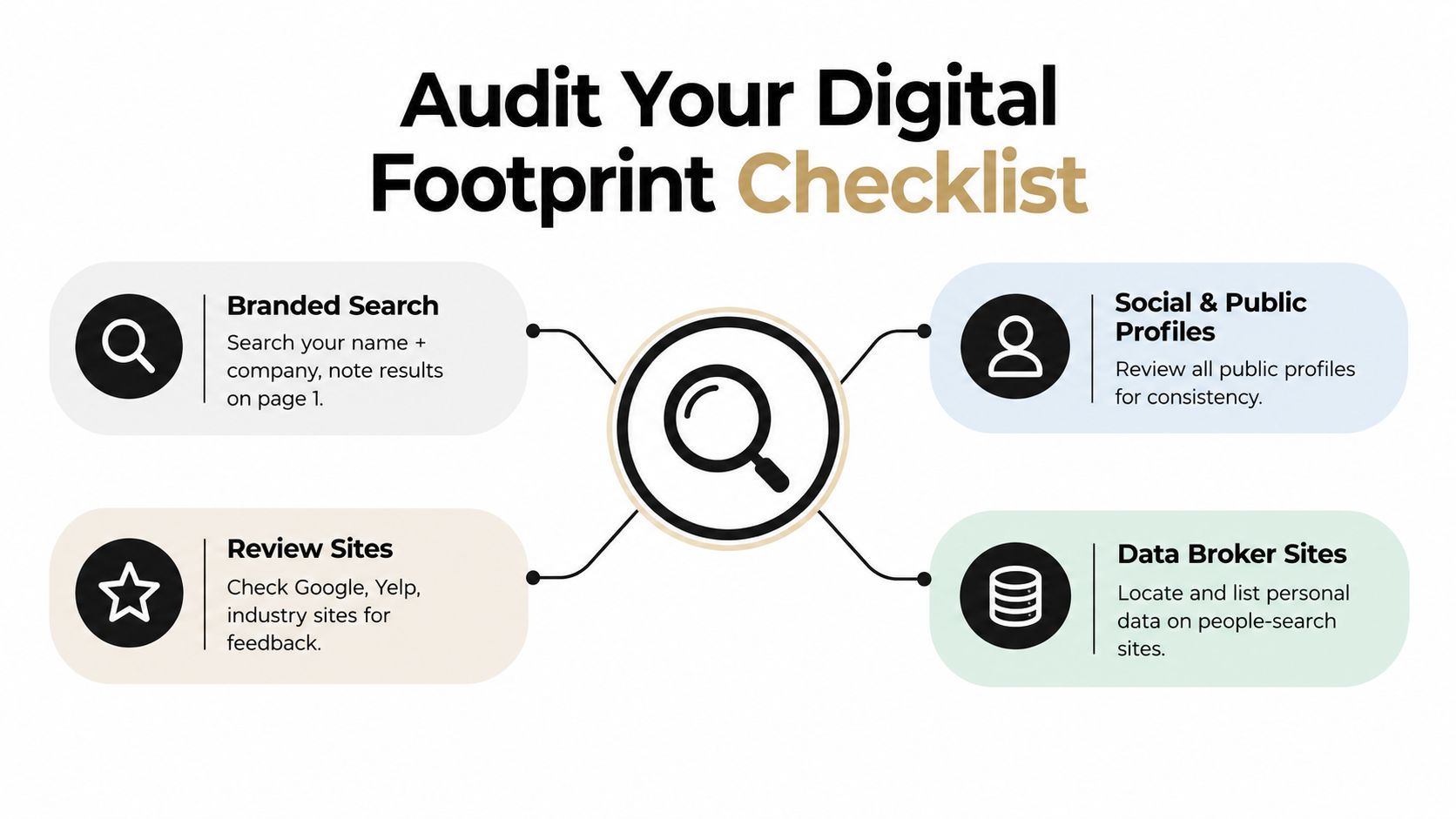
Use a logged-out browser or a private window so personalized results don’t hide what others may see. Search several variations:
- Full name: Search your name with and without middle initials, accents, or common misspellings.
- Location and employer: Combine your name with your city, company, school, profession, or previous organization.
- Usernames: Search handles used on gaming platforms, forums, social networks, and creator communities.
- Images: Review image results and check whether old profile photos, tagged images, or copied pictures connect to your identity.
- Contact details: Search public versions of an email address or phone number, but don’t publish sensitive details while investigating.
Document page-one results in a simple spreadsheet. Record the URL, what it says, whether it’s accurate, whether you control it, and what action it needs. Don’t focus only on negative pages. A thin or inconsistent professional presence can create uncertainty even when nothing is openly damaging.
Inspect profiles and exposure points
Review every public social profile, including accounts you no longer actively use. Check usernames, bios, profile photos, public posts, tagged content, follower lists, location clues, and connected applications. A public post may look harmless by itself but reveal a workplace, routine, family relationship, or travel pattern when combined with other information.
Search people-finder and data broker sites for addresses, relatives, phone numbers, and historical locations. Request removal where the site offers a legitimate opt-out process, then repeat the search later because listings can return or appear on another service.
Check breach notifications as well. A compromised email address doesn’t prove that an account is currently under attack, but it tells you to change reused passwords, secure the email account first, and review recovery options. The guide to checking your digital footprint provides a useful workflow for organizing these checks.
For a broader audit mindset, an SMB IT audit guide from IT Cloud Global, LLC offers complementary ideas for documenting assets, access, and risks. Individuals can apply the same logic to personal accounts.
A scan can reduce manual searching. Digital Footprint Check searches more than 500 platforms, including social networks, professional profiles, gaming accounts, public records, and breach databases, then presents findings for review. Run the free Digital Footprint Check scan and use the results to create three lists:
- Keep and strengthen: Accurate profiles, useful work, legitimate reviews, and authoritative pages.
- Clean or restrict: Old posts, exposed personal details, inconsistent bios, and unused accounts.
- Investigate or remediate: Breach exposure, impersonation, fraudulent profiles, defamatory claims, and sensitive data.
Monitoring What Matters and Knowing When to Act
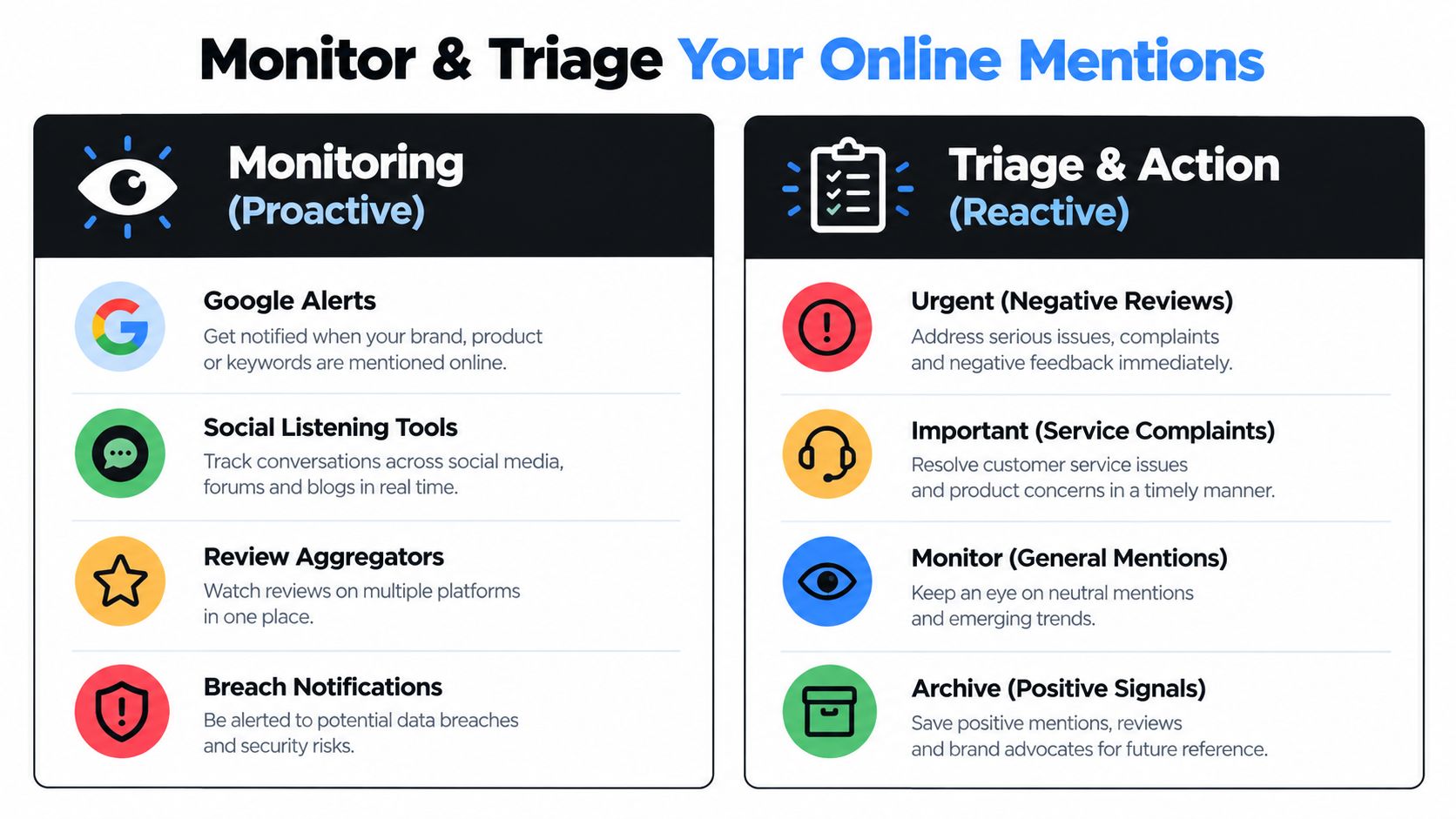
An audit gives you a snapshot. Monitoring tells you when the picture changes. Set alerts for your full name, business name, professional username, email address, and important brand terms. Add review notifications for relevant profiles, social listening for public mentions, and breach alerts for exposed credentials.
Your reputation is fragmented. A recent market guide says consumers use 6 platforms on average, so a person or company may appear across Google, social networks, directories, forums, gaming communities, and AI answers. A 2026 source also estimates that roughly 30% of online reviews are fake or deceptive, making it dangerous to treat every review as an authentic customer signal. These figures are reported in Social Czars’ guide to online reputation management trends.
Use a four-way triage model
Don’t answer every mention with the same response. First establish whether the content is accurate, actionable, harmful, and visible to the people who matter.
| Situation | Best Response | Why It Works |
|---|---|---|
| A genuine complaint with a solvable issue | Acknowledge it publicly, then move detailed resolution to a private channel | Shows accountability without exposing personal information |
| False, deceptive, or policy-violating content | Preserve evidence and report it through the platform’s process | Creates a documented basis for removal rather than relying on argument |
| An outdated but accurate page | Contact the publisher when appropriate, then publish current authoritative information | Updates the record without pretending history never existed |
| A negative result with no clear violation | Build accurate owned and third-party content that deserves visibility | Reduces attention through relevance and credibility, not suppression alone |
Respond publicly when other people need to see that you take the issue seriously. Move privately when the discussion includes order details, account data, health information, or personal safety concerns. Create new content when the problem is an information gap, such as an outdated biography or missing explanation of your work.
Avoid suppression-only thinking
Pushing negative mentions out of view can be part of remediation, but it shouldn’t replace complaint resolution or factual correction. One 2026 analysis reported 8 to 13 point rebounds in negative sentiment after suppression campaigns, as documented in Review42’s online reputation statistics. The safer approach combines authentic review generation, service improvement, evidence-based reporting, and useful content.
Use data breach monitoring guidance to separate a reputation concern from a security incident. A public complaint needs communication. A leaked credential needs containment, password changes, session review, and account protection.
Pushing Positive Content Above the Noise
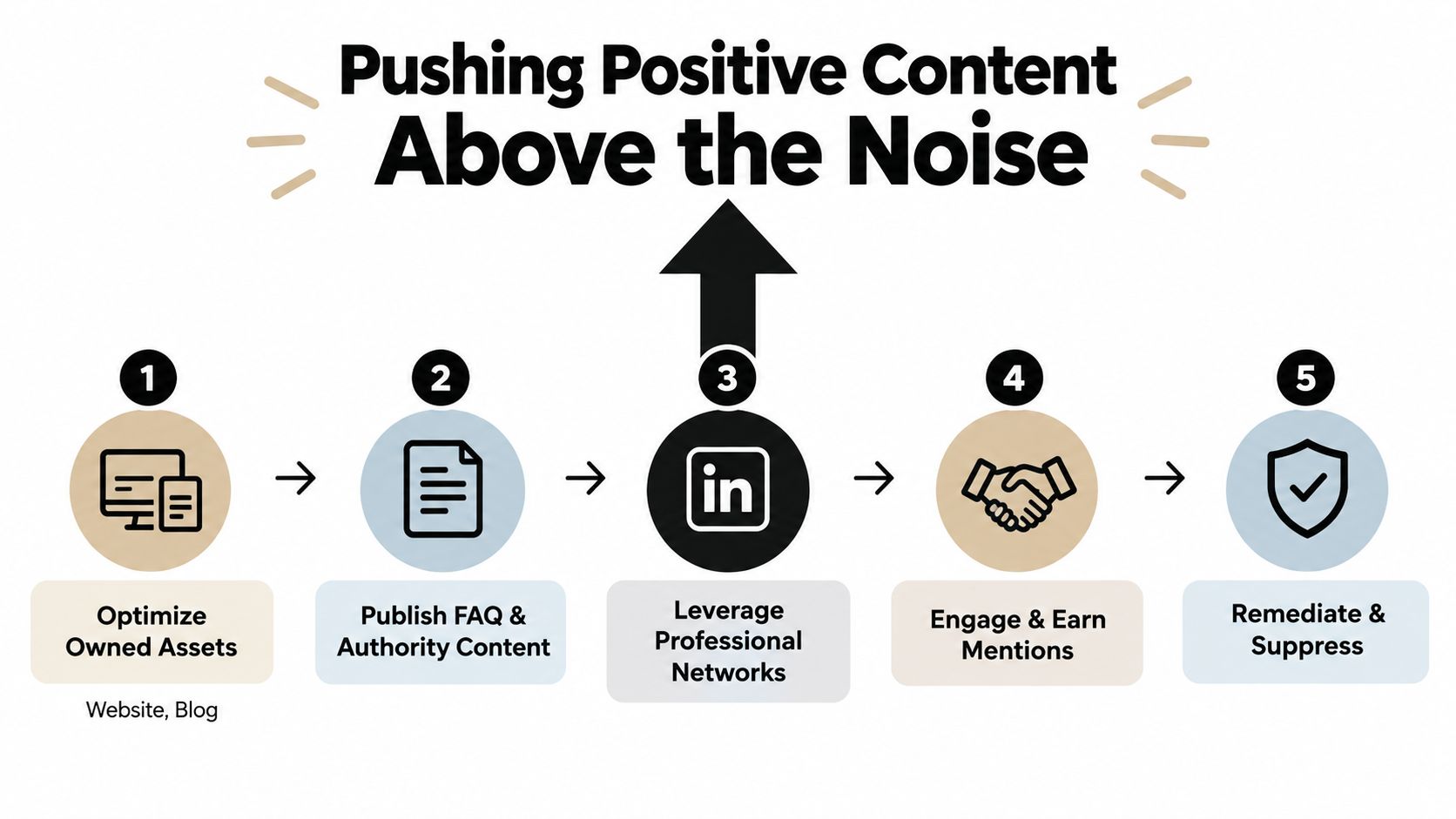
Search visibility is the first execution priority because page-one results receive disproportionate attention. The top three organic results receive 68.7% of clicks, while the number-one result has a 42.9% click-through rate when a snippet is present. Position one also receives 19 times more clicks than the top paid advertisement, according to First Page Sage’s Google click-through-rate report.
That doesn’t mean you should hide legitimate criticism. It means you should make accurate, useful, controlled assets easy to find. For a professional, those assets may include a personal website, LinkedIn profile, portfolio, author pages, conference bios, project documentation, and interviews. For a small business, they may include the official website, location profiles, service pages, FAQs, and verified directory listings.
Build an entity people and machines can recognize
Use the same professional name, role, headshot, company description, and links across important profiles. Resolve contradictions such as two different job titles, old company information, mismatched locations, or biographies that describe different services.
Create a clear “about” page and supporting pages that answer basic questions directly. Use descriptive headings, internal links, accurate author information, and structured data where appropriate. The aim is to make your identity legible to both search engines and AI systems.
Branded search behavior reinforces this approach. Third-party results appear in the top four positions for 62% of branded searches, while 4.8-plus average ratings are associated with 28% to 35% higher branded-search CTR than 3.2-star ratings. First-result sentiment also matters, with CTR reported at 32% for positive sentiment and 4% for negative sentiment, according to the earlier Review42 source.
Earn trust instead of manufacturing it
Ask genuine customers or collaborators for honest feedback after a completed interaction. Never buy reviews, pressure people to change opinions, or create multiple identities to praise yourself. Reply to criticism with specific facts, a calm tone, and a clear route to resolution.
For an individual, the equivalent is collecting credible proof of work. Publish a project explanation, contribute to a professional community, or update a portfolio with verifiable outcomes. Those assets can give searchers a more complete picture than an isolated old post.
Practical rule: Build content that answers the question a skeptical searcher would ask, not content that only praises you.
Add the AI-search layer
Ask ChatGPT, Perplexity, and Gemini how they describe you or your organization. Compare the answers. Look for stale roles, incorrect locations, missing achievements, unsupported claims, or confusion with another person.
You can’t directly control every model response. You can improve the source environment by correcting public pages, consolidating entity information, earning authoritative citations, and ensuring important facts appear consistently in crawlable content. This machine-readable approach is increasingly relevant to privacy professionals, executives, job seekers, and small brands.
The online reputation management guide can help you connect search visibility, content, reviews, and identity protection into one workflow.
Ongoing Governance That Keeps Your Reputation Resilient
Campaigns end. Governance continues. A durable system assigns ownership, defines acceptable responses, protects accounts, and schedules recurring reviews so you’re not rebuilding your reputation after every surprise.
For individuals, governance may be a monthly privacy review and a quarterly footprint re-scan. For a small team, it can include a shared incident plan, approved response principles, profile ownership records, and a publishing calendar. Neither requires constant posting. Both require consistency.
Match the control to the threat
| Reputation threat | Quick fix | Durable control |
|---|---|---|
| Exposed personal information | Remove or restrict the visible page | Review privacy settings and data broker listings regularly |
| Account takeover | Reset the affected password | Use unique passwords and enable 2FA on email, social, gaming, and professional accounts |
| Negative review | Respond with empathy and investigate | Improve the underlying service and invite honest feedback |
| Impersonation profile | Report the account and warn affected contacts | Reserve consistent usernames and monitor for copies |
| Dating deception | Pause contact and avoid sharing money or sensitive data | Verify identity across channels and maintain strict privacy boundaries |
| Gaming account compromise | Secure the linked email and platform account | Protect every connected service, not just the game profile |
Gaming accounts deserve special attention because a reused password can expose purchases, social connections, and linked identities. One gaming-security summary reports that 2FA can cut account breaches by about 80%, and that in a review of 5,000 stolen accounts, more than 4,000 lacked 2FA, as reported by ThisGenGaming. The same source says credential stuffing rose 64% in 2025, while gaming account-takeover incidents climbed 52% during that period.
Dating safety follows the same identity-protection logic. The FBI’s 2024 Internet Crime Report recorded 17,910 romance scam complaints in the United States, with losses exceeding $672 million, according to the FBI-related romance scam report. Aura also summarizes survey findings that nearly half of dating-app users encountered fraudulent behavior, while a UK report found 34% of online daters reported being targeted by romance scams, with the report extrapolating to roughly 3 million UK daters targeted annually and about 2 million experiencing financial harm. These figures appear in Aura’s dating-app fraud coverage.
Don’t let urgency override verification. A match who avoids video calls, moves you off-platform quickly, tells inconsistent stories, or requests money should be treated as a safety concern. Reverse-image checks, cross-channel verification, slow disclosure, and strong account security protect both your finances and your public identity.
Your Next Move Toward a Cleaner Digital Presence
A working online reputation management strategy has five stages. Discover what appears under your name. Classify each result by accuracy, risk, and importance. Respond where a human conversation can resolve the issue. Rebuild visibility with accurate profiles, useful content, and authentic mentions. Govern the system through security checks, monitoring, and scheduled reviews.
The order matters. Publishing positive content before securing an exposed account can leave you vulnerable to impersonation. Reporting a review before checking whether the underlying complaint is valid can make the situation worse. Asking an AI system for a reputation summary before correcting inconsistent public facts only reveals the confusion without fixing its source.
Use a short checklist to keep the work practical:
- Search your identity: Review name variations, usernames, images, employer references, and page-one results.
- Secure connected accounts: Prioritize email, then protect social, professional, dating, gaming, and financial accounts with unique passwords and 2FA.
- Check sensitive exposure: Look for data broker listings, breach notifications, public contact details, and impersonation.
- Triage deliberately: Resolve genuine complaints, report deceptive content, and build authoritative assets where information is incomplete.
- Probe AI answers: Compare how ChatGPT, Perplexity, and Gemini summarize you, then correct source inconsistencies.
- Schedule maintenance: Recheck your footprint, privacy settings, profiles, and alerts as part of a recurring routine.
If a harmful result is accurate but outdated, suppression may not be the first answer. Improve the current record and document legitimate removal options. For situations involving inaccurate or harmful search content, review this guide on how to remove negative search results and choose a response proportionate to the evidence.
Reputation management isn’t a one-time cleanup. It’s the habit of knowing what’s public, securing what you control, and correcting what no longer represents you.
Digital Footprint Check helps you discover exposed profiles, public information, breach-related risks, and reputation signals across the web, with reports that point to practical next steps. Visit Digital Footprint Check to start with a free check and turn your next search into an organized privacy and reputation review.