· Digital Footprint Check · Content Marketing · 15 min read
What Is Data Breach Monitoring: Essential Guide 2026
Learn what is data breach monitoring, how it works, and why it matters for protecting your identity, accounts, and online privacy in 2026.
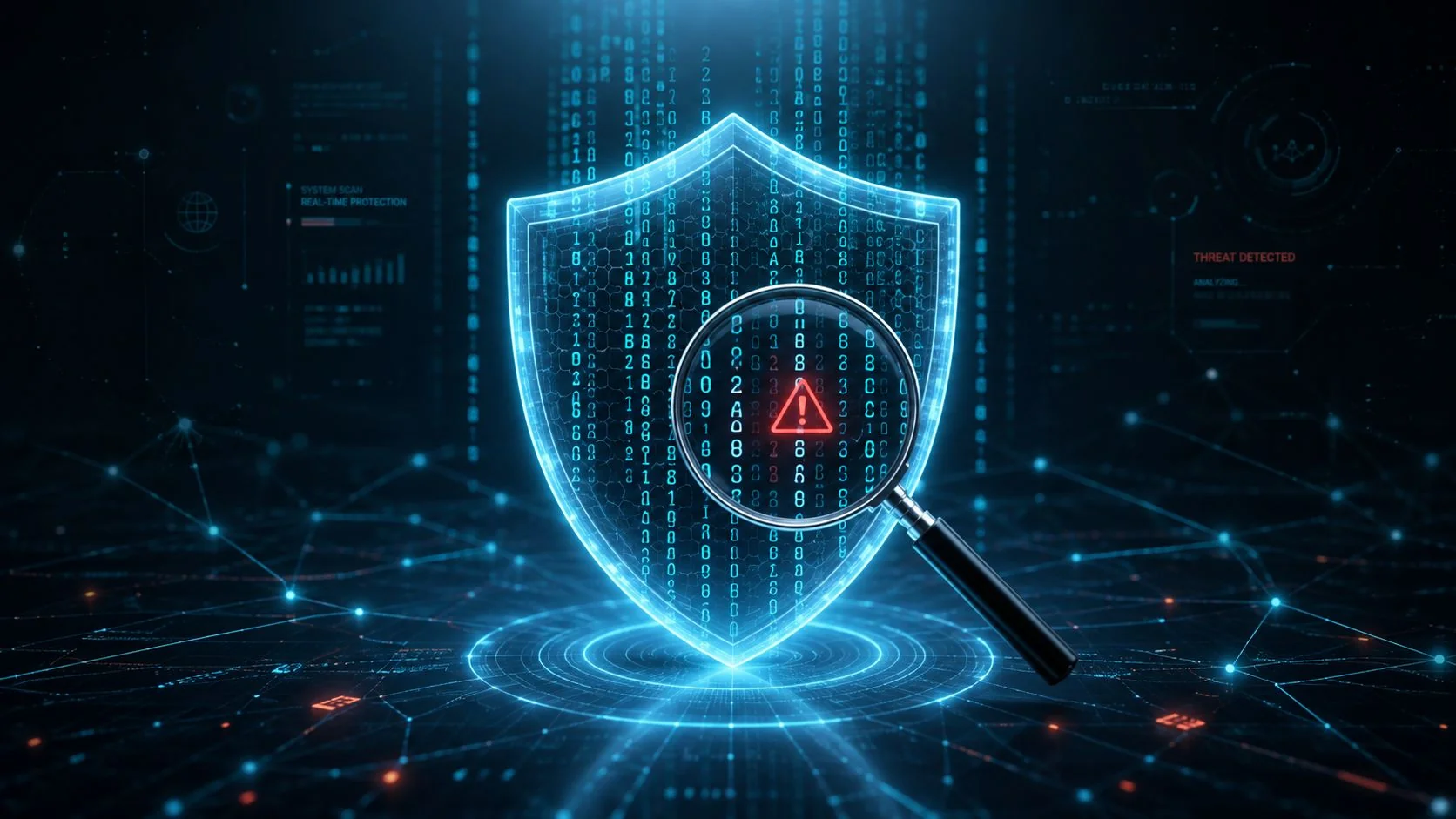
Data breach monitoring means continuously watching breach disclosures, dark-web dumps, and exposed credentials so you learn about your own exposure before attackers exploit it. The scale is immense: Privacy Rights Clearinghouse recorded 8,019 breach notification filings in 2025, representing 4,080 unique events affecting at least 375 million people (Privacy Rights Clearinghouse).
A password you created years ago may still protect an old shopping account, a gaming profile, or an email address you rarely use. If that password appears in a breach and you reused it elsewhere, attackers may test it against your email, banking, workplace, or social accounts. Monitoring gives you an early warning, but it doesn’t replace strong passwords, multifactor authentication, careful account habits, or a plan for responding to exposure.
Why Data Breach Monitoring Matters in 2026
Surfshark reports that 23.8 billion accounts have been breached worldwide since 2004, including about 7.9 billion unique email addresses, while 10.4 billion accounts have been breached since the start of 2020 (Surfshark’s breach monitoring research). These figures count records and accounts, not necessarily distinct people. They still show why checking one email address after a headline is not enough.
A forgotten password can remain attached to an old shopping account, gaming profile, dating service, or work tool. If criminals obtain it, they may test the same email and password elsewhere, a tactic known as credential stuffing. The exposure can also begin with a third party, such as a vendor, employer, hospital, application provider, or online platform. Your account may be affected even when you did nothing wrong.
Data breach monitoring works like a watch service for your digital identity. It checks whether email addresses, usernames, passwords, phone numbers, or other sensitive details appear in known breach records and illicit data collections. A one-time search shows what has already been indexed. Continuous monitoring can alert you when a newly disclosed or newly visible exposure matches your information.
That timing matters because a breach notice may arrive after the information has circulated. Privacy Rights Clearinghouse found that the most common notification window was 91 to 180 days, and fewer than 10% of breaches with known dates would meet California’s 30-day standard (Privacy Rights Clearinghouse’s 2025 Data Breach Report). During that interval, attackers may try credentials, impersonate customers, or exploit connections between suppliers and internal systems.
Practical rule: Treat a monitoring alert as a prompt to investigate, not as proof that every account has been taken over.
Monitoring gives a person or security team a starting signal. They can reset a reused password, revoke unfamiliar sessions, contact a bank, freeze credit, or examine a work account before a limited exposure becomes account takeover or identity theft. The alert does not repair the breach, and it cannot replace password managers, multifactor authentication, access controls, endpoint protection, or secure software development.
Organizations also need visibility beyond employee logins. Supplier accounts, customer records, privileged access, and slow disclosures can hide the path into a network. Physical controls matter as well, including secure handling of decommissioned hardware, because discarded devices can retain information that monitoring alone cannot remove.
How Data Breach Monitoring Evolved
The modern breach-monitoring story begins when security disclosures became a routine part of privacy protection. The Privacy Rights Clearinghouse chronology has recorded nearly 100,000 reported breaches since 2005 (Data Breach Chronology). During the same period, U.S. states and territories expanded breach-notification requirements, establishing formal processes for informing affected people after certain security incidents.
Early consumer responses were manual. A person heard about a major breach, visited a checking site, searched one email address, and changed a password if the result seemed relevant. That method fit isolated headlines. It struggles with several email addresses, abandoned accounts, professional profiles, family logins, and services connected through third-party providers.
North Carolina shows how disclosure became an ongoing public process. State officials report more than 20,000 security breaches since December 2005. The historical lesson is that breach reporting moved beyond rare headlines into continuing compliance and consumer protection. It also shows why monitoring must look past a direct account breach. A supplier, payroll platform, cloud service, or other partner may expose information before the affected organization understands the full chain.
From public notices to continuous visibility
Automated monitoring grew from the widening gap between exposure and notification. Public notices may arrive after an investigation, while stolen information can circulate through connected services and supply chains. Monitoring services began bringing together public breach repositories, exposed credential collections, and dark-web sources. Organizational platforms added internal security telemetry, identity systems, access logs, incident-response tools, and vendor-risk programs.
Recent reporting reinforces this shift. The Identity Theft Resource Center recorded a record 3,322 data compromises in the United States in 2025, compared with 3,152 in 2024 (ITRC 2025 Annual Data Breach Report). Victim notices fell from 1.36 billion in 2024 to 278.8 million in 2025, largely because 2024 included several mega-breaches. Incident counts and notice counts can therefore move in different directions.
The result is a change in purpose. Breach laws define what organizations must report and when. Monitoring helps individuals and security teams find exposure across fragmented systems, including third-party relationships, incomplete public records, and slow notifications. An alert is therefore an early signal, not merely confirmation that a password appeared in a breach.
How Data Breach Monitoring Works
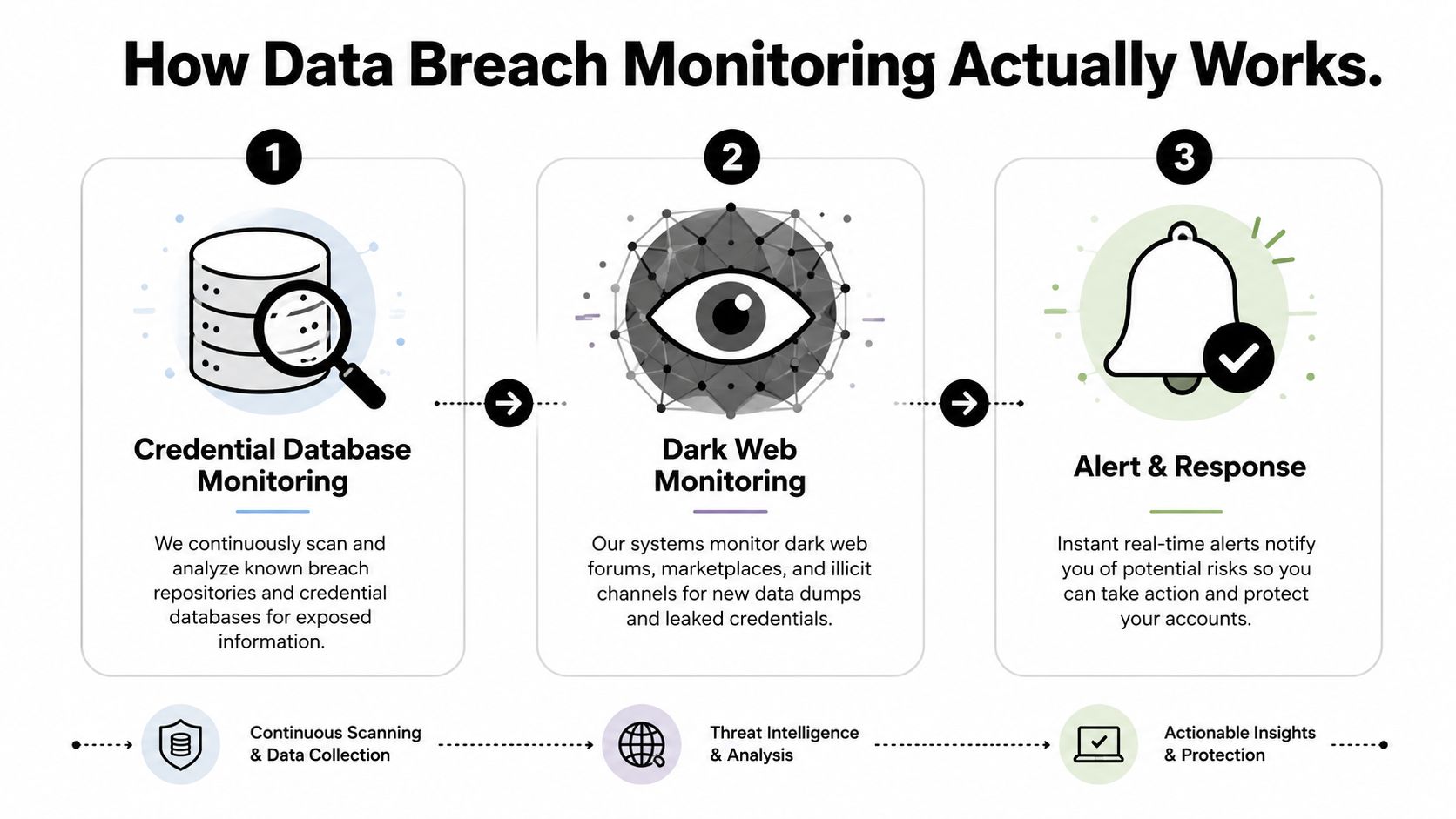
Modern monitoring uses connected layers, not one search box. Each layer answers a different question: Has my data appeared in a known exposure? Is someone misusing access now? Could a supplier expose me indirectly?
Credential and dark-web monitoring
The first layer checks breach repositories and exposed collections for email addresses, usernames, password hashes, phone numbers, and other personal information. A match usually indicates past exposure, not proof that someone has logged in. A useful alert identifies the affected service when possible, the data category, and the next recommended action.
Dark-web monitoring extends the search to illicit marketplaces, forums, paste sites, and locations that ordinary search engines do not index. Coverage differs between providers, so check whether a service explains its sources, update frequency, matching method, and limits. Dark-web credential monitoring can help when reused login information is the main concern.
Organizational telemetry
NIST describes data security monitoring as continuous observation of user and data activity to detect unauthorized data flows, suspicious behavior, and unauthorized access involving data in transit, at rest, or in use (NIST SP 1800-29). A security team may connect identity events, file access, endpoint activity, and network signals to see whether an incident is unfolding.
Examples include an employee account opening unusual files, a privileged user signing in through an unfamiliar route, or a system transferring an unusual set of records. Teams can improve detection quality with best practices for anomaly detection, such as sensible activity baselines, surrounding context, and defined investigation procedures.
Supply-chain tracking and response
A monitoring program also follows vendors, contractors, payroll providers, cloud applications, marketing platforms, and other connected services. The affected person may never have created an account with a compromised provider, while their information still passed through that provider. Third-party exposure can therefore remain invisible until a supplier, platform, or business partner reports it.
Slow notifications create another gap. An organization may discover an intrusion, investigate it, and notify affected people only after the exposed information has already circulated. Monitoring can connect a later notice with earlier signals, helping teams determine whether credentials, sessions, accounts, or vendor access require attention.
An alert matters only when it leads to a decision. The recipient should verify the match, identify the exposed data, reset credentials, revoke active sessions, review account activity, or escalate to incident response. Email, text, and dashboard notifications support that process, but they do not replace verification. Monitoring combines passive collection with active checking, reducing false positives and turning a warning into a practical response.
Who Uses Data Breach Monitoring and Why
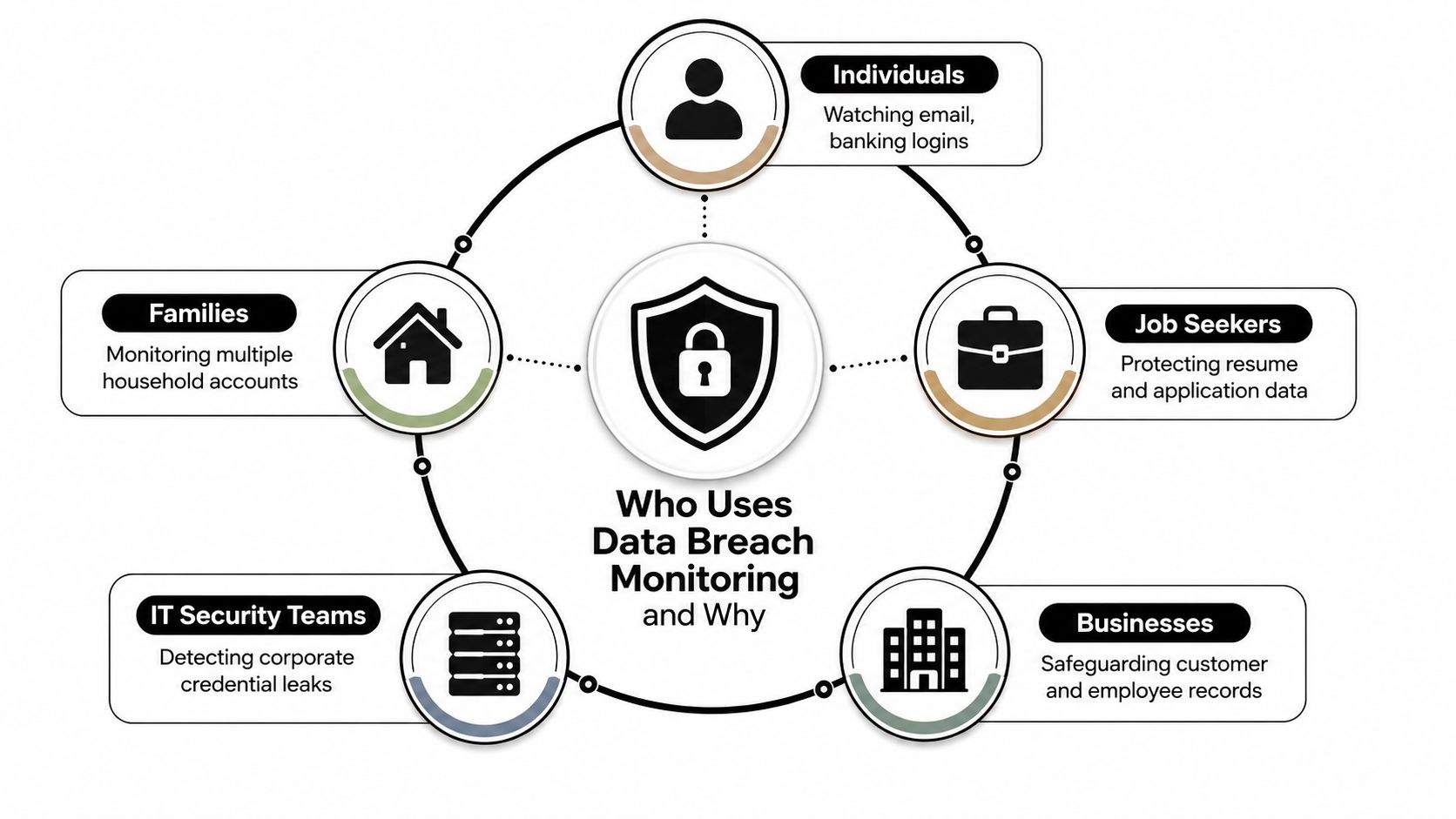
Breach monitoring isn’t only an enterprise security product. Different people use it to watch different parts of their digital identity, and the right alert leads to a different response.
Individuals
An individual might monitor a primary email address, older addresses, financial services, social accounts, and shopping logins. An alert stating that an email and password appeared in a breached service should trigger a password reset there and a search for password reuse elsewhere. If the account contains payment information, the person should also review transactions and contact the provider when appropriate.
Job seekers and professionals
A job seeker may have submitted a résumé through several recruiting portals, staffing firms, or employer systems. An alert involving an application service could expose contact details, employment history, or login credentials. The immediate response is to secure the affected account, watch for targeted phishing, and review public professional profiles that could help an attacker impersonate the candidate.
Professional reputation matters here as well. Exposed contact information can affect personal safety, unwanted outreach, and the way a recruiter interprets suspicious activity connected to a name or email address.
Families
Families often share devices, recovery addresses, subscriptions, and household services. A child’s gaming account may contain valuable digital items or a stored payment method, while a parent’s healthcare or school portal may contain more sensitive records. Household monitoring works best when each person’s accounts are mapped separately, with age-appropriate privacy guidance and no assumption that one alert covers everyone.
Businesses and HR teams
Small businesses can monitor employee credentials, contractor accounts, administrative identities, and SaaS services that connect to internal systems. An alert involving a privileged work email deserves faster escalation than a low-access marketing account because the potential access path differs.
HR teams should also consider applicants and former employees, while respecting employment, privacy, and data-protection rules. Monitoring should support an incident process, not become an excuse for indiscriminate surveillance.
Gamers and creators
Gamers and streamers face account-specific threats. A breached login can expose an in-game inventory, payment method, creator dashboard, recovery email, or streaming token. A gaming alert should prompt a unique password, multifactor authentication, session review, connected-app review, and checks for unauthorized trades or changes to payout details.
For a first check, an email breach lookup can help identify whether an address appears in known breach records. The result is a starting point for securing accounts, not a guarantee that no exposure exists.
The Hidden Gaps in Most Monitoring Tools
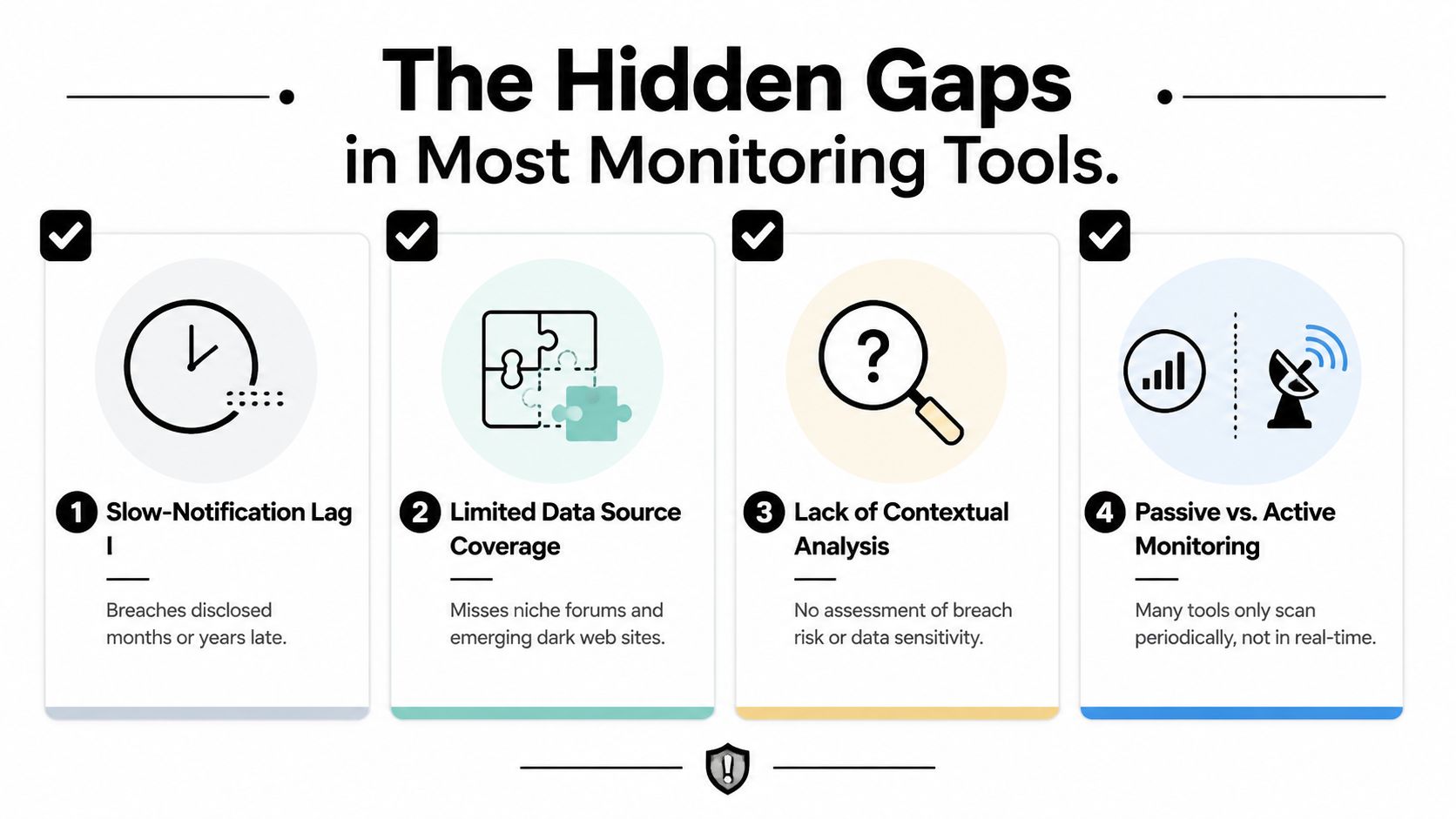
A correct alert can still leave the main questions unanswered. A match usually identifies one exposed record, not the full path through which data moved, who else received it, or how long an attacker had access. Effective monitoring must therefore cover third-party systems, supply chains, and delayed notifications, not only a user’s password.
Slow notification
Organizations may disclose an incident weeks or months after discovery, and the first notice may contain too little detail to guide personal risk decisions. Public reporting has shown that breach counts can be high while explanations of the root cause remain limited. An alert may arrive before the organization knows whether the exposure came from phishing, stolen credentials, ransomware, an insider, or a supplier.
European and UK rules set expectations for reportable incidents. GDPR Article 33 generally requires notification to the supervisory authority without undue delay and, where feasible, within 72 hours of awareness, subject to the rule’s risk exception (GDPR Article 33). The UK ICO describes the same 72-hour operational window for notifiable breaches (ICO breach guidance). These deadlines concern organizational reporting. They do not guarantee that each affected person receives a complete explanation at the same time.
Third-party exposure
A supplier can store or process personal information without appearing in a consumer’s list of everyday accounts. A payroll provider, cloud platform, identity-verification service, or data broker may be the route through which records are exposed. The visible company in a notification may therefore be only the front door, while the affected system sits deeper in the supply chain.
Monitoring should identify the supplier, processor, connected service, or downstream data broker involved when that information is available. It should also show whether the alert comes from a confirmed incident, a reused data set, or an unverified listing.
Coverage and context
No crawler can see every private forum, encrypted channel, or short-lived marketplace. For a practical comparison of providers, review these dark web monitoring services, then ask what each service covers.
Before choosing a provider, ask:
- Vendor visibility: Can it identify affected suppliers and connected services?
- Timeline clarity: Does it distinguish the breach, discovery, disclosure, and alert dates?
- Data sensitivity: Does it show whether the match involves a password, financial detail, identity document, or contact information?
- Remediation depth: Does it provide concrete steps beyond “change your password”?
- Coverage limits: Does it state which sources and identifiers it cannot monitor?
Recent reporting shows why context remains difficult. Many victim notices still omit the attack method, so users may need to act before the full story becomes public (ITRC H1 2026 reporting). Related reporting also highlights limited attack-vector detail in breach notices (Cybersecurity Stats reporting). A monitoring tool can flag a possible exposure, but its value depends on whether it explains the data involved, the organizations connected to it, and the limits of the available evidence.
What to Do When a Breach Alert Hits
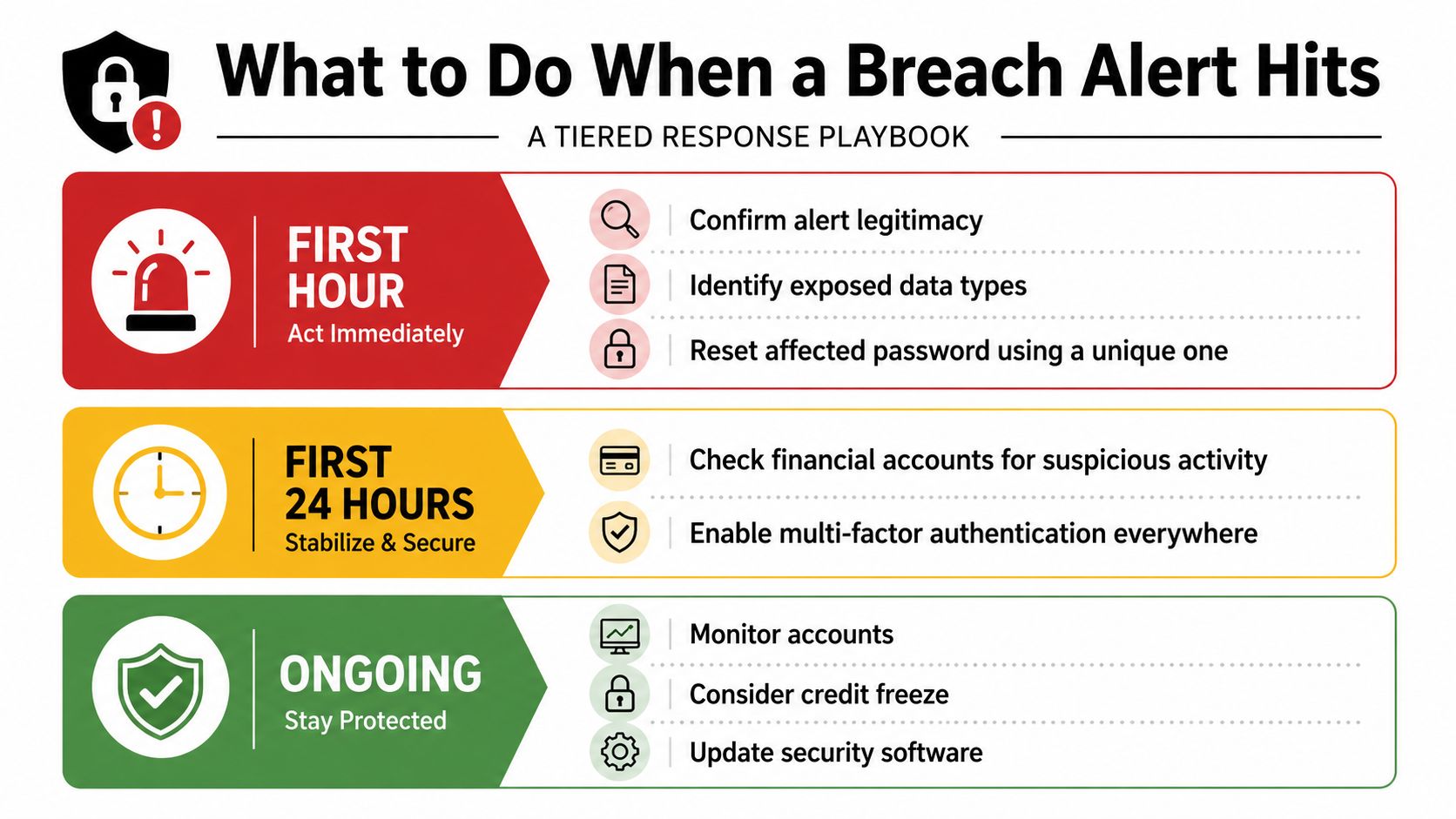
Speed matters, but panic creates its own risks. First verify that the notification comes from a legitimate service, avoid clicking unfamiliar links in the message, and open the affected provider through a known bookmark or manually typed address.
During the first hour
Identify the exact data involved. An exposed email address calls for vigilance against phishing, while a password requires immediate reset wherever it was reused. A financial account or identity number requires direct contact with the relevant institution and closer fraud monitoring.
Use a password manager to generate a unique replacement, then enable multifactor authentication. Sign out other sessions if the service supports that control, check recovery email addresses and phone numbers, and remove unfamiliar connected applications.
First response principle: Secure the account that was exposed, then search for every other account that may share the same credential.
A gaming alert may lead to a password reset and review of purchases, inventory, connected consoles, and payout settings. A banking alert deserves a direct call to the bank through an official number, transaction review, and discussion of card or account controls.
During the first day
Audit other accounts methodically rather than relying on memory. Start with email, financial services, work systems, cloud storage, social platforms, dating apps, and accounts that can reset other passwords. Review login history for unfamiliar devices or locations, but don’t treat location data alone as conclusive because networks and mobile connections can make it imprecise.
If payment details were exposed, notify the bank or card issuer. If a government identifier or similarly sensitive identity data was involved, consider a fraud alert or credit freeze where available, and preserve the breach notice for your records.
Organizations should isolate affected credentials, review access logs, assess supplier connections, and follow their incident-response and notification obligations. The data breach notification requirements for the relevant jurisdiction can help teams identify the proper reporting path.
During the first week
Continue monitoring financial statements, account activity, password-reset messages, and phishing attempts. Document the alert date, service name, exposed data, actions taken, support conversations, and any suspicious activity. That record can help with an insurer, bank, employer, regulator, or identity-theft report.
Consider whether the breached service still deserves access to your information. Delete an unused account, remove stored payment details, replace a vulnerable email address where practical, and review privacy settings. You don’t need a perfect recovery plan before taking the first protective action. A prompt password reset and multifactor authentication can reduce the chance that exposed credentials become an account takeover.
Choosing the Right Monitoring Approach for You
Organizations face three broad choices. They can do nothing, perform occasional manual checks on breach lookup services, or use continuous monitoring that combines breach records with dark-web and credential alerts. The right choice depends on exposure, not on a universal label of “safe” or “unsafe.”
Manual checks may suit someone with few online accounts, unique passwords, and limited public exposure. Free monitoring can provide a useful baseline for an email address or username. Continuous paid monitoring becomes more compelling when you reuse credentials, manage valuable accounts, have a public-facing role, support family members, run a business, or rely on vendors that process sensitive information.
| Approach | Coverage | Alert Speed | Best For |
|---|---|---|---|
| No monitoring | Depends on notices and personal vigilance | Unpredictable | People who have already built strong independent checks, though exposure can remain unseen |
| Occasional manual checks | Usually limited to the identifiers and databases searched | Only when you perform a check | Low-complexity personal account inventories |
| Free breach monitoring | Basic breach-record matching for selected identifiers | Often tied to database availability and user review | Establishing an initial exposure picture |
| Continuous monitoring | Broader recurring checks, with coverage depending on the provider | Alerts when a relevant match is detected | Reused credentials, families, public profiles, and higher-risk accounts |
| Business monitoring | Credential intelligence plus internal telemetry and supplier visibility | Integrated with security response processes | Organizations managing employees, customers, and connected vendors |
A free data breach checker can help you establish a starting point. Digital Footprint Check offers checks across breach records and broader online identity signals, while other services may focus more narrowly on credit files, dark-web data, or enterprise telemetry.
Ask yourself four questions: Do I reuse passwords? Could one compromised email reset several important accounts? Does a family member or employee depend on me for account security? Would exposure affect money, employment, personal safety, gaming assets, or a public reputation? The more answers are yes, the more valuable continuous coverage and clear remediation guidance become.
Digital Footprint Check helps you investigate exposed online identity information, including breach records, usernames, social profiles, gaming accounts, and other public digital-footprint signals. Visit Digital Footprint Check to begin with a practical privacy check, then use the findings to secure reused credentials, strengthen account protection, and reduce avoidable exposure.