· Digital Footprint Check · Content Marketing · 14 min read
What Is Online Reputation Management and Why It Matters
What Is Online Reputation Management. Learn what online reputation management is, why it matters for jobs, dating, and safety, and how

You search your name before a job interview, a first date, or a new client call. The first results look harmless until you spot an old forum comment, a tagged photo, or an account you forgot existed. Someone else may see that page before they ever meet you, and they may never know the context behind it.
Online reputation management, or ORM, is the ongoing practice of understanding, protecting, and improving what people find about you or your organization online. It includes search results, reviews, social profiles, public records, news mentions, photos, and information copied across other websites. ORM isn't about pretending negative information doesn't exist. It's about finding inaccurate, outdated, or risky information, handling it responsibly, and making accurate, trustworthy information easier to find.
The same principles apply to a job seeker, a parent, a gamer, someone using a dating app, and a company managing customer reviews. Your digital reputation affects how strangers assess trust, safety, professionalism, and identity before you get a chance to explain yourself.
The Moment You Realize Your Reputation Is Searchable
Maya opened a private browser window before a video interview. She searched her full name, expecting to see her professional profile and a few social accounts. Instead, an old student forum appeared near the top. The post contained a sarcastic comment she'd written years earlier, stripped of the conversation that had made it understandable at the time.
A second result showed a photo tagged by a former classmate. A third led to a forgotten blog she hadn't updated in years. None of these pages represented how Maya worked today, but a recruiter wouldn't automatically know that.

This is the personal side of what is online reputation management. Your reputation isn't limited to what you deliberately publish. It also includes what other people tag, quote, copy, review, index, or associate with your name.
A recruiter may scan your name before an interview. A date may look for signs that your profile is genuine. A customer may read reviews before paying a business. A scammer may use a public photo and an old username to make a fake account look convincing. You can read more about the professional side in this guide to what employers see when they Google you.
A practical starting point: Search for yourself as if you were a stranger. Don't rely on memory, because your memory only covers the accounts and posts you know about.
ORM begins with that outside view. You identify the pages attached to your name, separate harmless material from information that could create risk, and decide what you can change, report, clarify, or leave alone. The quiet interview has already started. A self-check lets you prepare for it.
Defining Online Reputation Management in Plain Language
Think of your online identity as a trail through a public place. Some parts are footprints, created by your own actions. Other parts are shadows, cast by people, platforms, databases, and websites around you.
Your footprint and your shadow
Your active footprint includes:
- Social profiles: Accounts, biographies, posts, comments, and photos you chose to publish.
- Reviews and forum activity: Your own words on product pages, community sites, gaming forums, and discussion boards.
- Websites and blogs: Pages, portfolios, professional profiles, and other content you control.
Your passive shadow includes:
- Third-party mentions: News articles, client reviews, public discussions, or references written by other people.
- Search results: The collection of pages a search engine connects to your name.
- Shared photos and tags: Images uploaded by friends, colleagues, family members, or strangers.
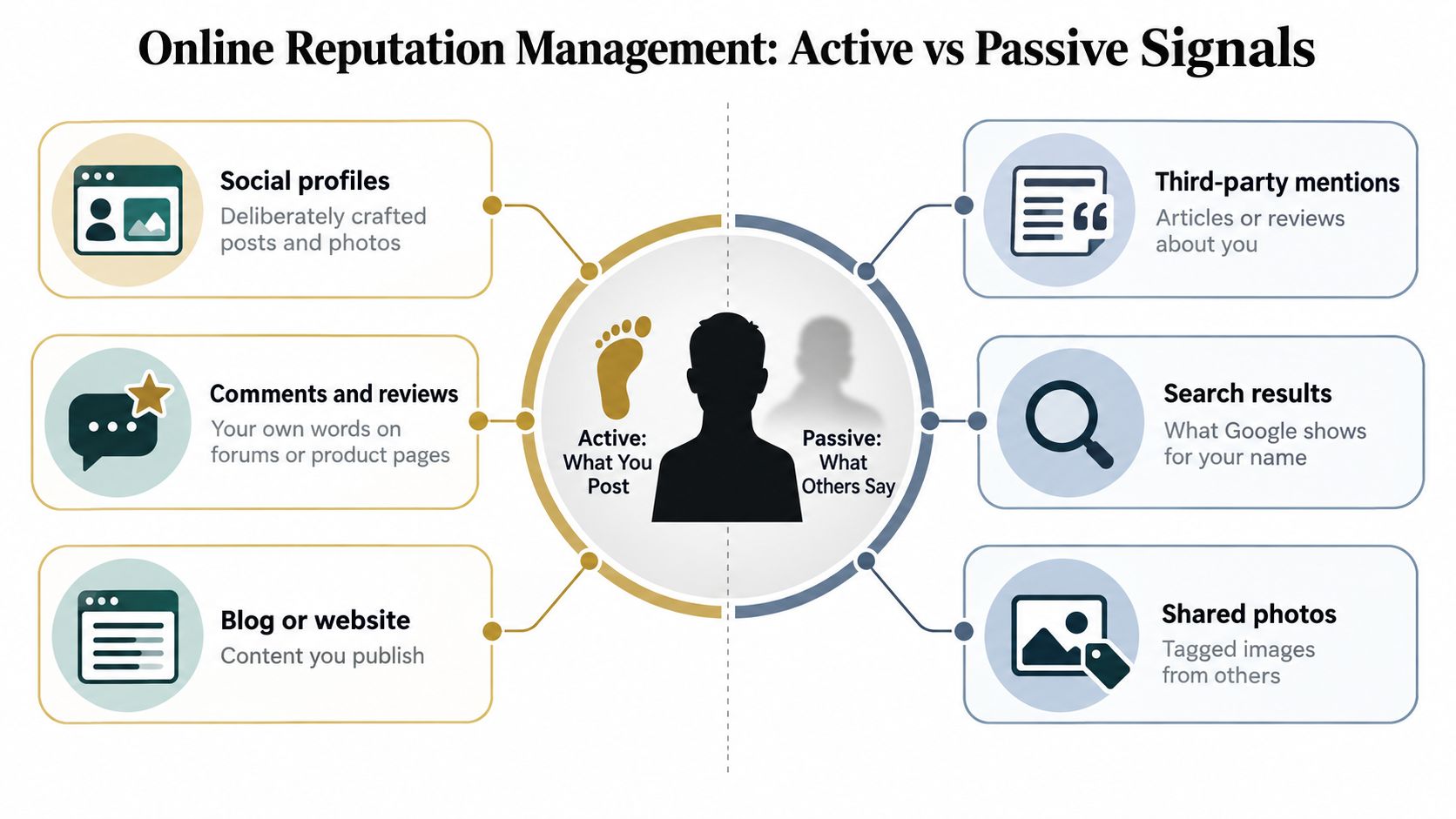
Online reputation management means auditing both the footprint and the shadow, shaping what you control, and responding appropriately to what you don't. That definition is useful because it avoids a common mistake. ORM isn't watching social media mentions, and it isn't a service that magically deletes every unpleasant result.
Your personal reputation is how others perceive you as an individual. Your professional reputation adds work history, credentials, published opinions, and conduct that may influence employment or business relationships. A brand reputation covers an organization, its products, customer service, reviews, and public communication.
The scale changes, but the process stays familiar:
- Discover: Find profiles, mentions, reviews, photos, and exposed information connected with a name, email address, phone number, or username.
- Evaluate: Decide whether each result is accurate, outdated, misleading, sensitive, or fraudulent.
- Act: Update profiles, remove content you control, report impersonation, request corrections, respond to reviews, and secure exposed accounts.
- Maintain: Repeat the checks because search results, reviews, and public conversations change.
A digital footprint is broader than a reputation. It describes the traces you leave online, whether or not anyone notices them. This explanation of what a digital footprint is helps separate the evidence from the interpretation. ORM focuses on how those traces are found and understood by other people.
Why Online Reputation Management Matters Now
You apply for a job, match with someone on a dating app, join a gaming community, or choose a local service. Before replying or deciding, another person may search your name, username, or email address. The result can include a polished profile, an old forum post, a review, or an account you forgot existed.
That search affects private lives as well as businesses. A family member checking whether an unfamiliar contact is safe may find information tied to an old username. A recruiter may compare your résumé with public profiles. A customer may read reviews before visiting a shop. ORM matters because these quick checks shape trust before you can explain the context.
The consumer numbers show how often this happens. One 2026 online reputation management statistics summary reports that 97% of consumers read online reviews before a local purchase decision, while 88% trust online reviews as much as personal recommendations. It also reports that 57% won't consider a business rated below four stars, and 73% trust only reviews written in the last month.
| Scenario | Percent Who Search the Name First |
|---|---|
| Consumers reading reviews before a local purchase | 97% |
| Consumers trusting reviews like personal recommendations | 88% |
| HR professionals using search engines to screen candidates | 75% (employment reputation summary) |
The employment figures point to a personal consequence. The same employment reputation summary reports that 70% of employers have rejected a candidate because of something found online, and one in three employers have reprimanded or fired an employee for online content. A search is not the whole hiring decision, but an unmanaged profile can become part of the evidence someone reviews.
Search is only one layer
A negative review, misleading headline, or post shown without its original context can change the first conversation. Readers may not investigate who created it or whether it remains accurate. The same problem appears in dating profiles, gaming accounts, and family-safety checks, where a familiar username can connect scattered details to one person.
Your public identity also changes over time. Recent photos can make an account look current, while an old email address, username, or copied biography links it to a dormant profile. Search engines, review sites, social networks, forums, and AI answer systems may each present a different version of you or your organization.
The market reflects this broader responsibility. One independent estimate values the industry at about USD 6.88 billion in 2025 and projects USD 14.01 billion by 2031, with a 12.59% compound annual growth rate from 2026 to 2031. A separate forecast places the market at roughly USD 7.75 billion in 2026, also projecting USD 14.01 billion by 2031. These estimates come from Mordor Intelligence's online reputation management market analysis, and they do not predict an individual outcome.
A useful habit is an OSINT-style self-check: search your name, usernames, email addresses, and phone number as another person might, then review what appears and what connects. ORM has become a life skill because identity decisions often happen before conversation begins.
Common Reputation Risks You Might Already Have
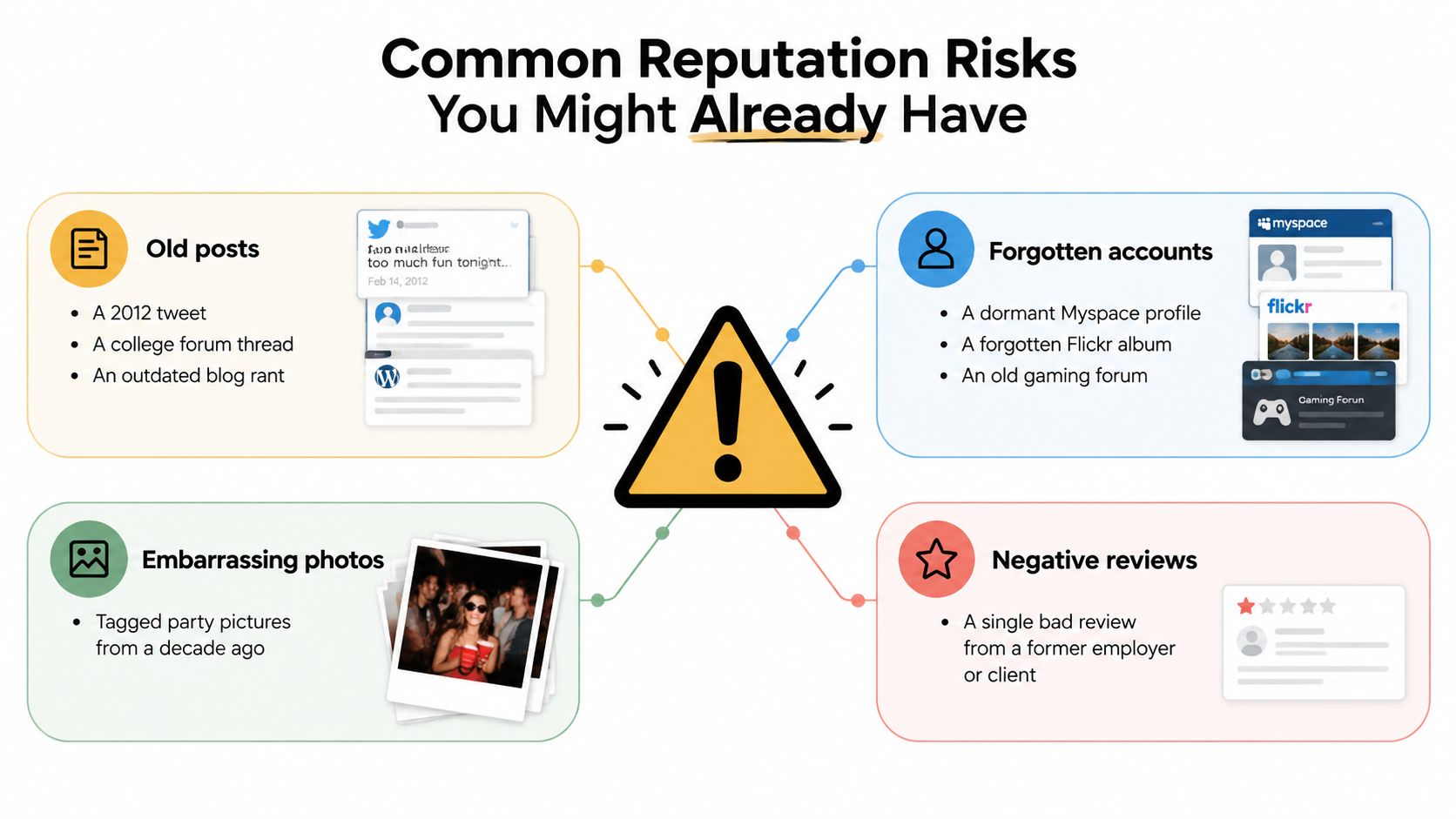
Most reputation problems don't begin with a dramatic public scandal. They accumulate in ordinary places, often because nobody remembers that the page still exists.
Old posts and forgotten accounts
An old comment may have made sense in a private conversation but look hostile when viewed alone. A dormant blogging platform, photo album, or gaming forum can also expose an outdated username, location, or personal interest.
Check old email addresses and usernames, not just your current name. If you recognize an account, change the password, remove unnecessary content, and close it if you no longer need it.
Review attacks and incomplete stories
A business might receive a negative review from a former customer, employer, or client. The review may describe a real problem, a misunderstanding, or a coordinated attempt to damage the rating. A single critical page can attract attention when it ranks prominently or appears beside more recent feedback.
Don't answer with anger. Save the page, check whether it violates platform rules, and write a factual response that protects private details.
Leaked personal information
A breach can expose an email address, phone number, home address, or old password. Data brokers and people-search websites may then connect that information to names, relatives, locations, and social profiles.
If you find exposed data, avoid clicking suspicious recovery links or contacting an unknown person who claims to have it. Use the platform's official removal process, replace reused passwords, and enable multi-factor authentication. This guide on how scammers get your information explains why small pieces of public data can become useful to attackers.
Impersonation and cloned profiles
A scammer can copy a professional photo, use a similar username, and message your contacts from a fake profile. On dating platforms, a stolen image may support a false identity. On professional networks, a cloned profile can create confusion about where you work or what you offer.
Capture screenshots, record profile URLs and dates, warn affected contacts through a trusted channel, and report the account directly to the platform. Don't publicly publish more personal information while trying to prove that the account is fake.
The Monitor, Respond, and Remediate Workflow
A reputation check often starts with an ordinary moment: a job application, a new dating match, a gaming username, or a family member's safety concern. Search your name, aliases, and usernames as an outsider would. Then use the same three-part routine: Monitor changes, respond carefully, and remediate the source or its visibility.
Monitor before a problem grows
Begin with repeatable checks:
- Set alerts: Create Google Alerts for your full name, common spelling variations, usernames, business names, and important product names.
- Search privately: Run a monthly search in a private browsing window so your history does not shape the results.
- Review mentions: Check tags, comments, public posts, and messages using your name or brand.
- Scan exposure: Schedule a deeper people-search and data exposure review each quarter.
- Record the baseline: Save screenshots and URLs. This makes it easier to spot what is new, changed, or gone.
For a comparison of scanners and alerts, see these top tools for monitoring your digital footprint. These checks resemble an OSINT self-audit, but the goal is personal awareness, not collecting information about other people.
Respond with evidence and restraint
A public reply should acknowledge the concern without exposing order details, health information, addresses, or other private facts. Thank people for useful feedback, correct clear inaccuracies briefly, and move complicated conversations to an official support channel.
For impersonation, document the profile name, URL, visible photos, messages, and dates before reporting it. That record can help you warn contacts, support a platform complaint, and check whether the same material appears elsewhere. The same habit applies to a cloned gaming or dating account: use a trusted contact route rather than sharing more personal information publicly.
Brands handling many mentions may use an AI brand monitoring framework to organize large volumes of public discussion. A person should still review any sensitive reply before publication.
Remediate the underlying issue
Remediation can mean requesting removal from a data broker, asking a search engine to review sensitive information, closing an unused account, changing privacy settings, or correcting inaccurate directory details. If a truthful page cannot be removed, publish accurate, useful material on profiles and websites you control. That gives readers better context and gives search engines clearer information to index.
ORM research treats reputation as a multi-channel system, not one score. A bibliometric analysis reviewed 1,136 papers and 48,385 cited references and identified 14 co-citation clusters, supporting separate listening, content, and communication processes. The analysis appears in this Online Reputation Management research document.
Tools and Methods for Tracking Your Digital Footprint
No single service sees every public trace. Search alerts are lightweight and useful for new indexed pages, while specialized scanners can connect aliases, exposed credentials, social profiles, and public records. Businesses may need review workflows, whereas an individual may care more about forgotten accounts and data broker listings.
| Tool Category | Best For | Cost Range | Skill Level | Coverage Depth |
|---|---|---|---|---|
| Search alerts from Google or Bing | New indexed mentions and basic name monitoring | Free options available | Beginner | Light |
| Social-listening tools such as Mention | Public conversations across social, blogs, forums, and news | Paid plans may apply | Beginner to intermediate | Moderate |
| Review platforms such as Birdeye or Podium | Business reviews and customer response workflows | Paid business tools | Intermediate | Focused |
| Data-broker removal services | Repeated removal requests and exposure reduction | Paid services commonly used | Beginner | Focused |
| OSINT-style scanners | Connecting names, usernames, emails, breaches, and public records | Free and paid options | Beginner to intermediate | Broad |
A practical setup layers tools instead of chasing an impossible all-in-one solution. Use Google or Bing alerts for ongoing notifications, check important social and review platforms directly, then complete a deeper scan each quarter. A private individual might start with alerts, account audits, and Digital Footprint Check, which searches public online sources and provides a report with reputation-related findings. A small business may add a review platform and assign a person to answer customer feedback.
Privacy rule: Use only information you have a legitimate reason to review, and don't collect or publish sensitive details about another person without consent or a lawful purpose.
Treat reports as leads, not final proof. A matching name doesn't always identify the same person. Confirm context through usernames, locations, profile history, and other non-sensitive signals before acting.
Connecting Reputation to Identity, Scams, and Account Safety
Reputation hygiene and security hygiene overlap because attackers reuse the same public clues that strangers use to assess you. An exposed email can attract phishing. A public phone number can support impersonation. A repeated username can connect a professional profile to a gaming account or an old forum conversation.
Romance scams show how serious the consequences can become. Australia's national 2026 fusion-cell report says Australians lost over A$156.8 million to romance scams in 2024, while warning that actual losses are likely higher because the figure includes only losses reported through multiple official channels. The finding appears in the Australian romance scam fusion-cell report.
Social platforms also matter. The U.S. Federal Trade Commission reported that in 2025, nearly 30% of people who reported losing money to a scam said it started on social media. That pathway is relevant to romance scams, catfishing, fake verification requests, and stolen-profile outreach, as explained by the FTC's online dating safety guidance.
Gaming accounts deserve the same attention. Proofpoint reported that in 2024, 99% of monitored customer tenants were targeted for account takeovers, while 62% experienced at least one takeover, with affected organizations averaging 12 incidents. The findings are detailed in Proofpoint's account takeover statistics. A public gamer tag isn't a password, but it can help an attacker connect accounts or create believable messages.
Professional profiles need accuracy without oversharing. People improving their LinkedIn presence may find BAMF's LinkedIn optimization services useful for presenting work history clearly while keeping unnecessary personal details out of public view.
Your first-week checklist
- Run a self-OSINT scan: Search your name, email addresses, phone number, and usernames.
- Enable alerts: Track name variations, aliases, and important brand terms.
- Audit privacy: Review public photos, tags, profile visibility, and contact details.
- Document old accounts: List dormant profiles and decide whether to secure, clean, or close them.
- Protect access: Use unique passwords and multi-factor authentication, then follow this account takeover prevention guide.
- Schedule a quarterly review: Repeat the scan and compare changes with your baseline.
Digital Footprint Check helps you review exposed information across social profiles, breach databases, gaming accounts, professional networks, public records, and other online sources. Visit Digital Footprint Check to run the free checker, see what a stranger may find, and use the findings to improve your privacy and online reputation.