
· Digital Footprint Check · Content Marketing · 13 min read
What Does Pii Mean: Identifying and Protecting Data
Understand what does PII mean and why protecting personal data is crucial. Learn practical strategies for identifying, handling, and securing sensitive
You've probably handed out pieces of your identity without thinking about it. A job application asks for your full name and email. A gaming platform stores your username and device details. A dating app shares profile clues that feel harmless on their own, until they're paired with other data and point back to you.
That's why people ask what does PII mean. The short answer is that PII, or Personally Identifiable Information, is any information that can distinguish or trace a person's identity, alone or when combined with other linked data (NIST glossary). The important part is the phrase “combined with other data.” A single fragment can become identifying once it's connected to other records, which is why privacy isn't just about obvious items like a government ID.
Understanding what PII means
A good way to think about PII is like a set of puzzle pieces. One piece may look harmless, but once someone fits it with other pieces, the full picture appears. A name, an email address, a phone number, a device ID, or a date of birth can all be part of that picture, depending on context (IBM's PII overview).
Why the definition matters in daily life
If a bill arrives in your name for an account you never opened, the problem is not just fraud. It also means some mix of identifying data has already escaped the place where you expected it to stay private. That same mix can affect job prospects, online dating safety, gaming account security, and even simple reputation checks, because employers, scammers, and strangers can piece together data from public sources, leaks, and social profiles.
Practical rule: If a detail can help someone identify, contact, track, or profile you, treat it as privacy-relevant.
This guide starts with the definition, then moves into how PII is classified, where it shows up online, how OSINT researchers find exposed fragments, and what you can do to reduce your exposure. For a broader look at how your online presence gets built across services and platforms, see what a digital footprint is.
Defining and classifying PII in US and GDPR contexts
As records moved into digital systems in the 1990s–2000s, PII became easier to copy, link, and misuse. That shift turned privacy work into a risk-based framework that asks who can access data, how easily different fields can be connected, and what happens if those fields are exposed.
U.S. definitions focus on traceability
In the U.S., NIST SP 800-122 gives the most cited definition. It describes PII as information that can be used to distinguish or trace an individual's identity, either alone or when linked with other data, and it lists examples such as name, Social Security number, date and place of birth, mother's maiden name, and biometric records (NIST glossary). The key point is that the standard does not stop at a short list of “private” fields. It asks whether a piece of information can help identify a person directly or through combination with other records.
That is why U.S. privacy programs often classify data by sensitivity, set access controls, and keep audit trails. Those controls are meant to show who touched the data, when they touched it, and whether it was used in ways that fit the stated purpose. In practice, breach response also depends on how the exposed data is categorized, which is why data breach notification requirements are tied to the bigger compliance picture.
GDPR uses a broader personal data standard
The GDPR does not use the term PII in the law itself. It uses personal data, meaning any information relating to an identified or identifiable natural person, including online identifiers and location data (Piwik PRO's GDPR comparison). That broader scope is why an IP address, cookie identifier, or device ID can count as personal data under GDPR even when some U.S. explainers treat them differently.
A simple example helps here. A shipping label with a name and address is easy to classify in both systems. A browser cookie or device ID looks less obvious, but in a GDPR context it may still point back to one person once it is combined with other records. The difference is not just legal wording. It changes how organizations collect, store, share, and review the data.
What trips people up: the same record can be treated as low-risk in one system and regulated in another, depending on the jurisdiction and how easily it can be linked to a person.
For global teams, job seekers, SaaS providers, and HR departments, that gap matters. The same dataset can trigger one set of privacy duties in the U.S. and a different, often broader, set under GDPR, so blanket assumptions about “PII” usually lead to mistakes. When breach response or notice obligations come into play, the classification decision affects what must be reported and how quickly the organization needs to act.
Direct and indirect identifiers of PII
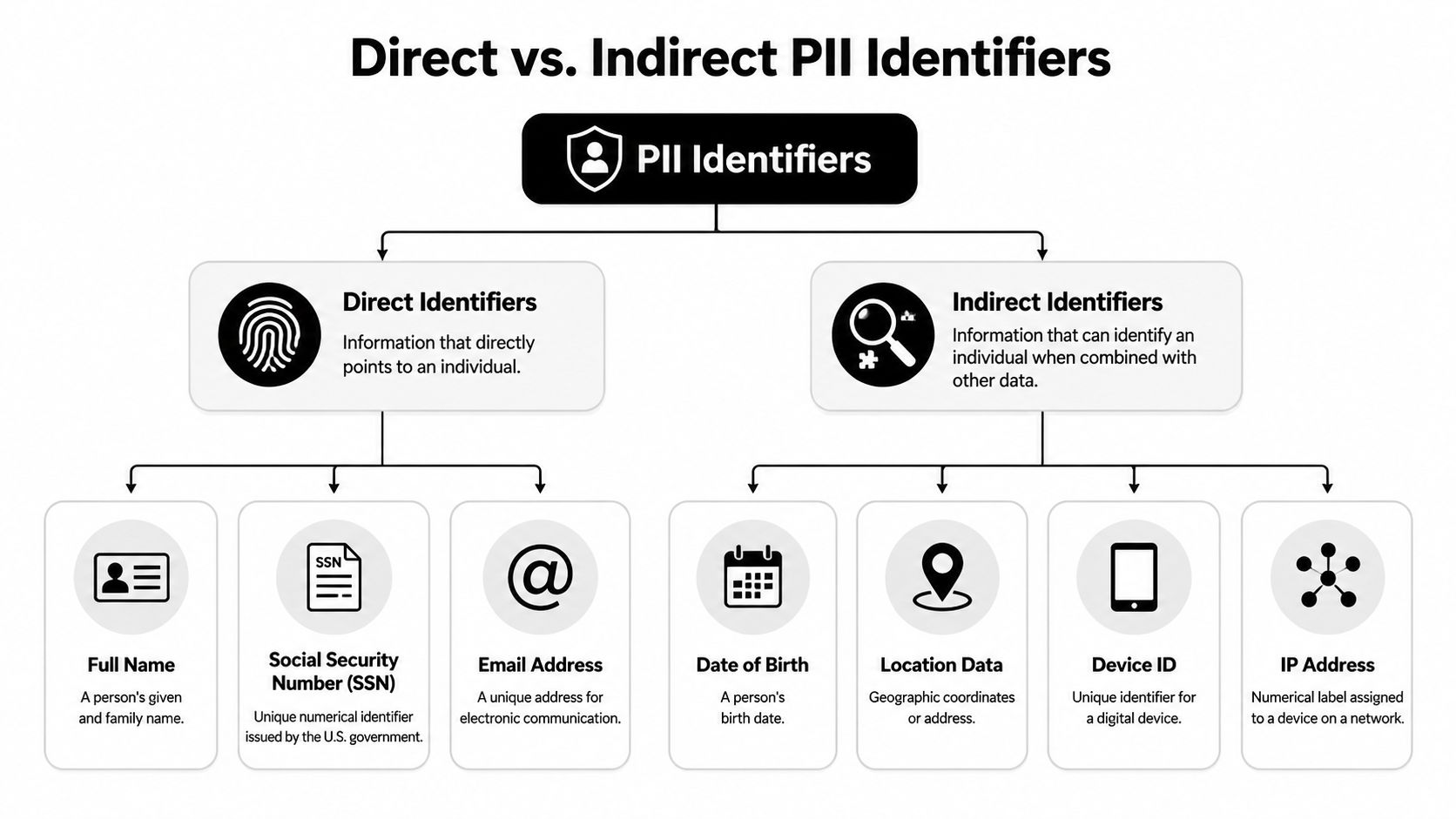
A single record can tell two different stories. A direct identifier points to one person on its own, while an indirect identifier needs other clues before it becomes identifying. That difference matters because privacy teams, investigators, and attackers rarely rely on one field alone.
Direct identifiers act like a fingerprint
NIST includes both direct and indirect identifiers in its definition of PII, and a direct identifier is the clearest path from a record to a person. A full name, Social Security number, or email address can identify someone on its own, which is why these fields usually receive the strictest handling in onboarding, HR files, account recovery, and breach response.
A fingerprint works the same way in practice. It is designed to point to one person quickly, without needing extra context. Direct identifiers do that in digital systems, so even small mistakes, like exposing one in a shared file or support ticket, can create outsized risk. If you want to see how one direct identifier can be misused after exposure, what someone can do with your SSN explains the downstream consequences in plain language.
Indirect identifiers act more like footprints
Indirect identifiers are quieter on their own. A date of birth, location data, device ID, or IP address may not identify you by itself, but it can become identifying once someone compares it with other records. That is why privacy teams have to look at context, not just field labels.
A footprint does not reveal the full person behind it, but it can still narrow the search.
The same logic shows up in everyday account checks. A birth date and email address may look harmless when viewed separately, yet together they can help someone pass a weak identity check or stitch together a fuller profile from public traces. OSINT researchers use that same pattern in reverse, starting with small clues and linking them across profiles, logs, and public records.
Concrete examples of PII in practice
People usually picture PII as a passport number or tax ID. In real life, the list is wider, and some of the most useful clues come from ordinary digital behavior. Usernames, IP addresses, device metadata, and public profile details can all matter when they're linkable to one person (UpGuard on less obvious PII examples).
| Identifier Type | Example | Source |
|---|---|---|
| Social media username | A handle used across multiple platforms | Public profiles, search engine indexes |
| IP address | A connection label tied to a device or network | Logs, breach dumps, analytics traces |
| Public records | Name tied to address or household records | Government or local public records |
| Gaming handle | A persistent alias used in game ecosystems | Leaderboards, forums, chat logs |
| Device metadata | Device ID, cookie ID, or browser-linked identifier | App telemetry, cookies, platform logs |
Why these examples matter
A username may look harmless until it appears in several places with the same profile photo, the same recovery email pattern, or the same posting habits. At that point, OSINT researchers can connect the dots without needing a government ID. The same thing happens with gaming handles, especially when players reuse them across forums, voice chats, and streaming accounts.
Device metadata is another blind spot. It feels technical rather than personal, but it can still help link sessions, accounts, and behavior patterns back to one person. That's why the line between “public” and “identifying” is thinner than commonly assumed.
How to read your own footprint
If you want to spot PII in your own online life, ask three questions about each data point:
- Does it point directly to me?
- Can it point to me when combined with other data?
- Would I be comfortable if a stranger linked it to my name?
That test is useful for profiles, receipts, forum posts, and game accounts alike. It's also a good way to decide which details should stay visible and which ones should be stripped out before you post, sign up, or verify an account.
Real-world risks of exposed PII
Exposed PII is not just a privacy annoyance. It can support identity theft, phishing, account hijacking, reputation damage, and social engineering. Security teams also treat IP addresses and device identifiers as PII in cybersecurity operations because they can be linked to individuals (Palo Alto Networks).
The harm shows up in more places than banking
A leaked email address can feed a phishing campaign. A public username can be tied to old posts that an employer later finds during screening. A gaming account tied to the same recovery email as other services can become a pivot point into wider account access. In dating, scattered profile clues can help a scammer build trust fast, especially when the target thinks the data points are too small to matter.
Reputation damage is often the part people underestimate. Someone can gather old posts, public bios, and linked social handles, then use them to paint a version of you that feels incomplete or unfair. The result can be awkward at best and professionally costly at worst.
Identity theft rarely starts with one big leak
Rule of thumb: Attackers don't always need your full identity. They often need enough fragments to impersonate you convincingly.
That's why exposed fragments deserve attention even when they don't look sensitive on their own. If you're trying to understand the mechanics of that chain, how identity theft occurs is the right place to connect the steps. The important lesson is simple, reduce the number of fragments available to strangers, and you reduce the odds that those fragments turn into access, fraud, or embarrassment.
Finding exposed PII online with OSINT best practices
OSINT works because public data is scattered, not because it's secret. A careful search can reveal old posts, breach references, shadow profiles, and usernames that were reused across services. A sloppy search can also create confusion, so the goal is to verify links, respect terms of service, and avoid over-collecting data.

Start with search operators and crosswalks
Use search operators to narrow the web. Queries like "your email" or site:pastebin.com "your@email.com" can surface public leaks, reposted lists, and cached references if they exist. Username-email crosswalks are useful too, because one handle often leads to profiles on multiple services.
The trick is to test patterns, not just exact strings. If a username appears on a forum, then on a gaming service, and then in a public bio, you may have enough to map a person's broader footprint.
Use breach and profile tools carefully
Dedicated breach databases, username search tools, and social scanning platforms can speed up the work, but they don't replace judgment. Rate limits matter, and so does consent when you're checking information that isn't yours. For a practical beginner-friendly overview, OSINT tools for beginners helps frame the workflow without turning it into guesswork.
If you want a deeper example of platform-specific investigation, Statiko's Telegram OSINT guide is useful because it shows how researchers think about public channels, usernames, and metadata in context.
Keep the ethics tight
Use OSINT to protect, verify, or investigate responsibly. Don't scrape private spaces, don't bypass access controls, and don't collect more than you need. Good OSINT practice is about reducing uncertainty while staying inside legal and ethical boundaries.
Protecting and monitoring your PII with Digital Footprint Check
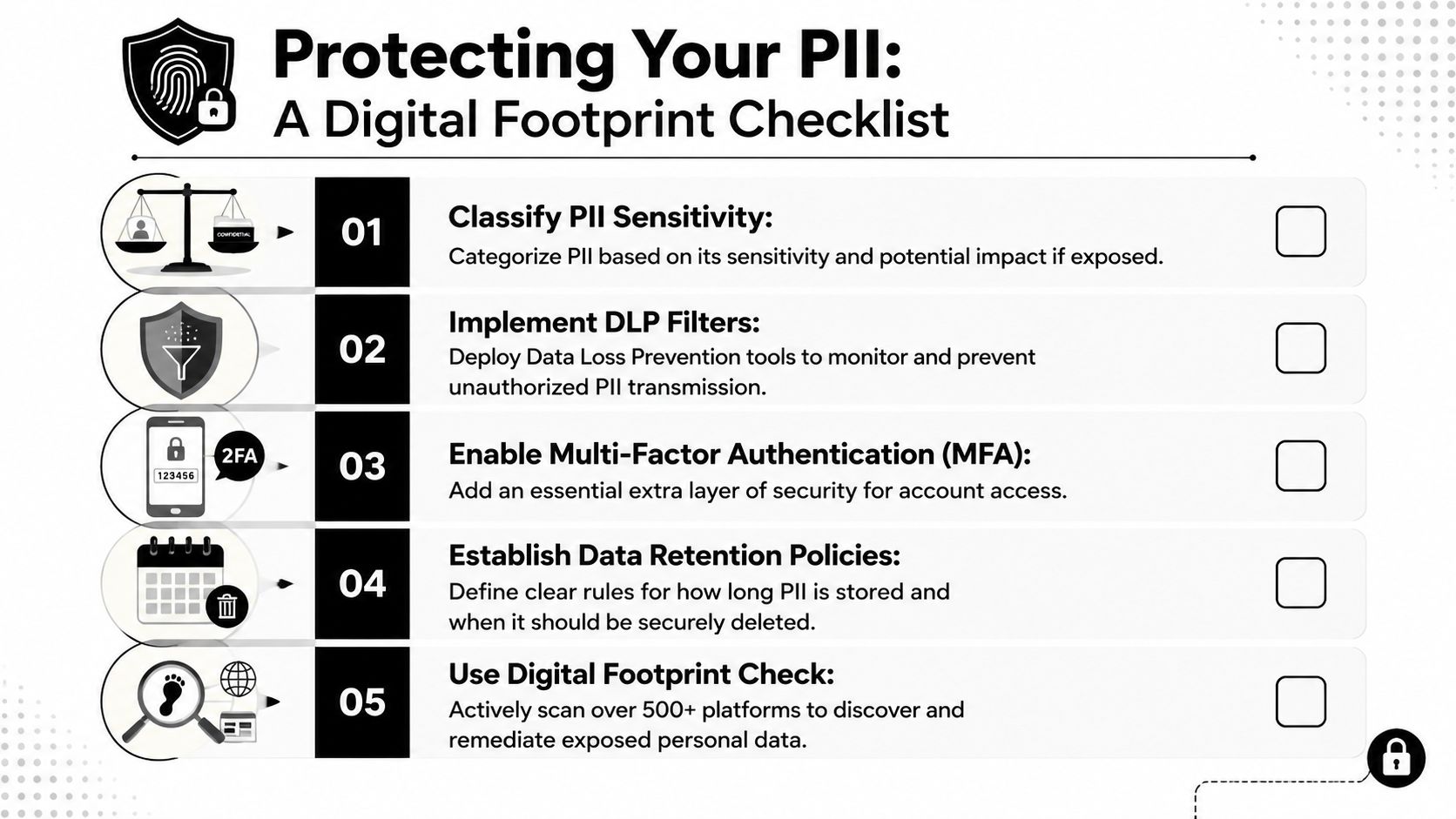
Protection starts with classification. Once you know which fields are direct identifiers, which are linkable, and which are tied to sensitive use cases, you can choose stronger controls for the riskiest data. Guidance from data governance and security frameworks recommends data loss prevention, retention policies, and other controls based on sensitivity and legal obligations (Imperva on PII controls).
Build a basic protection stack
Start with MFA on email, banking, social media, and any account that can reset others. Then tighten access with strong passwords, unique recovery methods, and a retention habit that deletes old accounts you no longer use. If you manage data for a business, classify the information first, then apply DLP filters and access rules to the categories that matter most.
That approach works because not every record needs the same treatment. A public-facing business contact page does not deserve the same handling as payroll data or account recovery details. The more linkable the information, the more damage it can cause when it escapes.
Monitor for exposure instead of waiting for a breach
A one-time cleanup helps, but continuous monitoring is better. Digital Footprint Check is designed to search across 500+ platforms and surface exposed data that can be hard to find manually, then turn that into actionable reporting and alerts for new leaks. That kind of monitoring supports the same risk-based logic used in formal privacy programs, because it helps you catch fresh exposures before they spread.
If the data can be found by strangers, you should assume it can be found again.
For individuals, that means fewer surprises in job searches, dating, and account recovery. For teams, it means a cleaner reputational surface and fewer opportunities for impersonation, phishing, or social engineering.
Conclusion and next steps
PII is broader than a short list of obvious identifiers. It includes data that can identify you directly, data that can identify you when linked with other records, and data fragments that only look harmless until they're combined. That's the key idea behind modern privacy work, and it's why U.S. frameworks and GDPR can treat the same signal differently depending on context.
The most useful habit is to audit your footprint the way an investigator would. Look for repeated usernames, old profiles, public records, leaked emails, and device-linked traces that connect across services. If you find something exposed, remove it where you can, lock down the account, and reduce the number of places where the same identifier appears.
Monitoring matters because your footprint changes over time. New posts, new signups, and new breaches can reintroduce the same risk even after you've cleaned up the obvious stuff. Staying ahead of that cycle is what keeps identity protection practical instead of theoretical.
A CTA for Digital Footprint Check.