· Digital Footprint Check · Content Marketing · 23 min read
The Ultimate Username Checker Guide to Protect Your
Discover how a username checker protects your privacy and online reputation. Learn to uncover your hidden digital footprint and secure your accounts today.

Think about your favorite username. It’s more than a login—it’s your digital key, the handle you’ve used to unlock doors to social media profiles, gaming networks, and forums all over the internet. What if you could see every place that key has been used? That forgotten gaming profile from a decade ago? That old dating app account?
That’s exactly what a username checker does. It’s a powerful OSINT tool that scans the web to find every account tied to a specific username, giving you a map of your digital identity and uncovering risks you never knew you had. In an age of widespread identity theft and online scams, knowing where your information lives isn’t just a good idea—it’s essential for your personal and professional safety.
What Is a Username Checker and Why Is It Essential for Digital Privacy?
Imagine your username is a real, physical key. Over the years, you’ve made copies and left them with dozens of services online. A username checker acts like a master locksmith who can instantly tell you where every one of those copies exists, from your main social media to a dusty, abandoned forum you used once in 2008.
This isn’t just a simple Google search, which barely scratches the surface. A dedicated username checker is an OSINT (Open Source Intelligence) tool that methodically dives deep, querying hundreds of platforms directly to piece together your online presence and expose potential vulnerabilities.
Beyond a Simple Google Search: The Power of OSINT Tools
Googling your username might show a few top-level results, but it misses the vast majority of your online activity. Search engines often overlook niche forums, old gaming sites, and profiles that aren’t indexed for the public to see. A specialized checker doesn’t rely on indexing; it asks the platforms directly, revealing a much deeper layer of your digital history.
This deeper search is critical because every account, active or abandoned, adds to your digital footprint—the complete trail of data you leave online. An unmanaged footprint isn’t just messy; it’s a real and present danger.
A single forgotten account on an insecure website is a prime target for data breaches. Statistics show that data breaches exposed 4.1 billion records in the first half of 2019 alone. Your old, forgotten profile could be a backdoor for cybercriminals to access your personal information, damage your reputation, or even commit identity theft.
The Real-World Impact on Your Job Prospects, Safety, and Reputation
That collection of online profiles you’ve built over the years can directly influence critical parts of your life. Not knowing where your username is active can lead to some serious, unforeseen problems.
Consider just a few areas where an unmanaged digital identity can cause harm:
- Job Prospects: A 2020 survey revealed that 70% of employers use social media to screen candidates. An old, unprofessional profile tied to your go-to username could easily cost you your dream job. What you posted on a gaming forum as a teenager could derail your career as an adult.
- Personal Safety & Identity Theft: Scammers and cyberstalkers use usernames as a starting point to gather information for identity theft, catfishing, or online harassment. The more places your username appears, the easier you are to target. The FBI’s Internet Crime Complaint Center (IC3) reported that victims lost over $10.3 billion to cybercrime in 2022.
- Gaming Account Security: Your gaming handle is a valuable asset, often linked to hundreds or thousands of dollars in digital goods. If it’s linked across multiple sites, a breach on one insecure forum could give hackers a backdoor into your entire gaming ecosystem, leading to account takeover and financial loss.
- Online Dating Safety: Romance scammers create fake profiles to exploit unsuspecting individuals. A username check can help verify a potential partner’s identity and expose catfishing attempts before you become emotionally or financially invested.
Ultimately, a username checker is your first line of defense in modern cybersecurity. It gives you the power to see what employers, scammers, and the rest of the world can see, letting you identify vulnerabilities and take back control of your online identity.
Ready to see what’s out there? Uncover your hidden digital footprint and protect your identity. Start with a free, confidential scan at www.digitalfootprintcheck.com/free-checker.
How a Username Checker Uncovers Your Hidden Digital Footprint
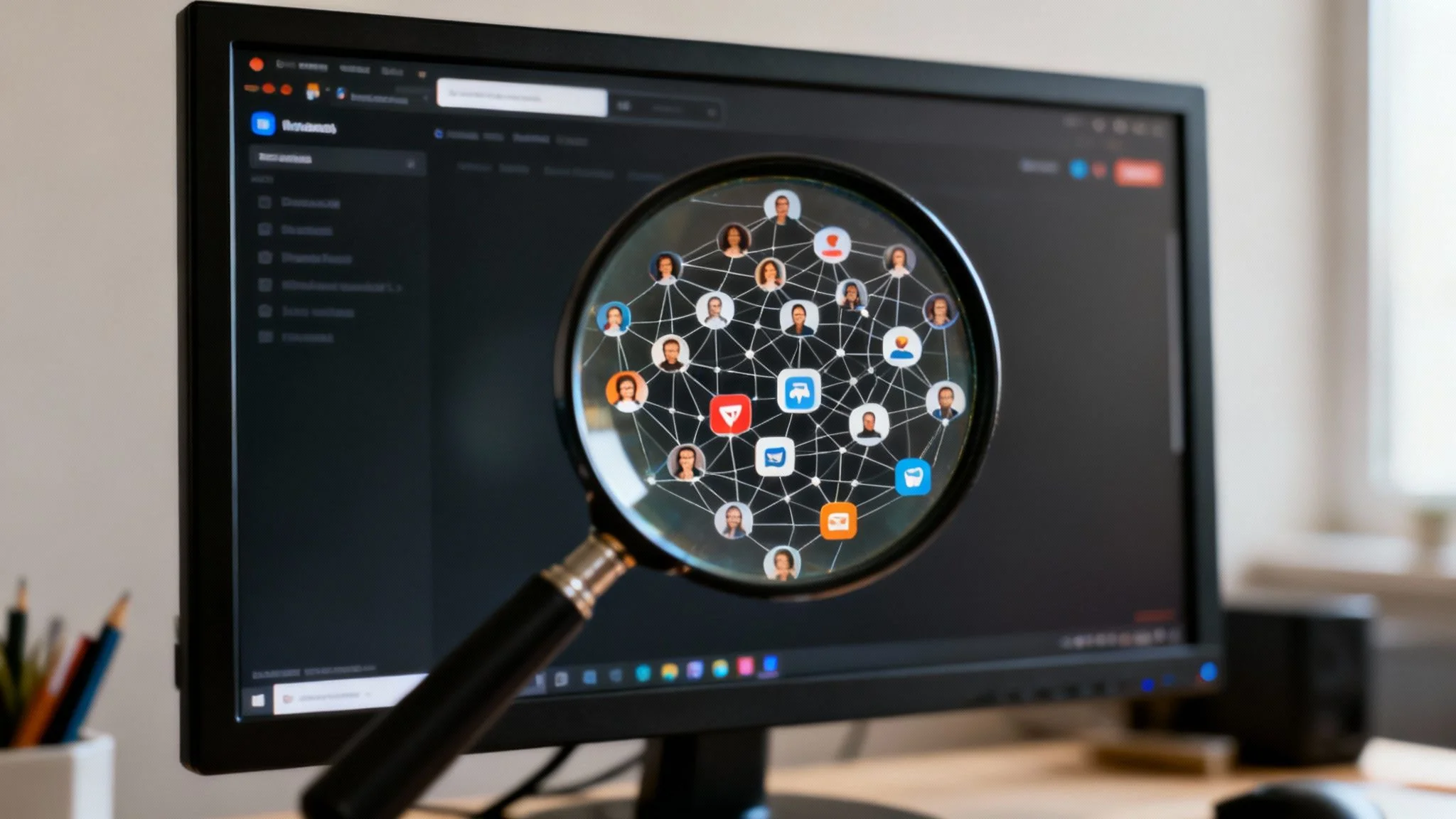
So, how does a username checker actually work? Think of it less like a simple Google search and more like a digital detective conducting a comprehensive investigation.
Googling your name is like asking a librarian for a book on a general topic—you’ll get the most obvious, well-known results. A username checker, on the other hand, is like a team of investigators who go to every library, archive, and records office in the city, asking for any file that specifically mentions your name.
This targeted investigation uses a methodology called Open Source Intelligence (OSINT). In simple terms, OSINT is the practice of finding, collecting, and analyzing information from publicly available sources to generate actionable intelligence. A username checker automates this process on a massive scale.
Instead of just skimming search engine results, it directly asks hundreds of websites, forums, and social networks if a profile with your exact username exists. It’s casting a wide, fine-meshed net across the digital ocean, pulling up information that standard searches miss completely.
What a Comprehensive Username Scan Covers
The real power of these OSINT tools lies in their sheer breadth. A good username checker doesn’t just peek at the big social media sites. It dives deep into the forgotten corners of the internet where fragments of your identity might still be floating around, creating a detailed map of your digital exposure.
The search typically covers a huge range of platforms:
- Social Media Networks: This isn’t just about Facebook, Instagram, or X (formerly Twitter). It includes smaller, international, and even defunct networks you might have joined and forgotten about years ago.
- Gaming Hubs: Think about platforms like Steam, Twitch, and Xbox Live, plus countless individual game forums where your gaming handle is your main identity. These are goldmines for hackers looking to perform account takeovers.
- Niche Forums and Communities: From Reddit and Discord to specialized forums for hobbies like photography, classic cars, or coding—these are places where you’ve likely shared detailed opinions and personal stories that could be used against you.
- Dating Apps & Websites: Checks across dating platforms can reveal old profiles or help you verify the identity of a potential match, which is a critical step in preventing romance scams.
- Professional and Creative Sites: This can include portfolio sites like Behance, professional networks like LinkedIn, and code repositories like GitHub.
By systematically pinging these diverse sources, the tool starts to piece together the full mosaic of your online life, uncovering connections and old profiles you never would have found on your own. It’s a fundamental technique for anyone just getting started with OSINT tools for beginners and wanting to map their own exposure.
Beyond Active Profiles: Checking for Data Breach Exposure
But a effective username checker doesn’t stop there. It cross-references your username with massive archives of known data breaches, a critical function for digital security today.
Cybersecurity reports show that over 15 billion credentials have been exposed in data breaches since 2004. Your username from an old, forgotten forum could easily be part of this compromised data, creating a security risk you don’t even know about.
When a checker flags your handle in a data breach, it means your login information from that specific site was likely stolen and is now circulating on the dark web. This is a huge red flag, mainly because so many people reuse usernames and passwords across different services. A hacker who gets your compromised credentials from an old gaming site could use them to try and access your more sensitive accounts, like your email or online banking.
This capability transforms the tool from a simple profile locator into a proactive security alarm. It doesn’t just show you where you are; it shows you where you’ve been compromised. This gives you the power to secure your active accounts and clean up the risks tied to your past online activities. By understanding just how deep this search goes, you can see why a simple username check is often the most important first step in managing your digital footprint and preventing identity theft.
Real-World Scenarios: Protecting Your Career, Finances, and Safety
Understanding the theory behind a username checker is one thing, but seeing it in action is where its value really clicks. The digital traces we leave behind aren’t just harmless echoes anymore; they are active data points that can shape our real lives. From landing your dream job to preventing devastating scams, a quick check can be the difference between security and serious vulnerability.
Let’s walk through a few common, high-stakes situations where running a username check isn’t just a neat idea—it’s an essential part of modern digital self-defense.
Safeguarding Your Professional Reputation and Job Prospects
In today’s job market, your online presence is your first interview. A staggering 70% of companies now use social media and online searches to vet candidates. That cringey, unprofessional username from a decade-old gaming forum could be a career liability you don’t even know exists.
Real-World Example: Sarah, a talented marketing professional, was a finalist for her dream job. The hiring manager did a quick search of her common username and found an old blog where, as a college student, she had posted angry, unprofessional rants. Despite her qualifications, the company quietly chose another candidate. Sarah never knew why she was rejected.
A username check lets you see your digital history through an employer’s eyes. It helps you find and clean up forgotten accounts, embarrassing posts, or unprofessional associations before they can sabotage your ambitions.
By running a check, you can:
- Identify problematic accounts: Uncover old profiles on platforms you’ve forgotten about.
- Clean up your image: Delete or privatize content that doesn’t align with your professional brand.
- Take control of the narrative: Ensure what employers find online is a curated, positive reflection of who you are today.
Protecting Yourself from Romance Scams and Catfishing in Online Dating
Online dating has connected millions, but it’s also a breeding ground for deception. Romance scams are rampant, with fraudsters building elaborate fake personas to manipulate and exploit people financially and emotionally. In 2022, reported losses from romance scams reached an astonishing $1.3 billion. A username checker is a critical tool for personal safety.
Real-World Example: Mark met “Anna” on a dating app. She seemed perfect, but her username felt generic. He ran it through a username checker and discovered the same handle linked to multiple profiles with different names and photos on other social sites, along with posts on forums known for scam activity. He had uncovered a catfishing scam before he sent any money or became further invested.
This kind of proactive verification is a cornerstone of modern dating safety. For a deeper dive into these strategies, our guide on protecting yourself from online dating scams offers a detailed look at spotting red flags and staying secure.
Securing Your Gaming Identity and Preventing Account Takeover
For any serious gamer, a username or gamertag is a core piece of their identity, tied to valuable in-game assets and a hard-earned reputation. But that same username often gets reused across countless forums and third-party sites, creating a massive security risk.
Real-World Example: A gamer named “ShadowBlade” used the same username and a similar password on a small, insecure game modding forum and his main Steam account. The forum was breached, and his credentials were leaked. Hackers used this information to access his Steam account, change the password, and sell off his entire collection of rare in-game items, worth over $1,000. He lost everything.
Cybersecurity reports show that 85% of data breaches involve compromised usernames. A username check can reveal if your gamertag has been exposed in a breach, allowing you to change passwords before hackers can strike.
Ensuring Your Child’s Online Safety and Preventing Cyberbullying
For parents, the internet can feel like a vast, unknown world where their kids spend hours every day. Monitoring a child’s online activity isn’t about spying—it’s about protecting them from cyberbullying, online predators, and inappropriate content.
A username checker gives parents a way to see where their child’s chosen handles are being used across the web. It can reveal accounts on platforms they weren’t aware of or show participation in forums that might be unsafe. This visibility opens the door for crucial conversations about online behavior, privacy settings, and being a good digital citizen, helping you protect your family in an increasingly complex digital world.
Each of these scenarios proves that a username is far more than a simple login. It’s a thread that ties your entire digital life together, and knowing where that thread leads is the first step toward real online security and reputation management.
How To Interpret Your Results And Secure Your Identity
You’ve run a username checker and now you’re staring at a list of links. Don’t just see it as data—see it as a personalized action plan. The real magic happens when you turn that information into concrete steps to clean up your digital past and lock down your future. Think of it as essential digital hygiene for reputation management and identity theft prevention.
The first step is to sort through the clutter. Every result you find will probably fall into one of four buckets: accounts you actively use, old profiles you forgot existed, public mentions on forums or blogs, and scary-looking exposures in data breaches. Each one needs a different game plan.
From Report To Action Plan: A Practical Guide
Once your results are in, it’s time to get organized. It can feel like a lot to take in at first, but a methodical approach turns a long list of digital breadcrumbs into a manageable to-do list for protecting your online identity.
A username check is a powerful tool for anyone trying to get a handle on their online life, whether for professional, personal, or security reasons. This guide shows how different people can find value in knowing what’s out there.
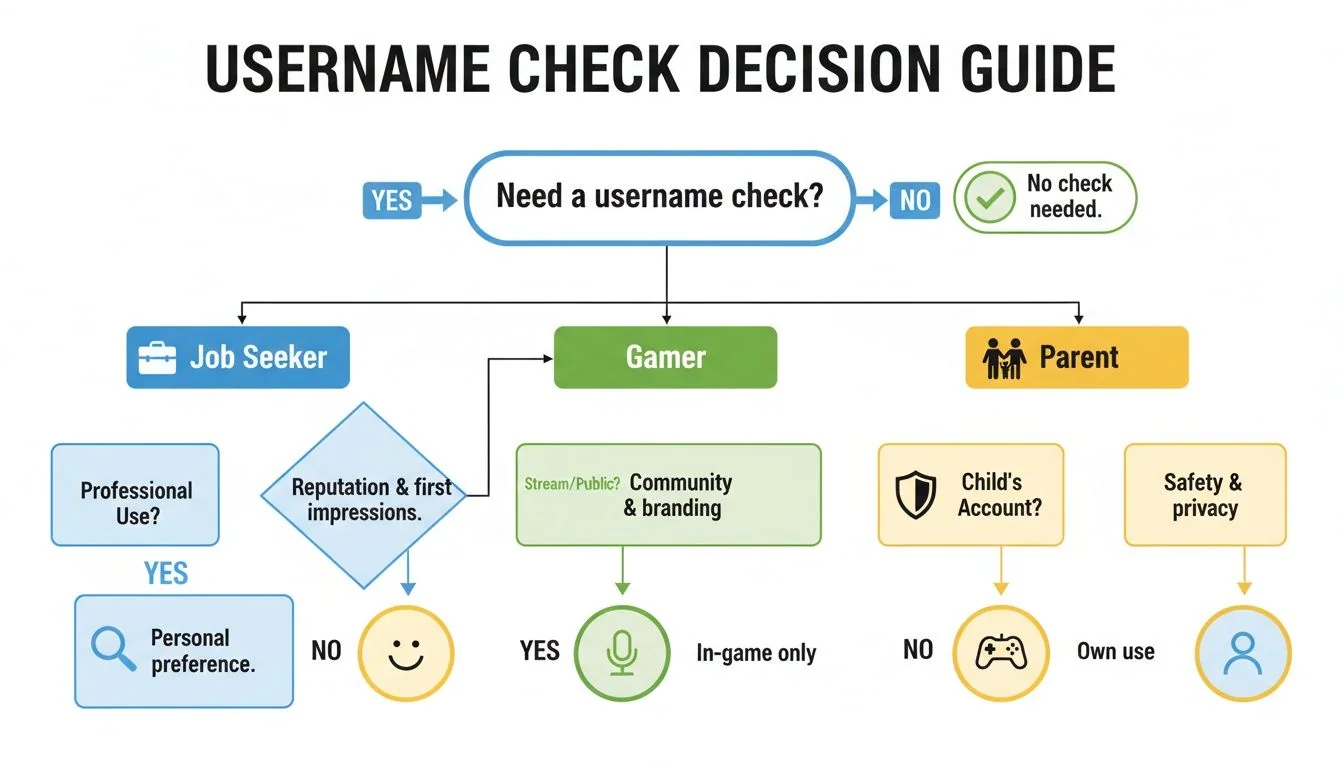
As the flowchart shows, job seekers, parents, and even gamers have compelling reasons to see where a username pops up, which makes having a clear plan for the results even more important.
Here’s a simple breakdown of how to tackle each type of finding:
- Active and Current Accounts: These are the profiles you know and use. For each one, check your security settings. Is two-factor authentication (2FA) turned on? Is the password strong and unique? This is your first line of defense.
- Forgotten or Dormant Accounts: These are the ghosts of your digital past—that old gaming forum, a defunct social media profile, or a service you tried once and ditched. These accounts are a massive liability because their security is almost certainly outdated. Your goal here is simple: delete them.
- Public Mentions and Content: This bucket includes any forum posts, blog comments, or articles where your username appears. You’ll want to review this content to make sure it still reflects the personal or professional image you want to project today.
- Data Breach Exposures: If a username checker flags your handle in a known breach, treat it as a high-priority alert. It means your login details for that site were likely stolen and are probably floating around the dark web.
The table below provides a quick-reference guide to help you prioritize your cleanup efforts based on what your username check uncovers.
Action Plan for Your Username Checker Report Findings
| Finding Type | Risk Level | Recommended Action |
|---|---|---|
| Data Breach Exposure | Critical | Immediately change the password on the breached site and any other account using a similar password. Enable 2FA everywhere. |
| Forgotten/Dormant Account | High | Log in and permanently delete the account. If you can’t access it, contact support to request removal. This is a key step in reputation management. |
| Unsecured Active Account | Medium | Log in, create a strong, unique password, and enable two-factor authentication (2FA) immediately. |
| Negative Public Mention | Medium | If possible, edit or delete the content. If not, focus on creating positive content to push it down in search results. |
| Active Account (Secured) | Low | No action is needed, but schedule a periodic review of its privacy and security settings. |
| Neutral Public Mention | Low | Acknowledge and file it away. No immediate action is required unless the context changes. |
By categorizing your findings this way, you can systematically address the most critical risks first and work your way down the list.
Taking Control Of Your Digital Identity and Preventing Identity Theft
Now that you’ve sorted everything, it’s time for action. For your active accounts, make updating passwords and enabling 2FA your top priority. For those forgotten accounts, start the deletion process. It can be a pain, but it’s the only real way to eliminate the risk they pose.
If your username checker reveals your information on data broker sites, taking action is essential. Learning how to opt out of data broker sites like FastPeopleSearch is a crucial skill for reclaiming your privacy.
Every forgotten account is a potential backdoor for identity thieves. A study by the Identity Theft Resource Center revealed that 57% of identity theft victims could trace the incident back to a compromised online account, making account cleanup a non-negotiable step in digital security.
Dealing with public mentions can be a bit trickier. If you can, go back and edit or delete old posts that are embarrassing or unprofessional. If that’s not an option, the best strategy is often to build a stronger, positive online presence to bury the negative stuff.
For data breach alerts, change the password on the affected site right away, and be sure to change it on any other site where you might have used the same one. To learn more about proactive protection, check out our complete guide on how to prevent identity theft online.
By following these steps, you can transform your username search results from a source of anxiety into a powerful tool for digital self-defense and reputation management.
Choosing a Safe and Trustworthy Username Checker
When you’re trying to lock down your digital privacy, the OSINT tools you use can either be your strongest ally or your weakest link. A username checker is powerful, but picking the wrong one can expose you to the very risks you’re trying to prevent, like identity theft or data harvesting. Not all checkers are created equal, and knowing what to look for is key to making a choice that actually enhances your cybersecurity.
Think of it like hiring a security consultant. You wouldn’t hand over your keys to someone with a shady reputation. Your digital keys—your usernames—deserve the same caution. Only trust them to a platform that operates with crystal-clear, ethical principles.
Key Features of a Reputable Service
As you evaluate different username checkers, focus on features that provide real value and signal a commitment to a thorough, safe analysis.
- Extensive Platform Coverage: A tool is only as good as its reach. A quality checker digs into hundreds of platforms, including social media, gaming hubs, niche forums, dating apps, and professional networks to give you the full picture.
- Data Breach Integration: Just finding where a username exists isn’t enough. The best services cross-reference your username with massive databases of known data breaches. This tells you not just where your accounts are, but if they’ve already been compromised.
- Clear and Actionable Reports: A simple list of links is just noise. Look for a service that organizes its findings into an easy-to-read report, helping you see the biggest risks first so you can take immediate action for your reputation management and online identity protection.
Red Flags: How to Spot an Unsafe Tool
Knowing what to avoid is just as critical as knowing what to look for. Some services use the lure of a “free check” to harvest your data for their own gain. Be skeptical of any platform that shows these warning signs.
A “free” service that asks for too much personal information might be selling your data. It’s the golden rule of the internet: if you aren’t paying for the product, you are the product.
Keep an eye out for these red flags:
- Excessive Data Demands: A username checker only needs one thing: a username. If a site demands your full name, address, phone number, or credit card details for a simple search, it’s a massive red flag.
- Vague or Missing Privacy Policy: Any legitimate service will have a clear privacy policy that explains exactly how your data is handled. If you can’t find one, or if it’s packed with confusing legal jargon, steer clear.
- Lack of Transparency: Reputable services are upfront about how they work. They’ll tell you they use ethical OSINT techniques and are open about the scope of their searches.
Ethical OSINT and the Importance of User Privacy
In the world of cybercrime, username checkers are your first line of defense against account takeovers, which skyrocketed by 231% between 2022 and 2025, affecting 1 in every 27 internet users globally. Platforms like Digital Footprint Check aggregate OSINT from over 500 sources, revealing that 73% of breached credentials involve duplicated usernames paired with weak passwords. These numbers underscore why manual Google searches, which dominate with an 89.57% market share, fall short by capturing only surface-level hits. You can discover more insights about Google’s market position to understand the limitations of basic searches.
Just as a username checker helps you map out your public digital presence, other specialized tools exist to analyze different parts of your online profile. For example, a quality ATS CV checker can help job seekers make sure their resume is optimized for the automated systems that companies use, another crucial piece of managing a professional digital identity.
At Digital Footprint Check, our entire platform is built on a commitment to ethical OSINT and user privacy. Our goal is to empower you with the information you need to secure your identity, not exploit it. We provide the comprehensive tools you need for a deep, meaningful analysis of your online presence. For more on this, you might find our guide on the top tools for monitoring your digital footprint helpful.
By making an informed choice, you can turn a simple username checker into a powerful tool for taking back control of your digital life. Start your investigation with confidence by using the free, secure tool at www.digitalfootprintcheck.com/free-checker.
Frequently Asked Questions About Username Checkers
Diving into username checkers and digital identity can bring up a lot of questions. From legality to accuracy, getting the details straight helps you move forward with confidence. Here are some clear, straightforward answers to the most common questions we hear.
Is Using a Username Checker Legal?
Yes, using a username checker for your own digital privacy and security research is perfectly legal. These tools operate using Open Source Intelligence (OSINT), which is the practice of finding and analyzing information that is already publicly available. They aren’t hacking into accounts or accessing private data.
Think of it this way: walking down a public street and noting the names on mailboxes is legal. A username checker does the digital version of that—it automates the search for public profiles across the internet. Because it only gathers information that’s already in the open, it’s a legitimate tool for personal digital hygiene, reputation management, and security audits.
How Accurate Are the Search Results?
The accuracy of a username checker depends on the quality of the service. A reputable platform like Digital Footprint Check queries hundreds of websites in real-time, giving you a highly accurate picture of where your profiles exist. That said, no OSINT tool can be 100% infallible, and here’s why:
- Deleted vs. Deactivated Accounts: Some platforms don’t immediately wipe deleted accounts. This can sometimes lead to a false positive, showing an account that’s technically still in their database but not publicly visible.
- Username Uniqueness: If you have a common username like “JohnS,” some results might point to other people who use the same handle. Context is key to distinguishing your accounts from others.
- Platform API Changes: Websites constantly update their systems. A checker’s ability to get a result depends on its connection to a site’s public interface, which can change without warning.
Even with these variables, a high-quality username checker gives you a precise map of where a specific handle is active online, which is a crucial first step in online identity protection.
Can a Username Checker Find Deleted Accounts?
For the most part, no. A username checker is built to find active, existing profiles. Once you permanently delete an account from a platform’s servers, its public-facing profile is gone, making it invisible to a standard username search.
But there’s a critical distinction to make. While the account itself is gone, traces of it can linger elsewhere, impacting your reputation management efforts:
- Mentions of your username might stick around in search engine caches for a while.
- Your username could still be listed in archives of data breaches that happened before you deleted the account, posing a risk of identity theft.
- Content you posted on old forums might remain, sometimes attributed to a “deleted user” but occasionally still showing your original username.
This is exactly why proactively managing your digital footprint is so important. Deleting an account is a great move, but it doesn’t always erase every trace of its history.
What if I Find Information I Cannot Remove?
It’s a stressful feeling—finding an old, embarrassing, or negative piece of information tied to your username that you can’t just delete. This is common with old forum posts, comments on blogs, or mentions in articles written by someone else. When you don’t control the website, removal gets tricky, but you aren’t out of options for reputation management.
Your first step is to try contacting the website administrator directly. Send a polite request asking to have the content removed or your username anonymized. Explain your situation calmly. They aren’t always obligated to help, but many will if the request is reasonable.
If that doesn’t work, your next best strategy is suppression. This means creating new, positive, and professional content associated with your name and username. By building a strong, positive online presence, you can push the unwanted results further down in search engine rankings until they’re effectively buried.
Remember, the goal is to take control of the narrative. Even if you can’t erase the past entirely, you can build a stronger, more positive digital present that defines who you are today. This is the essence of effective online identity protection.
Ultimately, a username checker is your starting point. It’s the intel you need to build a smart strategy for cleaning up and securing your digital identity, one account at a time.
Ready to take control of your online identity, protect yourself from scams, and manage your reputation? Digital Footprint Check provides the powerful OSINT tools you need to see exactly where your usernames are exposed online.
Start your free, secure investigation now and own your digital life. Visit www.digitalfootprintcheck.com/free-checker to begin.