· Digital Footprint Check · Content Marketing · 12 min read
Background Check Dating: a Practical Ethical Guide
Learn how to run a background check dating the smart way. Step-by-step OSINT, legal limits, red flags, and safer conversations.

You’re chatting with someone on a dating app, the conversation is good, and the meet-up is getting real. That’s usually when the small knot in your stomach shows up, the one that asks whether the person on the other side is who they say they are, and whether you should do a little background check dating before you say yes.
My view is simple. Light vetting is normal now, and it’s smarter than walking in blind. The trick is doing it like a sane adult, not like a private investigator with a grudge.
When a Dating Background Check Actually Makes Sense
A promising match can still leave you uneasy. Maybe the chat is warm, but the details don’t line up cleanly, or the person keeps dodging a video call. Maybe they’re out of town, talking about meeting soon, and you’re deciding whether that first coffee is just a coffee or something that carries more risk.
That’s where dating vetting earns its keep. People search a match’s social media, look up names online, and sometimes run a full background check because they’re curious, because they’ve been burned before, or because they’re trying to avoid catfishing and romance scams. In a 2022 YouGov poll, 44% of dating-app users had searched a date’s social media profile, 40% had searched the person’s name online, and 9% had run a background check, with women more likely than men to do so, including 51% vs. 38% for social-profile searches and 13% vs. 6% for background checks (YouGov poll on dating-app background checks).
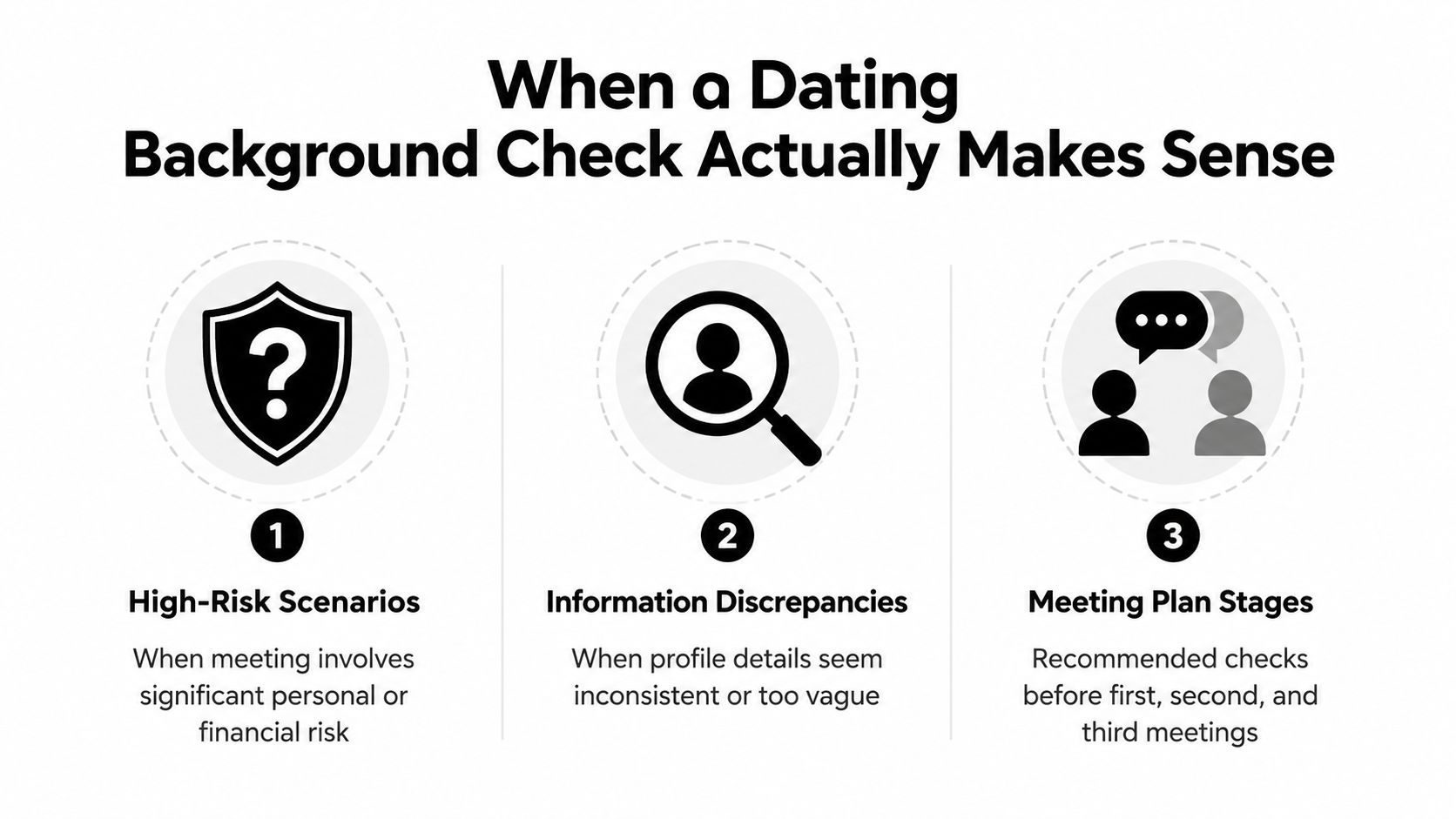
The level of check should match the risk
A casual Google search is enough when you’re meeting someone for a low-stakes first drink, the profile is consistent, and the only thing you want is a quick sanity check. A deeper screen makes more sense when the person keeps changing details, asks for money, pushes for travel, or refuses to appear on video before meeting.
Practical rule: if you’re only checking your gut, start small. If you’re checking for safety, privacy, or fraud, go deeper.
A lot of people think vetting is paranoid. It isn’t. It’s just a modern response to the reality that online profiles are easy to polish, and sometimes easy to fake. The right question isn’t whether you should check at all, it’s whether the situation calls for a quick search or a layered one, like the approach in this guide to protecting yourself from online dating scams.
What Counts as a Background Check in Dating
People throw around the term background check like it means one thing. It doesn’t. In dating, it usually means a stack of checks, ranging from free public searches to paid consumer reports, and the level you choose should match the risk you’re trying to manage.
A basic dating screen can include identity verification, criminal-record lookups, sex-offender registry checks, civil court filings, and a quick scan of the person’s digital footprint. The most useful checks in a dating context are the ones that help confirm the person is real, consistent, and not hiding obvious red flags. A practical workflow starts with high-yield identifiers, then checks those against search engines, reverse-image results, public court portals, sex-offender registries, and social profiles to spot identity inconsistencies and fraud (Checkr’s dating background-check workflow).
The reason this matters is not theoretical. A 2022 Norton/Harris Poll found that 73% of online daters had vetted matches in some form, with 49% scrolling social media profiles, 37% typing a name into a search engine, and 30% checking a professional networking profile before meeting. The same study said 14% had paid for a background check on a dating match and 28% had looked up a match’s friends or family on social media (Norton/Harris Poll on vetting online daters).
Free checks versus paid reports
Free checks are slower, but they’re transparent. You’re looking at public records, social profiles, and search results yourself, which means you can judge context instead of swallowing a black-box score. Paid reports are useful when you want the work consolidated, especially if you’re juggling multiple identifiers or trying to reduce manual digging.
If you want a useful contrast, compare dating vetting to voice screening for fake applicants. The categories are different, but the logic is the same, you’re trying to verify that the person presenting themselves online is the person you’ll meet in real life.
A background check dating approach is strongest when you treat it as layered OSINT, not as a magic stamp of safety. If a match is vague, inconsistent, or pushing boundaries, the check gets deeper. If the profile is ordinary and the first date is low risk, a light pass is usually enough.
The Legal and Ethical Lines You Cannot Cross
People get sloppy, and this carelessness can turn a safety habit into a real problem. You can check public information about a person before meeting them. You can’t stalk them, impersonate them, snoop in private accounts, or use the information as a bargaining tool.
The cleanest line is public data only. That means public profiles, public records, and search results you can access without trickery. Once you start trying to obtain private financial records, phone records, or account access through pretexting, you’ve crossed out of ordinary vetting and into conduct that can create legal exposure. If a match tries to pull you into that world, walk away.
Know what FCRA does and doesn’t do
The U.S. Fair Credit Reporting Act matters when consumer reports are used for housing, credit, or employment decisions, because those uses trigger consent and specific procedures. Personal dating use sits outside that formal employment lane, but that doesn’t give you a free pass to misrepresent what you found or to weaponize a report.
A practical privacy policy from the world of digital media is a good reminder that ethical data handling is about boundaries, not just access. See the Click Click Bang Bang privacy policy as a useful example of how seriously organizations have to treat personal information once they collect it.
If you can’t say out loud how you found something, you probably shouldn’t be doing it.
The baseline is straightforward. Stick to publicly available information, don’t share findings as blackmail, and don’t use a check to intimidate someone into compliance. If asked, be ready to disclose that you did a public-record and social-profile review before meeting. If that conversation feels impossible, that’s already a sign the dynamic is off.
For a simple consent-centered reference, the background check consent forms guide is worth keeping in mind, even if dating itself isn’t an employment process. The principle is the same, people don’t like being lied to about how their information is being used.
A Practical Search Workflow That Respects Privacy
Start with the identifiers you already have. Don’t start collecting extra details just because curiosity kicks in. Use the full name, email, current or past city, employer, and profile photos from the app as anchors, not as permission to dig into everything else.
A clean workflow begins with the fastest signals. Search the name with a city qualifier. Run the profile photos through reverse-image search and look for mismatches, reused images, or obvious stock-photo behavior. If you want a plain example of why that matters, read identifying fake profiles on Facebook. Then scan public social profiles for consistency in job, education, and location. If they gave you an email, check whether it appears in breach databases or other public exposure contexts. After that, look at public-record portals in the relevant jurisdiction if you have a real reason to do it.
A consolidated OSINT tool can save time. Digital Footprint Check is one option that compiles signals across 500+ platforms, public records, and breach exposure sources, which matters when you want a faster first pass instead of stitching every lookup together by hand. Use tools like that after you’ve done the cheap, high-yield checks yourself, because the point is prioritization, not outsourcing judgment.
The volunteer world uses a similar mindset. A volunteer background check process is usually about narrowing risk efficiently without overcollecting data, and that same restraint belongs in dating too.
Good rule: search less, but search smarter. Multiple weak signals beat one dramatic assumption.
Keep the search bounded
A proper search ends when you’ve answered the question, not when you’ve satisfied curiosity. If the results are boring and consistent, stop. If the results are messy, collect only what you need to decide whether meeting makes sense, then move on.
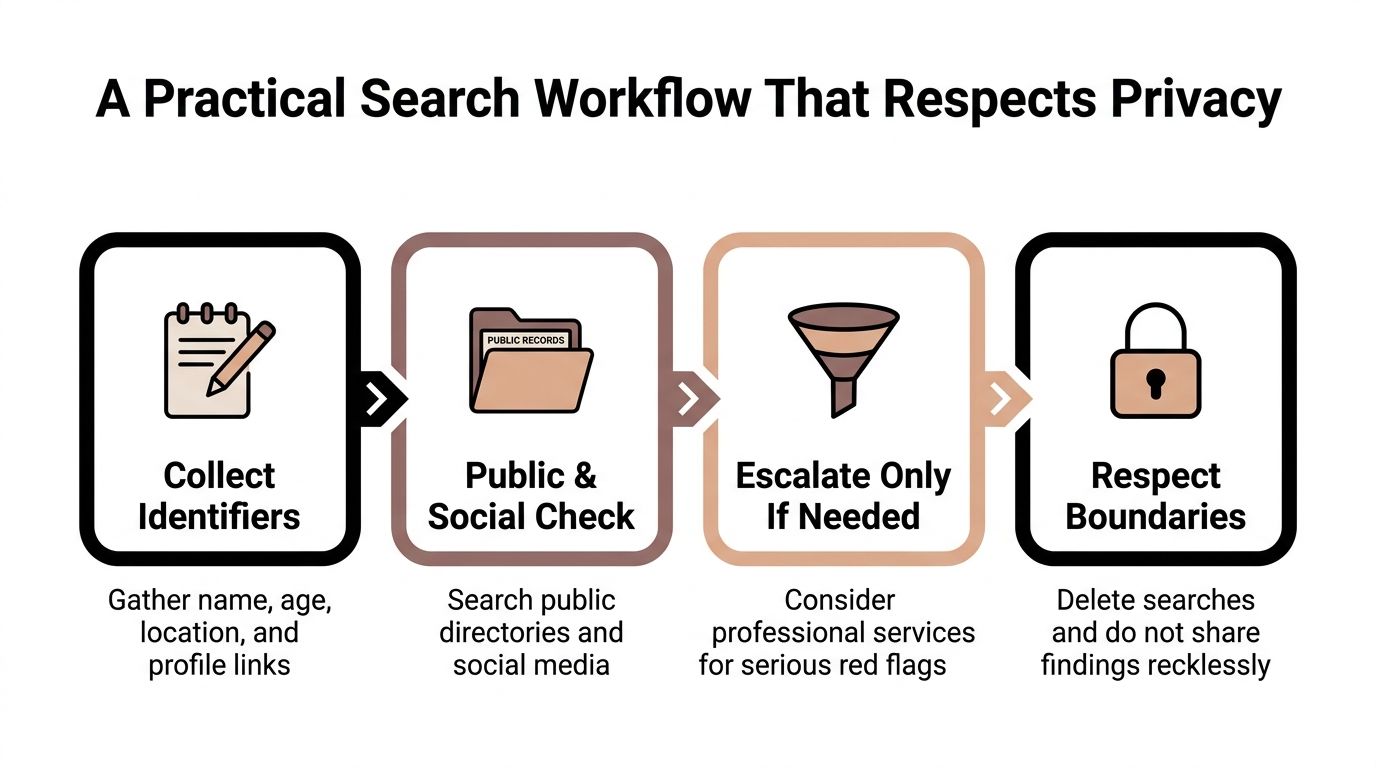
A privacy-respecting workflow keeps the search narrow. It does not ask for extra identifiers you were not given, and it does not turn into a habit of checking every stranger for sport. It also does not pretend a clean report proves a clean person. Plenty of people look fine on public surfaces and still lie, omit, or keep their worst behavior out of reach. Use the search to reduce risk, not to hallucinate certainty.
A 12 Minute First Pass vs a Deeper Review
A first pass should be fast enough that you’ll do it before a date. One consumer guide breaks the early screening into a rough 2-minute Google search, 2-minute reverse-image check, 3-minute social-profile review, 2-minute registry lookup, and 3-minute ID-verification step, for about 12 minutes total before any paid report is needed (consumer screening guide).
Quick Pass vs Deep Review
| Step | 12 Minute Pass | Deep Review |
|---|---|---|
| Search name and city | Quick Google and Bing sweep | Search multiple counties and address history |
| Check photos | Reverse-image lookup | Compare across more platforms and older posts |
| Review social presence | Scan public profiles for consistency | Check professional profiles and breach exposure |
| Public records | Basic sex-offender and public-record lookups | Court-record searches in relevant jurisdictions |
| Identity confidence | Decide whether to meet in public | Consider a consolidated report and ask follow-up questions |
When to go deeper
A deeper review makes sense when the relationship is moving beyond a single drink. It also makes sense when the person is asking for travel, money, secrecy, or fast emotional commitment. That’s when I’d rather spend more time on court records, address history, and public identity signals than trust a pretty profile.
The smarter move is to deepen only when the situation earns it. The how to find someone’s digital footprint guide is useful for understanding how a bigger footprint search is assembled, but you still need judgment before you use any of it.
Don’t over-invest in a three-hour investigation for a first coffee date. Don’t under-invest if you’re planning to spend a weekend with someone you’ve only known online. The effort should match the stakes.
Red Flags That Should Change Your Plans
A single odd detail doesn’t always mean trouble. A cluster of odd details usually does. That’s the part people ignore because they want the story to be simple, and dating is rarely simple.
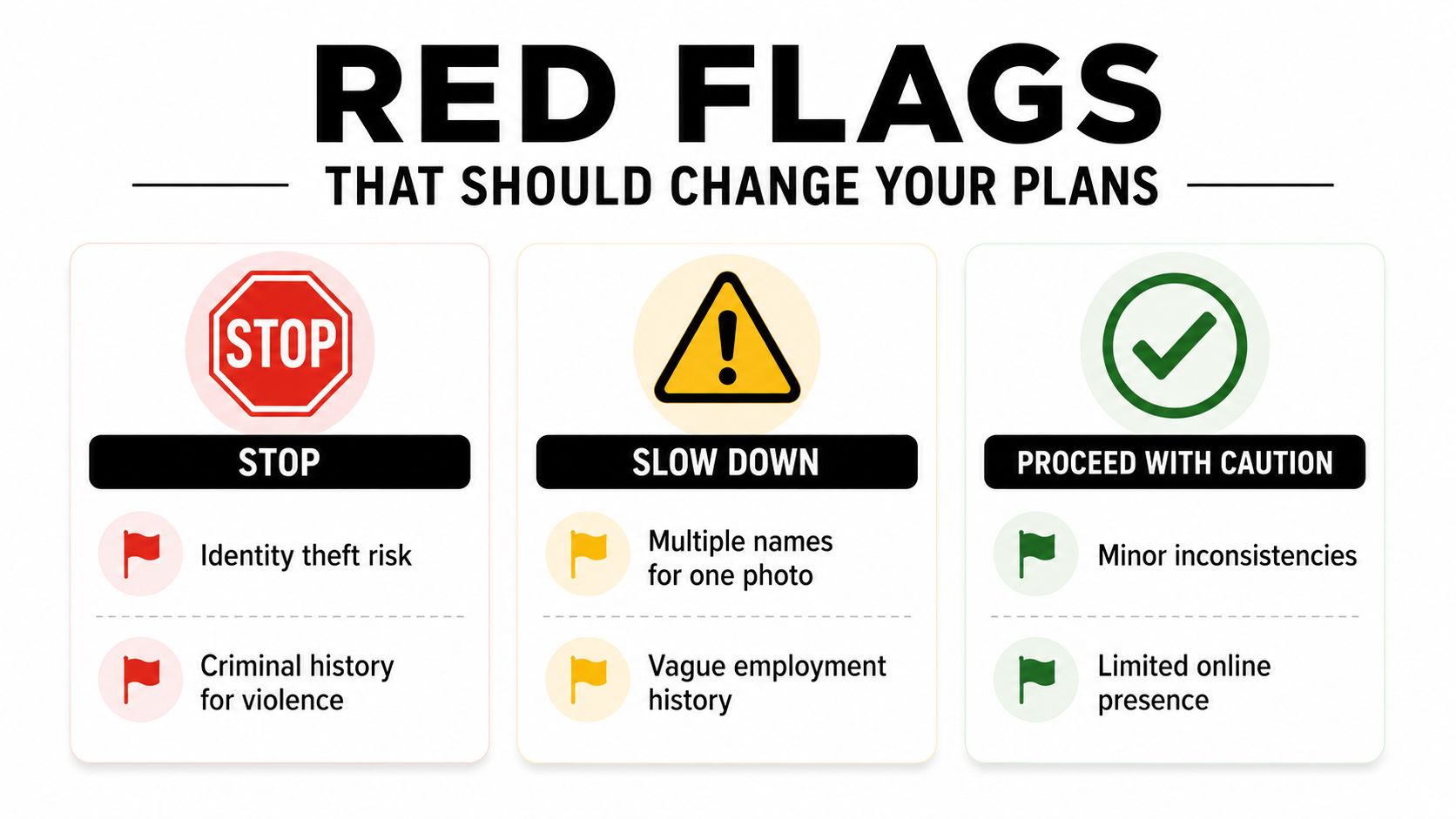
Stop means stop
If the same face appears under multiple names, or the person pressures you for money, travel, or private data, stop. If you find a serious criminal history connected to violence, stop. If the situation starts to look like identity theft or a romance scam, stop and don’t rationalize your way through it.
Slow down means verify again
A photo that looks recycled, a vague employment history, or biographical contradictions around city, school, or job should slow you down. These are classic catfishing signals because they show the person is either hiding something or can’t keep the story straight.
Proceed with caution is not the same as ignore
Limited online presence can be normal, and minor inconsistencies happen. A clean report can also be misleading, because public records often miss minor infractions, expunged misdemeanors, police reports that never led to charges, and some protection orders depending on state rules. A clean screen lowers uncertainty, it doesn’t prove someone is safe (consumer guidance on what dating checks miss).
The internal rule should be simple. One red flag means ask a question. Two or three red flags mean change your plan. If your gut and the data are both telling you to slow down, listen.
For more on the practical risks, the dangers of online dating guide is a useful reminder that the biggest problem is usually not one dramatic lie, it’s the pattern around it.
Turning Results Into the Next Conversation
If the search comes back clean, don’t turn it into permission to act careless. Meet in public, tell a friend where you’re going, and keep your normal guardrails. A clean result is a reason to relax a little, not a reason to ignore basic safety.
If you found inconsistencies, bring them up plainly and without accusation. Try something like, “I noticed your profile and your public page don’t line up on the city you live in. Can you help me understand that?” You’re not building a case, you’re checking whether the person can answer a direct question like an adult.
If you want to disclose that you did a check, keep it calm. Say, “I do a quick public search before meeting anyone from an app. It’s part of how I handle my own safety.” That’s honest without being hostile.
When the findings are serious, keep the ending short. “I’m not comfortable meeting up, so I’m going to pass. I wish you the best.” You don’t owe a debate, and you definitely don’t owe more access.
If you’ve never checked your own footprint, start there before digging into someone else’s. A free profile tool is the right first move because it shows you what strangers can already see about you, which is the same lens you should use on a match.
If you want a practical starting point, visit Digital Footprint Check and run a footprint review before your next first date. It’s a straightforward way to see what’s public, spot obvious gaps, and make your dating decisions with more clarity and less guesswork.