· Digital Footprint Check · Content Marketing · 14 min read
Cease and Desist Letter Template Guide
A practical cease and desist letter template guide with customizations for IP, defamation, harassment, and privacy disputes, plus delivery tips and follow-up
You’ve found a competitor using your brand name, a former employee has posted confidential material, or a stranger keeps publishing private images and contacting people connected to you. You want the conduct to stop, but sending an angry message can create more risk than benefit. A well-built cease and desist letter template gives you a disciplined way to identify the conduct, state the legal basis, demand specific action, and preserve a record without pretending you already have a court order.
The letter should also fit the digital facts. Save the URLs, usernames, timestamps, screenshots, messages, profile details, and platform names before anything disappears. If negative search results are part of the harm, review this practical guide on removing negative search results before you decide whether a private demand, platform report, or formal legal filing belongs first.
When You Actually Need a Cease and Desist Letter
A cease and desist letter is a calibrated pre-litigation tool, not a formality and not a performance of toughness. It works best when you can identify a specific behavior that should stop, explain why you believe it violates a right, and give the recipient a realistic way to comply.
The standard cease and desist letter format identifies the sender and recipient, describes the alleged conduct, explains the rights involved, states the requested remedy, and sets a deadline. In trademark practice, deadlines commonly fall in the 10 to 30 day range, and senders often use certified mail and email to create a dated delivery record.
What the letter can accomplish
A private letter can:
- Create notice: It records what you complained about and when you complained.
- Define compliance: It tells the recipient exactly what to remove, stop, correct, return, or surrender.
- Open negotiations: It may begin settlement talks, a coexistence discussion, or a takedown process.
- Support later action: It can become evidence that the recipient knew about the claimed harm.
The letter is not a court order, a restraining order, or a finding that the recipient is legally liable. It cannot impose damages, force a platform to remove material, or guarantee that the conduct will end. If you need an enforceable restriction because someone presents an immediate safety threat, contact emergency services or seek the appropriate protective remedy instead of relying on a letter.
A useful decision rule is simple. Send the letter when written notice improves your position more than surprise would. If you’re ready to file immediately, evidence may disappear after a warning, or the recipient could race to court, get legal advice before sending. For the procedural difference between a demand and formal litigation, consult this filing a business lawsuit guide.
The Anatomy of a Letter That Holds Up
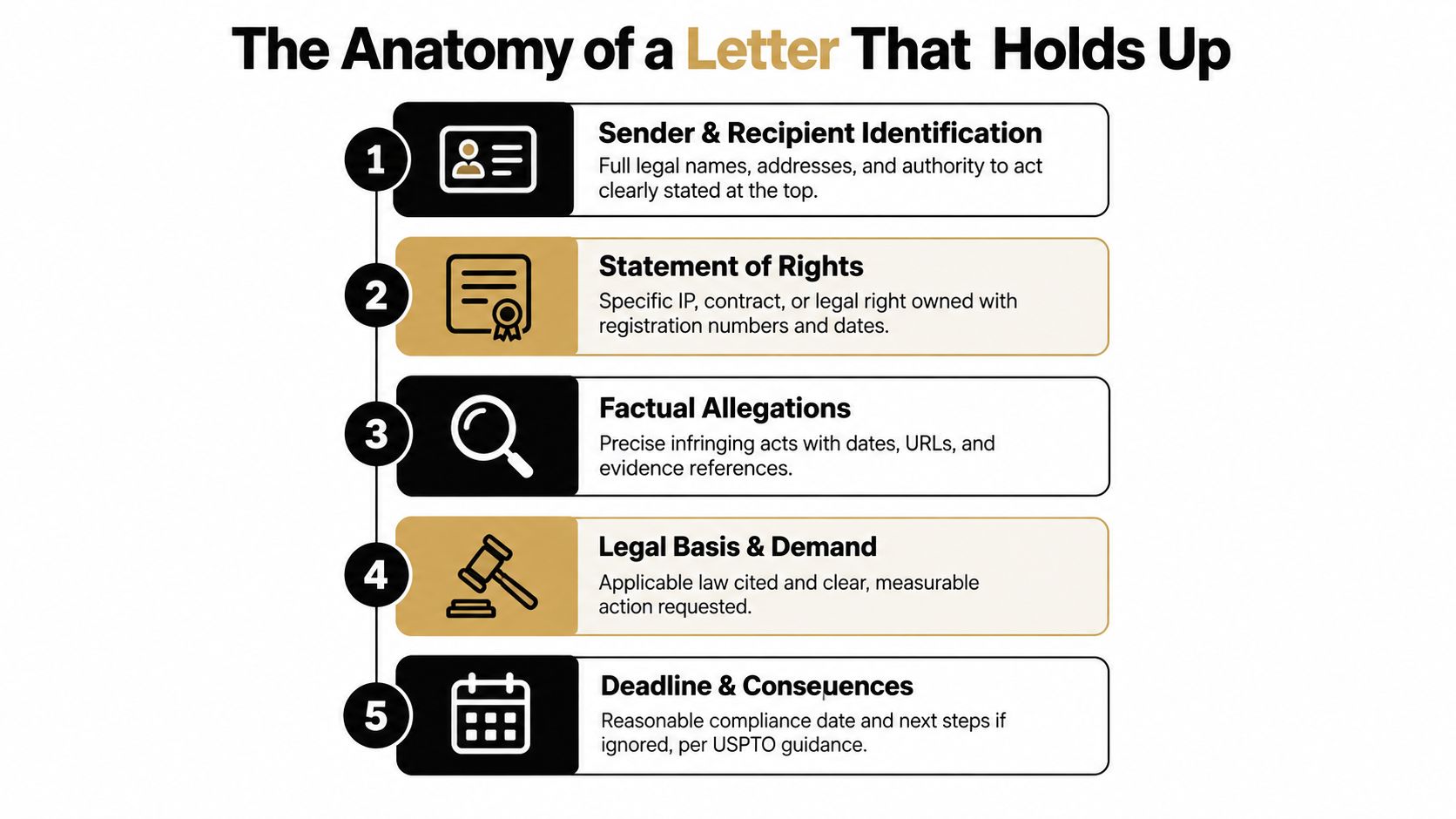
A defensible letter has five blocks. The structure is familiar because each block answers a question a recipient, platform, mediator, or judge may later ask: Who is making the demand? What happened? What right is involved? What must stop? What happens next?
The five essential blocks
Sender and recipient identification. Use full legal names, entity names, addresses, email addresses, and any known registered agent or authorized representative. If you’re writing for a business, state your authority to act. A letter sent to the wrong entity is a weak notice record.
Factual allegations. Describe who did what, when, where, and through which channel. Identify URLs, account handles, publication dates, product listings, messages, or attached exhibits. Avoid conclusions such as “you’re malicious” when a factual description will do more work.
Legal basis. Name the right or law you’re asserting with precision. Examples include Lanham Act § 32 for certain registered-trademark claims and copyright infringement under 17 U.S.C. § 501. Don’t cite a statute merely because it sounds forceful. Confirm that the provision fits the facts and jurisdiction.
Demand and deadline. State measurable actions, such as removing a specific URL, stopping use of a mark, deleting identified copies, correcting a specific statement, or ending contact through named channels. Tie the response to a concrete date and explain how the recipient should confirm compliance.
Consequences. State the next step without bluffing. “My client reserves all rights and may pursue available civil remedies” is safer than promising criminal prosecution, emergency relief, or damages you haven’t analyzed.
Practical rule: Write the letter as a demand, not a decree. The recipient should understand how to comply without being asked to guess what “stop” means.
The same disciplined logic appears in other demand documents, including this discussion of injury claim demand letter structure. Your digital footprint matters here because usernames, old accounts, exposed addresses, and copied material can connect the sender to the facts. Before attaching personal information, understand what personally identifiable information means and disclose only what the recipient needs to identify the claim.
Four Scenario Templates You Can Customize
A generic form is useful only for the stable parts, such as the date, parties, delivery method, response channel, and compliance window. The legal-basis block and demand block must change with the claim. Trademark confusion is not copyright copying, a false factual statement is not merely an unpleasant opinion, and harassment demands require careful attention to safety and platform procedures.
| Scenario | Legal Basis Block | Demand Block | Key Phrasing Shift | Counsel Review? |
|---|---|---|---|---|
| Trademark infringement | Identify the mark, ownership, registration if applicable, and alleged confusing use | Stop using the mark, remove identified listings and pages, and confirm cessation | Replace broad “brand theft” language with a likelihood-of-confusion explanation tied to the actual marketplace use | Recommended for valuable marks or contested ownership |
| Copyright infringement | Identify the work, ownership or authorization, and unauthorized copying or distribution | Remove specified copies, stop reproducing or distributing the work, and preserve relevant records | Use a per-infringement theory based on copying, not a trademark confusion theory | Recommended when fair use, licensing, or registration is disputed |
| Defamation | Identify the exact statement, publication, falsity, applicable fault theory, and resulting harm | Remove or correct the statement and stop repeating the identified assertion | Distinguish provably false facts from opinion, insult, parody, or protected commentary | Strongly recommended |
| Online harassment or privacy | Identify repeated unwanted contact, impersonation, publication of private material, or other actionable conduct | Stop contact through specified channels, remove identified material, and preserve evidence | Name the platform, account, conduct, and privacy harm. Don’t rely on “stop harassing me” alone | Strongly recommended where safety or intimate material is involved |
Trademark version
Re: Unauthorized use of [MARK]
“I own or represent the owner of [MARK], used in connection with [goods or services]. Your use of [mark, logo, or domain] on [URL, profile, listing, or advertisement] creates a likelihood of confusion regarding source, sponsorship, or affiliation. Cease use of the identified designation, remove it from the listed materials, and confirm compliance by [date].”
If the use is clearly unrelated or expressive, don’t pretend every mention creates infringement. Identify the commercial use that creates the actual problem.
Copyright version
Re: Unauthorized reproduction and distribution of [WORK]
“I own or am authorized to enforce rights in [work]. You reproduced, displayed, distributed, or made available the work at [URL or account] without permission. Remove the identified copies, stop further reproduction and distribution, preserve relevant records, and confirm completion by [date].”
A copyright demand should identify the work and the copies at issue. If the recipient raises a license, permission, fair use, or public-domain defense, counsel review becomes valuable before you escalate.
Defamation version
Re: False statements concerning [subject]
“On [date], you published the following statement through [platform or publication]: [exact statement]. The statement asserts a fact, is false because [brief factual correction], and has caused or is likely to cause [specific harm]. Remove the identified publication, issue a correction in the same channel where appropriate, stop repeating the statement, and confirm your actions by [date].”
Don’t label an opinion as defamation merely because it’s harsh. Don’t claim “libel” without preserving the exact wording and publication context. A lawyer should review this version before sending because defamation law varies and an overbroad accusation can create a counterclaim.
Harassment or privacy version
Re: Demand to stop unwanted contact and publication of private material
“You have contacted me through [platforms, accounts, or channels] and published or threatened to publish [specific material] at [URLs or account identifiers]. I demand that you stop contacting me through those channels, remove the identified material, stop republishing or threatening to republish it, and preserve relevant records. Confirm compliance by [date].”
For online conduct, name the originating platform precisely. The FTC reported that in 2025 nearly 30% of people who said they lost money to a scam said it started on social media, and reported romance-scam losses reached $304 million that year, according to its online dating fraud information. The platform and account details aren’t decorative. They help the recipient, platform, and later investigator identify the conduct.
For business administration, don’t confuse a legal notice with an agency filing. A document such as a Dubai trade license cancellation form serves a different administrative purpose and shouldn’t be substituted for a dispute demand.
Verifying Your Claim Before You Draft
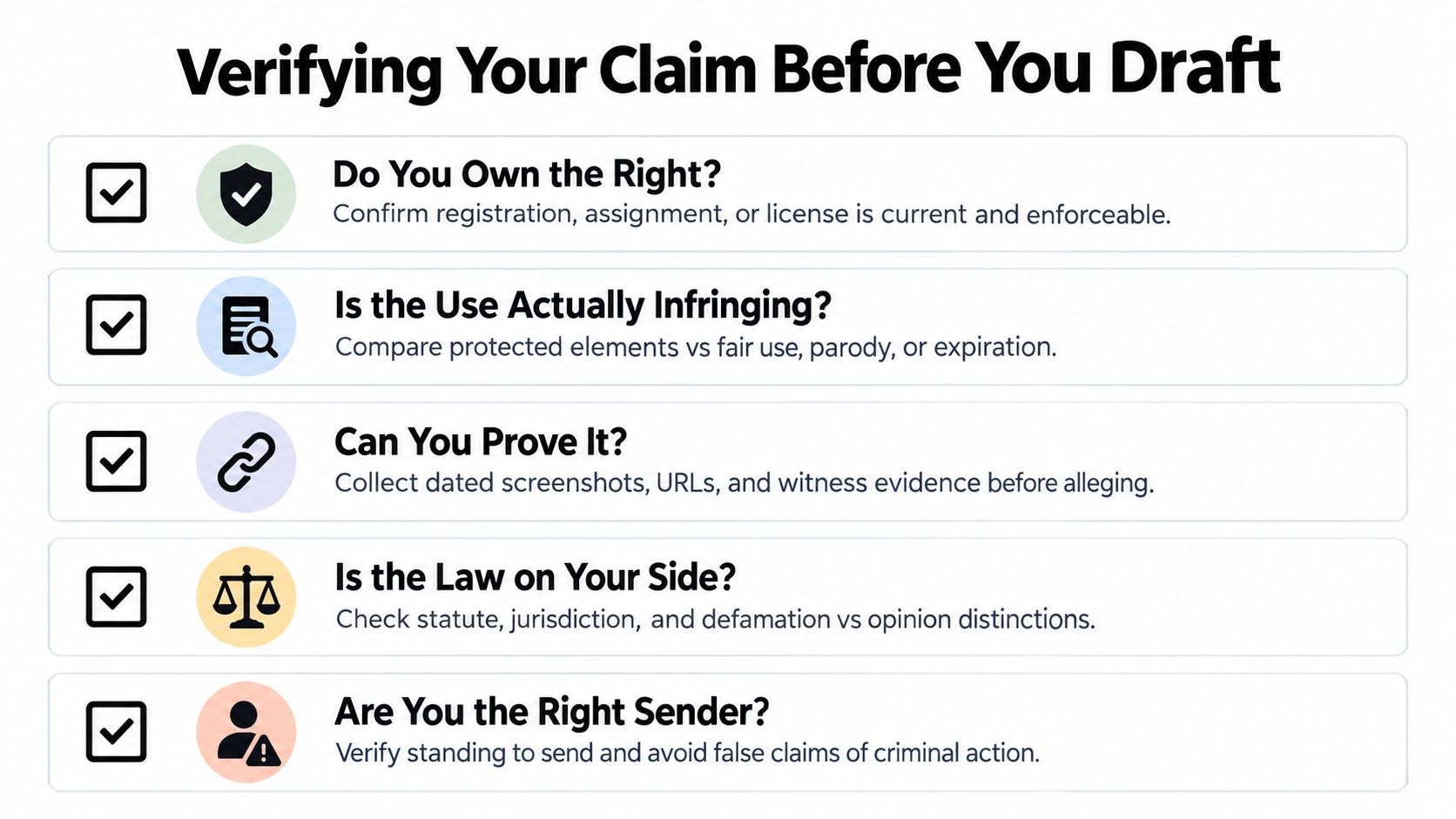
The first question a lawyer asks isn’t “How aggressive should this sound?” It’s “Do you own, hold, or reasonably assert the right described in the letter?” If the answer is unclear, drafting should pause.
Build an evidence file by claim type
- Trademark: Save the USPTO TSDR record, registration certificate if one exists, ownership or assignment documents, and dated examples of your use. Capture the allegedly confusing use exactly as a consumer sees it.
- Copyright: Preserve the original work, creation records, registration information or deposit materials where relevant, and copies of the allegedly unauthorized posting, reproduction, or distribution.
- Defamation: Save dated screenshots, page URLs, archived captures such as Wayback records, the exact statement, publication context, factual corrections, and a witness list if someone saw the statement or its effects.
- Harassment or privacy: Export messages without stripping timestamps, preserve account handles and profile URLs, keep call logs and platform reports, and store the original files separately from edited working copies.
The letter’s authority collapses if you cite exhibits you can’t produce. A screenshot with no date, a cropped message with no account identifier, or a copied URL that no longer resolves may still help you investigate, but it’s a weak foundation for a categorical accusation.
Before sending, decide whether a different route is faster. A platform report may address impersonation or harassment. A DMCA notice may fit an online copyright dispute. A short pre-letter message may resolve a misunderstanding when the recipient is identifiable and cooperative. For a broader audit of exposed accounts and public records, use a privacy-focused process for finding what data brokers have about you, then separate evidence relevant to the legal claim from information that merely feels invasive.
Delivering the Letter and Proving It
Delivery is part of the legal strategy, not an afterthought. Send the final letter as a fixed PDF, keep the editable draft and exhibits in your file, and use two channels when the dispute matters.
Certified mail with a return receipt creates a dated mailing and delivery trail. A process server can provide stronger personal-delivery documentation in a high-conflict matter, but it may escalate the relationship. Email is fast and useful as a parallel channel, especially when the conduct occurs online, yet email alone can create disputes about whether the account was monitored, the attachment was received, or the message reached the right person.
Confirm the recipient before sending
For a company, verify the exact legal entity, registered agent, principal place of business, relevant department, and known decision-maker. For an individual, confirm the last known address and the account or email connected to the conduct. Keep a note explaining how you verified the details.
Notarization isn’t required for every private demand, but it can help when you expect to file the letter or attach it to a later motion and want a more formal execution record. It doesn’t transform the letter into a court order.
Write the deadline as an event that can be measured:
“Please complete the actions listed above and provide written confirmation by 5:00 p.m. local time on [specific calendar date].”
Avoid “immediately,” “as soon as possible,” or “promptly.” Those phrases sound urgent but don’t define compliance. Preserve your research trail using ethical techniques described in this guide to using OSINT responsibly, and don’t access private accounts or bypass security controls.
What Comes After the Letter Is Sent
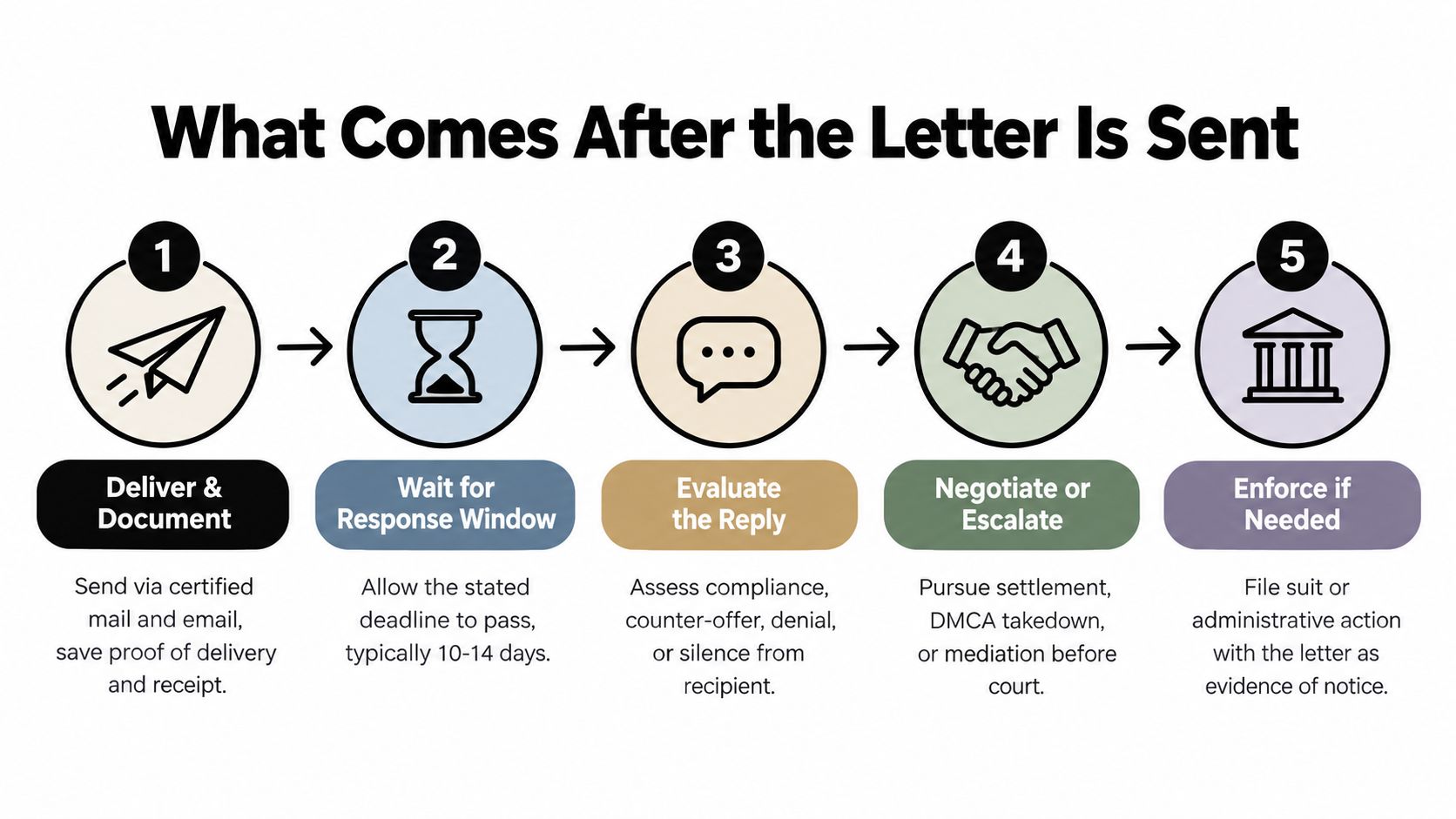
Sending the letter starts a documented escalation path. It doesn’t end the dispute and it doesn’t enforce itself. Save one complete proof file containing the final PDF, exhibits, sent email with headers, mailing receipt, tracking history, delivery confirmation, and every response.
Read the response carefully
Silence, partial compliance, and refusal mean different things.
Silence means you should verify delivery and monitor the deadline. Don’t send emotional follow-ups. If the deadline passes and the conduct continues, prepare the next remedy that fits the claim.
Partial compliance requires a precise inventory. Check each URL, profile, listing, message channel, or physical item named in the demand. Ask for written confirmation of the remaining steps instead of accepting a general promise.
A denial or counter-threat is the point where many senders make the problem worse. Don’t argue through a long email chain. Preserve the response, compare it against your evidence, and retain counsel when the recipient threatens a declaratory action, asserts a serious counterclaim, or disputes a technical legal issue.
Preserve the digital record
Web content changes. Save archived pages, original downloads, screenshots with visible timestamps and URLs, and metadata-preserving exports of messages or files. Hashes can help demonstrate that a saved file wasn’t altered after collection, but they don’t prove that the underlying content was truthful or lawfully obtained. Keep originals read-only where practical and document who collected each item and when.
Your own reputation strategy should continue independently. Update public business filings and domain registration information where appropriate, secure exposed accounts, report impersonation through the relevant platform, and prepare a short factual public statement only if silence would create greater harm. Don’t publish the entire dispute or identify private individuals unnecessarily.
If the conduct involves personal information, review the available personal information removal options while the legal process continues. Removal and enforcement are separate tracks. One reduces exposure; the other preserves your rights and creates pressure.
Common Drafting Mistakes and Quick Answers
Sloppy letters create exposure instead of putting the recipient on notice. These are the errors I see most often.
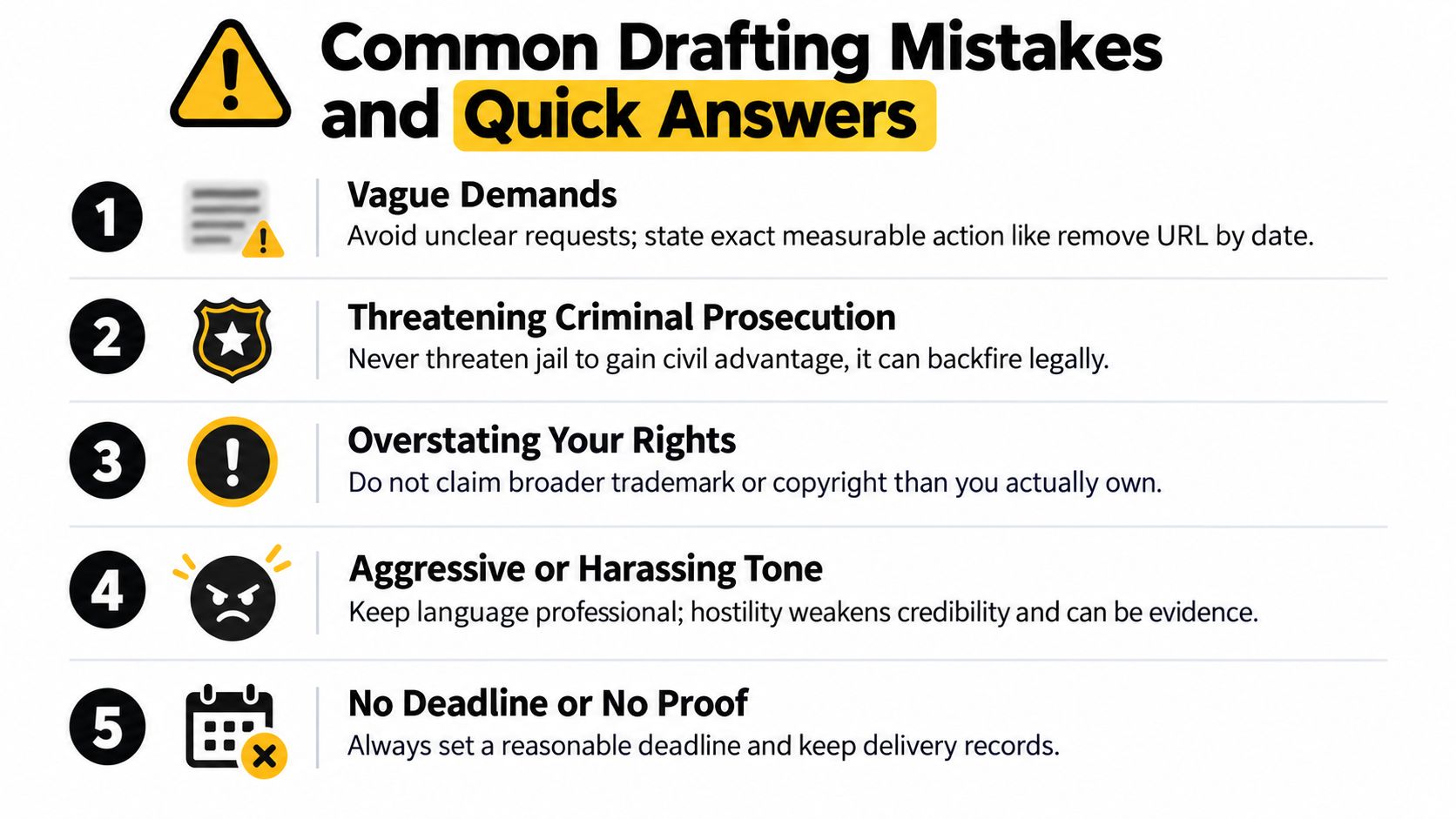
- Vague demands: Replace “stop harassing me” with “stop contacting me through [named accounts and channels] and remove [identified URLs] by [date].”
- Criminal threats: Don’t threaten jail to gain leverage in a civil dispute. Use “I reserve the right to pursue available civil and administrative remedies.”
- Overstated rights: Don’t claim ownership of every use of a name, image, or idea. Identify the right you hold and the conduct that allegedly violates it.
- Aggressive tone: Remove insults, accusations about motives, and theatrical promises. Use “The identified conduct appears to violate [right or law], and we demand the following corrective actions.”
- Missing deadline or proof: Set a calendar date, specify the confirmation method, and retain delivery records.
Quick answers
Is a letter overreach for a minor dispute? It can be. If the recipient is already cooperating or a simple conversation will solve the issue, a formal notice may unnecessarily harden positions. Use it when you need a reliable boundary and record.
How long should I wait before suing? There’s no universal deadline. The appropriate window depends on the claim, urgency, jurisdiction, evidence risk, and remedy. Trademark guidance commonly uses 10 to 30 days, but a safety emergency may require immediate formal protection instead of waiting.
Does email to a foreign recipient count? It may establish actual notice, but cross-border service, jurisdiction, privacy rules, and enforcement are separate questions. Use verified addresses and obtain advice in the relevant jurisdictions before treating email as sufficient formal service.
Can a cease and desist support a SLAPP counterclaim? It can become part of a retaliation or anti-SLAPP argument if it targets protected speech, contains unsupported accusations, or uses litigation threats to suppress lawful criticism. Defamation and privacy drafts deserve counsel review before delivery.
Digital Footprint Check can help you identify public accounts, exposed personal information, breach indicators, and reputation-related results that may support a documented online-harm review. Run your information through the Digital Footprint Check free checker, save the relevant findings, and use that evidence to decide whether you need a notice, platform report, removal request, or attorney review.