· Digital Footprint Check · Content Marketing · 16 min read
Competitive Intelligence Gathering: a Practical Osint Guide
Learn practical competitive intelligence gathering using ethical OSINT. This guide covers data sources, analysis, and tools to protect your business and career.

Your competitor changes pricing on Tuesday. Sales notices on Thursday. Marketing updates the website the following week. By then, buyers have already compared both offers, and your team is explaining a loss after the fact instead of preventing it.
That's why competitive intelligence gathering matters. Teams often don't lose because they lack talent. They lose because nobody built a disciplined way to watch the market, verify what changed, and get the right signal to the people making decisions.
Good intelligence work isn't corporate espionage. It's structured, legal research using public information and internal observations. It means noticing a pattern in job postings before a product launch. It means spotting a messaging shift on a competitor's homepage before your sales team starts hearing the same objection in calls. It means understanding what your own public footprint reveals, which matters just as much for a company as it does for an individual managing privacy, reputation, or identity exposure online.
Why Competitive Intelligence Gathering Matters Now
Monday morning, a prospect asks your sales rep why your product costs more than a competitor that now offers a lighter plan with faster onboarding. By lunch, product has heard rumors of a new feature release. By Friday, leadership is reacting to fragments instead of facts.
That is the substantial cost of weak competitive intelligence. The problem is rarely effort. Teams are busy doing their actual jobs, and competitor monitoring becomes a side task with no owner, no method, and no standard for verification. Small businesses feel this even more sharply because they do not have a dedicated CI team to absorb the work.
Late visibility creates avoidable mistakes. A rival changes packaging, shifts its message upmarket, or starts recruiting for roles tied to a new service line. If you catch that after pipeline slips or churn ticks up, your options narrow fast. Sales scripts get rewritten under pressure. Marketing responds to claims that have already spread. Leaders make budget and product decisions using last month's assumptions.
Good intelligence work gives smaller teams a fair shot. You do not need a Fortune 500 budget to monitor public signals and turn them into better decisions. You need a clear question, a disciplined process, and a hard line on ethics.
Ethical OSINT gives smaller teams an edge
Competitive intelligence gathering is structured research based on lawful, public, and willingly shared information. In practice, that means reviewing websites, pricing pages, job posts, regulatory filings, review platforms, press releases, conference talks, social posts, and your own frontline notes from sales and support. It does not mean pretexting, scraping behind access controls, misrepresenting identity, or collecting personal data with no business reason.
That distinction matters. I have seen small teams waste time chasing gray-area tactics that create legal and reputational risk, even though the useful signal was sitting in plain view. Public evidence is often enough to answer the question that matters, such as whether a competitor is moving into your segment, changing its sales motion, or struggling with delivery quality.
A local service company can learn a lot by tracking review themes, offer changes, and response times. A startup can spot direction changes through release notes, partner announcements, and hiring patterns. Independent consultants and job seekers use the same discipline to understand how firms position themselves and what their public footprint reveals. That is one reason to understand who really owns your data online while you study competitors. Your visibility and theirs are part of the same public information environment.
Public information is usually not the constraint. Discipline is.
What strong intelligence changes
Well-run intelligence work improves decisions before a problem shows up in the numbers. It helps a sales lead prepare for a pricing objection before reps hear it on every call. It helps a founder decide whether a competitor's hiring pattern signals a real expansion or just noise. It helps marketing separate a meaningful positioning shift from a one-off homepage test.
The benefit is not more information. The benefit is better timing and better judgment.
Useful intelligence answers specific business questions, such as:
- Sales: Why are deals stalling against one competitor in one segment?
- Product: Do new job postings and release notes point to a feature push that affects our roadmap?
- Marketing: Has a rival changed its audience, proof points, or pricing story in a way that will change buyer expectations?
- Leadership: Which competitor moves require action now, and which ones should be monitored without overreacting?
Competitive intelligence gathering supports decisions with verified external context. Done well, it keeps teams from confusing market noise with a signal that deserves a response.
Define Your Intelligence Mission and Scope
Most weak intelligence programs fail at the beginning. They start with a vague brief like “monitor competitors” and end with a messy pile of screenshots, links, and alerts nobody trusts or uses.
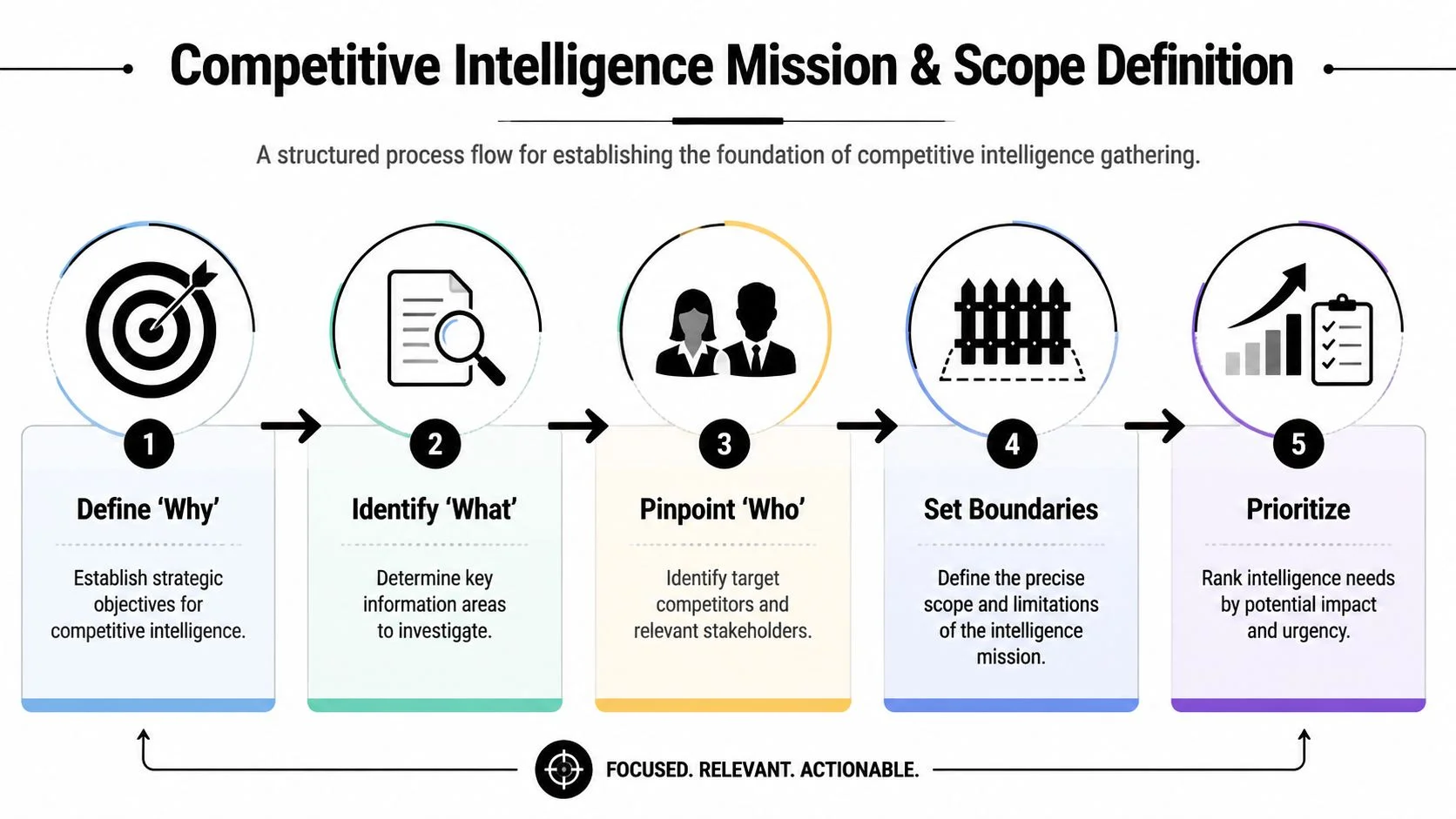
A stronger approach starts with one business question. Guidance on high-performing CI workflows recommends a five-step operating loop: set a specific business question, prioritize direct, indirect, and emerging competitors, gather from a mix of public and internal sources, analyze into decision-ready insights, then disseminate and act. That same guidance stresses starting with objectives instead of trying to monitor everything, because unfocused collection wastes effort and lowers signal quality, as outlined by Stravito's competitive intelligence workflow guide.
Use the 5 Ws before you collect anything
Before opening a browser tab, write down five things.
- Who: Which competitors matter right now? Split them into direct, indirect, and emerging players.
- What: What exactly are you trying to learn? Pricing changes, launch timing, channel strategy, hiring direction, reputation issues, partner moves.
- When: What decision deadline matters? Next sales quarter, upcoming renewal cycle, next roadmap review.
- Where: Which environments are most likely to produce evidence? Websites, filings, reviews, social channels, job boards, app stores, forums, CRM notes.
- Why: Which decision will change if the answer is different from your assumption?
That last question filters out most noise.
Scope beats volume
A new analyst often thinks more collection means better intelligence. It usually means more clutter. If your question is whether a rival is moving upmarket, don't spend hours tracking every social post they publish. Focus on high-signal indicators: pricing page edits, enterprise case studies, hiring for account executives, security documentation, procurement language, and implementation partners.
Use a simple scope table to stay honest.
| Mission element | Good scope | Bad scope |
|---|---|---|
| Competitors | Three named rivals relevant to current deals | “The entire market” |
| Time frame | Activity from the last quarter plus current changes | “Everything we can find” |
| Topics | Pricing, packaging, messaging, hiring | Every department and channel |
| Output | One brief for sales leadership | A giant research dump |
Prioritize by business impact
Not every competitor deserves equal attention. Put effort where a missed signal would hurt.
One practical ranking model:
- Direct competitors who appear in active deals or buyer comparisons.
- Indirect competitors that solve the same problem differently.
- Emerging threats that aren't taking revenue yet but are changing buyer expectations.
For people learning OSINT methods, this is the same discipline used in digital investigations. A search only helps when the question is clear. If you need a primer on that mindset, what OSINT is used for in practical research is a useful starting point.
Practical rule: If you can't explain which decision the research supports, the mission isn't ready.
Your Ethical OSINT Data Sources
Most of the useful material in competitive intelligence gathering is hiding in plain sight. The challenge isn't finding data. It's knowing which public sources reveal strategy, which only create noise, and where the ethical line sits.
A missed legal or ethical step can damage more than the project. It can create compliance problems, expose your company to unnecessary risk, and poison trust in the intelligence function itself.
Mainstream guidance increasingly notes that competitive intelligence is a legal, ethical practice grounded in public sources, but practical guardrails around source provenance, consent, and antitrust or IP risk are often underexplained, especially in the age of AI-assisted research and public-web scraping, as discussed in ABI Research's article on competitive intelligence gathering.
High-signal sources that people underrate
Some sources are obvious. Others are consistently overlooked.
Corporate and regulatory material
Public filings, company press releases, government databases, and patent records can reveal corporate structure, stated priorities, partnerships, and product direction. For larger firms, these are often more reliable than marketing copy because the company has to stand behind the statements.
Job postings are especially useful. They can suggest expansion into a region, a shift toward enterprise sales, investment in a new product line, or changes in internal tooling.
Customer-facing surfaces
A competitor's website, pricing pages, help center, demo signup flow, app store listings, changelogs, and webinar pages show how they want the market to perceive them. Review platforms and public support threads show how users experience the product.
That combination is powerful. Messaging tells you the promise. Reviews tell you the gap.
Social and community channels
Social media posts, executive profiles, conference appearances, YouTube demos, Reddit threads, niche forums, and public communities often surface early signals before official launches. These channels are noisy, so don't treat them as final proof. Treat them as leads that need verification.
If your team also researches public online presence more broadly, social media investigation methods can help organize that work without turning every platform into a rabbit hole.
What to collect and what to avoid
Use this distinction as your baseline.
| Ethical source | Why it's fair game | Avoid |
|---|---|---|
| Public websites and documentation | Intentionally published | Bypassing access controls |
| Public filings and databases | Official public records | Using leaked or stolen records |
| Public reviews and forum posts | Open user commentary | Pretending to be someone else to gain access |
| Conference observations | Public business activity | Recording or distributing restricted material |
| Internal sales notes from lawful interactions | Firsthand business context | Collecting private personal data unrelated to the business question |
Guardrails that keep your research clean
- Respect access boundaries: If content requires login, invitation, payment, or private membership, pause and assess whether access is appropriate and authorized.
- Record provenance: Save where you found each item, when you found it, and whether it was public at the time.
- Avoid deception: Don't impersonate buyers, applicants, journalists, or customers to extract information.
- Minimize personal data: If the business question can be answered without collecting personal information, leave it out.
- Check terms and internal policy: Especially before using scraping or AI ingestion workflows at scale.
A disciplined analyst doesn't just ask, “Can I collect this?” The better question is, “Can I defend this method in writing if legal, leadership, or the subject asks how the information was obtained?”
A Repeatable Data Collection and Verification Workflow
Ad hoc searching creates brittle intelligence. One analyst remembers where to look. Another doesn't. One person saves screenshots. Another drops links into chat and loses the trail. A repeatable workflow fixes that.
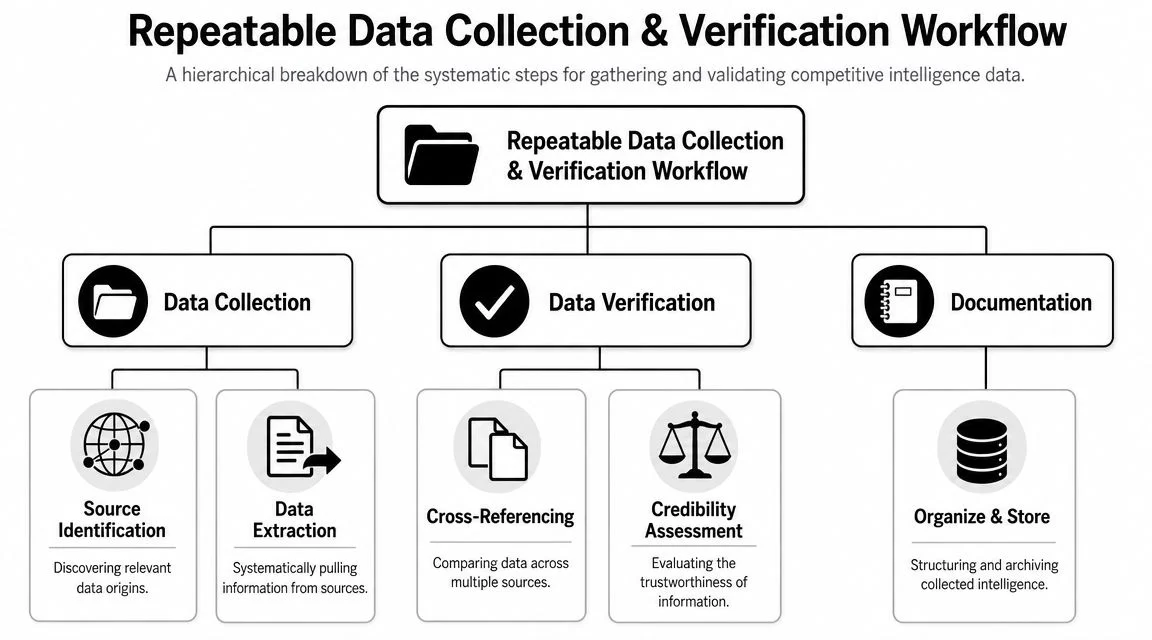
Modern guidance recommends tracking metrics such as win rate shifts, pricing patterns, and product launches, with monthly checks for top competitors. It also describes three collection channels, internal path, competitor approach, and social environment approach, plus four stages, collection, analysis, dissemination, and action, according to Klue's guidance on gathering competitive intelligence.
Build a collection routine you can hand to someone else
A usable workflow should survive turnover, vacations, and changing priorities. If only one person knows how the process works, you don't have a workflow. You have a habit.
A practical routine looks like this:
-
Start with named targets
Keep a current list of competitors, executives, product names, category terms, and partner brands. -
Map source types to each target
Website pages, pricing pages, changelogs, job boards, review platforms, app stores, press rooms, social profiles, and internal sales notes. -
Schedule collection by signal value
Watch high-volatility items more often than slow-moving ones. Pricing and homepage messaging may change quickly. Corporate structure usually won't. -
Capture evidence consistently
Save the page title, date observed, URL, screenshot, and short note on why it matters. -
Tag by topic
Use tags like pricing, product, hiring, messaging, partnerships, complaints, and security.
Verification matters more than speed
The internet produces false certainty. A single screenshot can be outdated. A forum post can be wrong. A social comment can be sarcasm taken at face value. Verification is where analysts earn credibility.
Use a simple confidence model.
- High confidence: Confirmed by an official public source or multiple independent sources.
- Medium confidence: Plausible and supported by one strong source, but still awaiting confirmation.
- Low confidence: Interesting signal only. Don't circulate as fact.
Treat unverified findings as hypotheses, not conclusions.
A rumored launch is a good example. If someone mentions a new feature on social media, don't send an alert yet. Check the product page, help center, app store release notes, executive posts, customer emails, and user discussions. If multiple sources align, the rumor becomes an actionable signal.
Organize for retrieval, not just storage
Teams frequently underperform in this area. They collect evidence but can't retrieve it when a decision-maker asks, “When did this shift begin?”
Use a simple log structure:
| Date found | Competitor | Signal | Source type | Confidence | Business note |
|---|---|---|---|---|---|
| Observed date | Company name | Pricing edit, new role, launch clue | Website, review, job board, CRM | High, medium, low | Why it matters |
If you're building this process from scratch, beginner-friendly OSINT tools for practical monitoring can help with search, alerts, archiving, and organization. The tool matters less than consistency. A clean spreadsheet and disciplined archive beat a fancy platform used badly.
Analyzing Data and Reporting Actionable Insights
Raw collection doesn't help anyone until it answers a business question. A folder full of screenshots is not intelligence. A short brief that tells sales how to respond in active deals is.
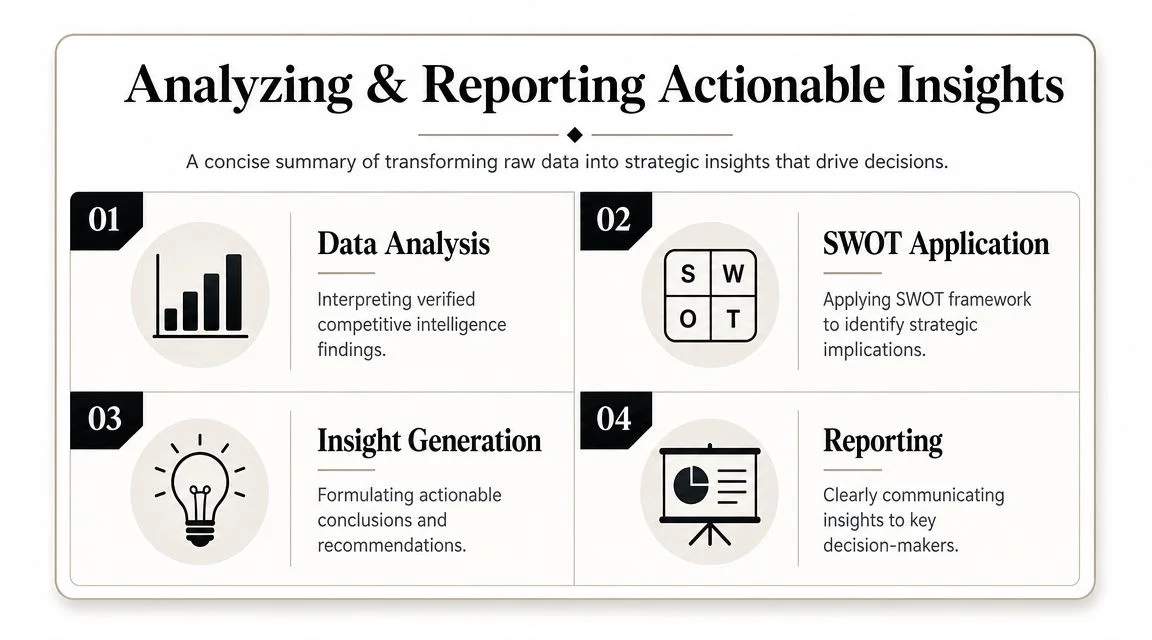
One of the most common failure modes in CI is weak stakeholder adoption. Practitioners recommend tying insights to concrete decision cycles and tracking win/loss rates against competitors so teams can see where intelligence changes outcomes. Info-Tech explicitly highlights win/loss analysis as a core CI use case in its competitive intelligence research.
Turn observations into a position
Analysis starts by asking one hard question: so what?
A pricing page change might mean nothing. Or it might indicate a packaging shift aimed directly at your core segment. A cluster of hiring posts might be routine backfill. Or it might signal expansion into enterprise accounts. The job of the analyst is to compare evidence, assess likelihood, and explain the practical implication.
A lightweight SWOT can help.
Simple competitor SWOT from OSINT
| Area | Example input from public data |
|---|---|
| Strengths | Strong review themes, clear enterprise messaging, polished onboarding content |
| Weaknesses | Repeated complaints, unclear pricing, slow support perception |
| Opportunities | Underserved segment, new geography, weak competitor coverage |
| Threats | New entrant momentum, feature parity, channel conflict |
Don't overcomplicate this. The point isn't to fill boxes. The point is to force interpretation.
Write briefs that busy people will actually read
A useful intelligence brief is short, decision-linked, and explicit about confidence. Skip the theatrical language. Skip long market overviews unless someone requested them.
A practical format:
- Question: What were we trying to answer?
- Bottom line: One paragraph with the main conclusion.
- Evidence: The strongest verified findings only.
- Implication: Why it matters for sales, product, marketing, or leadership.
- Recommended action: What should change now?
- Confidence: High, medium, or low.
Field note: If a stakeholder can't tell what action to take after reading your brief, the analysis isn't finished.
Tie the work to decisions, not vanity output
Many CI programs die because they optimize for volume. More alerts. More battlecards. More updates. None of that proves usefulness.
A better test is whether the work changes something concrete:
- Sales enablement: Objection handling, competitor battlecards, renewal strategy
- Product planning: Feature prioritization, packaging decisions, roadmap timing
- Marketing: Positioning changes, landing page updates, campaign angles
- Leadership: Market entry, partner strategy, risk assessment
Win/loss analysis matters here because it closes the loop. If your team keeps losing to the same competitor for the same reason, your intelligence work should surface that pattern early and help shape the response.
Automate and Monitor with Digital Footprint Check
A founder checks a competitor's pricing page on Monday. By Thursday, the page is gone, the offer has changed, and sales is still using last week's talking points. That is the cost of relying on memory and occasional manual checks.
Manual research still matters, but ongoing monitoring is what keeps a small team from getting surprised. Public signals change constantly. Websites update. New profiles appear. Reviews pile up. Executives delete posts. If nobody is tracking those changes, the team reacts late and usually with less context than it needs.
Large companies have formal CI programs, but the core advantage is simpler than people assume. They watch public information consistently. Small businesses and solo operators can do the same thing with a narrower scope, a clear process, and a firm ethical line. Stay with public, lawfully accessible information. Do not scrape gated systems, impersonate anyone, or cross into personal surveillance.
What automation should actually do
Good monitoring reduces routine checking and preserves change history. It should help you:
- Track changes in public presence: New accounts, revised bios, updated team pages, shifts in messaging, and changes to pricing or packaging pages.
- Watch multiple public surfaces: Social profiles, company sites, review platforms, public records, and other openly available signals.
- Capture timing: Knowing what changed is useful. Knowing when it changed is often what makes the pattern clear.
- Create alerts worth reviewing: Fewer, better alerts beat a noisy feed that people start ignoring.
For smaller teams, one practical use case is running the same OSINT discipline on your own organization. Audit your public footprint, your executives' visible profiles, your brand mentions, and the traces tied to a business email or username. That work supports competitive awareness, reputation management, and privacy hygiene at the same time.
One option is Digital Footprint Check's monitoring tools for digital footprint safety. Used carefully, tools like this help surface public online presence across many sources so you can review exposure, spot impersonation risks, and monitor changes without revisiting the same pages by hand.
Combine monitoring with human review
An alert is not an insight.
Someone still has to decide whether a change matters to the business question. A new profile may be irrelevant. A spike in reviews may come from a short-term campaign. A pricing page edit might signal a packaging shift, or it might just be cleaner copy. The analyst's job is to check the context, compare it with prior observations, and decide whether the change affects sales, product, hiring, partnerships, or risk.
This is also where ethics matter in practice. Monitoring a competitor's public website, app store listing, press release, or executive LinkedIn post is fair game. Trying to gain access to restricted communities, posing as a customer to obtain protected material, or collecting personal details that have no business relevance is not. Good CI answers business questions without creating legal or reputational problems.
Teams that already review support conversations can connect that stream to competitive monitoring. A platform for AI customer support can help surface repeated competitor mentions, comparison questions, and objection patterns that deserve a place in the intelligence workflow.
Why this matters beyond big companies
You do not need an enterprise budget to build a useful monitoring habit. A local service business can track review shifts and competitor offer changes. A consultant can watch category language and new entrants. A founder can monitor public traces tied to their own brand before a prospect or investor does.
The method stays the same. Set a narrow watchlist. Monitor public sources. Review changes on a schedule. Save evidence. Act only when the signal connects to a real decision. That is how ethical OSINT becomes practical competitive intelligence, especially for people working without a large research team.