
· Digital Footprint Check · Content Marketing · 16 min read
Your Guide to Using a Username Finder for Digital Privacy
Discover how a username finder helps protect your online identity. Learn to manage your digital footprint, improve your privacy, and ensure online safety.
A username finder is a specialized search engine, meticulously designed for one crucial task: scanning hundreds of websites to see where a specific username appears. Think of it as a master key for your digital life, capable of checking social media profiles, gaming accounts, and old forum memberships to reveal every public account unlocked by a single username. This tool is fundamental for digital privacy, online identity protection, and managing your online reputation.
What Is a Username Finder and How Does It Work?
Imagine you’re preparing for a major job interview. You've perfected your resume and rehearsed your answers, but what about your online identity? A potential employer's quick search could unearth an old, unprofessional gaming forum profile from a decade ago, linked to the very same username you use on professional networks today. This scenario is more common than you'd think and highlights a critical reality: our online lives are far more interconnected and visible than we often realize, with significant real-world impacts on job prospects.
This is precisely where a username finder becomes an invaluable OSINT (Open Source Intelligence) tool for managing your digital privacy and online identity. At its core, it’s a powerful instrument designed to map out every public instance of a username across a vast network of websites, giving you control over your reputation.
The Power of Open Source Intelligence
These tools don't engage in illicit activities like hacking private accounts. They operate using a method called Open Source Intelligence (OSINT), which is the practice of gathering and analyzing information that is already publicly available.
They systematically check hundreds, sometimes thousands, of websites, including:
- Social Media Networks like Instagram, X (formerly Twitter), and Facebook.
- Gaming Platforms such as Steam, Xbox, and PlayStation Network, where account security is paramount.
- Professional Sites like LinkedIn and GitHub.
- Forums and Communities like Reddit and countless niche discussion boards.
The process is straightforward but powerful. When you enter a username, the tool sends automated queries to its extensive list of websites. It then compiles a report showing you every public profile tied to that name. This gives you a clear picture of your complete what is a digital footprint—the trail of data you've created online over the years. This process is crucial for preventing identity theft and managing your reputation.
By using OSINT, a username finder connects the dots between what seem like separate online identities, creating a single, cohesive map of a person's public digital life.
Many investigative tools that rely on public data are available online. For instance, some services offer a free email finder that helps users discover email addresses by searching public records, operating on similar OSINT principles.
Understanding how these tools work is the first step toward reclaiming control over your online identity. It helps you ensure that old, forgotten profiles don't surface unexpectedly and sabotage your personal or professional future.
How Username Finders Map Your Digital Footprint
The true power of a username finder lies in its ability to connect the dots between your seemingly separate online lives, revealing a surprisingly detailed map of your digital activity. This entire process is effective because of one simple, common habit: username reuse.
Think of your favorite username. It’s like a digital key you use to open doors all over the internet. A username finder acts as a master locksmith, methodically trying that one key on hundreds of different locks—social media sites, gaming platforms, forums, and blogs—to see where it fits.
When you input a username into one of these tools, it’s not just performing a simple Google search. Instead, it’s running that name against a massive, curated database of websites, checking for a profile match. This automated process scans hundreds of sites in seconds, accomplishing a task that would take a human hours, if not days, to complete manually.
The Breadcrumb Trail of Username Reuse
This technique is so effective because we are creatures of habit. Using the same handle everywhere creates a consistent digital breadcrumb trail, linking your professional persona on LinkedIn directly to your gaming identity on Steam and even your anonymous musings on Reddit. This is a critical vulnerability for gaming account security and personal privacy.
And it’s more common than you might think. Statistics show that 30–40% of social media users have identical or very similar usernames across at least two major platforms. One analysis of 250,000 public profiles found an exact cross-platform username match rate of 32% and a “fuzzy” match rate (with only minor variations) of nearly 45%.
This means that almost half of all users create a persistent, easily traceable link across different services, making their digital footprint an open book for anyone from potential employers to malicious actors looking to commit identity theft.
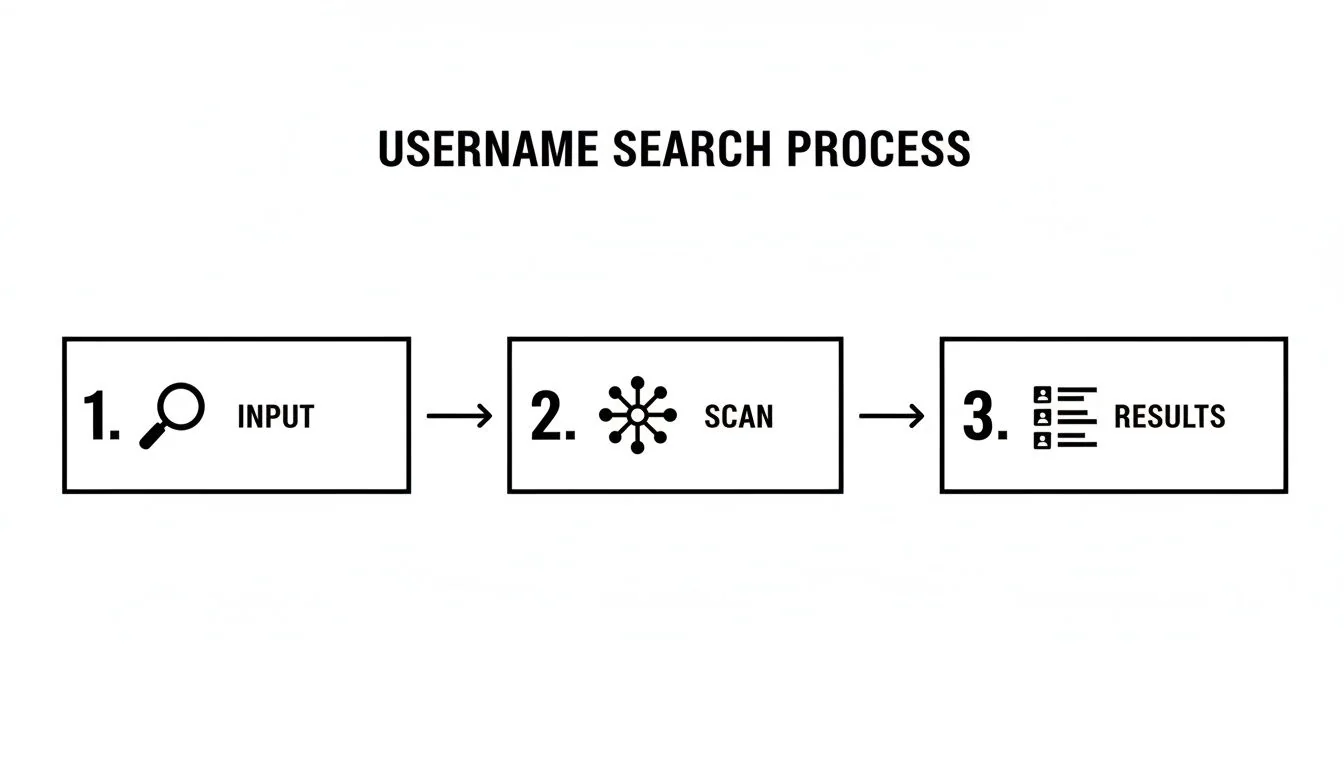
The flowchart below breaks down how this simple process works from start to finish.
This three-step flow shows just how efficiently a username finder can turn a single piece of information into a comprehensive list of your online profiles.
From Data Points to a Full Profile
Each profile a username finder uncovers is another piece of your digital puzzle. An old forum post might reveal personal interests from a decade ago. A gaming profile could highlight your hobbies and the communities you're part of. A professional network, of course, details your entire career history.
When you aggregate these scattered data points, they paint a complete picture of who you are. To better understand how to locate these profiles yourself, check out our guide on how to find a person on social media using these very techniques.
For anyone looking to reduce their online exposure and protect against cybersecurity threats, it's worth exploring valuable strategies to erase your digital footprint and start reclaiming your privacy. Once you understand how these OSINT tools map your identity across the web, you can begin to take back control of what others can see.
4 Practical Ways You’ll Actually Use a Username Finder
Understanding the theory behind a username finder is one thing, but how does this technology benefit you in the real world? This isn't just an abstract tool for cybersecurity experts; it's a practical resource for everyday life, from securing your next job to ensuring your family's online safety. It’s about converting scattered data into actionable insights that protect your identity and reputation.
Let’s explore a few real-world examples where a quick username search can prevent major headaches.
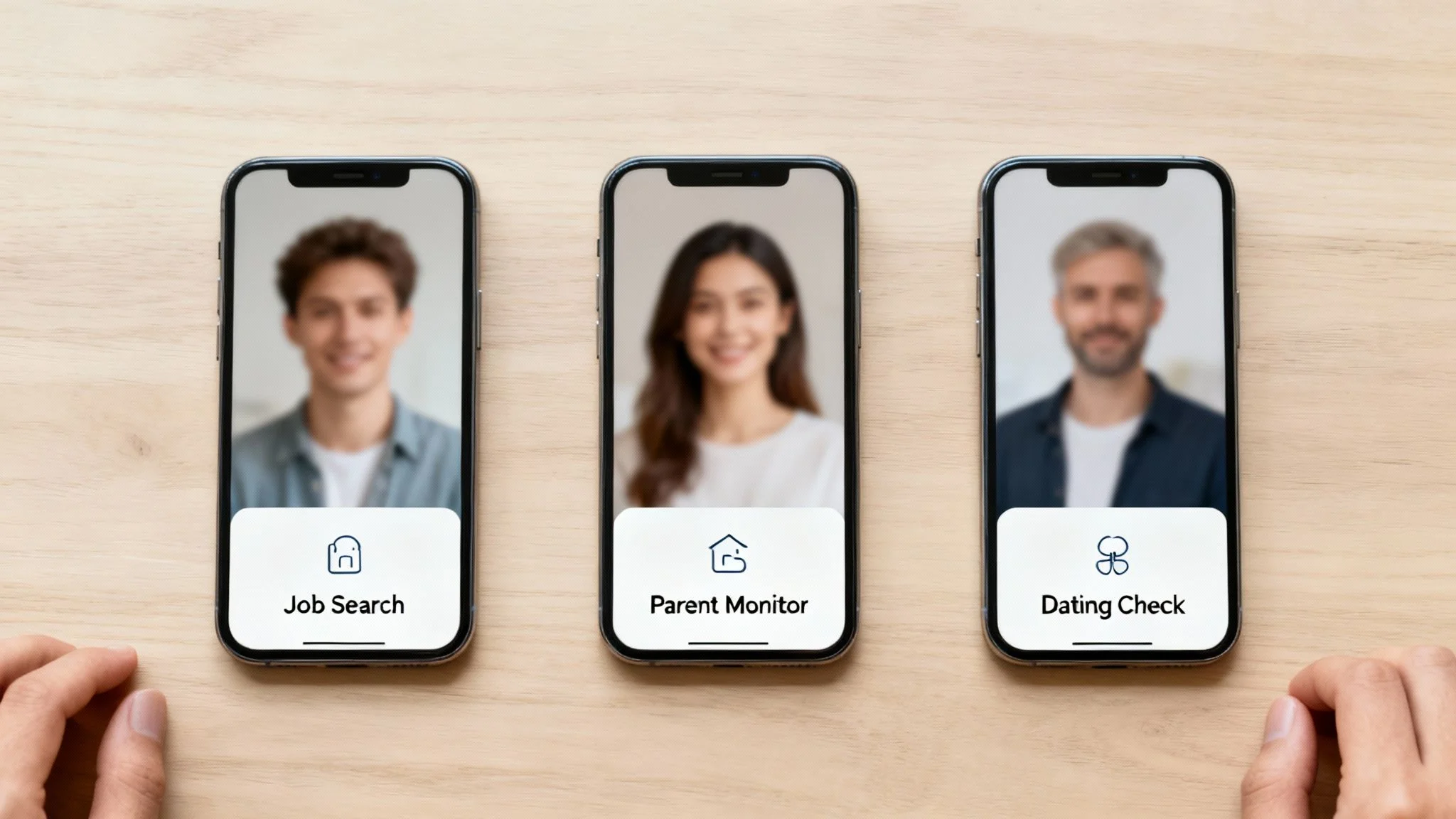
Proactively Manage Your Professional Reputation
Consider your online presence your second resume, because hiring managers certainly do. An old forum account from 15 years ago with questionable opinions or a gaming handle you thought was hilarious as a teenager can cost you a job opportunity. A 2020 survey revealed that 70% of employers use social media to screen candidates during the hiring process.
A username finder allows you to conduct a pre-emptive audit on yourself before an employer does. By searching for your common handles, you can discover and scrub those forgotten accounts that no longer reflect who you are. This simple step in reputation management ensures your digital self aligns with your professional self.
Safeguard Your Children’s Online Safety
For parents, the internet can feel like a dangerous, unknown territory. Children are constantly creating profiles on new apps and gaming platforms, often unaware of how much personal information they're sharing publicly. This exposure is a significant concern for online identity protection.
Using a username finder with your child’s known handles helps you see what the rest of the world sees. This isn't about spying—it's about personal safety. You can identify public accounts you didn't know existed, review their privacy settings, and initiate important conversations about responsible online behavior. It's a crucial OSINT tool for protecting them from cyberbullying, online predators, and potential identity theft.
By uncovering all public accounts associated with a child's username, parents can gain a clearer picture of their online exposure and take proactive steps to ensure their digital safety.
Verify Identities in Online Dating for Enhanced Safety
The world of online dating is built on trust, but it’s also a breeding ground for deception. Catfishing, where someone creates a fake persona, is a real danger that can lead to emotional distress and financial scams. According to the FTC, romance scams resulted in a staggering $1.3 billion in losses in 2022. A username finder is an essential first line of defense for online dating safety.
If a match seems too good to be true, run their username through a search for dating app verification. Do they have profiles on other sites under different names? Do the details they’ve shared conflict with what you find online? These inconsistencies are major red flags and can help in catfishing detection.
Username Finder Use Cases and Key Benefits
This comparison table outlines common scenarios where a username finder is beneficial, the primary goal for each, and the specific positive outcome for your digital privacy and safety.
| Use Case | Primary Goal | Potential Benefit & Real-World Impact |
|---|---|---|
| Job Hunting | Reputation Management | Find and remove old, unprofessional accounts to improve job prospects and prevent negative employer impressions. |
| Parental Monitoring | Child Safety & Identity Protection | Discover unknown public profiles to secure a child's online activity, prevent cyberbullying, and protect them from predators. |
| Online Dating | Identity Verification & Scam Prevention | Spot red flags for catfishing and romance scams by checking for consistent profiles across platforms, ensuring personal safety. |
| Personal Privacy Audit | Digital Footprint Control & Identity Theft Prevention | Identify and delete forgotten accounts that may expose personal information, reducing the risk of data breaches and identity theft. |
As you can see, a username finder is much more than a simple search tool; it's a practical instrument for navigating modern digital life safely and securely.
If you're curious what a search might uncover about your own handles, our guide on how to run a free username search will walk you through the process. It’s the first step toward taking back control of your online identity.
What’s Under the Hood of a Username Finder?
Think of a modern username finder less like a simple search engine and more like a high-speed reconnaissance drone, systematically scanning hundreds of digital territories in mere seconds. This power doesn't come from hacking or accessing private data. It's all about sophisticated technology built to process immense amounts of public information with incredible speed and precision.
These tools are built on three core components working together. First is a massive, constantly updated database of websites—a map of the internet's busiest cities and quietest backroads, from major social networks to niche forums. Second, they use a combination of targeted web scraping and API (Application Programming Interface) integration to ask each of those sites, "Is this username here?" Finally, powerful algorithms kick in to sort through the raw results, filtering out all the noise to give you a clean, useful report.
The Automated OSINT Engine
What we're really talking about here is a form of automated Open Source Intelligence (OSINT). While you could manually type a username into a dozen search bars, a dedicated finder automates that exact process across hundreds of platforms at once. It's a fundamental technique, and you can learn more about the broader field in our guide to OSINT tools for beginners.
This automation is what makes a real difference. The sheer scale is hard to grasp. Industry trackers estimate that between 0.5% and 1.2% of all daily search queries are people looking up usernames. When you consider that Google alone handles over 9 billion searches a day, you’re looking at a global volume of roughly 45–110 million username-related searches every day. You can dig into the numbers yourself in recent statistical reports.
This technology is designed to navigate the modern web responsibly, respecting platform rules and API limits while still delivering comprehensive results. It highlights the gap between a casual search and a structured digital investigation.
Once you see the complex engineering at play, it's clear why a specialized username finder delivers insights that are nearly impossible to gather on your own. It’s technology that empowers you to see your digital footprint not as a collection of scattered accounts, but as an interconnected network you can finally begin to manage for better cybersecurity and online identity protection.
Choosing a Safe and Effective Username Finder
With so many username finders out there, picking the right one can feel like a shot in the dark. But not all of these tools are created equal. Some are powerful allies for managing your digital life, while others are ineffective, outdated, or even downright dangerous to your privacy.
Making the right choice is crucial. You need accurate results without exposing your own data in the process.
The best way to approach this is to think like a cybersecurity expert. A trustworthy service will be upfront about how it works and will always put your digital privacy first. While free tools might seem tempting, they often have a hidden cost—they might sell your data, bombard you with ads, or give you incomplete results that leave you with a false sense of security.
Key Criteria for Evaluating a Tool
When you’re comparing different services, a few non-negotiable features separate the professional-grade OSINT tools from the questionable ones.
Your evaluation checklist should include these three things:
- Comprehensiveness: How many websites and platforms does it actually check? A good tool scans hundreds of sites, from the obvious social media networks to gaming platforms, forums, and professional sites. The wider the net, the better.
- Accuracy and Speed: The tool should deliver up-to-date, relevant results in a reasonable amount of time. Outdated information is useless, so you need a service that’s constantly updating its search capabilities.
- Privacy and Security: This is the big one. The service must have a clear, easy-to-understand privacy policy. It should never ask for information it doesn't need to perform a simple public search.
The highest standard for any OSINT tool is its commitment to user privacy. A reputable service will never require you to hand over sensitive data to perform a search on publicly available information.
Spotting Red Flags and Making a Safe Choice
You have to vet these tools with a critical eye. Be wary of any service that asks for your passwords, wants you to link your accounts, or demands excessive personal details just to run a search. These are massive red flags for your cybersecurity.
Similarly, if a tool has a vague or nonexistent privacy policy, that’s your cue to leave. Legitimate services are transparent about how they handle data. You can find more details on how to evaluate different services in our overview of trusted internet privacy tools.
Ultimately, your safest bet is to invest in a professional service that was built with security in mind from the ground up. These platforms are designed to provide comprehensive results while rigorously protecting your privacy, giving you a secure environment to explore your digital footprint without creating new risks.
Now that you know what to look for in a safe and effective username finder, you’re ready to take the next step. Confidently check your own digital footprint with a tool you can trust. Use our free, private checker at www.digitalfootprintcheck.com/free-checker to see where your username appears online, securely and without compromise.
Why Your Username Is a Valuable Digital Asset
Think of your username as more than a login—it’s a piece of digital real estate. In many ways, it’s the brand name for your entire online identity, whether that’s personal or professional. A unique, memorable username has real value, especially when the best ones get snapped up within minutes of a new platform launching.

This scarcity has fueled a booming secondary market. The practice of username squatting—where people grab desirable names on new platforms just to sell them later—is common. Short, catchy, or common names can fetch serious money, cementing their status as valuable digital property. It's why your go-to username is so often taken, even on a service that just launched yesterday. This has serious implications for gaming account security and reputation management.
The Economics of Digital Scarcity
The speed at which good usernames vanish is mind-boggling. On major new social apps, analyses show that within the first 72 hours of hitting 100,000 daily users, over 60% of memorable five-character combinations are gone. A year later, that number jumps to over 85% as early adopters and automated bots hoard the best handles. You can dig deeper into how people behave online by checking out these key search and platform statistics.
This frantic land grab highlights a critical point.
Your username is a persistent identifier that ties your digital life together. Protecting it is just as important as securing a password because it represents your identity across the web.
When you see your username as a valuable and scarce asset, you have a powerful reason to manage it carefully. Keeping it consistent across platforms helps you build a recognizable presence. Securing it prevents others from impersonating you or damaging your reputation, which is a cornerstone of online identity protection and preventing identity theft. A good username finder helps you audit where your digital "property" is located, making sure you stay in control of this crucial piece of your identity.
Got Questions About Username Finders? We Have Answers.
When you start digging into the world of OSINT tools like username finders, a few key questions always pop up. It's natural to wonder about the legal lines, your own digital privacy, and what to do with what you uncover. Let's clear the air on some of the most common queries so you can move forward with confidence.
Is It Legal to Use a Username Finder?
Absolutely. Using a username finder to search for information that's already out in the open is legal.
Think of these tools as highly specialized search engines. They're designed to scan public domains—social networks, forums, and websites—for mentions of a specific username. They aren't hacking into private accounts or accessing anything that isn't already available to the public, which makes them a legitimate and powerful tool for OSINT, reputation management, and cybersecurity.
Will Someone Know I Searched for Their Username?
With any reputable tool, your search is anonymous. The platform's own servers run the query, so the owner of the username is not notified in any way.
Your research stays private and confidential. This allows you to investigate a digital footprint without leaving one of your own or tipping off the person you're looking into, which is crucial for online dating safety and catfishing detection.
What Should I Do If I Find an Old, Forgotten Account?
Stumbling upon an old account you forgot about is one of the most common—and useful—outcomes of a self-search. Don't just leave it sitting there. The best move is to log in and delete it for good to protect your online identity.
- If you can't remember the password, use the platform's "forgot password" feature to try and regain access.
- Can't get back in? Head over to the website’s support or help section to find their policy on removing abandoned accounts. They often have a process for this.
- Taking the time to delete these dormant accounts is a massive step toward cleaning up your digital footprint, preventing identity theft, and locking down your online privacy.
Ready to take control of your online identity? Digital Footprint Check gives you a safe, private way to discover where your username appears across the internet. Uncover those forgotten accounts, manage your reputation, and protect your privacy with our powerful, easy-to-use OSINT tools.
Start with a free scan today and see what's out there.