· Digital Footprint Check · Content Marketing · 13 min read
Continuous Monitoring to Strengthen Supply Chain Security
Learn how continuous monitoring fortifies your supply chain security. Discover key strategies to protect against threats and ensure resilience in 2026.

By 2025, global supply chain disruptions were estimated to cause about $184 billion in annual losses, even after an 88% reduction from previous peak levels, which is a blunt reminder that supply chain fragility is still an economic problem, not just a technical one. In practice, that kind of loss shows up as stalled shipments, broken service delivery, delayed releases, and the kind of outage that makes executives ask why a vendor issue could reach production in the first place. A mid-size tech company can do everything right internally, then pull compromised open-source code into a build and spend weeks dealing with downtime, compliance fallout, and customer trust repair. That's why modern supply chain security has to combine technical controls with continuous intelligence, not rely on annual vendor reviews alone. business continuity planning support
Introduction to Supply Chain Security
Supply chain security starts with a simple idea: every trusted input in your business can become a path for risk. That input might be a raw material, a courier, a cloud provider, a build server, an open-source package, or a contractor account with too much access. If one link is compromised, the impact rarely stays isolated — it can move through logistics, manufacturing, software delivery, and customer-facing services.
The reason this matters is visible in the cost of compromise. Supply chain compromise has become one of the most expensive cyberattack vectors, with IBM's 2025 Cost of a Data Breach research reporting an average breach cost of $4.91 million and a mean lifecycle of 267 days for supply chain compromise incidents, the longest of any attack vector tracked, while Verizon's 2025 DBIR found that 30% of all breaches in 2025 involved a third party, up from 15% the year before IBM and Verizon supply chain breach data. That shift makes vendor exposure feel less like a niche concern and more like a default operating risk.
A common failure mode is simple. A company trusts a supplier, a package maintainer, or a build partner because the relationship looked clean during onboarding, then a hidden dependency, leaked credential, or altered artifact enters production later. By the time teams notice, the blast radius can include downtime, recovery work, and lost continuity across multiple systems.
Practical rule: treat every upstream relationship as something that can change after onboarding, not as something that stays safe because it passed a checklist once.
Understanding Key Concepts in Supply Chain Security
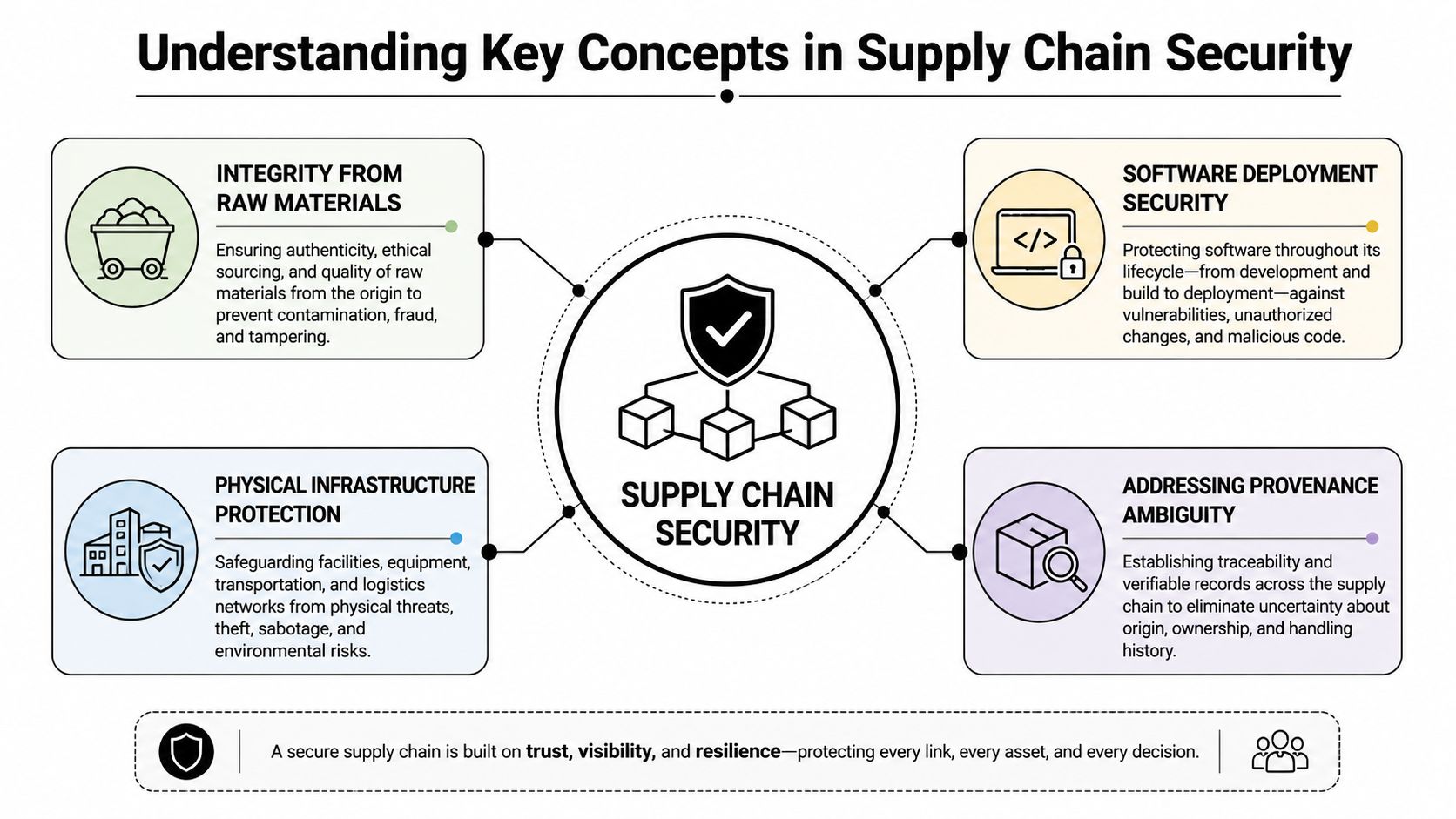
A useful way to think about supply chain security is to compare it to a restaurant kitchen. The chef doesn't just watch the front door, they inspect ingredients, storage, prep surfaces, delivery timing, and who handled each item before it reached the pan. Security works the same way, because risk can enter through raw materials, software dependencies, physical infrastructure, and the build process that turns inputs into something customers trust.
Provenance ambiguity and why it matters
One of the most important ideas is provenance ambiguity. That means you can't clearly prove where an artifact came from, how it was built, or whether anything changed along the way. CNCF guidance recommends SBOMs, signed attestations, immutable pipeline infrastructure, and reduced network connectivity in build systems because those controls make it easier to verify that a build came from the expected source and environment CNCF software supply chain practices.
The same logic applies outside software. If a shipment chain or disposal chain has unclear custody, you don't just have an operational problem, you also have a trust problem. That's why ensuring ITAD compliance matters when sensitive equipment leaves your environment, because the chain of custody is part of the security story, not a paperwork afterthought.
A mental model you can use
Think in layers.
- Raw material integrity: the physical or digital input should be known, traceable, and expected.
- Software deployment security: the artifact that reaches production should match what was built and approved.
- Physical infrastructure protection: the facilities, hardware, and transport paths should resist tampering.
- Provenance verification: each step should leave a trail that defenders can inspect later.
That model helps because it shows why a warehouse audit alone isn't enough. You can have excellent door controls and still ship unsafe code. You can also have strong DevSecOps and still fail if the hardware chain or disposal process leaks trust. Supply chain security is really the discipline of making sure every handoff is explainable.
Analyzing Major Threats and Attack Vectors
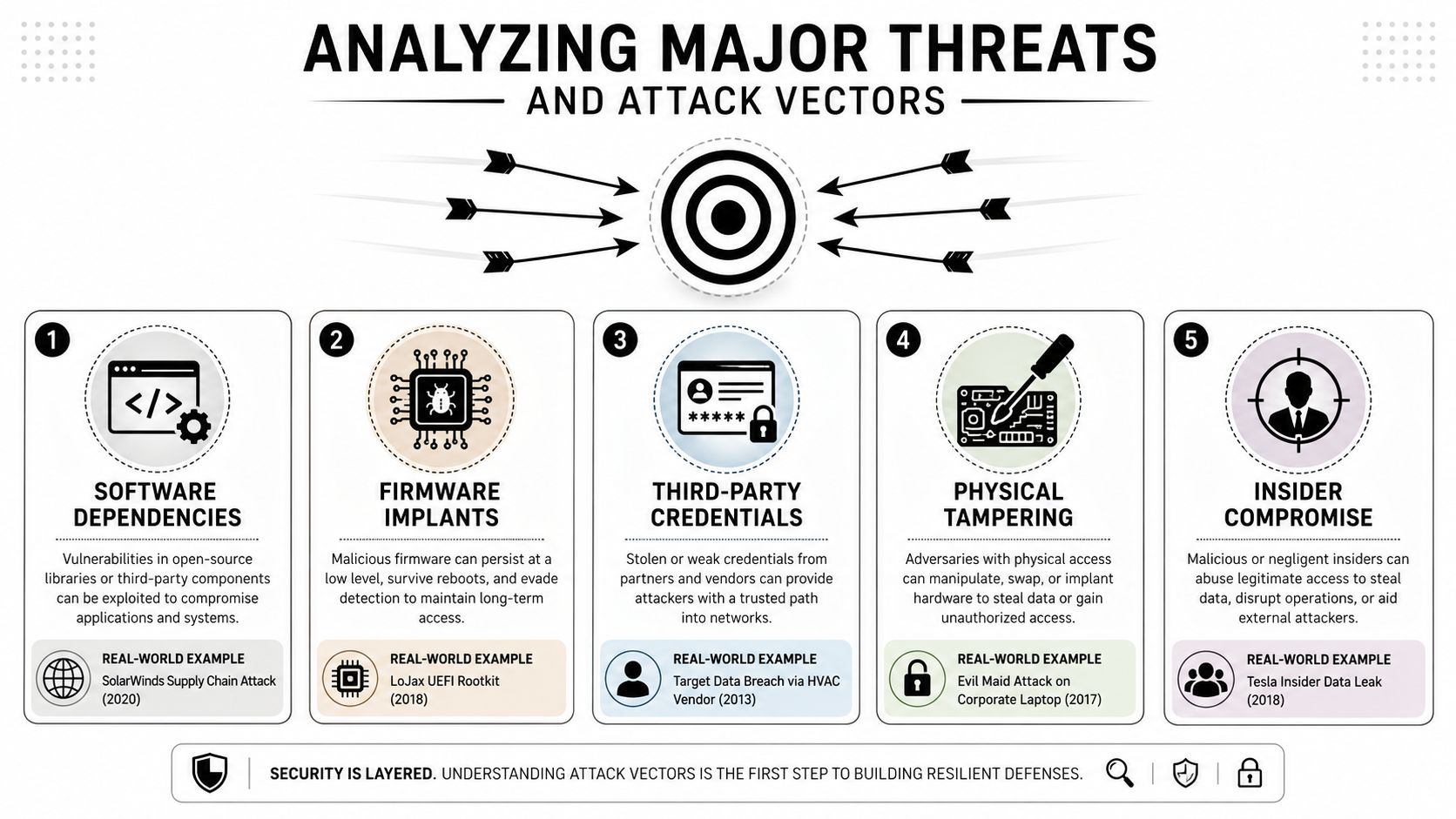
The biggest mistake teams make is treating supply chain compromise as one type of attack. It isn't. The path changes depending on where trust is weakest, and that means the defense has to match the path.
Five attack vectors that keep showing up
Software dependencies are the most familiar. Attackers poison open-source packages, abuse maintainer accounts, or slip malicious code into a dependency chain that developers assume is safe. The SolarWinds incident remains a clear reminder that trusted software distribution can become the delivery mechanism for a much larger breach.
Firmware implants are harder to spot because they sit below the operating system. If malicious code lands in device firmware or embedded management layers, normal endpoint tools may never see it.
Third-party credentials are another common entry point. A vendor account, support login, CI/CD token, or cloud secret can become the key that opens your environment. That's why the third-party share of breaches matters so much in the current threat picture IBM and Verizon supply chain breach data.
Physical tampering affects hardware, logistics, and industrial systems. A malicious USB device in an ICS environment or a tampered component in transit can create an attack path that never touches your app stack.
Insider compromise is often overlooked because people expect the threat to come from outside. But suppliers, contractors, and developers can be coerced, phished, or overprivileged.
A breach rarely starts where the team is looking. It starts where trust was assumed.
Why the cost keeps climbing
IBM's 2025 research, as cited in later coverage, reported an average breach cost of $4.91 million and a mean lifecycle of 267 days for supply chain compromise incidents supply chain breach cost and lifecycle data. Those numbers don't just reflect incident response, they also reflect the time it takes to discover what was altered, where it spread, and which downstream systems are still carrying the compromise.
For teams evaluating tooling or logistics analytics, the lesson carries over. Strong visibility changes outcomes. That's one reason resources like how AI will transform transport for hauliers are relevant beyond transport itself, because real-time visibility and anomaly detection are becoming core defensive habits across complex operations.
Comparing Key Regulatory and Framework Guidance
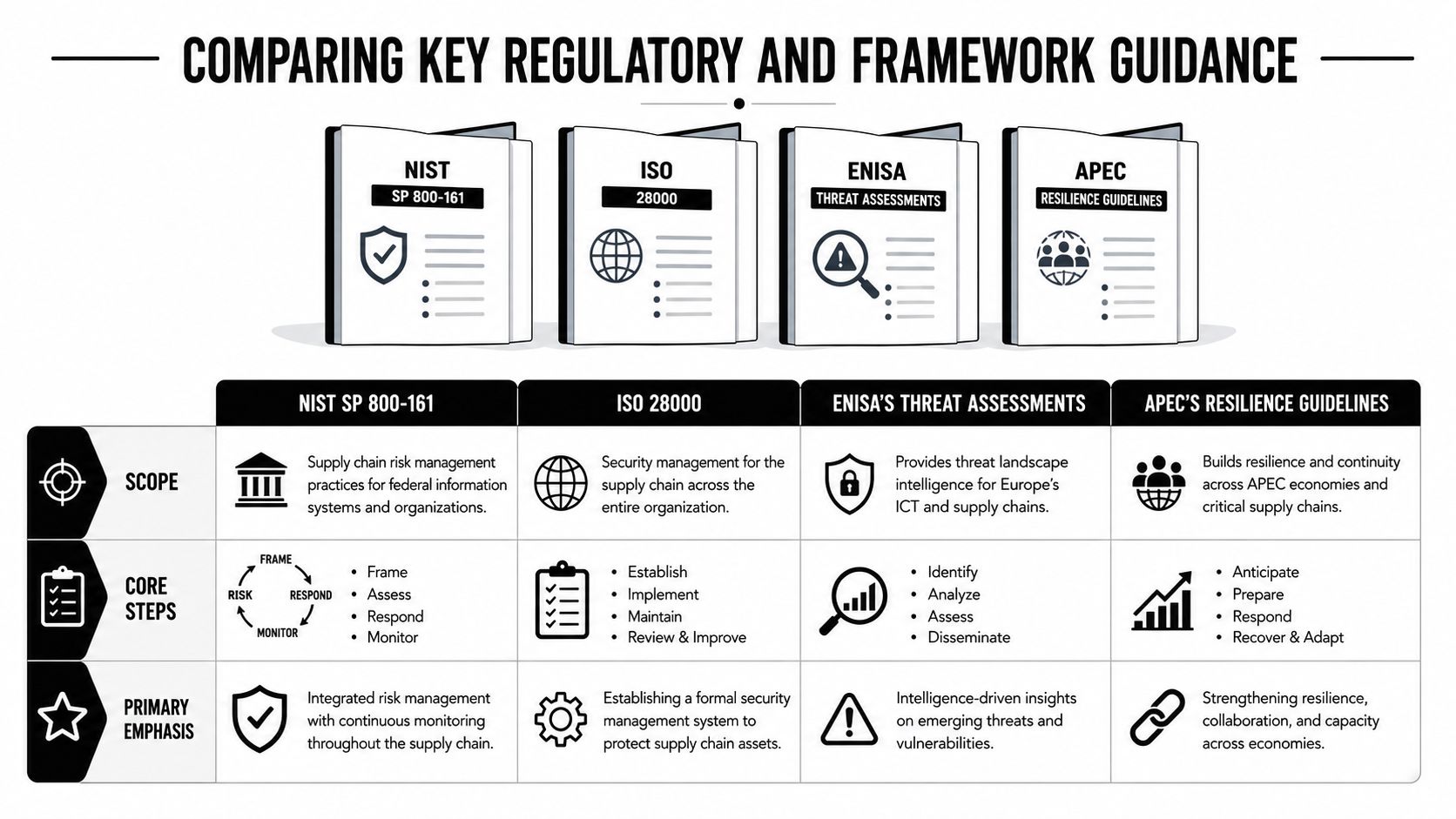
Most organizations don't need to choose one framework and ignore the rest. They need a map that shows which guidance helps with governance, which helps with technical verification, and which helps with supplier resilience.
How the major frameworks differ
NIST SP 800-161r1 is the most process-oriented of the group. It calls for rigorous due diligence and recognizes multiple acceptable validation and revalidation methods for supplier risk profiles NIST SP 800-161r1. That matters because vendor vetting is not a one-time questionnaire, it's a repeated assessment.
NCSC guidance, which summarizes NIST's process, frames the work as four steps, Frame Risk, Assess Risk, Respond to Risk, and Monitor Risk, with ongoing verification of compliance and control effectiveness NCSC supply chain ecosystem guidance. That structure is useful when you need to assign ownership across risk, operations, procurement, and security teams.
APEC's 2024 resilient supply-chain guidance is broader and more operational. It pushes organizations to review the entire end-to-end supply chain, including workflow and processes, regulatory compliance, export controls, sanctions, trade issues, cybersecurity, ESG issues, track-and-trace/material identification, and procurement, while also naming resilience measures like procuring multiple sources and increasing inventory on hand APEC resilient supply-chain guidance. That makes it especially useful for leaders who need both continuity and security in one program.
ENISA's threat analysis work matters because it keeps the ecosystem view in focus. The key takeaway is that supplier compromise is not just a contract issue, it's a propagation problem that crosses software, infrastructure, and operations.
A simple way to align them
Use NIST for process discipline, NCSC for operational cadence, APEC for end-to-end resilience, and ENISA for ecosystem threat context. If your organization is in software delivery, that mix gives you both verification and resilience. If you're in manufacturing or logistics, it also helps you connect cyber controls to physical continuity.
For teams building breach response obligations into their governance, the practical side of data breach notification requirements belongs in the same policy conversation as vendor oversight, because supplier incidents often trigger reporting decisions fast.
Practical Vendor Risk Management and Mitigation Strategies
A strong vendor program starts before the contract is signed. NIST SP 800-161r1's emphasis on rigorous due diligence and repeated validation means the question isn't just “Do we trust this supplier today?” It's “How will we keep checking whether that trust is still justified?” NIST SP 800-161r1
The controls that actually reduce exposure
CNCF guidance is useful because it translates trust into artifacts you can inspect. It recommends SBOMs, signed attestations, SCA across all dependencies, immutable pipeline infrastructure, and signed build-step attestations to reduce provenance ambiguity CNCF software supply chain practices. In plain language, that means you're not just accepting a supplier's word, you're asking for machine-verifiable proof.
A practical vendor checklist usually includes:
- Contract language: require security notification timelines, logging access, patch disclosure, and incident cooperation.
- Artifact controls: demand SBOMs, signatures, and attestation records for software or firmware deliverables.
- Access limits: enforce least privilege and segment vendor connectivity so a single account can't roam widely.
- Deployment gates: hold updates until patch validation and integrity checks pass.
- Review cadence: revalidate critical suppliers regularly, especially when their tooling or hosting changes.
Operational rule: if a supplier can push code, firmware, or configuration into your environment, they need controls that are stronger than a standard procurement checklist.
A mini-case in practice
A useful pattern is to block malicious dependencies before they ever reach production. Teams that run SCA during build and review, then require signed artifacts before deployment, can catch packages that look legitimate but don't match policy. That's not theoretical, it's the same defense pattern behind modern CI/CD hardening, where the pipeline refuses unverified inputs rather than trying to clean them up after the fact.
For business screening and supplier due diligence, background check services for businesses belong in the procurement workflow alongside technical review, because supplier trust has legal, operational, and cyber dimensions.
Implementing Continuous Monitoring with OSINT Use Cases
Static vendor checks fail because supplier environments change faster than annual reviews can track. Security posture, patch status, exposed services, and public footprints can all shift without notice, which is why continuous monitoring has to replace the old “check once, file it away” model.
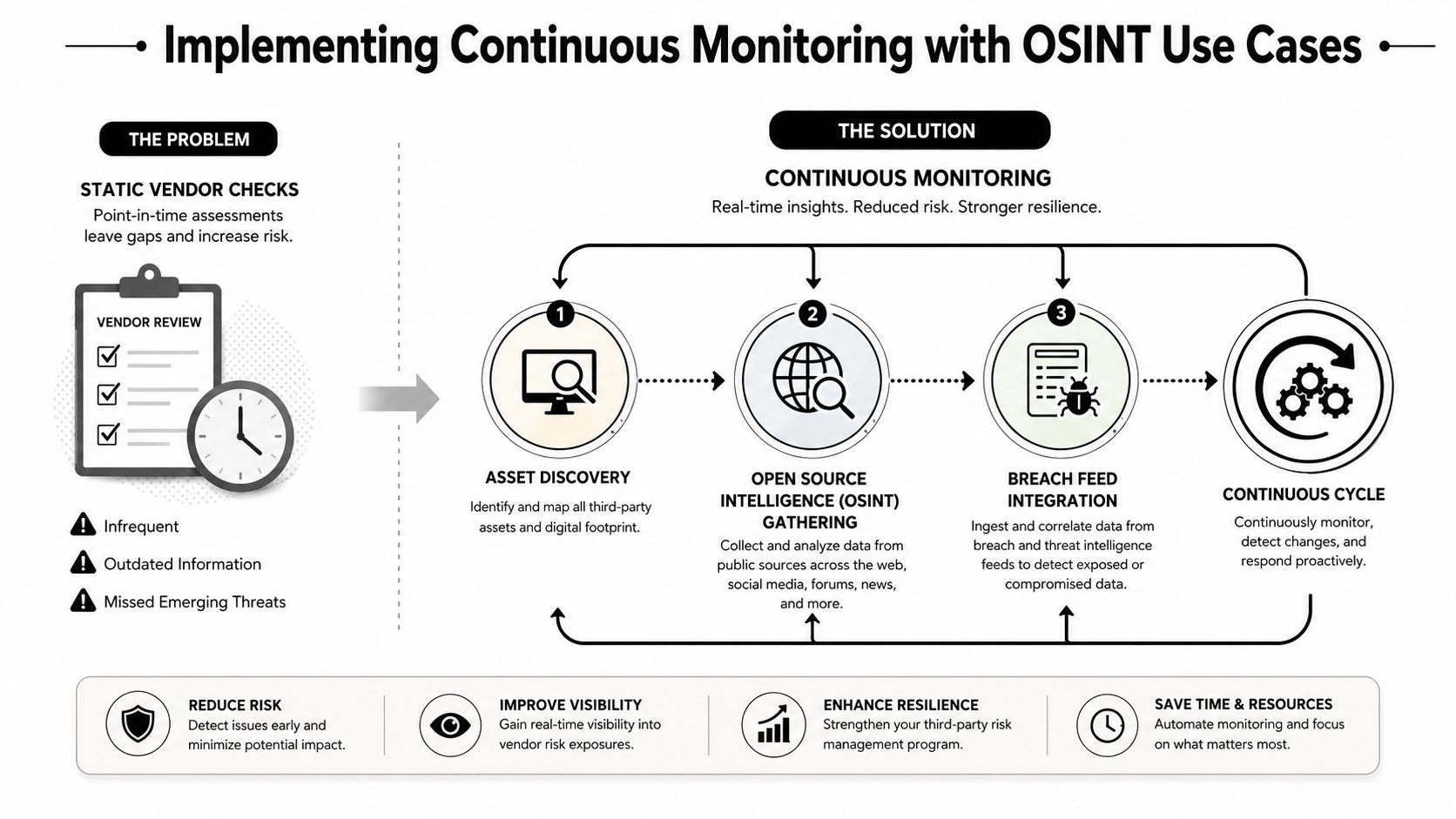
The Canadian Centre for Cyber Security explicitly says static monitoring is not enough and recommends continuous monitoring of vendors and their security controls Canadian Centre for Cyber Security supply chain guidance. The best operating model starts with asset discovery, then adds OSINT collection, breach-feed integration, and alerting tied to vendor risk tiers.
What the workflow looks like
First, identify the supplier's visible footprint. That includes domains, public repositories, exposed services, document leaks, and credentials that may have surfaced in breach data or code sharing. Then layer on open-source intelligence so you can spot changes in ownership, infrastructure, or exposure patterns before an attacker does.
The practical value is speed. A continuous workflow can flag a build server that appears where it shouldn't, a leaked firmware image on a public file host, or a supplier credential that turned up in a breach feed. Those findings are strongest when they're tied to an operational follow-up rule, not just a dashboard alert.
For teams new to the field, OSINT tools for beginners is the kind of reference that helps people move from theory into actual monitoring habits without overcomplicating the process.
Why OSINT matters in vendor security
OSINT is useful because it catches the things a supplier may not volunteer. That includes hidden subdomains, forgotten repositories, public build artifacts, leaked documents, and other clues that show how a supplier operates. Scrapeway's guidance on choosing a web scraping API service is relevant here because reliable collection is what turns scattered public data into a repeatable monitoring process web scraping API considerations.
The point isn't to spy on partners. It's to keep a current external view of the risk they expose to you, so you can react before that exposure becomes a production incident.
Prioritized Implementation Checklist and Monitoring Playbook
Start with the controls that change outcomes fastest. A vendor security program doesn't need to be perfect on day one, but it does need a clear order of operations.
A practical rollout order
- Set governance. Assign owners across security, procurement, legal, and engineering so vendor risk isn't orphaned.
- Map the framework. Use NIST for due diligence, NCSC for the four-step risk cycle, and APEC for end-to-end resilience.
- Classify suppliers. Separate critical vendors from low-impact ones so monitoring and response effort match the risk.
- Require technical proof. Add SBOMs, signed attestations, and SCA review to supplier contracts and build gates.
- Restrict connectivity. Apply least privilege and segment vendor access so compromise doesn't spread easily.
- Activate OSINT monitoring. Track external footprints, breach feeds, and infrastructure drift continuously.
- Practice response. Run incident drills that include vendor shutdown, rollback, and communications paths.
- Review on cadence. Recheck supplier status regularly and after material changes.
Fastest win: start with critical suppliers and one monitoring workflow, then expand from there. A narrow, working process is better than a broad policy no one uses.
A 30, 60, 90 day playbook
In the first 30 days, define critical suppliers, set contract minimums, and turn on basic external monitoring. In the next 60 days, require SBOMs and signatures for software suppliers, then validate that your team can verify them. By 90 days, run a tabletop exercise that walks through a vendor compromise, including who isolates systems, who contacts the supplier, and who decides whether to pause releases.
A strong monitoring playbook also assigns thresholds. If a critical supplier's public footprint changes, if a new credential appears in a breach feed, or if a vendor update fails integrity checks, the alert should go to named owners immediately. That way, response stops being a debate and becomes a sequence.
For teams building their own tracking stack, top tools for monitoring your digital footprint and keeping your data safe offers a useful starting point for structuring that kind of continuous review.
If you're ready to turn vendor visibility into an active control instead of a quarterly report, visit Digital Footprint Check and start building a clearer, continuously monitored view of the external exposure that touches your supply chain.