
· Digital Footprint Check · Content Marketing · 17 min read
Scams on Dating Apps: Red Flags and How to Report Them
Learn the common scams on dating apps, from romance fraud to fake verification links, with red flags, ethical OSINT checks and reporting steps.
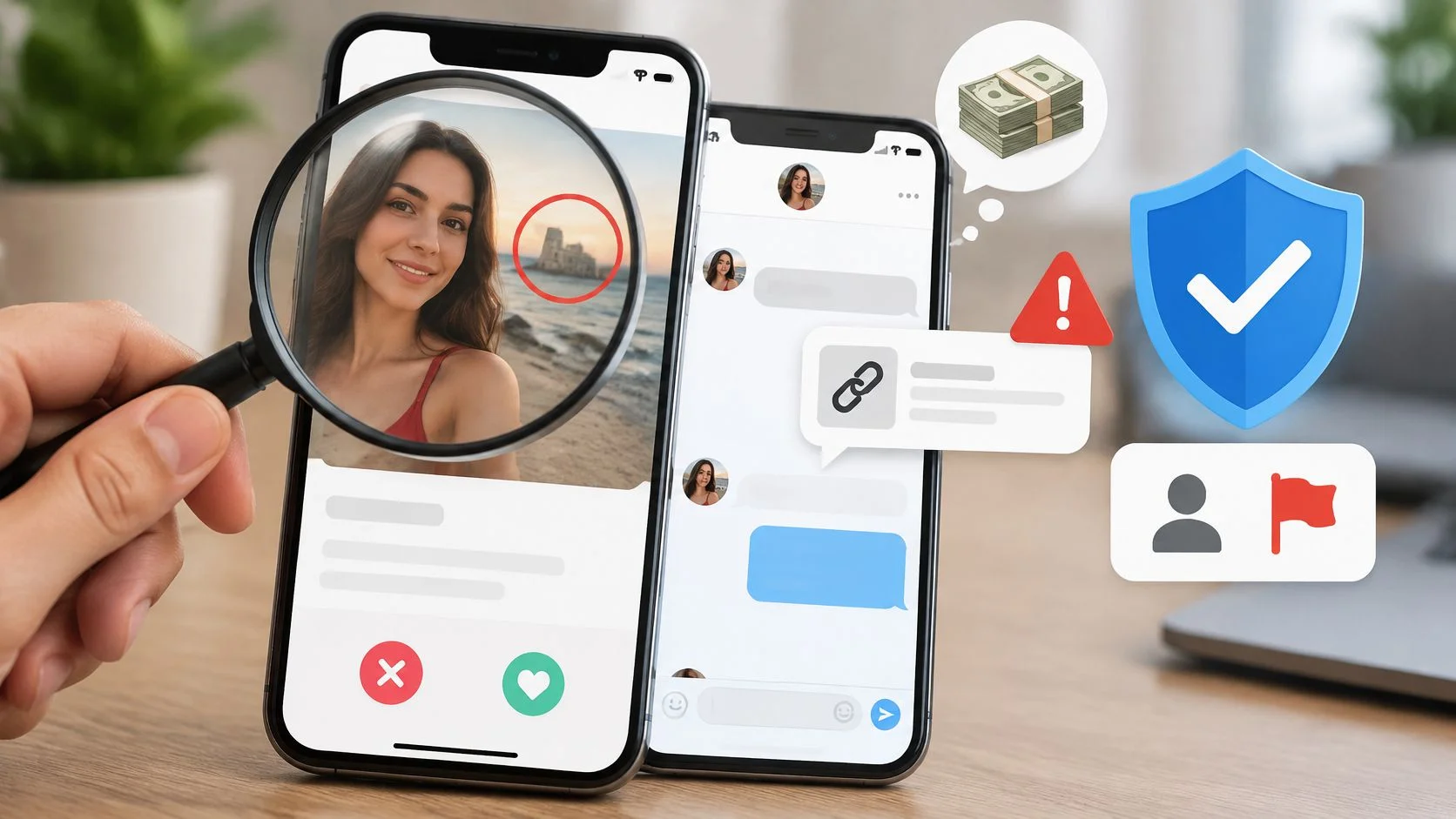
You've matched with someone who seems to get you. The conversation is warm, the photos look great, and within a day they're asking to move to WhatsApp because they "barely check this app." Now there's talk of a future together, a small emergency, or an investment that's been working for them. Something feels slightly off, but you don't want to misjudge a real person. That moment of doubt is worth taking seriously. Most scams on dating apps don't start with a demand for money. They start with a plausible profile, build trust across several platforms, and only turn financial once you're emotionally invested. Stopping the chain early is far easier than recovering money later.
Dating App Scam Types at a Glance
This isn't rare, and encountering it says nothing about your judgment. In a February 2024 Kaspersky survey of 2,000 adults, 42% of online dating users in the United States and Canada said they had encountered scams on dating apps, while 24% said they had fallen victim.
Find the row below that looks closest to what you're seeing. Naming the type helps you predict what comes next.
| Scam type | How it starts | What they ask for | First warning sign |
|---|---|---|---|
| Catfishing | Stolen or fabricated photos and bio | Often nothing at first; later attention or gifts | Refuses live video or real-time photos |
| Emergency romance fraud | Warm chat that builds for days or weeks | Money for travel, medical bills or customs fees | Sudden crisis that needs an urgent transfer |
| Relationship investment scam | Match introduces a trading or crypto platform | Deposits that grow, often about 10 escalating payments | Shows guaranteed profits or screenshots of gains |
| Advance-fee scam | Offer of a gift, inheritance, parcel or prize | Fees to release money or deliver a package | New fees appear after each payment |
| Phishing link | Link to verify an account, watch a video or join a call | Login details, card numbers or ID documents | Link leads to a page that is not the app's own domain |
| Sextortion | Invitation to a video chat or to exchange intimate images | Payment to stop release of a recording | Threat to send images to friends or contacts |
The Difference That Matters
Catfishing is identity deception. Someone pretends to be another person, and they may never ask for money at all. Some want attention, companionship, or entertainment under a borrowed face. It's still a betrayal, but the goal isn't always financial.
Romance fraud is built to extract value. The relationship itself is the tool, and the endpoint is money, documents, account access, or goods. Real cases often blend both, so a catfisher may start out seeking attention and later pivot to requests once they sense attachment.
Three Threads in Every Type
Whatever the label, watch for the same pattern underneath.
- A fabricated or borrowed identity: Photos, job claims, or biographies come from someone else or don't exist.
- Emotional speed: Affection and commitment arrive faster than real knowledge of each other would justify.
- A move away from the app: The conversation shifts to a private messenger where reporting and moderation are weaker.
One thread alone can be innocent. All three together describe a setup, not a relationship. Keep your row in mind as you read on, because each type unfolds in a predictable sequence, and predictable means interruptible.
How a Dating App Scam Unfolds Stage by Stage
A match starts on a dating app, but a scam can move through several places before money changes hands. Each step builds on the last: first trust, then a private conversation, then a request. At every stage, you can pause or leave the chain.
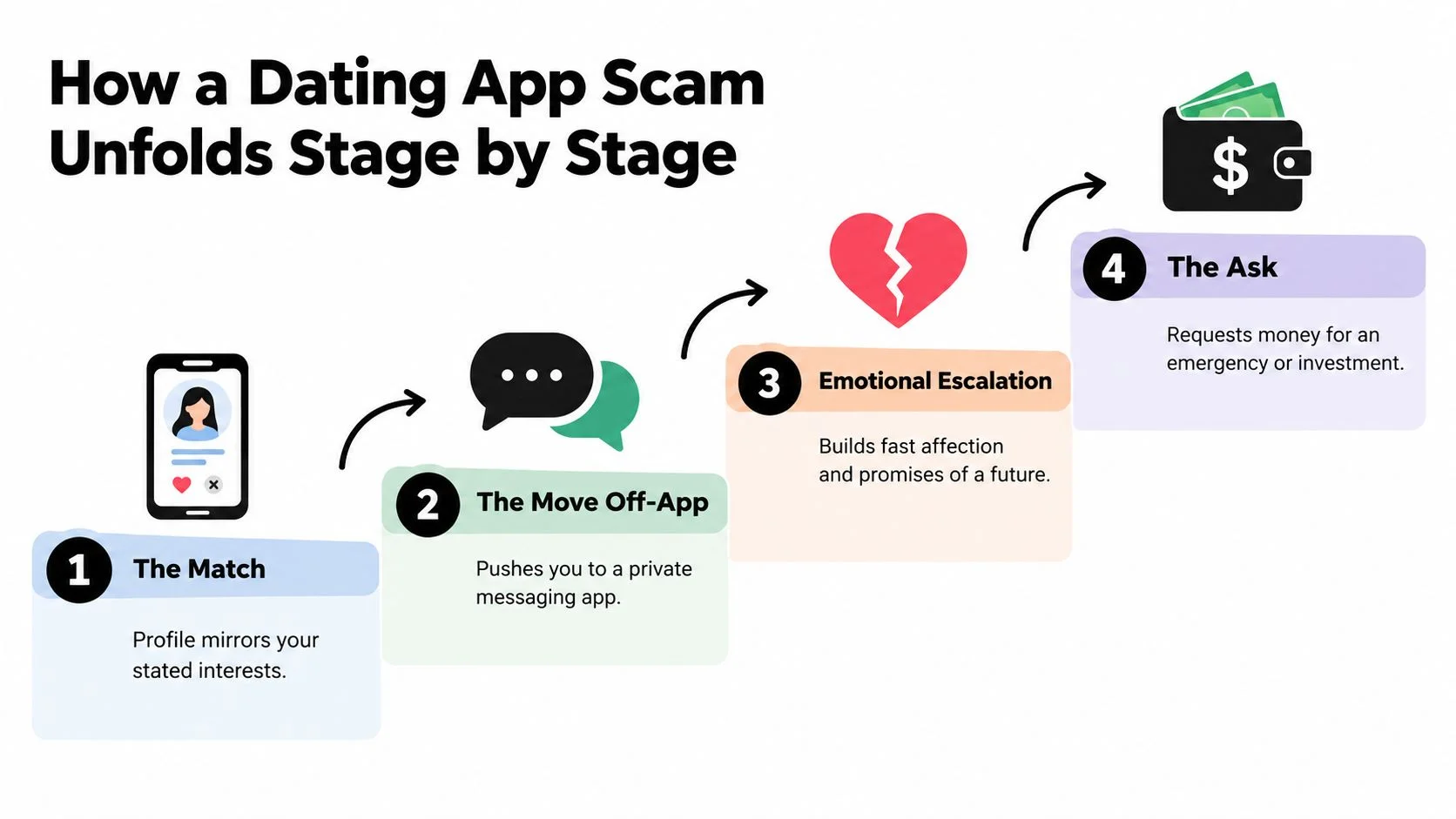
Step 1, the match. A profile may reflect the interests and relationship goals you share. A systematic review screened 279 studies and included 53, identifying fabricated profiles, rapid relationship formation, moves to private messaging, emotional dependency, and crisis-based requests for money among recurring mechanisms. Scammers may tailor profile details to a target's interests, using hobbies, work, location, and relationship goals to create a sense of compatibility. If your bio mentions hiking and a dog, a match who shares both may seem especially convincing. Similarities are a starting point for conversation, not proof of identity.
Step 2, rapid affection. Within days, the person may talk about fate, exclusivity, or a shared future, with messages arriving morning and night. That intensity can be part of a persuasion pattern. Learning about social engineering awareness can help you recognize how manufactured intimacy may build trust and make a later request feel personal.
Step 3, the move off-app. They suggest switching to WhatsApp, Telegram, or Google Chat, often citing convenience or privacy. The conversation then leaves the dating app's reporting and moderation tools. Staying on the app keeps that route available while you get to know the person. If you later plan to meet, review women's safety app privacy features and consider how location sharing and trusted contacts fit into your plans.
First exit: Keep chatting on the dating app. A genuine match can wait to exchange numbers, and you retain access to the platform's tools.
Step 4, the small test. The person shares a vulnerable story or asks for a minor favor, such as receiving a code or checking something. A small request can test whether you will act without checking. You can decline, verify independently, and avoid sharing codes or account access.
Step 5, the pivot. A crisis appears, or the match introduces an investment they say is doing well. Guilt and urgency can push you toward a quick decision. Before sending money, documents, or changing an account, pause and speak with someone you trust. A delay and a second perspective can interrupt many of these scripts.
Second exit: Stop before money moves. Do not let an urgent message decide for you.
Step 6, escalation. One payment may lead to another; an ID request can expose you to identity theft. After losses, it may feel difficult to admit doubt, which can make it harder to stop. The chain depends on your continuing to trust and act. You can still leave it at any stage, especially before a payment or account change.
Red Flags That Separate Real Matches From Fakes
One odd detail proves very little. People travel for work, dislike video calls, and fall hard and fast. Use a smoke alarm as your model instead. One beep might be toast. Several beeps mean you check the kitchen.
This printed comparison is a handy reference to keep beside you while you review a profile.
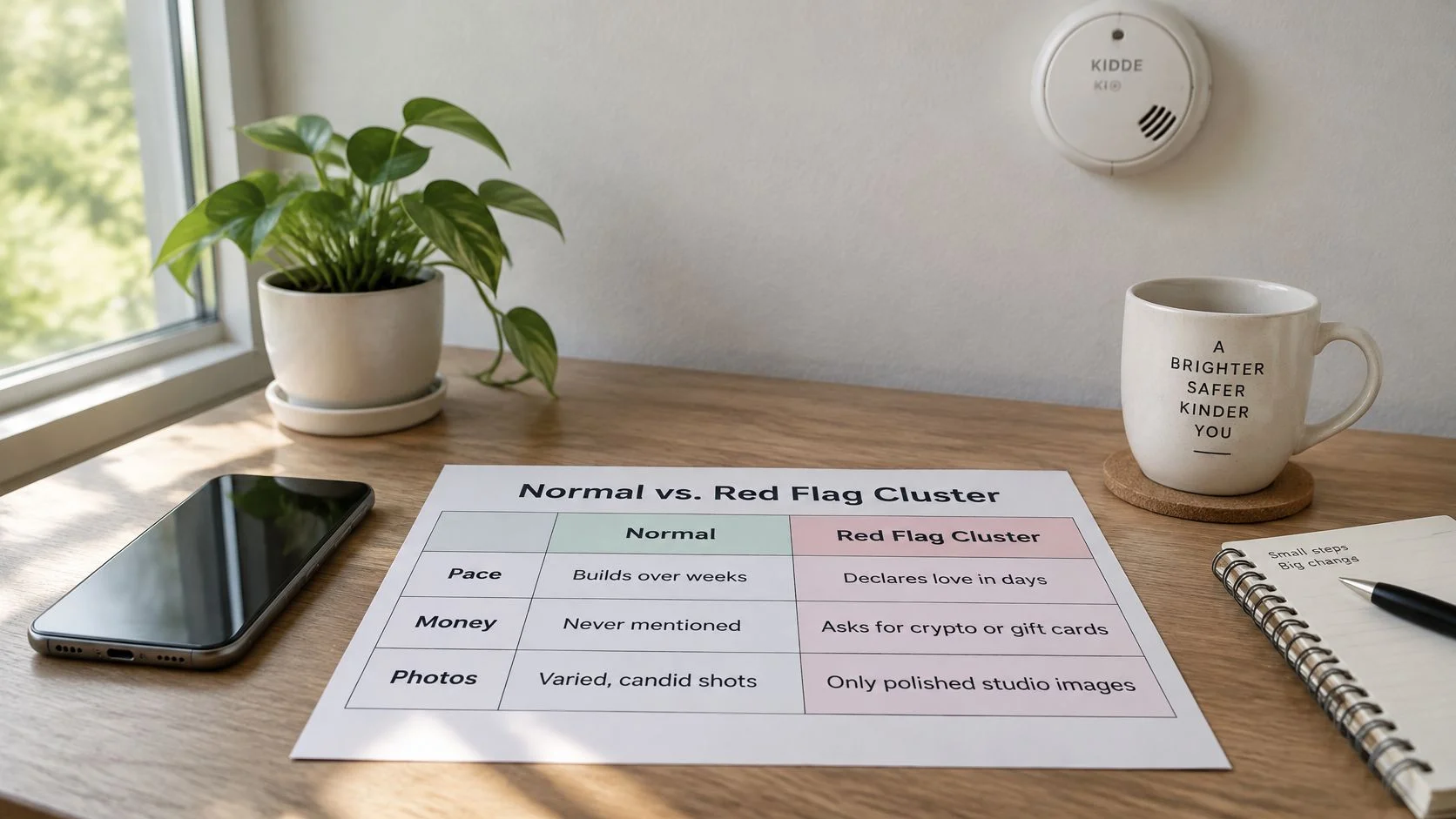
| Signal | Normal behavior | Suspicious version |
|---|---|---|
| Profile photos | Varied shots with friends in different settings | Only polished studio-style images, or images that appear on other people's accounts |
| Video calls | Happens within days or weeks, even if brief | Always refused, with a new excuse each time |
| Pace | Trust builds over weeks of conversation | Love declared within days and talk of a shared future |
| Moving off the app | Number exchanged after a real conversation | Pushes WhatsApp, Telegram or Google Chat within the first day |
| Money talk | Never comes up early in the relationship | Mentions crypto, trading, gift cards, wire transfers or emergencies |
| Location and job | Consistent and checkable | Works overseas, on an oil rig, or on a deployment that blocks any meeting |
| Story consistency | Details stay the same across chats | Details shift, or the same story appears with a different name |
Catfishing Specific Tells
Catfish profiles often use photos that look like professional shoots, with flawless lighting and no candid shots. Linked social accounts tend to have no tagged friends and no older posts, because the identity was assembled recently. The clearest tell is a refusal of live video that always comes with a fresh excuse, a broken camera one week and a bad connection the next. Before any meeting, practical guidance on protecting yourself when meeting someone online is worth reading alongside these checks.
The pattern causes real harm when it's missed. An FBI account of confidence fraud and romance scams describes a documented victim who lost $90,000 over several months to someone impersonating a celebrity. The relationship never moved to an in-person meeting, while requests escalated toward money, personal and financial information, and valuable items.
The short video below walks through how these warning signs tend to cluster in practice.
Try this before you reply again. Write down the three strongest signals you've seen, then rate them as if a friend had shown you the same screenshots. Emotional investment makes people discount evidence in their own case that they'd act on immediately in someone else's. Writing it down puts you back in the friend's seat.
Investment and Advance-Fee Scams That Start With a Match
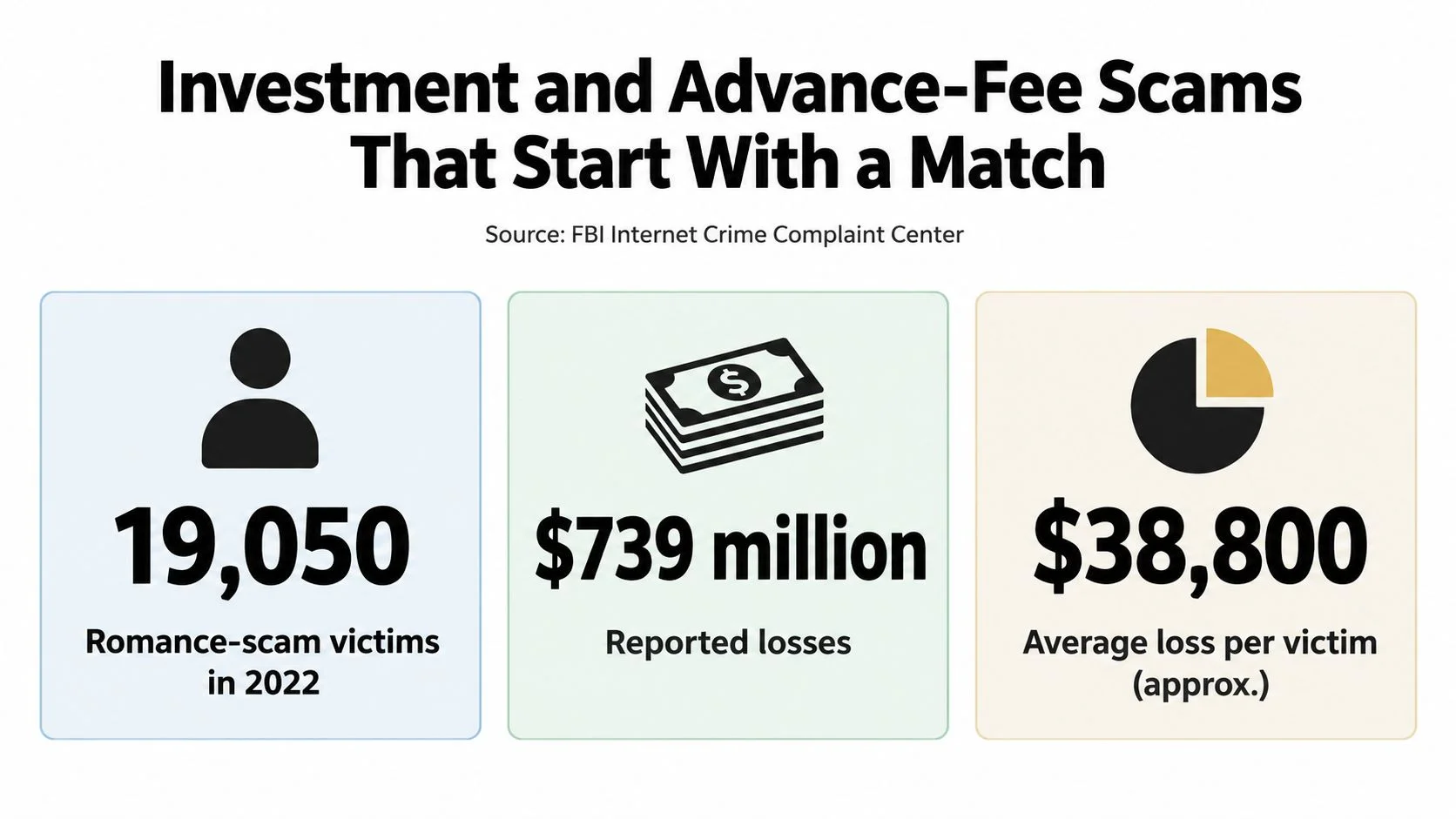
The most expensive version of this fraud rarely looks like begging. It looks like help. The FBI's Internet Crime Complaint Center recorded 19,050 reported romance-scam victims in 2022 who collectively lost $739,030,292, an average reported loss of roughly $38,800 per victim, and warned that many schemes used the relationship-building stage to persuade victims to invest in cryptocurrency through fraudulent websites or applications.
The Relationship Investment Pattern
Say a match mentions, almost in passing, that an uncle taught them to trade crypto and it's going well. A screenshot follows showing a balance climbing fast. They offer to walk you through a small first deposit on a platform they recommend. The site looks professional, your balance rises, and a small withdrawal may even succeed to build confidence.
Then deposits grow. The CFTC advisory on relationship investment scams states victims commonly make about 10 payments, with each payment larger than the previous one, before being financially drained. The gains were never real. The platform displays numbers, not assets, and the money went to wallets the scammer controls. If a match steers you toward moving funds through peer-to-peer services first, check how secure Cash App is for transfers like these before sending anything.
The Advance-Fee Pattern
This version dangles something already yours. A gift is stuck at customs. An inheritance needs a release fee. A parcel can't be delivered until a tax is paid. You pay a small amount, and a new obstacle appears, each one slightly larger and supposedly the last.
A withdrawal or delivery blocked until you pay one more fee is the point where these schemes usually reveal themselves. Legitimate firms deduct charges from the balance. They don't demand new money to release your own.
Recovery is hard for a structural reason. You authorised the transfers yourself, so card protections built for unauthorised use don't always apply, and crypto and wire payments are difficult to reverse. That means the critical decision point isn't after the loss. It's before the first transfer.
Apply two questions to any request. First, is money being sent to open up a gain or a release? Second, is the payment going to a platform you found through the match rather than one you chose independently through an official app store or regulator listing? A yes to either question is reason enough to stop, however convincing the relationship feels.
Phishing Links and Sextortion Threats
Not every scam wants a bank transfer. Some want your login, your card details, or images they can use against you. These attacks are faster and less romantic, but they run on the same trust you've built with a match.
Legitimate dating apps verify users inside their own system. Photo verification, ID checks, and age confirmation happen in the app's settings, using the app's own camera flow. So any request that moves verification outside the app is itself the warning sign, whatever reason is given.
Common Lures to Recognise
- A verification or video link: You're sent to a site that isn't the app's domain to "verify you're real" or watch something privately.
- A QR code: Scanning it opens a login page asking for your dating app or email credentials.
- A file download: An archive or app offered as the only way to see private photos.
- A recommended trading app: The match sends an install link instead of naming an app you can find yourself.
- A card check: You're asked to enter card details to confirm your age or activate video calls.
- A secure payment step: A small "verification fee" framed as protection for both of you.
Checks That Take Seconds
Read the full web address, not the name displayed in the message. Lookalike domains swap one letter, add a word like "verify" or "secure," or use an unfamiliar ending. If you're unsure how to judge an address, this guide on how to check if a website is safe explains what to inspect before you type anything.
Better still, ignore the link entirely. Open the official app yourself and use its own safety or verification section. If the feature the match described doesn't exist there, it doesn't exist.
Your password manager is also a quiet ally. If it refuses to autofill on a page that looks like a service you use, that's because it recognises the address isn't the genuine site, even when the logo and layout are copied well. Treat that refusal as a stop sign, not an inconvenience to work around by typing the password manually.
When the Threat Is Personal
Sextortion follows a tighter script. A match steers you to a video chat and quickly encourages you to undress or send intimate images. Sometimes the person on screen is a recording. Minutes later a message arrives claiming you were recorded, sometimes alongside screenshots of your friends list, demanding payment to prevent release.
Don't pay. Payment rarely ends the threat, because it confirms you're frightened and able to pay, which usually brings a second, larger demand. Stop the chat, but screenshot the threat, the username, profile links, and any payment details they provided before you block. Report the account inside the app, and file a report with the FBI's IC3. Where intimate images are involved, use the takedown tools offered by the platforms where they might appear, which can block known images from being reposted.
None of this is your fault, and you don't have to handle it alone. Tell one person you trust. Secrecy is the pressure the threat depends on, and naming what's happening to a friend weakens it immediately.
Stop, don't click, don't enter any details, don't pay, and report the link or account to the app.
How to Check a Match With Ethical OSINT Steps
You can check a match without crossing lines. The rule is simple. Use only what the person has shared with you or made publicly available. Don't create fake accounts to follow private profiles, don't try to access anything behind a login you don't own, and don't pay for dossiers compiled about someone. You're verifying consistency, not building a surveillance file.
The photo below shows the kind of quiet, methodical checking this process involves.

Work through these steps in order. Each one takes minutes, and you can stop as soon as you have enough to decide.
- Collect what's been given to you: Write down the first name, username, city, job claim, and where each photo appears. Checking against a fixed list stops details from drifting in your memory as the story changes.
- Reverse image search every photo: Run each profile picture through Google Lens or TinEye. Older copies under a different name, or the same face on a modelling or stock page, tell you the photos aren't theirs. Search each image separately, since scammers mix stolen shots with generic ones.
- Search the username across platforms: Type the exact handle into a search engine in quotes. The same username attached to accounts with a different name, age, or country is a lead worth noting. Reused handles across gaming profiles, forums, and social media often reveal a history the dating profile hides. A username scan from Digital Footprint Check can sit alongside your manual searches, since it checks a handle against many public platforms in one pass and shows where it appears.
- Compare details across profiles: Line up the dating profile against any public social or professional accounts. Note where job, school, city, or age conflict. Small gaps are normal. A different career and city on every platform isn't.
- Check the employer independently: Find the company through its official website or a business listing, never through a link the match sent you. If the firm has no staff page and no trace of them, ask yourself whether the job exists to explain why they can never meet. A structured approach to background checks before dating someone can help you keep these comparisons organised.
- Screen contact details you were given: If they've shared a phone number or email, run it through the free checker to see whether it appears in known data leaks or is tied to accounts under other names. An email address showing up in breaches linked to unrelated identities is another inconsistency to weigh.
- Ask for live verification: Request a real-time video call, or suggest meeting in a public place with a friend nearby. Ask them to do something unscripted on camera, like holding up today's date on paper. Repeated refusal after weeks of intense messaging is itself an answer.
- Treat findings as leads, not verdicts: A mismatch can reflect a changed name, a privacy choice, or an old account. It doesn't prove fraud on its own, and a clean result doesn't prove honesty either, since a well-built fake identity may have no public contradictions yet.
The point isn't certainty. It's reducing the information advantage a scammer builds from your own profile while giving you concrete inconsistencies to act on, before money, documents, or your home address enter the conversation.
Report and Lock Down Accounts Before Anything Else
If money or sensitive data has moved, the first step is to interrupt the chain: contact the payment provider, then secure the accounts that could expose more information. Act in hours, not days. A bank or exchange may be able to freeze or recall a transfer if it hears from you quickly.
| Time window | Action | Who to contact |
|---|---|---|
| First hour | Stop contact, save screenshots of the profile and chats with timestamps, and ask whether the transfer can be frozen | Bank, card issuer, or crypto exchange |
| Same day | Change email and banking passwords, turn on two-factor authentication, and remove remote-access apps | Email provider and financial institutions |
| First week | File reports and keep copies of records and transaction IDs | FBI IC3 at ic3.gov, FTC at ReportFraud.ftc.gov, and the dating app's safety team |
| Ongoing | Watch credit reports and accounts for new accounts or identity misuse | Credit bureaus and the bank |
Follow the sequence, but preserve evidence before blocking or reporting the profile. Usernames, profile URLs, wallet addresses, and transaction IDs can disappear if an account is deleted. Start with your email password because email is often used to reset other passwords, then secure banking and social accounts. For more steps, use this guide to prevent account takeover. If you installed remote-access software at the match's request, remove it the same day.
A dating scam can move from an app to a private messenger, then to a payment service. You can still break that chain at any point: stop replying, report the account, and contact the payment provider before sending anything else. If a transfer has already gone through, report it promptly and share the transaction details.
Be alert for a second approach. A supposed “recovery service” may promise to retrieve your money in exchange for an upfront fee. Treat that request as another warning sign, and do not pay to find out whether recovery is possible.
Shame can make it harder to act, but telling someone you trust is a safety step, not a confession. Scammers use practiced scripts to build trust and urgency. You do not need to handle the reporting and account security steps alone.
For future matches, set one pause rule: requests for money, documents, or account access wait 48 hours and are discussed with someone outside the relationship. You can also use a free exposure checker to see what personal information about you is publicly visible, then review profiles that may give a stranger material to build a convincing persona.
If someone you're speaking with is pressing you to move off the app or send money, pause before taking the next step. Check the username, email, or phone number they gave you, and review what your own profiles reveal. Digital Footprint Check searches public platforms, breach records, and social accounts for exposed information and identity inconsistencies. Keep the conversation on the dating app until you feel comfortable, and do not let urgency make the decision for you.